
Why Anduril Should Acquire Kraken Robotics for Maritime Supremacy
Anduril builds underwater drones. Kraken Robotics builds the sonar, batteries and navigation that help them see and last longer. With $5 billion in fresh capital, Anduril could buy the subsea supply chain it needs. Here's the case, and why Ottawa might say no.
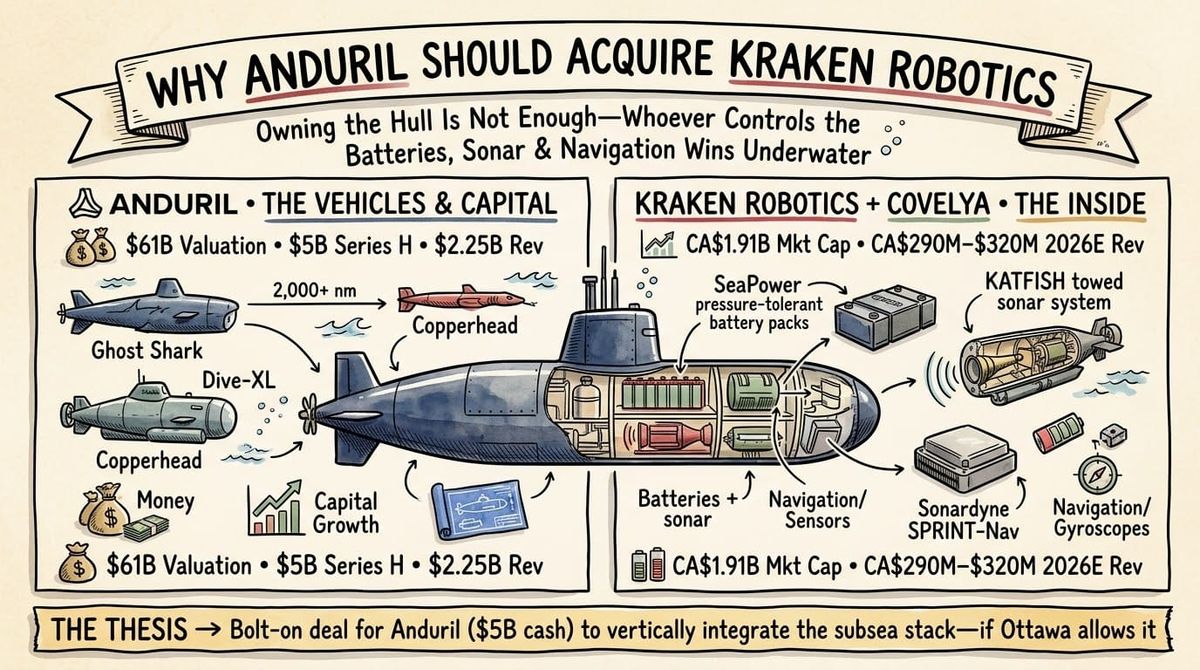
The next big naval contest may be decided under the water.
Autonomous submarines, seabed sensors and underwater drones are moving from experiments to real programmes.
Anduril is already one of the leading builders of those vehicles.
But a vehicle is only as good as what's inside it: the batteries that decide how far it goes, the navigation that keeps it on course without GPS and the sonar that lets it see.
That's exactly what Kraken Robotics makes.
I think Anduril should buy it.
What Anduril Has Built Underwater
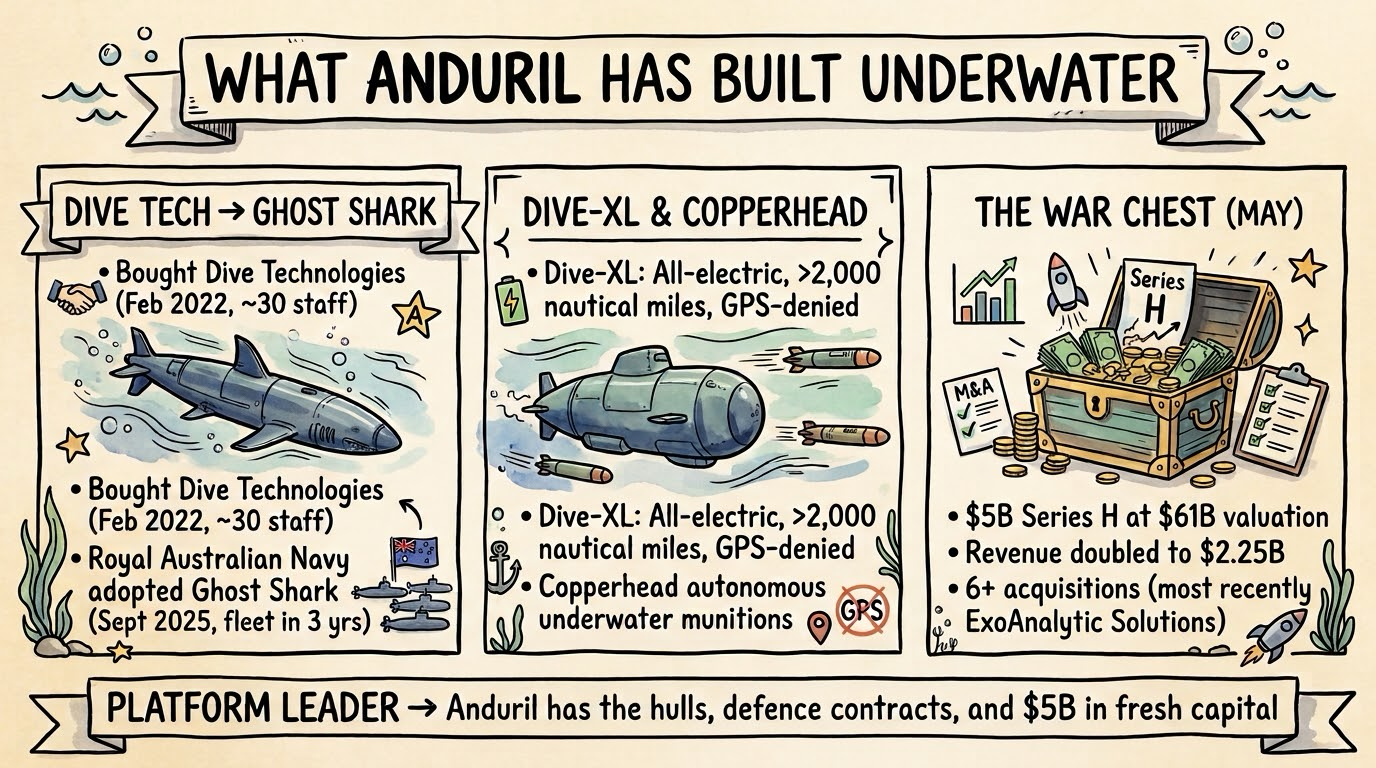
Anduril entered the maritime market in February 2022 by acquiring Dive Technologies, a Boston startup of about 30 people that built large unmanned underwater vehicles.
Since then, the maritime side has grown quickly.
The Royal Australian Navy formally adopted Anduril's Ghost Shark in September 2025 and plans to field a fleet within three years.
In March, the US Navy and the Defense Innovation Unit selected Anduril's Dive-XL for their extra-large autonomous submarine project.
Dive-XL is all-electric, can travel more than 2,000 nautical miles and is designed to operate where GPS doesn't work.
Anduril has also unveiled the Copperhead family of autonomous underwater munitions.
I wrote about why extra-large autonomous underwater vehicles will change submarine warfare, and Anduril is now one of the main companies building them.
It has the money to keep going.
In May, Anduril raised a $5 billion Series H at a $61 billion valuation, and an investor memo said its revenue doubled to $2.25 billion last year.
It has made more than half a dozen acquisitions, most recently the space surveillance company ExoAnalytic Solutions.
What Kraken Robotics Brings
Kraken, based in Newfoundland, makes the subsystems that sit inside and around underwater vehicles.
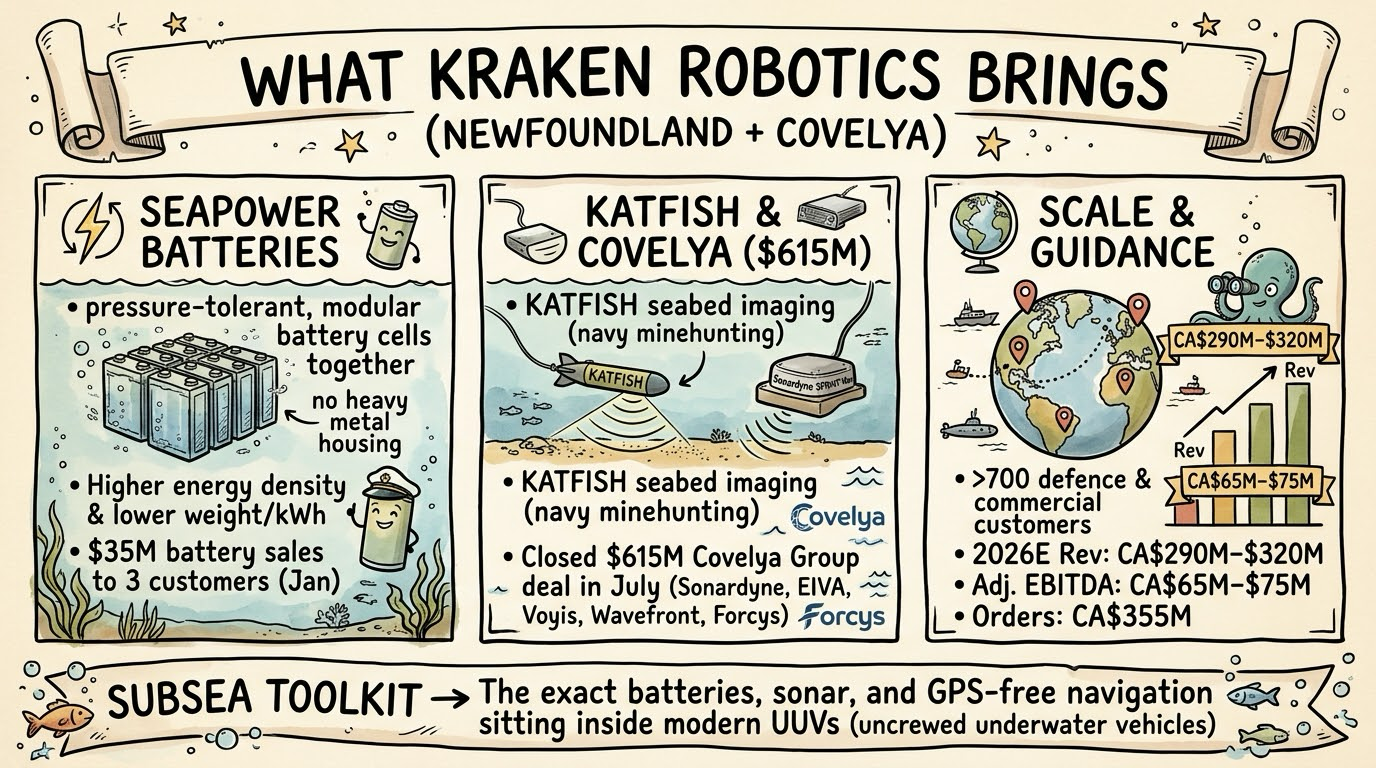
Its SeaPower batteries are pressure-tolerant, which means they don't need a heavy pressure housing.
Kraken says that gives them higher energy density and lower weight per kilowatt-hour than the alternatives.
In January, it announced $35 million in SeaPower battery sales to three customers, for vehicles ranging from small drones to extra-large systems.
Its KATFISH towed synthetic aperture sonar produces high-resolution images of the seabed, and Kraken delivered one for a navy minehunting programme this year.
In July, Kraken closed its $615 million acquisition of Covelya Group, which owns Sonardyne, EIVA, Voyis, Chelsea Technologies, Wavefront Systems and Forcys.
Sonardyne is known for underwater navigation and positioning, including its SPRINT-Nav system.
The combined company serves more than 700 customers in defence and commercial markets.
Kraken expects 2026 revenue of CA$290 million to CA$320 million, with adjusted EBITDA of CA$65 million to CA$75 million.
Announced orders for Kraken and Covelya reached CA$355 million by the time it reported its second quarter.
Why The Fit Is So Strong
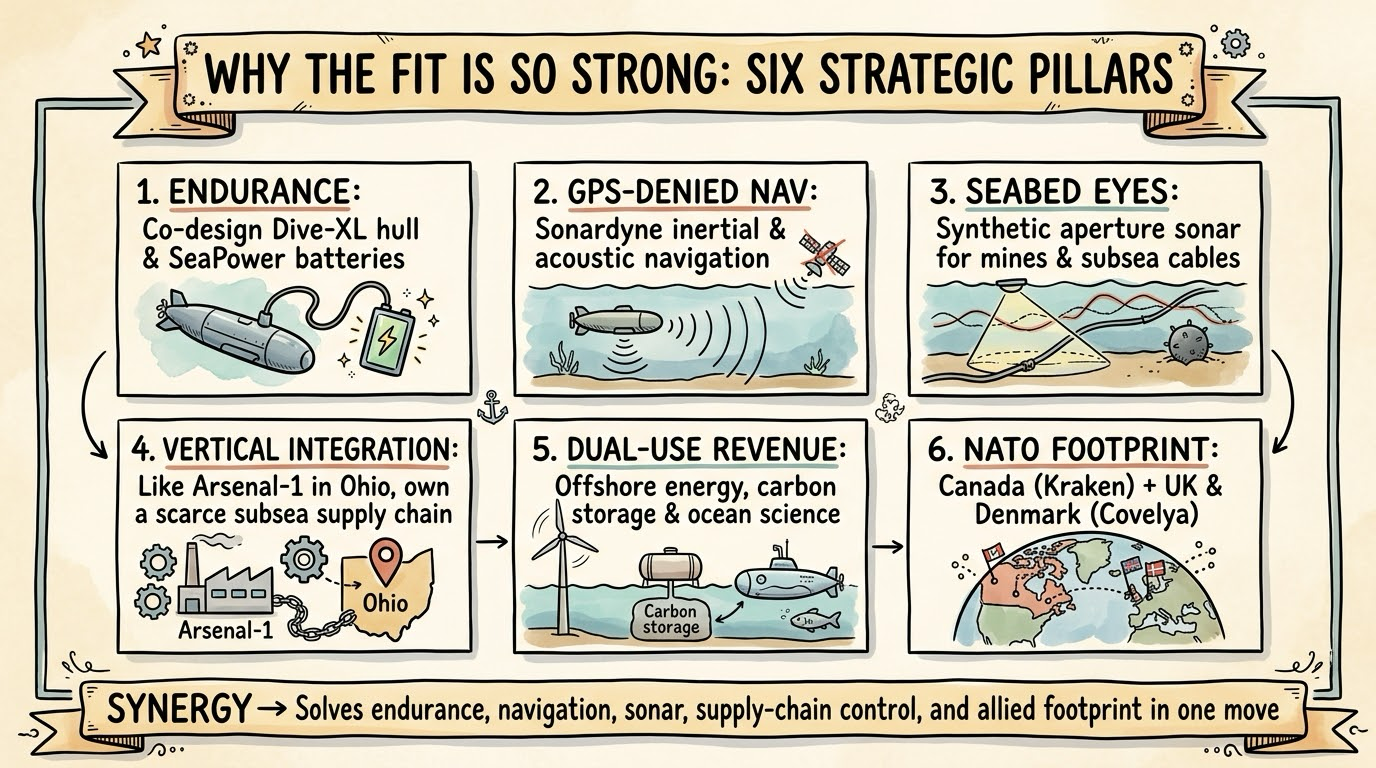
Endurance.
An all-electric vehicle like Dive-XL lives or dies by its batteries.
Owning the battery supplier would let Anduril design the vehicle and the power system together.
Navigation without GPS.
The Navy's project specifically asked for a vehicle that works in GPS-denied environments.
Sonardyne's inertial and acoustic navigation is built for exactly that.
Seeing the seabed.
Synthetic aperture sonar is how you find mines, monitor undersea cables and map the ocean floor.
Those are core missions for autonomous submarines.
Vertical integration.
Anduril already prefers to build things itself, from its software to its new Arsenal-1 factory in Ohio.
The subsea supply chain is small and specialised, so owning a key piece of it would be a real advantage.
Steady commercial revenue.
Kraken and Covelya also sell to offshore energy, carbon storage and ocean science customers.
That dual-use revenue would give Anduril a business that doesn't depend entirely on defence budgets.
An allied footprint.
Kraken brings operations in Canada, and Covelya brings companies based in the UK and Denmark.
That would give Anduril a larger industrial base inside NATO, similar to how Ghost Shark gave it a foothold in Australia.
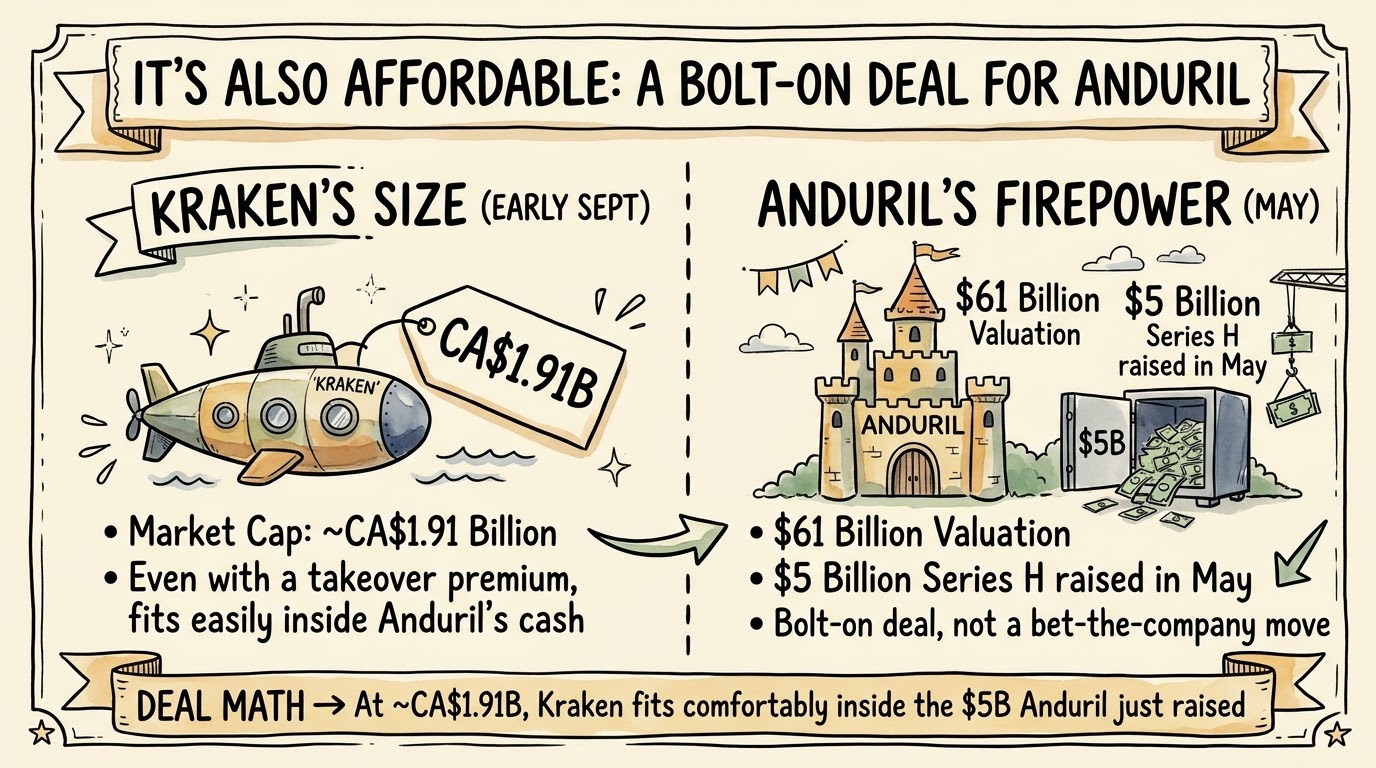
It's Also Affordable
Kraken had a market capitalisation of about CA$1.91 billion in early September.
Even with a typical takeover premium, that would fit comfortably within the $5 billion Anduril raised in May.
For a company valued at $61 billion, this would be a bolt-on deal rather than a bet-the-company move.
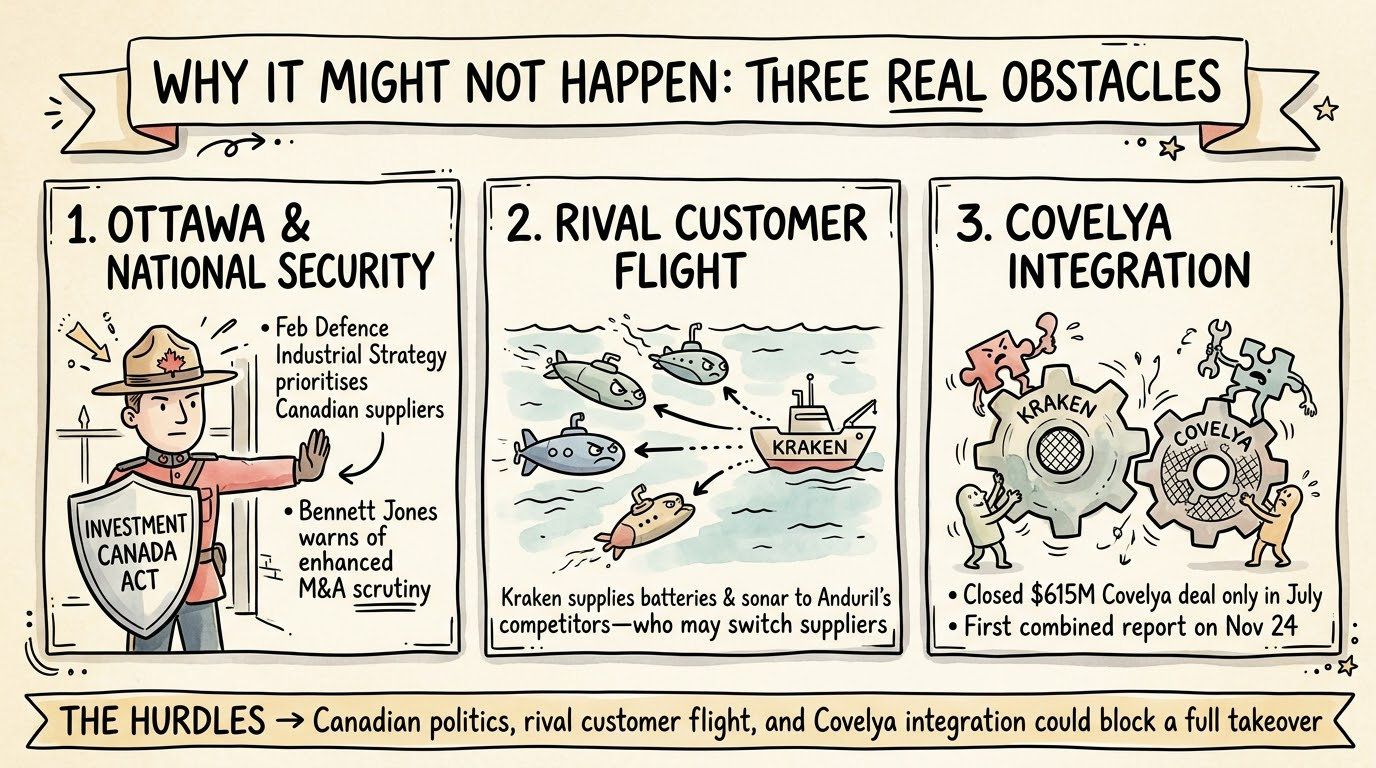
Why It Might Not Happen
The biggest obstacle is Ottawa.
Canada launched its first Defence Industrial Strategy in February, and it explicitly prioritises Canadian suppliers.
Under the Investment Canada Act, the government can review or block foreign takeovers that may harm national security.
Lawyers at Bennett Jones expect enhanced scrutiny of defence contractors and dual-use technology companies.
Kraken is one of the few Canadian companies in this sector with real scale, so selling it to an American company would be a hard sell politically.
There's also a customer problem.
Kraken sells batteries and sonar to many vehicle makers, and some of them compete with Anduril.
If Anduril owned Kraken, those customers might look for another supplier.
And Kraken is still integrating Covelya, which it only closed in July.
It reports its first quarter with Covelya included on November 24.
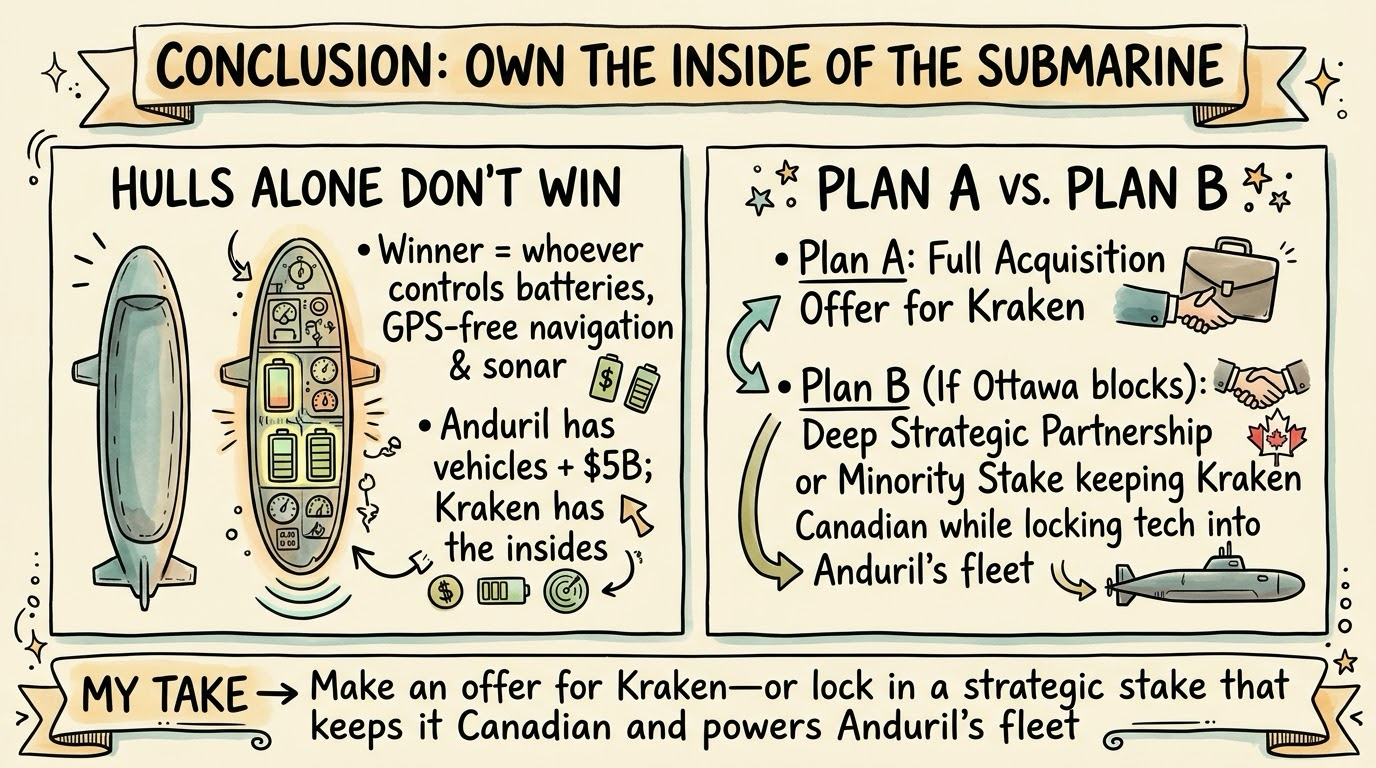
Conclusion: Own The Inside Of The Submarine
The underwater race won't be won by hull designs alone.
It will be won by whoever controls the batteries, navigation and sensors that make autonomous vehicles useful.
Anduril has the vehicles and the capital.
Kraken has many of the subsystems that sit inside them.
My Take: Anduril should make an offer for Kraken, and if Ottawa won't allow a full takeover, it should push for the next best thing: a deep strategic partnership or minority stake that keeps Kraken Canadian while locking its technology into Anduril's maritime fleet.
Disclosure: I own shares of Kraken Robotics. This post is my opinion and isn't investment advice.
Sources
Pages I opened for the facts in this post:
- Defense News: Anduril buys underwater drone maker Dive Technologies
- Military Times: US Navy partners with Anduril to develop XL underwater vessel
- SiliconANGLE: Anduril doubles valuation to $61B with $5B round
- Pulse 2.0: Kraken Robotics announces $35 million in SeaPower battery sales
- Unmanned Systems Technology: Kraken Robotics to acquire Covelya Group for $615 million
- Offshore Source: Kraken Robotics posts Q2 2026 results
- Kapitalmarktexperten: Kraken Robotics Q3 reporting date
- StockAnalysis: Kraken Robotics market cap
- Bennett Jones: Impacts of the Defence Industrial Strategy on Canadian M&A