
When AI Designs Its Own Chips: The Recursive Self-Improvement Loop Has Already Started
Google's AI has helped lay out its TPUs, and those TPUs train the models that now improve the next chips. Agentic design tools are cutting weeks of work to hours. Here's why AI-designed hardware could supercharge recursive self-improvement, and what still slows it down.
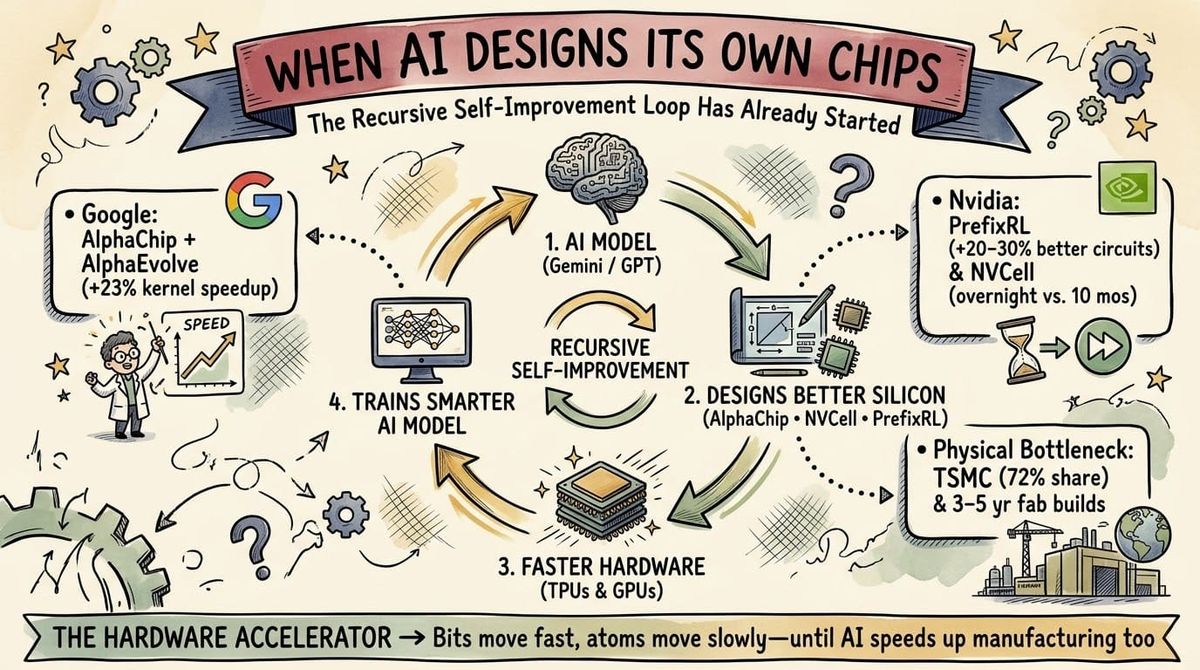
Recursive self-improvement is the idea that AI gets good enough to make better AI, which then makes even better AI.
Most people picture this happening in software, with models writing their own code.
I think the bigger accelerator is hardware.
Once AI models run on chips that AI helped design, every improvement in the model can feed back into the silicon, and every improvement in the silicon can feed back into the model.
That loop isn't science fiction anymore.
At Google, an early version of it is already running.
The Loop Already Exists At Google
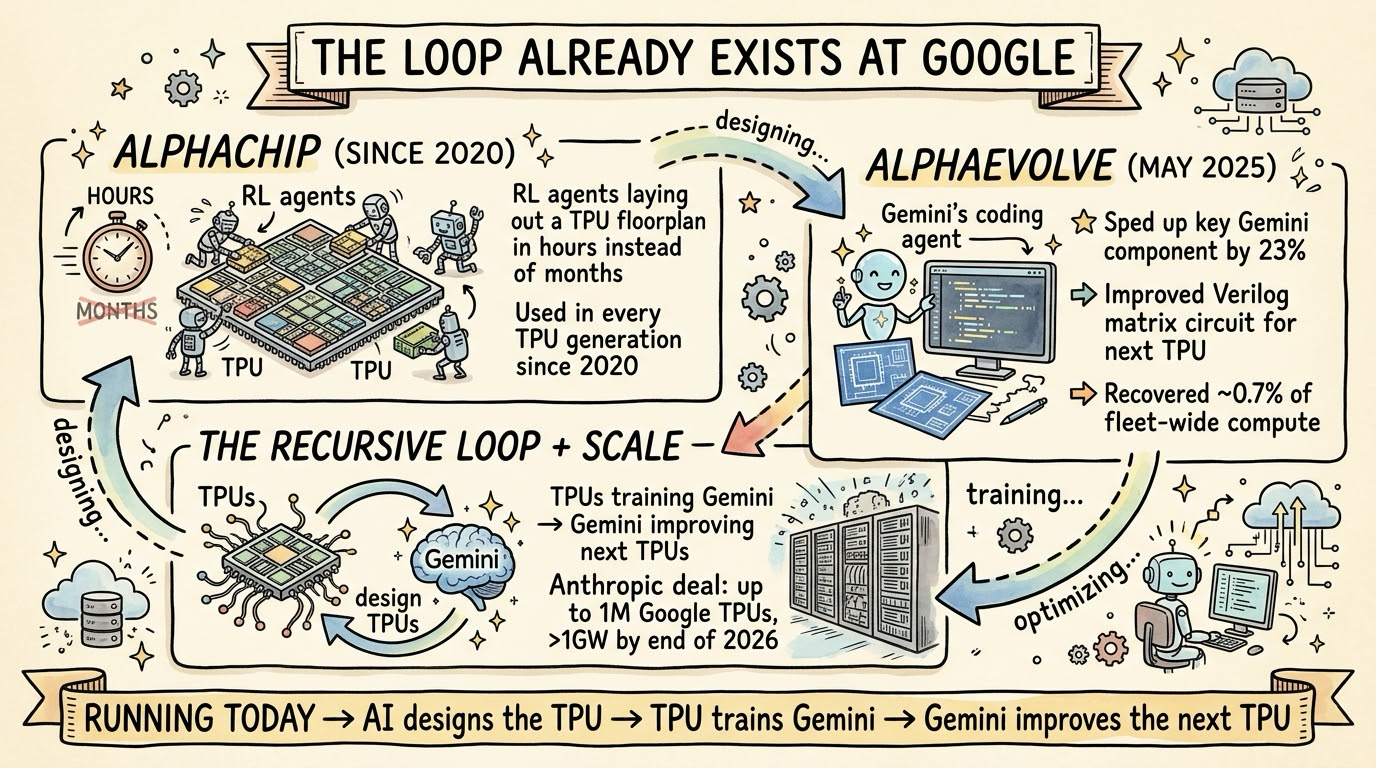
Google DeepMind's AlphaChip uses reinforcement learning to lay out parts of a chip.
Google says it produces layouts in hours rather than weeks or months of human effort, and that it has been used in every generation of its TPU since 2020.
TPUs are the chips Google uses to train and run its Gemini models.
Then, in May 2025, Google announced AlphaEvolve, a coding agent powered by Gemini.
AlphaEvolve sped up one of the most important parts of Gemini's architecture by 23%.
It also helped engineers improve the Verilog code for a matrix-multiplication circuit that Google has built into an upcoming TPU.
And it found a scheduling improvement that recovers about 0.7% of Google's fleet-wide compute.
Put those together and you get the loop.
AI helps design the chip.
The chip trains the model.
The model helps improve the next chip and the software that runs on it.
The chips aren't only for Google, either.
Anthropic agreed in October 2025 to use as many as one million Google TPUs, with more than a gigawatt of capacity coming online by the end of 2026.
Nvidia Is Doing The Same Thing
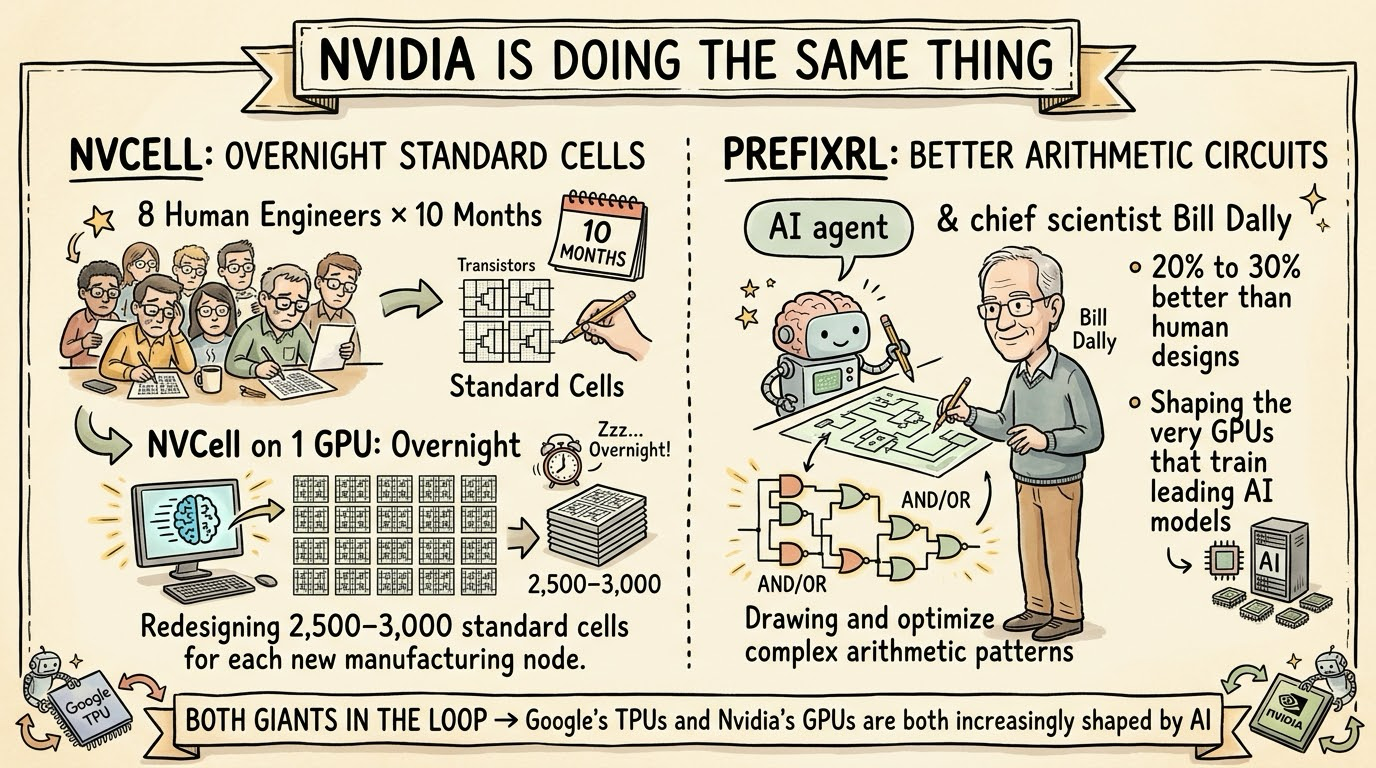
Nvidia uses AI across its own chip design process.
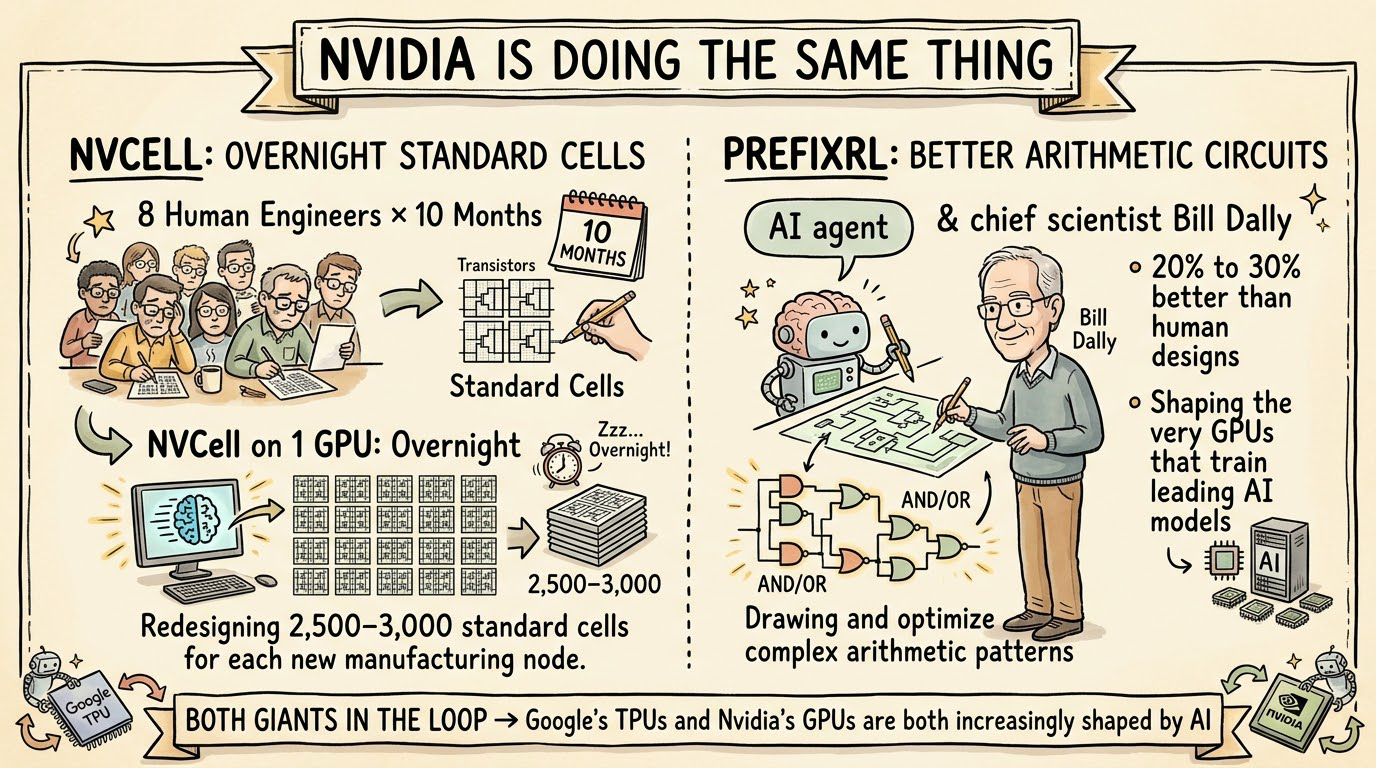
Every new manufacturing process requires redesigning about 2,500 to 3,000 standard cells, the basic building blocks of a chip.
Nvidia's NVCell tool does that work overnight on one GPU, a job that used to take eight engineers about 10 months.
Its PrefixRL agent designs the arithmetic circuits inside its GPUs.
Chief scientist Bill Dally said those circuits are 20% to 30% better than human designs.
So Nvidia's GPUs, which train many of the world's leading models, are increasingly shaped by AI too.
Agents Are Taking Over Chip Design Work
The big chip design software companies are now selling autonomous agents.
Cadence, Synopsys and Siemens all launched agentic design tools this year.
Cadence claims its agents cut one validation loop from five weeks to under a day.
Synopsys claims validation up to 50 times faster, with 20% better coverage.
In April, a startup called Verkoran said its AI system designed a RISC-V processor from a 219-word specification, although the design was only validated in simulation and never manufactured.
I've written about how AI agents will build their own programming language, and I think chip design is heading the same way, with agents designing for agents.
Why Hardware Makes The Loop Faster
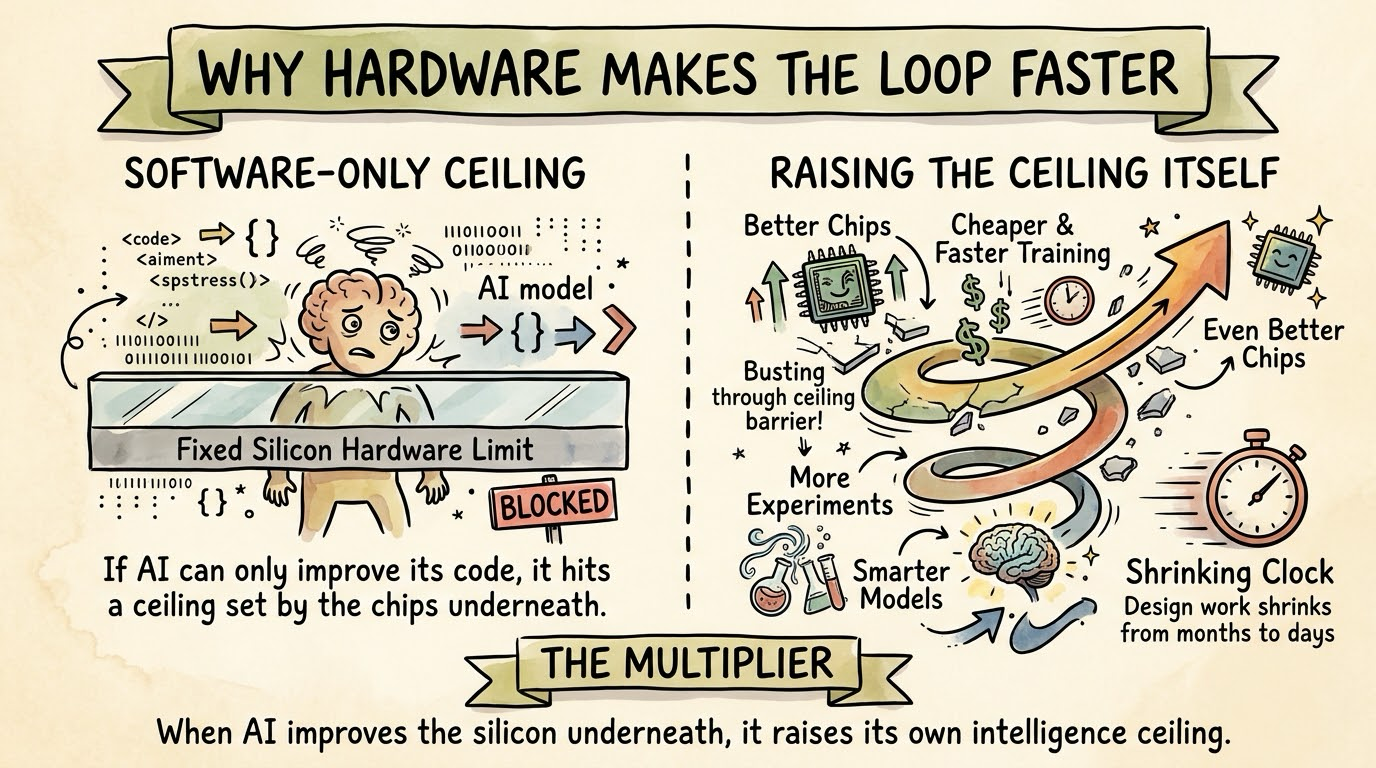
Software improvements eventually run into the limits of the hardware underneath them.
If AI can only improve its code, it hits a ceiling set by the chips it runs on.
If AI can also improve the chips, it can raise that ceiling itself.
Each generation of chips makes training cheaper and faster.
Cheaper training means more experiments, which means better models.
Better models then design better chips, and the cycle repeats.
The key is how short each cycle gets.
If AI cuts design work from months to days, the time between chip generations starts to shrink.
That's where I think the real acceleration comes from.
What Still Slows It Down
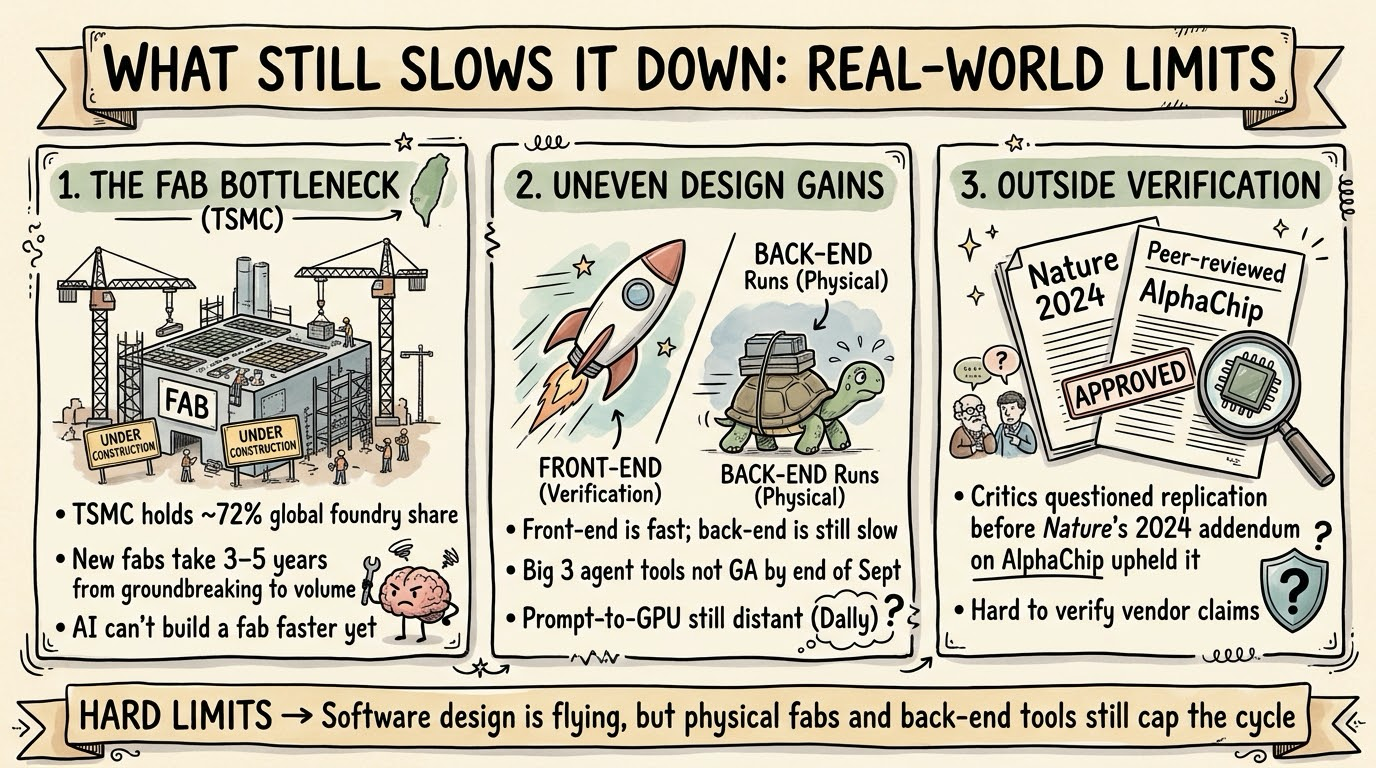
This is where I'd temper the hype, because the loop has hard limits today.
The biggest is manufacturing.
TSMC holds about 72% of the global foundry market, and its CEO expects AI chip demand to outpace supply for several years.
New fab capacity has historically taken three to five years to go from groundbreaking to volume production.
AI can design a chip faster, but it can't build a fab faster yet.
The gains are also uneven.
The biggest speedups are in front-end design and verification, where results come back quickly.
Back-end work is still slow because the tools take a long time to run.
Most of the performance numbers are vendor claims, and none of the big three's agentic tools had reached general availability by the end of September.
Even Nvidia's Dally said designing an entire GPU from a prompt is still a distant goal.
And the research hasn't been free of controversy.
AlphaChip's original Nature paper was challenged by critics who reported weaker results when they tried to replicate it.
Nature reviewed it again and published an addendum in 2024 that upheld the paper, but the debate shows how hard these claims are to verify from the outside.
Conclusion: Bits Move Fast, Atoms Move Slowly
The recursive loop between AI and its hardware has already started.
AI helps lay out TPUs, designs GPU circuits and improves the software that trains the next models.
What it can't yet do is speed up the factories, the power grid and the physical supply chain.
That's the speed limit for now.
My Take: Recursive self-improvement will accelerate sharply as AI designs the chips it runs on, but the real takeoff comes when AI starts speeding up chip manufacturing and energy as well, because that's when the slowest part of the loop finally gets faster.
Disclosure: I use Claude, made by Anthropic, as a research and writing assistant.
Sources
Pages I opened for the facts in this post:
- Google DeepMind: How AlphaChip transformed computer chip design
- SiliconANGLE: Google DeepMind develops AlphaEvolve
- Malay Mail: Anthropic to buy one million Google TPUs
- DeepLearning.AI, The Batch: How Nvidia uses AI to design chips
- Tom's Hardware: The state of agentic AI in chip design tools in 2026
- Pulse: TSMC CEO warns AI-driven chip shortage could last years
- arXiv: That Chip Has Sailed, a response to AlphaChip critics