Will Civil Unrest Drag Countries Into War? What the Data Actually Says
Protests hit more than 70 countries in 2025, and conflicts between states reached a post-WWII record. Does unrest at home push governments into fights abroad? History says less often than you'd think. The bigger risk is quieter: crackdowns, scapegoats and proxy wars.
It feels like half the world is in the streets right now.
Youth-led protests forced Nepal's prime minister to resign, protests forced out a prime minister in Mongolia, and anti-government movements have spread across every continent.
At the same time, wars between countries are back at levels we haven't seen since the Second World War.
It's tempting to connect the two.
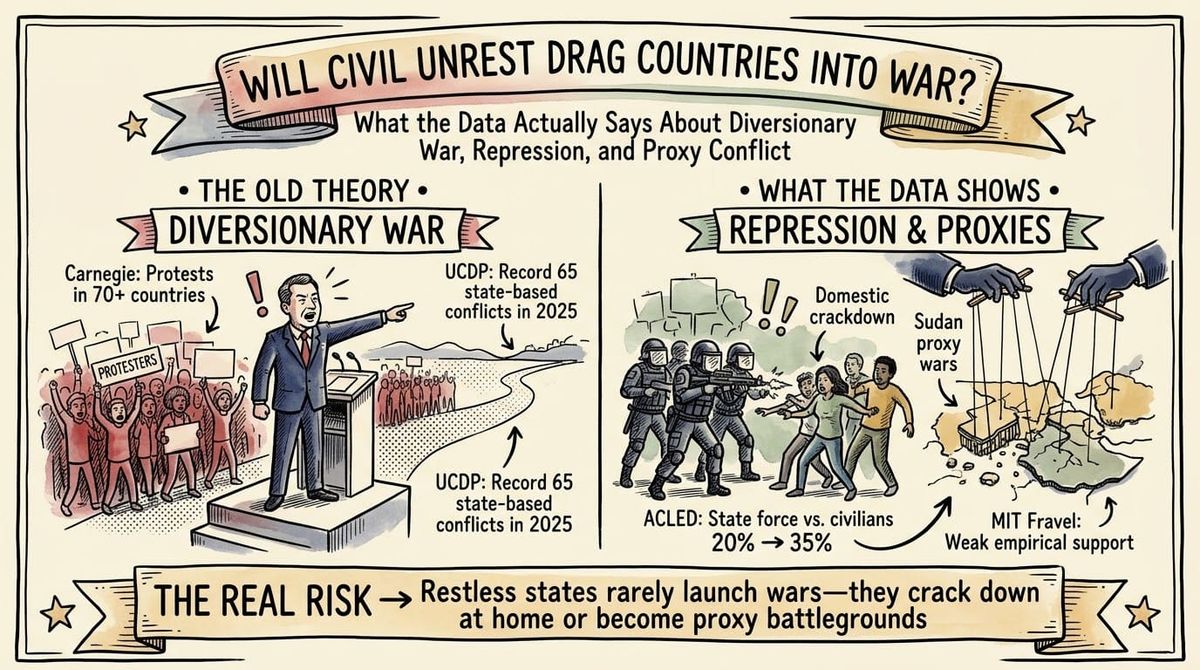
The old theory says that when a government loses control at home, it looks for an enemy abroad to rally people around the flag.
I think the risk is real, but it shows up differently than most people expect.
The World Is Restless
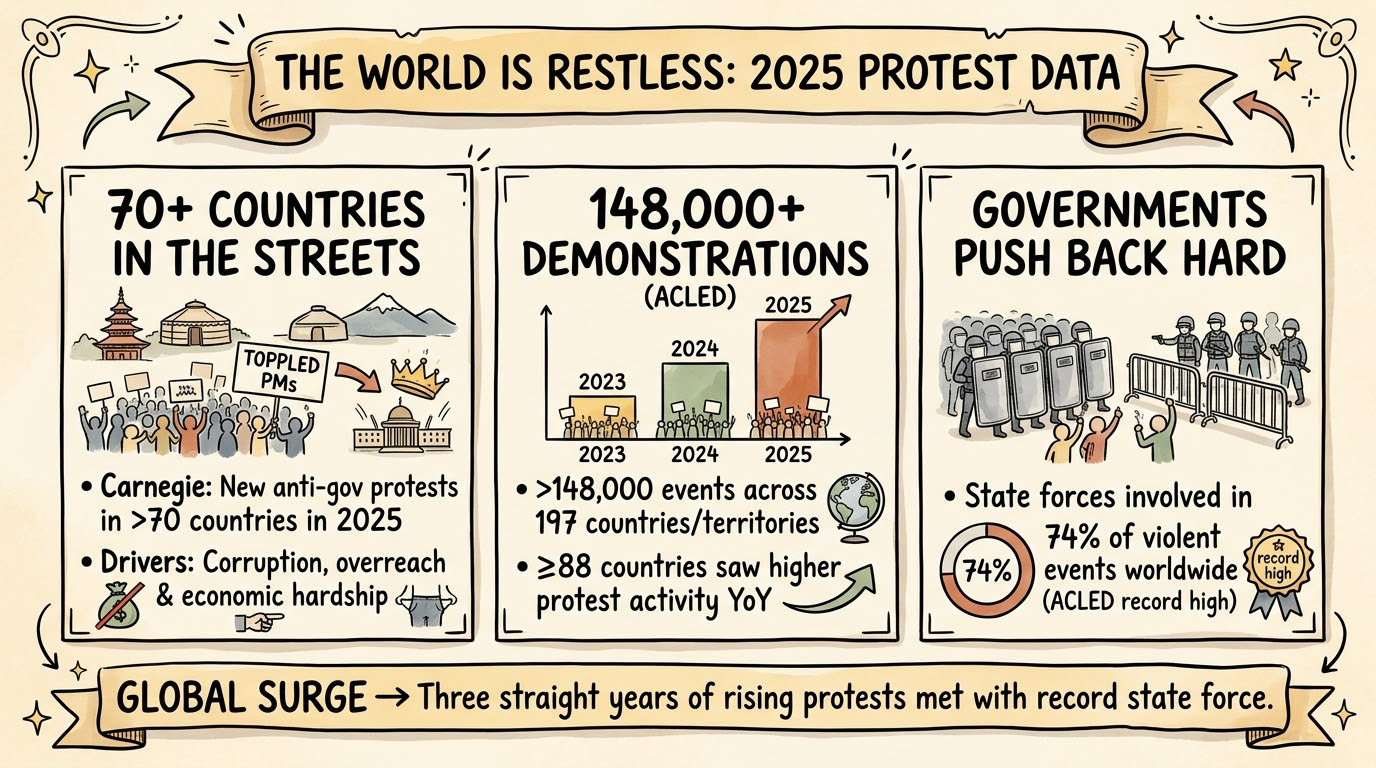
According to the Carnegie Endowment's Global Protest Tracker, new anti-government protests broke out in more than 70 countries in 2025.
They happened in free, partly free and authoritarian countries alike.
The main drivers were corruption, governments overreaching their powers and economic hardship.
ACLED counted more than 148,000 demonstration events in 197 countries and territories in 2025, the third straight year of growth.
At least 88 countries saw more protest activity than the year before.
And governments are pushing back hard.
State forces were directly involved in 74% of violent events worldwide, the highest share ACLED has recorded since it reached global coverage.
And Countries Are Fighting Each Other Again
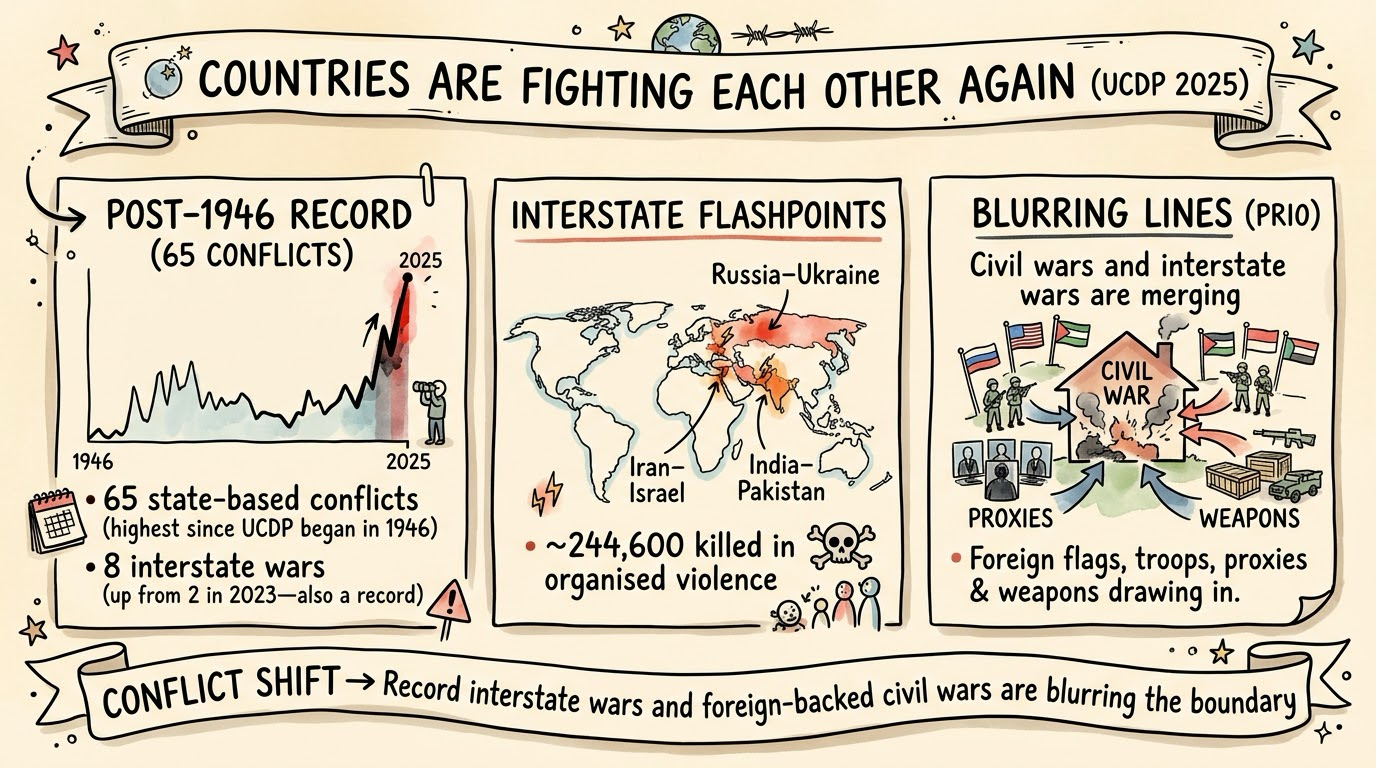
The Uppsala Conflict Data Program recorded 65 state-based conflicts in 2025, the most since its records began in 1946.
Eight of those were conflicts between states, up from two in 2023 and also a record.
They included Russia and Ukraine, Iran and Israel, India and Pakistan, and Israel and Syria.
About 244,600 people were killed in organised violence, making it one of the deadliest years since the Rwandan genocide.
Researchers at PRIO say the line between civil wars and wars between states is becoming blurred, as more internal conflicts draw in foreign governments through troops, proxies, weapons and political support.
The Theory: Look Abroad When Home Is On Fire
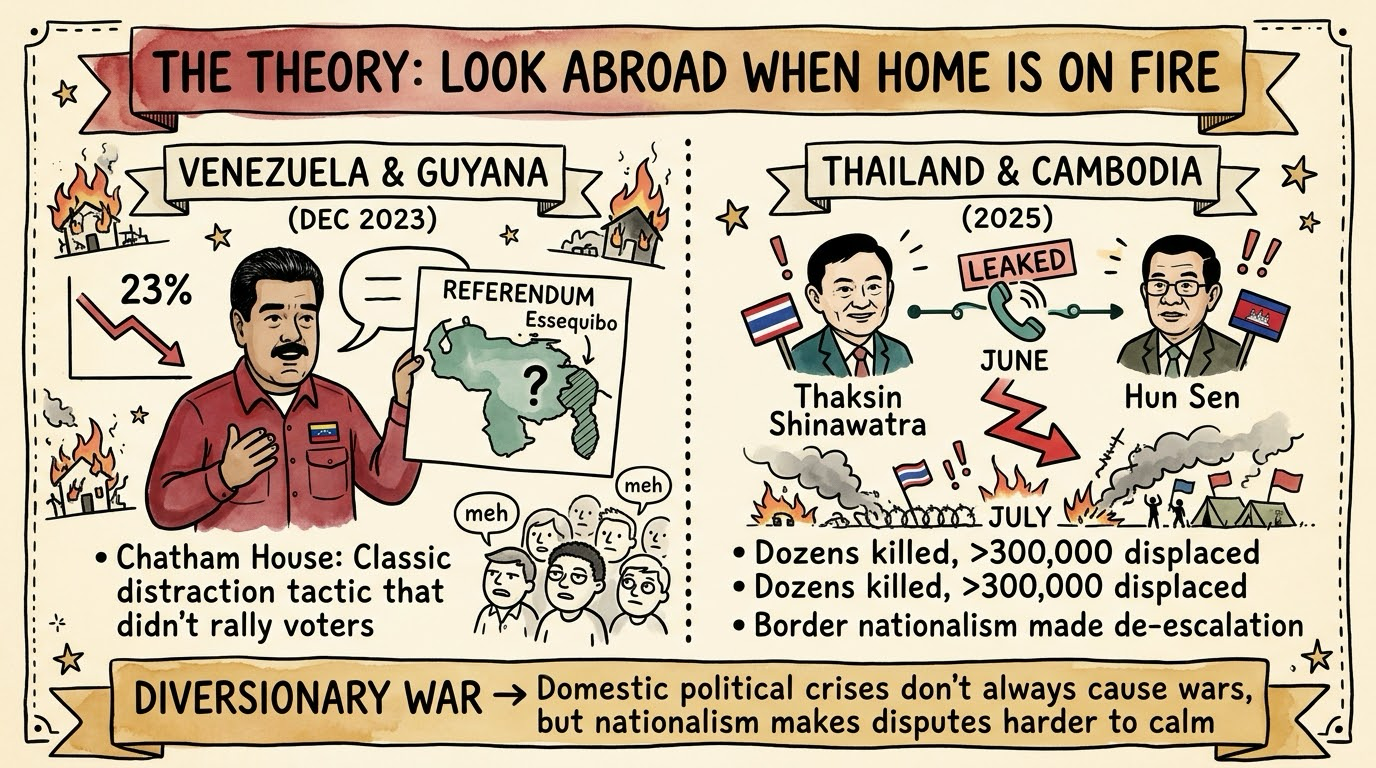
Political scientists call it diversionary war.
A leader facing protests or a failing economy picks a fight with a foreign rival, hoping patriotism will drown out the anger at home.
There are examples that look like it.
In December 2023, Venezuela held a referendum on annexing most of Guyana's oil-rich Essequibo region.
Chatham House noted that Nicolás Maduro's approval rating was around 23% at the time and that surveys suggested he would lose a fair election to the opposition.
It called the referendum a distraction that didn't work: "the classic autocratic tactic of rallying popular support for a trumped-up external threat didn't work."
Thailand and Cambodia are a messier example.
In June 2025, a leaked phone call between Thai Prime Minister Paetongtarn Shinawatra and Cambodia's Hun Sen set off a political crisis in Thailand, and she was later removed from office.
In July, the two countries fought their most serious border battle in over a decade, with dozens killed and more than 300,000 people displaced.
Both sides used border nationalism to rally public support.
That isn't proof that anyone started a war to distract voters.
But it shows how domestic politics and nationalism can make a border dispute much harder to calm down.
Why The Evidence Is Weaker Than It Sounds
Here's where I'd push back on the simple version of this idea.
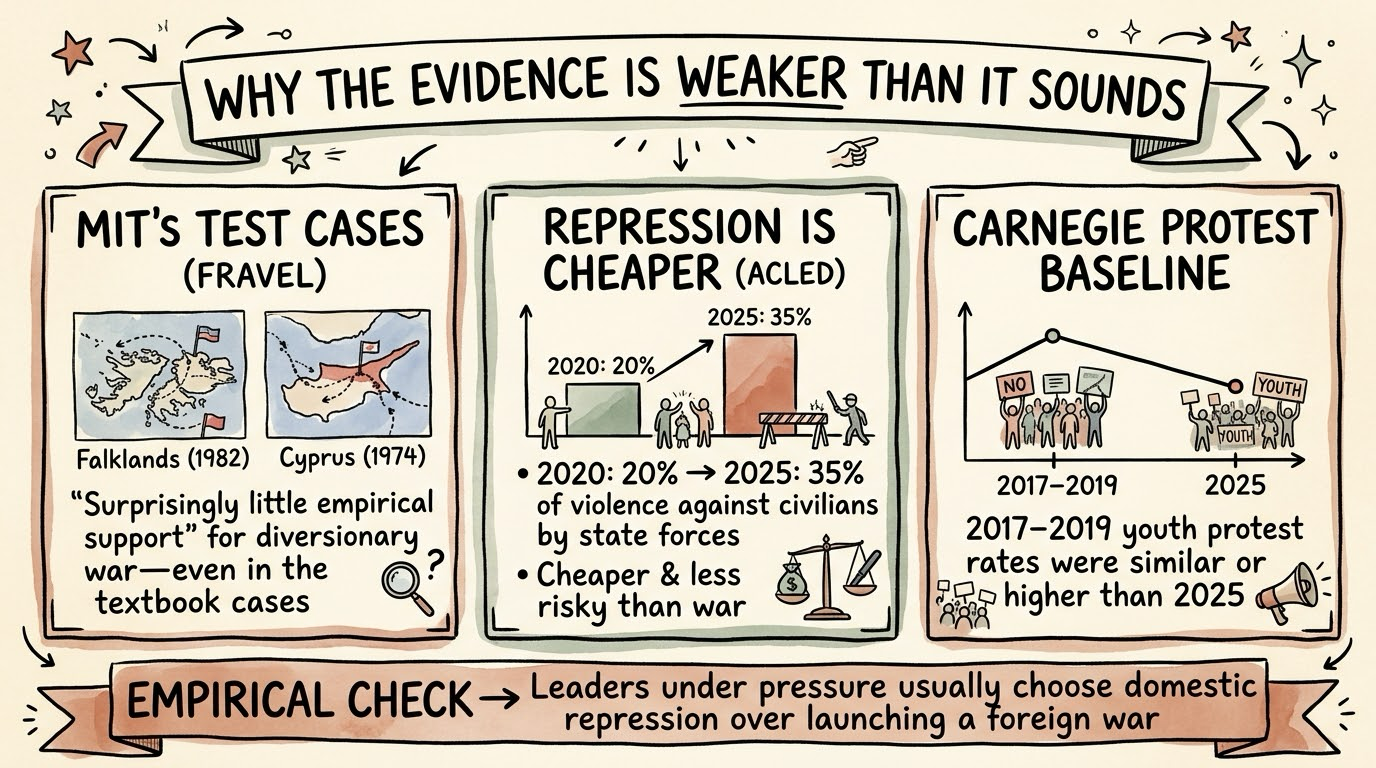
MIT political scientist M. Taylor Fravel reviewed the research and found that quantitative studies of diversionary war have produced mixed and contradictory results.
He then tested two of the cases where diversion should be easiest to prove: Argentina's 1982 invasion of the Falklands and Turkey's 1974 invasion of Cyprus.
He found "surprisingly little empirical support" for the theory, even there.
The ACLED numbers point to a different pattern.
Governments are increasingly using force at home: state forces were responsible for 35% of violence against civilians in 2025, up from 20% in 2020.
I think that's because repression is usually cheaper, faster and less risky for a leader than a war.
And today's protest wave may be less unusual than it feels.
Carnegie found that youth-led protest rates in 2017 to 2019 were similar to or higher than in 2025.
Indirect Conflict Is The Bigger Risk
So I don't think most restless countries will start wars.
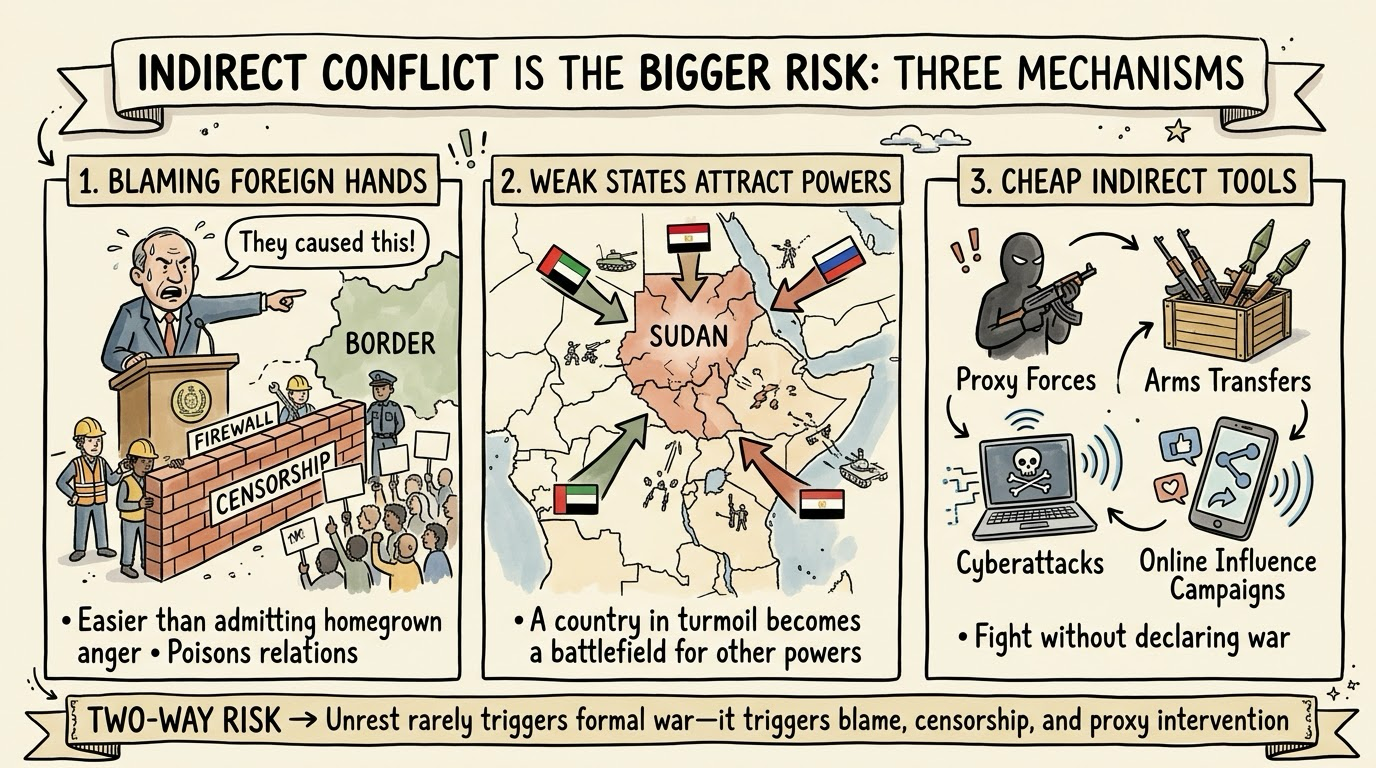
I think the more likely outcome is indirect conflict, and it can run in both directions.
First, governments under pressure blame foreign hands.
It's easier to say protesters are funded by a rival country than to admit the anger is homegrown, and that rhetoric can poison relations between neighbours.
I've written about how governments try to control information with censorship and firewalls, and unrest makes that instinct stronger.
Second, unrest makes a country weaker, and weak countries attract outside players.
PRIO points to Sudan, where regional actors and shifting alliances have prolonged the fighting.
A country in turmoil is more likely to become a battlefield for other powers than to launch a war of its own.
Third, the tools of indirect conflict are cheaper than ever.
Proxy forces, arms transfers, cyberattacks and online influence campaigns let governments fight without declaring war.
Conclusion: Watch The Weak States, Not Just The Angry Ones
Unrest is rising in many countries, and wars between states are at a post-war high.
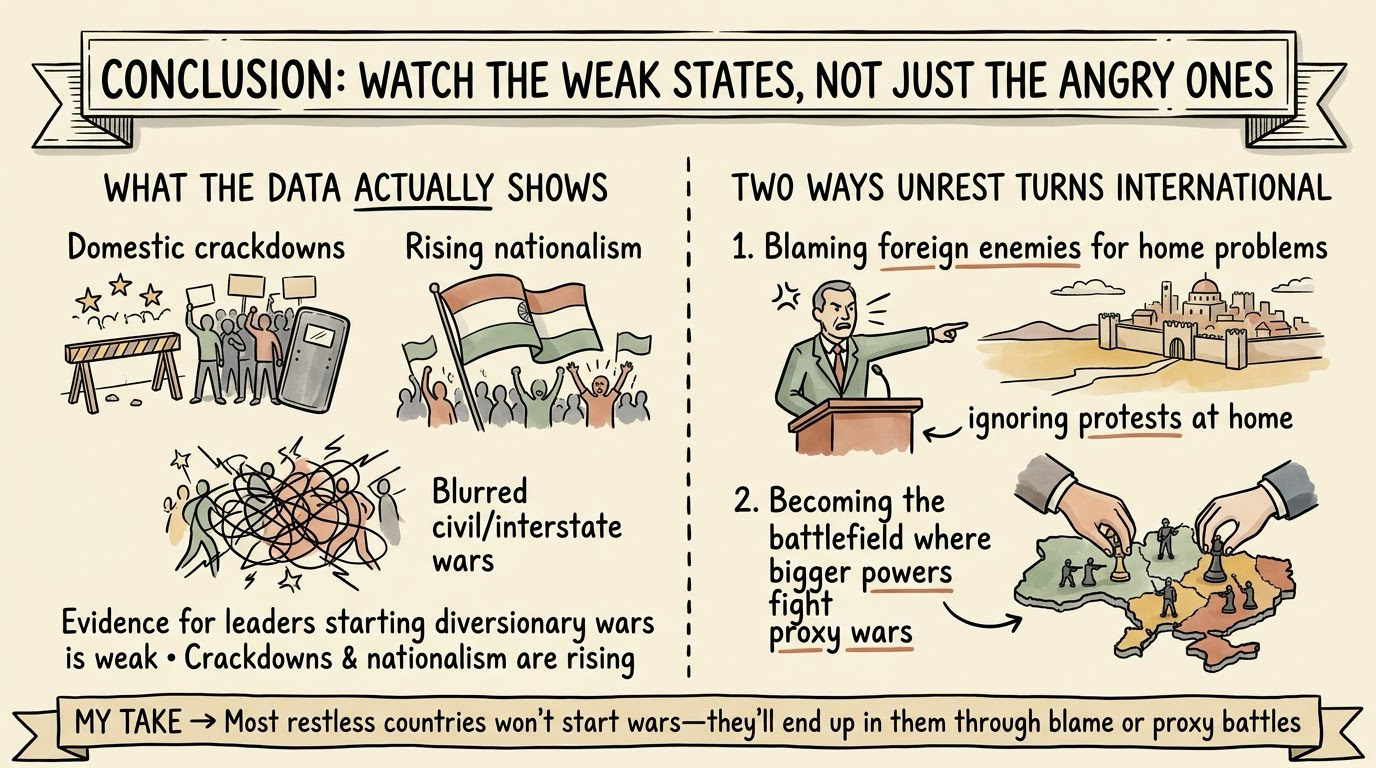
But the evidence that governments start foreign wars to escape domestic anger is weaker than the theory suggests.
What the data shows more clearly is crackdowns at home, rising nationalism and a world where civil wars and international wars blur together.
My Take: Most countries with civil unrest won't start wars, but many will end up in international conflicts anyway, either by blaming foreign enemies for problems at home or by becoming the place where bigger powers fight their proxy wars.
Sources
Pages I opened for the facts in this post:
- Carnegie Endowment: Global protests in 2025
- ACLED: What's driving conflict today
- Uppsala University: UCDP records record number of conflicts between states
- PRIO: The return of interstate war should change how we think about conflict
- Chatham House: Maduro hoped to mobilise Venezuelans around an old grievance in Guyana
- Wikipedia: Cambodia–Thailand phone call leak
- The Business Standard: What sparked the Thailand–Cambodia border clashes
- Fulcrum: Thai-Cambodian dispute, when foreign policy begins at home
- MIT Security Studies Program: The Limits of Diversion