
Next-Generation Extra Large Autonomous Underwater Vehicles (XLAUVs) — The Submarine That Doesn't Need Humans
85 ft, 3,100 miles, months without surfacing, fits in a shipping container, carries 3 payloads or one missile. The future of undersea warfare is unmanned.
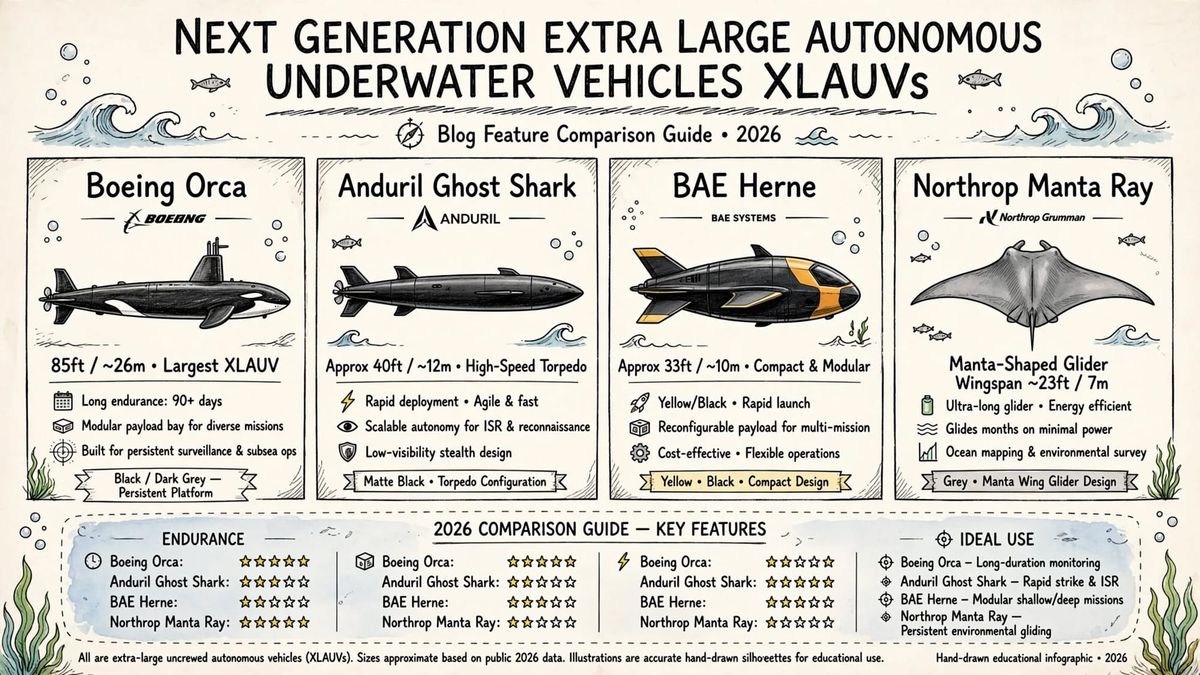
What Is an XLAUV?
XLAUVs are unmanned multi-mission capable robotic vessels that are inexpensive, autonomous, and durable.
XLUUVs are characterized by their size and endurance. While there's no official standard, these vehicles are generally over 10 m (32 ft 10 in) in length. Their long endurance, often measured in months, is achieved through efficient hull designs, advanced propulsion systems, and large battery or fuel cell power sources.
The shift: from UUVs deployed from a mothership to vehicles that swim from port, depart for mission, and return to base on their own. No personnel on front line.
1. Orca XLUUV — Boeing, USA
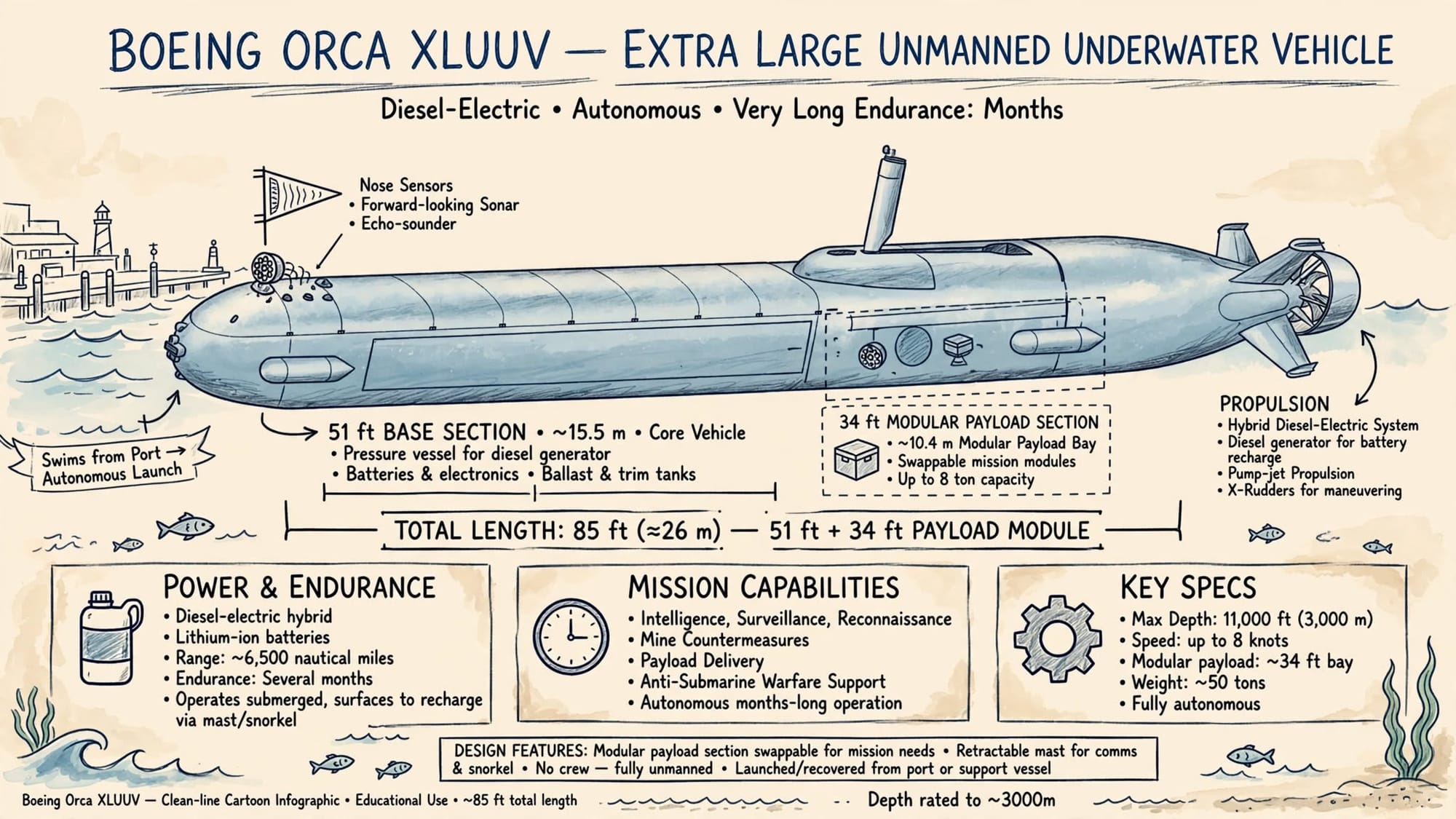
The Orca XLUUV is a cutting-edge, autonomous, unmanned diesel-electric submarine with a modular payload section.
Specs:
- Envelope (no payload) 51 ft x 8.5 ft x 8.5 ft (15.5 m x 2.6 m x 2.6 m)
- Envelope with a 34 ft payload section 85 ft (25.9 m) — TOTAL LENGTH 85 FT WITH PAYLOAD MODULE
- Very Long Endurance/Range — swims from port, months of autonomous operation, >10,000 NM class
- Propulsion: Diesel-electric + batteries, power & control systems
- Modular payload section +34 ft: swappable payloads — ISR / Survey / Communications / Cargo / Mine Countermeasures / Logistics
- Nose / sensors & navigation, propeller & fin control
First Orca Extra-Large Unmanned Undersea Vehicle prototype delivered to US Navy. Boeing awarded $43M to build four. Basis: Echo Voyager.
It will allow for a wide range of missions, end the reliance on crewed platforms, keeping people out of harm's way and boosting endurance.
2. Ghost Shark — Anduril, Australia
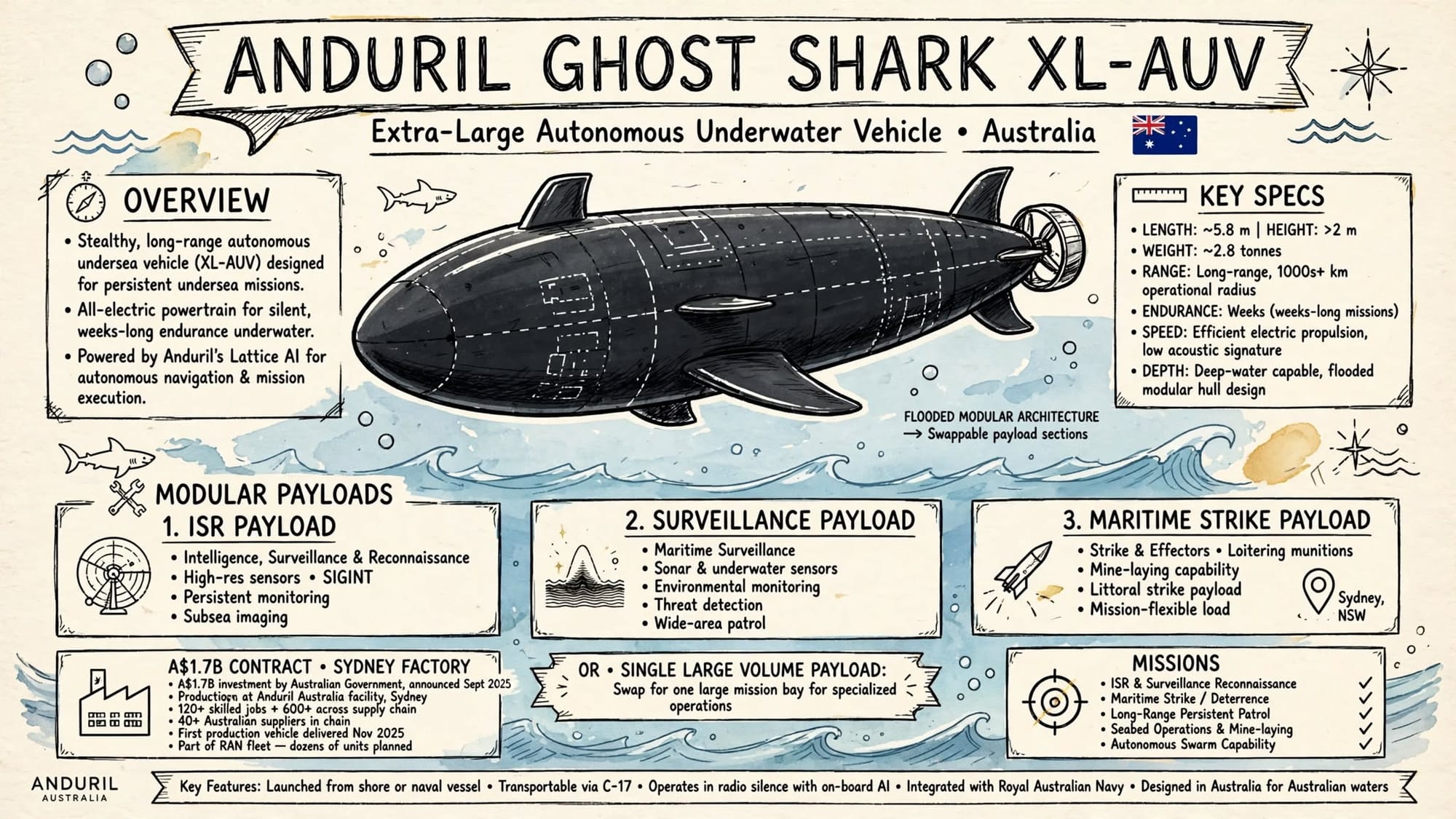
The modular Ghost Shark XLAUV is designed to conduct autonomous intelligence, surveillance, reconnaissance (ISR) and underwater maritime strike operations at long range.
All-electric, stealthy, uncrewed. Baseline capable of carrying either three distinct payloads or a single large-volume payload, enabling roles from strike to communications or ISR, with endurance measured in weeks without intervention.
Endurance: 10+ weeks on mission, low-power all-electric propulsion, persistent operation no surfacing, long-range covert patrols, months endurance.
Payloads:
- PAYLOAD 1: ISR / Surveillance Pod — EO/IR Camera, SIGINT, Persistent ISR, Multi-spectral Sensors
- PAYLOAD 2: Maritime Recon Pod — Acoustic SONAR, Ocean Mapping, Data Relay, Environmental Sensing
- PAYLOAD 3: Strike Module — Modular Strike, Sea Mine / Torpedo, Precision Strike, Covert Offensive
Program: A$1.7 billion five-year contract September 2025 for delivery, maintenance, continued development of dozens of vehicles. Defence stated on 15 April 2026 that Navy has now taken delivery. Ghost Shark manufacturing facility in Sydney, 40+ Australian suppliers, 150+ skilled jobs — sovereign manufacture.
Ghost Shark is historic leap forward for Australian Navy.
3. Next Challengers: Herne, Manta Ray, Jalkapi
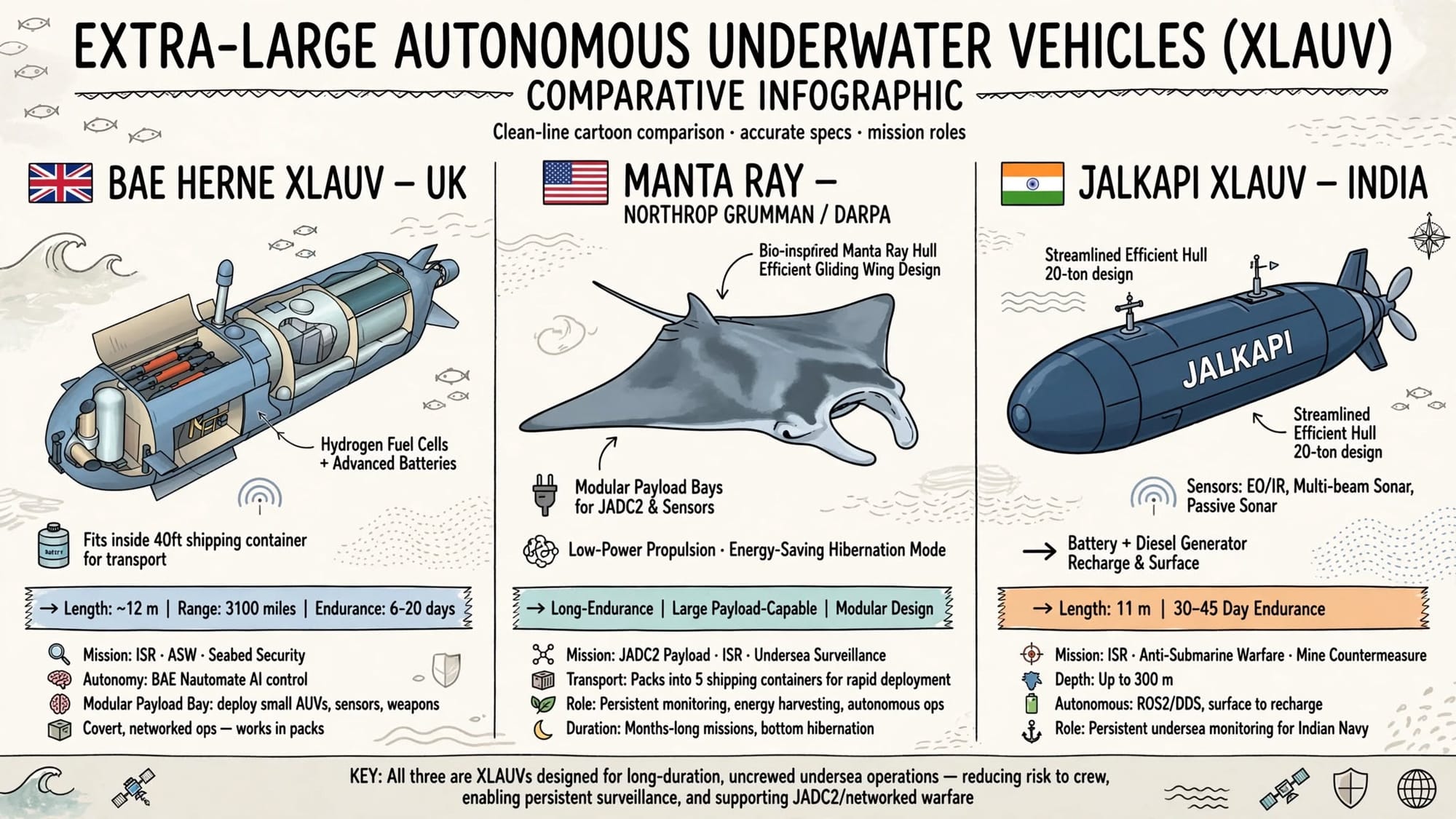
BAE Herne XLAUV — UK
Endurance powered by advanced batteries, with hydrogen fuel cells available to stretch missions even further.
Sized to fit inside a standard 40-foot (12-meter) container, can be deployed from ports, surface ships, or submarines. Range 3,100-mile. Capabilities reach zenith with Nautomate — next generation military autonomous control system for uncrewed marine vehicles.
Game changer in underwater battlespace, cost-effective, more endurance, efficiency, and scale, keeping people out of harm's way.
Manta Ray — Northrop Grumman / DARPA, USA
Manta Ray will provide payload capability from the sea, making it a critical component of subsea warfare and the DoD's Joint All Domain Command and Control (JADC2) vision. Inspired by rays, gliding, long-duration.
Jalkapi XLAUV — India
India has taken decisive step with first public showcase of complete design of Jalkapi Extra-Large Autonomous Underwater Vehicle.
Leap in unmanned underwater warfare capability, to be mothershipped by Project-77 SSNs in manned-unmanned teaming.
Plus HADALUS — NATO DIANA 2026: novel low-cost composite hull structures and proprietary deep-water battery systems to achieve long-range, high-payload operations at significantly lower cost than all other XL-AUVs.
Why Next-Gen XLAUVs Matter
- Distributed Maritime Operations: Dozens of cheap, autonomous, durable vessels vs one $4B Virginia-class. Mass + persistence.
- No Surfacing: Weeks to months covert — ISR, infrastructure inspection, communications relay, targeting.
- Containerized: 40-foot container deployment = any port, any ship, anywhere. No dedicated tender.
- Modular: Three distinct payloads or single large volume — ISR today, strike tomorrow. Open architecture.
- Keep Humans Safe: Cost effective autonomous capability that will allow for wide range of missions, end reliance on crewed platforms.
The future undersea force is not 10 manned subs. It is 10 manned subs + 100 XLAUVs.
From Orca 85 ft to Ghost Shark weeks-long to Herne 3,100-mile hydrogen to Manta Ray gliding — the large diameter autonomous undersea vehicle will be delivered as testbed to enable experimentation from first quarter next year.
We are entering the era of robotic undersea vessels that are inexpensive, autonomous, durable, and lethal.