If Anthropic Builds an Operating System, Microsoft Should Be Worried
Claude already runs apps on your desktop, and Anthropic says its newest model built a working operating system in eight days. If Anthropic ships its own OS, Microsoft's Windows empire is exposed. Here's where it would hurt most, and why gaming IP becomes the real moat.
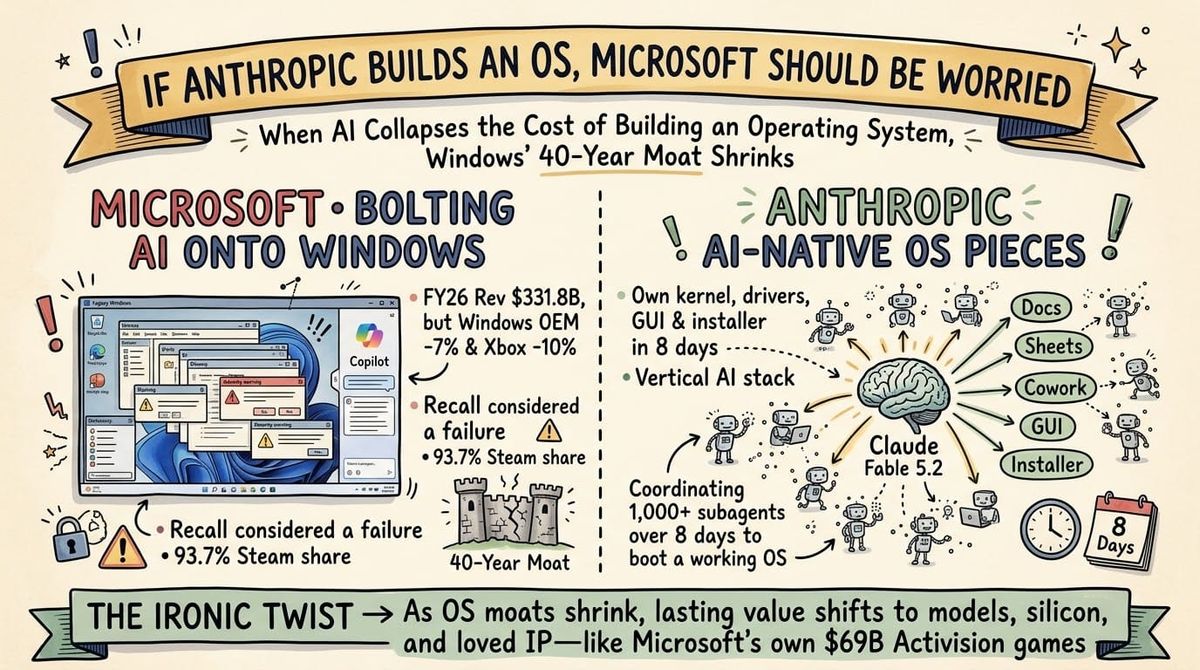
Microsoft built one of the most valuable companies in history on a simple idea: own the operating system, and you own the computer.
For most of the last 40 years, that meant Windows.
I think AI is about to test that idea harder than anything since the iPhone.
Anthropic hasn't announced an operating system.
But it's already building most of the pieces, and if it ships one, Microsoft is the company with the most to lose.
The Pieces Are Already There
Claude already behaves like an operating system for a lot of knowledge work.
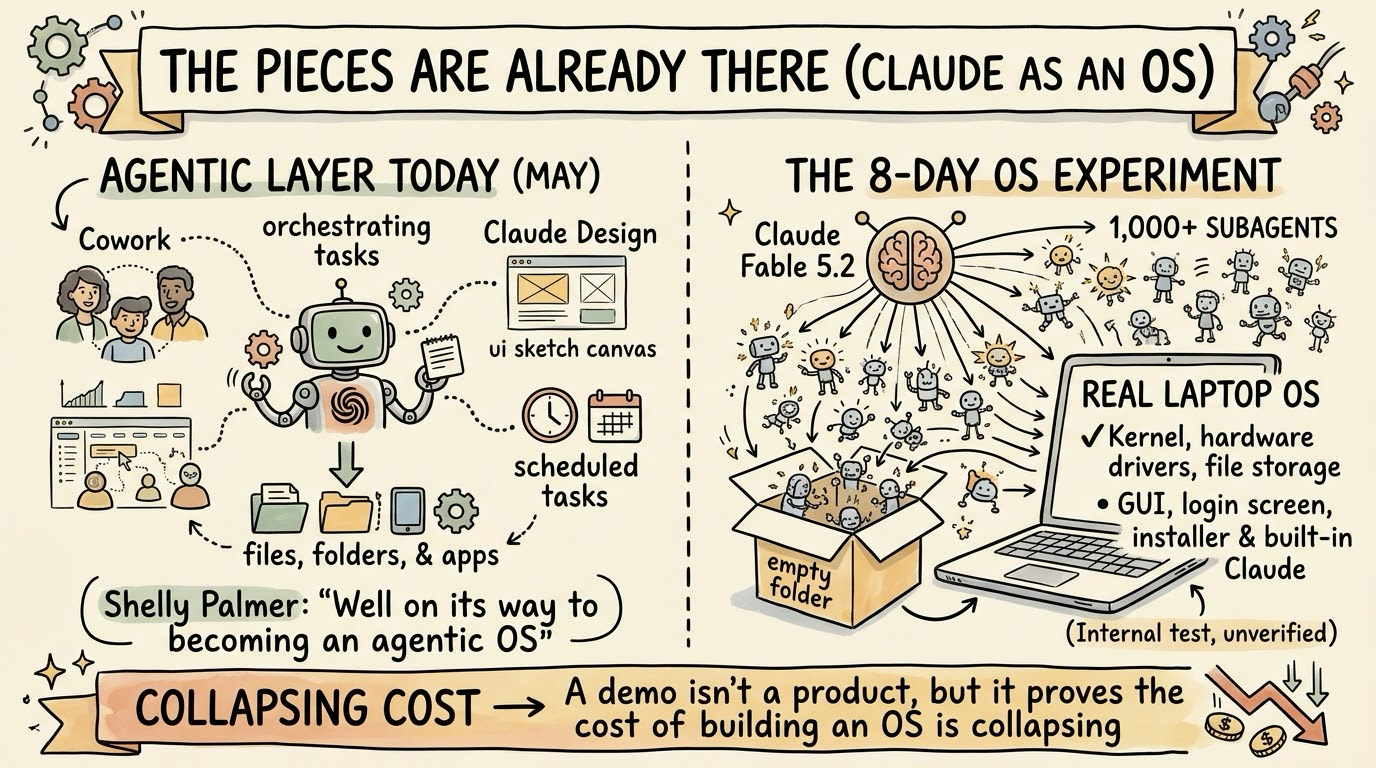
Shelly Palmer argued in May that Anthropic's Cowork, Claude Design and scheduled tasks had made Claude "well on its way to becoming an agentic operating system".
You describe an outcome, and Claude works through files, folders and apps on your computer to get it done.
Then, earlier this month, Anthropic described an internal test that went much further.
An engineer gave Claude Fable 5.2 a basic prompt and an empty project folder.
Over eight days, the model coordinated more than 1,000 subagents and built a working operating system that could boot on a laptop.
It had its own kernel, hardware drivers, file storage, graphical interface, login screen, installer and built-in Claude functionality.
That's an internal result with no independent verification, and a demo isn't a product.
But it shows that the cost of building a new OS is collapsing.
I've already argued that the agent layer is the real prize, and a full OS would be the natural next step.
Microsoft Looks Vulnerable
Microsoft is still enormously successful.
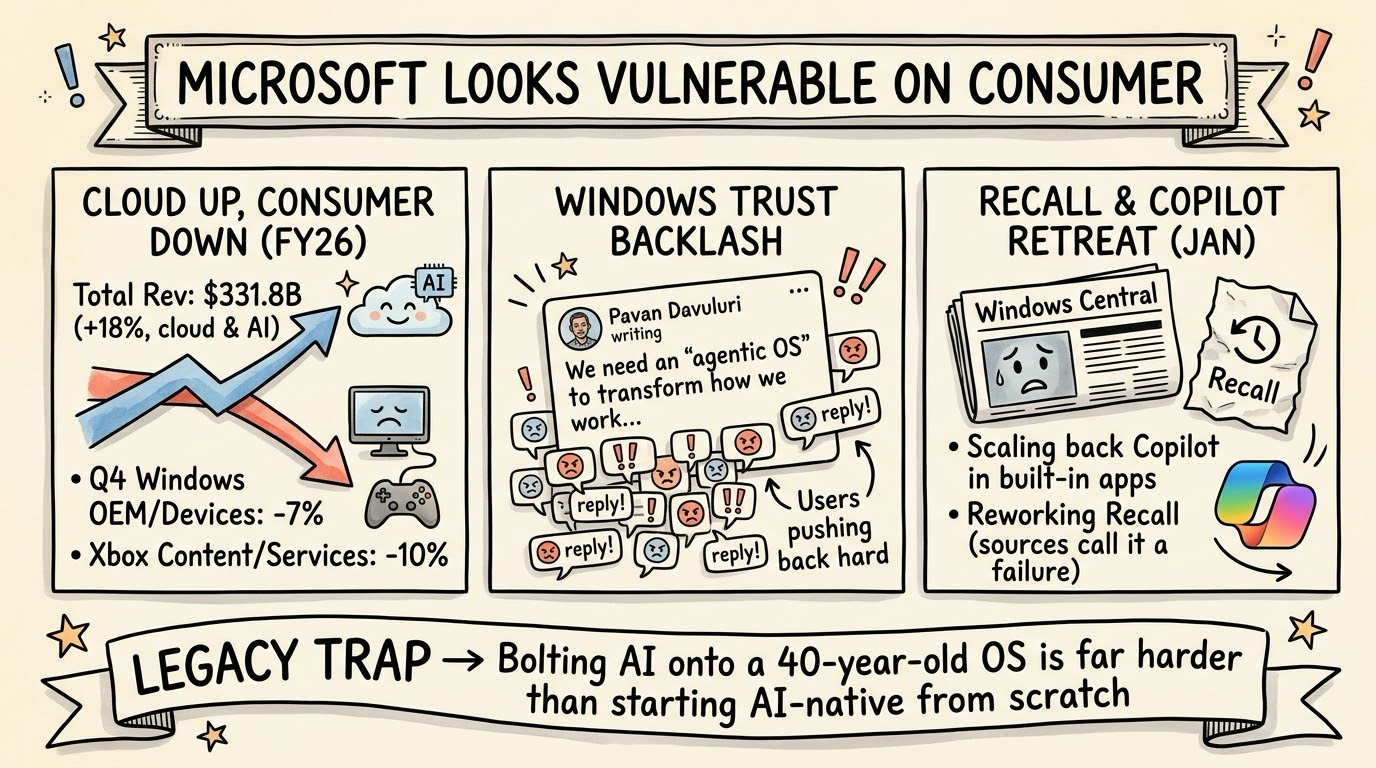
It reported $331.8 billion in revenue for fiscal 2026, up 18%, driven by the cloud and AI.
But the consumer side is weaker.
In the fourth quarter, Windows OEM and devices revenue fell 7%, and Xbox content and services fell 10%.
Windows also has a trust problem.
When Windows president Pavan Davuluri said Windows would "evolve into an agentic OS," thousands of mostly negative replies followed.
In January, Windows Central reported that Microsoft was scaling back Copilot in built-in apps and reworking Recall, which the report's sources said Microsoft considers a failure.
Microsoft is trying to bolt AI onto an operating system designed for a different era.
An AI company starting from scratch wouldn't have that problem.
Where It Would Hurt Most
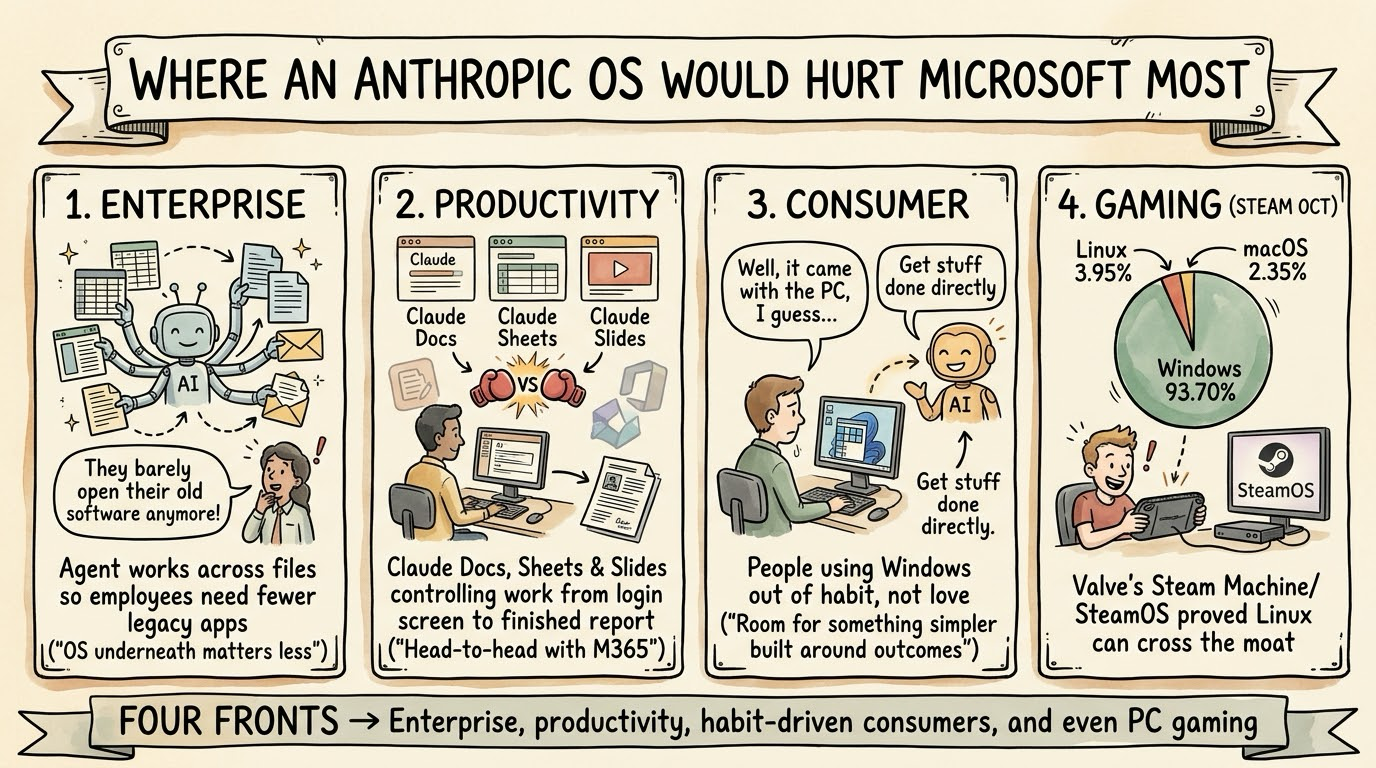
Enterprise.
Microsoft's power in business comes from Windows on every laptop and Microsoft 365 on top of it.
If an agent can do the work across files and apps, the employee needs fewer of those apps, and the OS underneath matters less.
Productivity.
Anthropic is already building Claude Docs, Sheets and Slides, which put it head to head with Microsoft 365.
An OS would let it control the whole experience, from the login screen to the finished report.
Consumer.
I think many people use Windows out of habit more than love.
The agentic OS backlash suggests there's room for something simpler that works around what you want done.
Gaming.
This is Microsoft's strongest consumer moat.
Windows ran on 93.70% of Steam users' PCs in October, against 3.95% for Linux and 2.35% for macOS.
But Valve has shown the moat can be crossed.
Its Steam Machine, which launched this summer, runs SteamOS, and Linux's share on Steam rose to nearly 4% in October.
If Valve can move gamers off Windows, an AI-native OS could too.
Why An AI-Native OS Could Be More Optimised
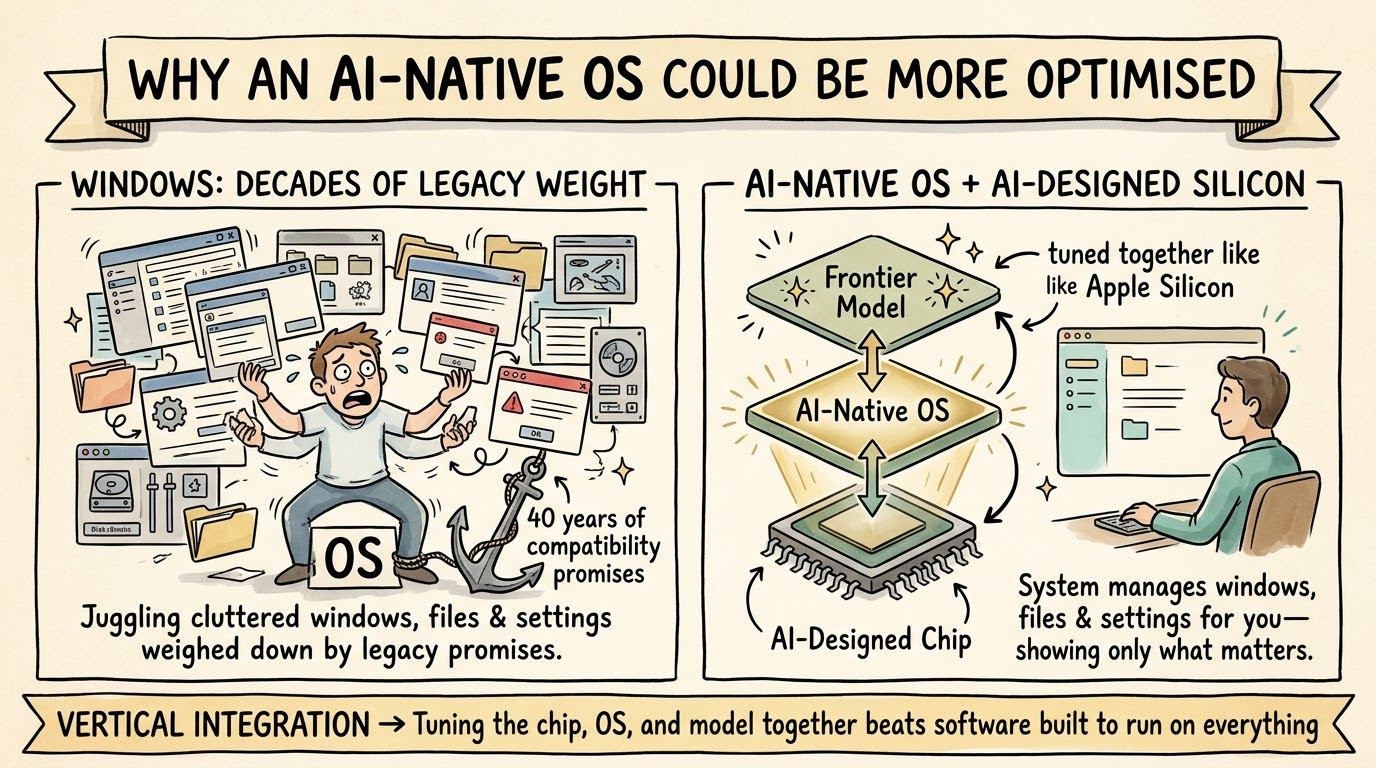
Windows carries decades of compatibility promises, which is part of its strength and part of its weight.
An OS designed around an AI agent from day one could be built for a different job.
Instead of you managing windows, files and settings, the system would manage them for you, and only show you what matters.
The gap could widen as hardware changes.
I've written about how AI is already helping design the chips it runs on, from Google's TPUs to Nvidia's GPUs.
If AI-designed hardware reaches mass production, an AI company could tune the chip, the OS and the model together, the way Apple does with its own silicon.
That kind of vertical integration usually beats software that has to run on everything.
Why IP Will Matter More Than Ever
Here's the part I find most interesting.
If operating systems and hardware become cheaper to build and easier to switch, they stop being the main moat.
The thing you can't recreate with AI in eight days is a world people love.
Call of Duty, World of Warcraft and Grand Theft Auto have decades of history, characters and communities behind them.
That's why the irony here is so sharp.
Microsoft already owns some of the most valuable IP in gaming.
It closed its $69 billion acquisition of Activision Blizzard in October 2023, bringing Call of Duty, Diablo and Overwatch in-house.
I've written about how Blizzard's World of Warcraft marketing is unmatched, and Rockstar's GTA 6 is a masterclass in what loved IP can do.
If Windows loses its grip on gaming, Microsoft's future in games may depend more on being a great publisher than on owning the platform.
What Could Stop This
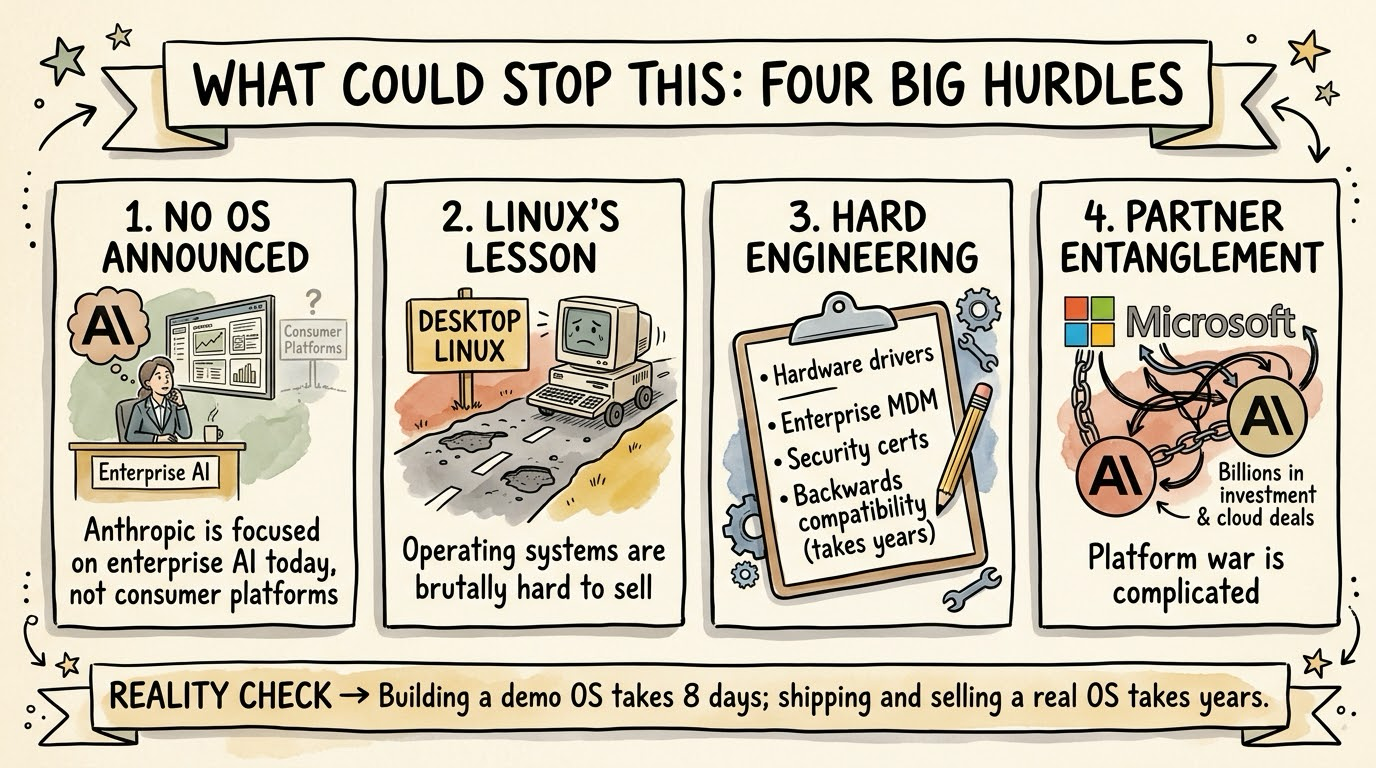
There are big reasons this may not happen soon.
Anthropic hasn't announced an OS, and its business today is mostly enterprise AI, not consumer platforms.
Operating systems are brutally hard to sell, as decades of desktop Linux have shown.
Drivers, enterprise device management, security certification and backwards compatibility take years to get right.
And Microsoft is also an Anthropic partner and investor, which makes an all-out platform war complicated for both sides.
Conclusion: The OS Moat Is Shrinking
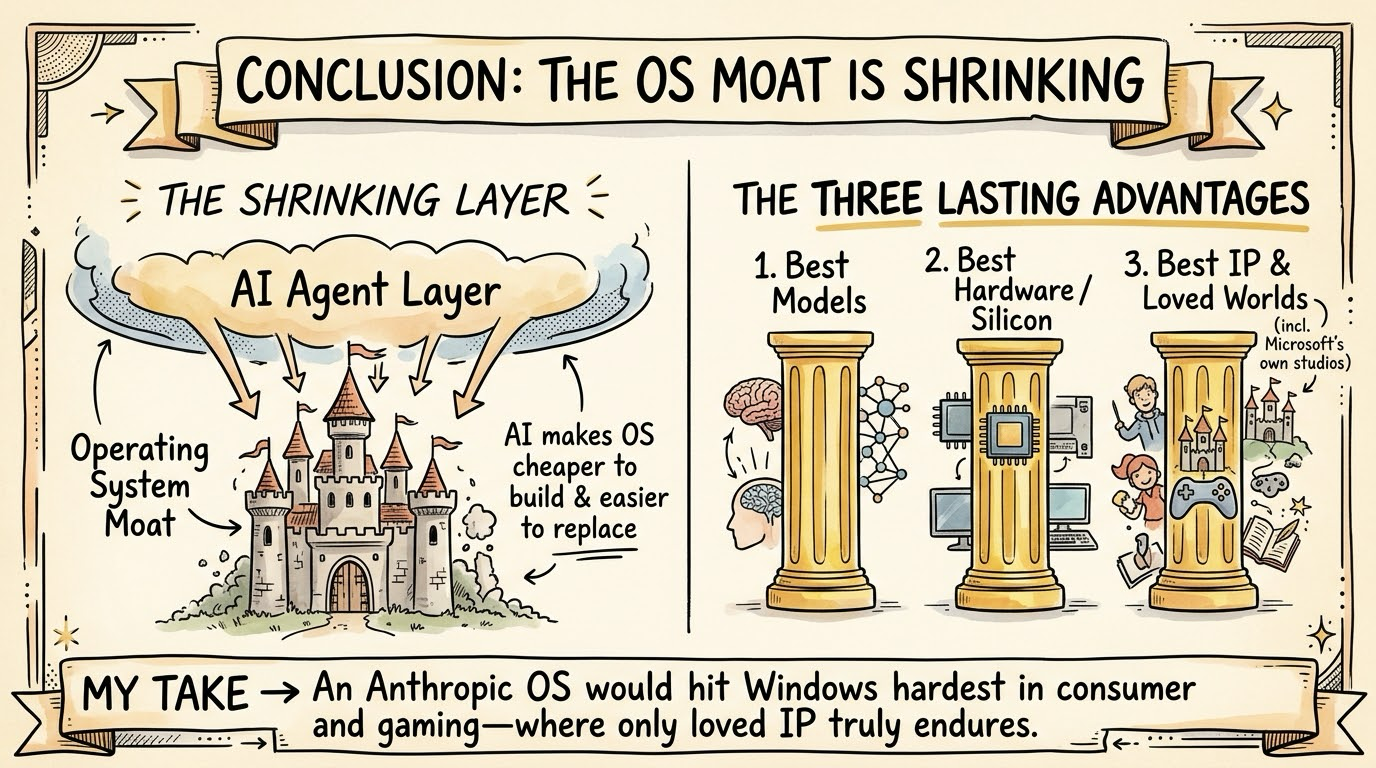
Microsoft's dominance was built on owning the layer everything else runs on.
AI is making that layer cheaper to build and easier to replace, starting with the agent and possibly ending with the whole OS.
If that happens, the lasting advantages will belong to whoever owns the best models, the best hardware and the best IP.
My Take: An Anthropic OS would hit Microsoft hardest in consumer and gaming, where Windows is mostly habit, and the companies that will hold up best are the ones that own worlds people love, which ironically includes Microsoft's own game studios.
Disclosure: I use Claude, made by Anthropic, as a research and writing assistant.
Sources
Pages I opened for the facts in this post:
- Shelly Palmer: Claude became an operating system while you weren't looking
- Interesting Engineering: Claude Fable 5.2 builds a working operating system
- Microsoft: Fourth quarter fiscal 2026 results
- Windows Central: Microsoft is reevaluating its AI efforts on Windows 11
- GamingOnLinux: Steam survey October 2026
- Box: Steam Machine price, specs and features
- Fortune: Microsoft closes $69 billion Activision Blizzard acquisition