Can the GrapheneOS Motorola Phone Steal Market Share From Apple and Android?
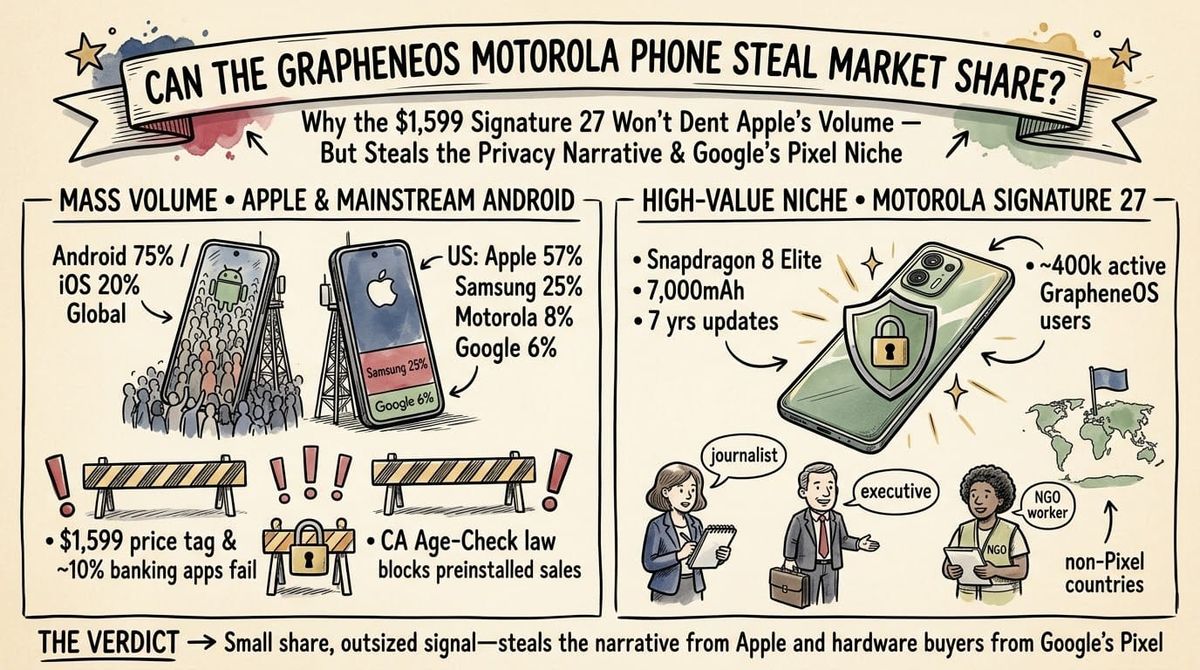
Motorola's Signature 27 is the first phone built to run GrapheneOS outside Google's Pixel line. It won't move Apple's or Android's numbers anytime soon. It could still win the most valuable slice of the market: people who will pay a premium to own their phone.
Since GrapheneOS launched in 2019, using it has meant buying a phone from Google.
That's an odd arrangement for an operating system whose main appeal is keeping Google out of your life.
In March 2026, at MWC, Motorola announced a long-term partnership with the GrapheneOS Foundation.
In November, it started selling the first phone built for it, the Motorola Signature 27.
So the obvious question is whether a privacy-hardened Motorola can take market share from Apple and from mainstream Android.
My short answer is no, at least not in any way that shows up on a quarterly market share chart.
The longer answer is more interesting, because the share it can take is the most valuable kind.
What Motorola Actually Shipped
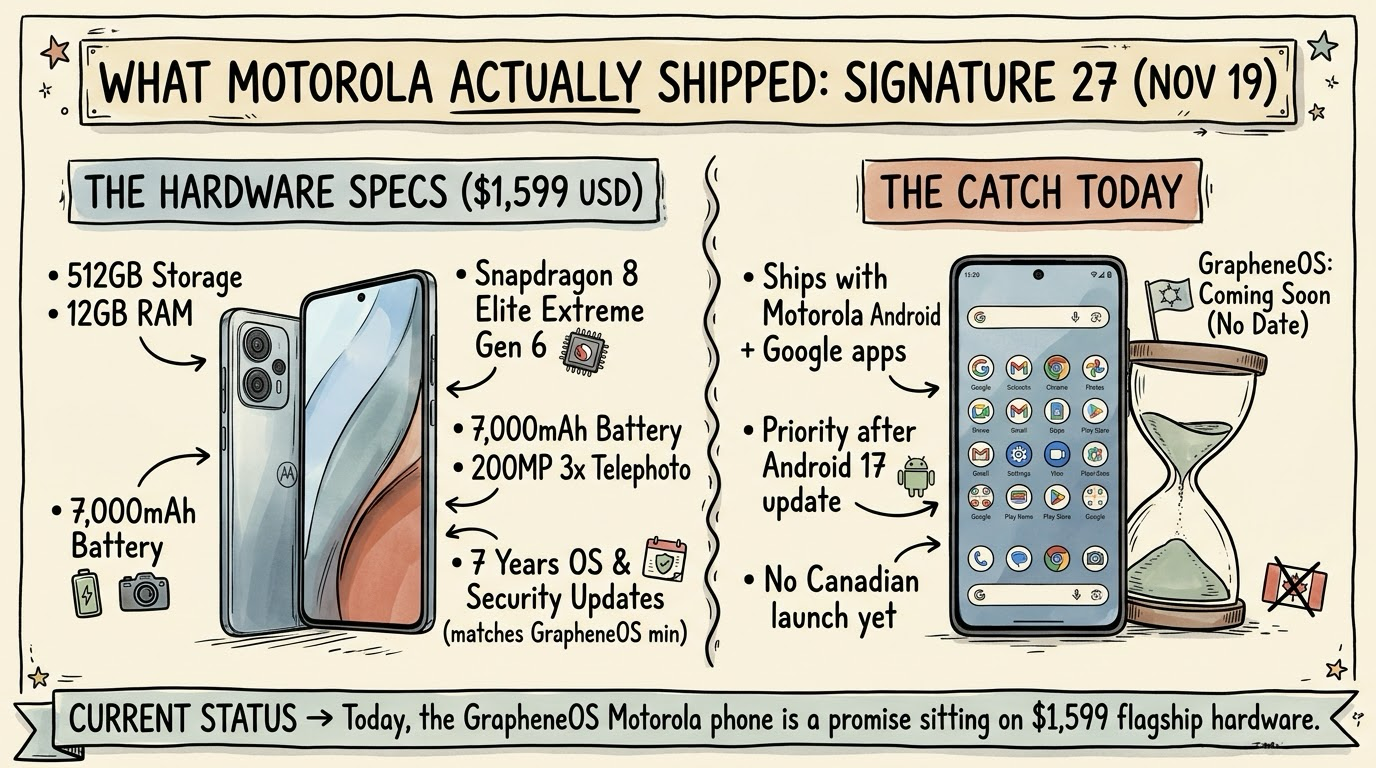
The Signature 27 opened for US pre-orders on November 5 and went on sale on November 19.
It costs $1,599 USD for the only US configuration, with 512GB of storage and 12GB of RAM.
It runs Qualcomm's Snapdragon 8 Elite Extreme Gen 6, with a 7,000mAh battery and a 200MP 3x telephoto camera.
Motorola promises seven years of OS and security updates, which matches GrapheneOS's minimum requirement.
Here's the catch.
The phone ships with Motorola's own Android and Google's apps.
GrapheneOS isn't available for it yet, and neither company has given a date.
GrapheneOS says finishing Signature 27 support is its main priority after its current Android 17 update.
It has also said it still plans for devices to be sold with GrapheneOS preinstalled.
There's no Canadian launch for now either.
So today, the GrapheneOS Motorola phone is a promise sitting on very expensive hardware.
Why This Partnership Is Different
For years, GrapheneOS refused to support anything besides Pixels.
Its reasoning was simple: no other manufacturer met its security and update standards.
Two things changed that.
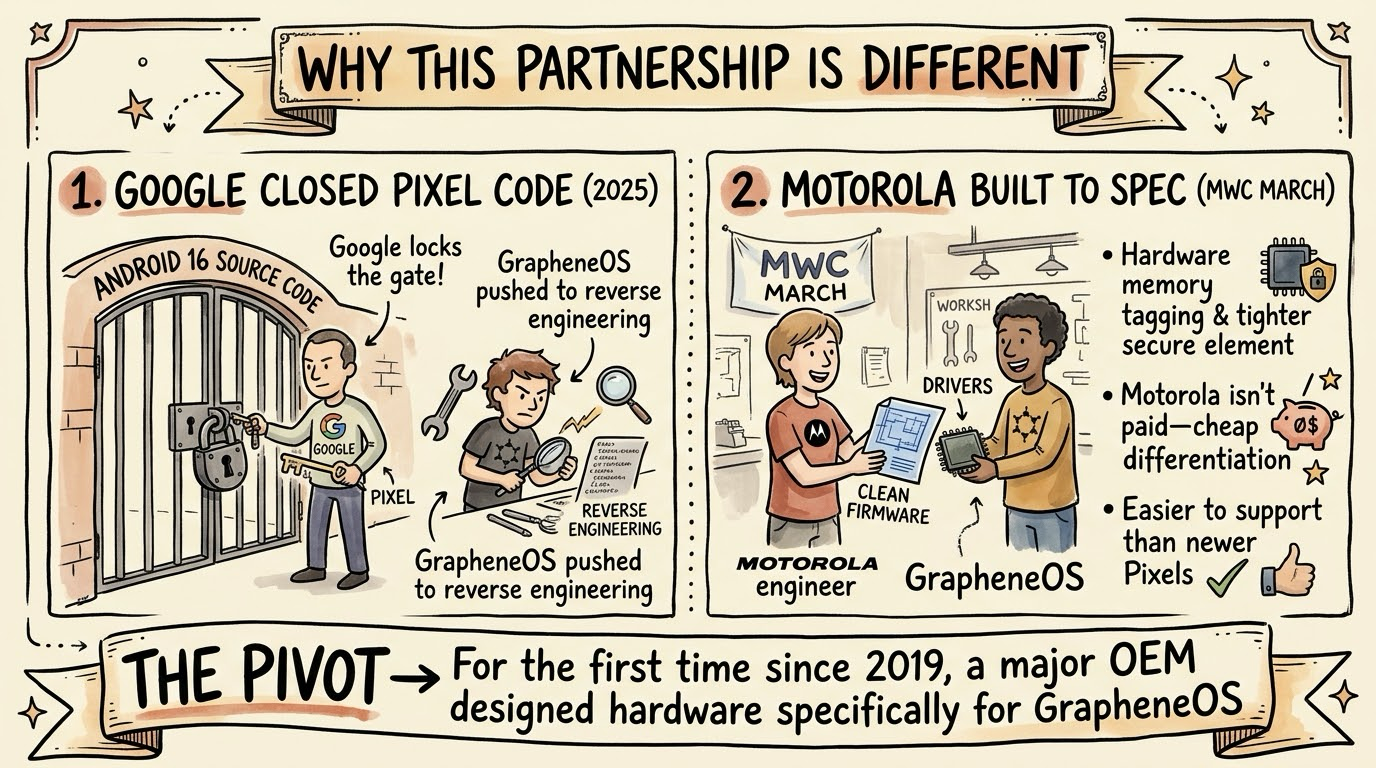
First, Google stopped publishing the code needed to build Android for Pixels with Android 16 in 2025, which pushed GrapheneOS toward reverse engineering.
Second, Motorola agreed to build hardware to GrapheneOS's requirements, including hardware memory tagging and tighter secure element integration.
Motorola supplies firmware and drivers in the format GrapheneOS needs, and its engineers are helping with the port.
GrapheneOS now says Motorola devices should be easier to support than newer Pixels.
That's a remarkable turn for a project that used to call Pixels the only acceptable option.
It's also cheap differentiation for Motorola, since it isn't paying GrapheneOS for the partnership.
The Numbers It's Up Against
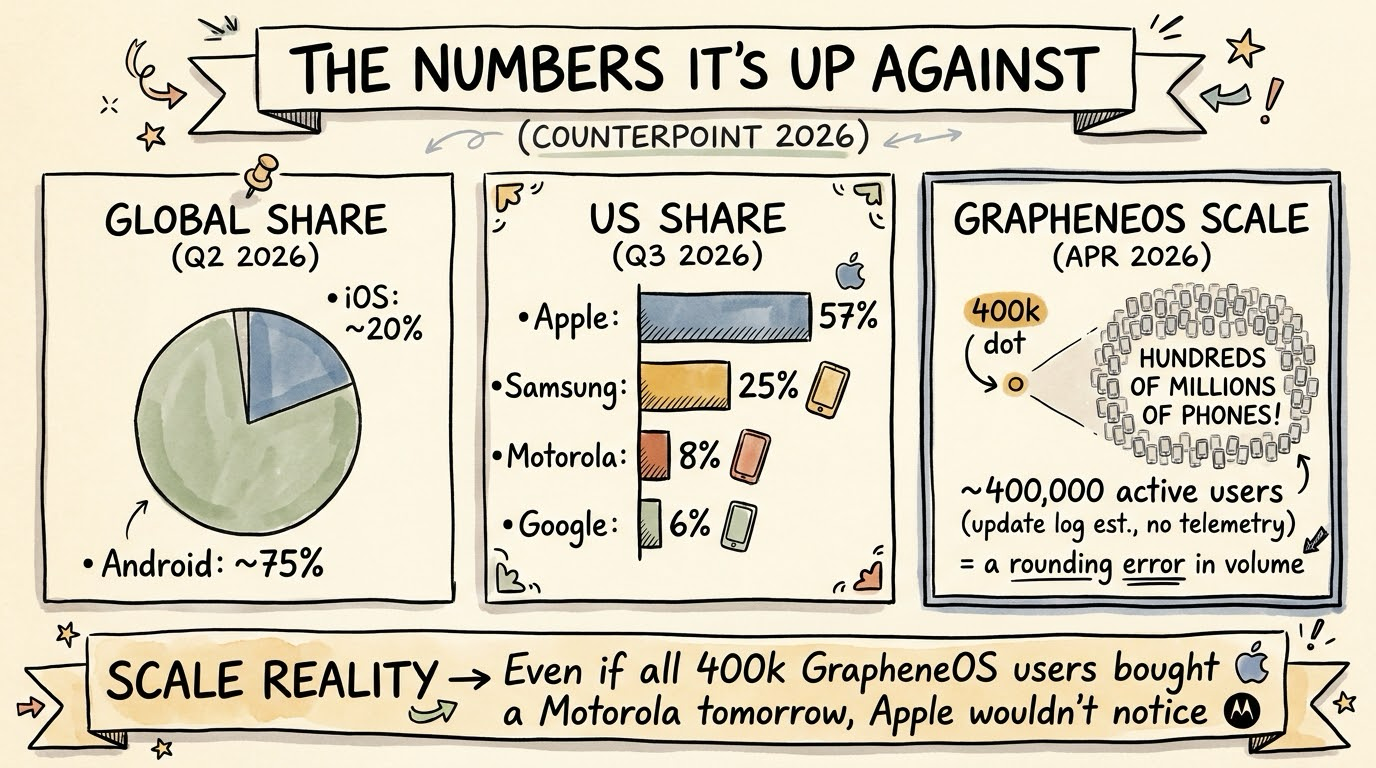
Counterpoint estimates Android held about 75% of global smartphone sales in Q2 2026, with iOS at about 20%.
In the US, Counterpoint's Q3 2026 figures put Apple at 57%, Samsung at 25%, Motorola at 8% and Google at 6%.
GrapheneOS's developers estimated about 400,000 active users as of April 2026.
That figure is a rough count from update server logs, because the OS has no telemetry.
In a market that sells hundreds of millions of phones a year, 400,000 users is a rounding error.
Even if every one of them switched to Motorola tomorrow, Apple wouldn't notice.
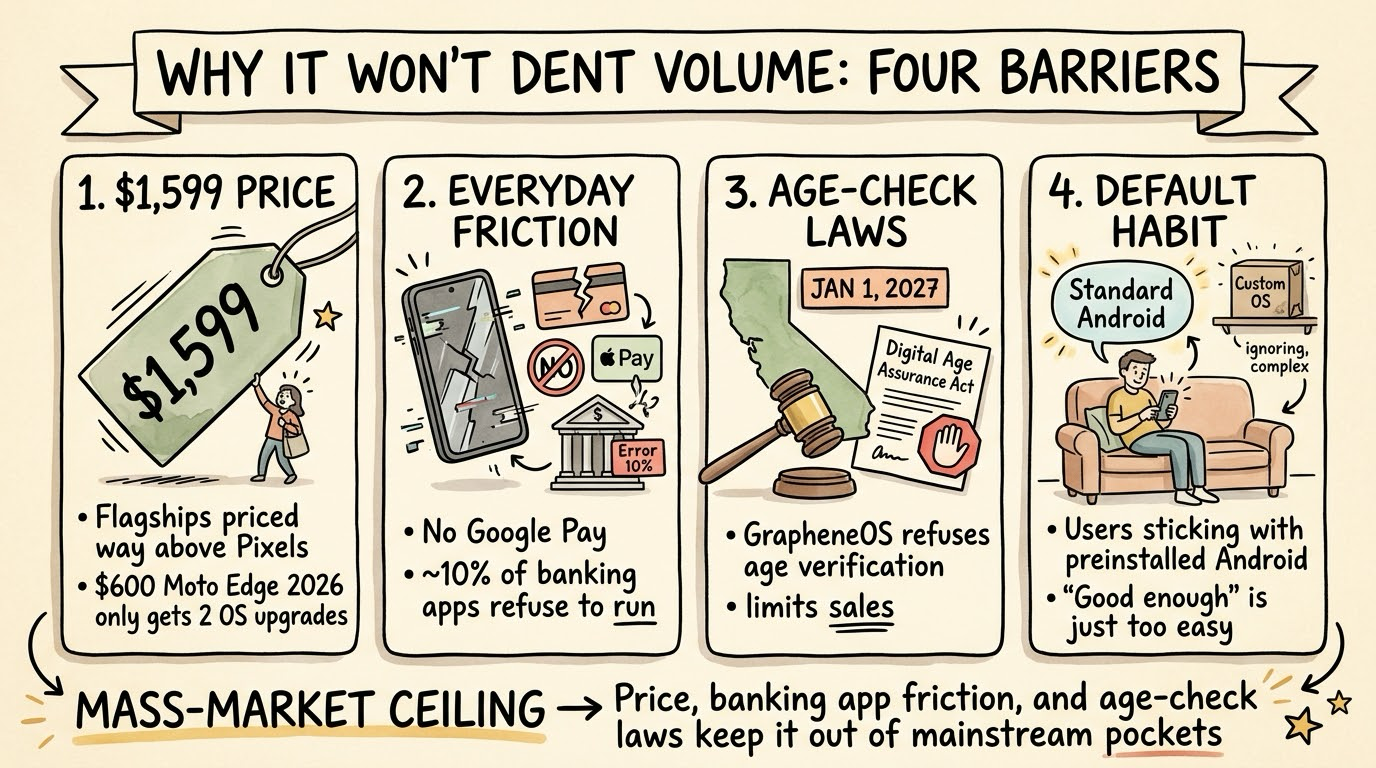
Why It Won't Dent Apple Or Android In Volume
The first barrier is price.
GrapheneOS itself said its first Motorola devices would be flagships priced above comparable Pixels.
Cheaper Motorolas can't qualify until they get longer support, and the roughly $600 Motorola Edge 2026 promises only two major Android upgrades.
The second barrier is everyday friction.
GrapheneOS ships without Google's apps, though the Play Store can be installed as a regular app with only the permissions you grant it.
Google Pay still doesn't work.
GrapheneOS estimates about 10% of banking apps refuse to run because they check for Google-approved software.
For most buyers, one broken banking app is enough to send the phone back.
The third barrier is regulation.
California's Digital Age Assurance Act takes effect on January 1, 2027, and requires operating systems to collect age information.
In March 2026, GrapheneOS said it won't implement age verification and accepts that its devices may not be sold in regions that require it.
That's a principled stance, and it touches the same tension I explored in whether government censorship can survive AI agents and open-source models.
It's also a hard ceiling on distribution for any phone maker shipping GrapheneOS preinstalled.
The last barrier is habit.
Most people keep whatever software their phone ships with, and today this phone ships with regular Android.
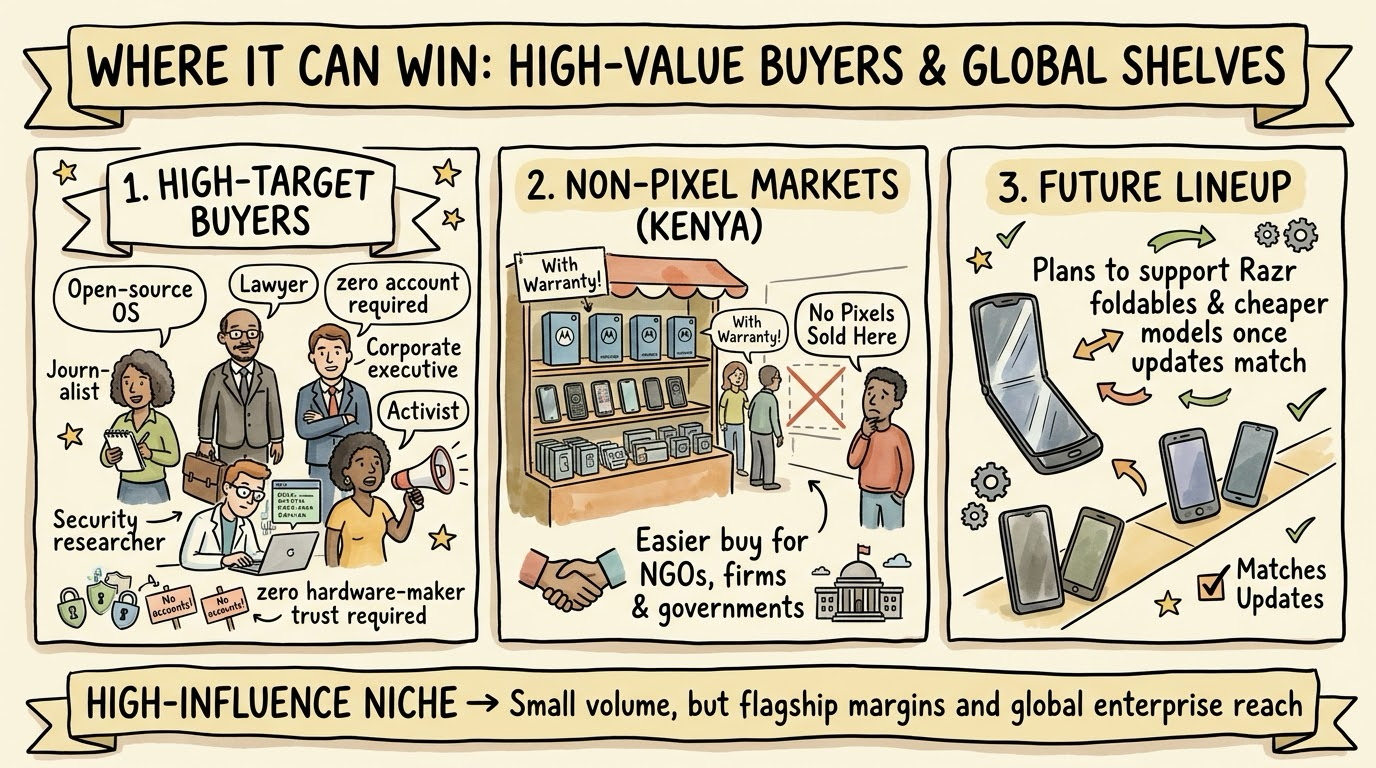
Where It Can Win
The prize here is the buyer, and the volume matters much less.
Think journalists, lawyers, executives, security researchers, activists, and anyone whose phone is a likely target.
Apple has spent years telling this group the iPhone is the private choice.
GrapheneOS offers them something Apple can't: an open-source operating system they can run without an account and without trusting the company that made the hardware.
That group is small, but it pays flagship prices and influences what the people around it buy.
Distribution is the other quiet advantage.
Google doesn't sell Pixels in many countries, so GrapheneOS users there buy imported phones with no local warranty.
Kenya is one example, where Motorola phones sit in regular retail stores and Pixels don't.
A hardened phone from a brand with local shelves and service is a much easier purchase for a company, an NGO or a government buyer.
The lineup should also widen over time.
GrapheneOS plans to support future Razr foldables, and cheaper Motorola phones are expected to follow once they meet its hardware and update requirements.
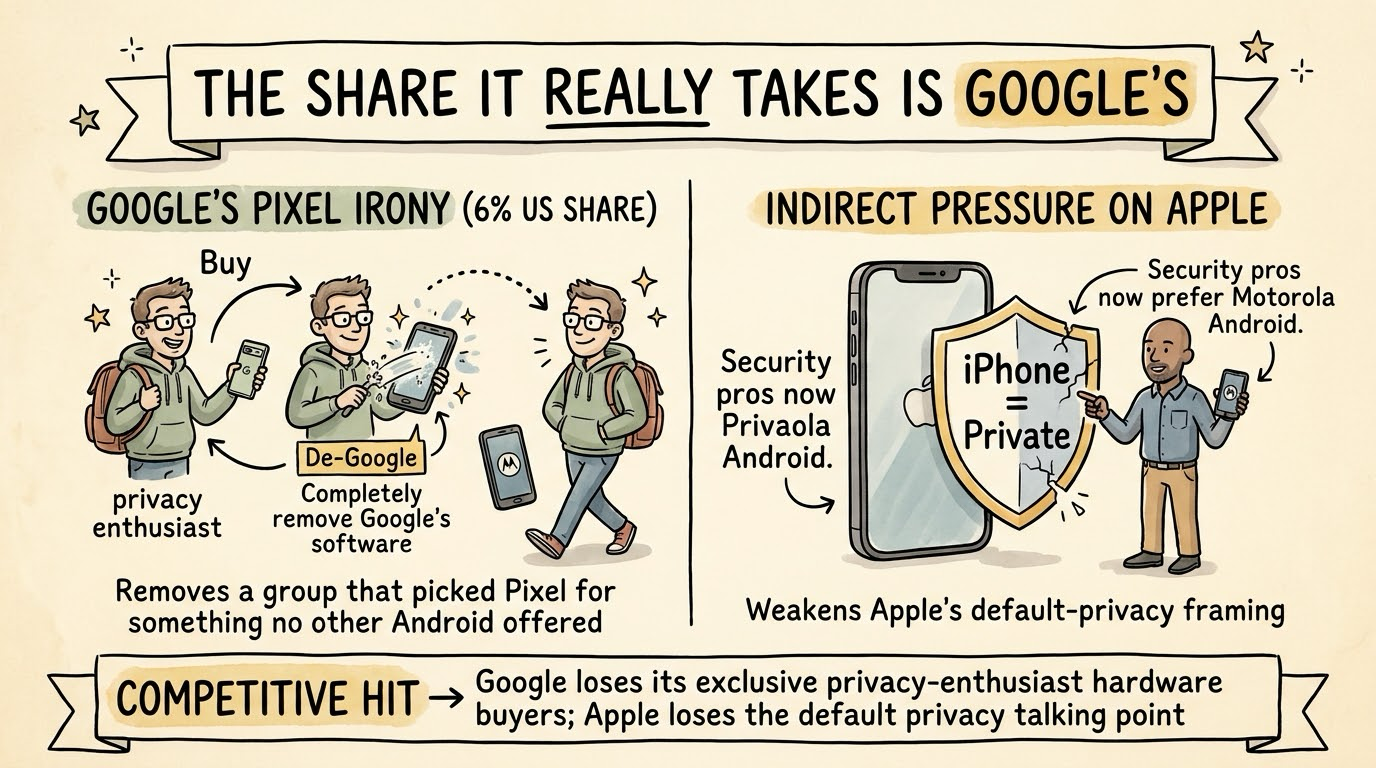
The Share It Really Takes Is Google's
Every officially supported GrapheneOS phone today is a Pixel.
That means Google has been earning hardware revenue from people buying its phones specifically to remove Google from them.
Once Motorola support lands, those buyers finally get an alternative.
Google holds about 6% of the US market, so losing privacy enthusiasts won't sink the Pixel.
It does remove a group that picked Pixel for a reason no other Android phone offered.
The pressure on Apple is indirect.
Apple's privacy pitch works partly because Android looks like the less private option by default.
A mainstream Android brand selling a phone that security people prefer weakens that framing, even if few people buy it.
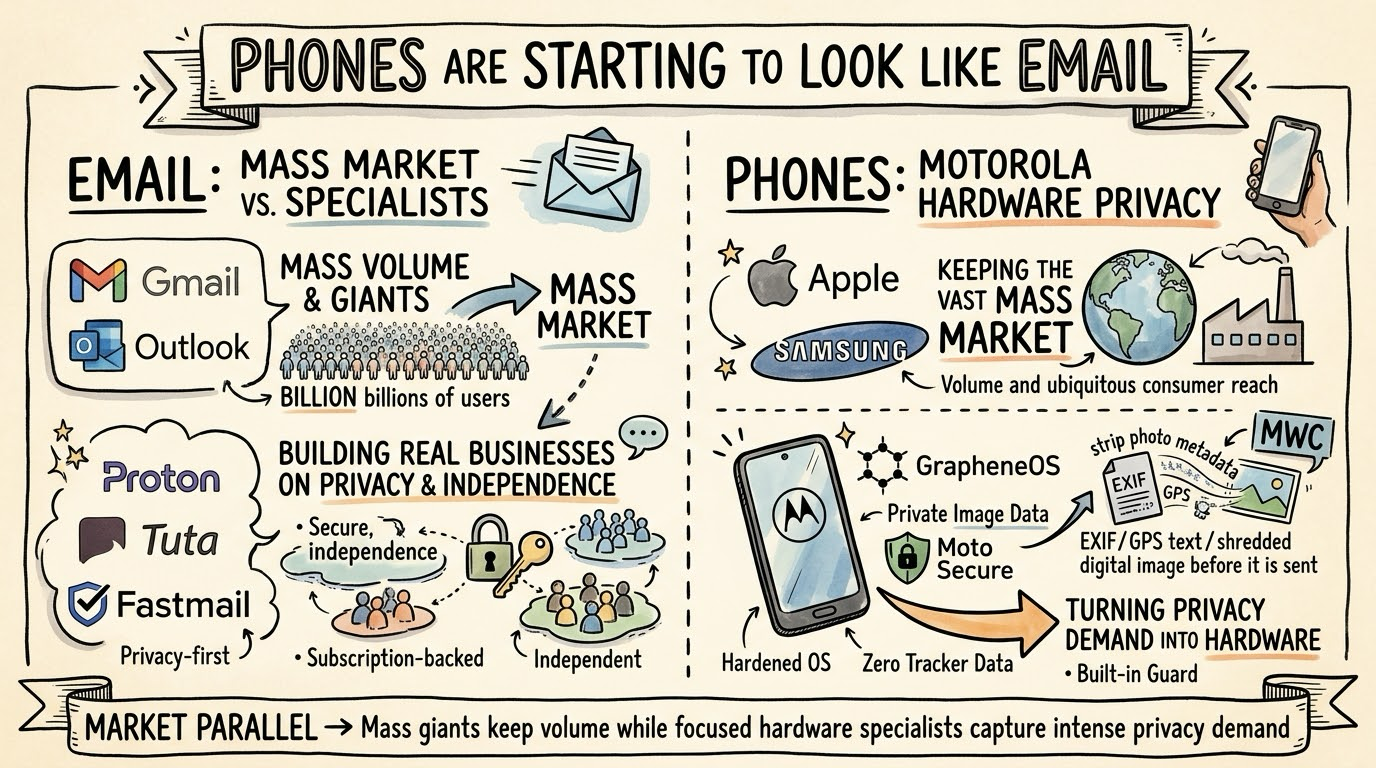
Phones Are Starting To Look Like Email
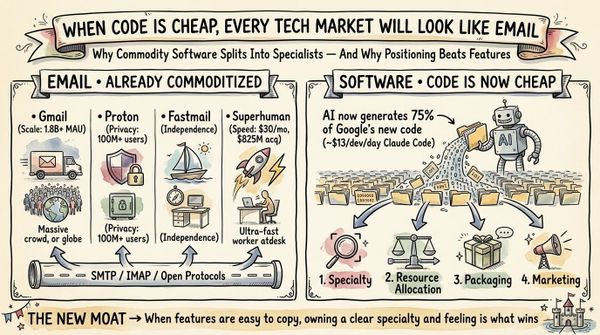
In email, Gmail and Outlook own the mass market.
Proton, Tuta and Fastmail still built real businesses by specializing in privacy, security or speed.
The Motorola deal suggests phones could follow the same pattern.
Apple and Samsung keep the mass market, while specialists take the segments that care intensely about one thing.
Motorola is clearly leaning into privacy beyond GrapheneOS, too.
At MWC it also introduced Private Image Data, a Moto Secure feature that strips location and other sensitive metadata from new photos.
This fits the wider privacy boom I've written about, where people pay for tools that shield them while still living online.
The difference is that Motorola is trying to turn that demand into hardware.
Where This Argument Has Limits
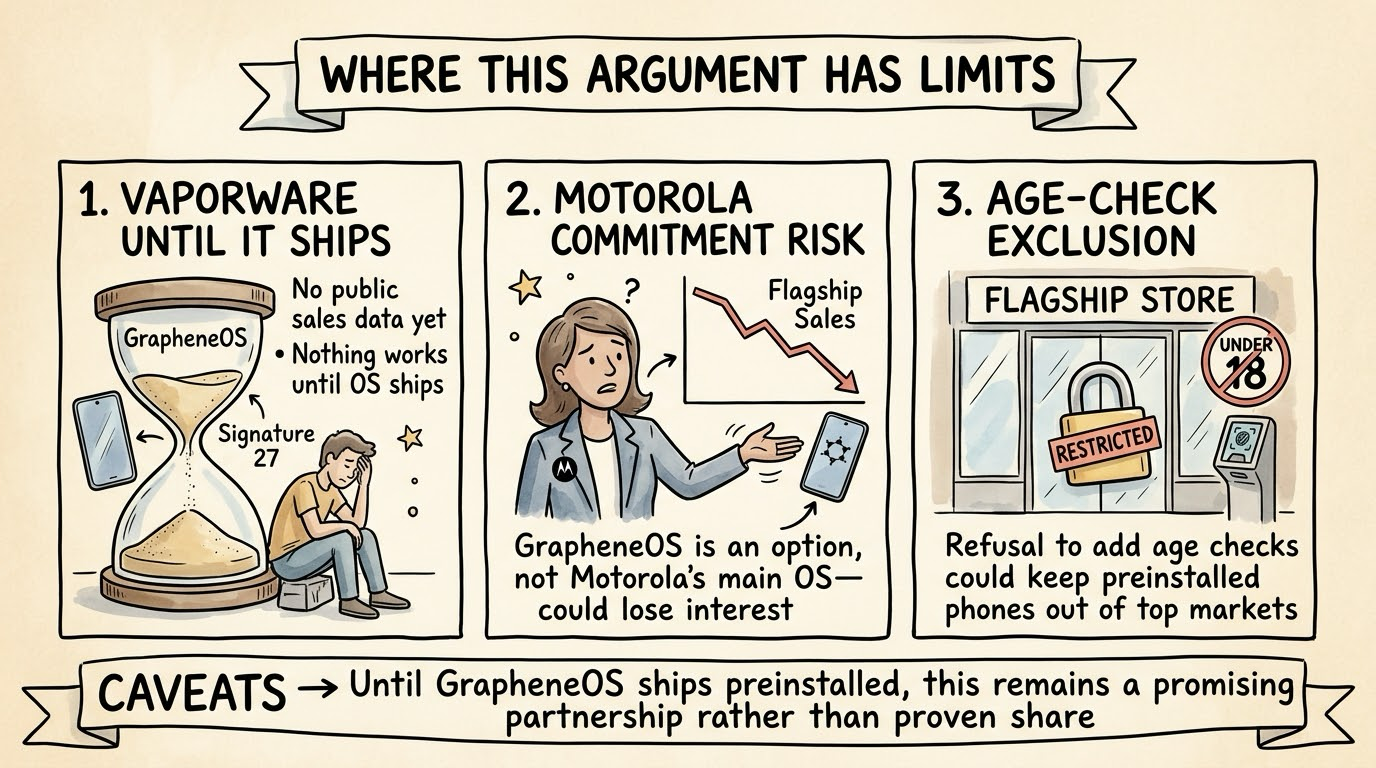
None of this works until GrapheneOS actually ships on the Signature 27.
There's no public sales data for the phone yet, and there won't be any for GrapheneOS installs specifically.
Motorola could also lose interest if the phone sells poorly, since GrapheneOS is an option rather than its main software.
And GrapheneOS's refusal to implement age verification could keep preinstalled phones out of exactly the markets where carriers sell the most flagships.
Conclusion: Small Share, Outsized Signal
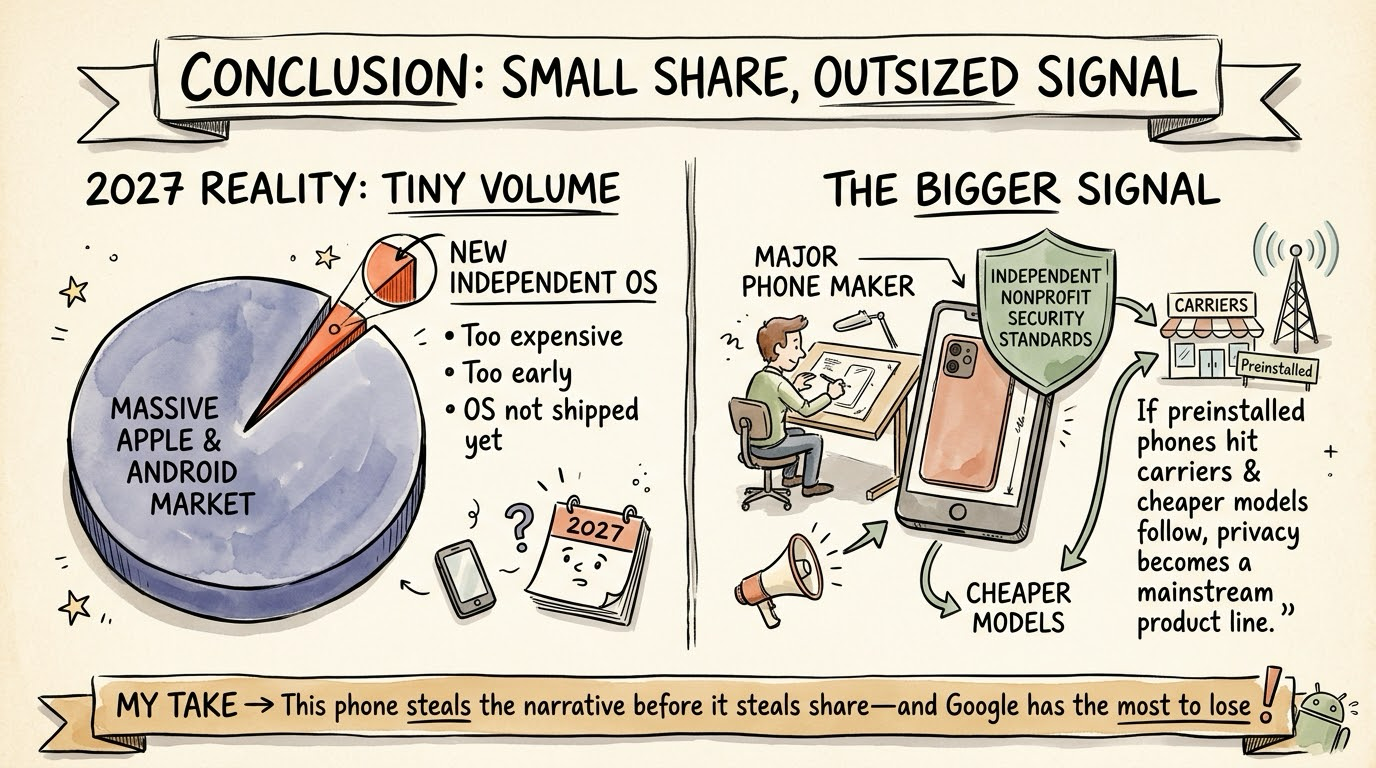
The GrapheneOS Motorola phone won't move Apple's or Android's market share in any meaningful way in 2027.
It's too expensive, too early and too dependent on software that isn't available yet.
What it does is prove a major manufacturer will design its flagship around an outside nonprofit's security standards.
If preinstalled GrapheneOS phones reach carriers and cheaper models follow, privacy stops being a hobbyist project and becomes a product line.
My Take: This phone will steal the narrative long before it steals share, and Google has the most to lose, because it has been selling the hardware to the people trying to escape it.
Sources
Pages I opened for the facts in this post:
- Android Authority: Motorola announces partnership with GrapheneOS
- 9to5Google: Motorola Signature 27 confirmed to support GrapheneOS
- 9to5Google: Motorola Signature 27 specs, price and release date
- Tech-ish: Motorola is officially supporting GrapheneOS on the Signature 27
- Android Authority: GrapheneOS's Motorola plans, seven years of updates and foldables
- Android Authority: GrapheneOS Motorola phones will cost more than Pixels
- 9to5Google: Android's global sales share in Q2 2026 (Counterpoint)
- Counterpoint Research: US smartphone market share, quarterly
- Wikipedia: GrapheneOS
- Privacy Guides: GrapheneOS won't implement age verification