Why Barbara Liskov Built Silicon Valley: The Architect of the Digital Economy
We assume the modern tech monopoly was built by consumer visionaries like Steve Jobs or Jeff Bezos. The reality is that the entire global software economy rests on the invisible architectural principles engineered by Barbara Liskov.

We celebrate the founders who sold the software, but we ignore the pioneer who invented the fundamental physics of how modern code actually scales.
Inspiration: Reflecting on the legacy of Turing Award winner Barbara Liskov. Realizing that her breakthroughs in data abstraction were not just academic computer science achievements—they were the foundational operational blueprints that allowed software to become a globally scalable commodity.
The Artisanal Bottleneck
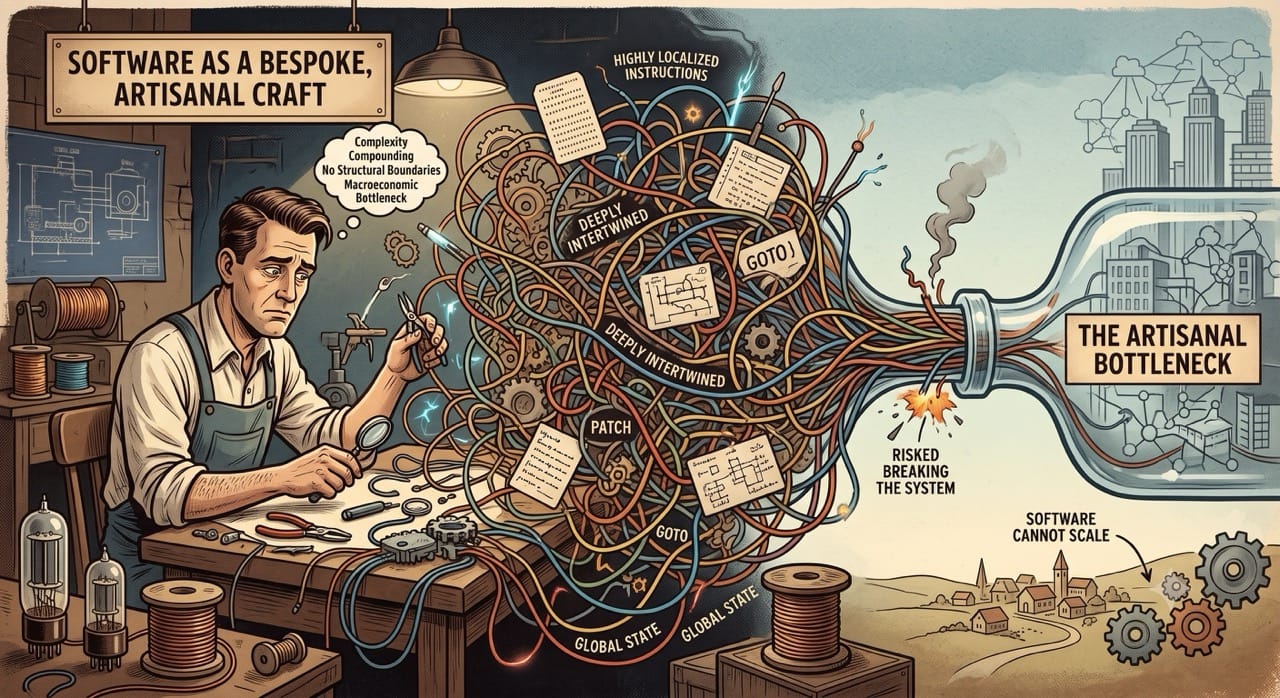
To understand the magnitude of Liskov’s contribution, you have to look at how software was built in the early days of computing. Code was essentially a bespoke, artisanal craft.
Programmers wrote tangled, highly localized instructions, often referred to as "spaghetti code", where every piece of the program was deeply intertwined with everything else.
If you wanted to change one small feature, you risked breaking the entire system because there were no structural boundaries.
This created a severe macroeconomic bottleneck; software simply could not scale into complex, enterprise-grade products because the human brain couldn't manage the compounding complexity.
The Abstraction Revolution
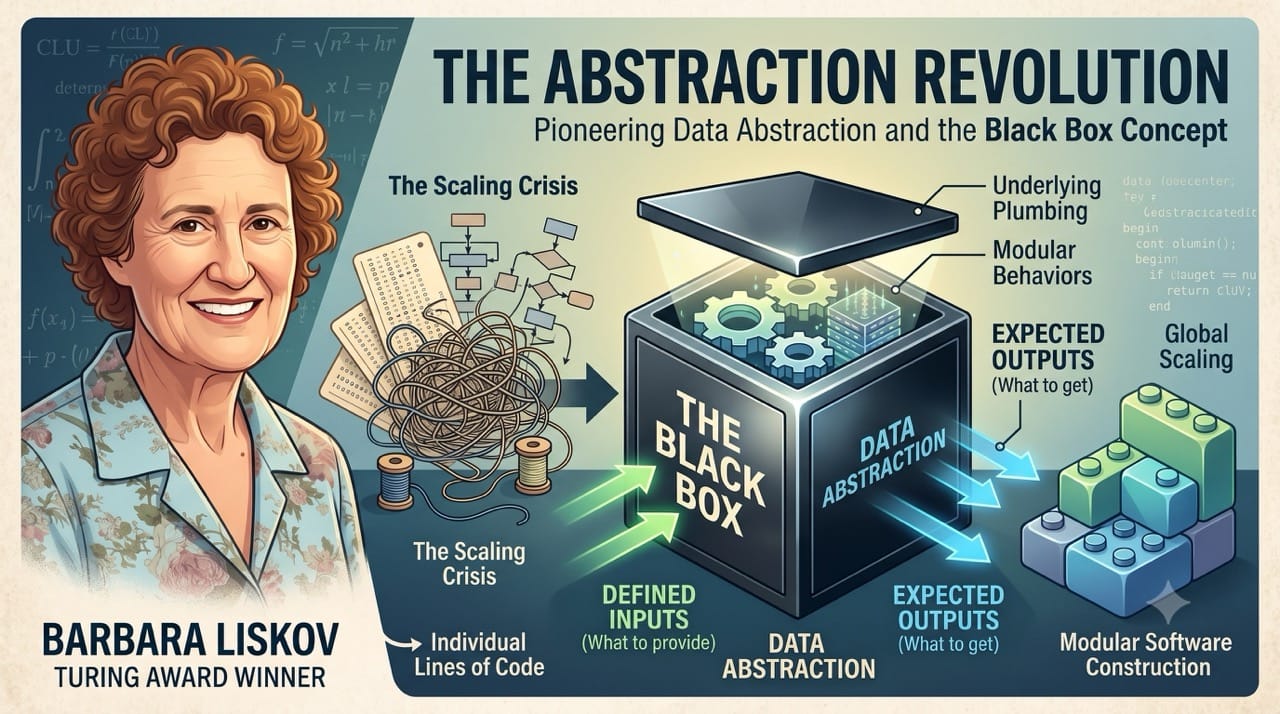
Barbara Liskov solved this scaling crisis by pioneering the concept of data abstraction.
She realized that to build massive digital structures, programmers needed to stop thinking about individual lines of code and start thinking about isolated, modular behaviors.
With her programming language CLU, she introduced the idea that you could bundle data and its associated operations into a neat, self-contained package.
In business terms, she invented the concept of the black box.
A developer using a piece of code shouldn't need to know how the underlying plumbing works, they just need to know what inputs to provide and what outputs to expect.

The Henry Ford of Code
This single conceptual shift transformed software from an artisanal craft into an industrial assembly line.
By enforcing strict boundaries around data, Liskov allowed tech companies to break massive projects into thousands of smaller, manageable pieces.
You could now have a team of five hundred engineers working on the exact same product simultaneously without constantly overwriting each other's work.
She essentially invented the organizational physics that makes modern software development teams actually function.

The Substitution Principle
Her most famous contribution, the Liskov Substitution Principle, pushed this modularity to its absolute logical conclusion.
The principle dictates a strict rule for object-oriented programming: if you swap out a core component for a new, upgraded sub-component, the overall program must continue functioning flawlessly without any modifications.
This isn't just a coding rule, it is a brilliant supply chain strategy.
It guarantees that digital parts are perfectly interchangeable, allowing companies to iterate, upgrade, and pivot their product lines with incredible velocity.

The Foundation of SaaS
Every modern technology business model relies entirely on Liskov's architectural groundwork.
When you look at the explosive margins of Software-as-a-Service (SaaS) or the global dominance of Amazon Web Services, you are looking at the financial monetization of data abstraction.
Cloud computing only works because engineers can pull pre-packaged, abstracted modules of code off a digital shelf and seamlessly plug them into a new enterprise network.

Mastering the Cloud
Liskov didn't stop at organizing code on a single machine; she also tackled the chaos of the early internet.
She pioneered practical Byzantine fault tolerance, which is the underlying logic that allows distributed computer networks to agree on a single truth even when individual servers fail or get hacked.
Long before the blockchain or modern cloud infrastructure became buzzwords,
Liskov was actively engineering the complex mathematical consensus required to make global, decentralized systems trustworthy.

Conclusion: The Invisible Infrastructure
We spend all our time analyzing the brilliant marketing strategies and consumer hardware that define the modern tech era.
But the ultimate victor in any industry is always the architect who designs the fundamental plumbing, and Barbara Liskov quietly installed the pipes that run the modern world.