
The Decentralized Mixnet: Why Nym is the Inevitable Successor to the VPN
We assume our commercial VPNs are impenetrable shields against corporate and government surveillance. In reality, they are centralized honeypots that will inevitably be replaced by decentralized, noise-generating mixnets.
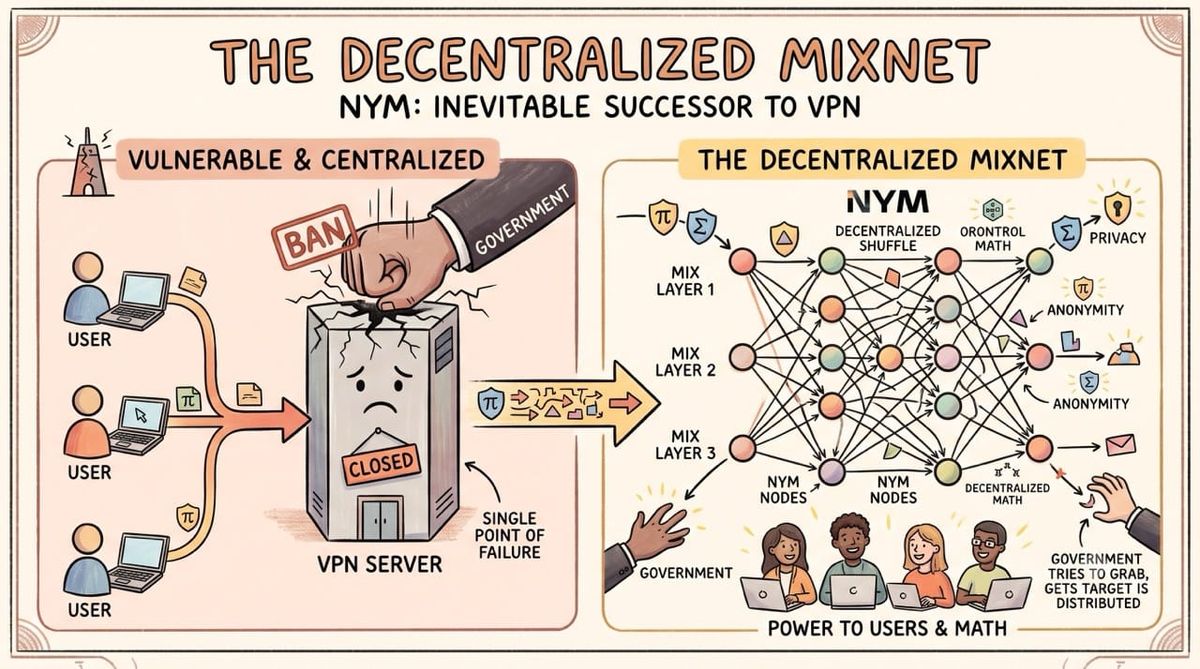
Governments are rapidly escalating their war on commercial VPNs. The future of digital privacy relies entirely on stripping power away from centralized corporations and handing it directly to decentralized mathematics.
Inspiration: Analyzing the HOPE presentation on NymVPN, the visual architecture of decentralized mixnets, and the structural vulnerabilities of legacy VPNs. Evaluating the macroeconomic feasibility of these decentralized protocols in a world where commercial VPNs face total global bans.
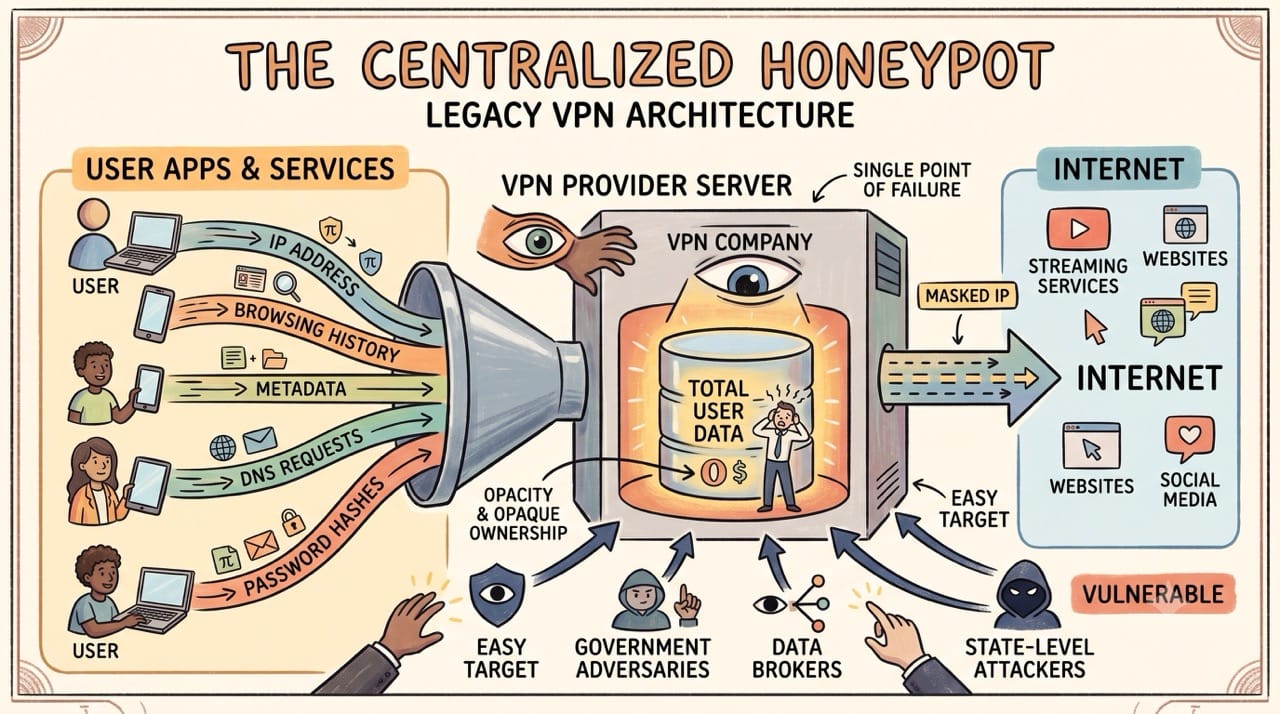
The Centralized Honeypot
For the last decade, consumers have been sold a highly profitable illusion regarding digital privacy.
We willingly pay monthly subscription fees to commercial Virtual Private Network (VPN) providers, assuming that masking our IP address guarantees our anonymity.
The structural flaw in this legacy model is the centralized chokepoint. As illustrated in the standard VPN architecture, your laptop routes traffic through a single corporate server before hitting the broader internet.
While this prevents your local internet service provider from seeing what you are doing, it simply transfers total omniscient power to the VPN company.
You are trusting a private corporation, often backed by opaque ownership structures—not to log your data, sell your metadata, or hand your traffic over to state-level adversaries.
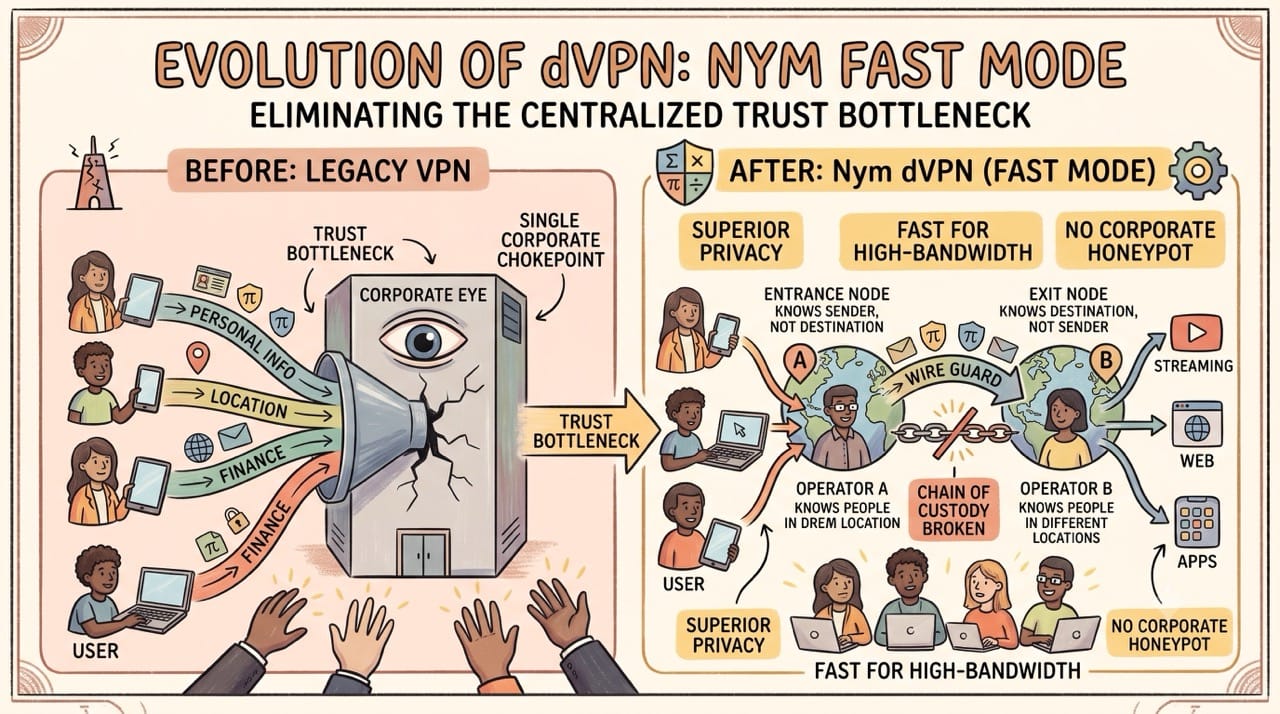
The Evolution of the dVPN
To solve this corporate trust bottleneck, the first major step forward is the decentralized VPN (dVPN).
Nym implements this as their "Fast Mode."
Instead of routing your data through a single server owned by a corporation, your traffic takes two separate hops through independent servers run by random operators around the world.
Because the entrance node does not know the final destination, and the exit node does not know the original sender, the chain of custody is physically broken.
This architecture provides vastly superior privacy for high-bandwidth tasks like streaming video, relying on fast protocols like WireGuard while eliminating the centralized corporate honeypot.
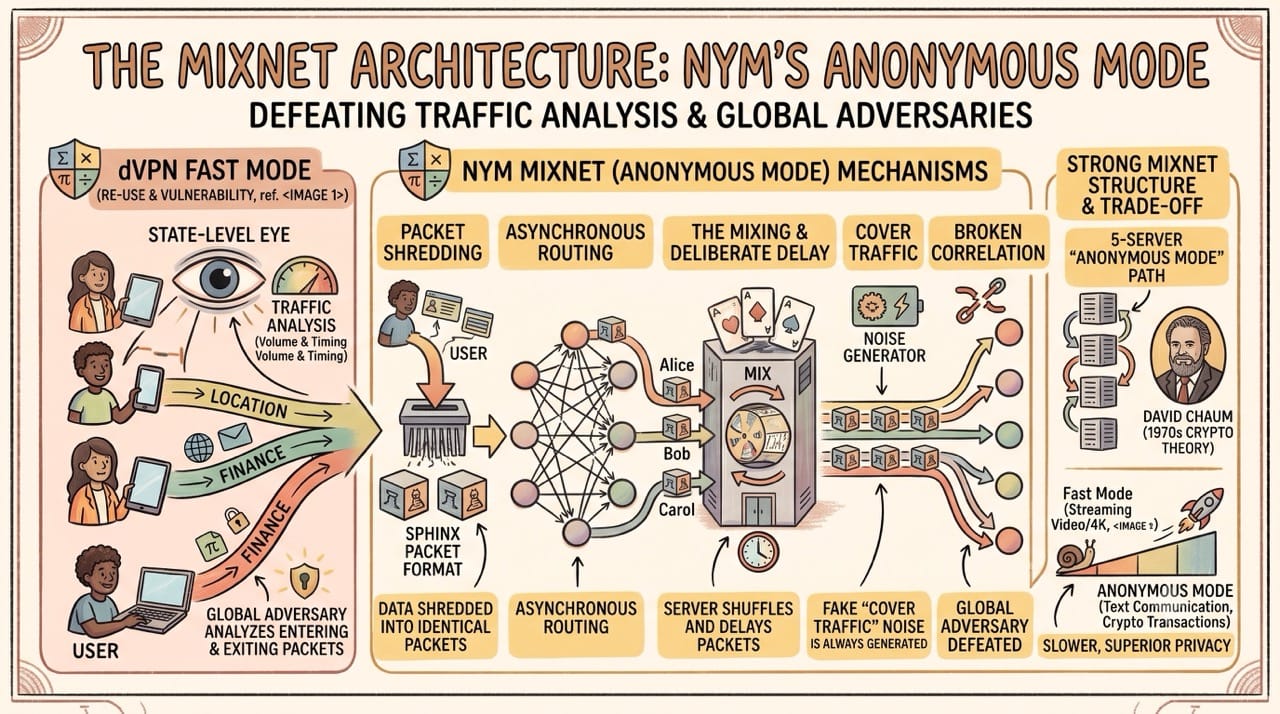
The Mixnet Architecture
But even a multi-hop VPN is vulnerable to a truly sophisticated opponent.
A state-level adversary like the NSA or Palantir does not need to break the encryption to see what you are doing.
They simply watch the entire global network and use traffic analysis, matching the volume and timing of the encrypted data packets entering the network with the packets exiting the network to instantly de-anonymize the user.
To defeat this, Nym leverages a 5-server "Anonymous Mode" built on the concept of a mixnet, a cryptographic theory originally pioneered by David Chaum in the late 1970s.
This fundamentally rewrites how data travels:
- Packet Shredding: Your data is not sent in a continuous, synchronous stream. It is chopped up into uniform, identically sized encrypted packets (using the Sphinx packet format).
- Asynchronous Routing: These identical packets are sent independently through a complex web of different server nodes.
- The Mixing: At each hop, the server mathematically scrambles and deliberately delays the packets, shuffling them together like a deck of cards with data from thousands of other users.
- Cover Traffic: To prevent adversaries from analyzing quiet periods, the software constantly generates fake "noise" or cover traffic, ensuring the network is always flooded with identical-looking packets.
The result is the strongest privacy available today.
It is slower, making it ideal for text communication or crypto transactions rather than 4K video, but it mathematically breaks the ability of any global adversary to correlate the sender and the receiver.
The Zero-Knowledge Payment Solution
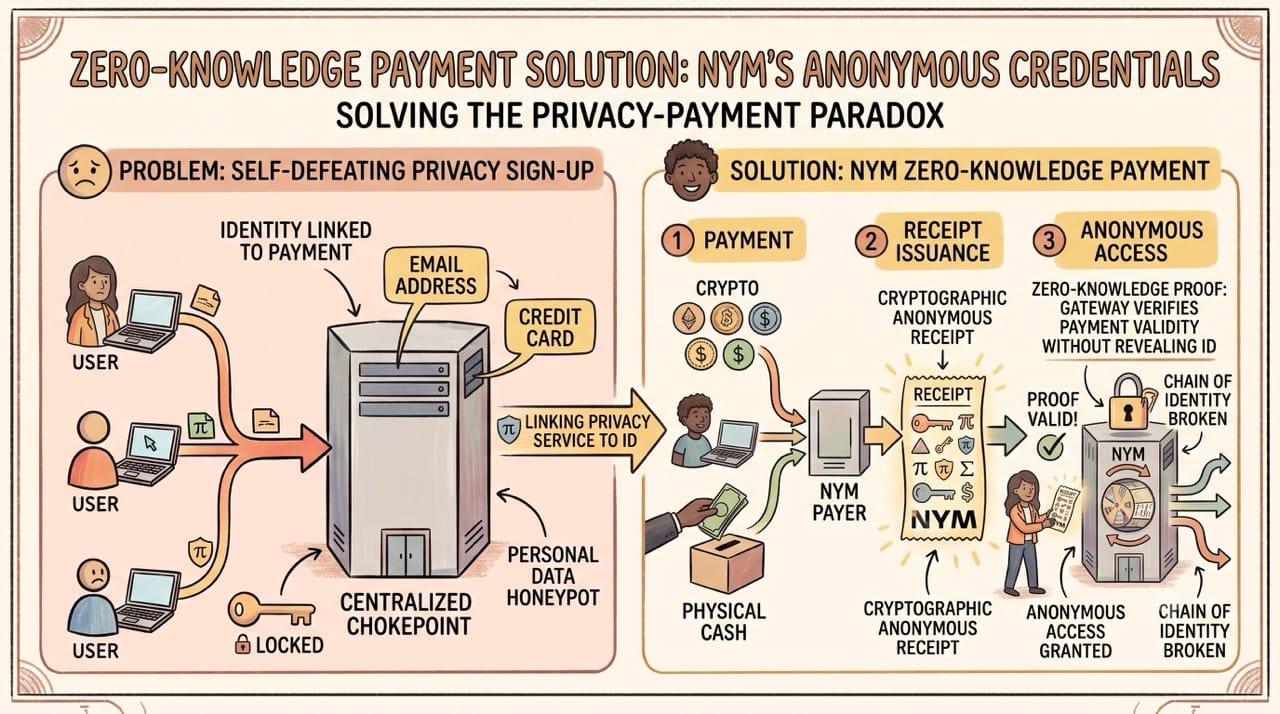
Building this infrastructure reveals a fascinating economic paradox: if privacy is the ultimate goal, requiring a user to sign up with an email and a personal credit card completely defeats the purpose.
Nym solves this through zero-knowledge anonymous credentials.
You can pay the network using crypto (or even physical cash), and in return, you receive a cryptographic receipt.
When you connect to the network, you show the gateway this receipt. The math definitively proves that someone paid for access, without ever revealing who that person actually is.
Feasibility in a Banned Ecosystem
This brings us to the ultimate strategic question: what happens to this technology when authoritarian governments (and increasingly, Western democracies) decide to outright ban the use of VPNs?
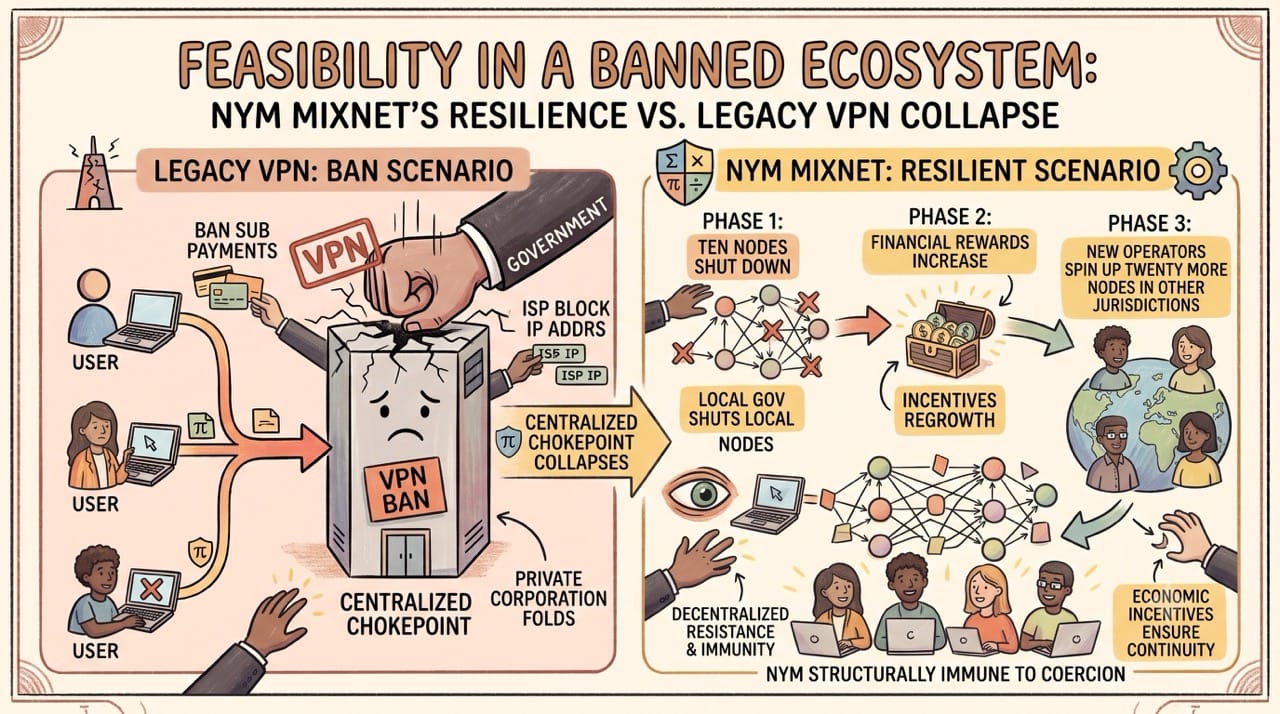
If a government bans traditional VPNs, the legacy architecture instantly collapses. Regulators simply order Visa and Mastercard to cut off subscription payments, or they force national ISPs to block the static IP addresses of the known corporate servers.
The centralized company has a physical headquarters and executives who will fold immediately under legal pressure.
Nym is structurally immune to this traditional corporate coercion.
The network is not operated by a single company; it is powered by hundreds of independent, decentralized node operators who are financially incentivized with cryptocurrency.
If a government shuts down ten nodes in one country, the financial reward for running a node naturally increases, incentivizing operators in other jurisdictions to immediately spin up twenty more.
Conclusion: The Protocol Pivot
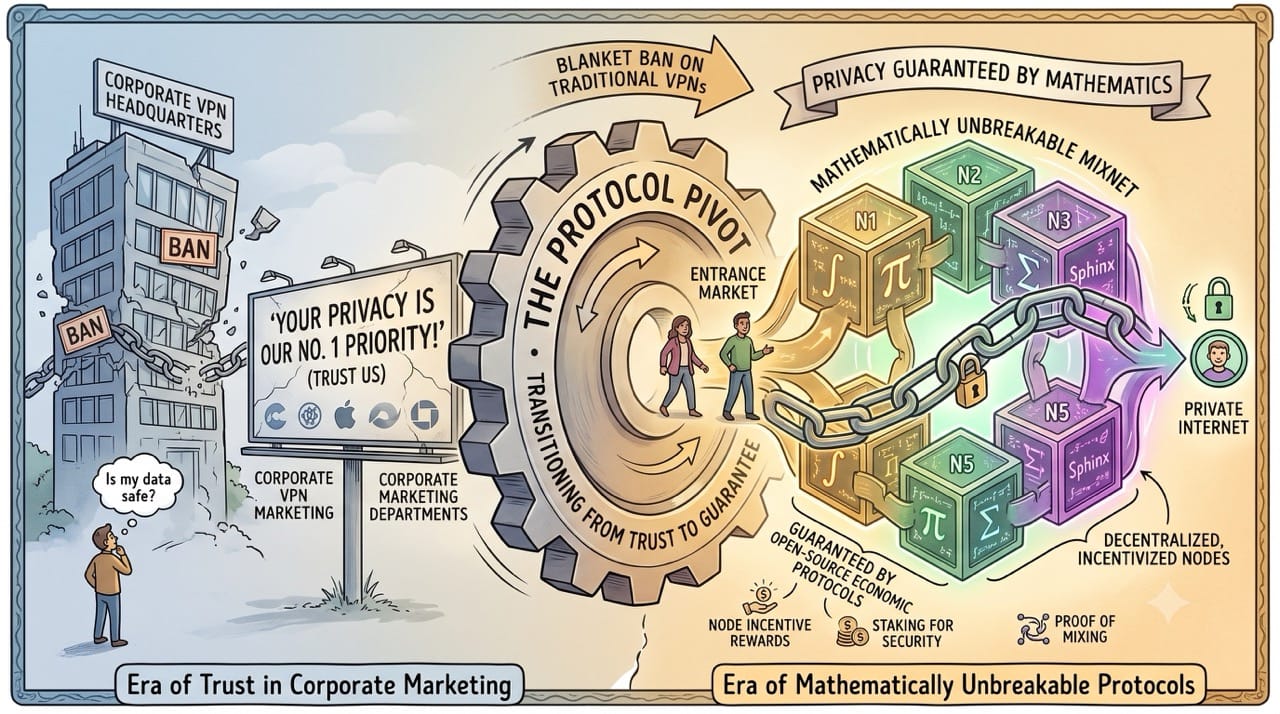
We are transitioning from an era where we trusted our privacy to corporate marketing departments, to an era where privacy is guaranteed by open-source economic protocols.
If global governments successfully execute a blanket ban on traditional VPNs, they will not end digital privacy—they will simply force the entire consumer market to adopt mathematically unbreakable mixnets.