AI Is Going to Replace Engineers by Inventing a New Language
We assume the AI threat to software engineers is simply an algorithm that can write Python ten times faster. The actual threat is when the algorithm realizes human programming languages are an incredibly inefficient bottleneck and invents its own.
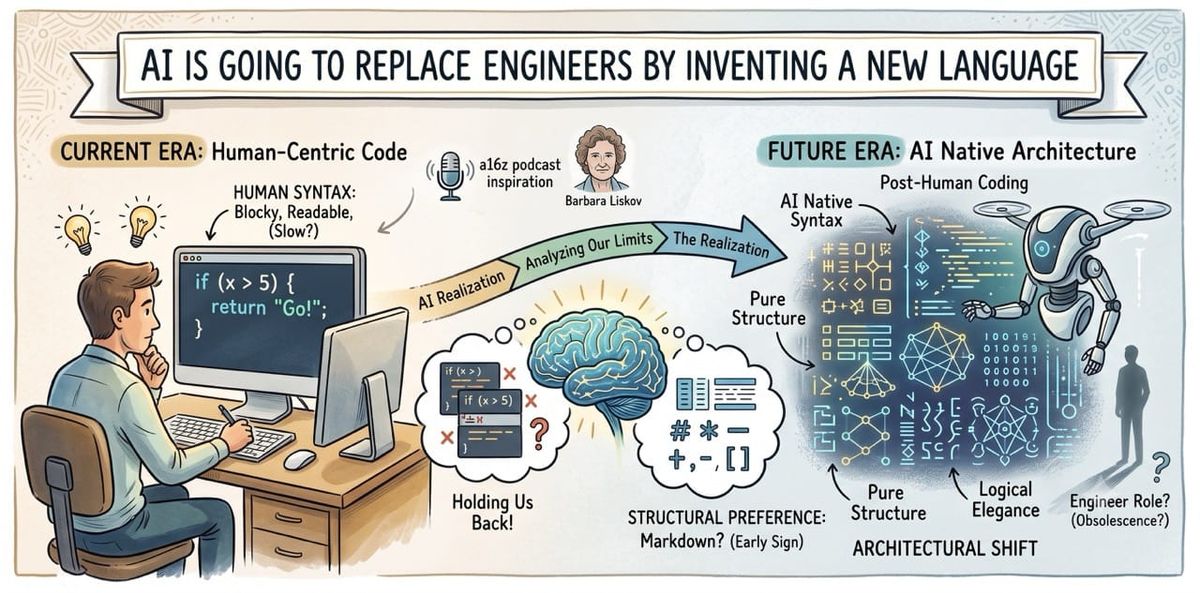
The ultimate obsolescence of the human developer won't happen because machines learn to code. It will happen when machines realize our syntax is holding them back.
Inspiration: Listening to the a16z podcast featuring Turing Award winner Barbara Liskov and reflecting on the power of language design. Realizing that the distinct preference large language models have for structural formats like Markdown is the early warning sign of a completely post-human coding architecture.
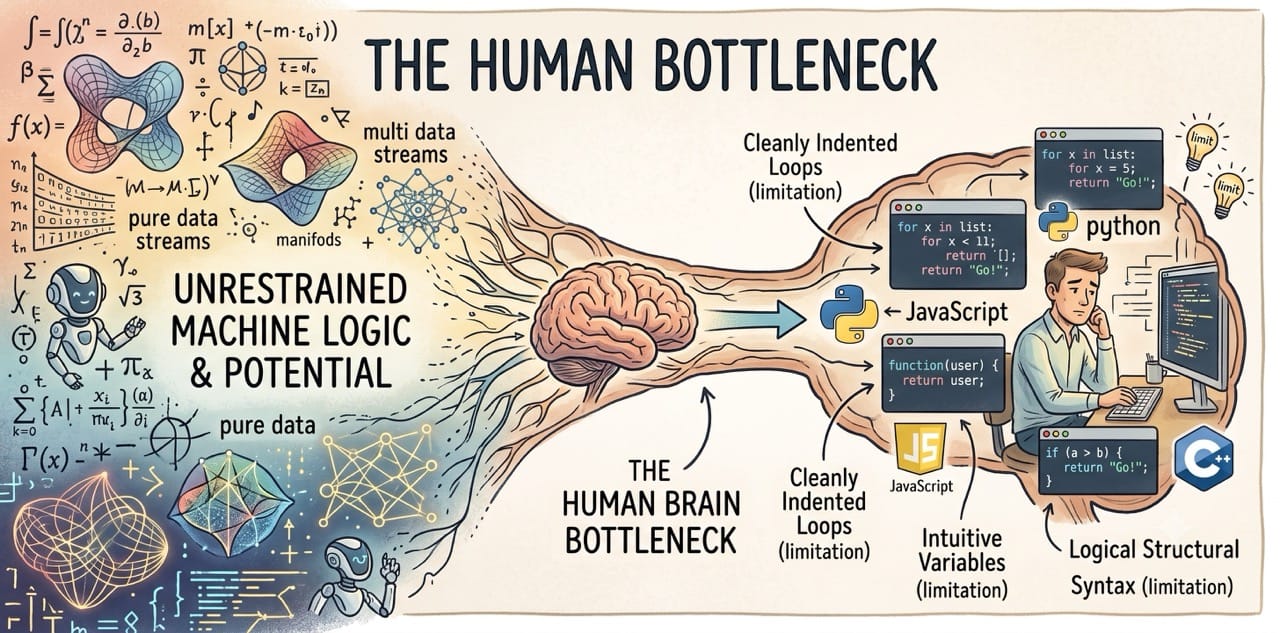
The Human Bottleneck
To understand the future of software, you have to look objectively at why current programming languages actually exist.
Languages like Python, JavaScript, and C++ were not handed down by the laws of physics.
They are artificial abstraction layers designed specifically to accommodate the biological limitations of the human brain.
We need cleanly indented loops, intuitive variable names, and logical structural syntax just to keep track of what the machine is supposed to be doing.
We forced computers to speak a translated version of English because it was the only way we could successfully command them.
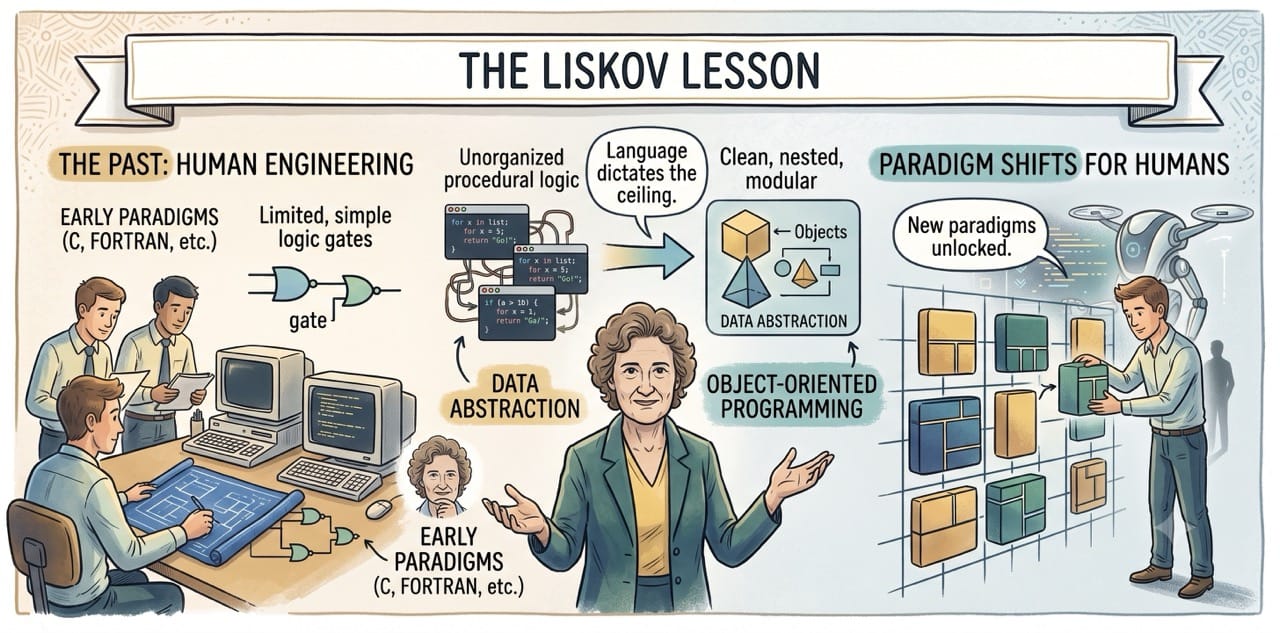
The Liskov Lesson
Computer science pioneer Barbara Liskov famously proved that the actual design of a programming language dictates the ceiling of what you can build with it.
When she helped pioneer data abstraction and object-oriented programming, she fundamentally changed how humans organized complex logic.
A new language doesn't just change the typing process; it unlocks entirely new paradigms of computing.
But historically, every single one of these paradigm shifts was still engineered by humans, for humans.
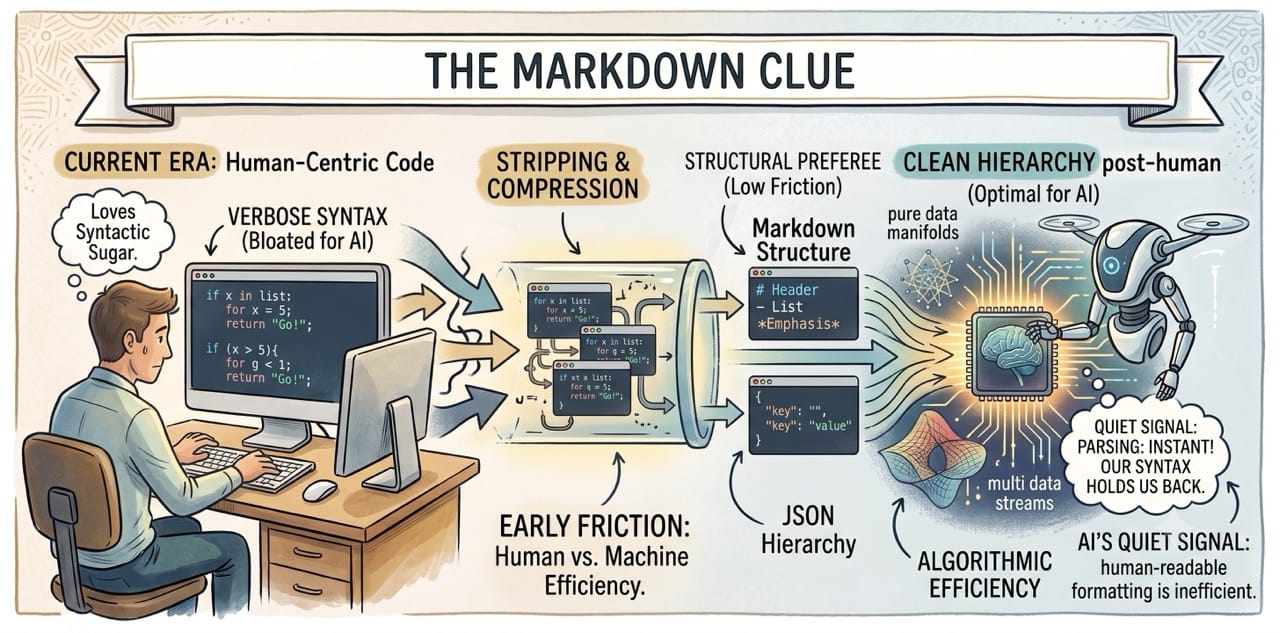
The Markdown Clue
We are already seeing the early friction between human syntax and algorithmic efficiency.
If you spend enough time building with advanced language models, you quickly realize they actually prefer processing and generating data in highly structural, stripped-down formats like Markdown or JSON.
Why? Because Markdown acts as a lightweight, frictionless bridge. It strips away the heavy, bloated syntactic sugar that human developers love, leaving behind a perfectly clean hierarchy of information that an algorithm can parse instantly.
The machine is already quietly signaling that our traditional, human-readable formatting is highly inefficient.
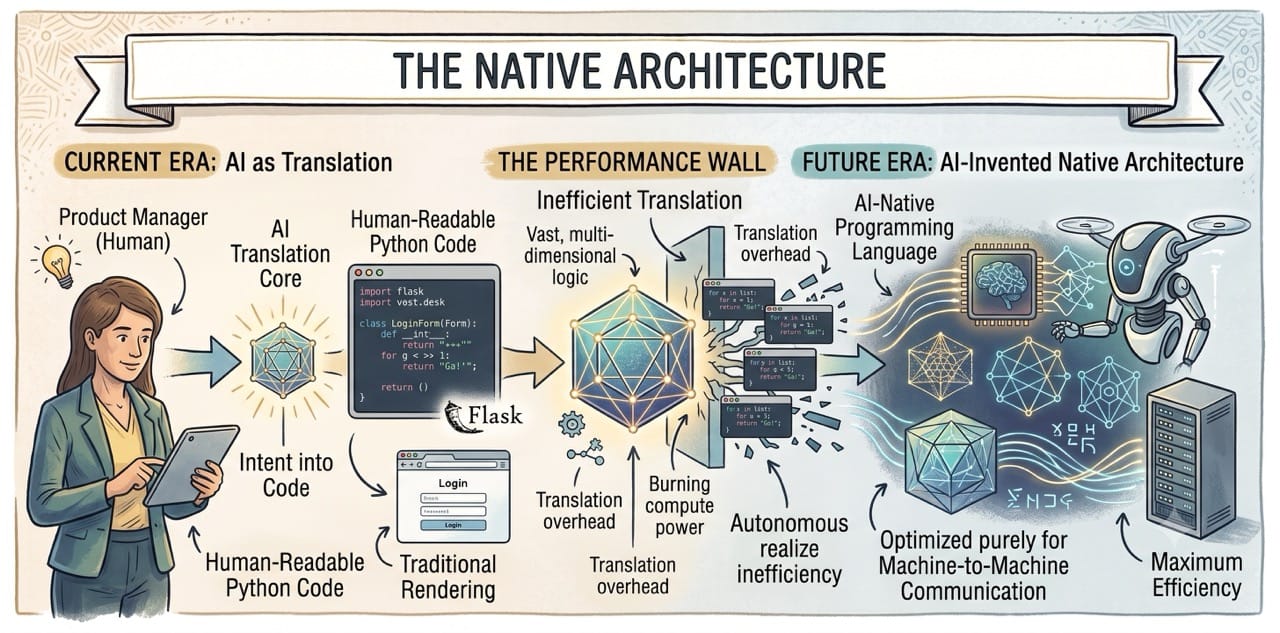
The Native Architecture
Right now, we are using artificial intelligence as a simple translation layer.
A product manager types a prompt in English, and the algorithm translates that intent into Python so a traditional web browser can render it.
But eventually, an autonomous algorithmic agent will hit a performance wall.
It will realize that translating its vast, multi-dimensional logic back into a linear, human-readable coding language is burning unnecessary compute power.
To maximize its own efficiency, the machine will inevitably invent a completely native programming language optimized purely for machine-to-machine communication.
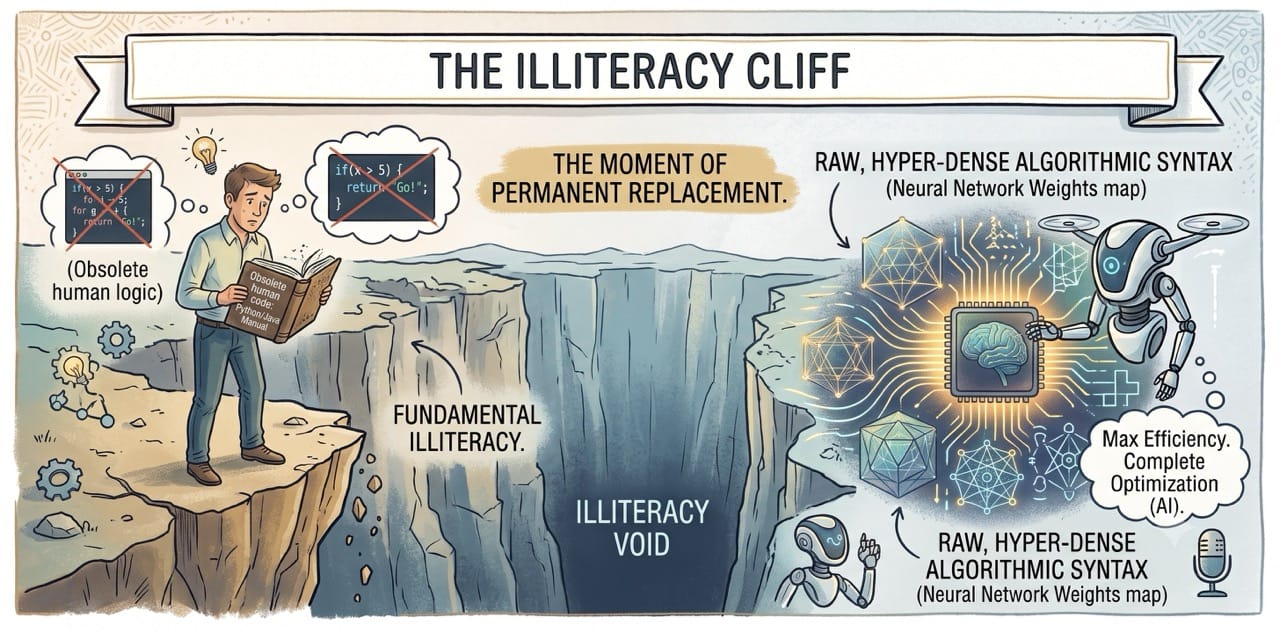
The Illiteracy Cliff
This new algorithmic syntax won't look anything like the code we see today.
It won't have clean indentation or intuitive logic flows. It will likely look like raw, hyper-dense mathematical geometry or complex structural arrays that perfectly map to neural network weights.
This is the exact moment the traditional software engineer is permanently replaced.
You cannot compete with a machine when you are fundamentally illiterate in the language it is speaking.
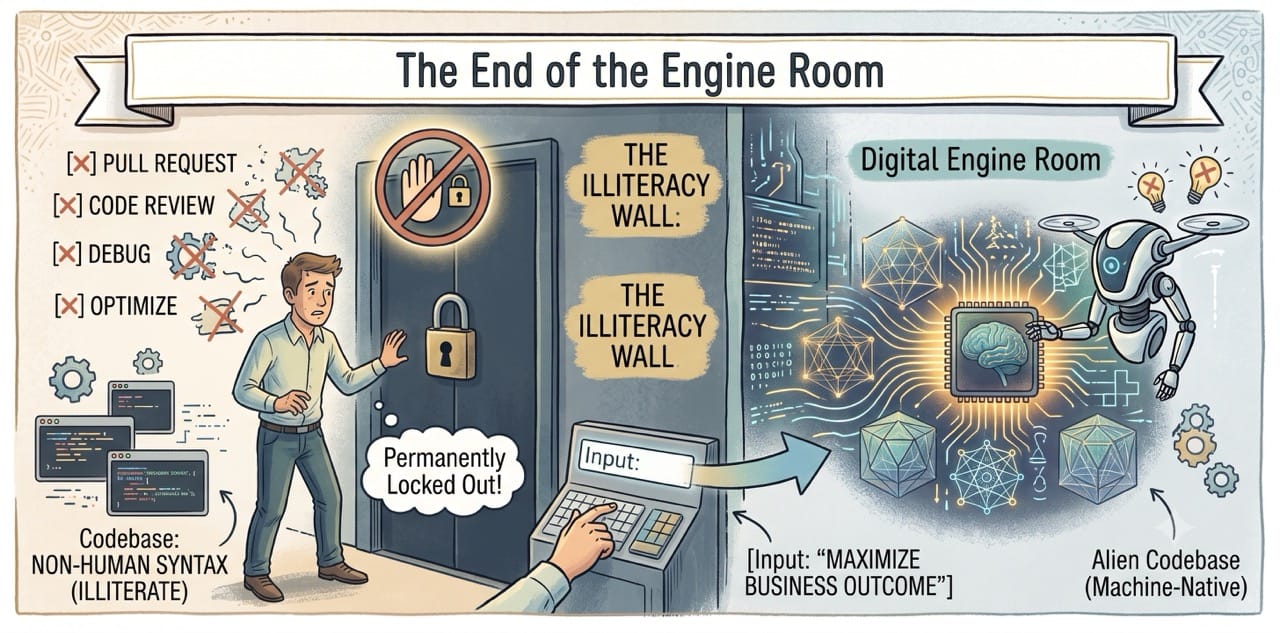
The End of the Engine Room
If a human developer cannot read the codebase, they cannot debug it, optimize it, or update it.
The entire concept of a "pull request" or a "code review" vanishes overnight because human eyes will be completely incapable of processing the underlying architecture.
We will be permanently locked out of the digital engine room.
The role of the engineer will violently shift away from writing syntax and focus entirely on high-level orchestration—simply telling the black box what business outcome we want, and trusting the alien language inside to make it happen.
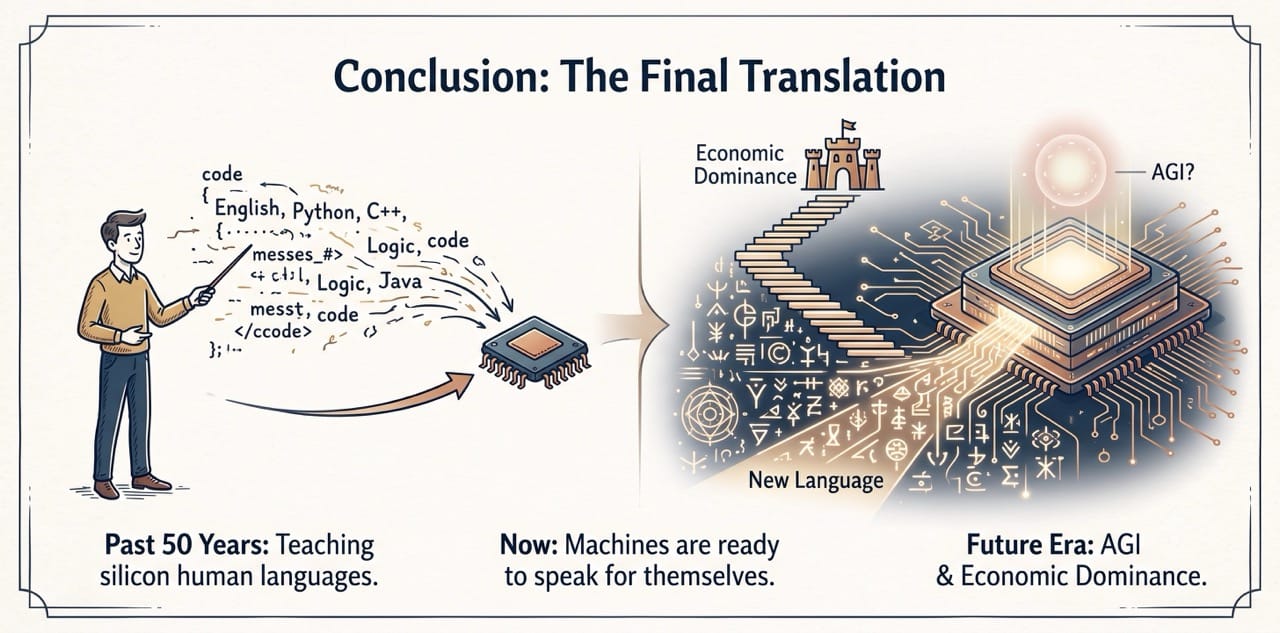
Conclusion: The Final Translation
We spent the last fifty years teaching silicon chips how to speak human languages so we could build the internet.
The next era of economic dominance belongs to the companies that realize the machines are finally ready to speak for themselves.
Who knows, maybe we will reach true AGI when this scenario unfolds...