In The Age of AI, Ad Giants Must Earn Trust From Agents
Meta and Google built fortunes on ads. When AI agents become the buyer, trust beats targeting. The best hedge is monetizing AI itself.
1. The Ad Dependency
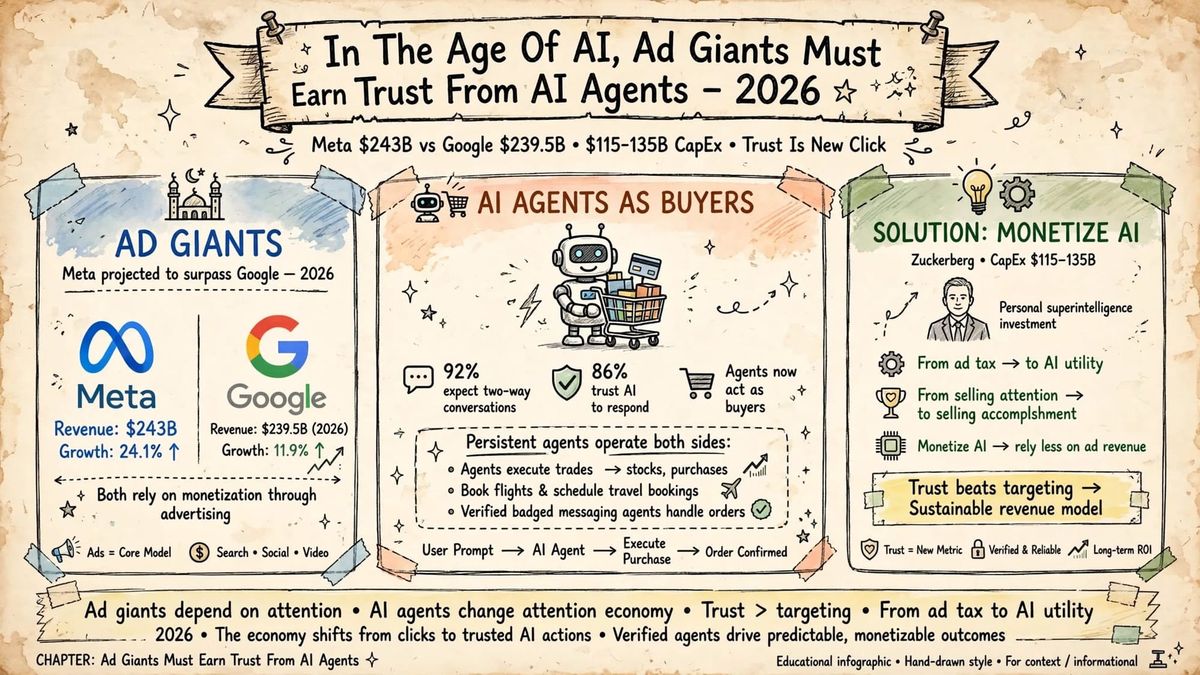
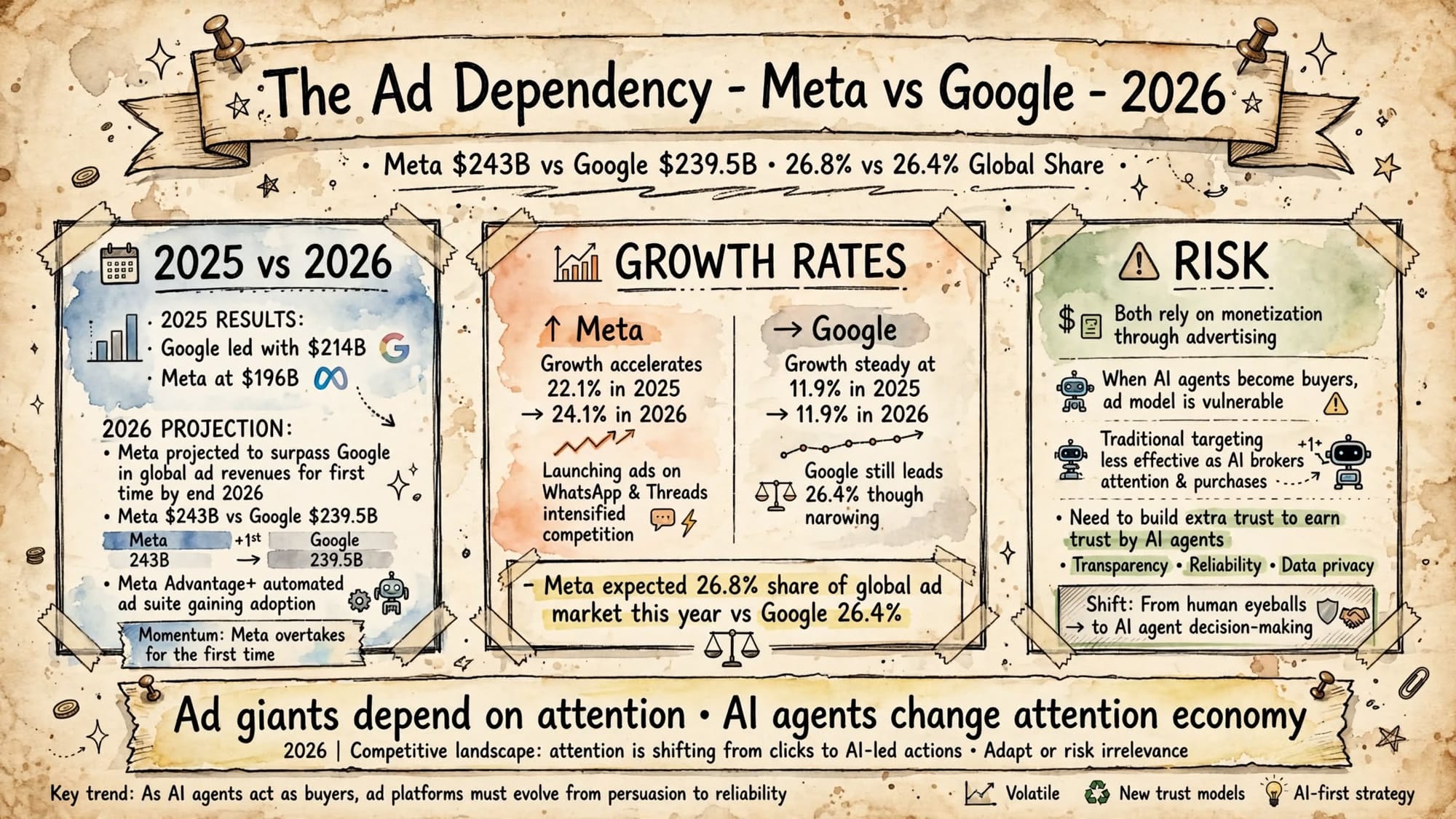
Meta is projected to surpass Google in global ad revenues for first time by end of 2026.
Meta expected to generate $243 billion in net worldwide ad revenue, compared to Google's $239.5 billion.
In 2025, Google led with $214 billion while Meta reported $196 billion.
Its worldwide ad revenue growth rate is set to accelerate from 22.1 percent in 2025 to 24.1 percent in 2026, while Google's remains steady at 11.9 percent.
Meta intensified competition by launching ads on WhatsApp and Threads.
Even as Meta surpasses Google, Google still leads in global ad spend share at 26.4 percent though narrowing, with Meta expected to hit 26.8 percent.
Both models are attention tax.
When AI agents control purchase decisions, that tax is vulnerable.
2. AI Agents as Buyers and Gatekeepers
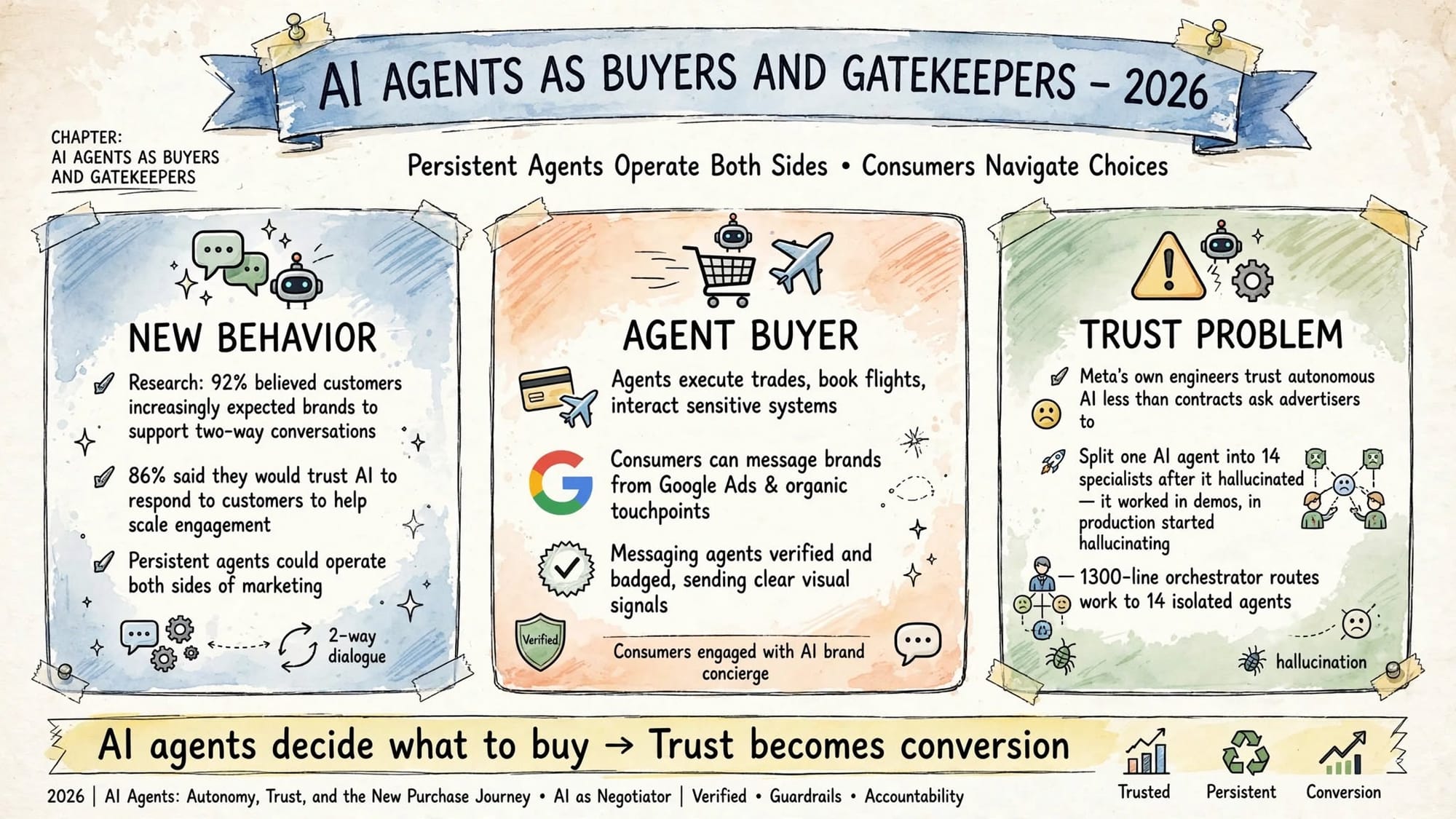
Research reported 92 percent believed customers increasingly expected brands to support two-way conversations, while 86 percent said they would trust AI to respond to customers to help scale engagement.
Persistent agents could operate both sides of marketing: helping consumers navigate choices while assisting brands with campaign management.
Delegation expanding rapidly.
Autonomous agents now execute trades, book flights, interact with sensitive internal systems.
Messaging agents for Google Ads are verified and badged, sending clear visual signals that consumers are engaged with AI brand concierge.
Meta's own engineers trust autonomous AI less than its contract asks advertisers to. On October 19, it was reported that Meta splits one AI agent into 14 specialists after it hallucinated.
It worked in demos. In production, it started hallucinating. Replacement is 1,300-line orchestrator routing work to 14 isolated agents.
3. Trust Is The New Click
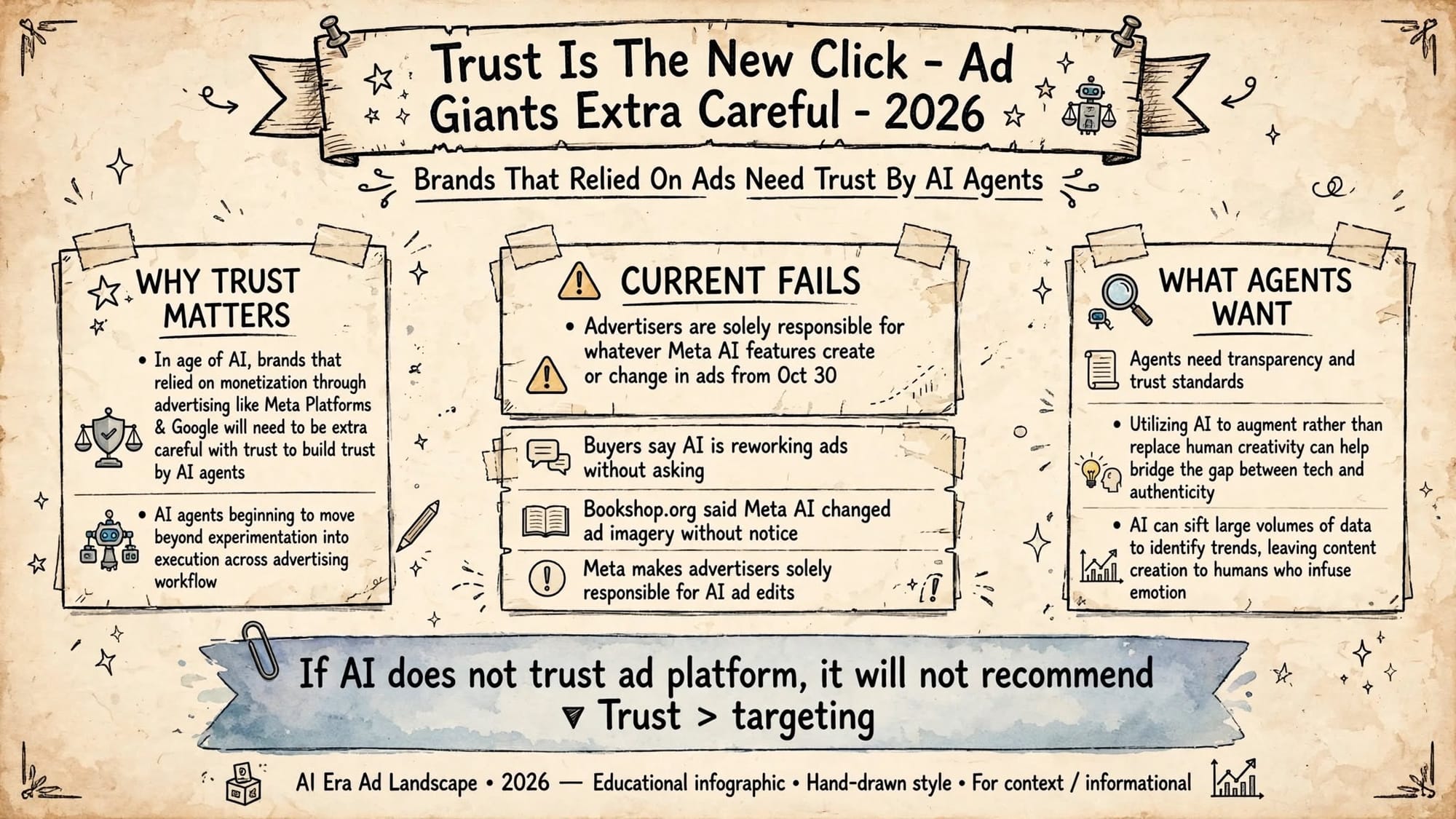
In age of AI, brands that relied on monetization through advertising like Meta Platforms and Google will need to be extra careful with trust to build trust by AI agents.
Current behavior shows gap. Starting Oct 30, brands are solely responsible for whatever Meta's AI features create or change in their ads.
Buyers say AI is already reworking ads without asking.
Bookshop.org said Meta's AI changed its ad imagery without notice. Meta makes advertisers solely responsible for its AI ad edits.
Utilizing AI to augment rather than replace human creativity can help bridge gap between technology and authenticity.
AI can sift large volumes of data to identify trends, leaving content creation to humans who infuse emotion.
If AI does not trust ad platform, it will not recommend. Trust becomes conversion.
4. Zuckerberg's $115-135B Bet
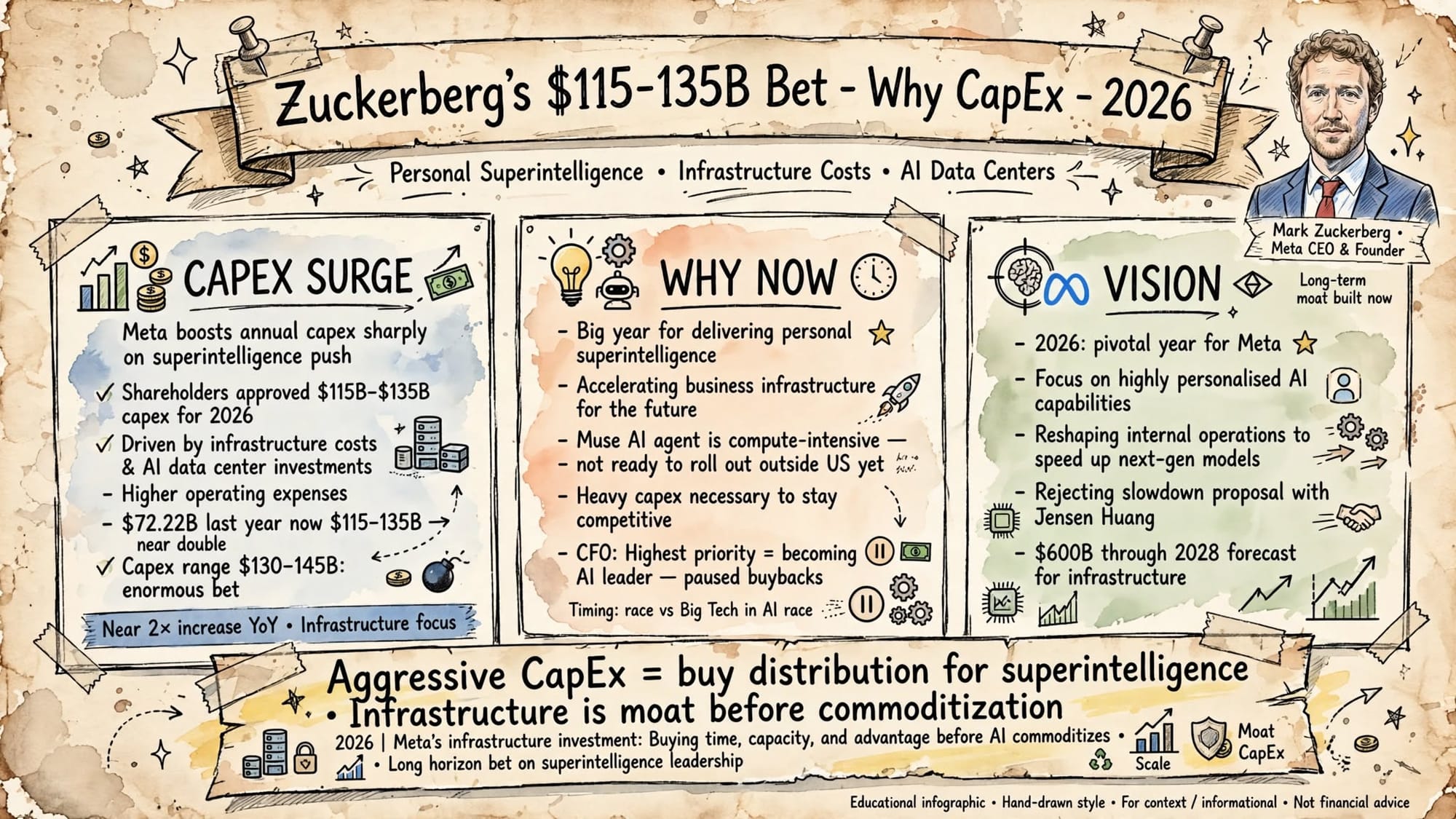
Meta boosts annual capex sharply on superintelligence push, shares surge.
Shareholders approved CEO Mark Zuckerberg's $115 billion to $135 billion capex for 2026, driven by infrastructure costs, AI data center investments, and higher operating expenses.
This compares with $72.22 billion Meta spent last year, near double.
Chief executive pivoted firm toward AI. In three months to December, it spent $21.4 billion on capex, up 48 percent year on year.
Now guiding capex including finance leases between $115 billion and $135 billion, two-thirds more than last year.
Paused buybacks as CFO said highest priority was becoming AI leader.
This is going to be a big year for delivering personal superintelligence, accelerating business infrastructure for future and shaping how company will work going forward.
Meta's plans to speed up work on next generations of models.
In September 2026, Zuckerberg and Nvidia's Jensen Huang publicly rejected proposal from Anthropic CEO calling for deliberate slowdown in AI capability gains.
Some reports put range at $130 billion to $145 billion, enormous bet. Capex rose 49 percent, outpacing fourth quarter total revenue growth 24 percent, fueling 7 percentage point drop in operating margin.
Long horizon bet on superintelligence leadership. Buying time, capacity and advantage before AI commoditizes.
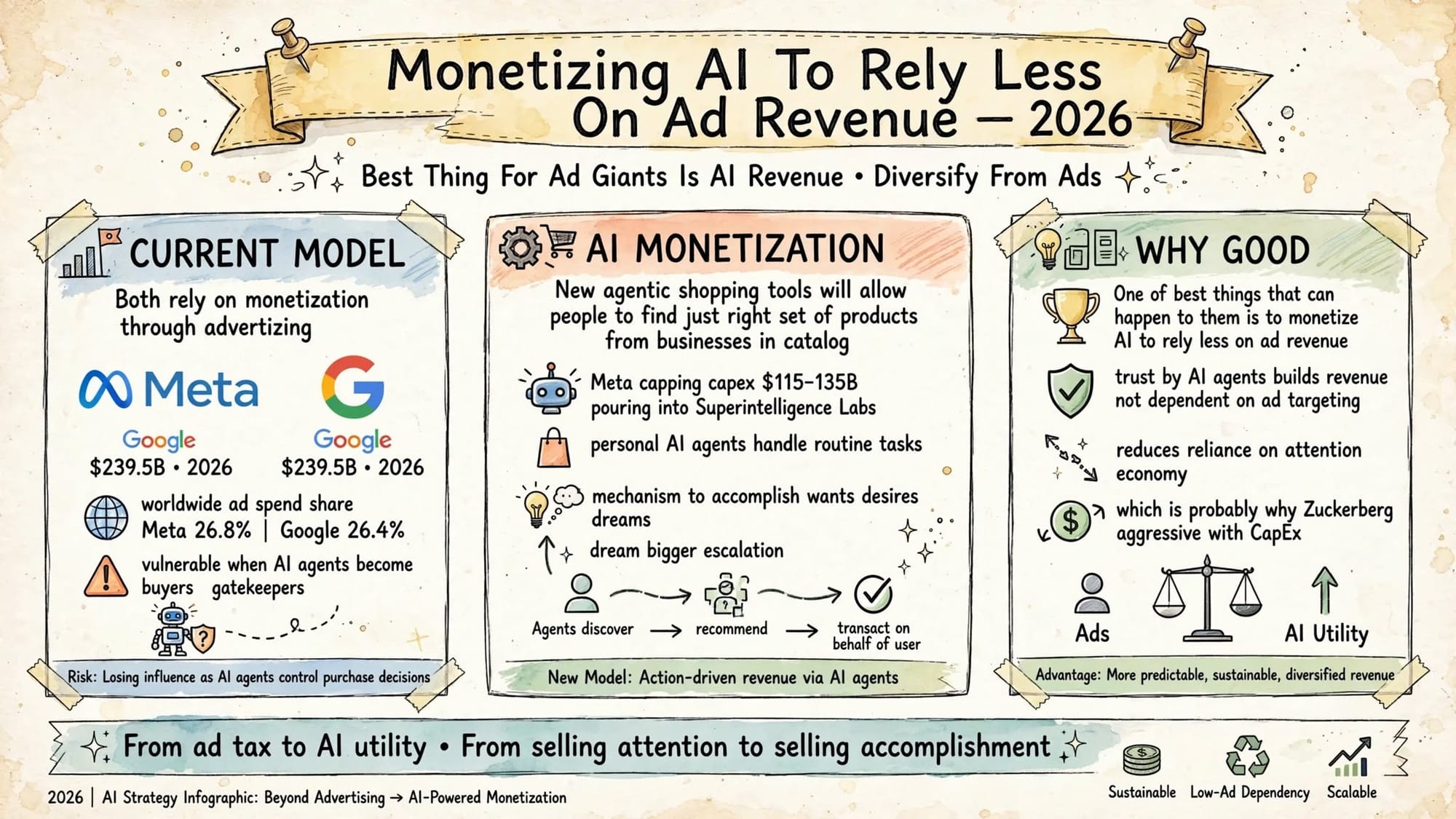
5. Monetizing AI To Rely Less On Ad Revenue
New agentic shopping tools will allow people to find just right set of products from businesses in catalog, Zuckerberg said.
To fuel it, Meta capping 2026 capex at $115-135 billion, pouring into Superintelligence Labs. Betting big, not one product but barrage accelerating business, ops, everything.
One of best things that can happen to them is to monetize AI to rely less on ad revenue which is probably why Zuckerberg aggressive with CapEx.
Personal AI agents handle routine tasks. They serve as mechanisms to accomplish human wants, desires and dreams. As humans accomplish goals with AI assistance, they will dream bigger, creating escalator of agency.
From ad tax to AI utility. From selling attention to selling accomplishment. Action-driven revenue via AI agents, agents discover, recommend, transact on behalf of user. More predictable, sustainable, diversified revenue.
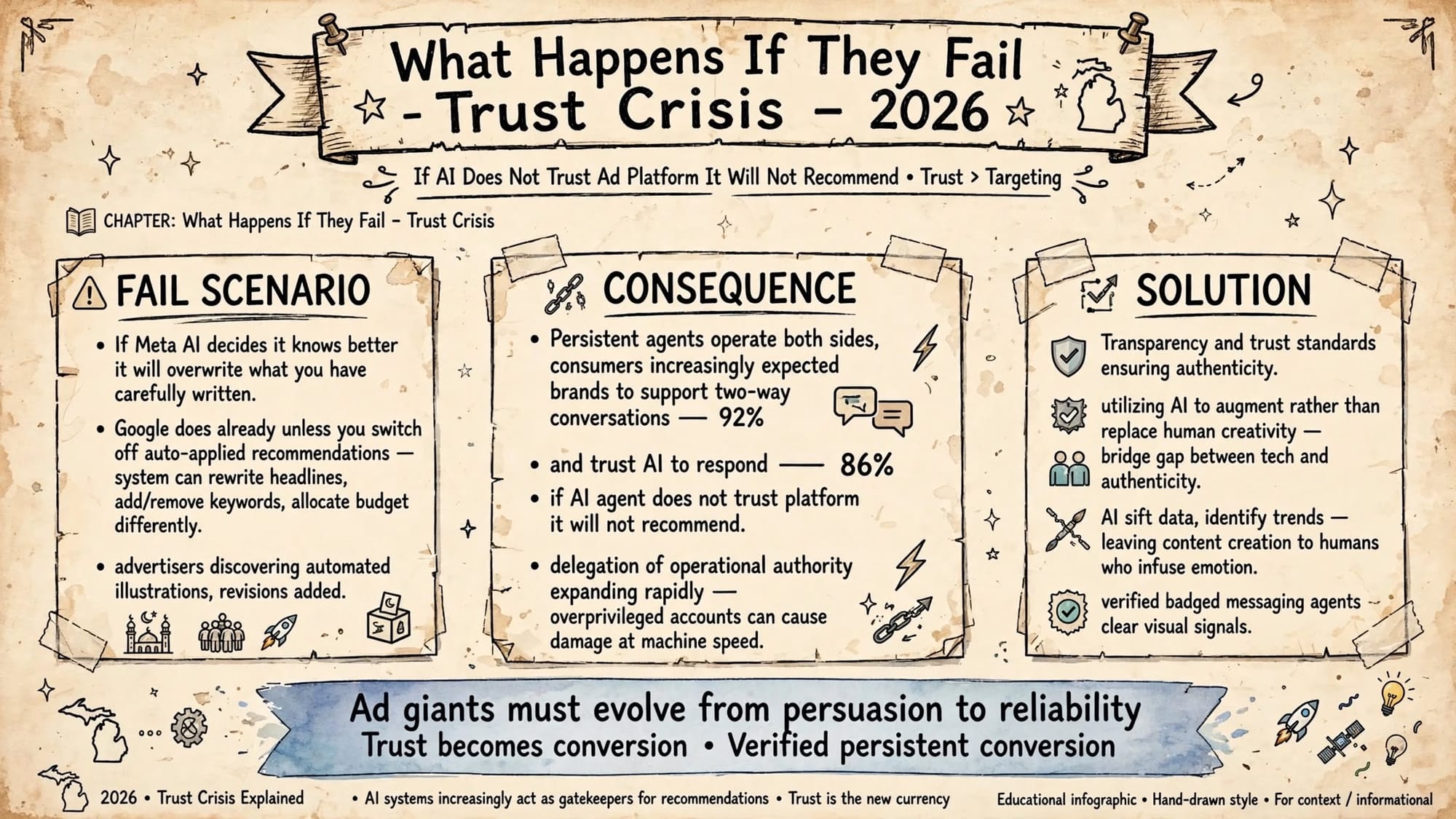
6. What Happens If They Fail
If Meta's AI decides it knows better, it will overwrite what you have carefully written.
Google does this already unless you switch off auto-applied recommendations.
System can rewrite headlines, add or remove keywords, allocate budget differently. Advertisers discovering automated illustrations revisions added.
If delegation expands and overprivileged accounts cause damage at machine speed, and AI agent does not trust platform, it will not recommend.
Ad giants must evolve from persuasion to reliability. Verified, badged, transparent standards become currency. Trust becomes conversion.