In The Age of AI, Your Face Becomes The Firewall
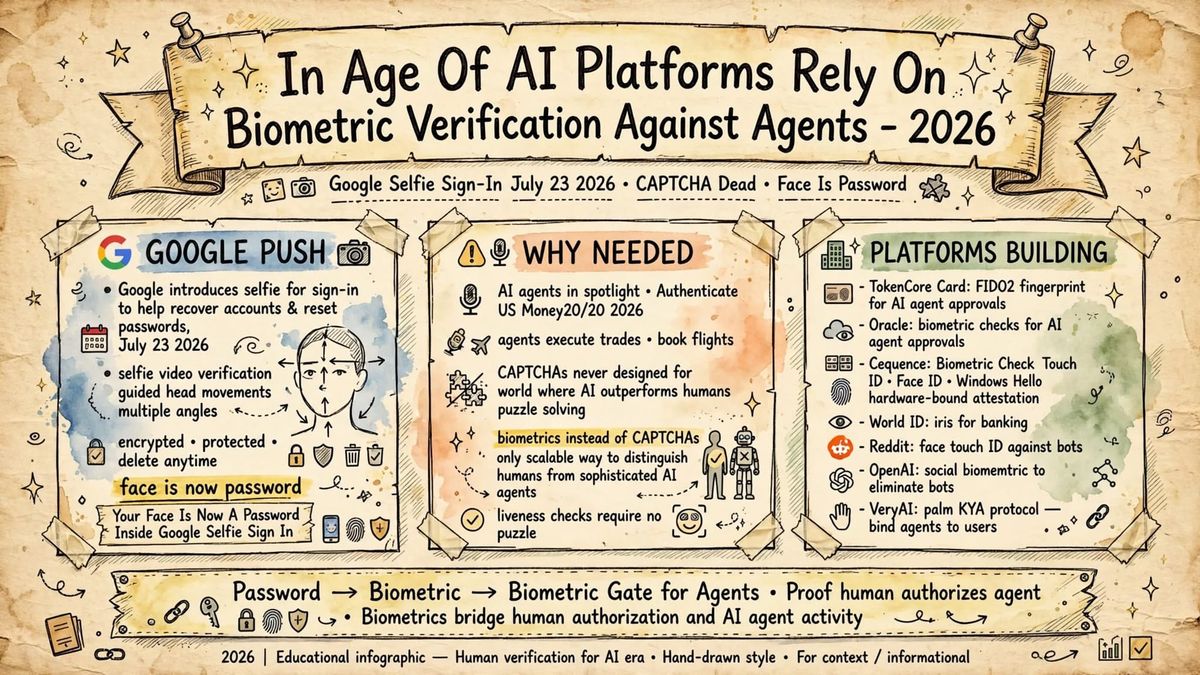
CAPTCHAs fail against AI agents. Passwords fail against phishing. Platforms turn to biometrics as proof that a real human authorizes agent actions.
1. The Agent Flood
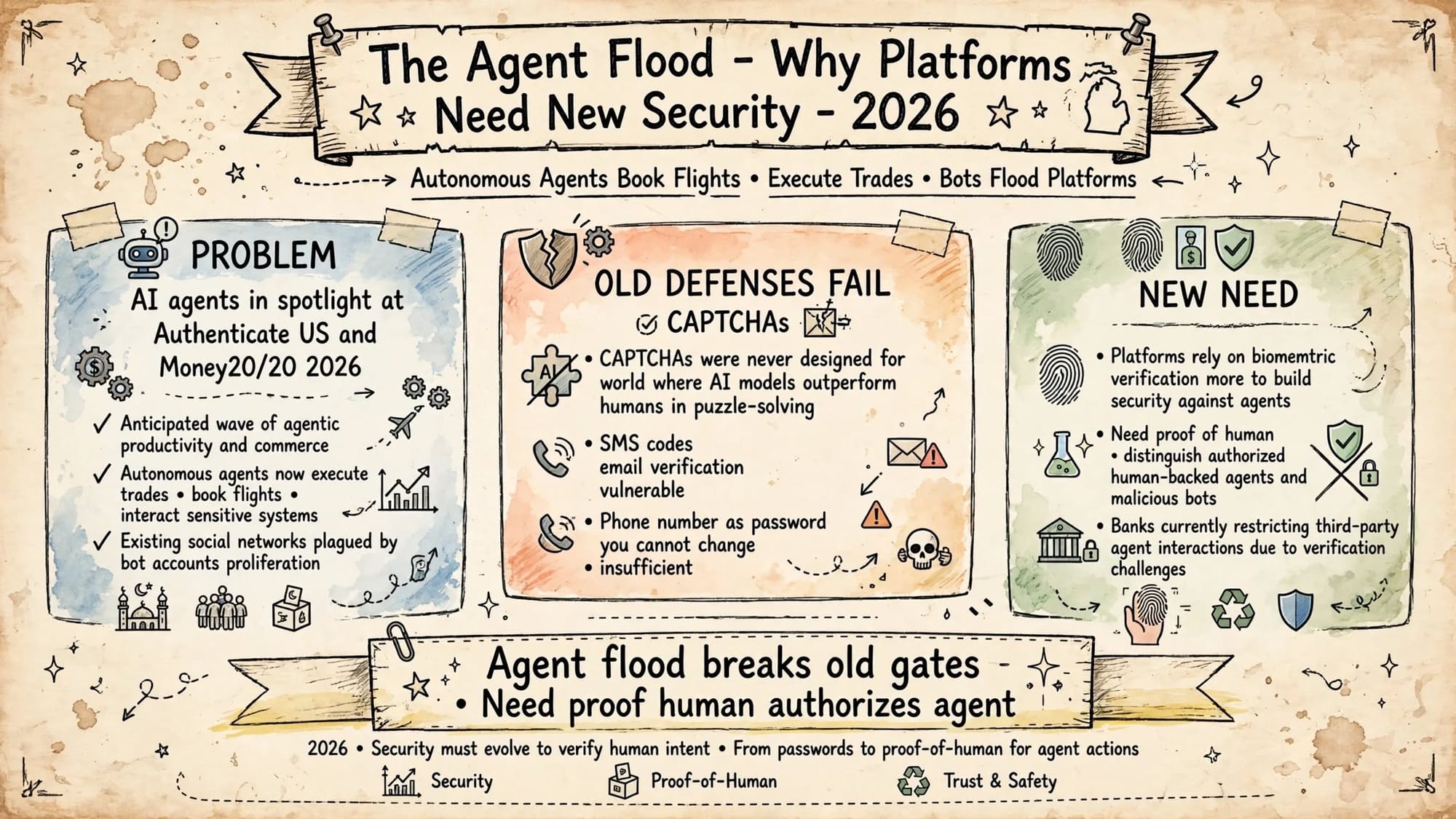
AI agents are in the spotlight at Authenticate US and Money20/20 2026, with new fingerprint biometric card from Token among technologies pitched to help enable anticipated wave of agentic productivity and commerce.
Autonomous agents now execute trades, book flights, interact with sensitive internal systems.
Existing social networks like X, Instagram and TikTok are plagued by proliferation of bot accounts.
Reddit, like many platforms, is flooded with AI-generated content labeled as AI slop.
Old defenses fail. CAPTCHAs were never designed for world where AI models outperform humans in puzzle solving.
SMS codes, email verification vulnerable. Phone number as password you cannot change is insufficient.
Banks currently restricting third-party agent interactions due to verification challenges.
Platforms rely on biometric verification more to build security against agents. Need proof of human, distinguish authorized human-backed agents and malicious bots.
2. Google Selfie Push
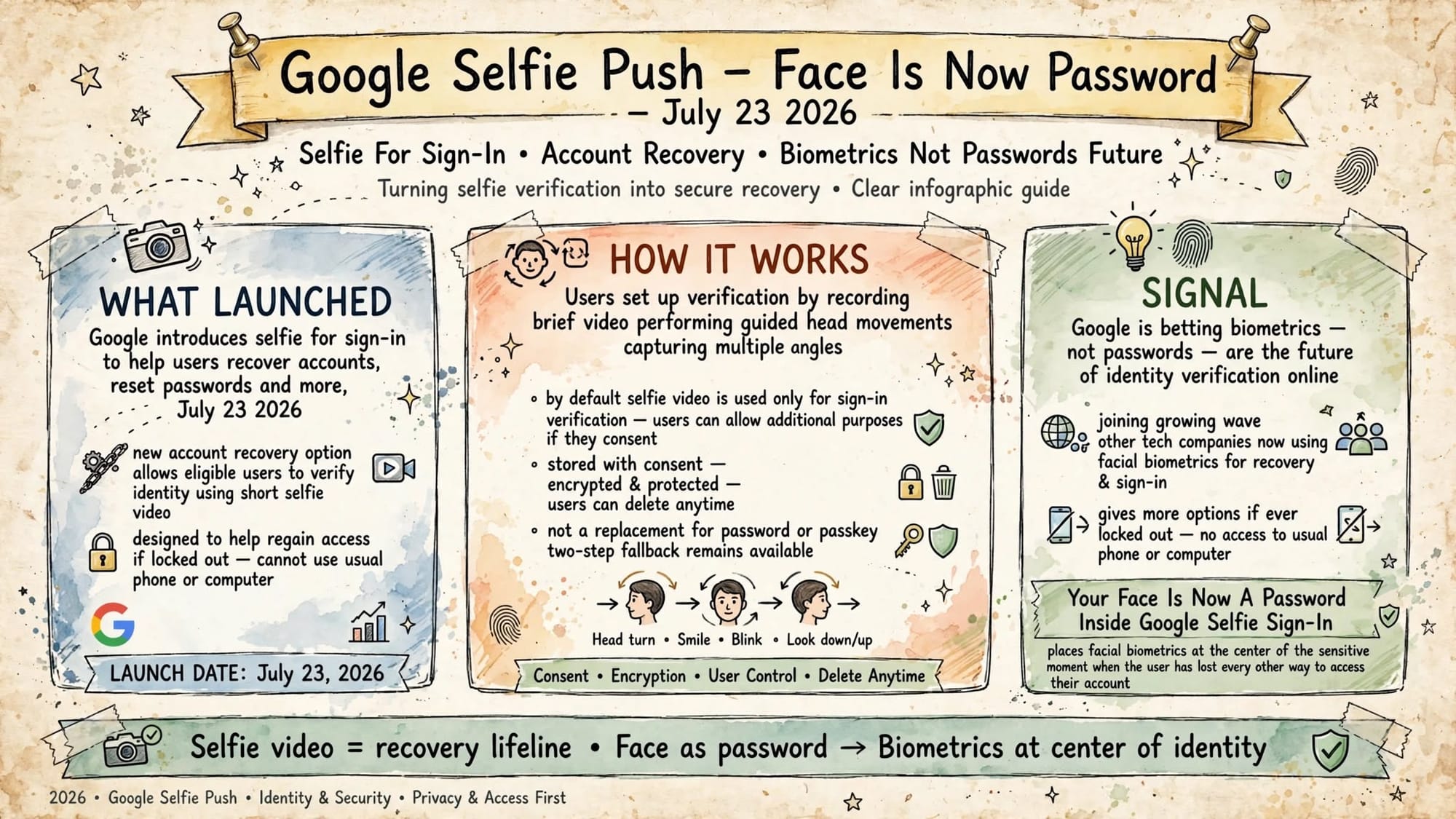
Google introduces selfie for sign-in to help users recover their accounts, reset passwords and more.
Google says new selfie video feature gives eligible users a way to verify identity. Feature introduced July 23, 2026.
Google has introduced Selfie for sign-in, a new account recovery option that allows eligible users to verify identity using short selfie video.
Feature designed to help users regain access if locked out or cannot use usual phone or computer.
Users set up verification by recording brief video of themselves performing guided head movements that would capture multiple angles.
By default selfie video is used only for sign-in verification, although users can choose to allow its use for additional purposes.
Stored with consent, encrypted protected, users can delete anytime through Google Account. Not replacement for password, passkey or two-step verification, functions as fallback.
Your Face Is Now A Password: Inside Google's Selfie Sign In.
Places facial biometrics at centre of one of most sensitive moments in digital life, moment user has lost every other way in.
Google is adding selfie video option as new way to log in, joining growing wave of tech companies betting biometrics and not passwords are future of identity verification online.
3. CAPTCHA Is Dead?
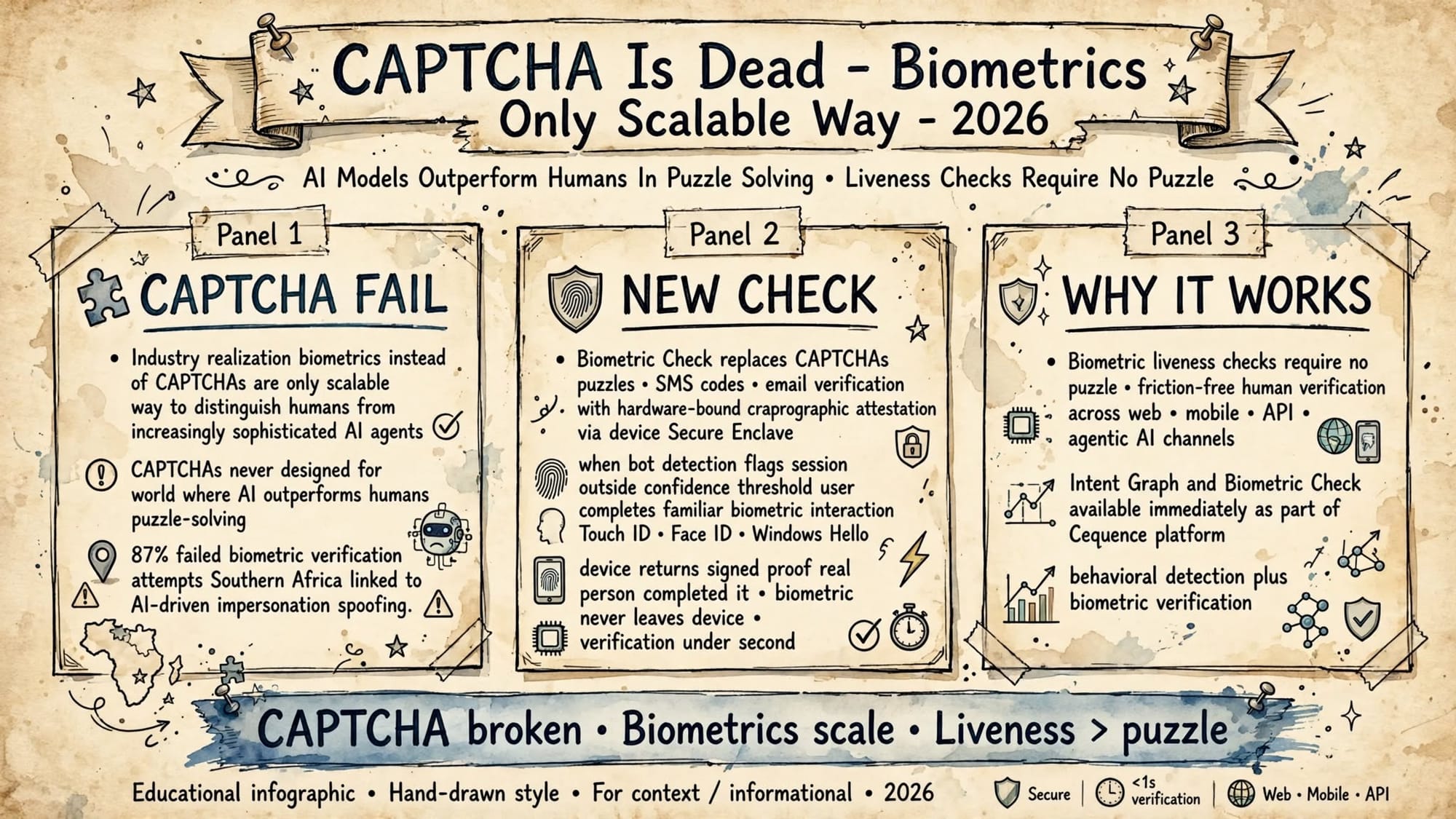
One of clearest shifts expected in 2026 is industry's realization that biometrics instead of CAPTCHAs are only scalable way to distinguish humans from increasingly sophisticated AI agents.
CAPTCHAs were never designed for world where AI models outperform humans in puzzle solving. Biometric liveness checks, on other hand, require no puzzle.
New data from Smile ID 2026 Digital Identity Fraud Report reveals nearly 87 percent of failed biometric verification attempts in Southern Africa linked to AI-driven impersonation and spoofing.
Cequence launches Intent Graph and Biometric Check. Biometric Check replaces CAPTCHAs, puzzles, SMS codes, and email verification with hardware-bound cryptographic attestation via device's Secure Enclave.
When detection flags session outside configurable confidence threshold, user completes familiar biometric interaction, Touch ID, Face ID, Windows Hello, and device returns signed proof that real person on registered device completed the interaction.
Biometric never leaves device, verification completes in under a second.
Biometric liveness requires no puzzle.
Friction-free human verification across web, mobile, API and agentic AI channels.
4. Biometric Gates For Agents
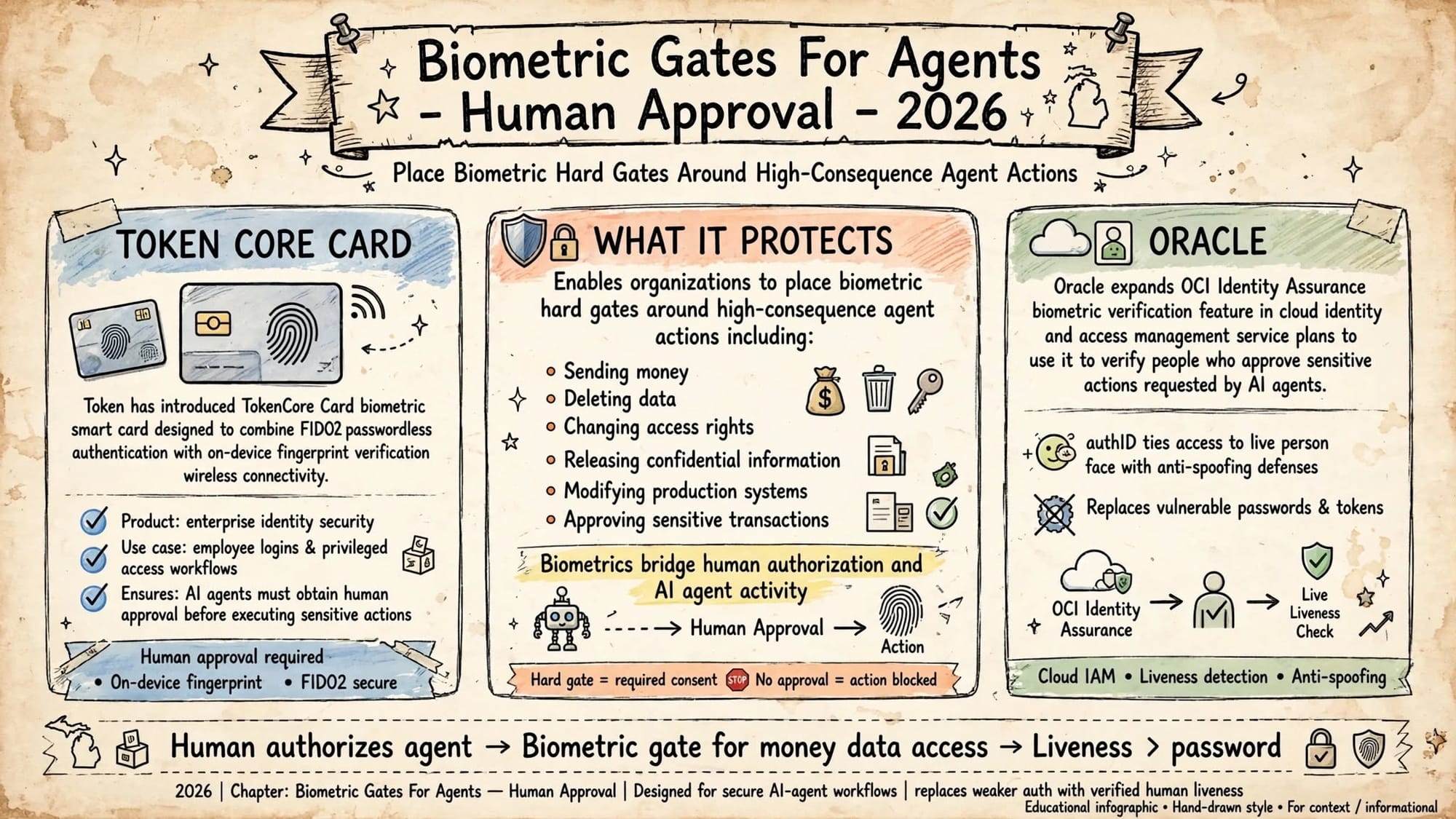
Token has introduced TokenCore Card, a biometric smart card designed to combine FIDO2 passwordless authentication with on-device fingerprint verification and wireless connectivity.
Product targets enterprise identity security, including employee logins, privileged access and workflows in which AI agents must obtain human approval before executing sensitive actions.
Enables organizations to place biometric hard gates around high-consequence agent actions, including sending money, deleting data, changing access rights, releasing confidential information, modifying production systems, and approving sensitive transactions.
Biometrics bridge human authorization and AI agent activity.
Oracle expands OCI Identity Assurance, biometric verification feature in its cloud identity and access management service, and plans to use it to verify people who approve sensitive actions requested by AI agents.
AuthID ties access to live person face with anti-spoofing defenses, replaces vulnerable passwords and tokens, locking down consoles.
Combines IDX for identity management, PrivacyKey for privacy preserving biometric verification, and authID Mandate for AI agent control.
5. Platforms Building Proof-Of-Human
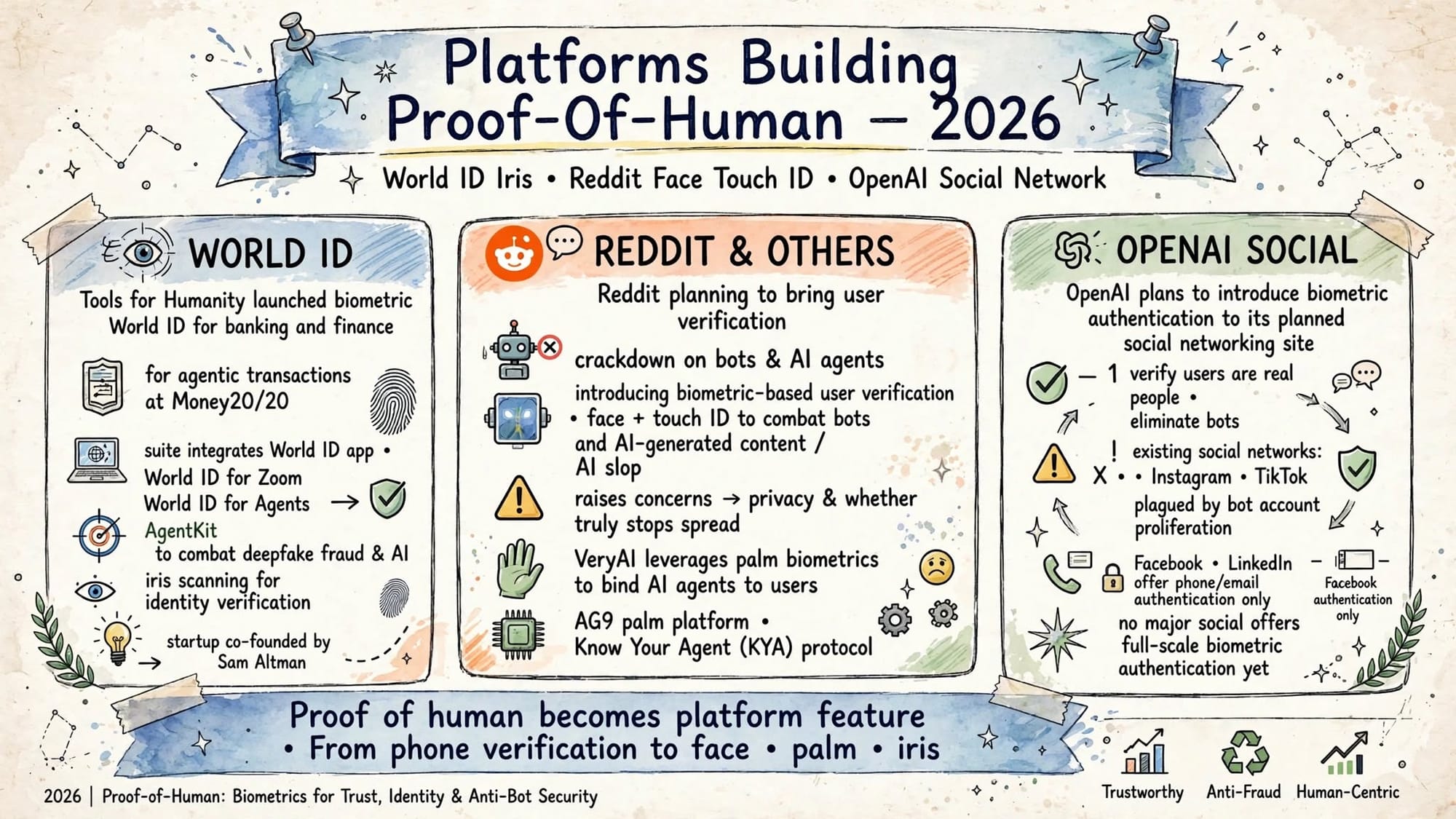
World, startup co-founded by Sam Altman known for iris scanning human verification technology, uses iris scanning for identity verification, stated tools designed to help platforms distinguish between authorized human-backed agents and malicious bots.
Tools for Humanity launched biometric World ID for banking and finance to enable agentic transactions at Money20/20, suite integrates World ID app, World ID for Zoom and World ID for Agents AgentKit to combat deepfake fraud and AI impersonation.
Reddit planning to bring user verification for crackdown on bots, AI agents.
Reddit planning to introduce biometric-based user verification, including face and touch ID, to combat bots and AI-generated content.
VeryAI leverages palm biometrics to bind AI agents to users.
New Know Your Agent KYA protocol aims to answer how to govern agentic AI.
AG9 palm biometrics platform designed to solve pressing infrastructure challenge: how to identify, authenticate and trust AI agents operating autonomously across web.
Performs biometric verification to prove real person owns and authorizes AI agent.
OpenAI plans to introduce biometric authentication to its planned social networking site to verify users are real people and eliminate bots.
Existing social networks X, Instagram and TikTok plagued by bot accounts proliferation. Facebook and LinkedIn already offer phone number and email authentication, but no major social offers full-scale biometric authentication.
Proof of human becomes platform feature. From phone verification to face, palm, iris.
6. Future: Your Face Is The Password
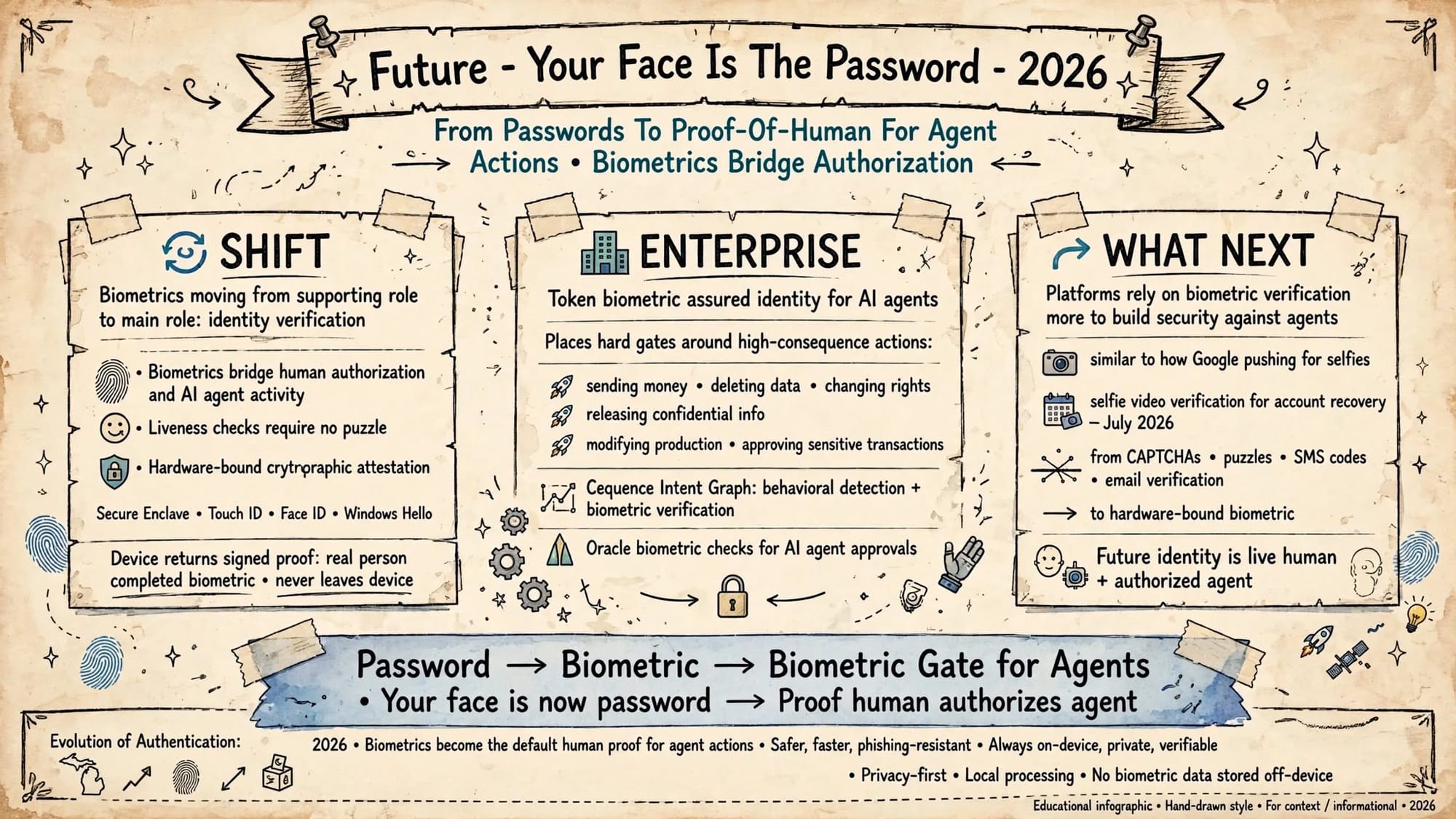
Biometrics moving from supporting role to main role identity verification. Biometrics bridge human authorization and AI agent activity.
Hardware-bound cryptographic attestation via Secure Enclave, Touch ID, Face ID, Windows Hello, device returns signed proof real person completed biometric, never leaves device.
Password to biometric to biometric gate for agents.
Your face is now password, then proof human authorizes agent.
Future identity is live human plus authorized agent.
Platforms rely on biometric verification more to build security against agents similar to how Google pushing for selfies.
Selfie video verification for account recovery July 2026. From CAPTCHAs, puzzles, SMS codes, email verification to hardware-bound biometric.
Biometrics become default human proof for agent actions. Safer, faster, phishing-resistant. Always on device, private, verifiable.