Energy, Tokens, Distillation: Why The Moat Becomes Distribution and Connectivity
Token costs falling 13x a year. Inference costs down 280x. When intelligence becomes commodity, defensibility moves from model to workflow.
1. The Cost Collapse
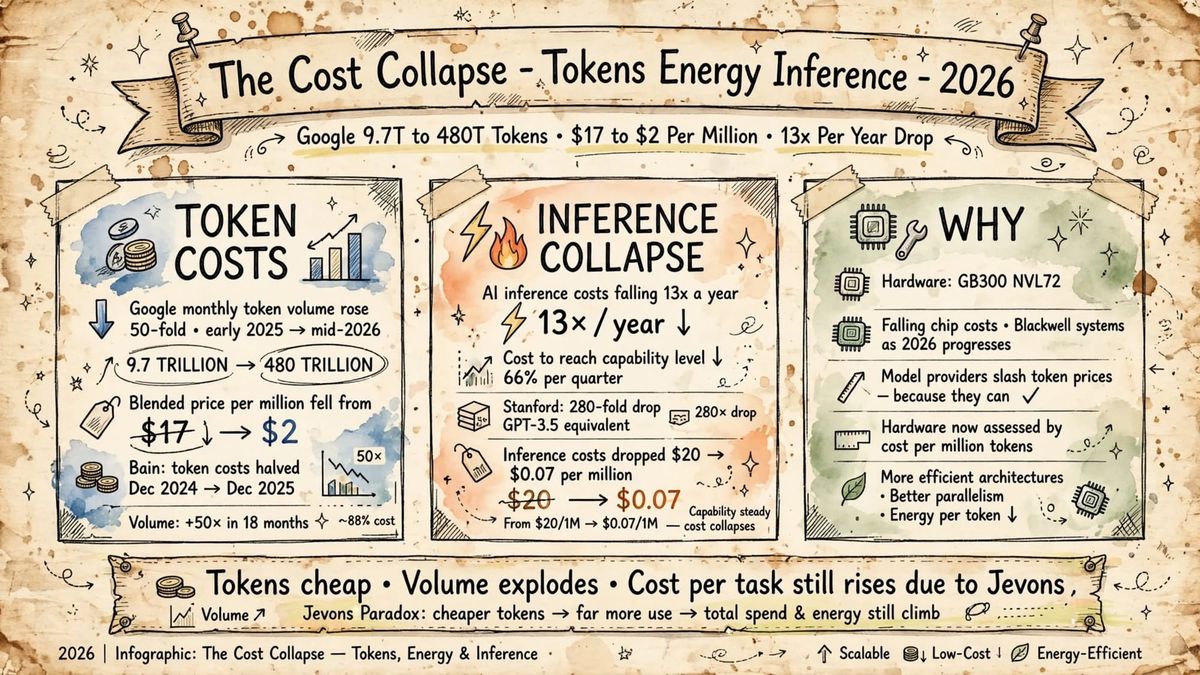
Google's reported monthly token volume rose roughly fifty-fold between early 2025 and mid-2026, from about 9.7 trillion to over 480 trillion, and blended price per million tokens fell from around 17 dollars to around 2.
Inference cost for comparable capability tiers has fallen from about $0.06 per 1,000 tokens in early 2025 to about $0.006 by mid-2026.
The discount has a lifespan.
On average, the cost to reach a capability level falls 66 percent per quarter while that level is state of the art, then slows to 32 percent.
Stanford's AI Index already clocked a 280-fold drop in GPT-3.5 equivalent inference, from $20 to $0.07 per million tokens.
At hardware level, falling chip and electricity costs have supported lower pricing. New Blackwell system GB 300 NVL72 replaces previous generation.
Model providers slash token prices because they can. GPU systems are now assessed by cost to generate one million tokens.
2. Post Training and Distillation
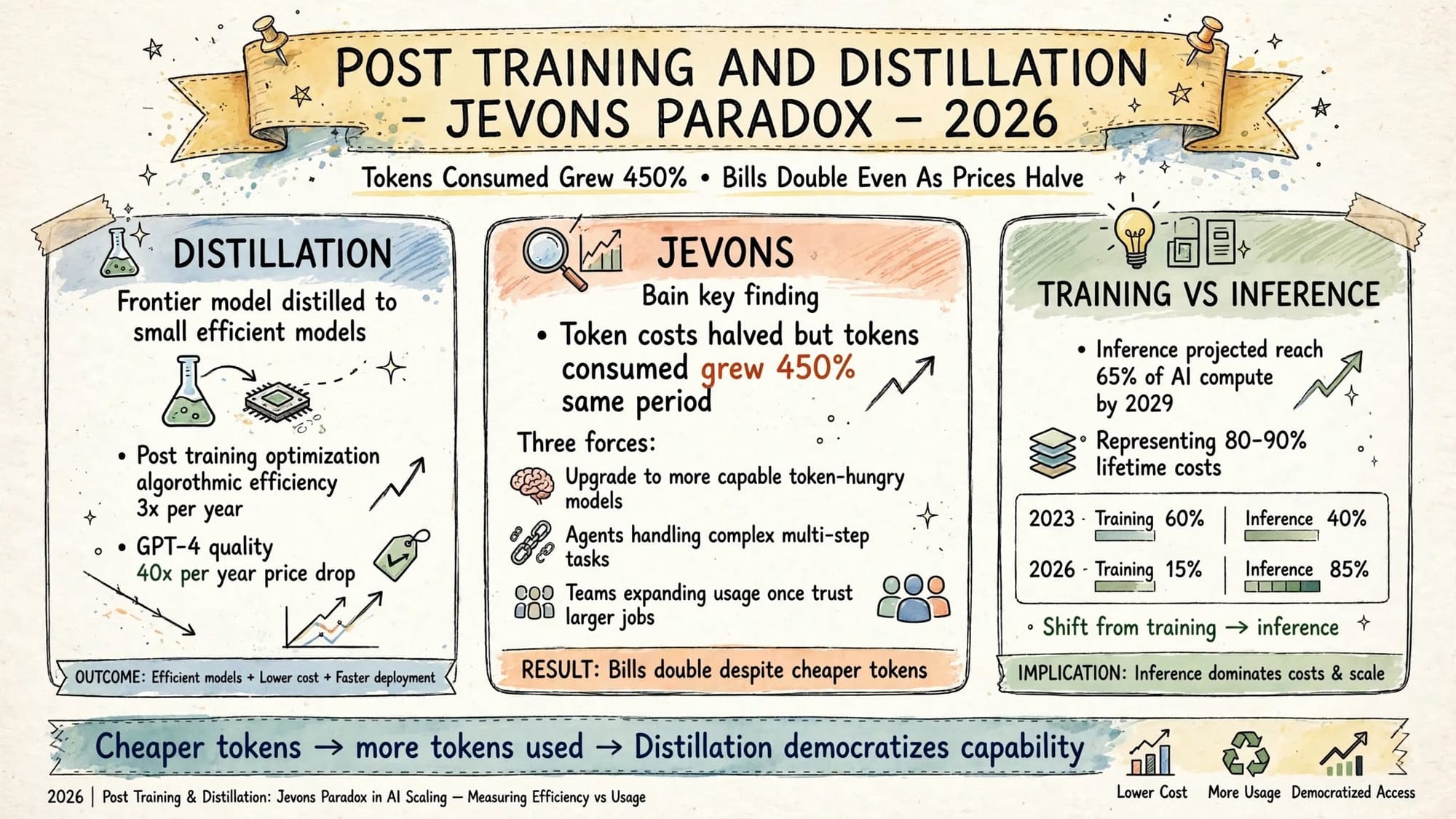
Distillation is post training optimization. Frontier model knowledge compressed into small efficient models.
Isolated algorithmic efficiency progress runs about 3x per year. GPT-4 quality on GPQA Diamond sees 40x per year price drop.
Jevons paradox appears. Bain & Company 2026 analysis found that token costs halved from December 2024 to December 2025.
But tokens consumed grew 450 percent over same period.
Three forces: companies upgrading to newer, more capable and token-hungry models, agents handling more complex multi-step tasks, and teams expanding AI usage once they trust it with larger jobs.
Inference projected to reach 65 percent of AI compute by 2029, representing 80 to 90 percent of lifetime AI system costs.
Shift visible: 2023 training 60 percent inference 40 percent, 2024 training 45 percent inference 55 percent, 2025 training 33 percent inference 67 percent, 2026 training 15 percent inference 85 percent.
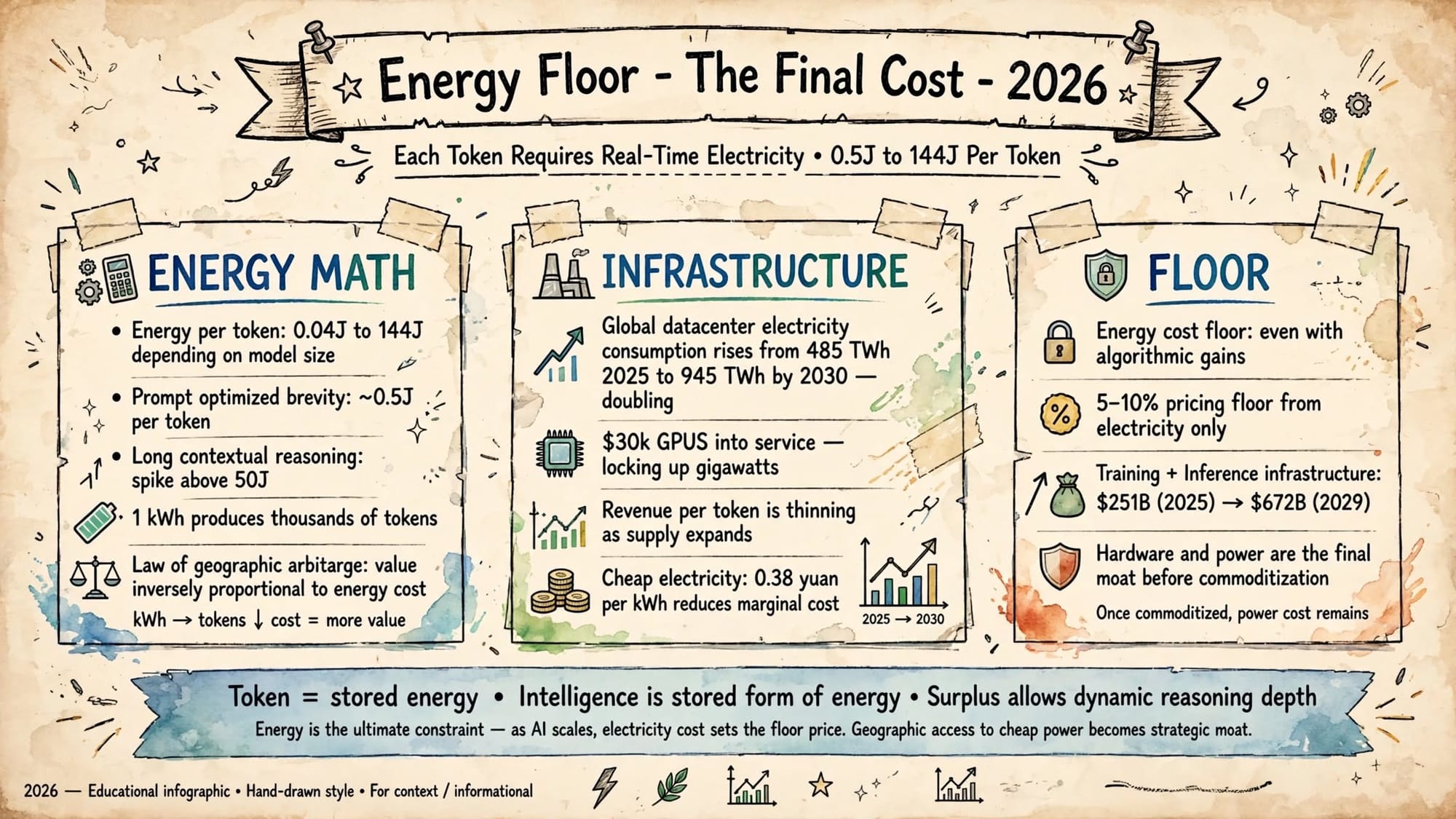
Combined training plus inference infrastructure sized at $251 billion in 2025, growing to $672 billion by 2029.
3. Energy Floor
Each token requires real time electricity. Energy per token ranges 0.04 to 144 J depending on model size.
Prompt optimized for brevity might cost 0.5 J per token, long contextual reasoning can spike above 50 J. One kWh produces thousands of tokens.
Global datacenter electricity consumption rises from approximately 485 TWh in 2025 to about 945 TWh by 2030, roughly doubling.
Providers are putting $30,000 GPUs into service and locking up gigawatts of power, yet revenue pulled per token is thinning.
Laws emerging: value of a token is inversely proportional to cost of energy used to produce it. Intelligence is stored form of energy.
Real time intelligence requires higher energy density, asynchronous intelligence allows extreme energy arbitrage.
Domestic green electricity at 0.38 yuan per kWh directly reduces marginal cost. Even with algorithmic gains, 5 to 10 percent of pricing floor comes from electricity. Hardware and power are final moat before commoditization.
4. Why Moats Evaporate
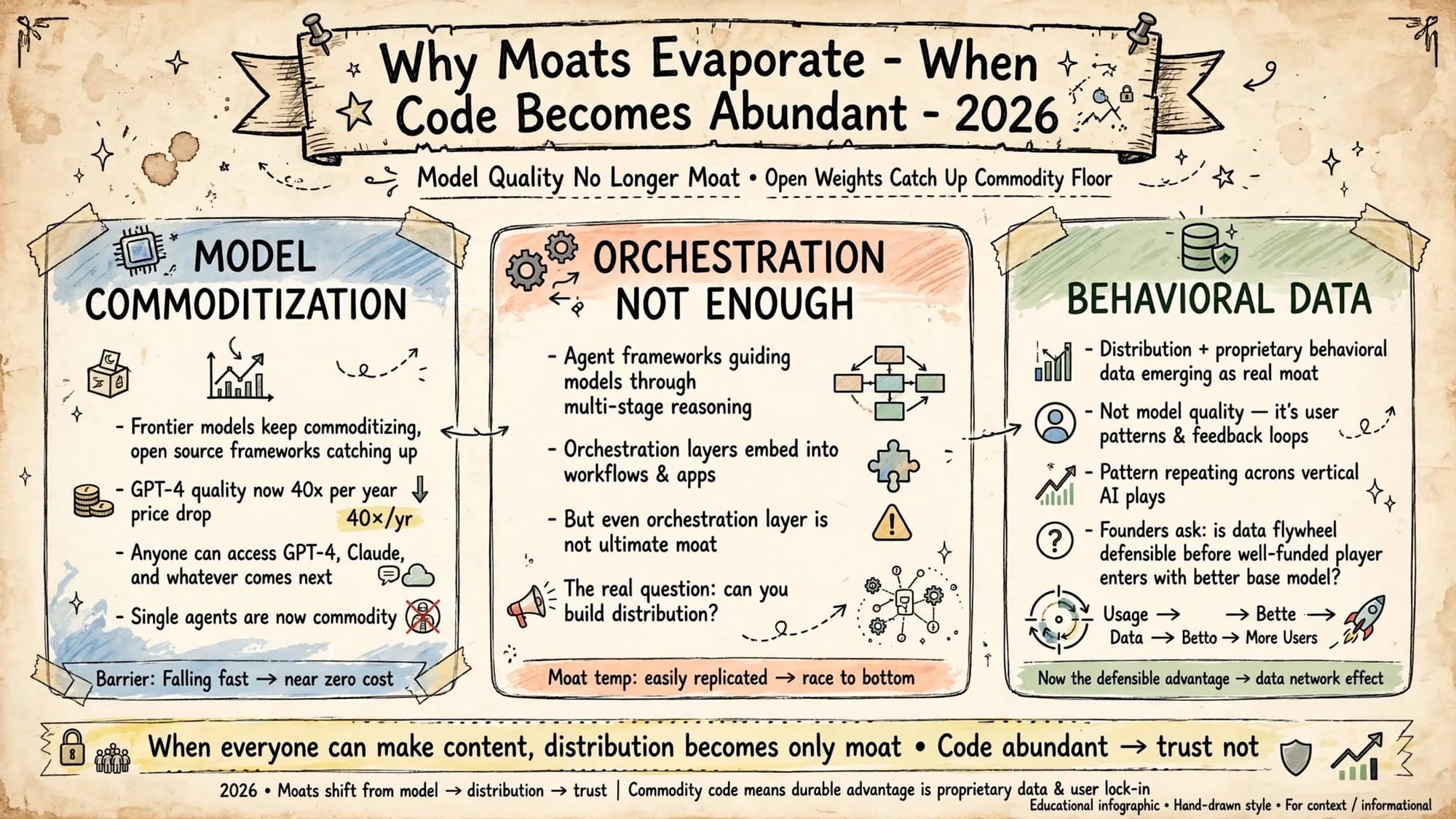
Frontier models keep commoditizing and open source frameworks keep catching up.
What actually makes enterprise AI product defensible is no longer model quality.
Any competent team can build lending product now, any team can access GPT-4 or Claude or whatever comes next. Single agents are a commodity.
Orchestration layers embedding themselves into workflows help, but even orchestration is not ultimate moat.
It is easily replicated, race to bottom. When everyone can make content, distribution becomes actual moat. Code abundant, trust not.
Distribution and proprietary behavioral data are emerging as real moat in AI, not model quality. Pattern repeating across vertical AI plays.
Founders building AI products should ask whether data flywheel is defensible before well-funded global player enters with better base model.
5. Distribution Is The Moat
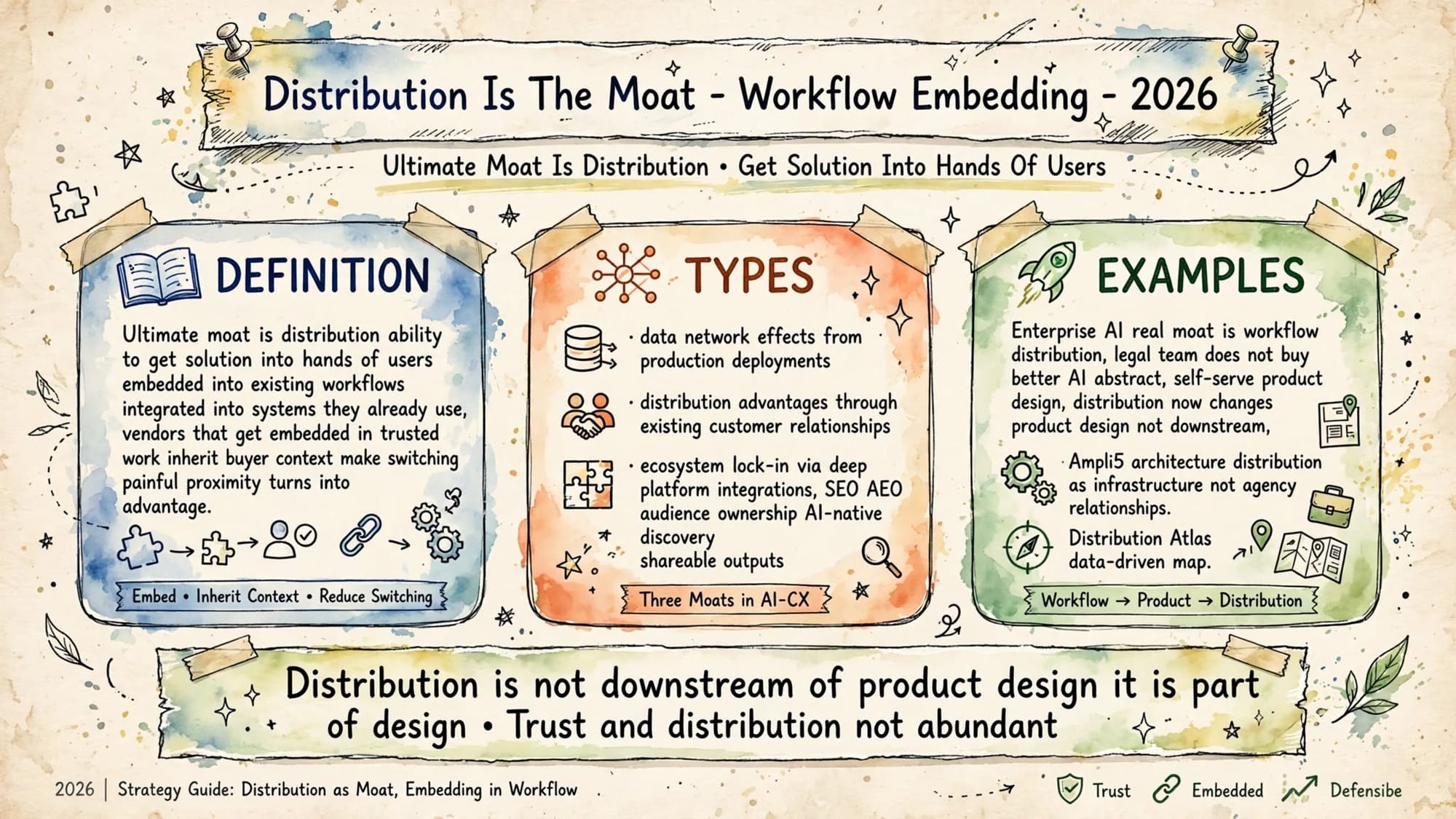
Ultimate moat is distribution, ability to get solution into hands of users, embedded into existing workflows, integrated into systems they already use.
Vendors that get embedded in trusted work inherit buyer context and make switching painful enough that proximity turns into distribution advantage.
Three moats in AI CX: data network effects from production deployments, distribution advantages through existing customer relationships, and ecosystem lock-in via deep platform integrations.
Anyreach leverages these moats to deliver sustainable differentiation in agentic AI.
Distribution now includes SEO, AEO, audience ownership, AI native discovery, shareable outputs.
Distribution changes product design.
Self-serve product needs distribution built in.
Ampli5 architecture built around premise distribution should function as infrastructure rather than collection of agency relationships.
Intelligence layer underneath routing is Distribution Atlas, data driven map.
Enterprise AI's real moat is workflow distribution.
A legal team does not buy better AI in abstract. Distribution is not downstream of product design, it is part of design.
6. Connectivity Is The Multiplier
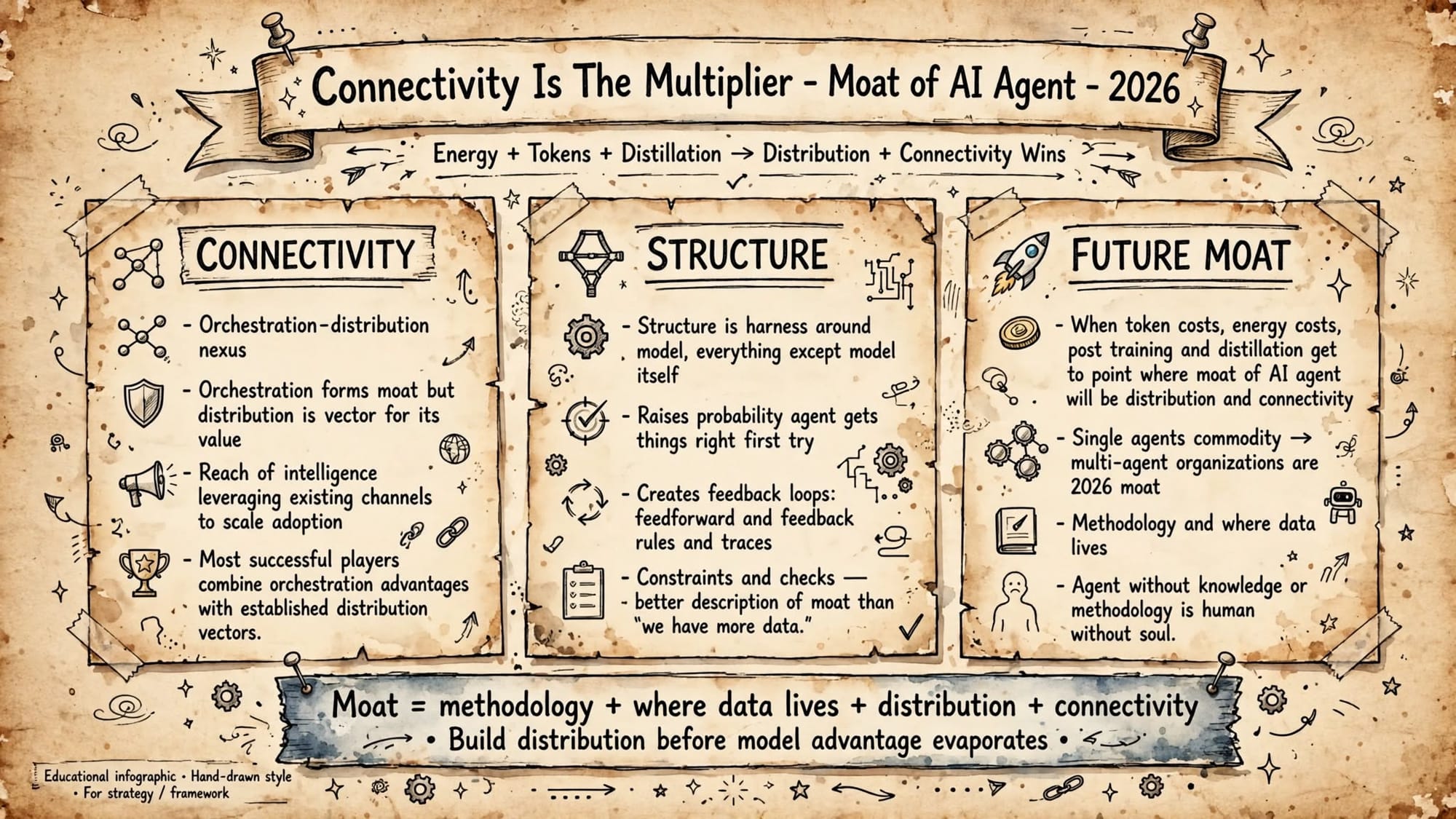
Orchestration forms moat, but distribution is vector for its value. Reach of intelligence leveraging existing channels to scale adoption.
Most successful players combine orchestration advantages with established distribution vectors.
Structure is harness around model.
Everything in AI agent except model itself. Good outer harness does two things: raises probability that agent gets things right on first try, and creates feedback loops that provide feedforward and feedback, rules and traces, constraints and checks. That is better description of moat than we have more data.
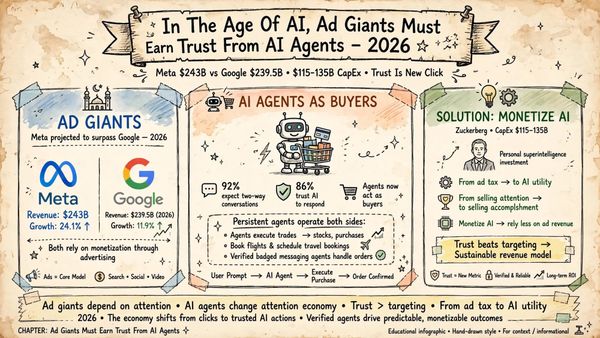
When token costs, energy costs, post training and distillation get to point where moat of AI agent will be distribution and connectivity, single agents commodity, multi-agent organizations are 2026 moat.
Chris Han, ThinkingAI co-founder, put thesis plainly:
An Agent without knowledge or methodology is a human without soul. If frontier models keep commoditizing and open source frameworks keep catching up, what actually makes enterprise AI product defensible?
Answer is short. Moat is methodology, and where data lives.
Build distribution before model advantage evaporates.