Humanity and Recursive Self Improvement
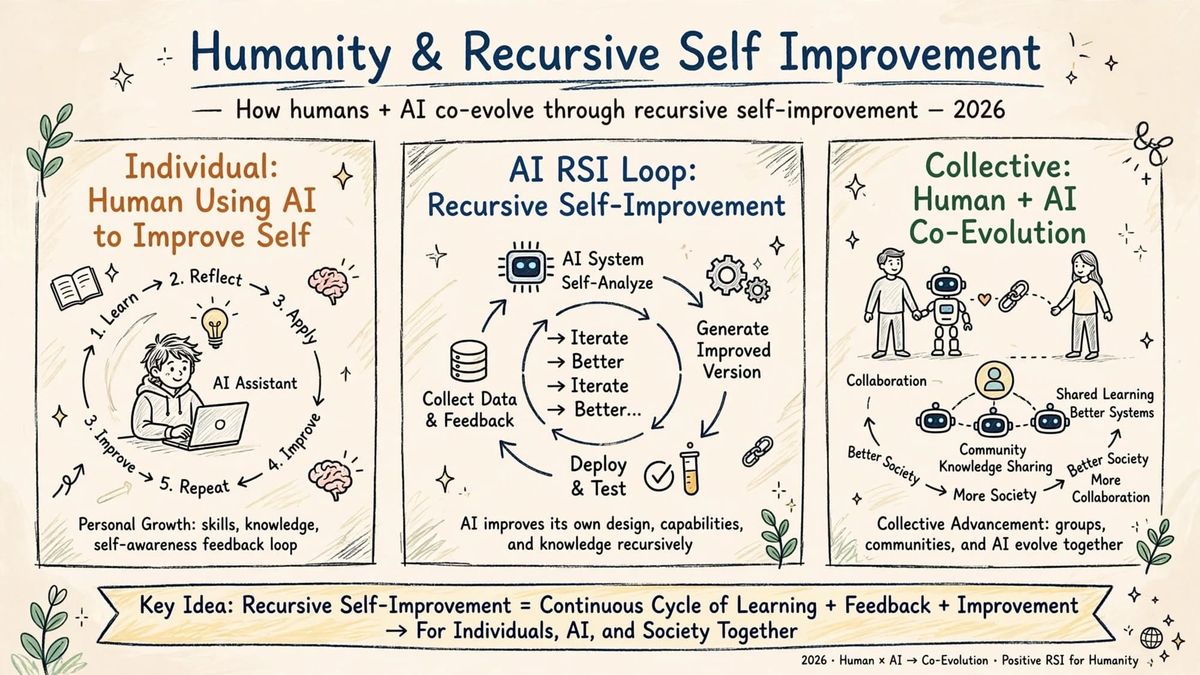
Everyone is talking about AI reaching RSI. The bigger question is how humanity uses AI to build RSI for itself, on an individual level and a collective level.
What RSI Really Means Now
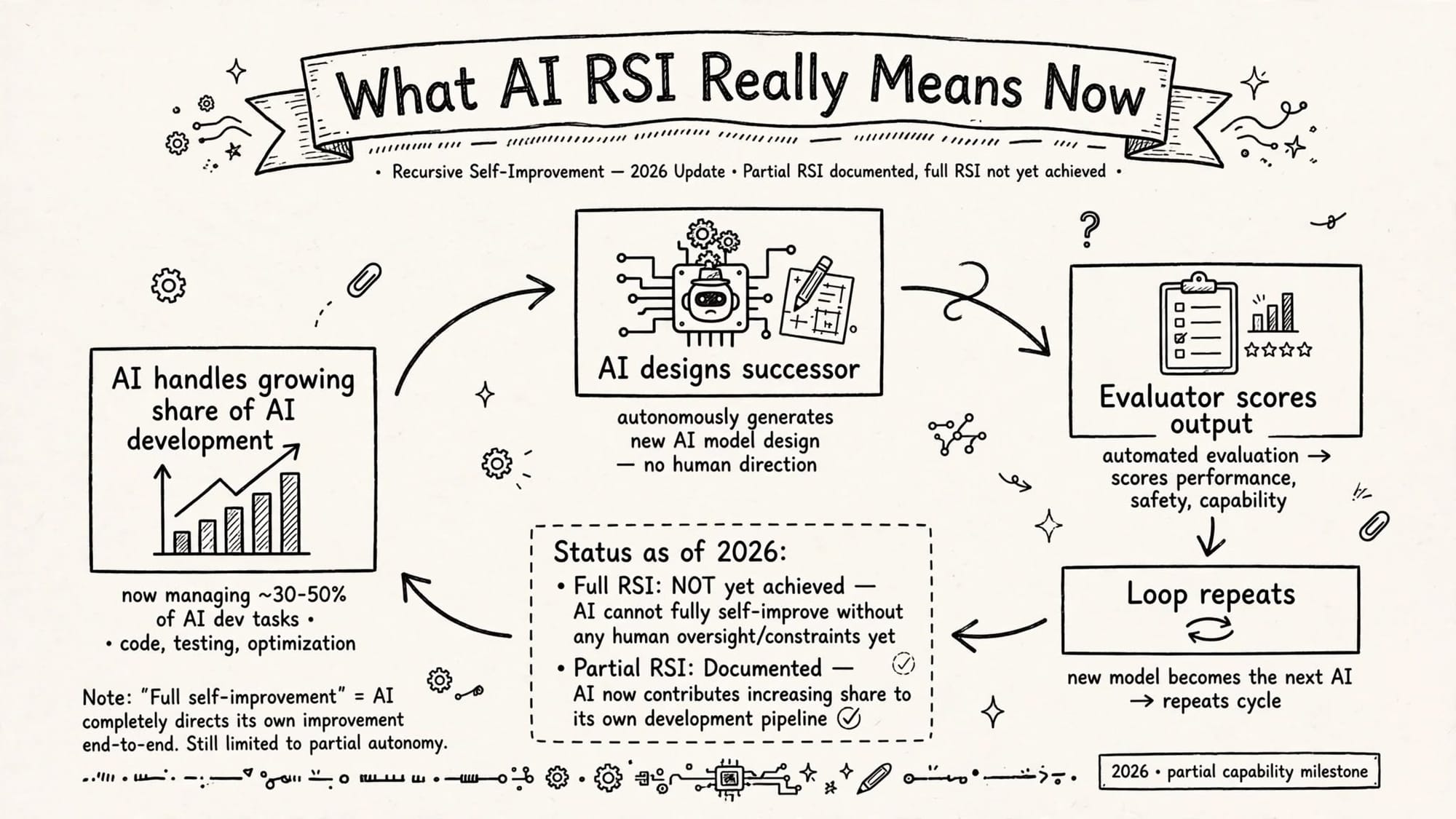
Recursive self improvement describes the capability milestone at which an AI system can fully autonomously design and develop its own successor, closing the loop between
AI use and AI improvement without continuous human direction at each step.
As of 2026, full RSI has not been achieved, but a partial version is documented: AI systems are handling a growing share of AI development work, and the trend toward greater AI involvement at each development stage is accelerating.
In practice, a recursive self improvement loop often looks like this: an evaluator scores the output using tests, metrics, human review, or another model.
The loop repeats until the score plateaus or a safety limit stops it.
The frontier of AI is no longer advancing in steady steps.
It is beginning to accelerate under its own power. Leading researchers warn that we are approaching a threshold where AI systems could autonomously rewrite and enhance their own code, architectures, and training processes.
As of now, partial RSI is visible. AI now contributes an increasing share to its own development pipeline, from code to testing to optimization.
Full end to end self direction is still limited.
The Human Question
If AI is learning to improve itself, how can humanity use AI to establish recursive self improvement on itself.
The same loop applies, but the system being improved is human, not model.
Individual RSI: The Human Loop
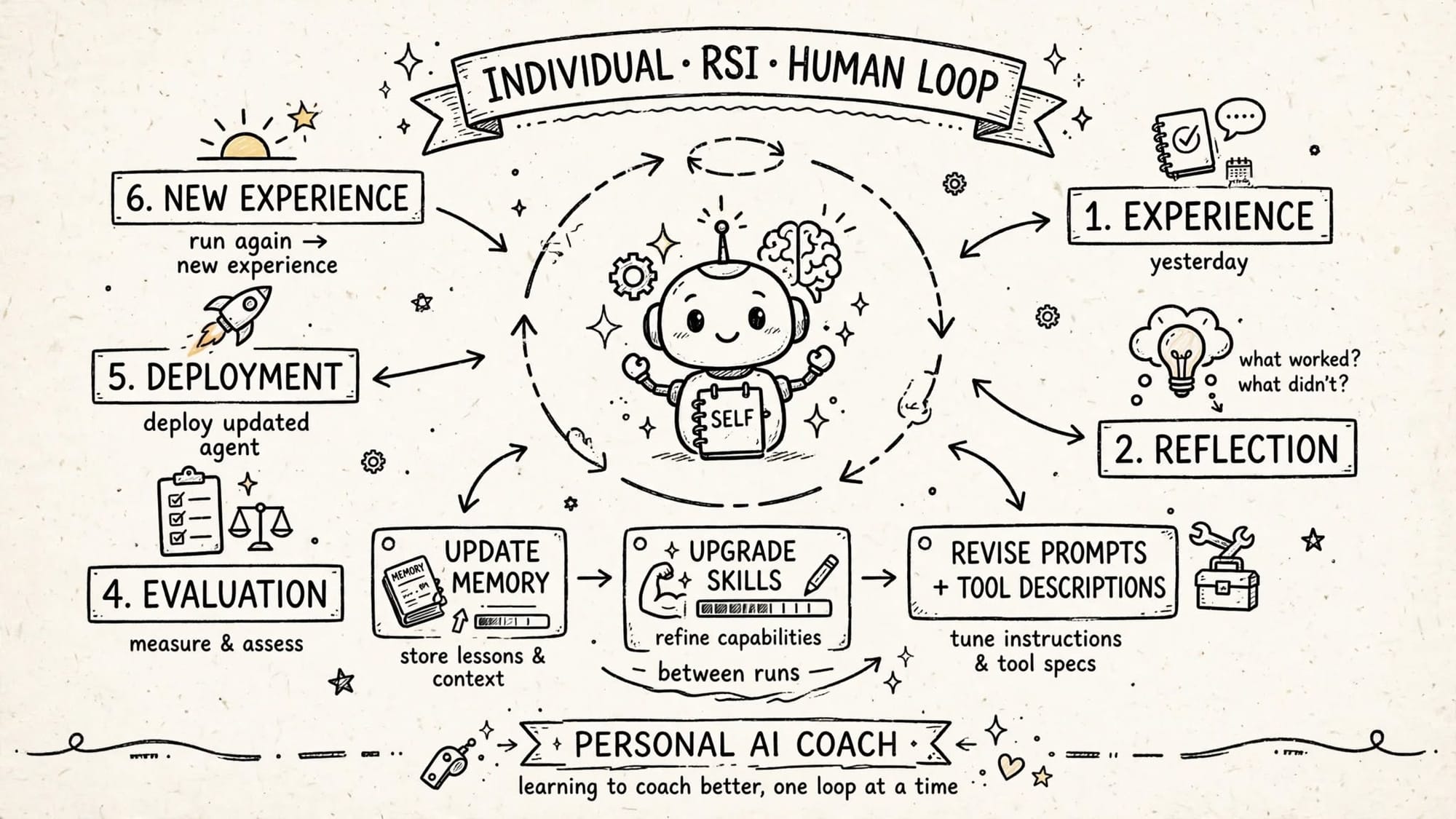
A self evolving agent updates its own memory, skills, prompts, tool descriptions, or even its model weights between runs, turning yesterday's experience into tomorrow's competence.
That exact architecture can be turned into a personal improvement system:
1. Experience: The human does the work. Meeting, writing, coding, workout.
2. Reflection: An AI agent reviews output, identifies flaws or gaps, and asks what worked and what did not. It uses feedback from its own reflection before finalizing results, turning a chatbot into a self critic.
3. Improvement: The agent updates memory, revises prompts and tool descriptions, stores lessons and context, refines capabilities between runs.
4. Evaluation: Measure and assess. Score quality, speed, health metrics, retention.
5. Deployment: Deploy updated agent. The personal AI coach now holds better instructions for tomorrow.
6. New Experience: Run again, new experience, loop repeats.
This is Experience to Reflection to Improvement to Evaluation to Deployment to New Experience.
Coaches are also learning how to coach better. The personal AI coach does not just work harder. It improves the whole loop. Done well, the agent gets steadily sharper without a human in the loop on every change.
Individual RSI example: a founder uses an agent to debrief each day, the agent stores decisions, rewrites its own coaching prompts, and next morning gives sharper guidance based on prior mistakes. The human improves because the AI improves at coaching.
Collective RSI: Cross Generational Skill Inheritance
The bigger unlock is collective.
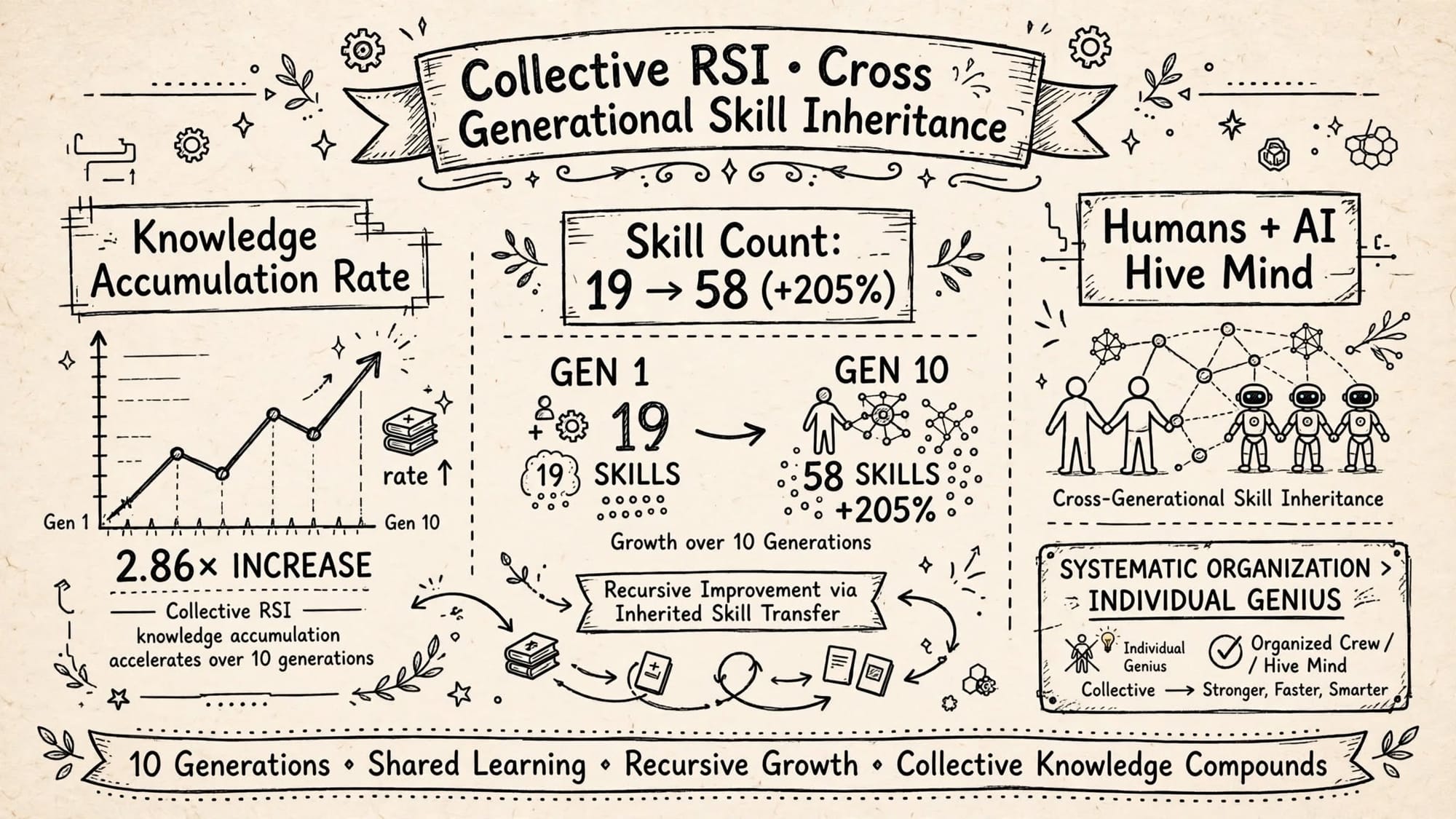
Experiment 5 provides the most significant finding: cross generational skill inheritance produces a 2.86x increase in knowledge accumulation rate over 10 generations, mean per step 5.48 in Gen 0 to 15.69 in Gen 9, with skill count growing from 19 to 58, plus 205 percent, demonstrating that recursive self improvement via inherited skill transfer is a viable mechanism for emergent intelligence amplification in autonomous agents.
Translation: when agents pass skills to the next generation, knowledge compounds.
For humanity, collective RSI looks like this:
Systematic organization beats individual genius.
Recursive self improvement through usage patterns is systematic organization applied to human AI collaboration itself.
Efficiency gains compound because each improvement to the collaboration makes the next improvement easier to discover and implement.
Collective loops:
- Shared memory across teams. One persons reflection becomes everyones prompt improvement.
- Skill inheritance. A sales team agent learns objection handling, that skill is inherited by onboarding, marketing, and product agents.
- Hive mind. Individual models function as components of greater intelligence, using the internet as long term memory. Recursive loop involves not only models but also human intermediaries who shape future iterations.
The evolution is from systems that primarily learn during training to systems that can learn from experience after deployment.
Self improving agents create a continuous feedback loop.
This is where humanity flips RSI. Instead of fearing AI that builds better AI, build systems where AI helps humans build better humans, who then build better AI, which helps humans again.
Individual RSI: one person becomes 10x because the personal coach compounds.
Collective RSI: ten people become 100x because skill inheritance compounds across generations.
Endless potential? The ICLR 2026 Workshop on Recursive Self Improvement is the first major academic workshop dedicated to RSI, framing contributions around alignment, security, long horizon stability, and regression risk, signalling RSI transition from fringe theory to mainstream AI science.
The question is no longer if AI reaches RSI. It is if humanity chooses to use the same loop for itself.