After Tokens Get Cheap, Fiber Is the Moat: Why Slow Internet Countries Must Build Now
Token costs are in freefall. The next bottleneck is not intelligence, it is infrastructure. Civilizations that do not lay fiber today will not run AI tomorrow.
1. Tokens Are Collapsing
We have crossed the threshold where intelligence is no longer expensive.
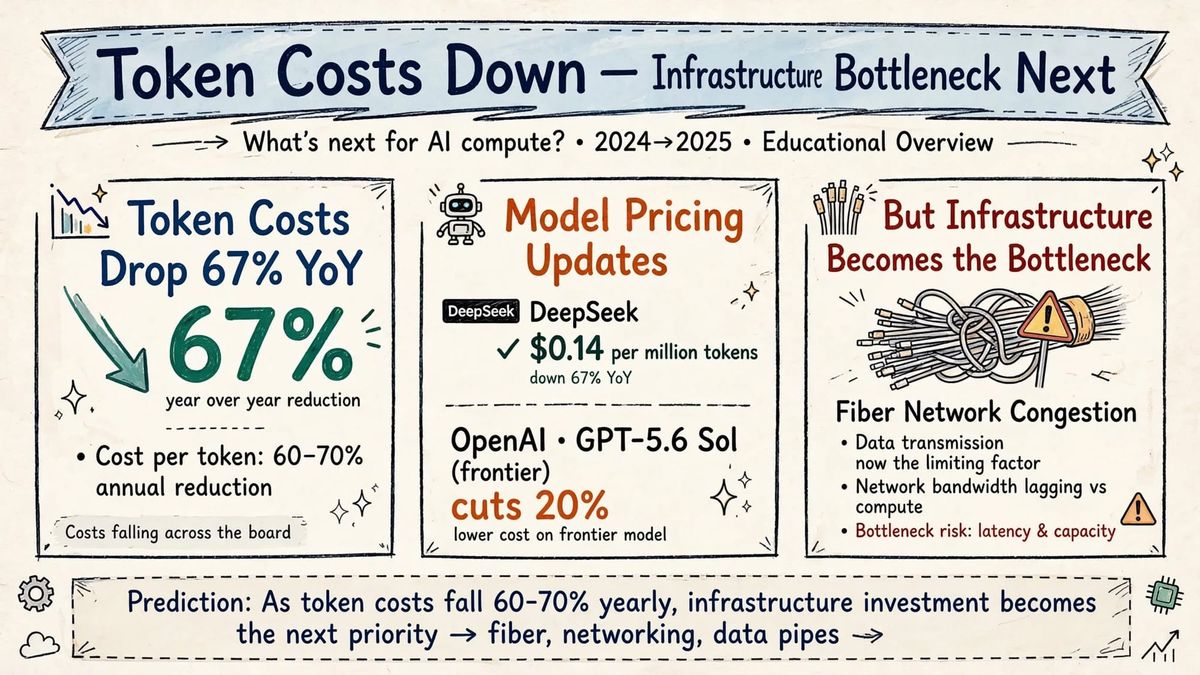
OpenAI cuts developer pricing for frontier GPT-5.6 Sol model by more than 20% for the next three months.
AICC Report: Enterprise Token Costs Drop 67% Year-Over-Year as multi-model adoption hits record high.
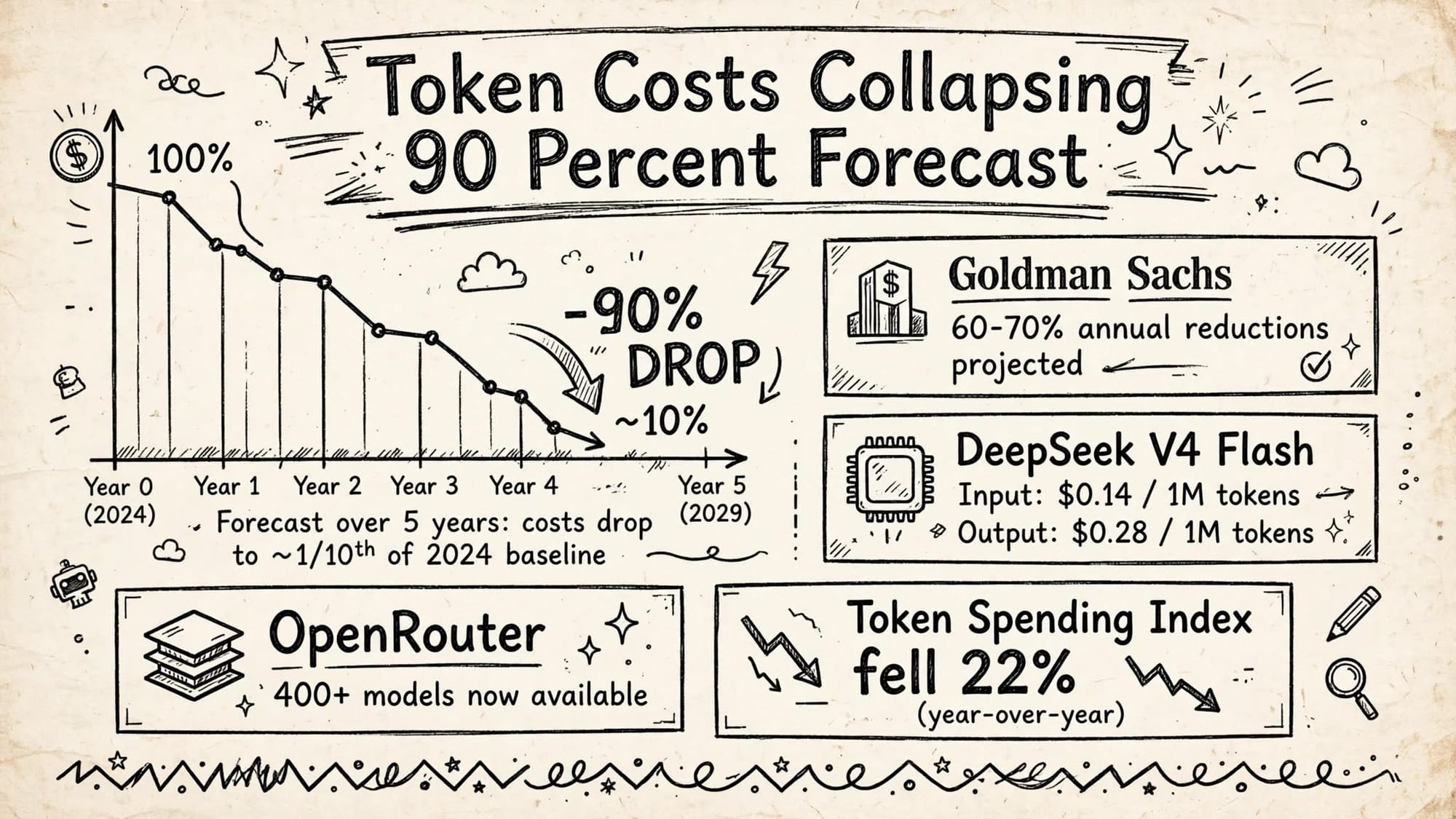
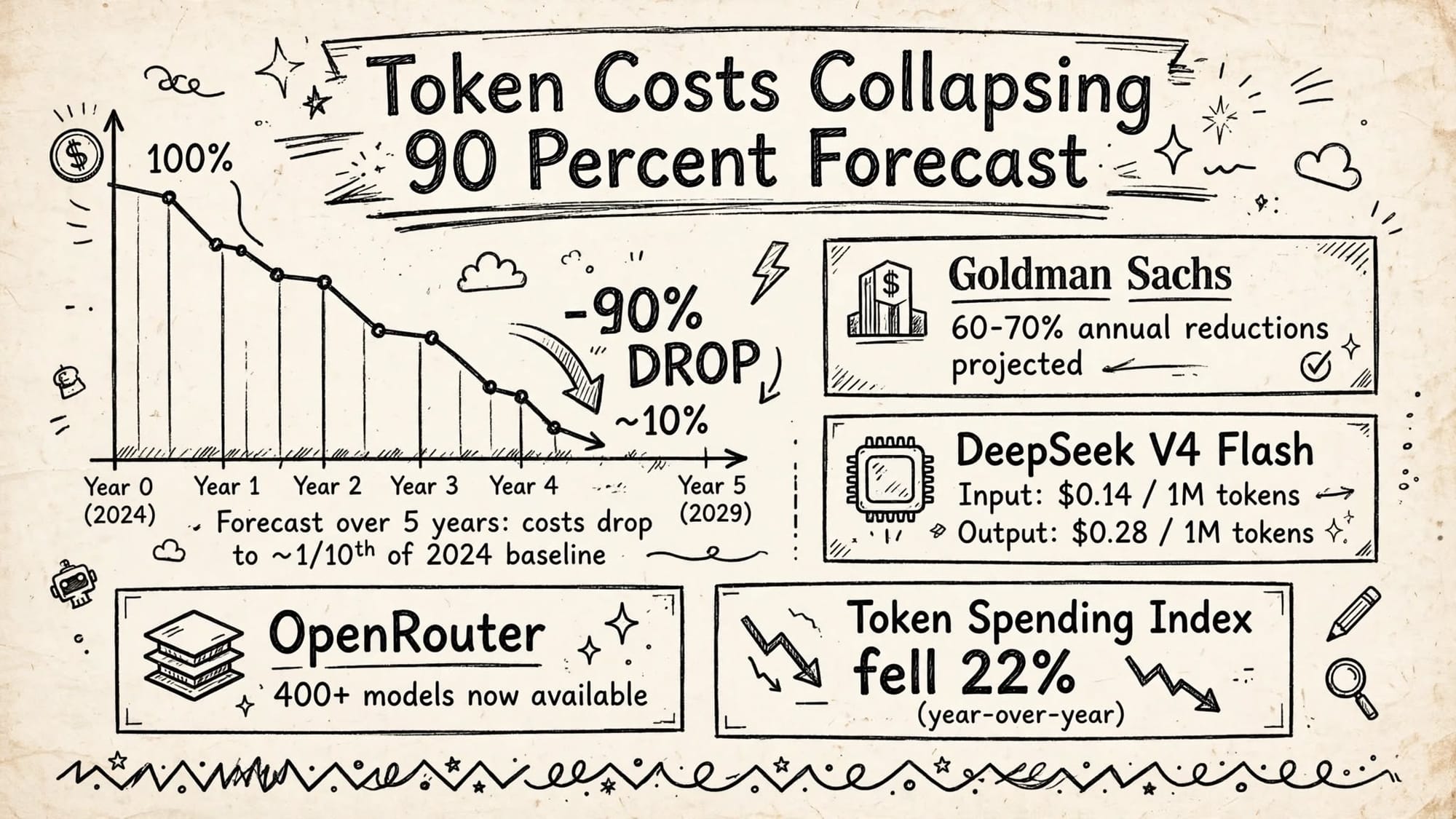
The price floor was set by DeepSeek V4-Flash at $0.14 per million input tokens and $0.28 per million output tokens on April 24, 2026 — following DeepSeek V3.2's earlier disruption at $0.28 per million input tokens.
Goldman Sachs has semiconductor suppliers delivering 60 to 70 percent annual reductions in cost per token.
Token costs for trillion-parameter models are forecast to drop by more than 90% over five years.
Token spending index fell 22% as companies route to cheaper Chinese models.
OpenRouter now gives 8 million users access to more than 400 AI models through a single platform.
Direction is clear: 60-70% annual reduction, 90% over five years, 67% YoY already. $0.14 is the new $28.
Intelligence will be near-free.
2. The Bottleneck Shifts: Fiber Is AI's Nervous System
When intelligence is free, what stops adoption?
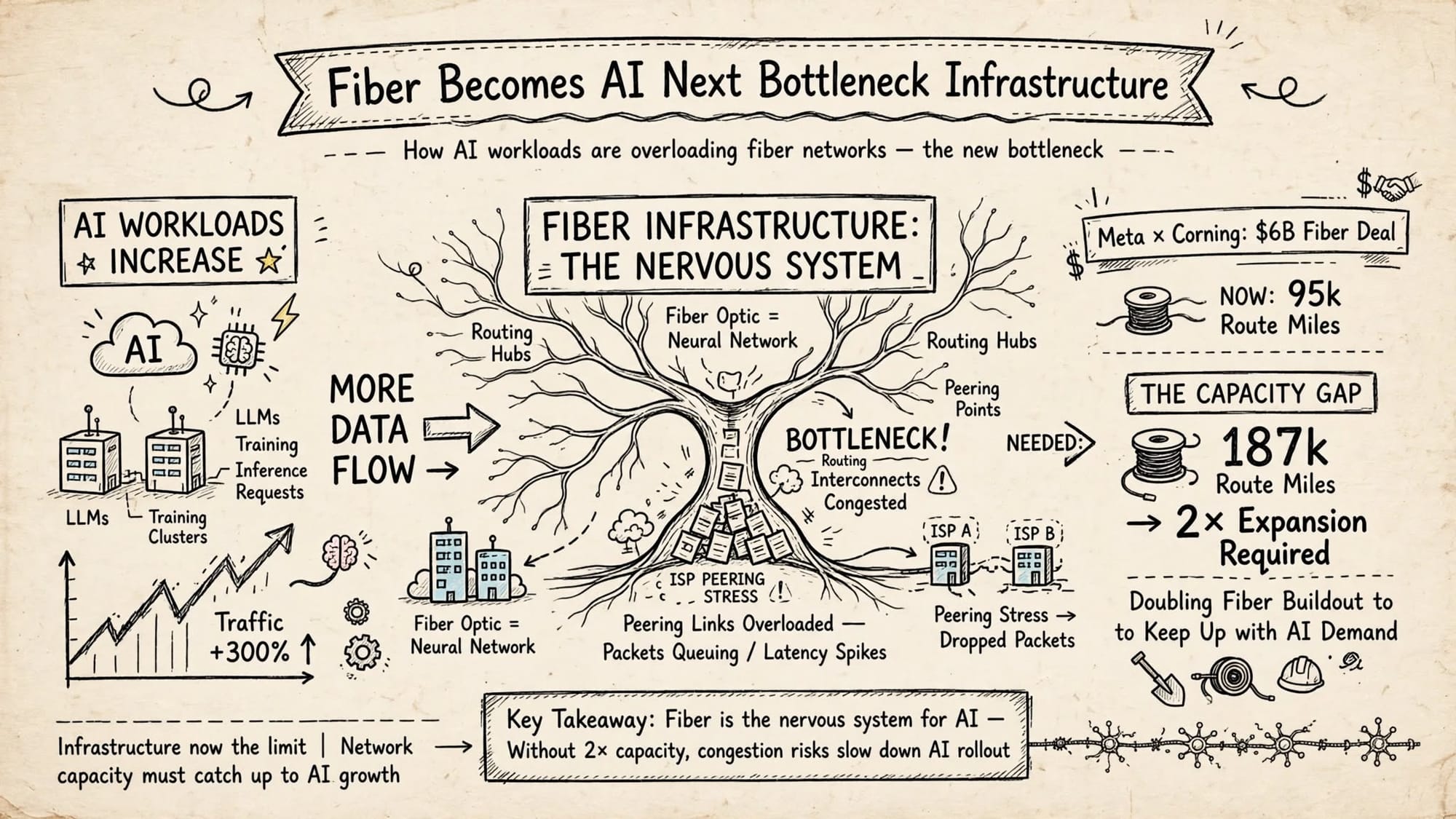
It's the network infrastructure, including routing, interconnects and protocols, that is becoming the real bottleneck as AI workloads increase.
Fiber becomes AI's next bottleneck. AI pushes fiber demand — inference and agentic AI will drive demand for high-speed, low-latency connectivity.
The network becomes a bottleneck, even as data center capacity is set to double in the U.S. over the next five years.
Meta has announced a $6 billion, multi-year fiber supply agreement with Corning, highlighting how AI infrastructure constraints are shifting beyond compute and into the physical network.
Numbers: US may need to nearly double fibre route miles from 95,000 to 187,000, and increase total fibre miles from 159 million to 373 million, by 2029 to support AI. Each new hyperscale datacentre requires 135 new route miles.
Why? AI workloads are not Netflix. They are persistent, east-west, high-bandwidth, low-latency, machine-to-machine. Training clusters chatter constantly. Inference at edge needs fiber backhaul. Regional ISPs and IXPs face increasing traffic asymmetry.
If the underlying infrastructure is not stable, the AI layer cannot perform.
3. The Token Divide Is Actually a Fiber Divide
This is where your point hits.
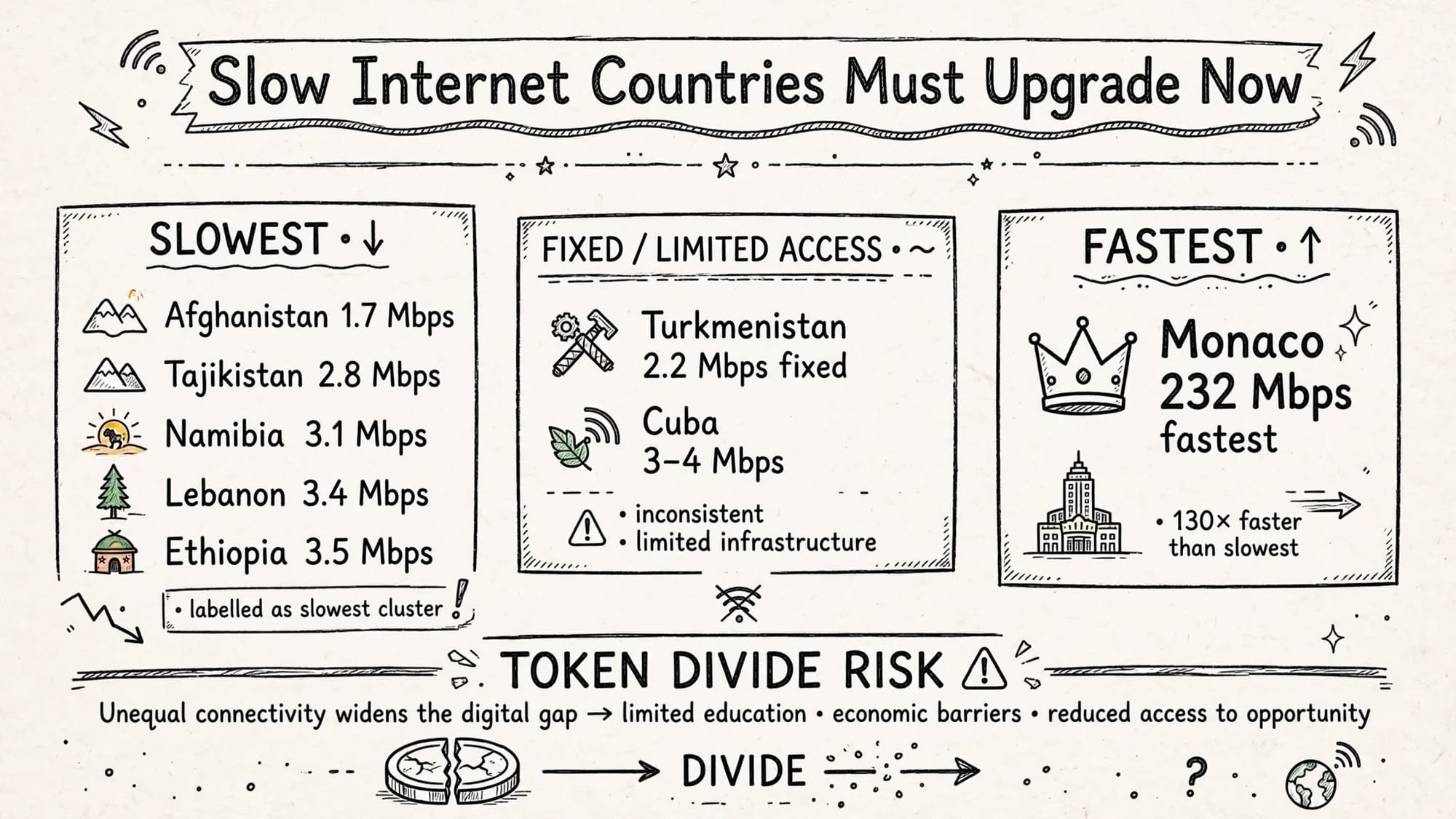
With a median download speed of 232.4 Mbps, Monaco ranked first. Afghanistan (1.7 Mbps), Tajikistan (2.8 Mbps), Namibia (3.1 Mbps), Lebanon (3.4 Mbps), and Ethiopia (3.5 Mbps) have some of the slowest connections.
Among countries in the Ookla ranked index, Turkmenistan has the slowest fixed broadband, with a median download speed of just 2.2 Mbps as of May 2026.
As of early 2026, Afghanistan and Cuba consistently rank among countries with slowest internet — Afghanistan often 4 to 5 Mbps, Cuba 3 to 4 Mbps.
Monaco 232 Mbps vs Afghanistan 1.7 Mbps = 136x gap.
When tokens were $10 per million, that gap did not matter — no one could afford AI anyway.
When tokens are $0.14, the gap is everything.
A student in Monaco can stream 100M tokens of GPT-5.6 Sol tutoring for pennies, real-time voice, video, agentic workflows.
A student in Afghanistan waits 30 seconds per response on 1.7 Mbps, cannot run multimodal, cannot run agents that need persistent low-latency.
The AI revolution threatens a token divide — falling per-token prices will not close the gap on their own, as increased usage, premium pricing for frontier models, and growing concentration of AI infrastructure could widen inequality even as costs decline.
The token divide is actually a fiber divide.
4. What Countries Must Do Now — Before It Is Too Late
Civilizations adopting AI will not be limited by model access. Models will be open, cheap, routed via OpenRouter. Bottleneck will be:
- Fiber route miles
- Last-mile broadband
- IXP capacity and peering stress
- Power + cooling for edge inference
- Latency to frontier models
Countries with slow internet speeds need to start improving their connectivity already — not in 2030 when token costs hit $0.01, but now.
Because fiber takes 5 years to lay. Data centers take 3 years to build. AI adoption takes 6 months once tokens are cheap.
If you start when tokens are already cheap, you are 5 years late.
Playbook:
- Double fiber route miles now — target 2x expansion required by 2029. Like Meta x Corning $6B.
- Fix fixed broadband — Turkmenistan 2.2 Mbps fixed, Cuba 3-4 Mbps — cannot run agentic AI on that.
- Build IXPs and peering — reduce international transit, keep inference local.
- Subsidize last-mile — token divide → economic divide → limited education, economic barriers, reduced access to opportunity.
Tokens down 67% YoY is celebration. But if your fiber is 1.7 Mbps, you cannot even download the celebration.
Infrastructure is the moat of civilizations.