iPhone Duo: Will It Bring In More Developers to Adapt or Push for Generative UI?
Apple's first foldable at $1,999 is not a hardware story. It is a developer story. Will you hand-code adaptive layouts for two screens, or will you let AI generate the UI?
The Surprise and Shine
Apple's long-awaited foldable phone announced at the company's Surprise and Shine event on Wednesday, contains a number of surprises, including a critical hinge that was designed and built with the help of AI and 3D printing.
Apple debuts $1,999 passport-shaped foldable phone, called Duo. The larger screen will support multiple app windows at once, a move aimed at productivity that Apple has made with some of its iPads.
Apple today announced the "iPhone Duo," a new kind of iPhone featuring two screens and a foldable inner display. The two halves connect into a single continuous frame with the same aspect ratio across both displays, and Apple said transition is fluid. When fully open, it is the thinnest iPhone ever made.
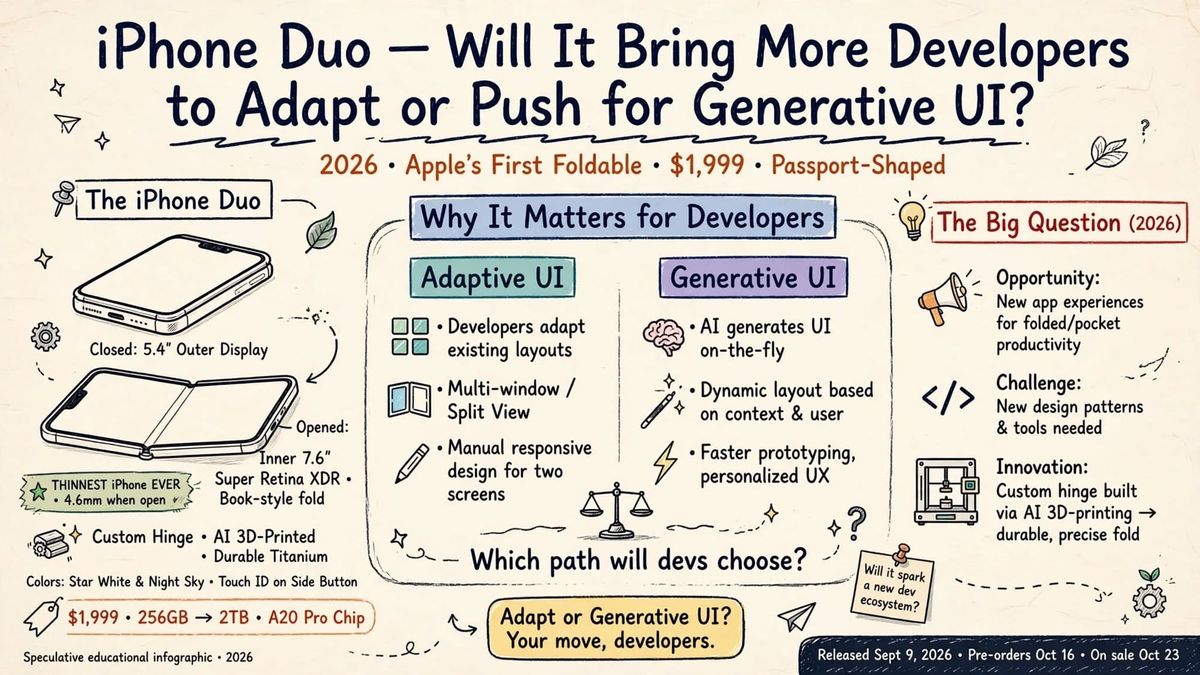
Specs from leaks and confirmed: Closed 5.4" outer display, opened 7.6" inner Super Retina XDR book-style fold, thinnest iPhone ever ∼4.6mm when open, custom hinge AI 3D-printed durable titanium, Touch ID on side button, colors Star White & Night Sky, A20 Pro chip, $1,999 256GB → 2TB, released Sept 9 2026, pre-orders Oct 16, on sale Oct 23.
The Developer Problem: Adapt
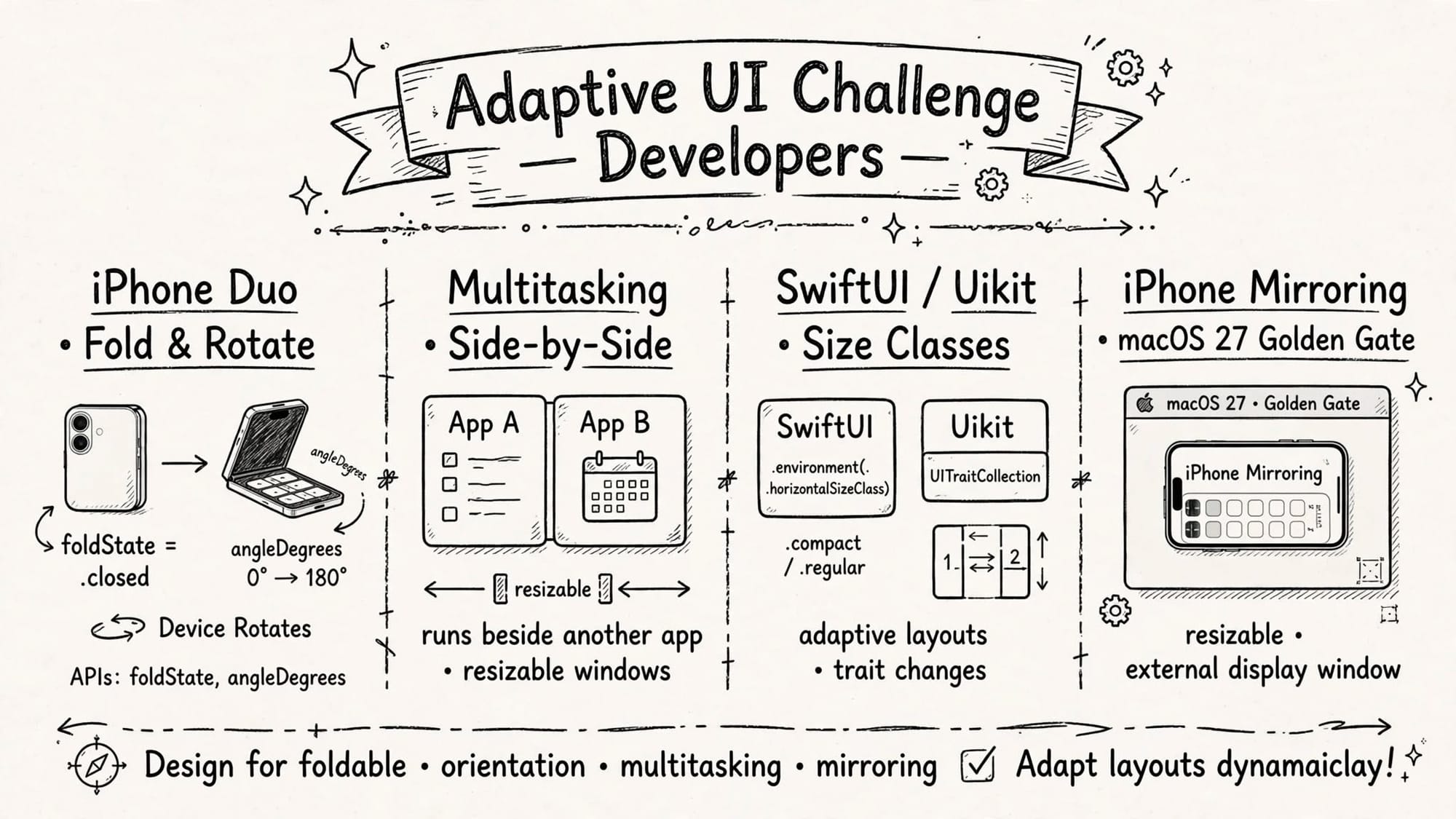
An app must adapt when iPhone Duo opens, closes, rotates, or runs beside another app.
Apple has built new APIs for developers to adapt their apps to the dual-display design, and iPhone Duo support is coming to Device Hub in Xcode.
Foldable devices introduce variable interface that challenges traditional fixed-screen app architecture. Developers have long designed for linear layouts where resolution is predictable. iPhone Fold could disrupt this by requiring adaptive frameworks that respond to folds, splits, and expanded states.
Apple's push:
- foldState = .closed / .open + angleDegrees 0° → 180° — spotted in iOS 27 frameworks
- Multitasking side-by-side — users will be able to run two apps side by side on larger internal display
- SwiftUI / UIKit size classes — new changes coming to SwiftUI, pushing devs to make apps work better across different screen sizes and aspect ratios. Size classes concept from 2014 WWDC was precursor to iPhone 6 and 6 Plus — same pattern now.
- iPhone Mirroring macOS 27 Golden Gate — allowing connected iPhone to be resized to iPad-sized layouts
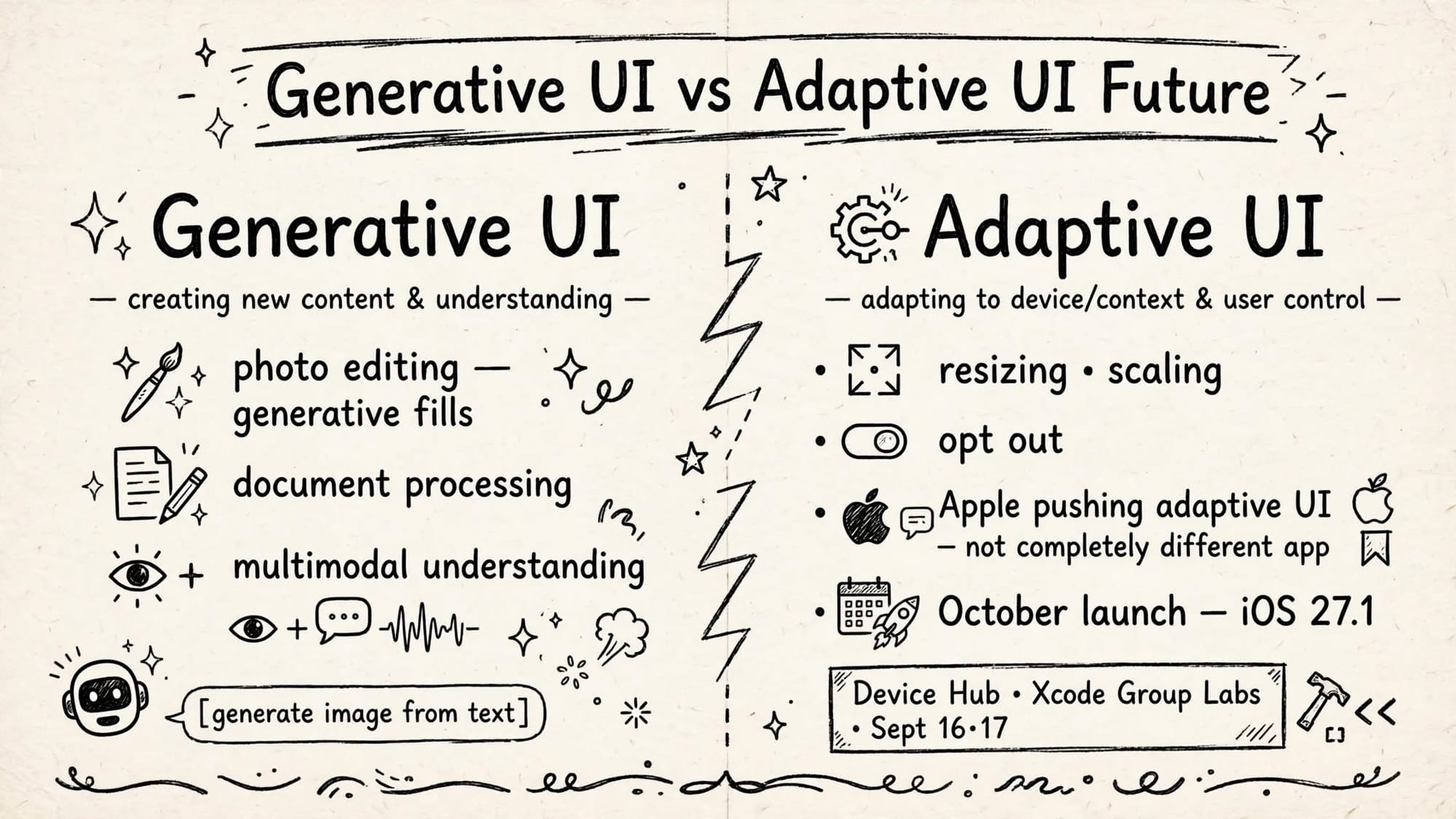
- Apple isn't asking developers to create completely different app for foldable. Instead pushing toward Adaptive UI. That includes two iPhone Duo Group Labs scheduled for September 16 and 17, Q&As on Photos & Camera, SwiftUI, UIKit Sept 23. iOS 27.1 alongside Duo in October.
But asking every major app developer to properly support a foldable inner display and separate outer display will take longer than six weeks between announcement and ship date.
My Take: The Generative UI Fork
Here is the strategic fork everyone is missing.
Apple is preaching Adaptive UI: Developers build responsive layouts, manual design for screen sizes, predictable, tested, structured. Developers adapt existing layouts, multi-window / split view, manual responsive design for two screens.
But the foldable form factor unlocks Generative UI:
For a foldable device with large inner display, that unlocks entirely new categories of apps — photo editing with generative fills, document processing with multimodal understanding, real-time.
- AI generates UI on the fly
- Adapts dynamically to user & context
- Less manual code, more prompt-driven
- Faster prototyping, personalized UX
My prediction:
iPhone Duo will not bring in more developers to adapt. It will push the industry to skip adaptation and go straight to Generative UI.
Why? Because adaptive UI for foldable is hell. You must handle the crease, manage difference in aspect ratios between folded and unfolded states, preserve continuity across transitions, resizable windows, angleDegrees, trait changes. That's 3x QA.
Generative UI: you prompt "build a note app that works closed as single column and open as canvas + sidebar with generative fill." Model generates SwiftUI that respects foldState automatically. No hand-coding .compact / .regular.
The dev who learns new foldable design patterns and builds for two-screen UX is playing the 2014 game. The dev who uses AI to auto-create adaptive interfaces is playing the 2026 game — and the hinge itself was built with AI and 3D printing. Apple told you.
Opportunity: New app experiences for folded/pocket productivity. Challenge: New design patterns & tools needed. Innovation: Custom hinge built via AI 3D-printing → durable, precise fold.
So which path?
- More Devs Adapt → Learn new foldable design patterns, build for two-screen UX
- Push for Generative UI → Use AI to auto-create adaptive interfaces
Cost $1,999 could limit adoption, but flywheel that rewarded Apple for 18 years — larger canvas tempts developers with new ways to earn money.
iPhone Duo is actually a software story. And the software story is: Will you adapt, or will you generate?