Would Tesla Exist Without EV Credits? The Real Story of Capital Alchemy vs Innovation
Tesla made over 13.5 billion dollars selling regulatory credits. Without them, 2020 would have been a loss. But credits alone do not build a 44.1 billion dollar cash fortress. The real story is how Musk turned competitor failures into permanent factories.
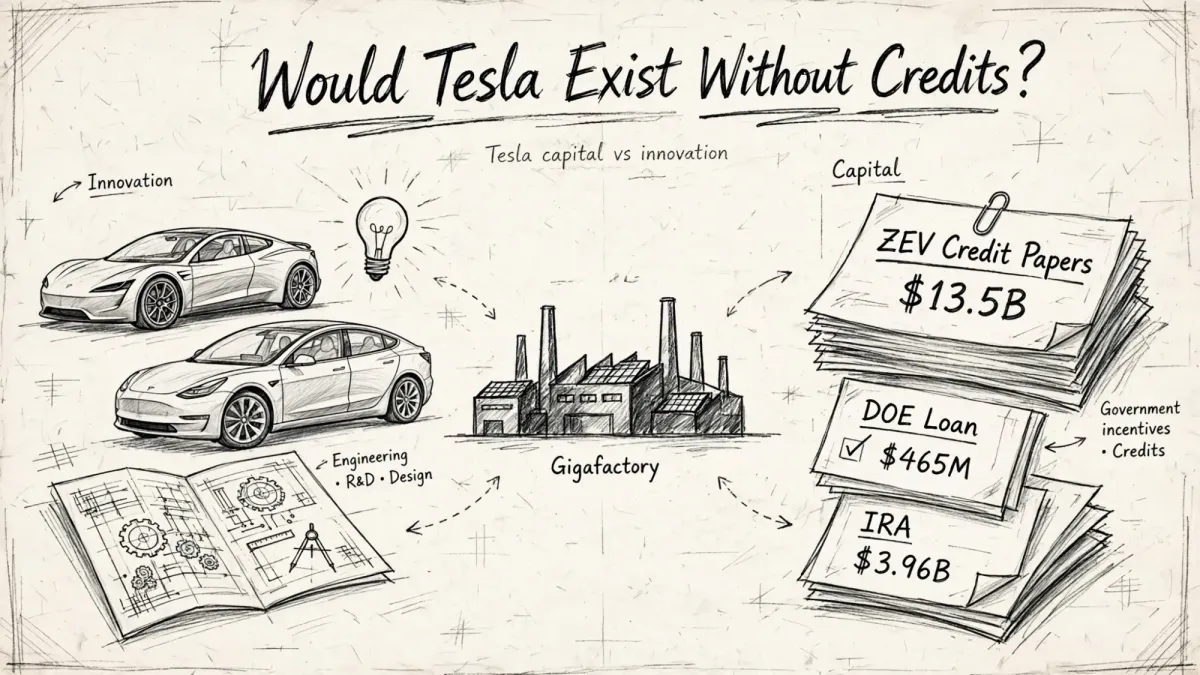
We assume Tesla won because it built a better car. In reality, it won because it turned competitor failures into a permanent factory.
Inspiration: Reading the 10-K history where 2020 shows 721 million dollars of GAAP profit and 1.58 billion dollars of credits. Realizing that profitability was an accounting bridge, not an engine, but the bridge is what allowed the factory to get built.
The Valley of Death
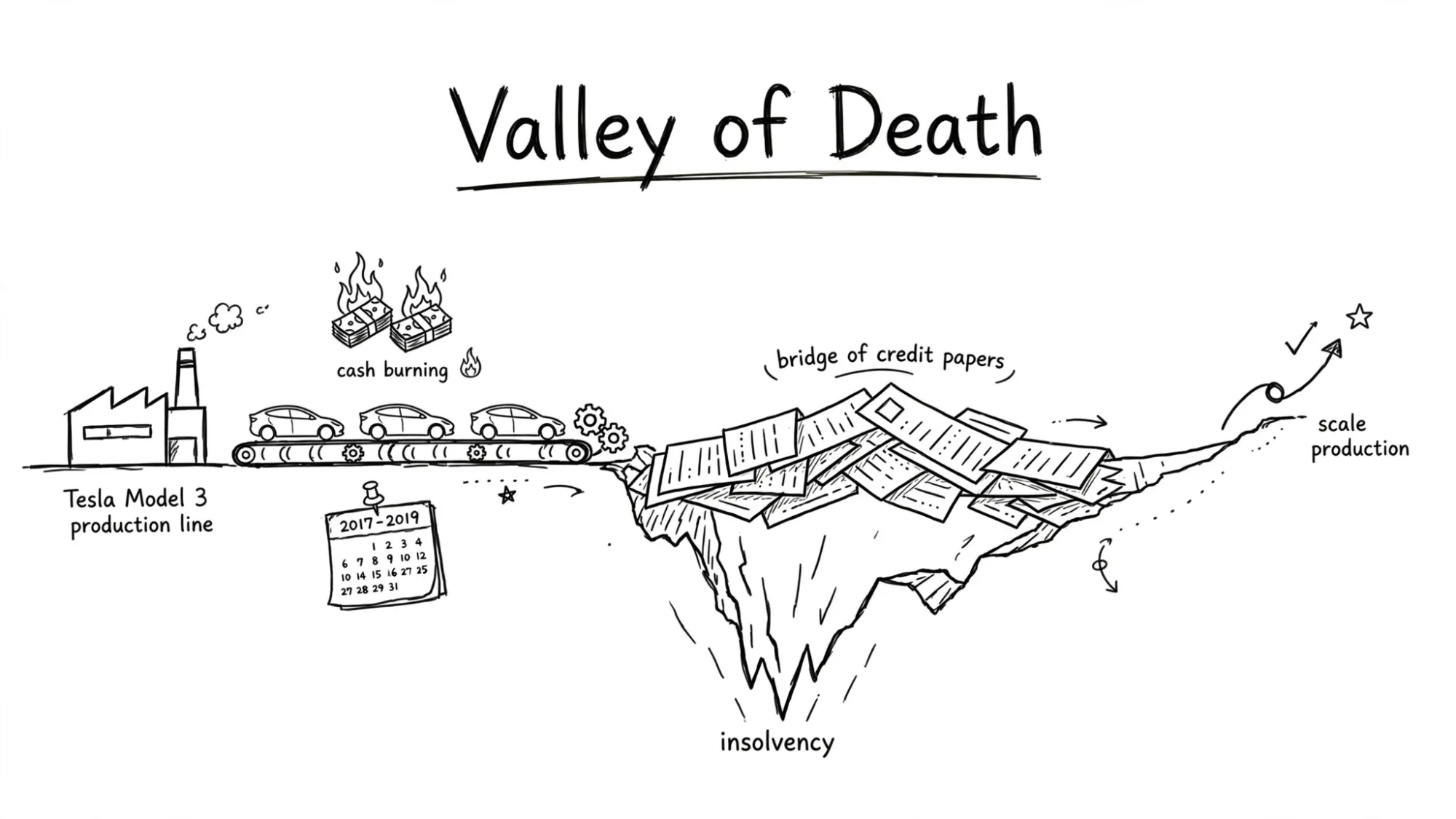
Every car company dies in the same place.
Between prototype and mass production, cash burn explodes while revenue stays flat. For Tesla, that was 2017 to 2019, the Model 3 ramp.
The company burned billions trying to automate the line. What kept the lights on was not car margin. It was regulatory credits that flow at 100 percent gross margin.
Over the past decade, Tesla has amassed over 13.5 billion dollars in direct regulatory credit sales. That capital was not a bonus. For much of its history, it was the sole driver of net profitability. Without it, the 2017 to 2019 ramp would have forced a distressed raise at the worst possible valuation, or worse.
Innovation got Tesla into the valley. Credits got it across.
The Credit Machine Everyone Ignores
To understand the machine, you have to understand the compliance market.
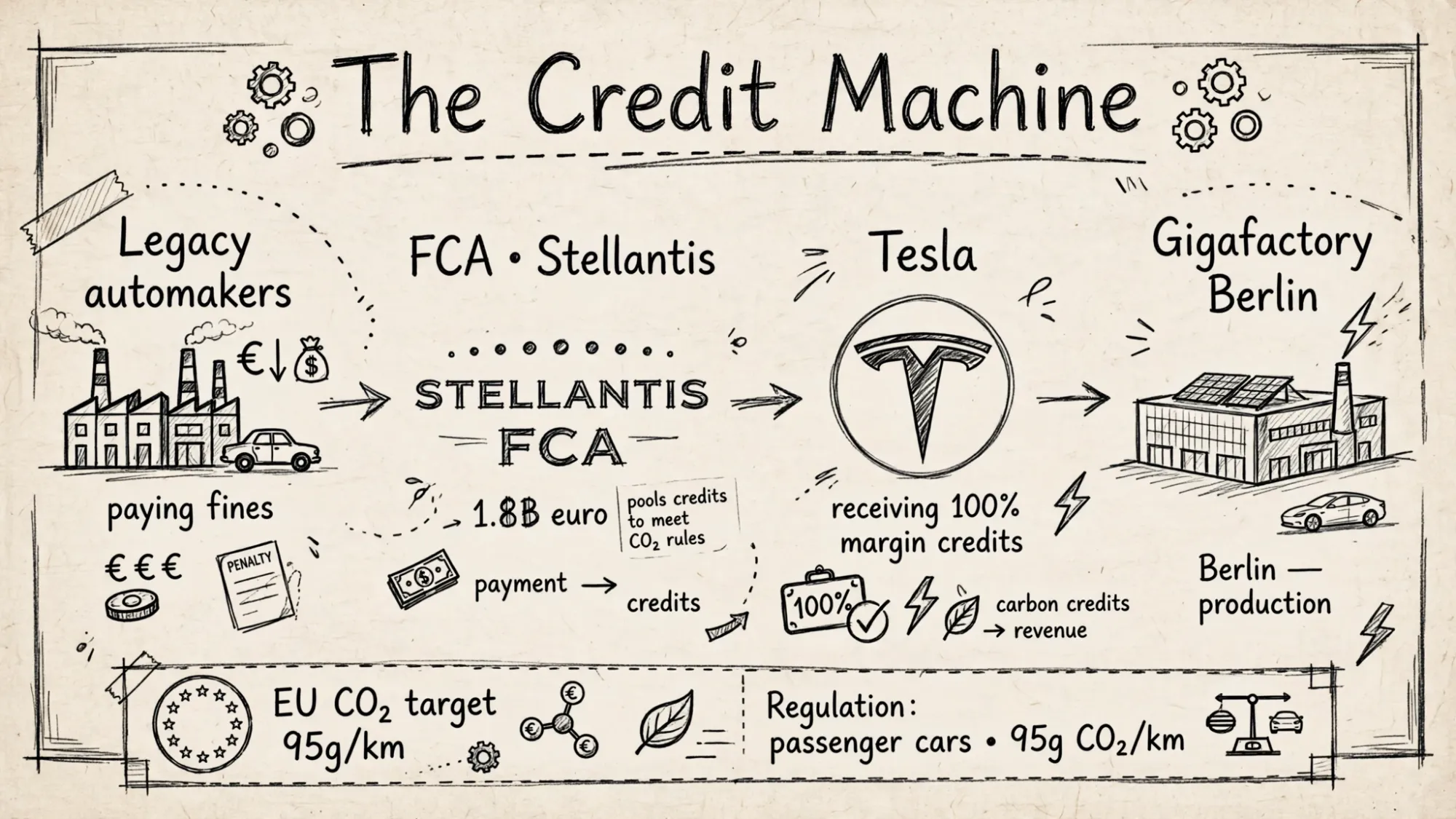
Governments in California, the US EPA, the EU, and China set emission targets. Legacy automakers who miss those targets pay fines. They can avoid fines by buying credits from companies that over comply. Because Tesla makes zero internal combustion vehicles, every car it makes generates a surplus of credits.
From an accounting view, credit revenue carries zero cost of goods sold. It flows directly to the bottom line.
The numbers tell the story:
- 2020: First full year of GAAP profitability. 721 million dollars net income, but 1.58 billion dollars in regulatory credits. Without credits, a loss of about 859 million dollars.
- 2024: Net income halved from 14.9 billion to 7.091 billion dollars as price cuts and rates hit. Regulatory credits surged 54 percent to a record 2.763 billion dollars. In Q4 2024 alone, credits were nearly 30 percent of net income.
- 2025: 1.993 billion dollars in credit revenue cushioning net income down to 3.794 billion dollars.
The European pooling case is the cleanest example. Facing multi billion euro fines under the EU 95 gram per kilometer target, Fiat Chrysler paid an estimated 1.8 billion euros over multiple years to pool emissions with Tesla. In effect, a legacy incumbent directly financed Gigafactory Berlin to avoid its own fines. Stellantis ended the deal in 2021 after merging with PSA, but by then the factory was already rising.
The 100 Percent Margin Bridge to Berlin
Credits are often described as a subsidy. That framing misses the point.
Direct support is broader than ZEV credits. The research puts total government support across the US and China at about 29.5 billion dollars. That includes:
- Off balance sheet consumer support: Section 30D federal EV tax credit, about 7.33 billion dollars. It does not hit Tesla's income statement, but it protects pricing power by lowering the effective price for buyers.
- Local tax packages: Gigafactory Nevada secured up to 195 million dollars in transferable credits plus abatements. Texas gave 70 to 80 percent property tax relief for 20 years. Shanghai granted a 15 percent corporate income tax rate versus the statutory 25 percent, plus land rights tied to capex targets.
- Supply side credits: IRA Section 45X, 35 dollars per kilowatt hour for cells and 10 dollars for modules, 45 dollars if modules do not use distinct cells. A 75 kilowatt hour pack made domestically yields 3,375 dollars in direct federal credit. Tesla recognized 750 million dollars in 2023, 1.2 billion dollars in 2024, and a projected 900 million dollars in 2025. In 2024 combined, regulatory credits 2.76 billion plus 45X 1.2 billion equals nearly 3.96 billion dollars of direct on income statement support, the highest single year ever.
These credits act as a margin buffer.
By Q4 2025, raw automotive gross margins excluding credits compressed to 13.6 percent. The credits lift reported margins back to a level that keeps capital markets comfortable, which then gives pricing flexibility to start a price war that competitors cannot match.
Why Ford Still Loses 132k Per EV and Tesla Does Not
If you want to see why credits were essential, look at Ford Model e today.
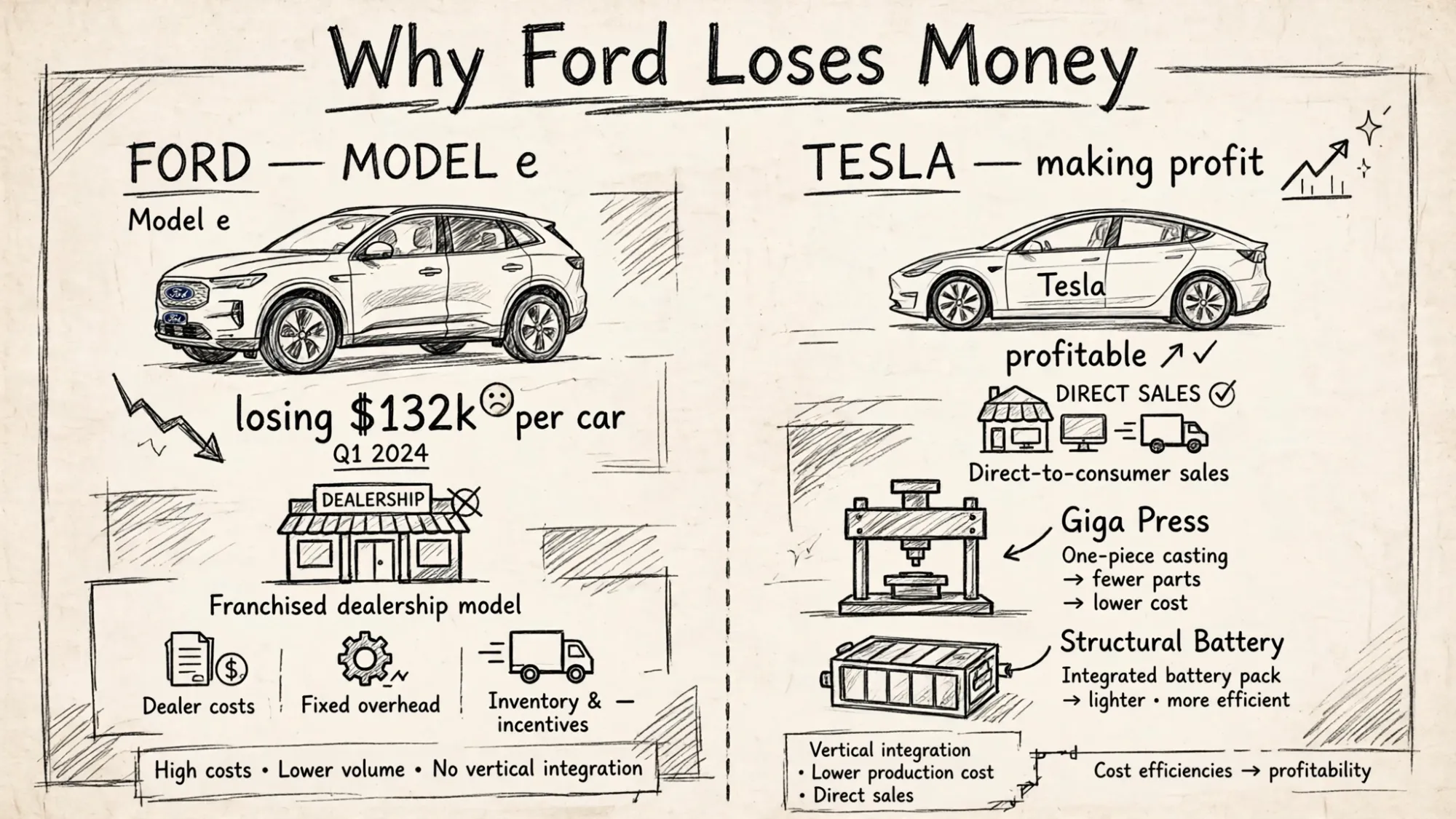
Ford reported a 1.3 billion dollar loss on just 10,000 vehicles in Q1 2024, about 132,000 dollars lost per EV sold.
In Q2 2025, EBIT loss of 1.329 billion dollars on 16,438 sales, margin minus 56.4 percent, burn of 22,000 to 80,000 dollars per vehicle. Full year 2025, 4.8 billion dollars loss, with 4.0 to 4.5 billion dollars projected loss in 2026, profitability pushed to 2029.
Why the gap?
- Scale and amortization: Ford is amortizing billions in new EV plants over 16,000 units per quarter. Tesla amortized the same pain in 2017 to 2019 over credits that kept the income statement alive.
- Architecture: Legacy uses dozens of ECUs from different suppliers. Tesla uses centralized domain controllers, own Hardware 3 and 4 silicon, structural battery, single piece Giga casting that eliminates hundreds of parts.
- Go to market: Franchise dealer laws force margin sharing and slow price moves. Tesla's direct model keeps retail margin and allows real time pricing.
- Credit capture: Low volume means Ford cannot claim as much IRA 45X as a company building nearly 2 million cars.
Tesla started a price war in 2023, cutting up to 20 percent, because its cost structure and credit cushion allowed it.
Ford had to match to hold share, and bled.
Innovation Without Capital Is Just Invention
So would Tesla be where it is today without EV credits?
No. The data is clear. Without regulatory credits and the broader 29.5 billion dollars of support, Tesla would have faced insolvency before 2020.
The bridge would not have existed.
But that does not mean Musk is a subsidy farmer.
That misreads how industrial economics works.
Credits are only earned if you build a desirable zero emission vehicle that consumers buy at scale.
The market does not hand 100 percent margin revenue to PowerPoints.
You have to ship cars people want.
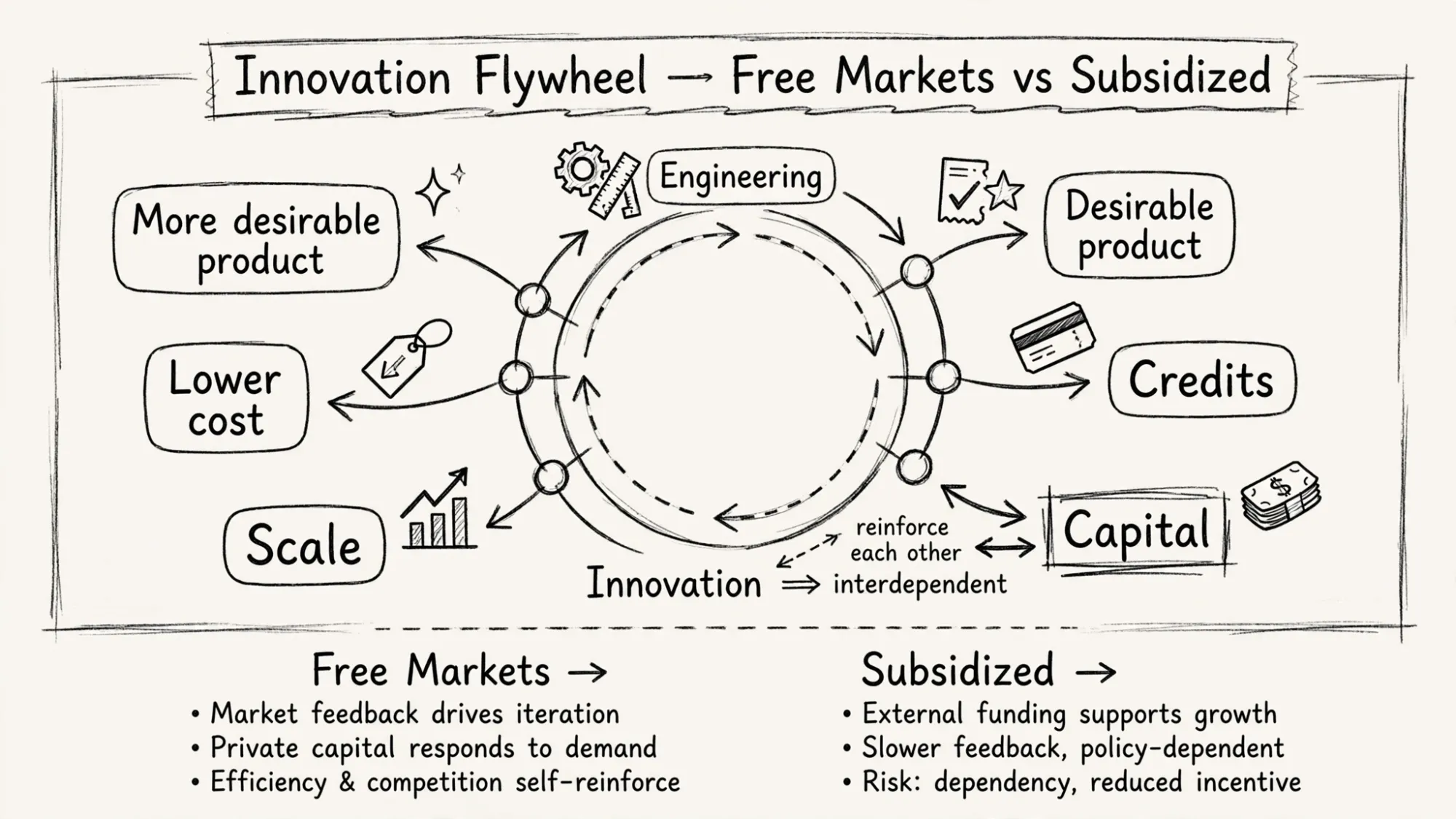
The flywheel that actually built Tesla is interdependent:
- First principles engineering created a software defined vehicle that legacy could not quickly replicate
- Shipping that vehicle generated credits across CARB, EPA, EU, and China NEV mandates
- Legacy failure to ship compelling EVs forced them to buy those credits to avoid fines
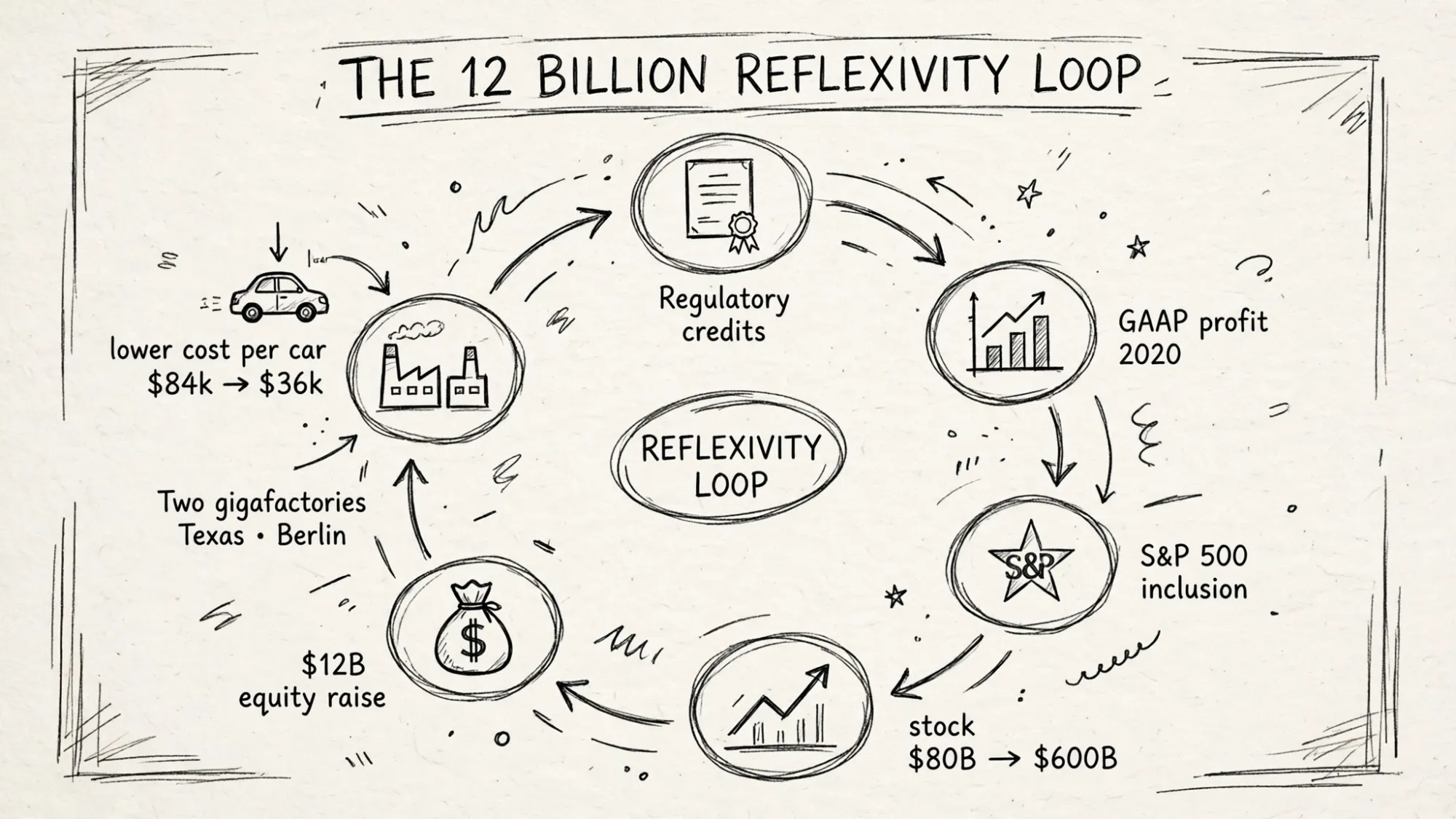
- Pure profit credits masked losses and created GAAP profitability in 2020
- GAAP profitability triggered S&P 500 inclusion and a rally from 80 billion to 600 billion dollars
- That valuation was monetized into 12 billion dollars of equity with low dilution
- That cash built Texas, Berlin, 65,000 Supercharger stalls, 11.0 gigawatt hours of Megapack deployment in 2024, and Energy revenues of 12.77 billion dollars in 2025
Innovation without capital is just invention. Capital without innovation is just a subsidy.
Tesla's skill was linking the two in a regulated, capital intensive industry where timing is everything.
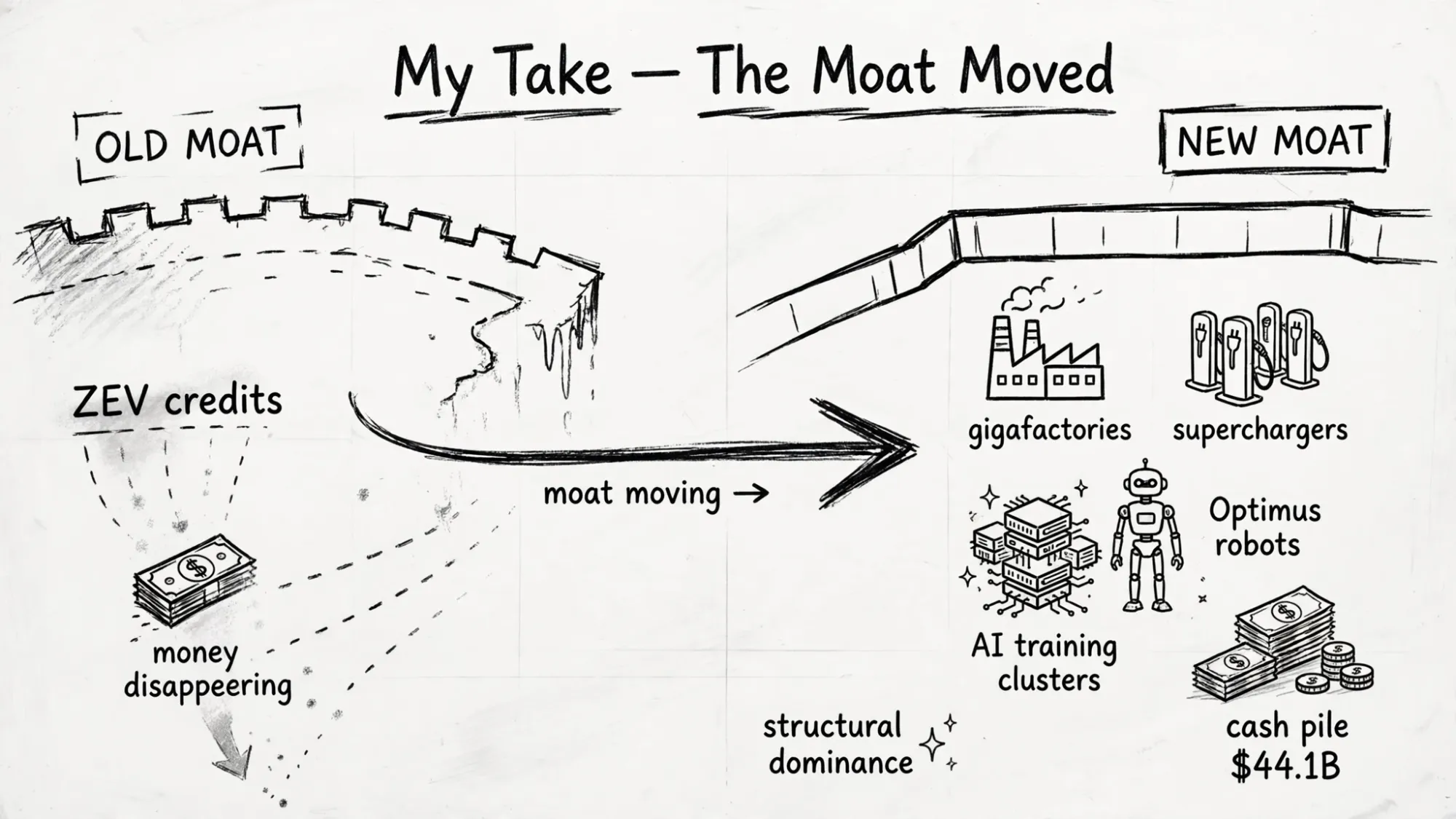
My Take: The Moat Moved
The regulatory credit era is ending. As competitors slowly electrify, ZEV pooling revenue will fade.
Tesla knows this, which is why it pivoted to harvesting supply side 45X credits and deploying its 44.1 billion dollar cash hoard into AI training, Robotaxi Cybercab, and Optimus.
My take is simple. Do not ask if Tesla needed credits. It did. Ask what it did with them.
Many companies get subsidies and build nothing durable.
Tesla turned temporary compliance revenue into permanent structural moats: localized gigafactories that ingest raw material at one end and ship finished cars at the other, a proprietary charging network that solved range anxiety before demand existed, and a manufacturing cost from 84k to 36k that allows it to set price while others set losses.
That is not subsidy farming.
That is capital alchemy in service of innovation.
And that is why the gap between Tesla and Ford Model e is not closing, it is widening.
Want me to generate the Ghost feature image and social cards with this same 16:9 ratio?