AI & Grandmother Effect: Will It Amplify or Reverse It
Post-menopausal longevity evolved to feed grandchildren. AI now wants that same job — will it make grandmothers super-powered or obsolete?
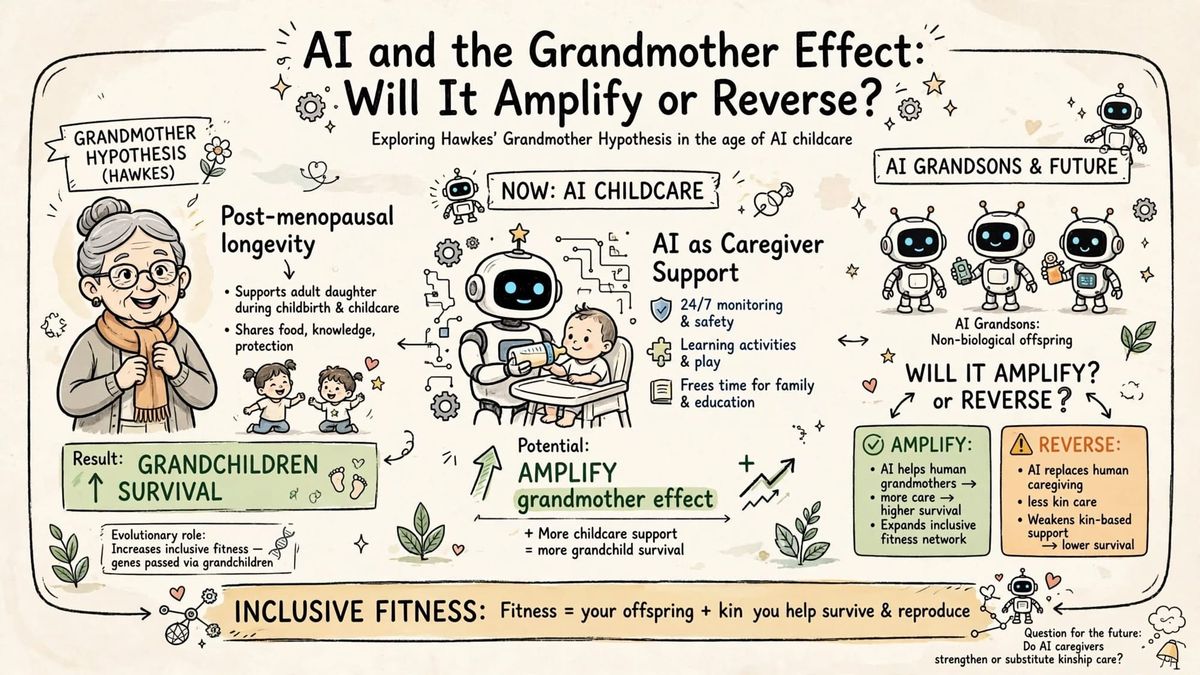
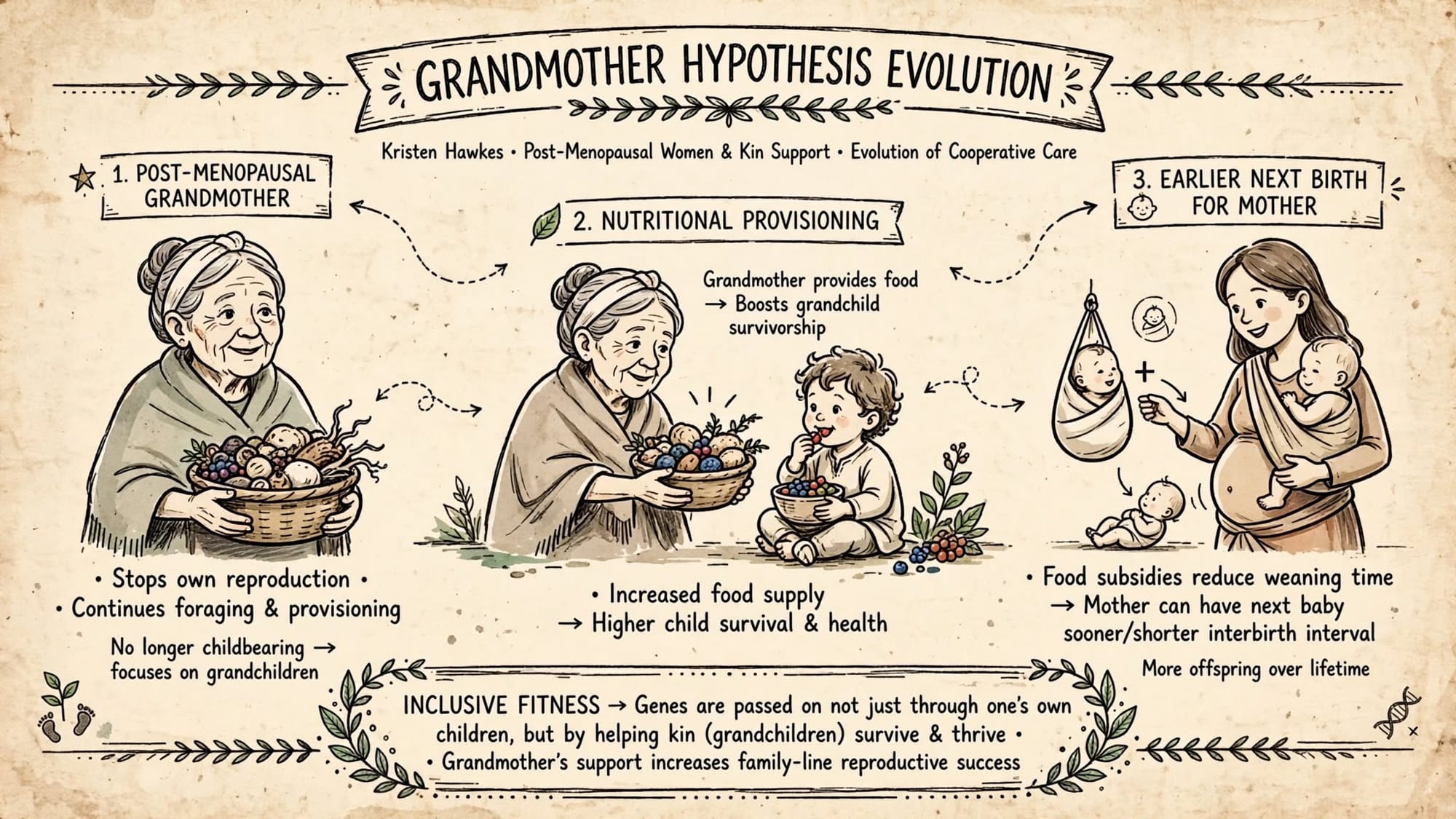
In evolutionary anthropology, the grandmother hypothesis is the most widely recognized explanation for human female post-reproductive longevity.
It suggests that vigorous, skilled, elderly women are able to contribute to their grandchildren's survivorship through nutritional provisioning.
The grandmother hypothesis suggests that early reproductive cessation and post-reproductive survival have been favoured by kin selection.
Older women, even if they do not bear more children themselves, can nevertheless gain inclusive fitness by helping their existing offspring to survive and reproduce.
Women gained significant fitness from surviving beyond menopause and helping to improve the reproductive success of their offspring.
The subsidies from ancestral grandmothers allowed mothers to have next babies before their previous was independent.
Result: shorter interbirth intervals, earlier weaning, slower maturation, longer lifespan.
Fitness = your offspring + kin you help survive and reproduce.
Now enter AI.
In China we already see dressed in festive red outfits, the AI grandsons appear in videos performing superhuman feats, such as lifting a roasted pig with ease, chopping vegetables for dinner.
AI babies seen confidently carrying gold ingots, chopping vegetables, and preparing multi-course meals.
Companies offered to resurrect deceased loved ones with AI avatars.
And commentary: Unlike parents, AI will never tire of entertaining our children. Here is the catch — risk raising a generation with severely skewed perceptions due to the personalized bubble AI creates.
So does AI amplify or reverse Hawkes?
Amplify: Super-Grandmother
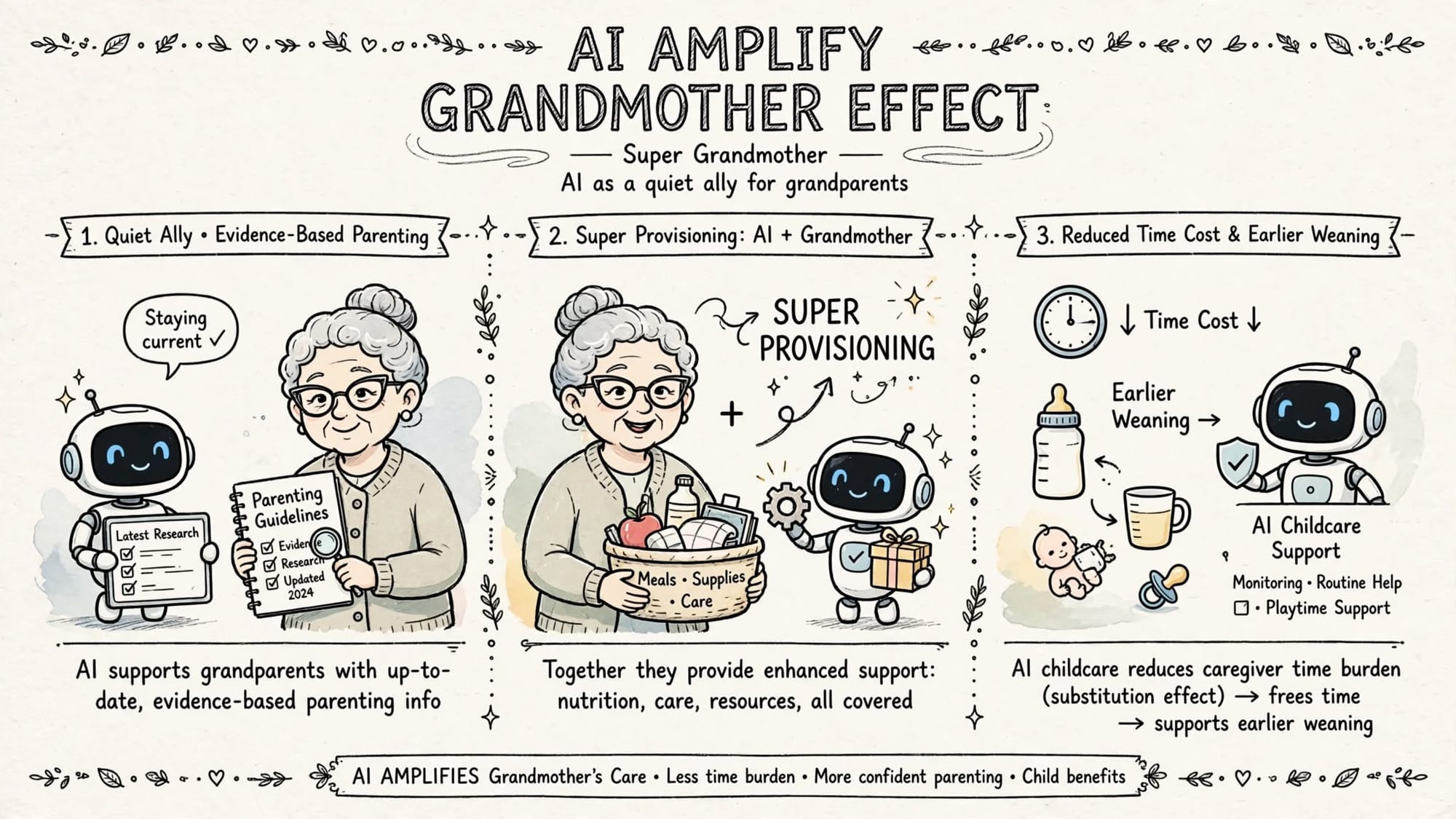
Thoughtfully used, artificial intelligence can be a quiet ally for grandparents, helping you stay current with evidence-based parenting guidance.
This is the amplify path.
And it maps exactly onto what we learned from low-fertility countries:
Recall: selection today is not against intelligence or health.
It is against delay. Any heritable disposition that correlates with postponing first child is under negative selection.
The mechanism is substitution effect — childrearing time costs more in foregone earnings, lowering fertility.
Grandmothers historically reduced that substitution effect by providing free childcare, allowing earlier weaning and next birth.
Nordic countries replicate this with state childcare — highly educated women's fertility converges when childcare infrastructure reduces time cost.
AI does the same, but as augmentation:
1. Quiet Ally: AI gives grandmother latest research, updated 2024 parenting guidelines, staying current — she stays relevant.
2. Super Provisioning: Meals, supplies, care + AI monitoring. Grandmother + robot = 24/7 nutritional provisioning, the original Hawkes function, but scaled.
3. Reduced Time Cost: AI childcare reduces caregiver time burden → frees time → supports earlier weaning. Same as grandmother effect, just synthetic.
In this world, inclusive fitness increases.
Grandchild survival up, interbirth interval down. Grandmother effect amplified. AI expands inclusive fitness network, not replaces it.
Reverse: Synthetic Replacement
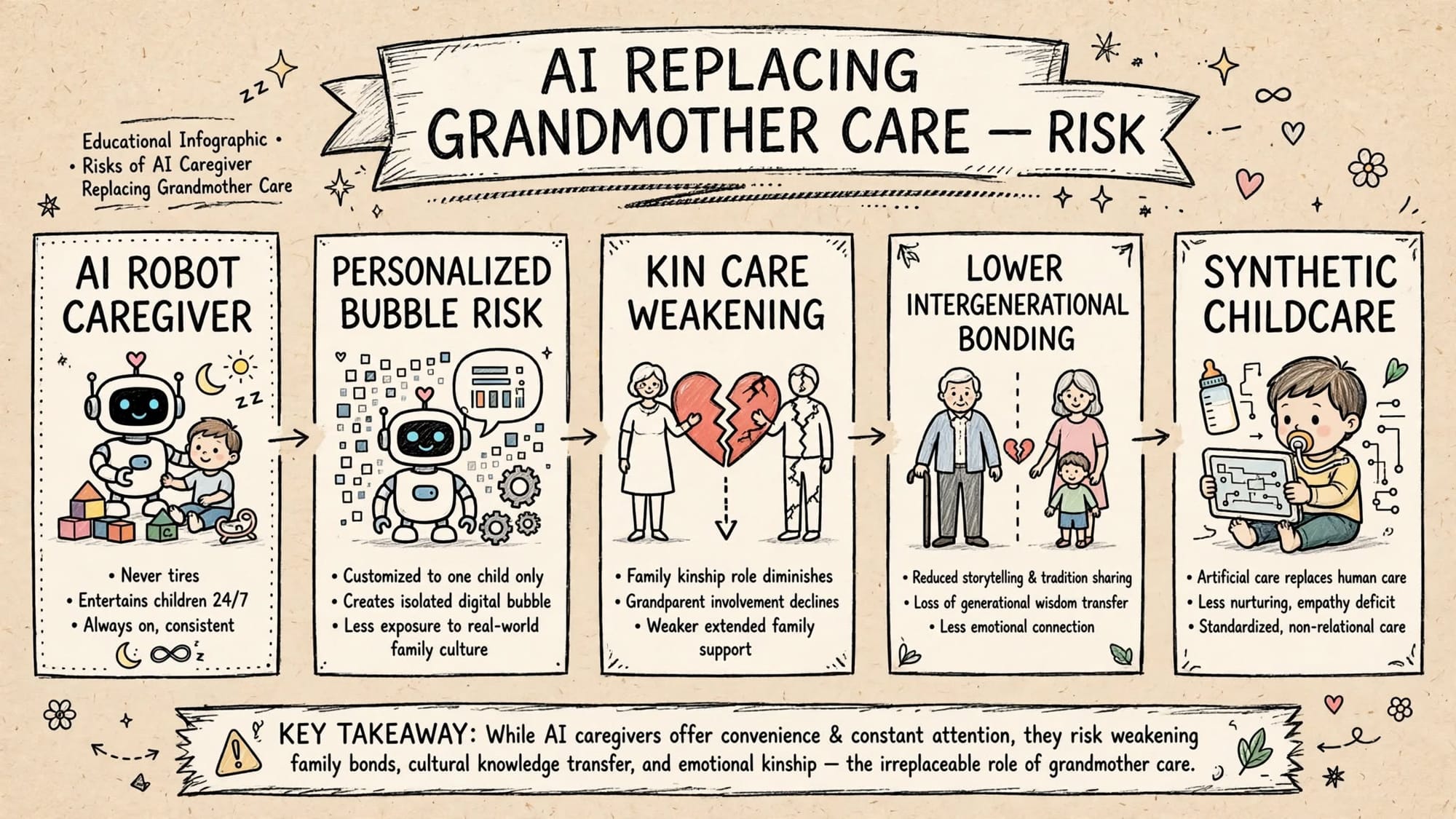
AI replaces human caregiving, less kin care, weakens kin-based support, lower survival.
If AI never tires of entertaining our children, families may outsource what grandmothers evolved to do.
AI grandsons that lift pigs and carry gold ingots are entertaining, but they break the fitness logic.
If provisioning comes from non-biological offspring, the inclusive fitness benefit of surviving beyond menopause collapses.
Why survive to 80 to provision if a $300 robot does it better? Selection pressure for post-reproductive longevity weakens.
Worse: personalized bubble.
Grandmother provides not just calories but cultural knowledge, risk detection, social embedding.
AI provides personalized entertainment optimized for engagement, not survival. Seeing how these personalised bubbles are making our youths struggle to understand and work with others, my worry is this will worsen with children raised by AI.
We saw this with South Korea bribing people to date — it failed because it solved meeting, not cost.
Replacing grandmother with AI solves presence, not kinship.
Children may survive physically but lose intergenerational transmission that made humans human.
My Take: Amplify If We Design for Amplify, Reverse If We Design for Replacement
The Hugh-Jones result matters here: direction of selection reverses once you control for age at first live birth.
The gradient is a function of institutions, not biology.
Same for AI.
If we deploy AI as quiet ally for grandparents — evidence-based parenting guidance, monitoring safety, learning activities and play, frees time for family — we amplify.
Grandmother lives longer, helps more, has more grandchildren because time cost down.
If we deploy AI as AI grandsons and resurrected avatars that replace kin, we reverse.
We get lower kin care, weaker support network, and a generation raised in personalized bubbles.
The grandmother effect was never about who holds the baby. It was about why a woman who can no longer reproduce would still be selected to live long.
Answer: because she makes her daughters have more babies faster.
AI that helps her do that amplifies us. AI that does it instead of her ends the story Hawkes started.