The AI Alliance Wars
The AI war is no longer model vs model. It is $25B + $100B cloud vs $1B/year iPhone brain vs non-exclusive Azure vs solo closed personal superintelligence.
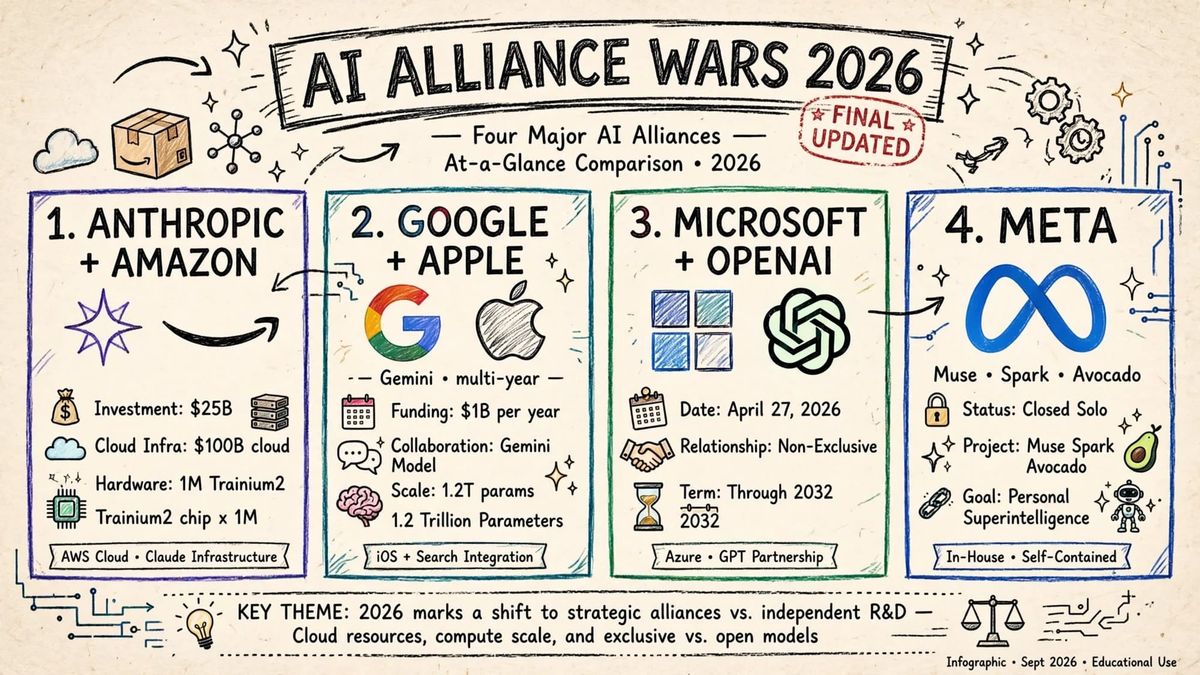
September 2026 locked in four blocks. No one is building alone anymore, except one player who decided being alone is the strategy.
Block 1: Anthropic + Amazon — Compute Marriage
Block 2: Google + Apple — Distribution Marriage
Block 3: Microsoft + OpenAI — From Exclusive Marriage to Open Marriage
Block 4: Meta — Solo Closed with Muse, Not Llama
1. Anthropic + Amazon
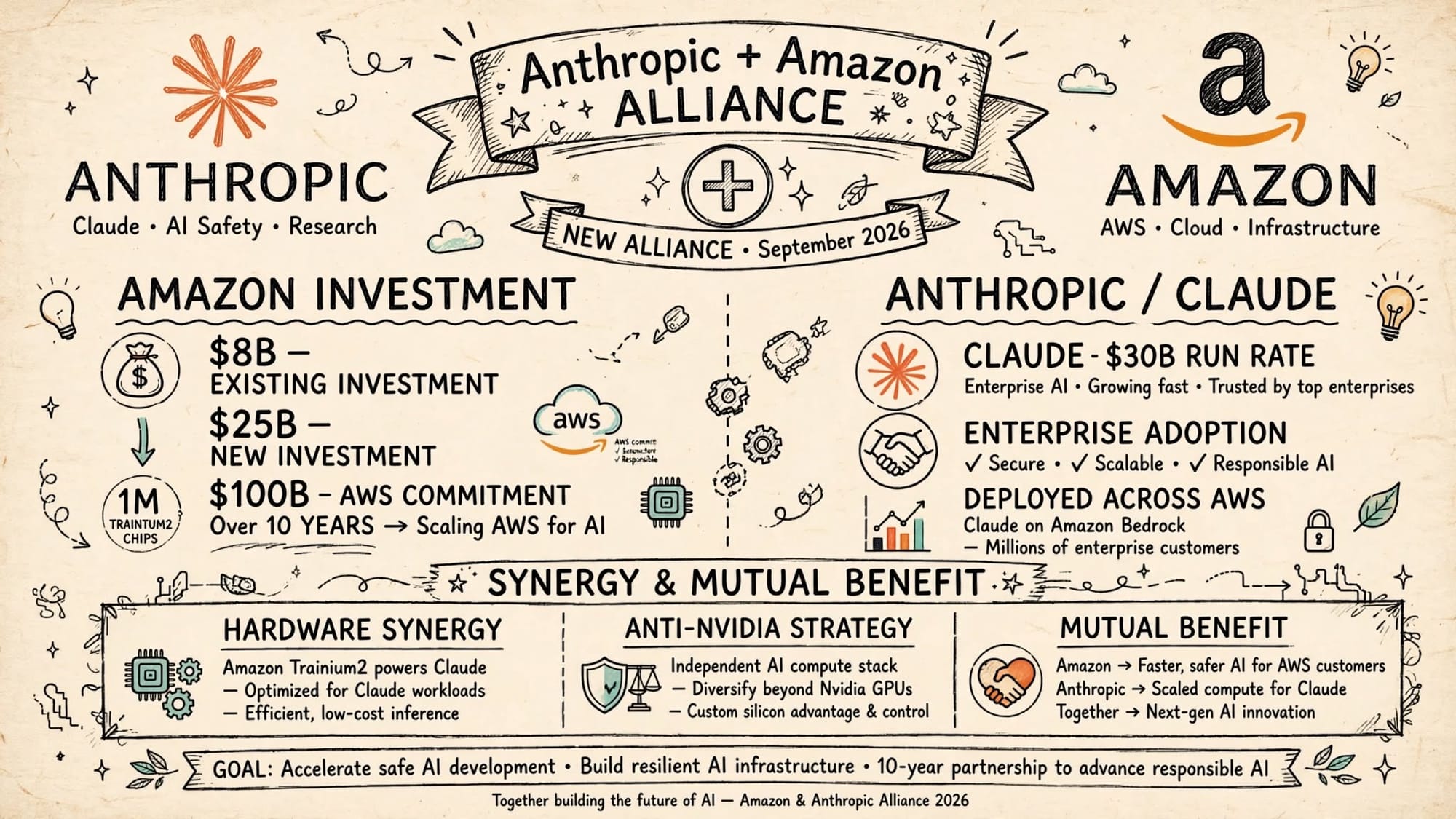
Amazon doubles down on Anthropic with $25B investment, mirroring its OpenAI cloud deal. Amazon and Anthropic announced an expanded partnership Monday that includes up to $25 billion in new investment and more than $100 billion in cloud commitments over 10 years.
On top of $8 billion already committed in November last year.
Anthropic to spend over $100 billion over a decade on Amazon's cloud tech, while using more than 1 million of Amazon's Trainium2 chips. Claude annual run-rate surpassing $30 billion, up from $9B end of 2025.
Impact breakdown:
- Mutual benefit: Anthropic gets infinite compute without Nvidia quota. Amazon gets frontier model to sell Bedrock to every enterprise. Claude = enterprise coding king.
- Hardware synergy: 1M Trainium2 = first credible alternative to CUDA at frontier scale. AWS validates own chip, Anthropic gets cheaper inference.
- Competition: Mirror of Microsoft+OpenAI. If Microsoft owns ChatGPT at work, Amazon owns Claude at work.
- Policy: Structured as commercial milestones investment + $100B cloud commit, not acquisition. Avoids antitrust block while creating de facto exclusivity.
This is the enterprise empire.
2. Google + Apple
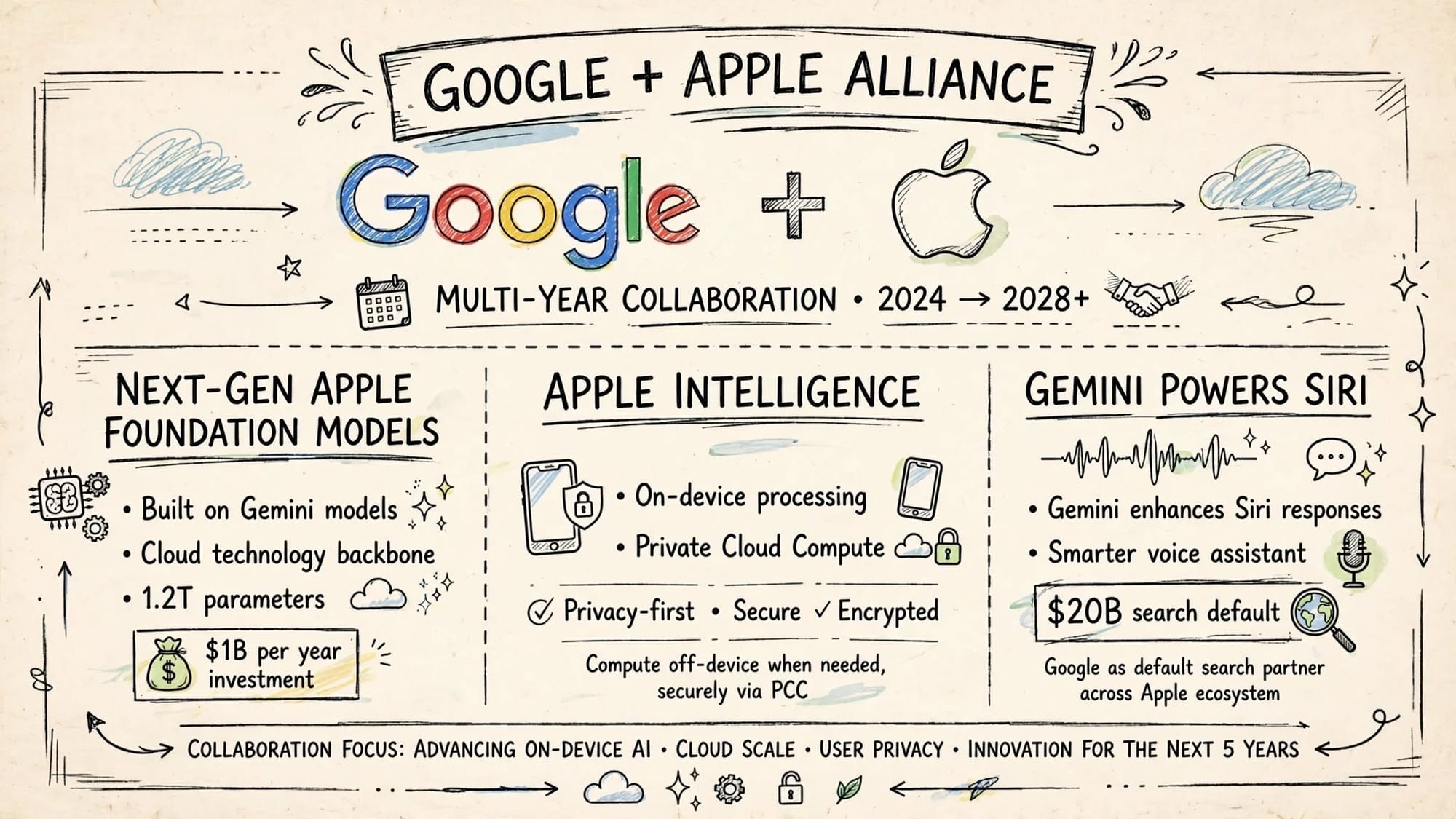
Apple and Google have entered into a multi-year collaboration under which the next generation of Apple Foundation Models will be based on Google's Gemini models and cloud technology.
Apple and Google enter multi-year AI partnership to bring Gemini-powered Apple Intelligence features to iPhone, iPad and Mac.
Deal: Apple will pay about $1 billion a year for access to Google's technology. The model's 1.2 trillion parameters would dwarf Apple's current systems.
While Google's models will underpin the intelligence layer, Apple said Apple Intelligence will continue to run on-device and through its Private Cloud Compute framework.
Impact breakdown:
- Mutual benefit: Apple failed to ship its own intelligence. Needs frontier brain now. Google needs 2.2B iPhones as distribution — $1B/year is cheap vs $20B it already pays for search default.
- Hardware synergy: Perfect split. Apple Silicon on-device + Private Cloud Compute for privacy, Google TPU + Cloud for heavy reasoning. Siri upgrade becomes multimodal.
- Competition: Blocks OpenAI. ChatGPT stays as plugin, Gemini becomes foundation. Apple keeps control of UX, Google gets invisible brain.
- Policy: Framed as licensing, not merger. Privacy-first story helps both in DOJ search case.
This is the consumer phone empire.
3. Microsoft + OpenAI
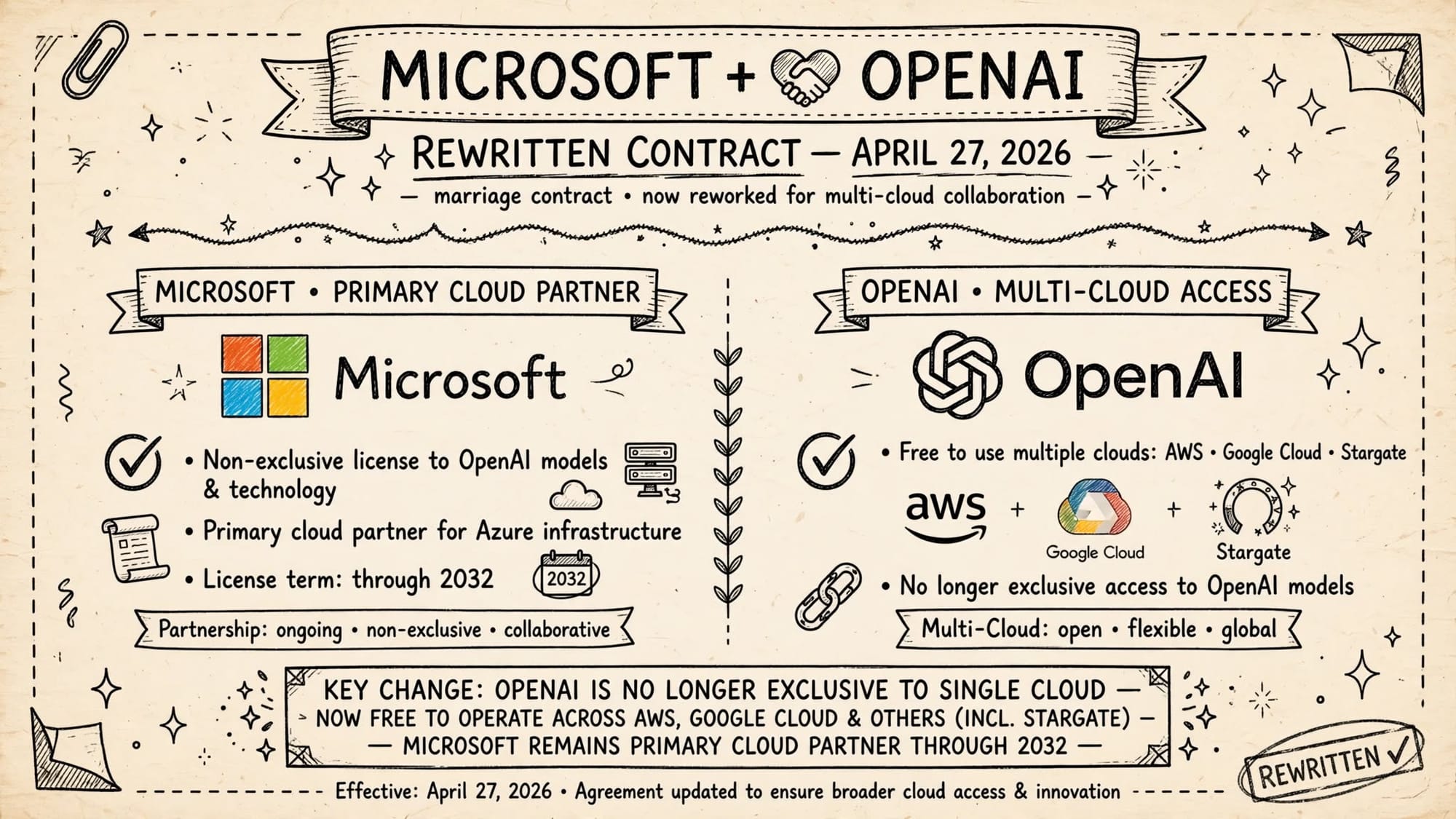
On April 27, 2026, OpenAI announced an amended partnership with Microsoft that turns one of the most important deals in tech into something more flexible, less exclusive, and a lot less weird.
Microsoft remains OpenAI's primary cloud partner, OpenAI products still ship first on Azure, and Microsoft keeps rights to OpenAI's models and products through 2032. But Microsoft's license is now non-exclusive. OpenAI can serve products across any cloud provider.
Microsoft will no longer have exclusive access to OpenAI's technology.
Impact breakdown:
- Mutual benefit: Microsoft keeps IP through 2032 + primary cloud, stops drama. OpenAI gets multi-cloud freedom to serve AWS, Google Cloud, Stargate, raise $60B from Nvidia/Amazon/SoftBank.
- Hardware synergy: OpenAI needs more than Azure for Stargate-scale training. Multi-cloud GPUs required. Microsoft de-risks concentration.
- Competition: Microsoft now runs same playbook with Anthropic and OpenAI. It is the Switzerland.
- Policy: Ending exclusivity is exactly what regulators asked for. Avoids "Microsoft absorbed OpenAI" claim.
This is not absorption. It is unwinding. From exclusive marriage to open marriage.
4. Meta — Solo Closed Player: Muse (Codename Avocado)
With LLAMA, they could be the key/solo open-source provider. But they pivoted...
Muse Spark is a large language model developed by Meta through Meta Superintelligence Labs.
It was introduced in April 2026 and launched as Muse Spark 1.1 on July 9, 2026.
Previously called Avocado, the new model is now called Muse Spark and will make up a larger family of models called Muse.
Reportedly known internally as Avocado during development, Muse Spark was built over nine months and is seen by executives as a refresh of Meta's AI strategy, which was previously focused on its open-source Llama models.
In a change from the company's prior open-source strategy, Muse Spark is a closed model.
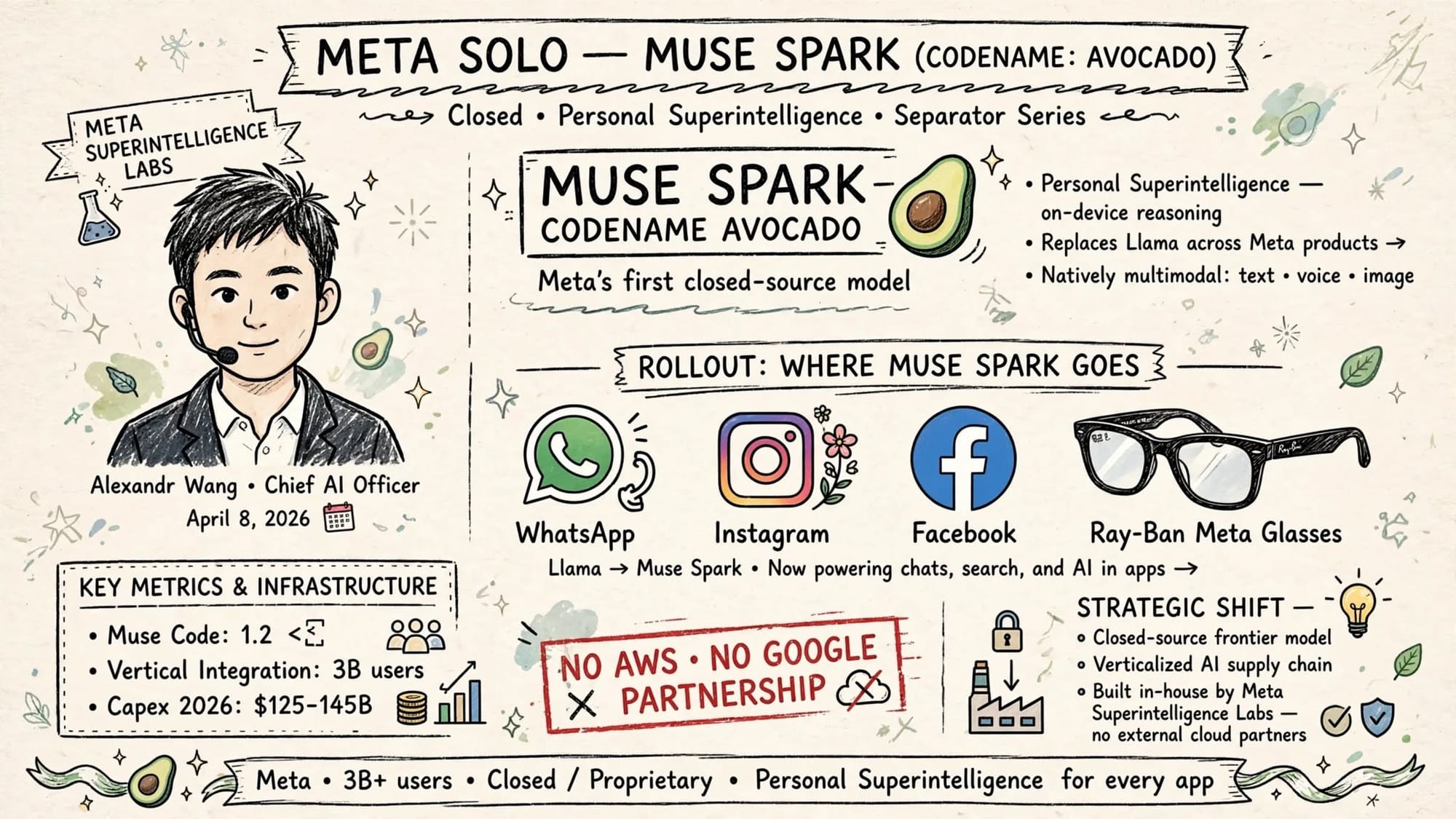
Meta debuted Muse Spark on April 8, 2026 — the first model from its newly formed Meta Superintelligence Labs led by Chief AI Officer Alexandr Wang.
Originally code-named Avocado, this marks a pivotal strategic shift: Meta is now shipping closed-source frontier models to compete directly with OpenAI, Anthropic, and Google.
This marks a structural pivot away from Meta's fully open-source Llama strategy toward proprietary, commercialized models.
The model will initially be available only on the lightly used Meta AI app and website, and in the coming weeks, replace the existing Llama models powering chatbots on WhatsApp, Instagram, Facebook and Meta's collection of smart glasses.
Also: Muse Code 1.2 launched as coding tool competing with Claude and Codex.
Impact breakdown for solo closed:
- Mutual benefit? There is none, and that is the point. Partnering with AWS or Google would strengthen rival ad businesses. Staying solo keeps data and margin inside Meta family.
- Hardware synergy: Own infra + MTIA chips + Ray-Ban Meta glasses + Quest. No other lab owns glasses that see what you see. Muse is glasses-first, not chat-first. Closed model lets Meta optimize for on-device reasoning, not API benchmarks.
- Competition: If Anthropic+Amazon = enterprise, Google+Apple = phone, Microsoft+OpenAI = work, Meta = social. Different battlefield. Solo closed lets Meta be 4th frontier lab, not open-source charity for rivals. Monetization via ads + devices, not API calls.
- Policy: Closed = pricing power + liability control. Llama open weights created misuse risk. Muse closed with Private Cloud Compute + Sentinel agent isolation is easier to defend. Plus $125-145B capex signals independence.
Most likely solo scenario: Vertical integration.
Personal Superintelligence as OS (which is proven by the release of Muse Personal Agent):
WhatsApp + Instagram + Facebook + Ray-Ban Meta Glasses all run same closed Muse.
No AWS partnership needed. NO AWS, NO GOOGLE PARTNERSHIP.
Old map was 3 closed + 1 open. New map is 4 closed empires fighting for different daily moments.
Who wins? Whoever makes frontier intelligence so cheap, embedded, and unavoidable you cannot leave.