Will Orexin Agonists Boost US Productivity and GDP? What OX2R Drugs Can and Can't Do
The first orexin receptor 2 agonist was approved in the US in August, for about 120,000 people with narcolepsy type 1. Some expect drugs like it to supercharge productivity and GDP. Here's what the evidence supports, what it doesn't, and what would have to change.
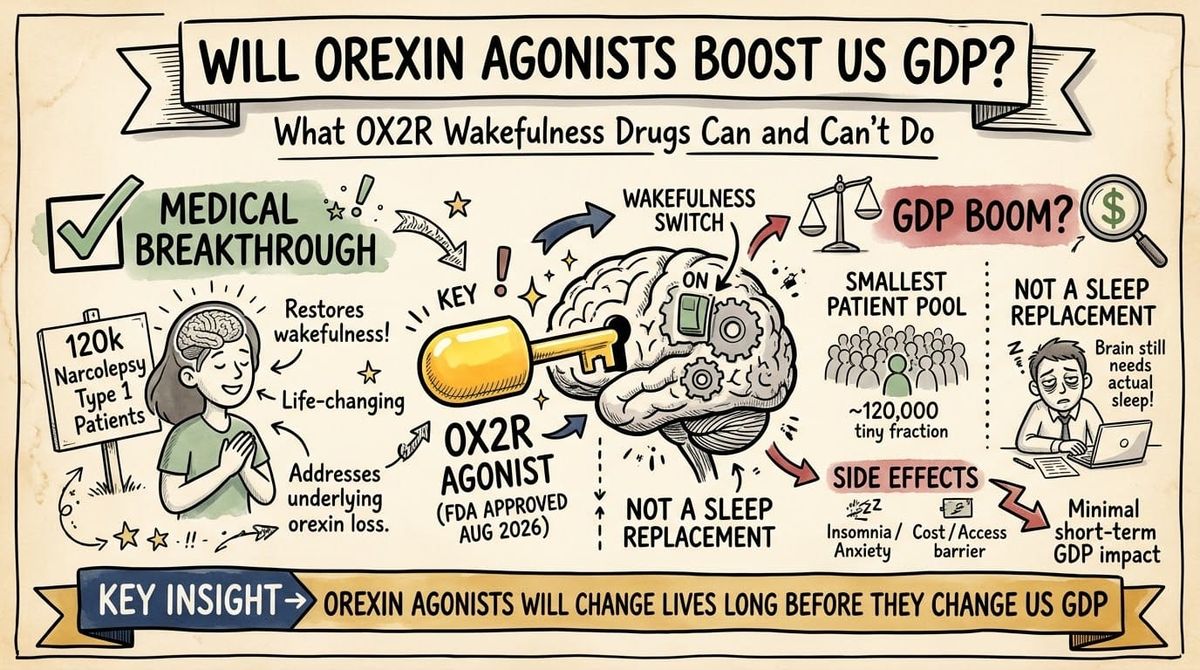
There's a new class of drug that switches on the brain's own wakefulness system.
They're called orexin receptor 2 agonists, or OX2R agonists.
Some people argue that once these drugs arrive, American productivity and GDP will take off.
The first one has now arrived.
The FDA approved it in August.
So it's a good moment to check the idea against the evidence.
My view is that these drugs are a real breakthrough for patients, and that the economic claim is much weaker than it sounds.
What Orexin Does
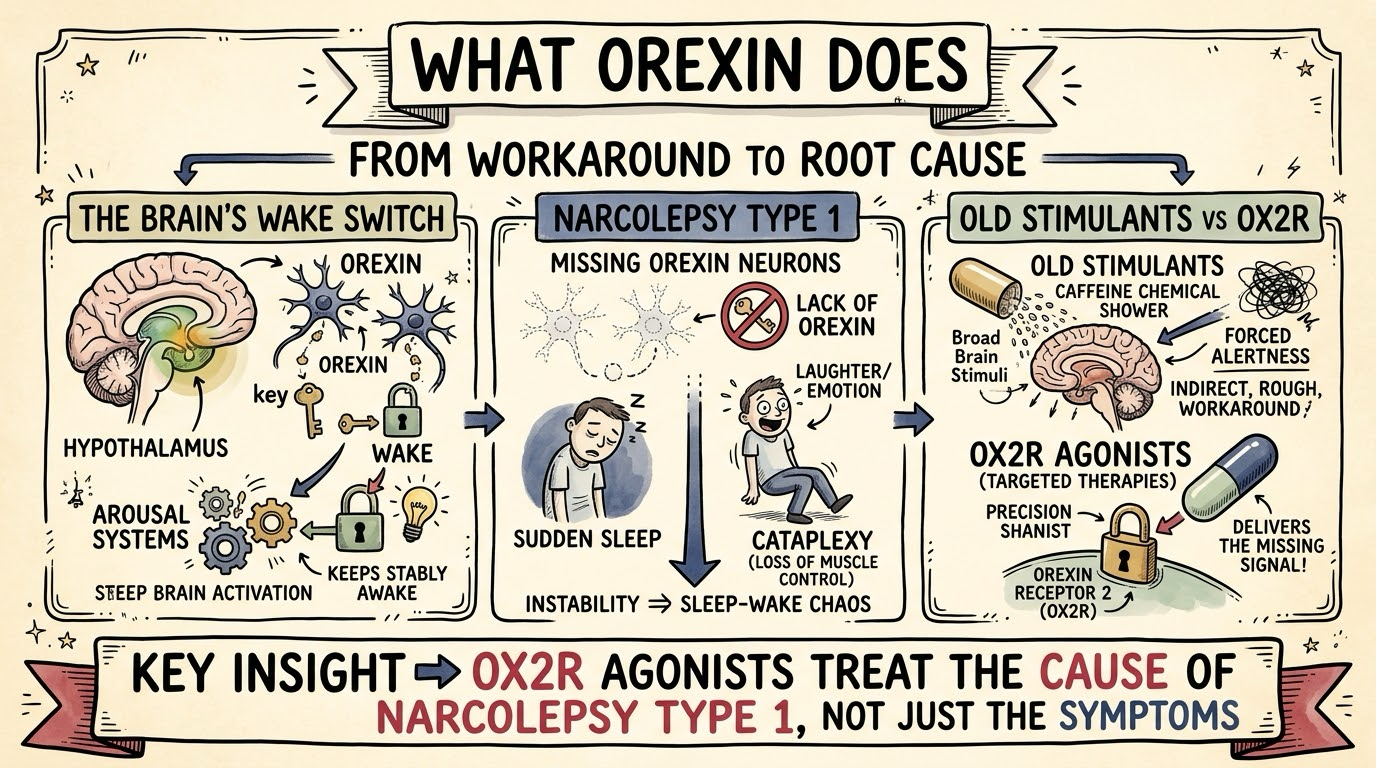
Orexin is a chemical messenger made by a small group of neurons in the hypothalamus.
Its job is to keep you stably awake.
When those neurons fire, they activate receptors across the brain's arousal systems, and you stay alert.
In narcolepsy type 1, those orexin-producing neurons are lost.
Patients have little or no orexin, so they fall asleep without warning and can lose muscle control when they feel strong emotion.
Older treatments work around the problem.
Stimulants push up other brain chemicals more broadly to force alertness.
An OX2R agonist does something more direct.
It binds to orexin receptor 2 and delivers the signal the missing orexin would have sent.
That's why researchers describe it as treating the cause of the disease.
The First One Is Here
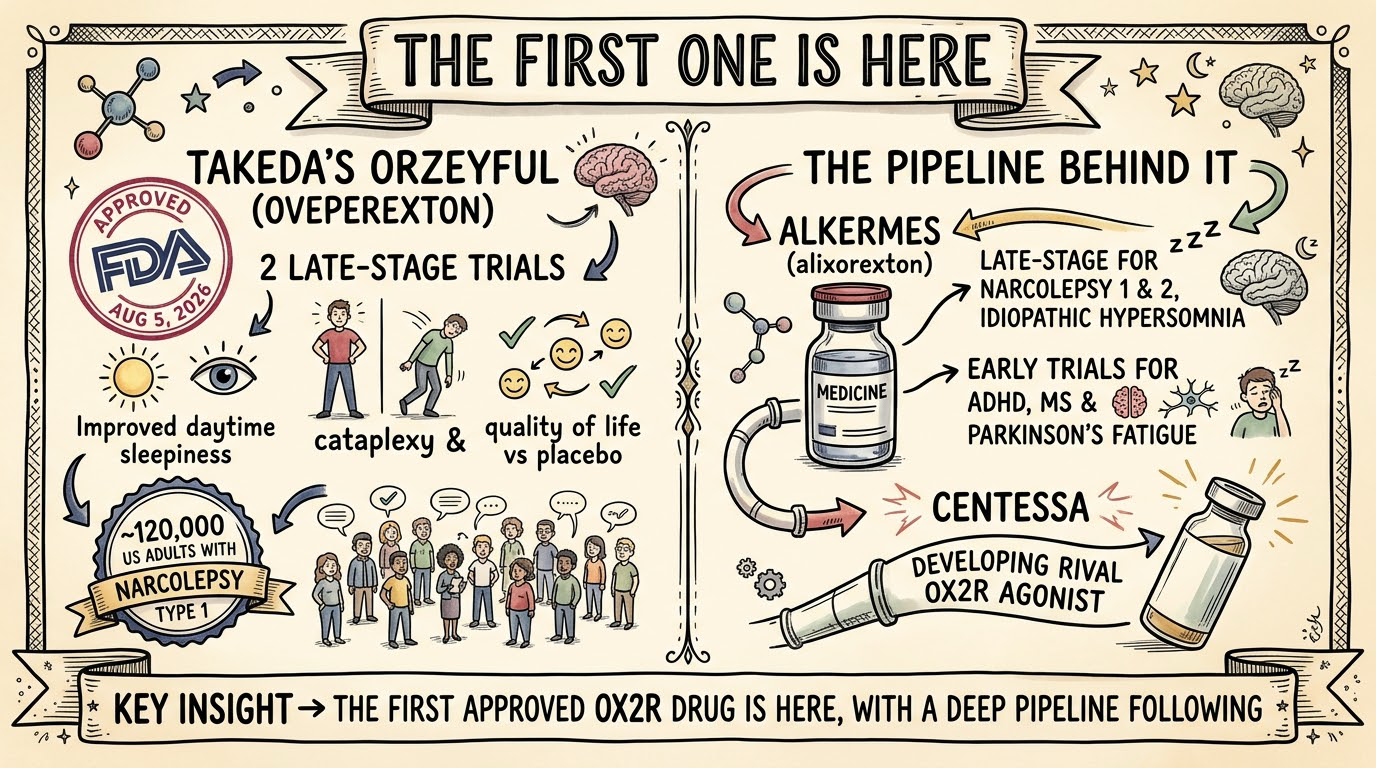
On August 5, 2026, the FDA approved Takeda's Orzeyful, known generically as oveporexton, for adults with narcolepsy type 1.
It's the first orexin agonist approved in the US.
In two late-stage trials, it improved daytime sleepiness, cataplexy and quality of life compared with placebo.
Takeda estimates about 120,000 people in the US have narcolepsy type 1.
Others are following.
Alkermes is running late-stage trials of a rival called alixorexton in narcolepsy types 1 and 2.
It's also testing the drug in idiopathic hypersomnia, a condition of excessive sleepiness with no known cause.
Alkermes says it has other OX2R agonists in early trials for ADHD and for fatigue in multiple sclerosis and Parkinson's disease.
Centessa is developing one as well.
Where The GDP Idea Comes From
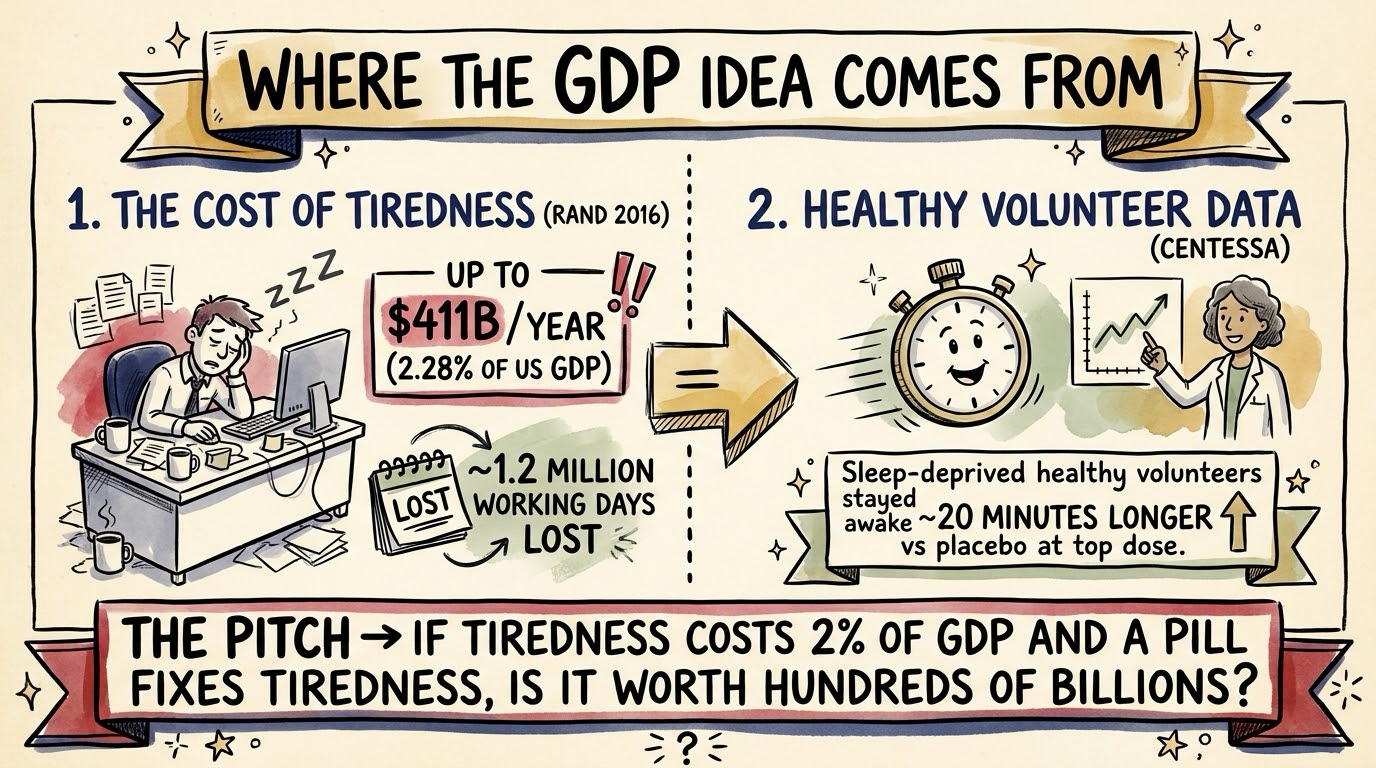
The excitement has two sources.
The first is the cost of tiredness.
A 2016 study by RAND estimated that insufficient sleep costs the US economy up to $411 billion a year, or 2.28% of GDP.
It put the loss at roughly 1.2 million working days a year.
The second is evidence that these drugs work in people whose orexin system is healthy.
In an early trial of Centessa's drug, sleep-deprived healthy volunteers stayed awake about 20 minutes longer on a standard wakefulness test at the highest dose than they did on placebo.
Put those together and you get the pitch.
If a pill can make tired people alert, and tiredness costs 2% of GDP, then the pill is worth hundreds of billions.
Why I Don't Think GDP Skyrockets
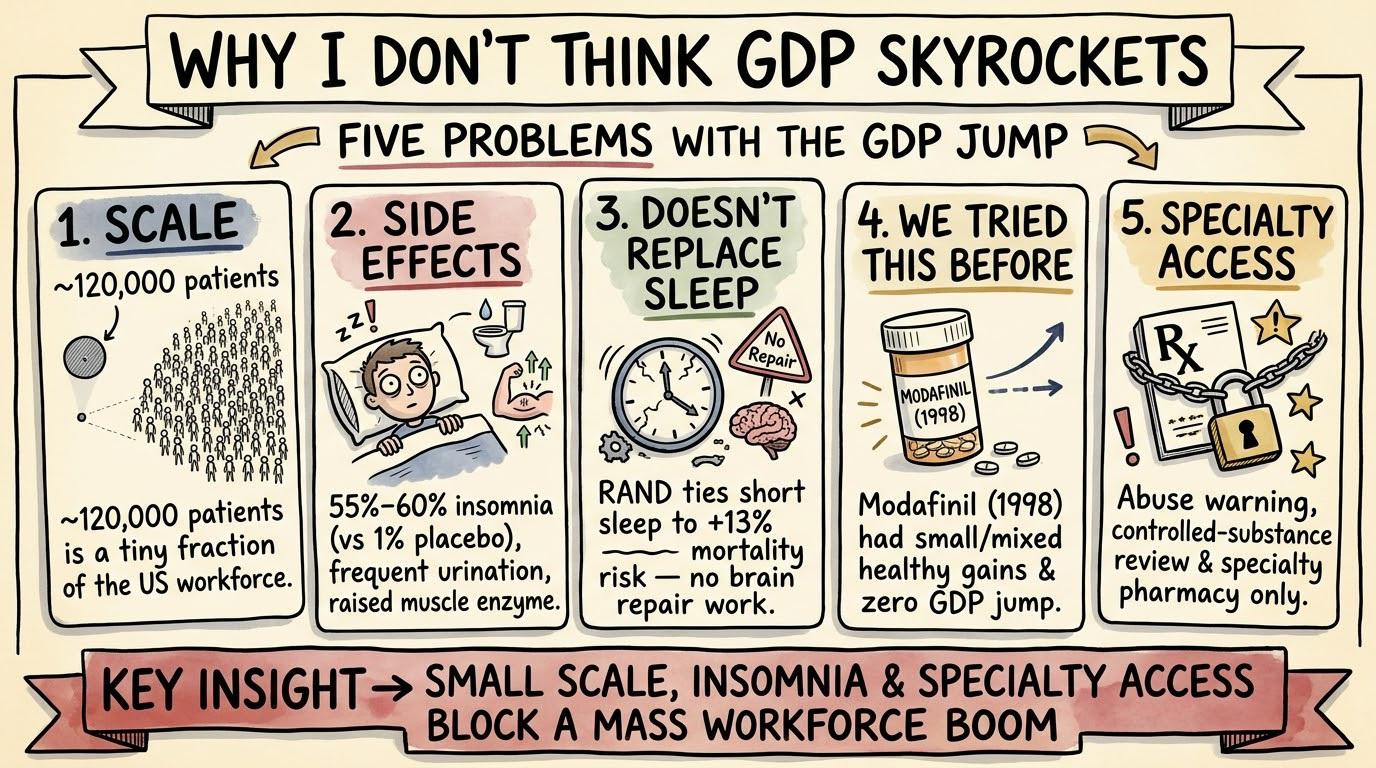
I see five problems with that jump.
The first is scale.
The approved use covers about 120,000 people, which is a tiny fraction of the American workforce.
Even a perfect result for every patient doesn't move a national number.
The second is side effects.
In Takeda's trials, 55% to 60% of patients on the drug reported insomnia, against 1% on placebo.
More than half reported needing to urinate more often.
Some had raised levels of a muscle enzyme in blood tests.
Those trade-offs make sense for someone with a serious disease.
They're much harder to justify for a healthy person who wants a sharper afternoon.
The third is that staying awake doesn't replace sleep.
RAND's own figures tie short sleep to a 13% higher risk of death compared with sleeping seven to nine hours.
A drug that keeps you alert doesn't do the repair work that sleep does.
If people used it to sleep less, the long-term health costs could cancel the short-term gains.
The fourth is that we've run this experiment before.
Modafinil, a wakefulness drug, was approved in the US in 1998 and later cleared for shift work sleep disorder.
Students and professionals have used it off-label for years.
Reviews of the research found only small or mixed benefits in healthy people who weren't sleep-deprived.
I'm not aware of anyone crediting it with a jump in national productivity.
The fifth is access.
The label warns of potential for abuse and misuse, and the drug was awaiting a controlled-substance classification at approval.
It will be dispensed through a specialty pharmacy to diagnosed patients.
That's a long way from something millions of workers pick up at a pharmacy.
Where The Real Economic Value Is
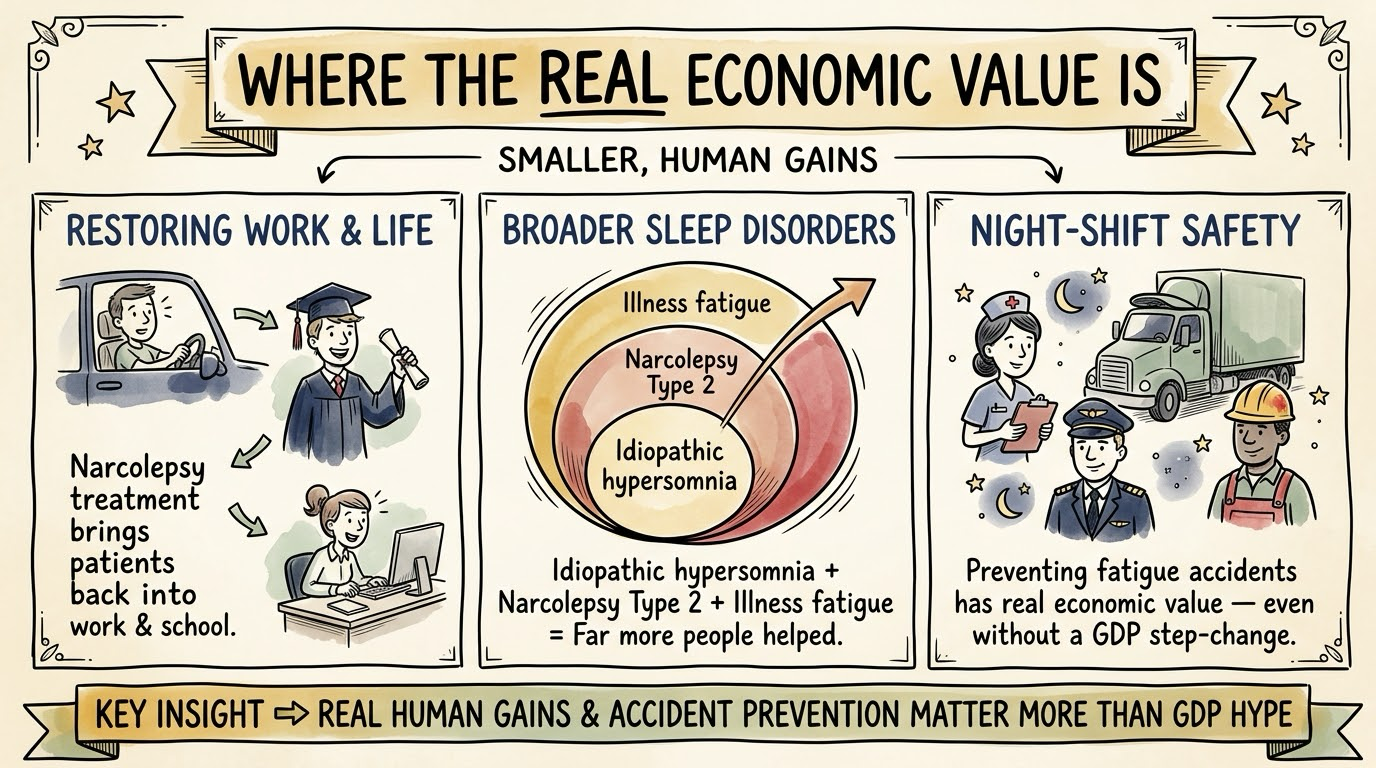
There is a genuine economic story here, and it's smaller and more human.
Narcolepsy can make it hard to hold a job, drive safely or finish school.
A treatment that restores normal alertness could bring many of them fully into work.
If the drugs prove safe in idiopathic hypersomnia, in narcolepsy type 2 and in fatigue from other illnesses, the number of people helped grows a lot.
Shift work is the area I'd watch most closely.
Nurses, drivers, pilots and factory workers on night shifts face real safety risks from sleepiness.
A well-tolerated drug approved for that purpose could prevent accidents, which have a large economic cost.
That would be a meaningful gain.
It still wouldn't be a step change in GDP.
What Would Have To Be True
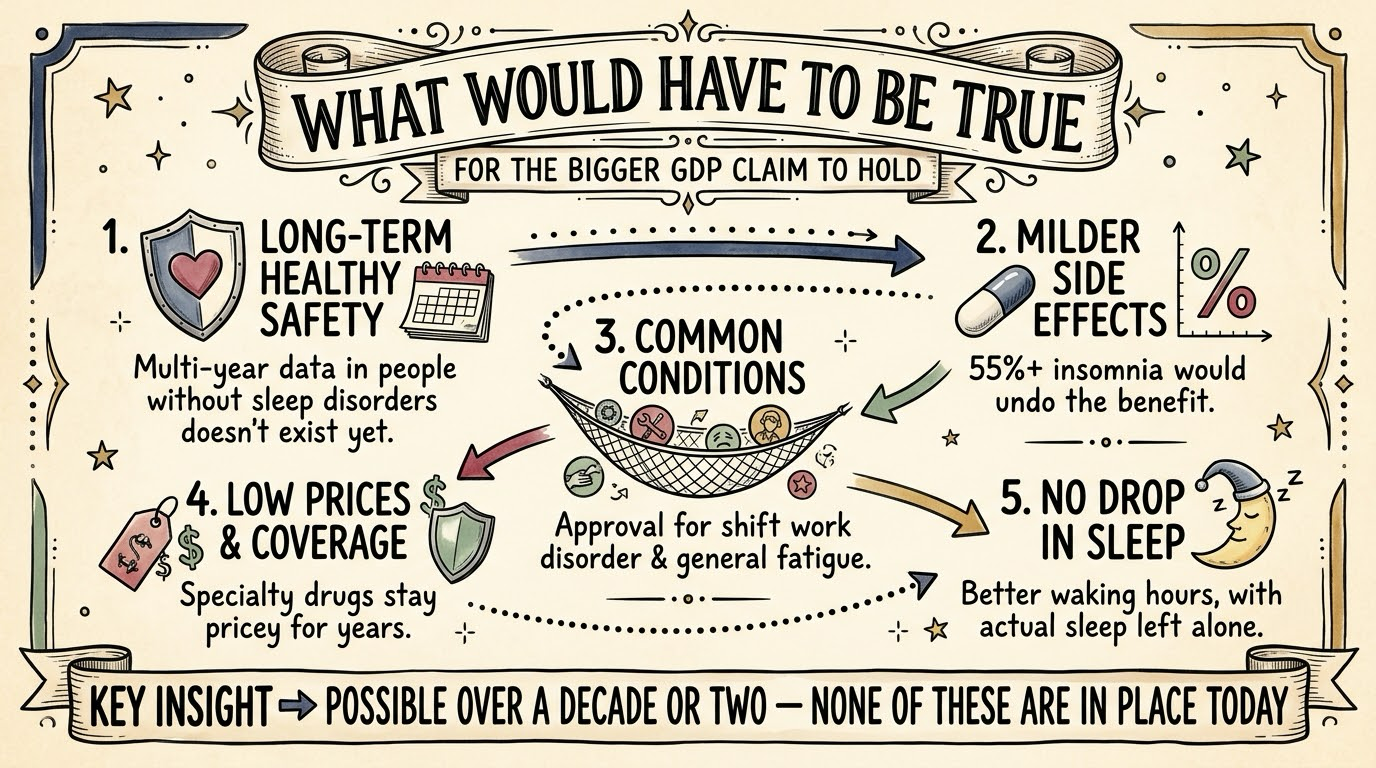
For the bigger claim to hold, several things would need to happen.
- Safety in healthy people over years. Long-term data in people without a sleep disorder doesn't exist yet.
- Milder side effects. Insomnia in more than half of users would undo much of the benefit.
- Approval for common conditions. Shift work disorder and general fatigue are far larger markets than narcolepsy.
- Low prices and broad coverage. New specialty drugs are usually expensive for years.
- No drop in sleep. The gain has to come from better waking hours, with sleep left alone.
I wouldn't rule any of these out over a decade or two.
None of them is in place today.
The Bigger Productivity Lever
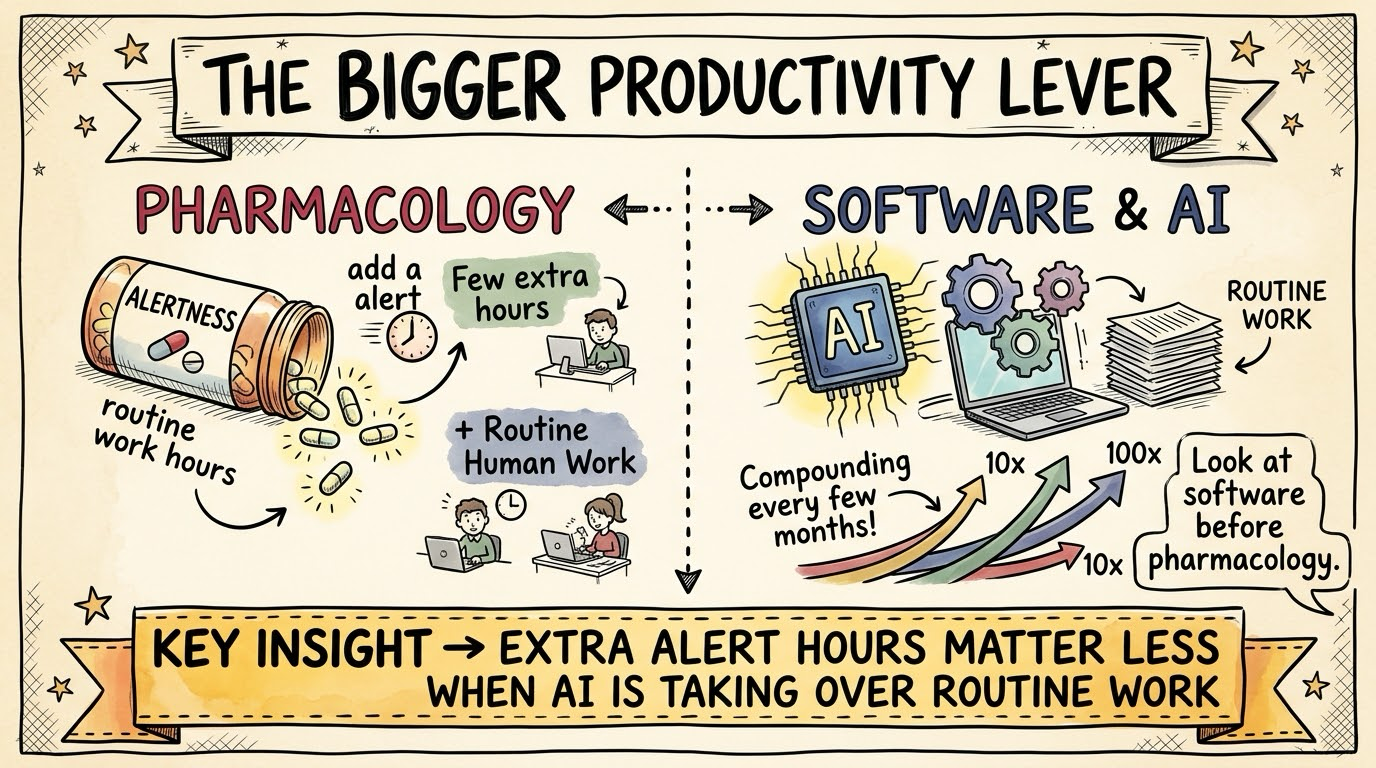
If the question is what lifts American output over the next ten years, I'd look at software before pharmacology.
AI is already changing how much work one person can do, and it improves every few months.
I've written about how that loop is speeding up in When AI Designs Its Own Chips.
A drug that adds alert hours matters less when machines are taking over more of the routine work those hours were spent on.
Where This Argument Has Limits
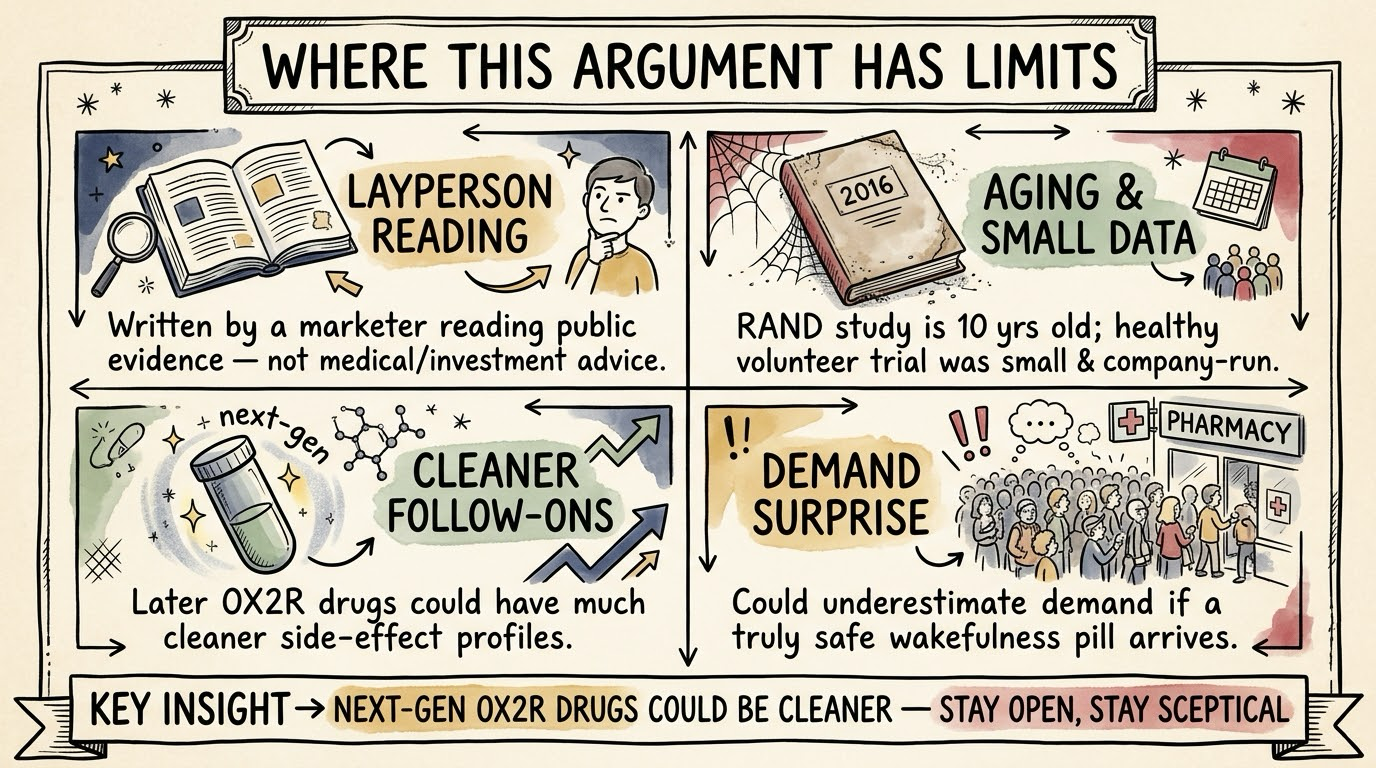
I'm a marketer, and I've read the public evidence as a layperson.
The RAND study is ten years old, and its figures are estimates.
The healthy-volunteer trial I cited was small and came from the company developing the drug.
Later drugs in this class could have much cleaner side-effect profiles than the first.
And I may be underestimating how many people would use a safe wakefulness drug if one became widely available.
Conclusion: A Medical Breakthrough First
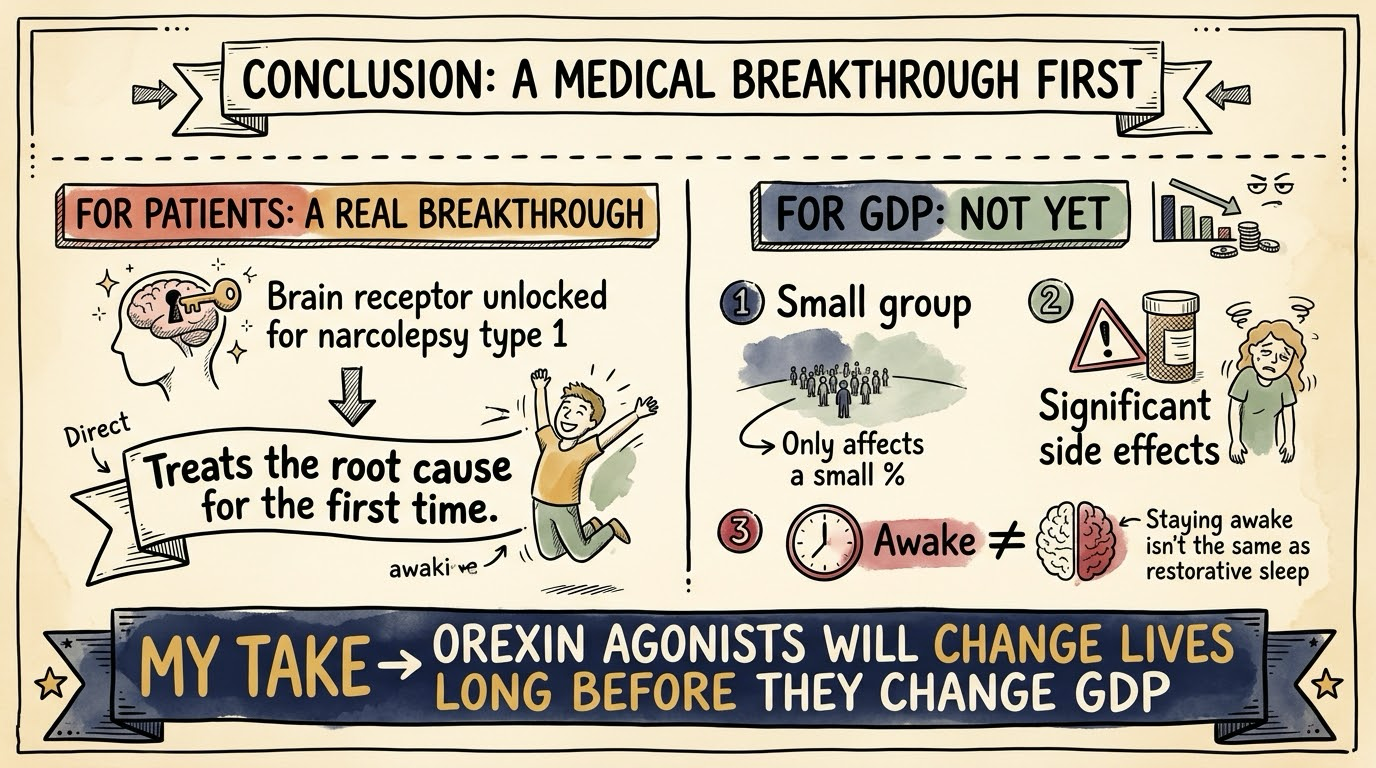
I think OX2R agonists are among the most important advances in sleep medicine in a long time.
For people with narcolepsy type 1, they treat the cause of the disease for the first time.
The leap from there to a surge in US productivity and GDP isn't supported by what we know so far.
The patient group is small, the side effects are significant and staying awake is a poor substitute for sleeping.
My Take: Orexin agonists will change lives long before they change GDP, and I'd treat any forecast of an economy-wide productivity boom from a wakefulness drug with real scepticism until there's long-term safety data in healthy people.
This post is my opinion and isn't medical or investment advice.
Sources
Pages I opened for the facts in this post:
- Takeda: FDA approves Orzeyful for adults with narcolepsy type 1
- PubMed Central: Orexin receptor 2 agonists, a pathophysiologic approach to narcolepsy type 1
- SEC: Alkermes press release on alixorexton, June 2026
- Sleep journal: Phase 1 data with ORX750 in sleep-deprived healthy volunteers
- RAND: Lack of sleep costing US economy up to $411 billion a year
- Wikipedia: Modafinil