Is the Lindy Effect Dead? Why Brands That Acquire or Partner Will Outlast the AI Age
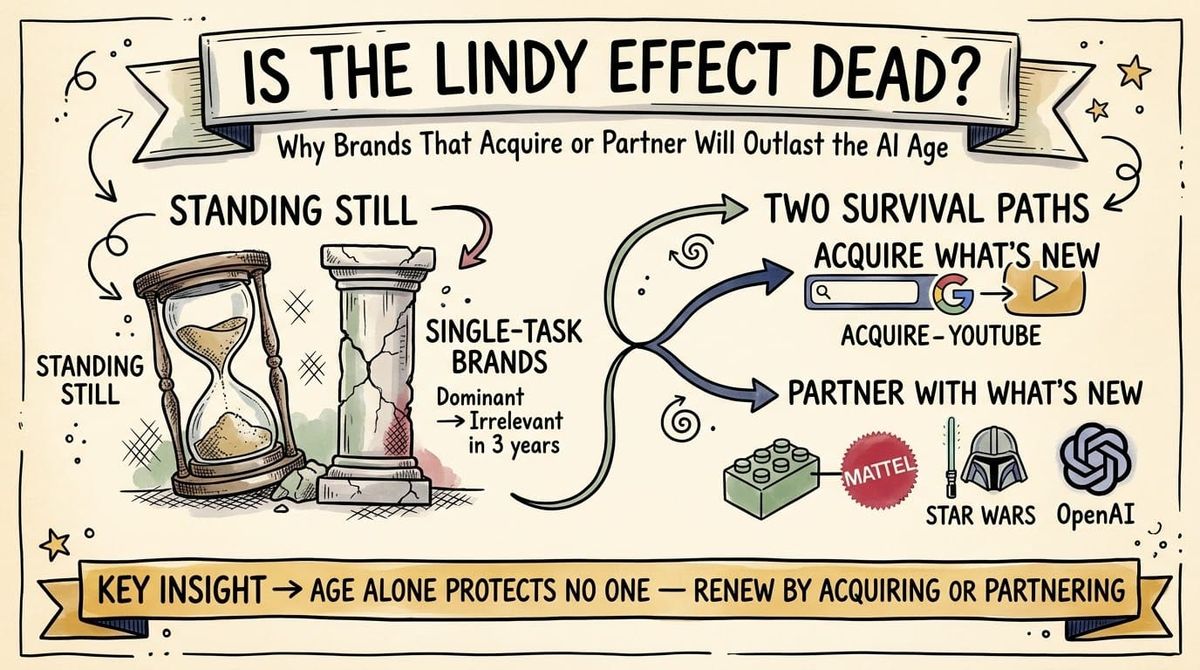
The Lindy effect says the longer something has lasted, the longer it will last. AI is breaking that rule for brands built on a single function. Here's why the survivors will be the ones that acquire, like Google with YouTube, or partner, like LEGO and Mattel.
There's an old rule of thumb that the longer something has been around, the longer it will stay around.
It's called the Lindy effect, and marketers have leaned on it for years to explain why heritage brands feel safe.
I think AI is breaking that rule for a large group of brands.
Products can now be copied in days, attention moves faster, and a company can go from dominant to irrelevant inside three years.
My view is that the brands most likely to last from here will do one of two things.
They'll acquire what's new, the way Google did with YouTube.
Or they'll partner with what's new, the way LEGO and Mattel do through collaborations.
What The Lindy Effect Actually Says
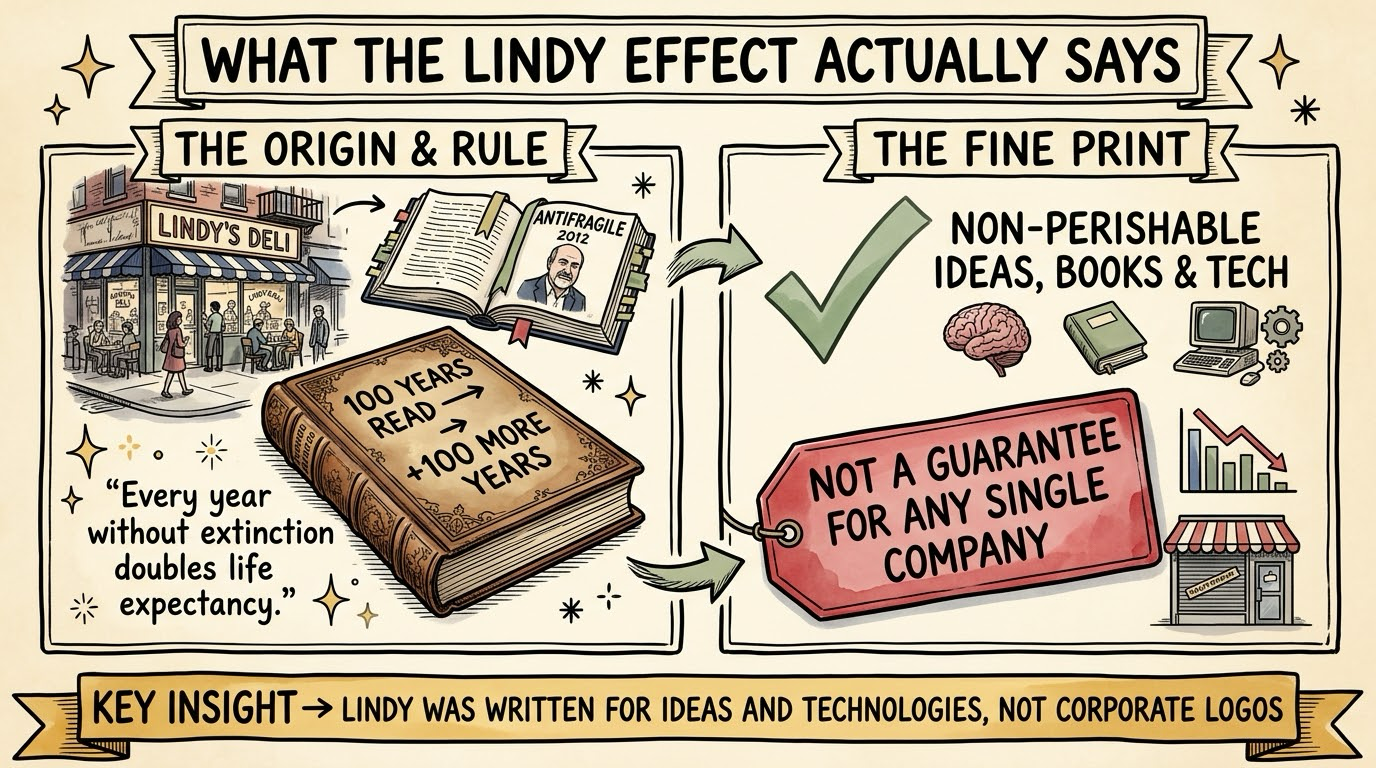
The name comes from Lindy's delicatessen in New York, where comedians used to trade theories about how long a show would run.
Nassim Taleb turned it into a general idea in his 2012 book Antifragile.
For things that don't naturally expire, like books, ideas and technologies, he argued that survival predicts more survival.
In his words, "Every year that passes without extinction doubles the additional life expectancy."
A book that has been read for 100 years will probably be read for another 100.
The important detail is the phrase about things that don't expire.
The rule was written for ideas and technologies.
It was never a guarantee for any single company.
Companies Were Already Dying Faster
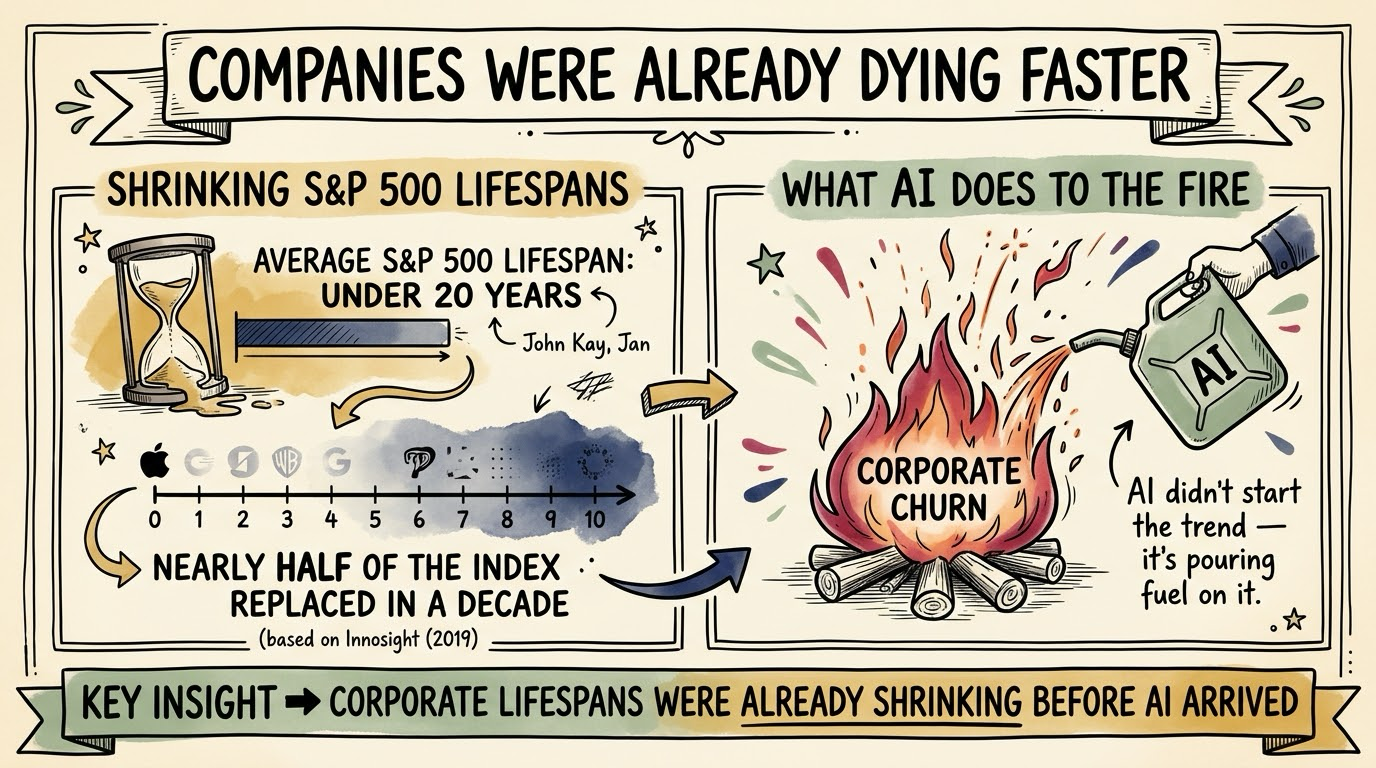
Corporate lifespans were shrinking well before AI arrived.
The economist John Kay wrote in January that the average lifespan of a company on the S&P 500 is now under 20 years.
Back in 2019, the consultancy Innosight projected that nearly half of the index would be replaced within a decade.
So AI didn't start this trend.
It's pouring fuel on it.
How AI Speeds Up The Fall
Chegg is the clearest case I know.
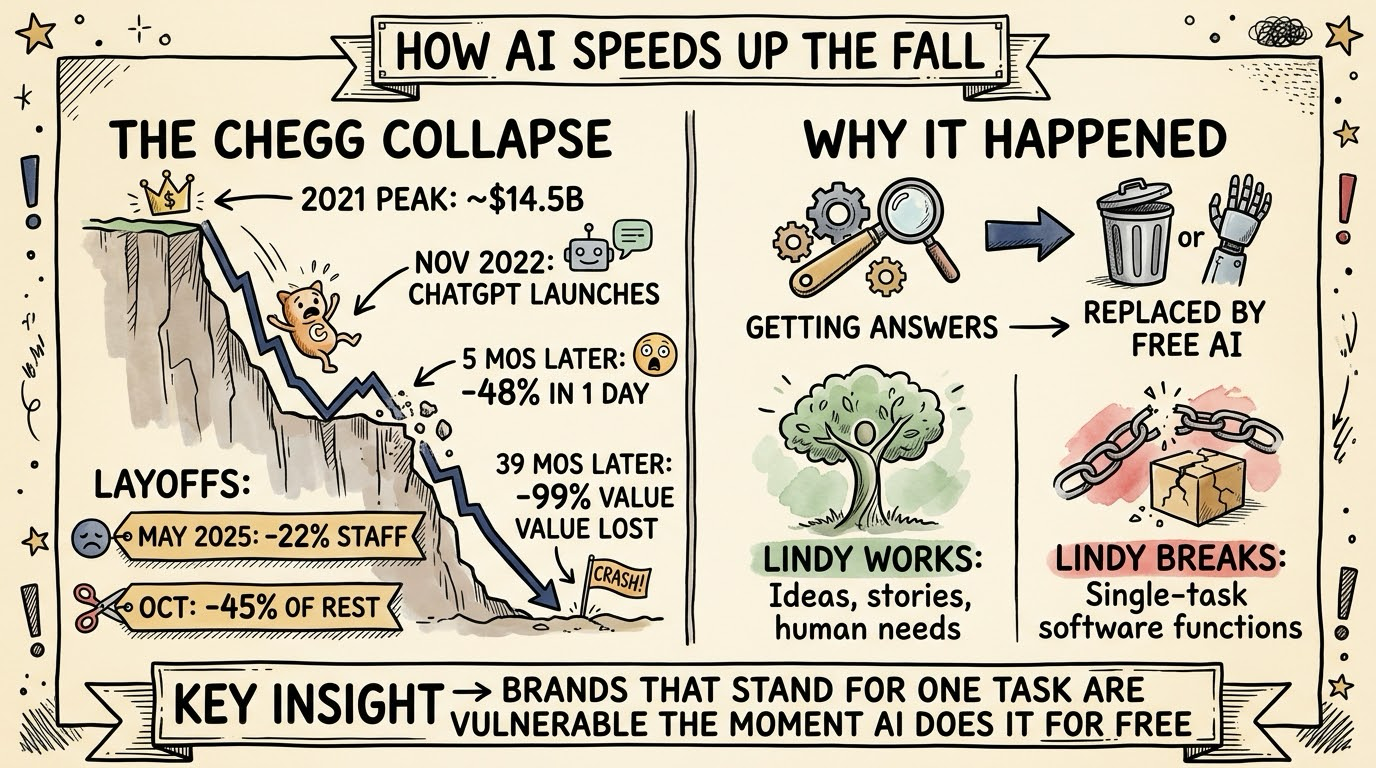
The homework-help company was worth about $14.5 billion at its peak in 2021.
ChatGPT launched at the end of November 2022.
Five months later, Chegg told investors the chatbot was hurting growth, and its stock fell 48% in a single day.
Within 39 months, it had lost about 99% of its value.
It cut 22% of its staff in May 2025 and 45% of the rest that October.
Chegg wasn't a weak brand.
Millions of students knew it and paid for it.
Its problem was that the brand stood for one function, getting answers, and AI began doing that function for free.
The rise is faster as well.
As I wrote in When Code Is Free, Customer Connection Becomes the Moat, anyone can now ship a decent product in days.
That means new brands appear constantly, and most of them vanish just as quickly.
So I'd refine the claim.
The Lindy effect still works for ideas, stories and human needs.
It has stopped working for brands whose whole value is a task that software can now perform.
Survivors That Acquire
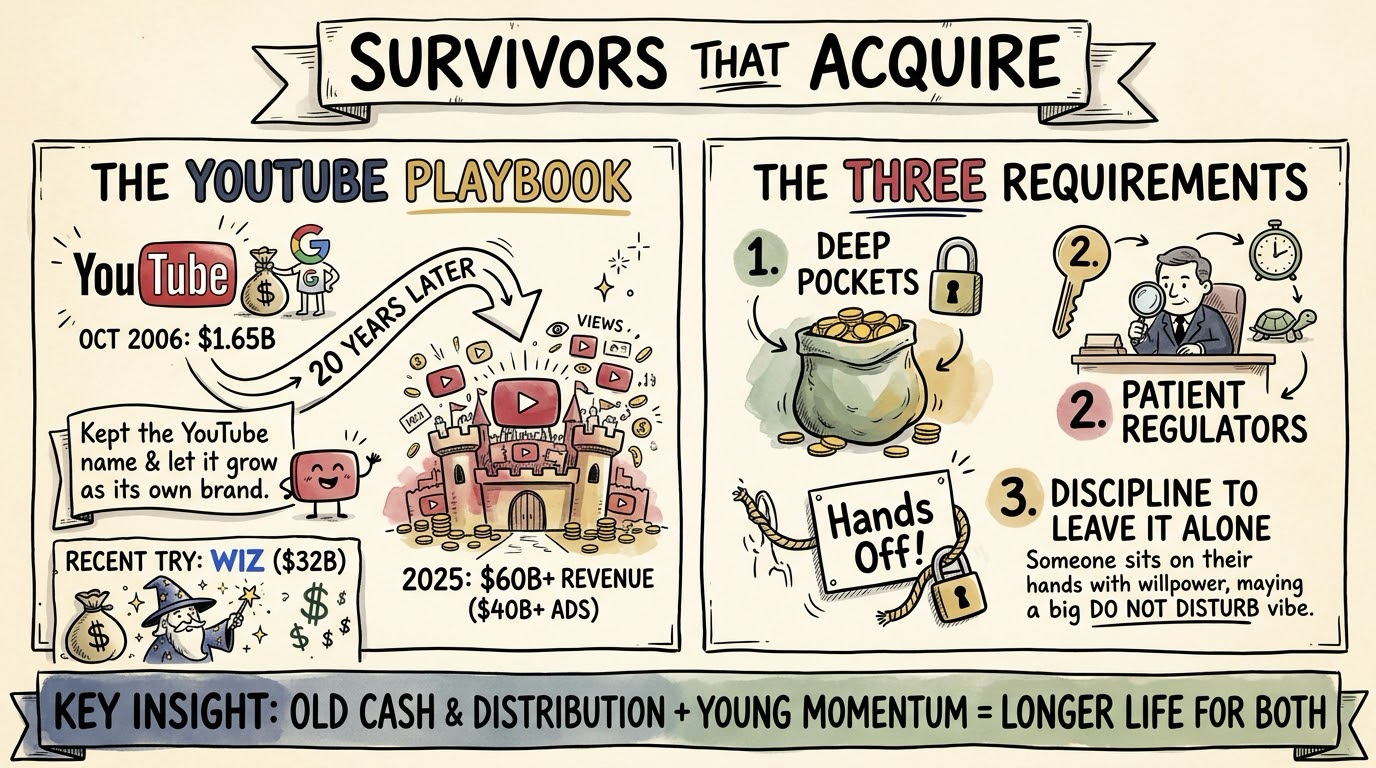
The first way to stay alive is to buy the thing that might replace you.
Google announced its purchase of YouTube in October 2006 for $1.65 billion.
Twenty years later, Alphabet says YouTube brought in more than $60 billion in 2025, including over $40 billion in advertising.
Google kept the YouTube name and let it grow as its own brand.
That's the pattern.
An older company with cash and distribution absorbs a younger one with momentum, and both last longer than they would have alone.
Google is still doing it, most recently with its $32 billion purchase of the security company Wiz.
The limit is obvious.
Acquisition only works for companies with deep pockets, patient regulators and the discipline to leave a good brand alone.
Survivors That Partner
The second way is open to far more companies.
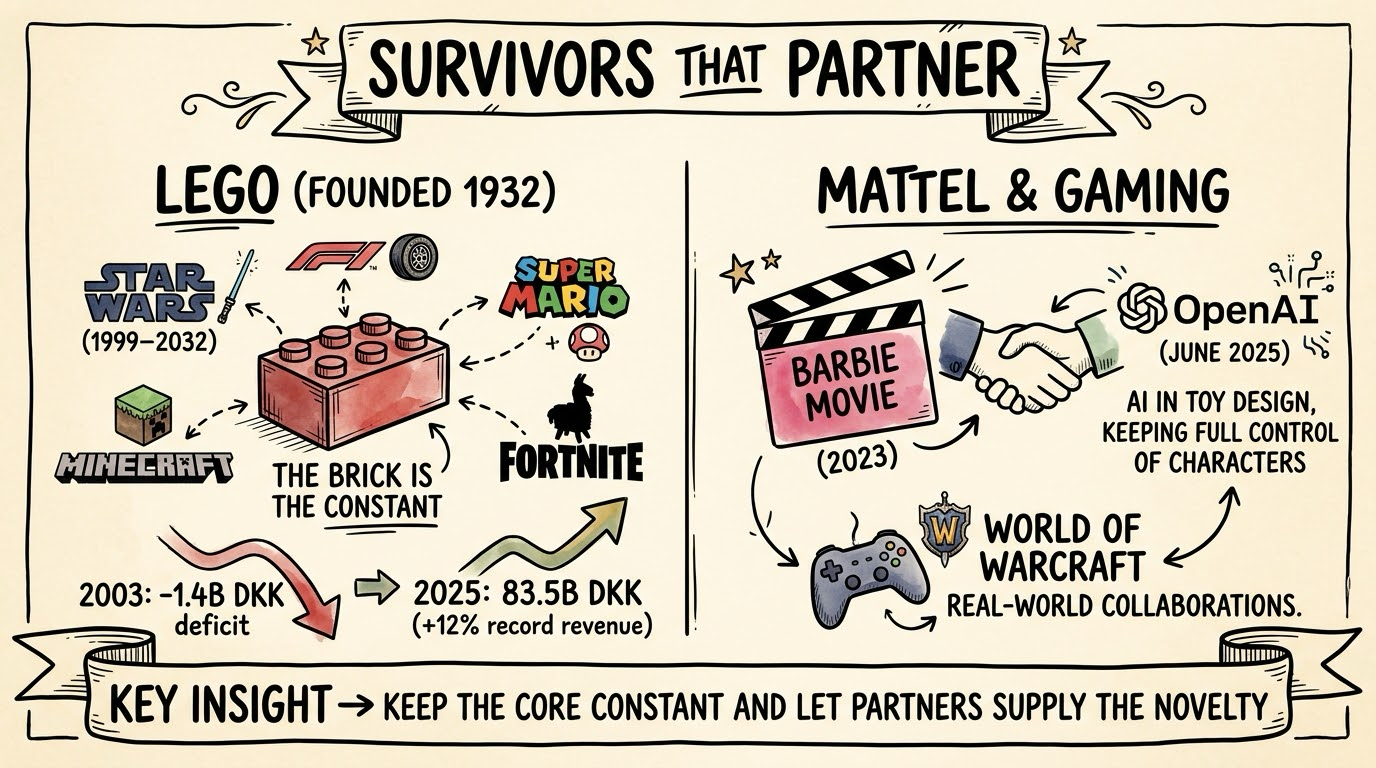
LEGO was founded in 1932, which makes it a Lindy brand by any measure.
It nearly lost its way in the early 2000s, reporting a deficit of about 1.4 billion Danish kroner in 2003, and the owner put 800 million kroner of his own money in to steady it.
It recovered by cutting costs and refocusing on its core toys, and it kept building on a habit it had started a few years earlier.
LEGO Star Wars launched in 1999, has run ever since and is licensed through 2032.
Today LEGO builds on Formula 1, Minecraft, Super Mario and Fortnite.
In 2025, its revenue rose 12% to a record 83.5 billion kroner, and its consumer sales grew more than twice as fast as the toy market.
Its chief executive named strategic partnerships as one of the drivers.
The brick is the constant.
The partners supply the novelty, and every new franchise gives another generation a reason to build.
Mattel has taken a similar route.
The 2023 Barbie film was a major hit and gave a decades-old doll a new audience.
In June 2025, Mattel partnered with OpenAI to bring AI into toy design, while keeping full control of its characters.
It partnered with the new technology instead of waiting to be disrupted by it.
I've seen the same logic in gaming, where World of Warcraft's marketing team keeps a long-running game relevant through real-world collaborations.
The Asset Underneath Both Strategies
There's a reason these particular companies can acquire or partner.
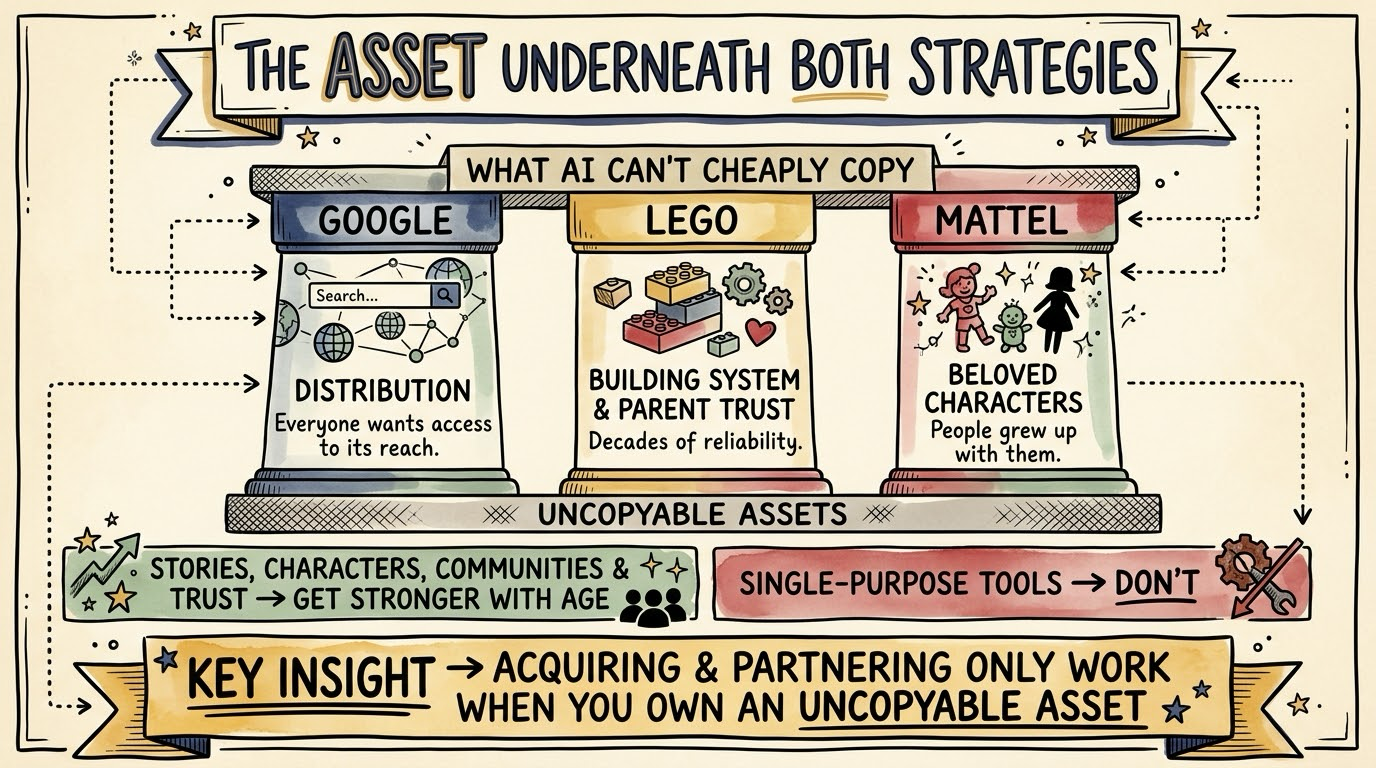
Each one owns something others want to attach themselves to.
Google owns distribution.
LEGO owns a building system and decades of trust with parents.
Mattel owns characters people grew up with.
Acquiring and partnering are methods, and the durable thing beneath them is an asset AI can't cheaply copy.
That's the part of the Lindy effect I think survives.
Stories, characters, communities and trust still get stronger with age.
Single-purpose tools don't.
What Smaller Brands Can Do
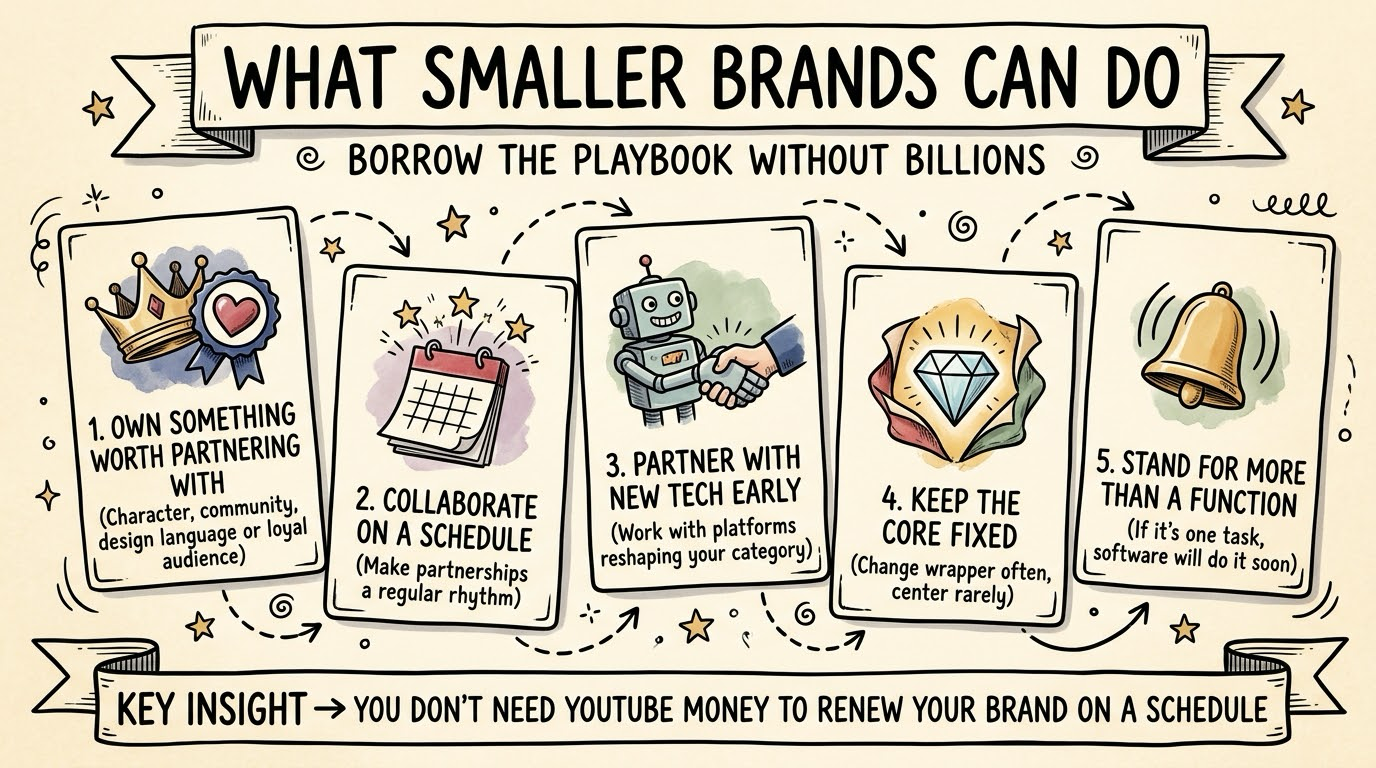
Most companies can't buy a YouTube.
They can still borrow the playbook.
- Own something worth partnering with. A character, a community, a design language or a loyal audience gives others a reason to collaborate.
- Collaborate on a schedule. Treat partnerships as a regular part of the calendar, the way LEGO treats new franchises.
- Partner with the new technology early. Work with the platforms and tools reshaping your category before they work around you.
- Keep the core fixed. Change the wrapper often and the centre rarely, so people always recognise you.
- Stand for more than a function. If a customer can describe your brand as one task, assume software will do that task soon.
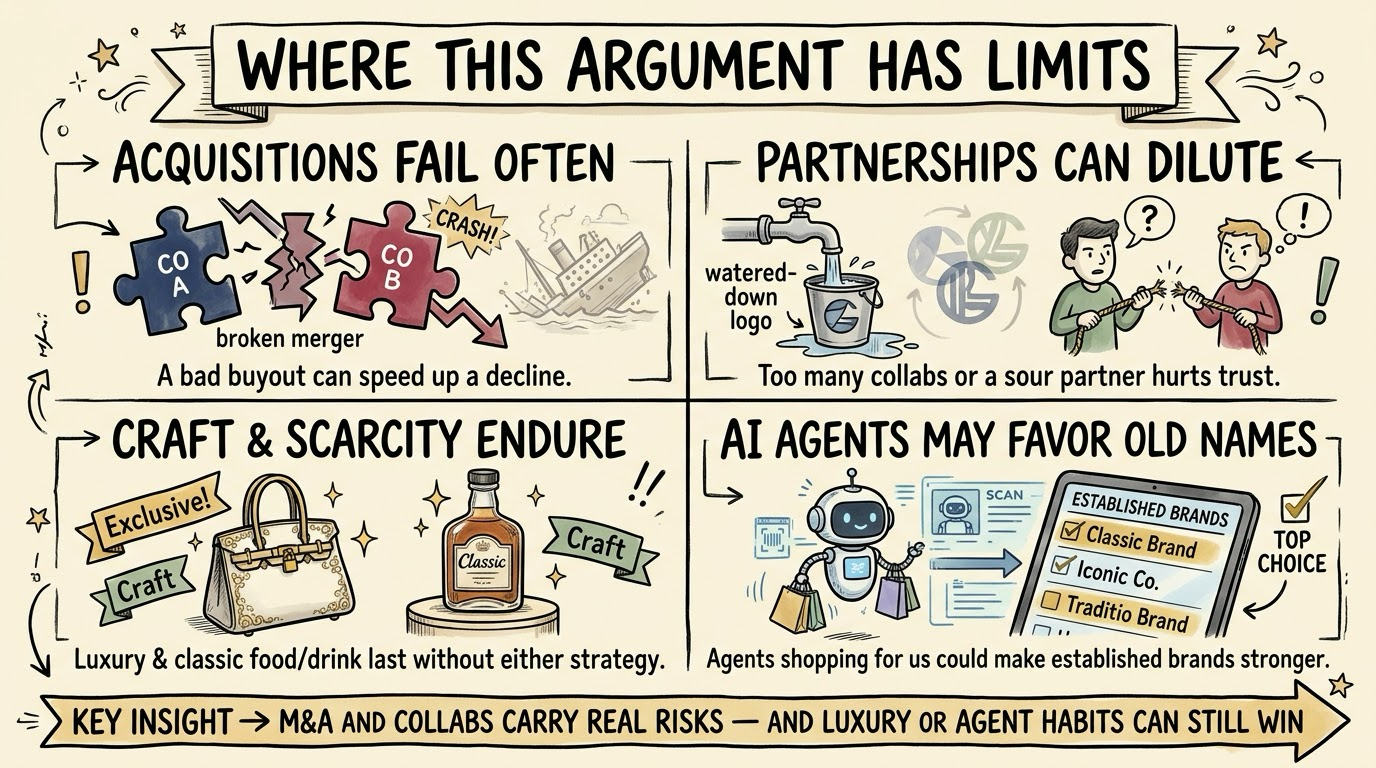
Where This Argument Has Limits
Nothing lasts forever, and that includes the survivors I've named.
Acquisitions fail often, and a bad one can speed up a decline.
Partnerships can dilute a brand if there are too many, or if the partner's reputation sours.
Some brands also last without doing either.
Luxury houses and certain food and drink brands endure through scarcity, craft and habit.
And I'm generalising from a few striking cases.
Chegg is one company, and its troubles also involved changes in search traffic and its own decisions.
It's also possible that AI agents end up favouring established names when they shop for us, which would make old brands stronger.
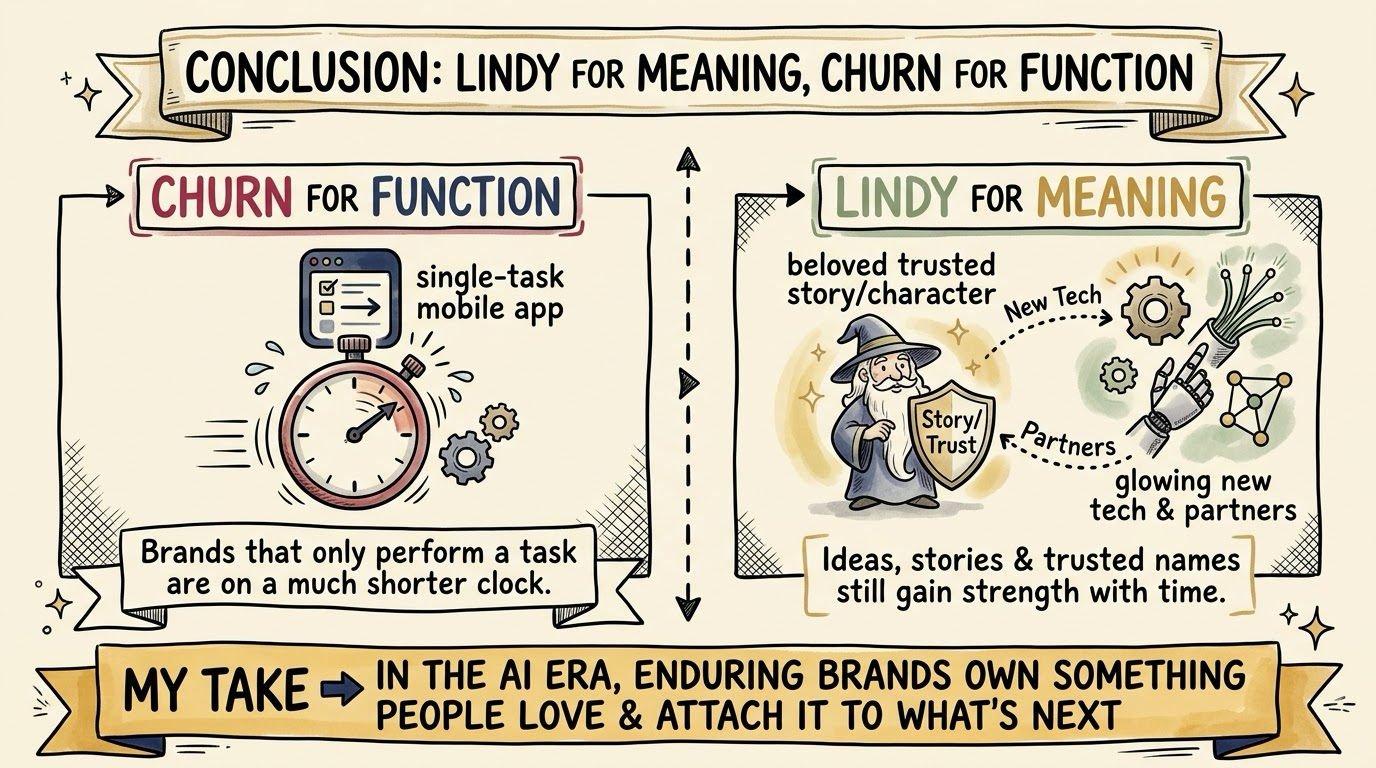
Conclusion: Lindy For Meaning, Churn For Function
The Lindy effect hasn't disappeared.
It has narrowed.
Ideas, stories and trusted names still gain strength with time.
Brands that only perform a task are now on a much shorter clock.
The companies that last will keep renewing themselves by buying what's next or teaming up with it.
My Take: In the AI era, age alone protects no one, so the brands that endure will be the ones that own something people love and keep attaching it to whatever comes next.
Sources
Pages I opened for the facts in this post:
- Wikipedia: Lindy effect
- I by IMD: Why corporate lifespans are shrinking and how to extend them
- Axios: S&P 500 company lifespan
- European Business Magazine: How ChatGPT and Google's AI Overviews dismantled Chegg in 39 months
- Forbes Argentina: Google bought YouTube for $1.65 billion, 20 years later the business exceeds $60 billion
- The LEGO Group: Record results in 2025
- Wikipedia: The Lego Group
- Wikipedia: Lego Star Wars
- TechCrunch: OpenAI and Barbie-maker Mattel team up
- Wikipedia: Wiz, Inc.