Why Meta Firing Palmer Luckey Was the Best Thing to Happen to US Defense
Facebook pushed Palmer Luckey out in 2017 after a political donation. He used the exit to start Anduril, now valued at $61 billion and building drones, missiles and autonomous jets for the US military. Here's why that firing may be Silicon Valley's biggest gift to American defense.
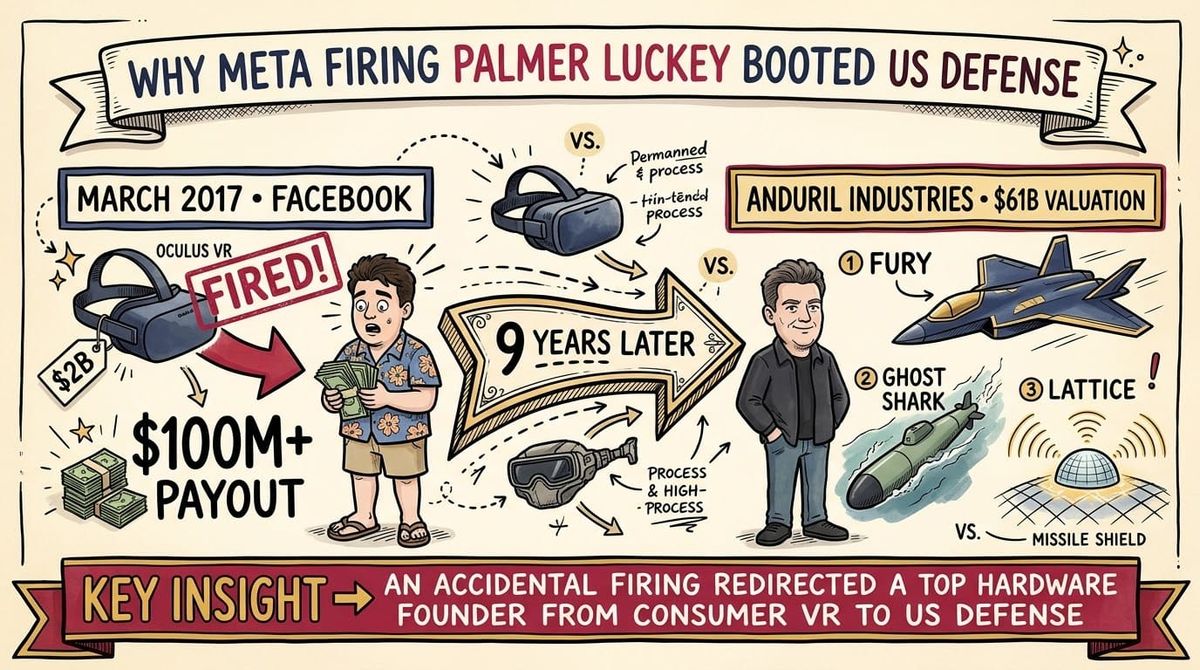
In March 2017, Facebook parted ways with the founder who had sold it Oculus for $2 billion.
It looked like the end of Palmer Luckey's career in tech.
Nine years later, the company he started next is valued at $61 billion and builds autonomous jets, missiles and submarines for the US military.
I think Facebook pushing him out was the best thing that could have happened to American defense.
It was also a complete accident.
What Actually Happened In 2017
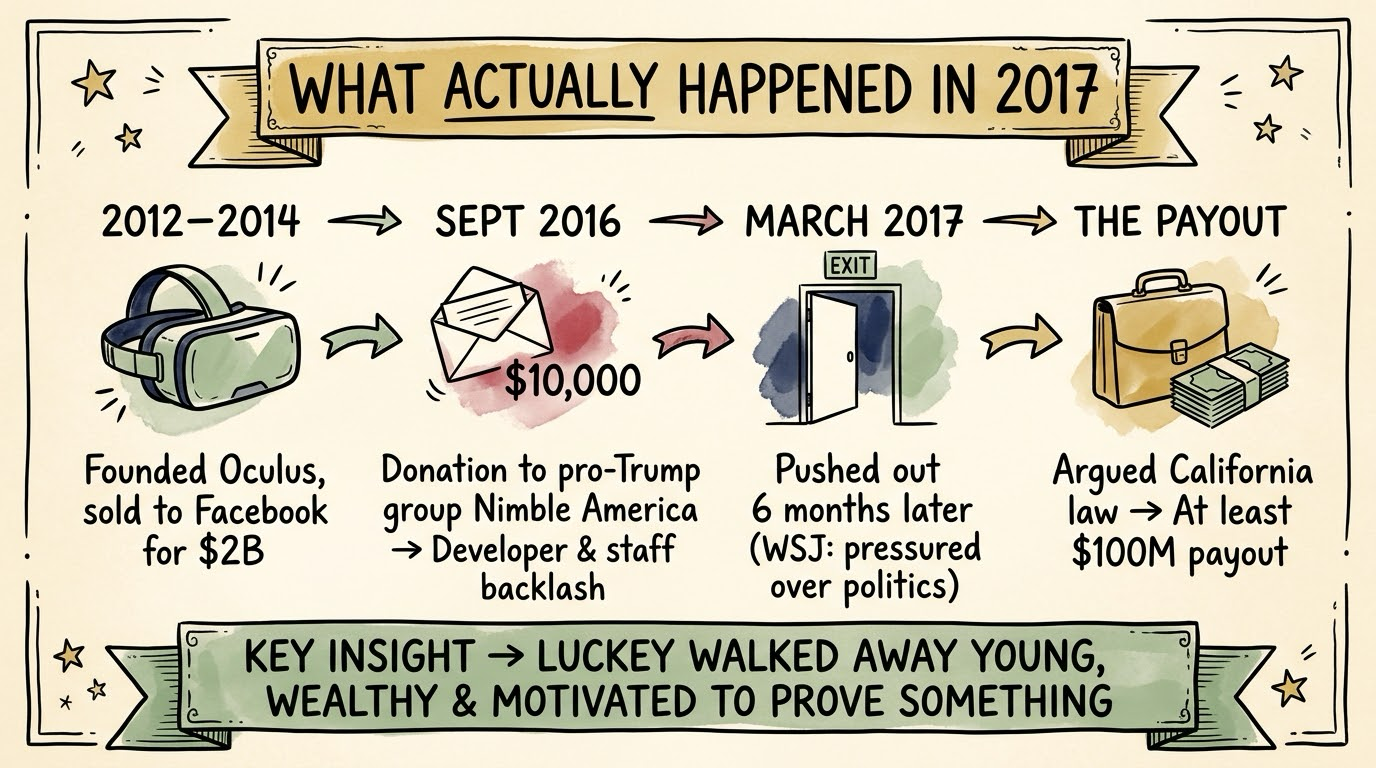
Luckey founded Oculus in 2012 and sold it to Facebook two years later.
In September 2016, it came out that he had donated about $10,000 to a pro-Trump group called Nimble America.
Some developers pulled their support for Oculus, and staff inside Facebook were furious.
Six months later, he was gone.
Facebook has always said his departure had nothing to do with his political views.
The Wall Street Journal later reported that he had been pressured over his politics while he was still there.
Luckey hired an employment lawyer, argued that the company had broken California law, and negotiated a payout of at least $100 million.
So he walked away young, wealthy and angry.
That combination turned out to matter a great deal.
From Headsets To Weapons
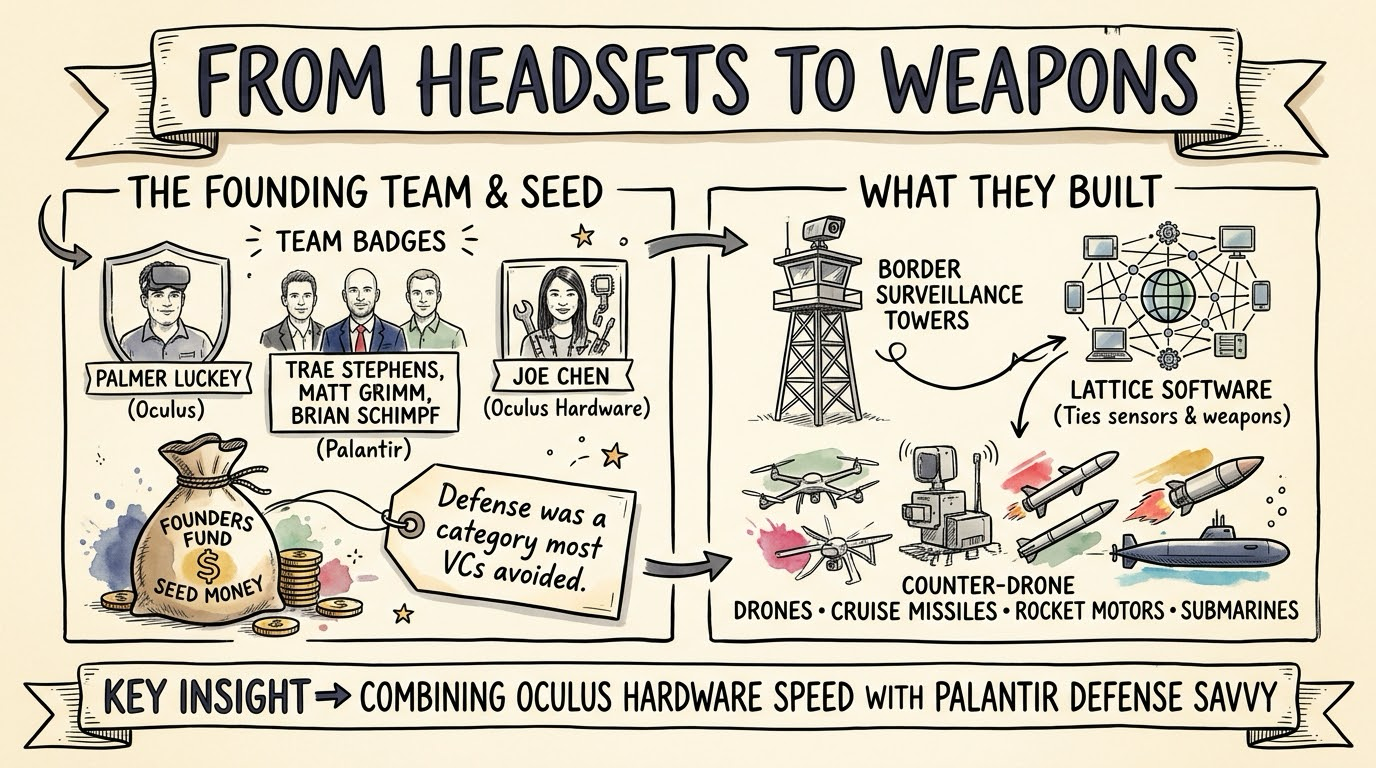
Within months, Luckey co-founded Anduril Industries.
His co-founders included Trae Stephens, Matt Grimm and Brian Schimpf, who came from Palantir, and Joe Chen, an early Oculus hardware lead.
Founders Fund provided the seed money.
The timing was terrible by Silicon Valley standards.
Defense was a category most venture investors avoided.
Anduril started with surveillance towers on the US border and a software platform called Lattice that ties sensors and weapons together.
It then moved into drones, counter-drone systems, cruise missiles, rocket motors and underwater vehicles.
I've profiled Luckey before as the uncancellable builder, and this stretch of his career is why.
What Anduril Has Become
The numbers show how far it has come.
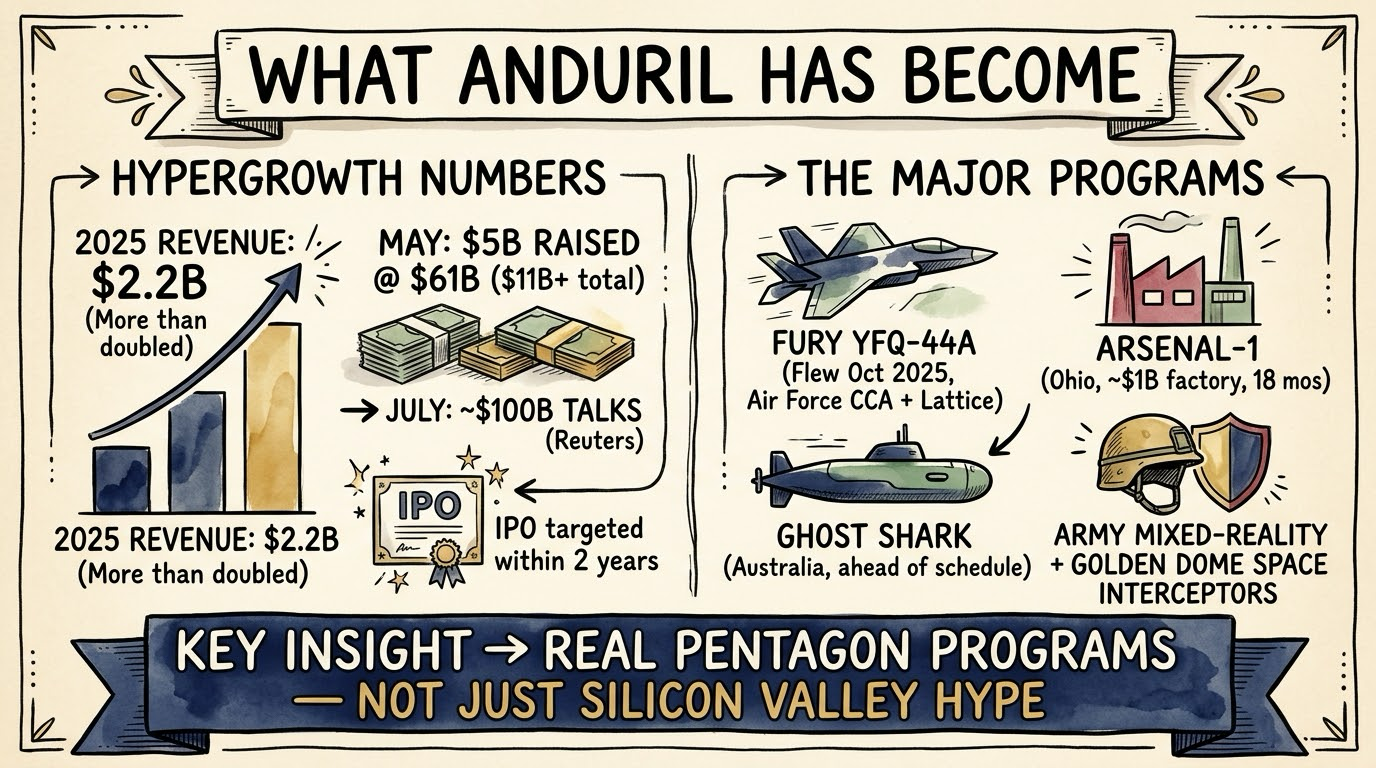
Anduril's revenue more than doubled to $2.2 billion in 2025.
In May, it raised $5 billion at a $61 billion valuation, bringing its total funding past $11 billion.
By July, Reuters reported it was in talks at around $100 billion.
The programs matter more than the valuation.
Its Fury unmanned fighter, the YFQ-44A, first flew in October 2025.
This June, the Air Force selected it for production under the Collaborative Combat Aircraft program, and chose Lattice for mission autonomy.
The first one built at Arsenal-1, Anduril's roughly $1 billion factory in Ohio, rolled out about 18 months after the site was announced.
Australia received its first Ghost Shark autonomous submarine ahead of schedule, a category I covered in my post on extra-large autonomous underwater vehicles.
Anduril also took over the Army's mixed-reality headset program from Microsoft and is part of a team developing space-based interceptors for the Golden Dome missile shield.
The company now says it hopes to go public within two years.
Why The Firing Mattered So Much
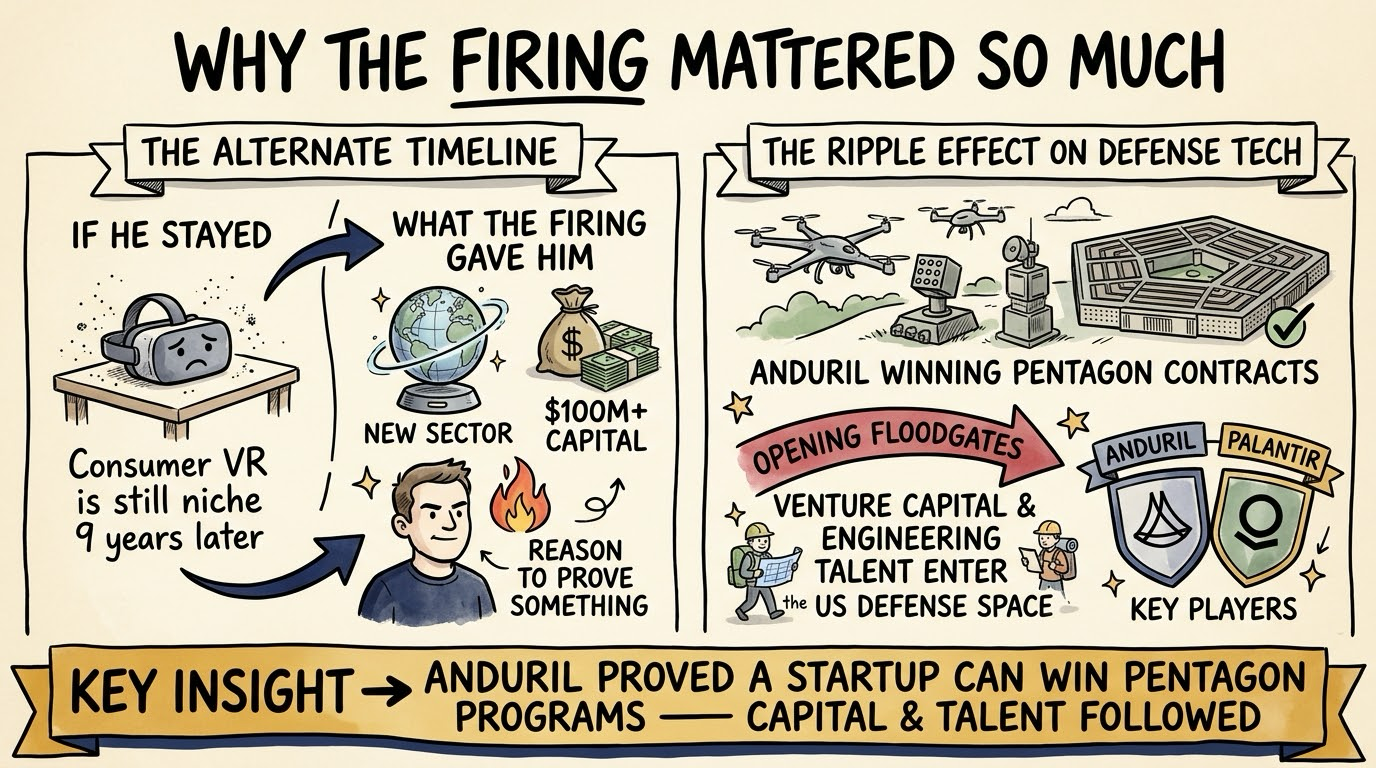
Here's my argument for why the exit was so valuable.
If Luckey had stayed, he would most likely have spent the past nine years making consumer headsets.
In my view, consumer VR is still a niche product all these years later.
The firing redirected one of the best hardware founders of his generation toward a sector that badly needed one.
It also gave him the money to start without asking permission.
And it gave him a reason to prove something.
Luckey has said the experience permanently changed how much he trusts the people he works with.
The bigger effect was on everyone else.
Anduril's CEO has said defense simply wasn't a category that attracted serious venture investment when the company started, and that this has changed meaningfully.
Once Anduril showed a startup could win major Pentagon programs, capital and talent followed it into the sector.
That's the part I'd call a contribution to American defense as a whole, beyond one company's products.
Together with Palantir, it forms what I've described as the duo that will establish US dominance.
The Irony: Meta Came Back
The story has a neat ending.
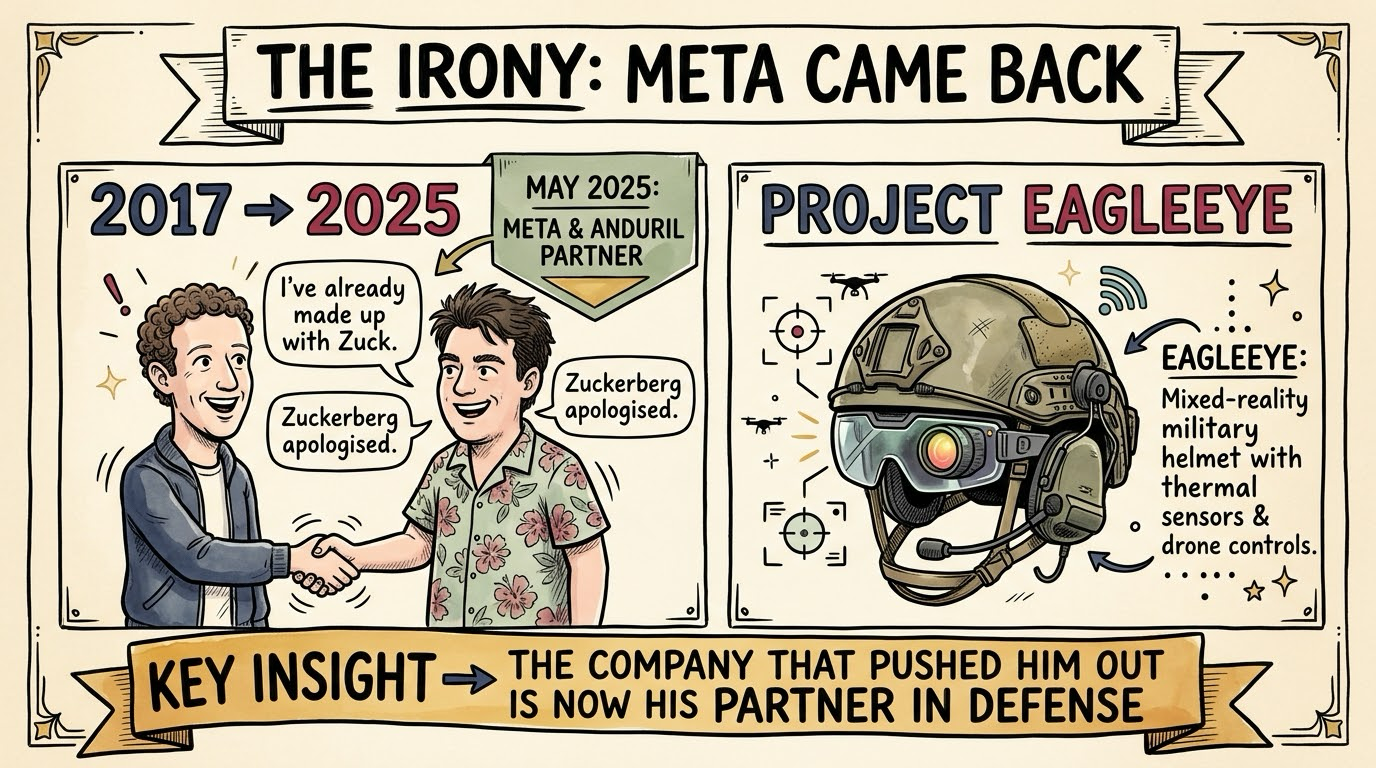
In May 2025, Meta and Anduril announced a partnership to build mixed-reality devices for the US military.
The first project, EagleEye, is a helmet and headset system with thermal sensors and built-in controls for drones.
Luckey had already told Fortune, "I've already made up with Zuck."
He also said Zuckerberg had apologised for what happened.
So the company that pushed him out for being too controversial is now his partner in defense.
That's about as clear a sign as you'll get of how much Silicon Valley's attitude has shifted.
Where This Argument Has Limits
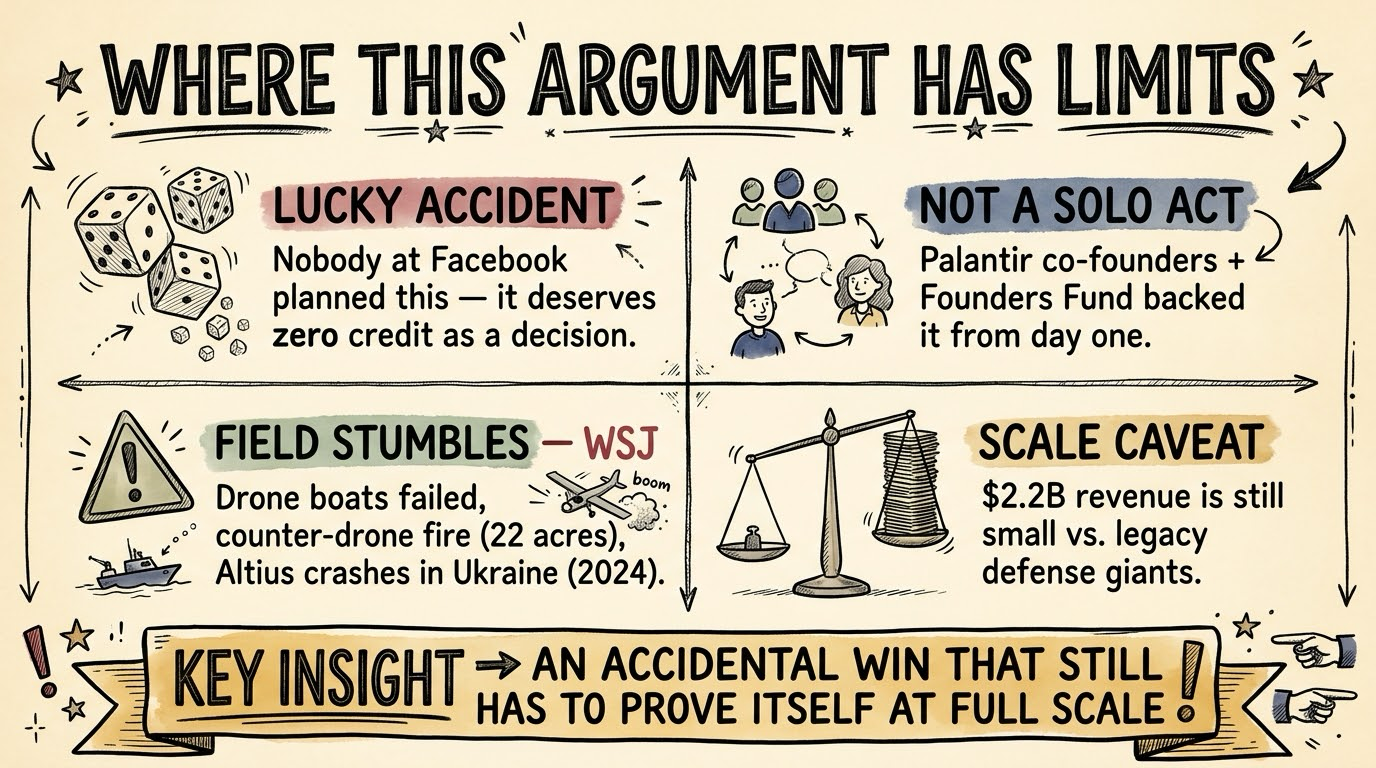
Nobody at Facebook did this on purpose, so it's a lucky accident and deserves no credit as a decision.
Luckey also didn't do it alone.
His co-founders brought Palantir's experience of selling to the government, and Founders Fund backed the company from day one.
Anduril's record isn't spotless either.
The Wall Street Journal reported last year that several of its systems stumbled in tests and combat.
More than a dozen drone boats failed during a Navy exercise, a counter-drone test started a 22-acre fire, and Ukrainian forces stopped using its Altius drones in 2024 after crashes.
Anduril says those problems are typical of weapons development.
Scale is the other caveat.
Revenue of $2.2 billion is still small next to the largest defense contractors.
And supremacy is only proven when these systems are fielded in large numbers and work under pressure.
Conclusion: The Most Useful Firing In Tech
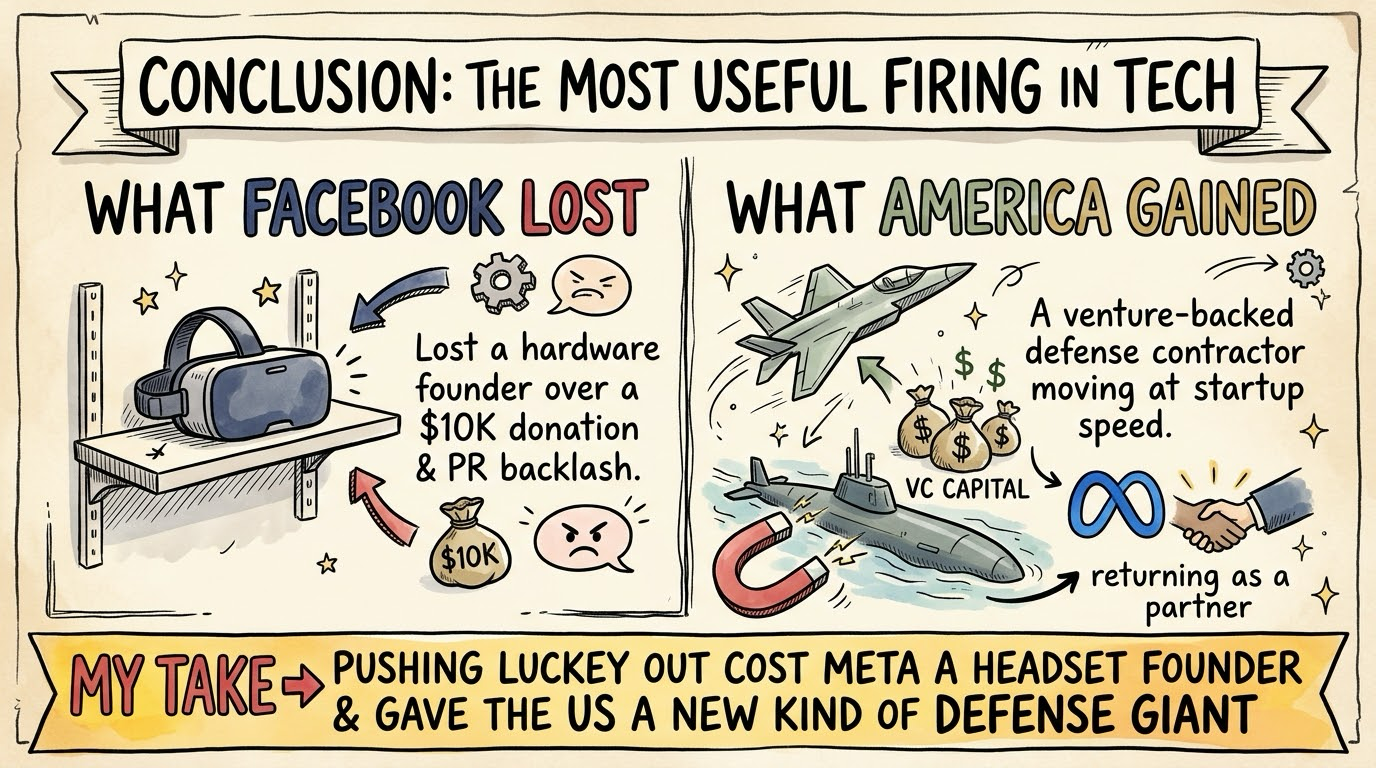
Facebook lost a founder over a political donation and a public relations problem.
The US gained a defense company that builds weapons with venture money and startup speed.
It pulled venture capital and engineering talent into a sector Silicon Valley had walked away from.
Even Meta ended up following him there.
My Take: Pushing Palmer Luckey out cost Facebook a headset founder and gave America a new kind of defense contractor, and I can't think of another firing in tech that has done more for US military strength.
Sources
Pages I opened for the facts in this post:
- Wikipedia: Palmer Luckey
- Wikipedia: Anduril Industries
- TechCrunch: Anduril raises $5B, doubles valuation to $61B
- TechCrunch: Anduril reportedly in talks to raise funding at $100B valuation
- Anduril News: Anduril timeline
- Fortune: Palmer Luckey, Mark Zuckerberg and the Anduril-Meta partnership
- TechCrunch: Anduril's autonomous weapons stumble in tests and combat, WSJ reports
- Seeking Alpha: Anduril eyes IPO within two years