Why Governments Are Telling You to Stockpile Food, and Whether Europe Faces Unrest Next
Thirty-three governments now tell citizens to keep emergency food at home. Fertilizer shocks, blocked shipping lanes, hacked supermarket fridges and failed harvests explain why. Here's how the food system lost its buffers, and whether pricier food could bring unrest to Europe.
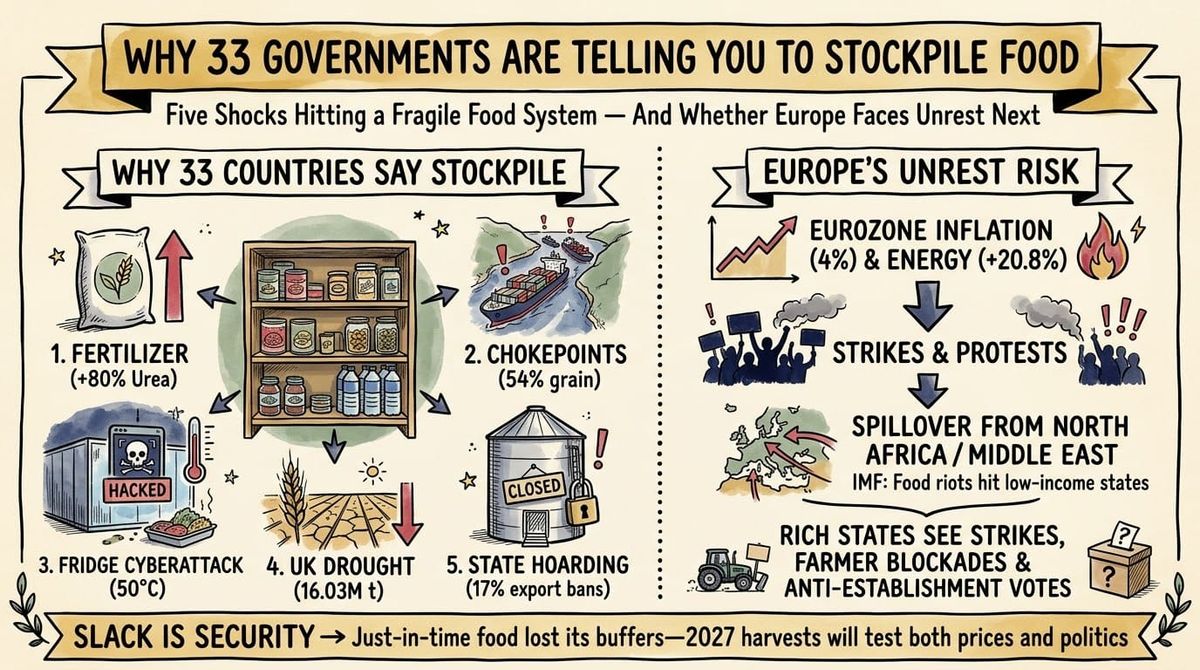
According to a Newsweek tally, 33 countries now advise their citizens to keep emergency food, water and supplies at home.
The list includes the UK, France, Germany, Canada, the US, Japan and Australia.
When that many governments say the same thing at once, it's fair to ask what they're worried about.
A recent video from The Invisible Hand, "Why We're Suddenly Being Told to Stockpile," made a convincing case that there's no single secret disaster behind it.
The problem is a food system with almost no slack, hit by several shocks at the same time.
I checked its main claims, and I want to add a question it doesn't fully answer: if food in Europe gets much more expensive, will that lead to unrest?
Full Shelves Hide What's Coming
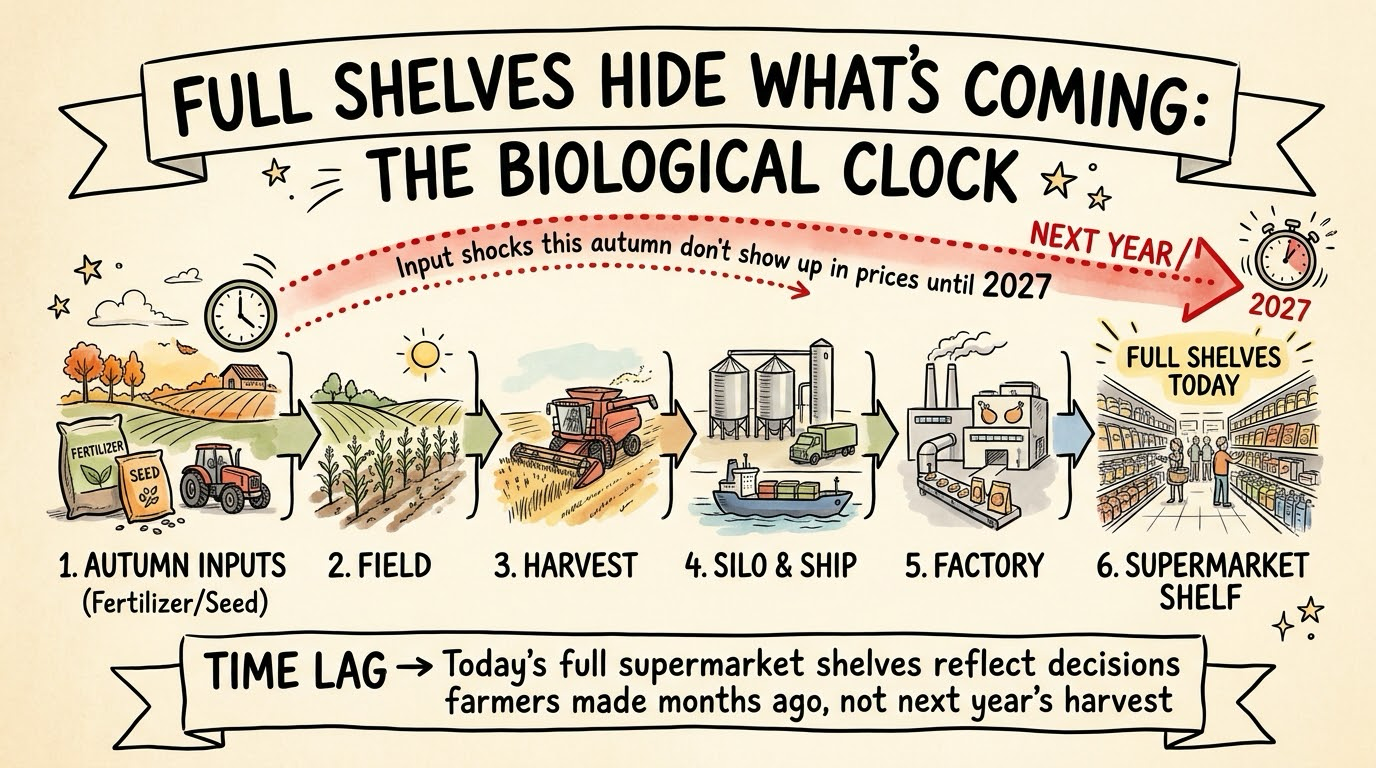
The shelves you see today reflect decisions farmers made months ago.
Food moves on a biological clock, from field to harvest to silo to ship to factory to shelf.
That means a shock to farming inputs this autumn doesn't show up in prices until next year or later.
So the fact that supermarkets look normal tells you very little about what happens next.
Shock One: Fertilizer
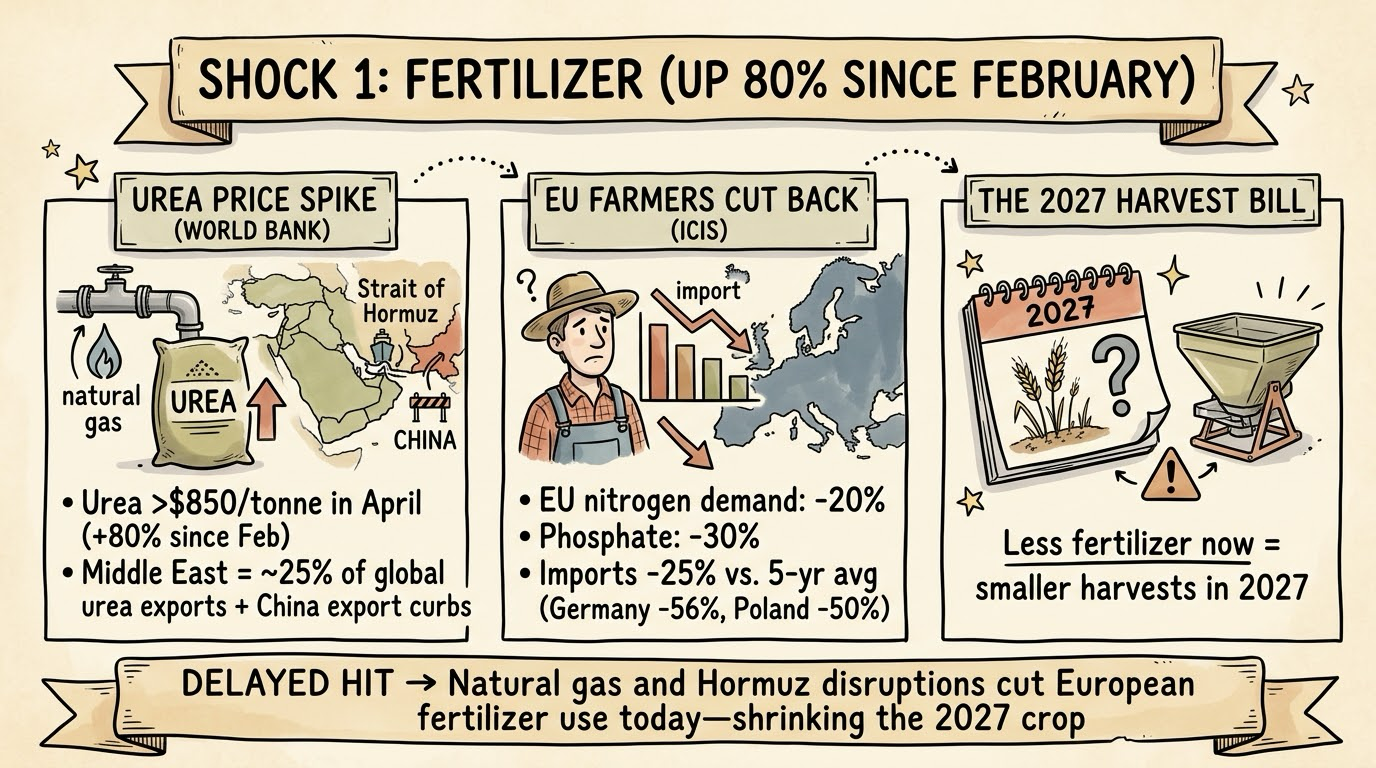
Modern farming depends on nitrogen fertilizer, and the most common type, urea, is made from natural gas.
When the Strait of Hormuz was closed this year, urea prices rose above $850 per tonne in April, up 80% since February, according to the World Bank.
The Middle East accounts for nearly a quarter of global urea exports.
China's tighter fertilizer export controls added more pressure.
European farmers are now responding by buying less.
According to ICIS, EU demand for nitrogen fertilizer is running 20% below normal for the season, and phosphate purchases are down at least 30%.
EU fertilizer imports fell 25% versus the five-year average in the first nine months of the year, including drops of 56% in Germany and 50% in Poland.
Less fertilizer usually means smaller harvests, and the bill for that arrives with the 2027 crop.
Shock Two: Shipping Chokepoints
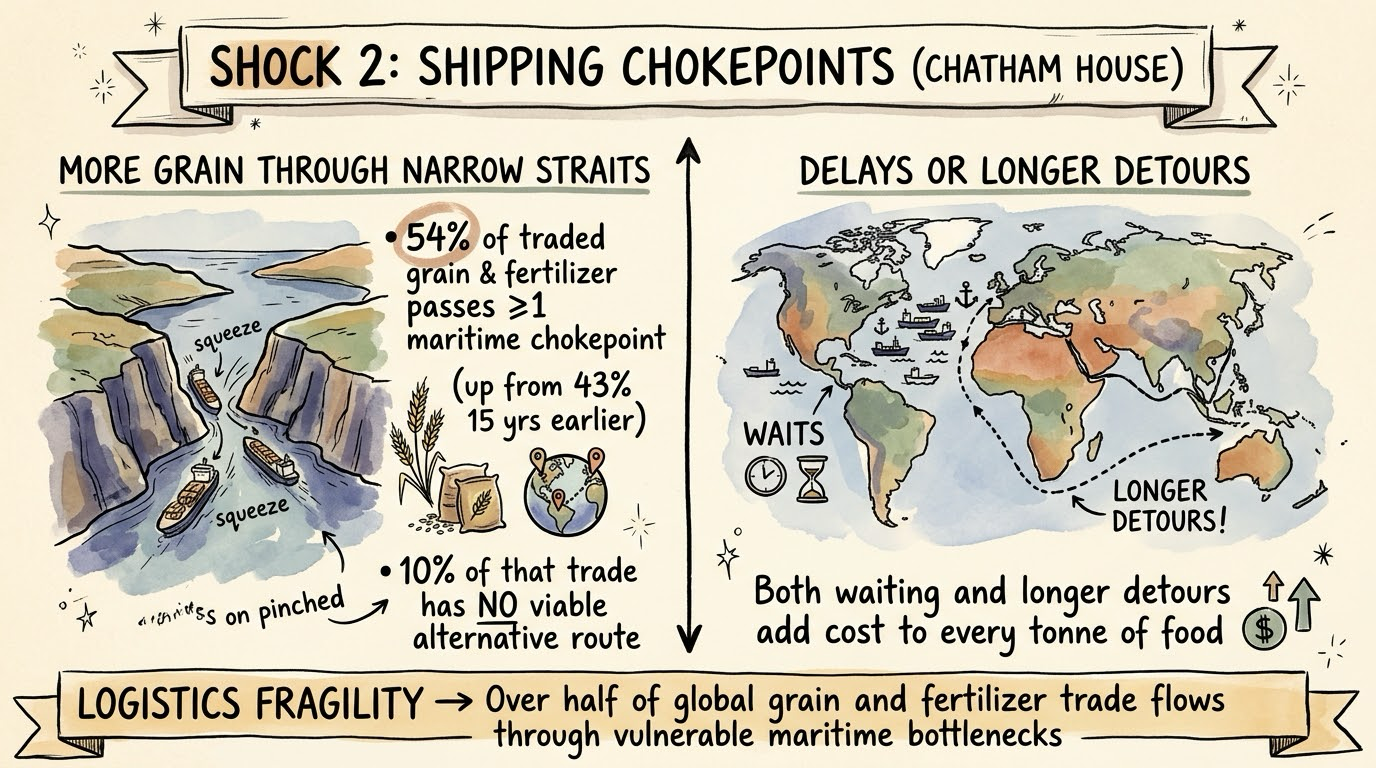
A 2017 Chatham House study found that 54% of traded grain and fertilizer passes through at least one maritime chokepoint, up from 43% fifteen years earlier.
For 10% of that trade, there's no viable alternative route.
When a strait closes or becomes too dangerous, ships either wait or take much longer routes, and both cost money.
Shock Three: Hackers In The Cold Chain
This is the shock I find most underrated.
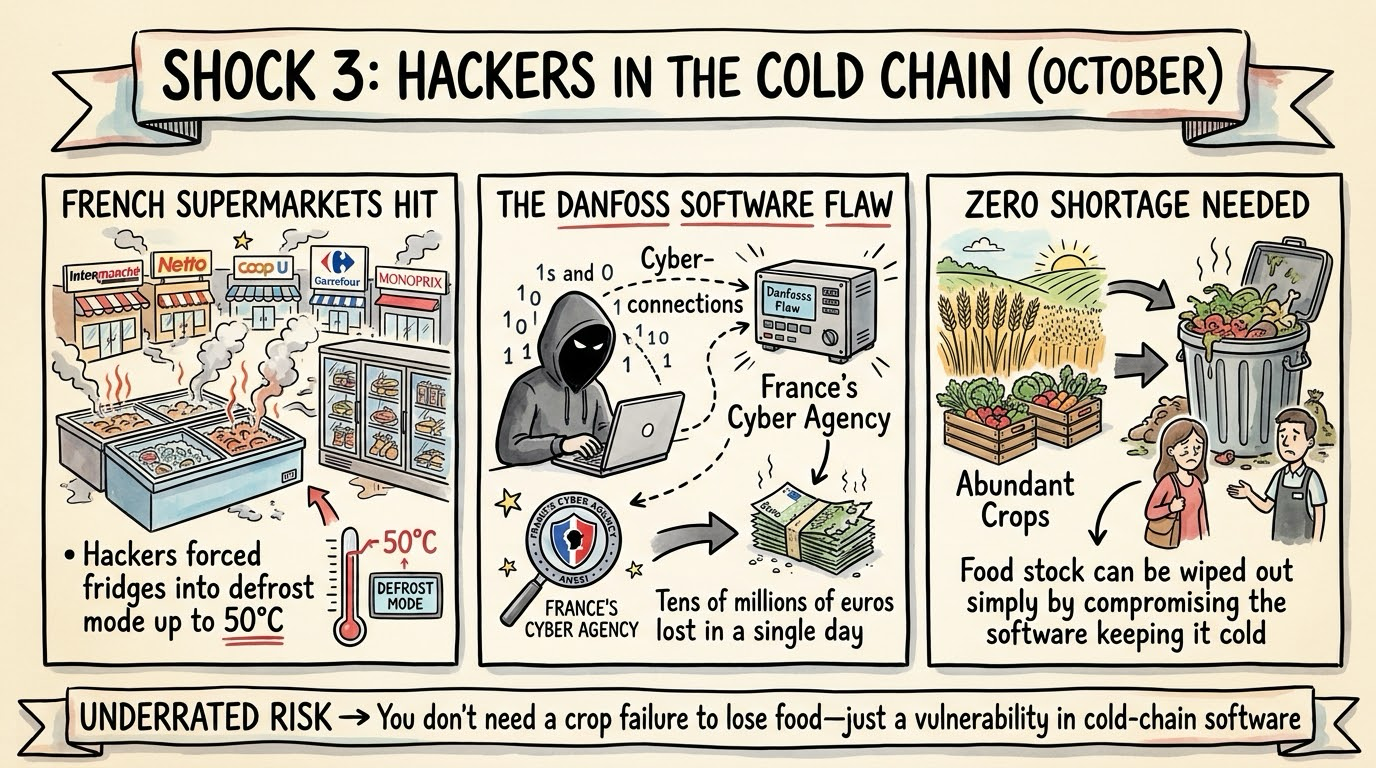
In October, a cyberattack hit hundreds of supermarkets in France, including Intermarché, Netto, Cooperative U, Carrefour and Monoprix stores.
Hackers forced refrigeration systems into defrost, pushing fridge and freezer temperatures as high as 50°C.
Stores had to throw out their fresh and frozen food, and Intermarché's CEO estimated losses in the tens of millions of euros in a single day.
France's cybersecurity agency traced it to a vulnerability in refrigeration software from the Danish company Danfoss.
A food system can now lose stock without any shortage of food, simply because the software that keeps it cold was compromised.
Shock Four: Weather
The weather didn't help.
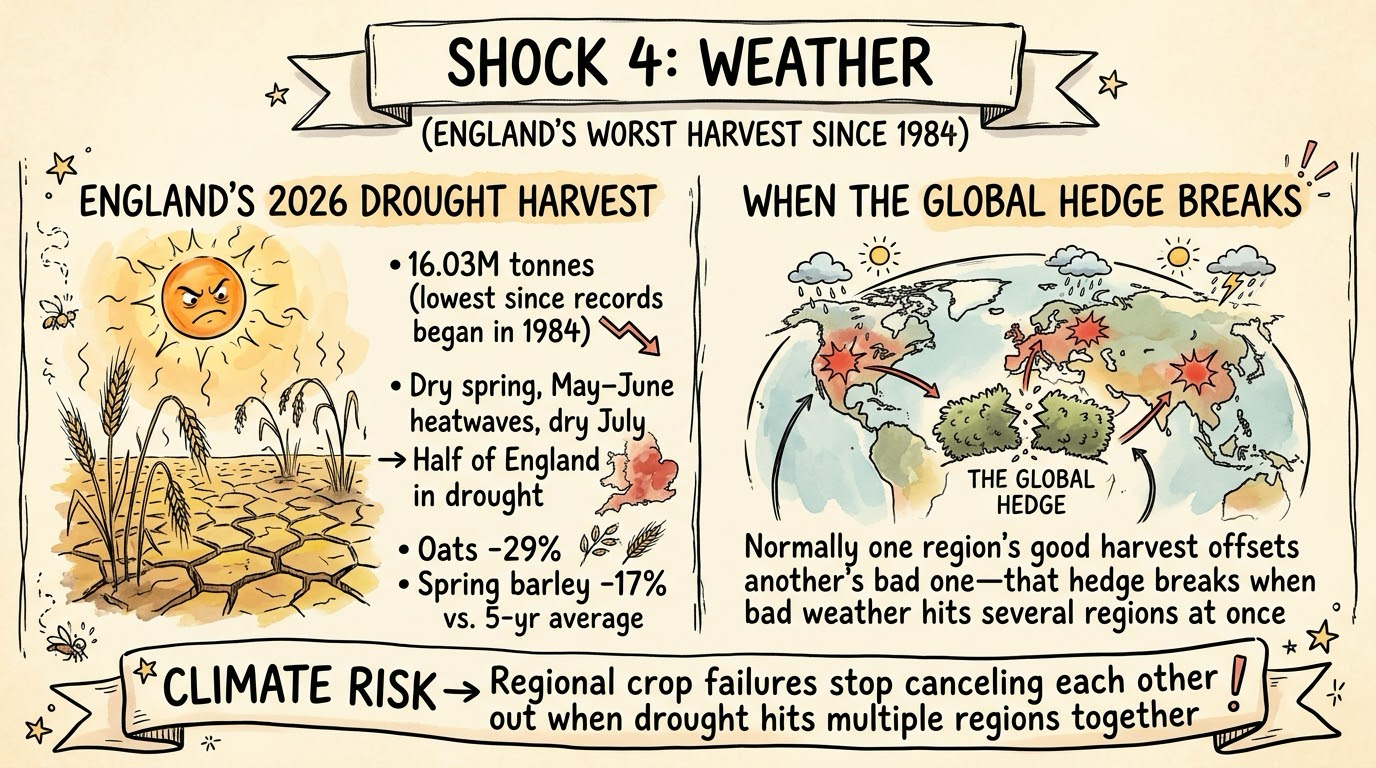
England's 2026 harvest of wheat, barley, oats and rapeseed came in at 16.03 million tonnes, the lowest since records began in 1984.
A dry spring, heatwaves in May and June and an exceptionally dry July left half of England in drought.
Oat production fell 29% and spring barley yields were 17% below the five-year average.
Global food markets normally rely on one region's good harvest offsetting another region's bad one.
That hedge breaks down when bad weather hits several regions at once.
Shock Five: Governments Hoarding
The last shock is political, and history shows it can be the worst one.
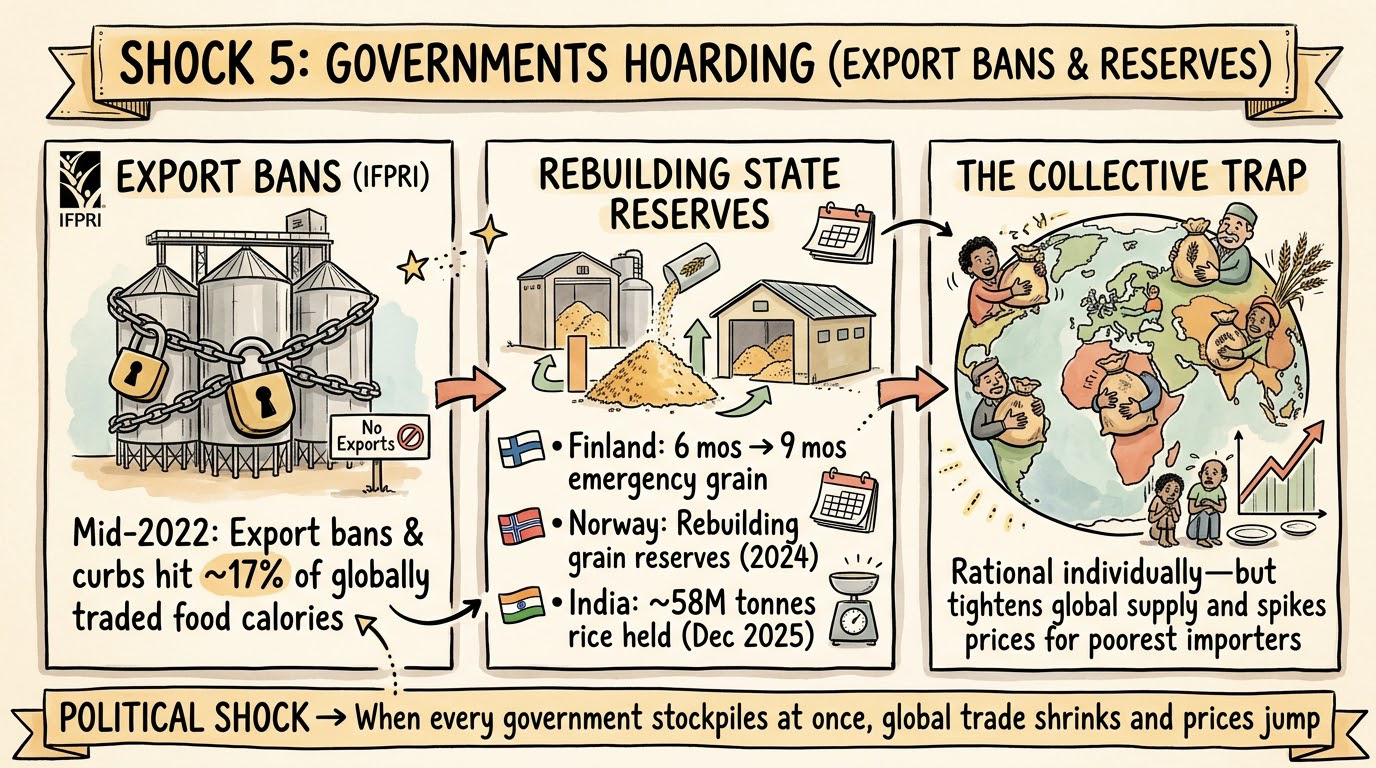
In mid-2022, export bans and restrictions affected about 17% of globally traded food calories, according to IFPRI.
Governments are rebuilding their own reserves now.
Finland has raised its emergency grain holdings from six months of supply to nine.
Norway began rebuilding its grain reserves in 2024, and India held nearly 58 million tonnes of rice by December 2025.
Each country is acting rationally.
But if everyone stockpiles at once, global supply tightens and prices rise for the poorest importers.
How We Lost The Buffers
For decades, governments and companies treated spare stock as waste.
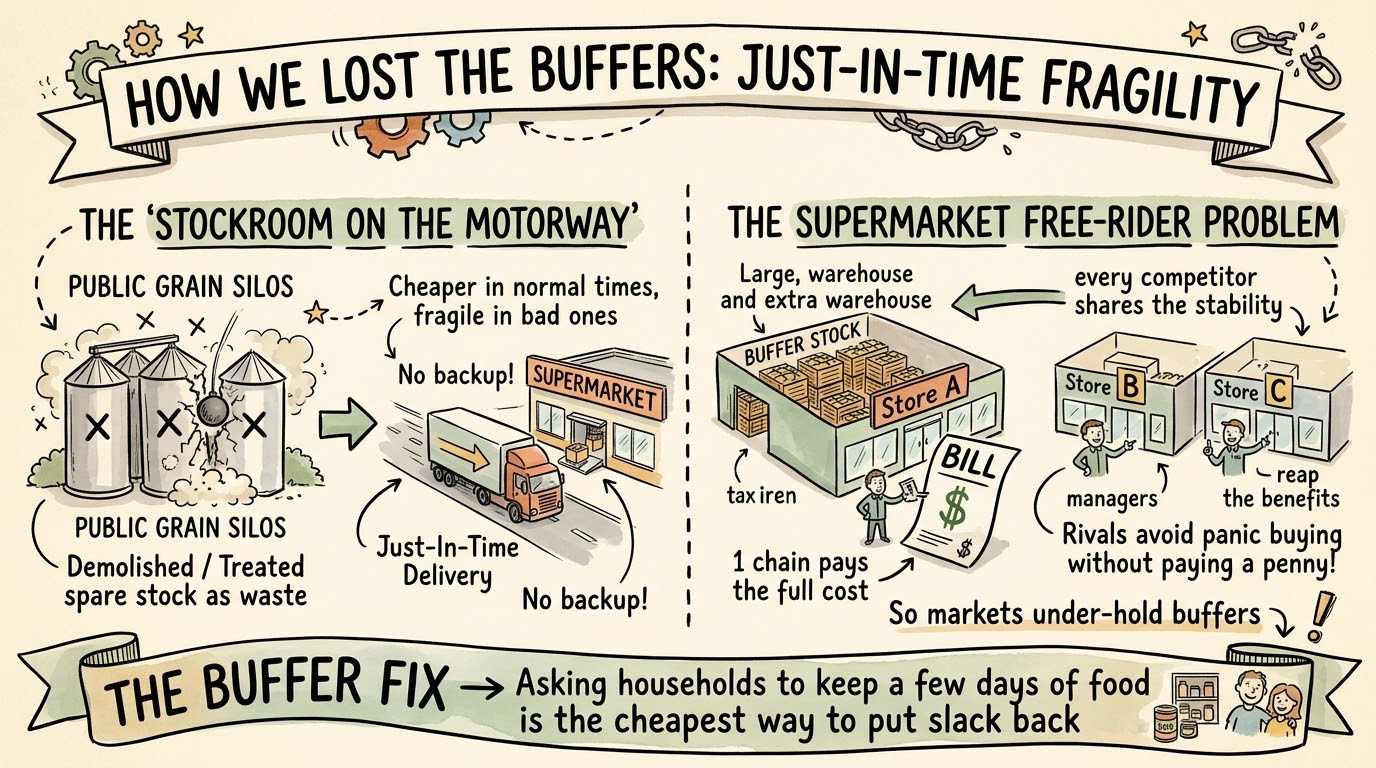
Public grain reserves were wound down, and supermarkets moved to just-in-time delivery, where the stockroom is effectively a lorry on the motorway.
That made food cheaper in normal times and much more fragile in bad ones.
The video makes a good economic point here.
If one supermarket chain pays to hold extra stock, it carries the full cost, but every competitor benefits when panic buying is avoided.
So the market will always hold less buffer than a country needs.
Asking households to keep a few days of food is a cheap way for governments to put some slack back into the system.
Will Expensive Food Bring Unrest To Europe?
This is the question I care most about.
The research says food prices are a powerful trigger for unrest, mainly in poorer countries.
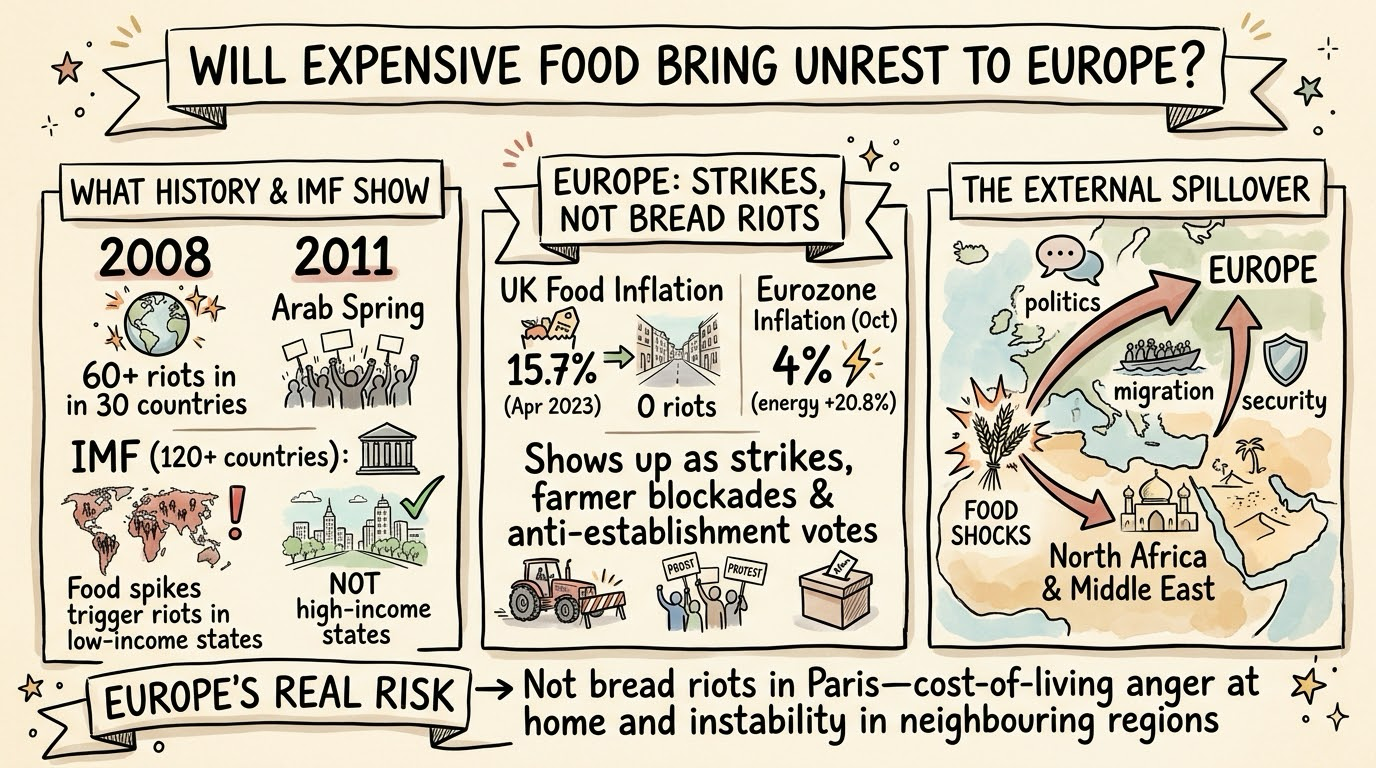
Researchers at the New England Complex Systems Institute found that when the FAO Food Price Index rose above a certain level, food riots followed, with more than 60 riots in 30 countries in 2008 and a role in the Arab Spring in 2011.
An IMF working paper by Rabah Arezki and Markus Brückner looked at more than 120 countries from 1970 to 2007.
It found that rising international food prices led to more anti-government protests, riots and civil conflict in low-income countries, but had no significant effect on conflict in high-income countries.
Europe's recent experience fits that pattern.
UK food inflation reached 15.7% in April 2023 on the British Retail Consortium's measure, and there were no food riots.
I think that's partly because Europeans spend a smaller share of their income on food, and welfare systems cushion the hit.
So I don't expect bread riots in Paris or Berlin.
But I do think expensive food adds to a bigger cost-of-living problem that's already building.
Eurozone inflation hit 4% in October, the highest in more than three years, with energy prices up 20.8% year on year.
In rich countries, that kind of pressure tends to show up as strikes, protests, farmer blockades and votes for anti-establishment parties rather than riots.
The bigger risk to Europe may come from outside it.
If food prices spike again, poorer countries in North Africa and the Middle East will feel it first and hardest, as they did in 2008 and 2011.
Instability there tends to reach Europe through politics, migration and security, even if Europe's own shelves stay full.
Conclusion: Slack Is The New Security
Governments are asking people to stockpile because the food system has lost its buffers.
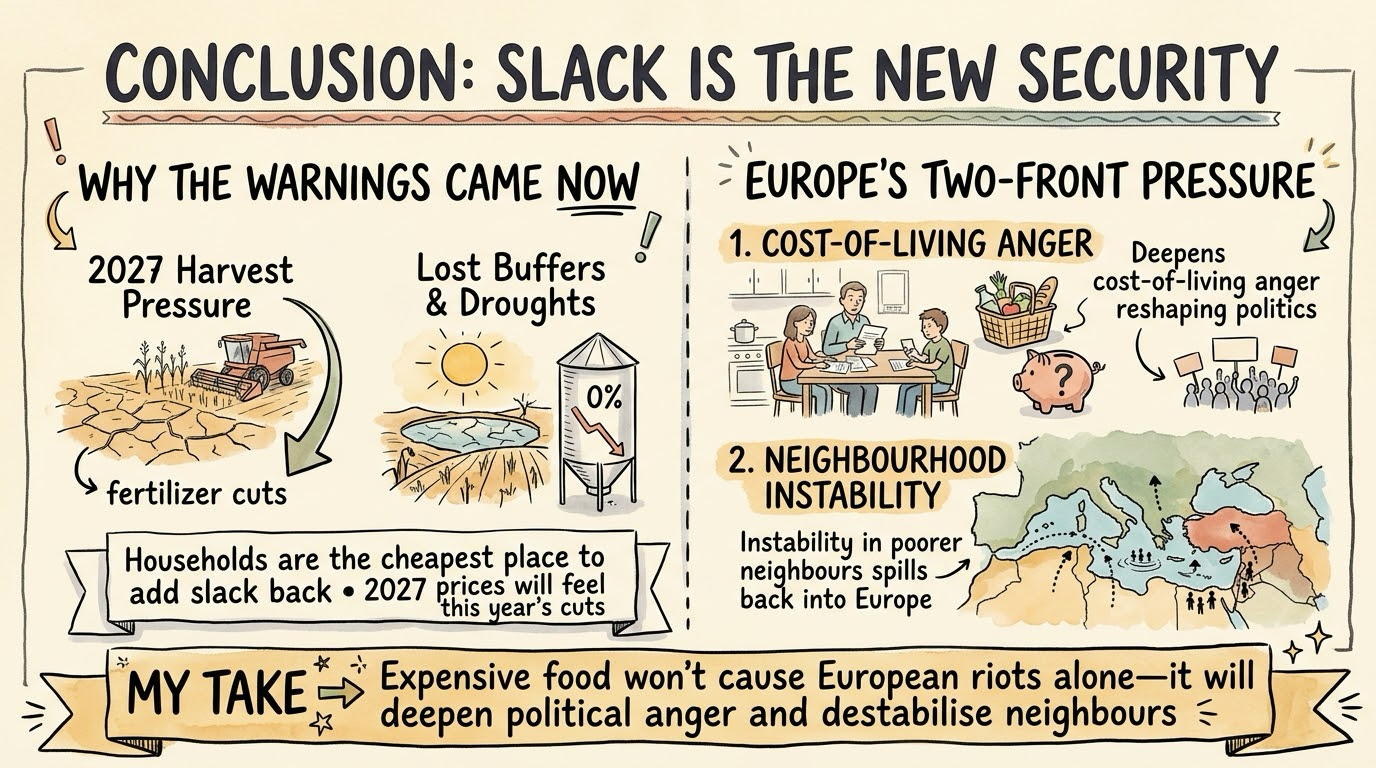
Several shocks are hitting it at once, and households are the cheapest place to add slack back.
The real pressure from this year's fertilizer cuts and poor harvests is likely to show up in 2027 prices.
Europe is better protected than most regions, but it isn't immune to the political fallout.
My Take: Expensive food is unlikely to cause riots in Europe on its own, but it will deepen the cost-of-living anger that's already reshaping European politics, and the bigger danger is instability in poorer neighbouring regions that spills back into Europe.
Sources
Pages I opened for the facts in this post:
- Newsweek: Map shows countries urging residents to stockpile food
- World Bank: Fertilizer prices surge as Strait of Hormuz disruptions tighten
- UkrAgroConsult: European farmers cut fertilizer purchases
- Chatham House: Chokepoints in the global food trade
- Al Jazeera: Unprecedented cyberattack hits French supermarkets
- Down To Earth: England records worst harvest in 42 years
- IFPRI: Food export curbs hit nearly a fifth of the global market
- Irish Times: Why the world has started stockpiling food again
- arXiv: The Food Crises and Political Instability
- IMF: Food Prices and Political Instability
- Grocery Gazette: UK food inflation in 2023
- GMK Center: Eurozone inflation accelerated to 4% in October