Why AI Companies Will Charge For Outcomes, Just Like Ad Platforms
AI is sold by the month today, but the flat subscription is already straining. Ad platforms took decades to move from selling views to selling results, and AI is following much faster. The catch is one every advertiser knows: somebody has to decide what counts as a result.
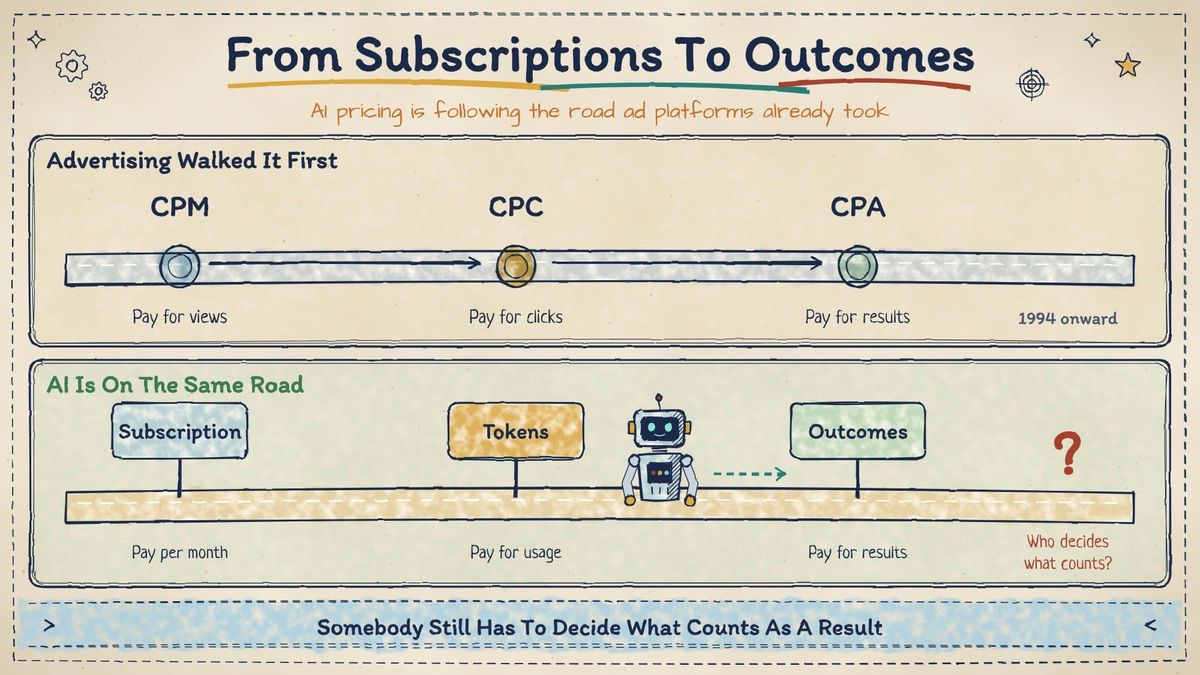
I buy ads for a living, and no ad platform has ever sold me a flat monthly plan.
I pay for clicks, or conversions, or whatever the campaign is set up to chase.
AI is sold very differently right now.
You pay a monthly fee, and the company has no idea whether you got $5 of value from it or $50,000.
I wrote last month that AI products are moving toward selling proven results.
The more I look at it, the more the ad industry looks like the closest thing we have to a preview.
I think AI companies will end up charging for outcomes wherever an outcome can be measured.
I also think they'll inherit the ugliest problem in advertising, which is that the seller gets to help decide what counted.
The Flat Subscription Is Already Cracking
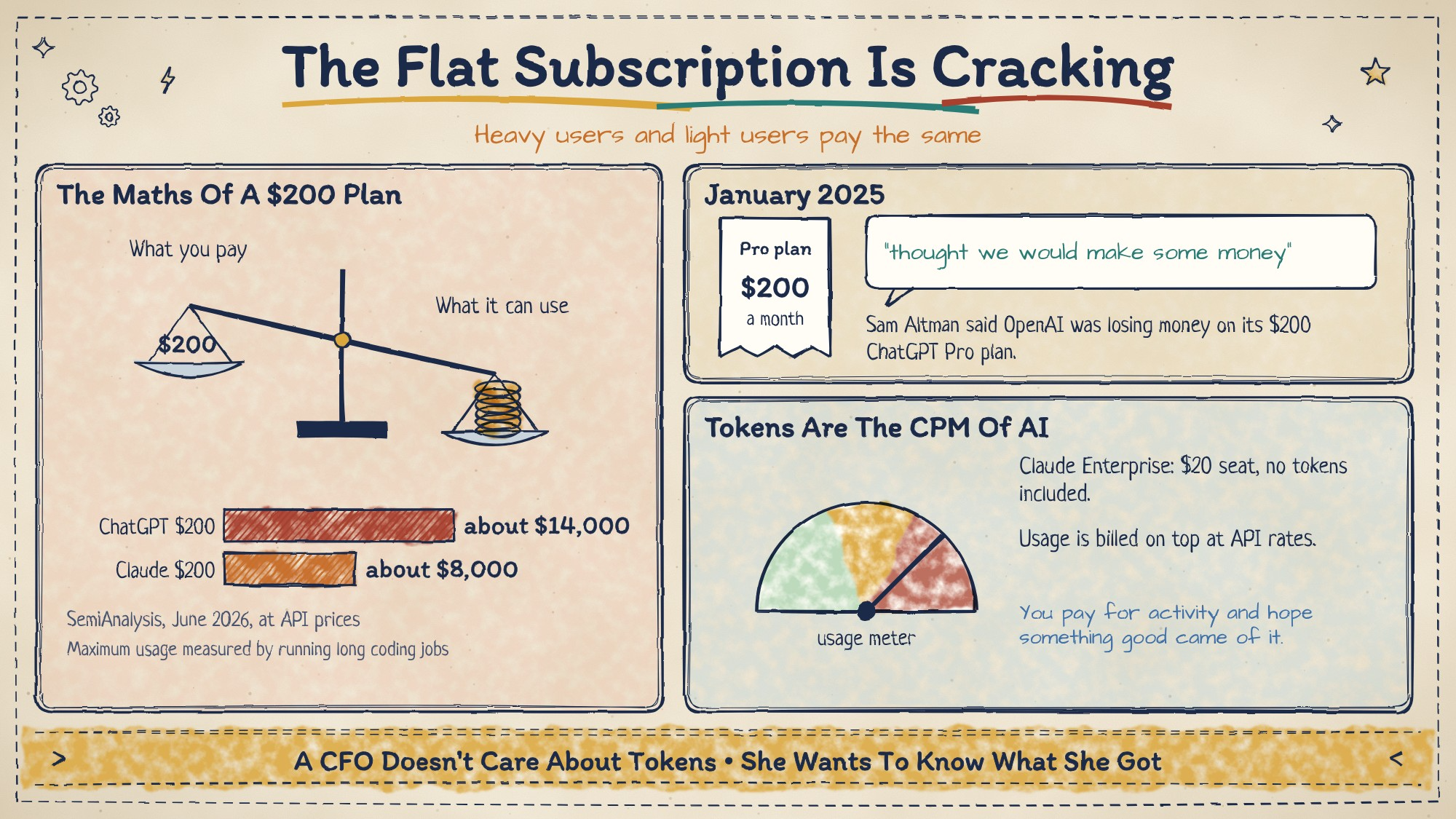
In January 2025, Sam Altman said OpenAI was losing money on its $200-a-month ChatGPT Pro plan.
"I personally chose the price," he wrote, "and thought we would make some money."
A flat fee only works when heavy users and light users average out, and AI makes that hard.
One person asks a few questions a week while another leaves agents running all night.
SemiAnalysis tested this in June by running long coding jobs until the weekly limits ran out.
At API prices, a $200 ChatGPT plan could reach about $14,000 of usage, and Claude's $200 plan about $8,000.
That's why limits keep showing up, and why business customers are getting moved off flat pricing first.
Anthropic's Enterprise plan now has a $20 seat fee with no tokens included, and usage is billed on top at API rates.
Usage pricing fixes the seller's cost problem, but I see it as a halfway house.
A CFO doesn't care how many tokens got used.
She wants to know what she got for them.
Tokens are basically the CPM of AI: you pay for activity and hope something good came of it.
Advertising Already Walked This Road
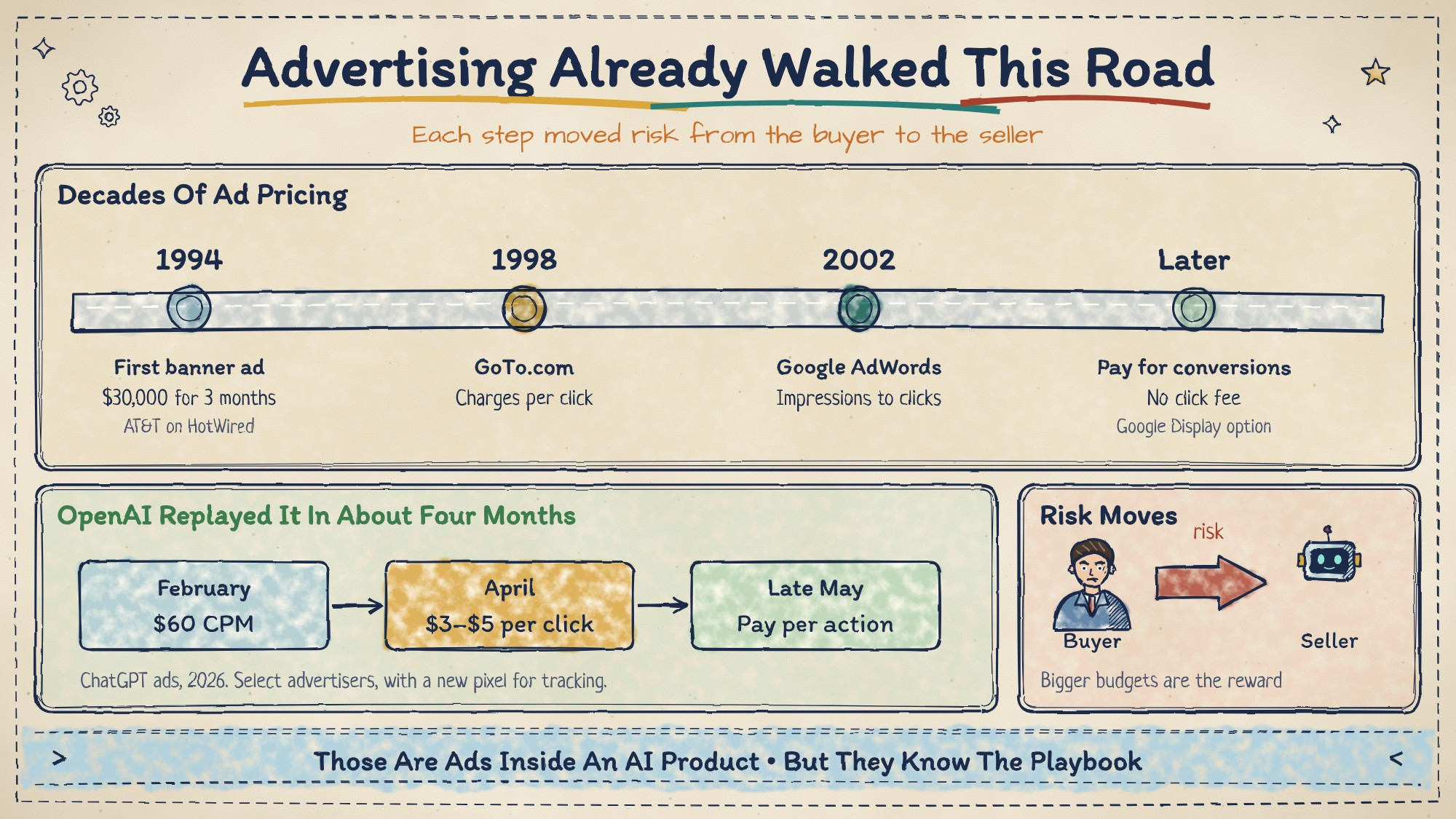
The first banner ad ran in October 1994, when AT&T paid HotWired $30,000 for a three-month placement.
Nobody could say what that was worth.
Display then settled on pricing per thousand impressions, the same CPM that still sits in every dashboard I open.
In 1998, GoTo.com started charging per click, and Overture later made that the standard for paid listings.
Google moved AdWords from impressions to clicks in 2002.
Then came paying for the conversion itself, including a Google Display option where you pay when someone converts and don't pay per click or impression.
Each step moved a bit more risk from the buyer to the seller.
Sellers accepted that, and my read is that they did because a buyer who can see a return will keep raising the budget.
What surprised me is how fast OpenAI replayed the whole thing.
ChatGPT ads launched in February at a $60 CPM.
By April, advertisers could bid $3 to $5 per click.
By late May, select advertisers could pay per action, with a new pixel doing the tracking.
That's decades of ad pricing replayed in about four months.
Those are ads inside an AI product, so it's a different thing from pricing the AI itself.
It does show that the people running these companies know the playbook.
Outcome Pricing Already Exists In One Corner
Customer support got there first, probably because a ticket is easy to count.
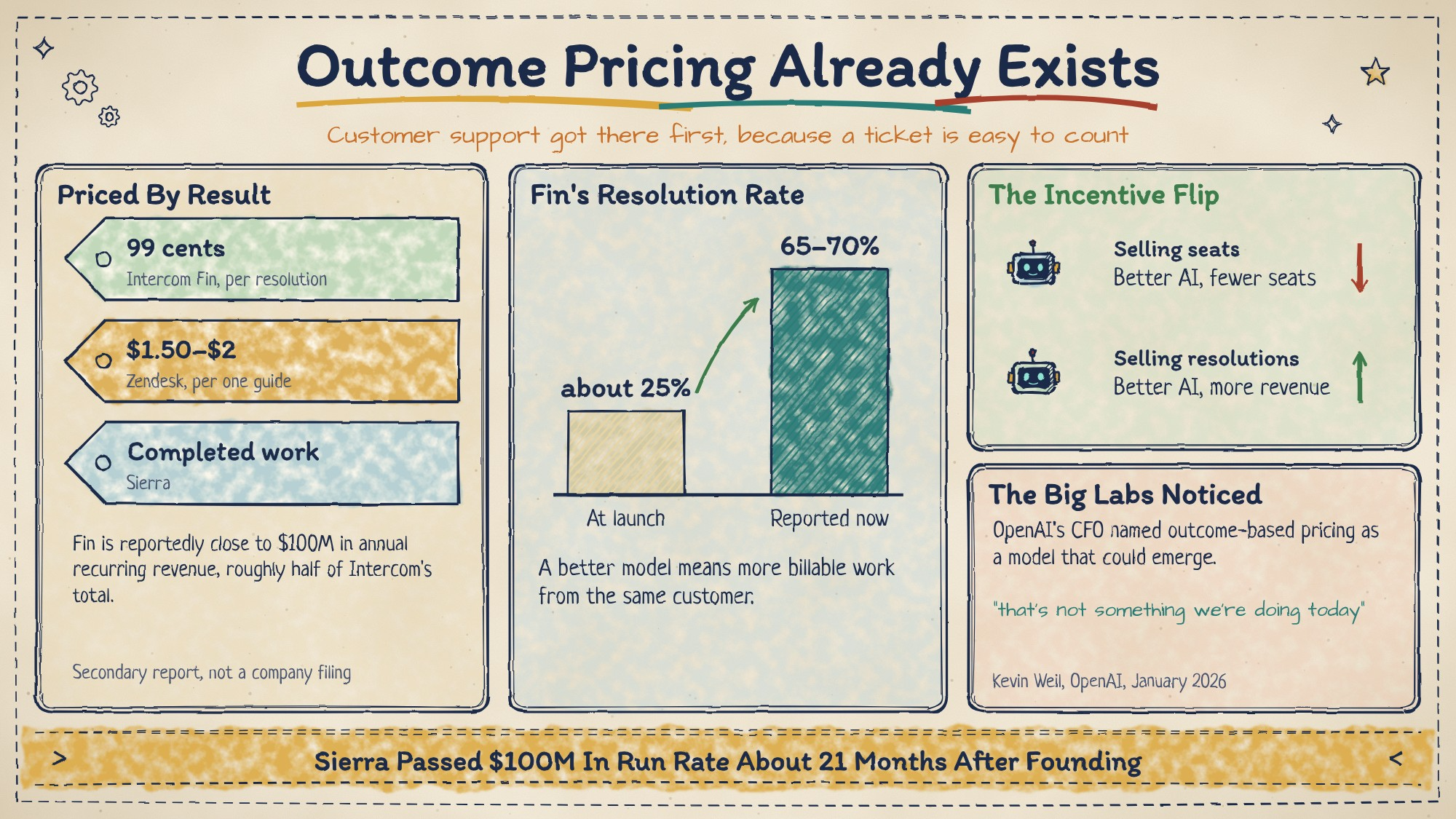
Intercom charges 99 cents per resolution for its Fin agent.
Fin is reportedly close to $100 million in annual recurring revenue, roughly half of Intercom's total, and its resolution rate is said to have climbed from about 25% at launch to 65–70%.
Zendesk announced outcome-based pricing in August 2024, and one guide lists it at $1.50 to $2 per automated resolution.
Sierra charges for completed work and passed $100 million in annual run rate about 21 months after it was founded.
The incentive flip is what I find most interesting.
A support software company selling seats has a strange problem with good AI, because every ticket the AI handles means one less agent who needs a seat.
Per-resolution pricing turns that around, so a better model means more billable work from the same customer.
The big labs have noticed.
In January, OpenAI CFO Sarah Friar named licensing, IP-based agreements and outcome-based pricing as business models that could emerge.
People took that to mean OpenAI wanted a cut of their discoveries, and Kevin Weil stepped in to say it had no such plans for individual users.
Any deal would be a bespoke one with a company, and in his words, "that's not something we're doing today."
Who Decides What Counted?
This is where my day job makes me nervous.
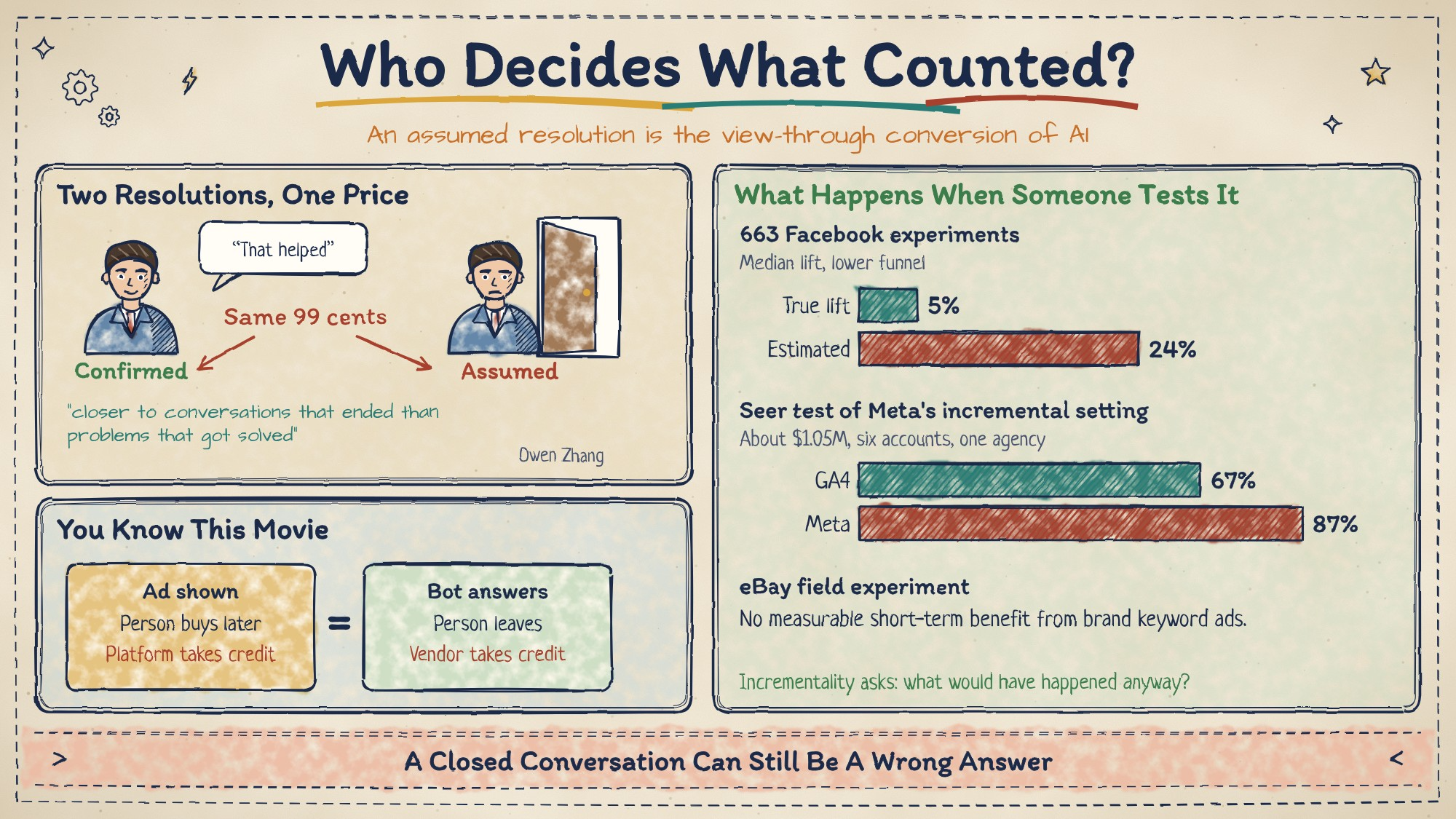
Intercom counts two kinds of resolution.
A confirmed resolution is when the customer says the answer helped.
An assumed resolution is when the customer leaves after Fin's last answer without asking for anything else.
Both are billed at the same 99 cents.
In fairness, a customer who comes back for more help gets that resolution deducted, and Intercom doesn't bill when a customer asks for a human.
Still, if you've ever bought display ads, you know this movie.
An assumed resolution is the view-through conversion of AI.
The ad was on screen and the person bought something later, so the platform takes credit.
The bot answered and the person left, so the vendor takes credit.
Owen Zhang made a similar point in CRM Magazine, saying the rate measures something closer to "conversations that ended" than "problems that got solved."
His example is Air Canada, whose chatbot gave a customer wrong bereavement fare information in a conversation that closed normally.
Advertising shows how far off these numbers can get once someone tests them properly.
A large field experiment at eBay found no measurable short-term benefit from brand keyword ads, and returns from paid search were a fraction of what standard estimates suggested.
A study of 663 Facebook experiments found a median true lift of 5% for lower-funnel outcomes, while the best non-experimental method estimated 24%.
One of those authors worked at Meta, so this isn't outsiders throwing stones.
The ad industry's answer was incrementality: what would have happened anyway?
Meta now has an incremental attribution setting, and when Seer tested it on about $1.05 million of spend, Meta called 87% of conversions incremental while GA4 said 67%.
That's six accounts from one agency, so it proves little on its own, but a 20-point gap is exactly the sort of argument AI buyers are going to have.
Even OpenAI's ad team has promised third-party measurement, and as of May it had no partners or timeline.
Where The Ad Comparison Breaks
I don't think everything ends up priced this way.
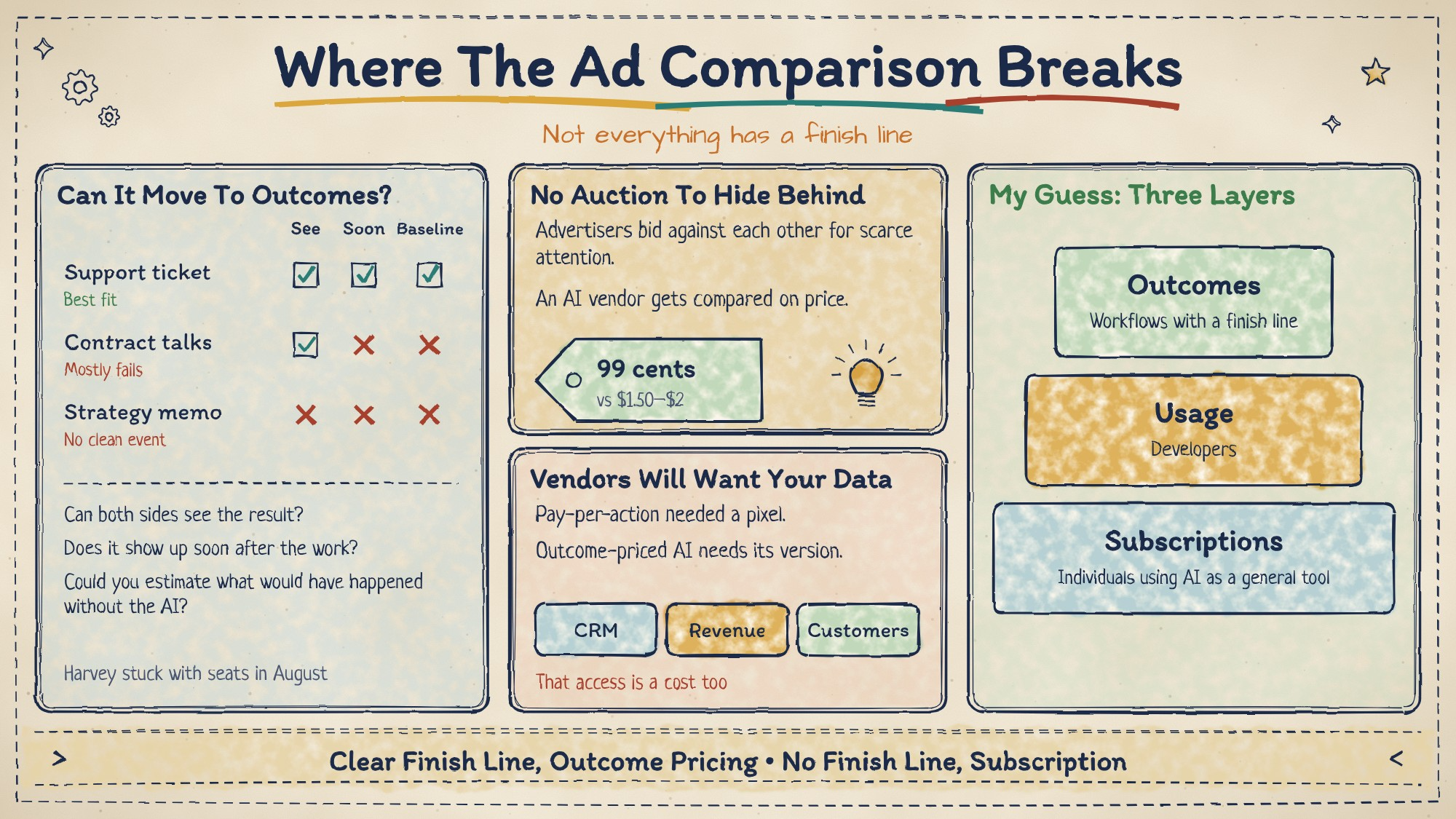
A purchase is a clean event, and most knowledge work isn't.
What's the outcome of a strategy memo, or a late-night chat that helped you think through a decision?
I can't see how you'd bill for that, so I expect subscriptions to survive for people using AI as a general tool.
High-end work is resisting too.
Harvey, the legal AI company, stuck with seat-based pricing after a major product overhaul in August.
I'd use a simple test for whether a task can move to outcome pricing.
Can both sides see the result, does it show up soon after the work, and could you estimate what would have happened without the AI?
A support ticket passes most of that, and a contract negotiation fails most of it.
The second break is pricing power.
Google and Meta own scarce attention and let advertisers bid against each other for it.
A vendor selling support resolutions has no auction protecting it, and Fin at 99 cents next to Zendesk at $1.50 to $2 is what shopping around looks like.
The third break is data.
Digiday noted that OpenAI needed its pixel before it could offer pay-per-action, because it had no reliable way to connect an ad to a later action.
Outcome-priced AI needs the same thing, so vendors will want access to your CRM, your revenue numbers and your customer records.
My guess is that we end up with three layers: subscriptions for individuals, usage for developers, and outcomes for narrow workflows with a clear finish line.
How I'd Buy It
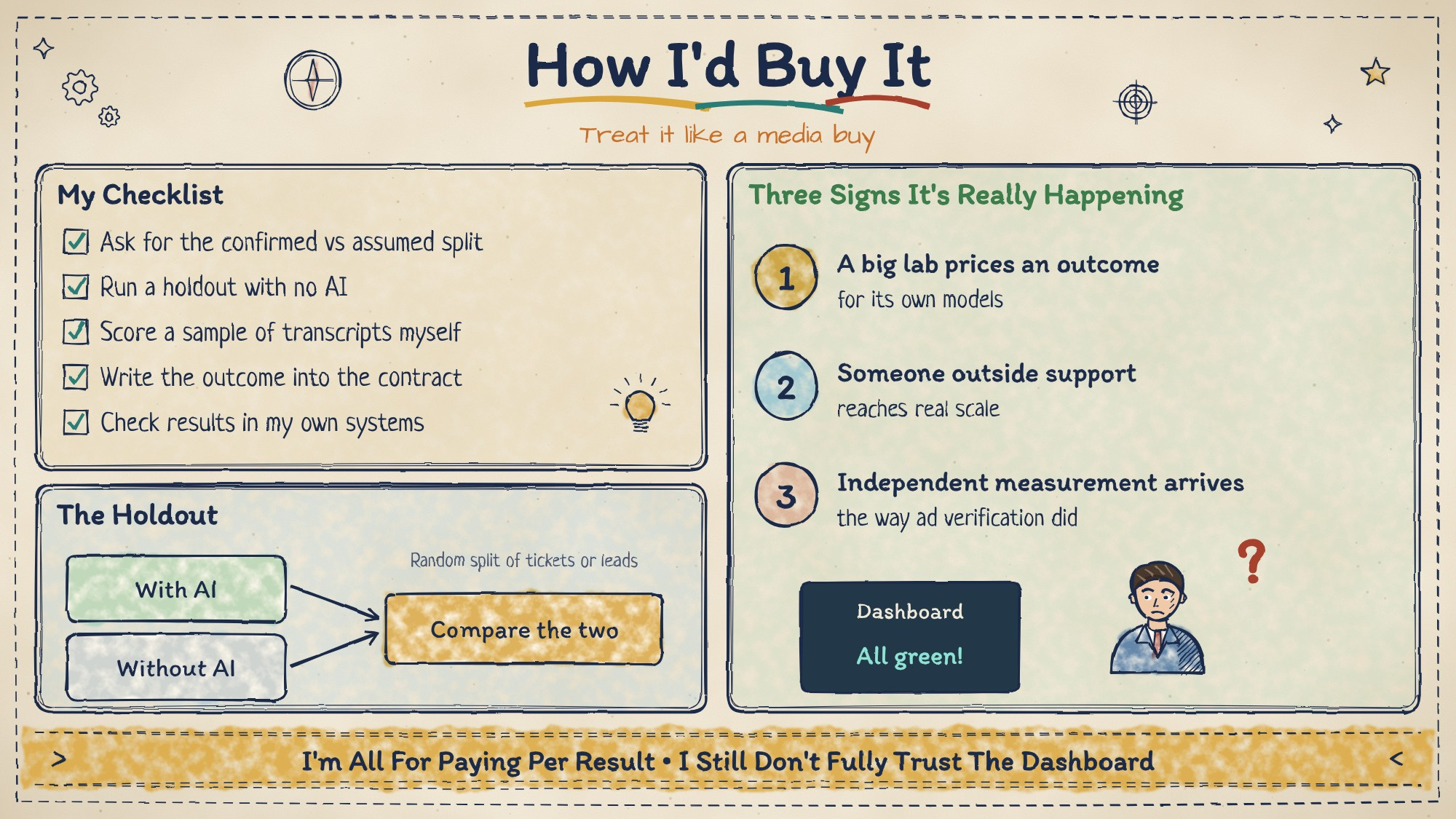
If a vendor pitched me outcome pricing tomorrow, I'd treat it like a media buy.
I'd start by asking for the split between confirmed and assumed outcomes, which Zhang says most vendors don't disclose.
Then I'd run a holdout.
Send a random slice of tickets or leads through without the AI, then compare the two groups.
I'd score a sample of the transcripts myself, because a closed conversation can still be a wrong answer.
And I'd want the definition of an outcome written into the contract, with the results checked against my own systems and not only the vendor's dashboard.
Three things would tell me this is really happening.
Does one of the big labs put a price on an outcome for its own models?
Does anyone outside customer support reach real scale with it?
And does independent measurement show up, the way ad verification did?
I'm all for paying per result.
I've been doing it for years, and I still don't fully trust the dashboard.
Sources
Pages I opened for the facts in this post:
- TechCrunch: OpenAI losing money on ChatGPT Pro
- TechSpot: SemiAnalysis on subscription costs
- The Register: Claude Enterprise billing
- Digiday: how the banner ad was born
- Wikipedia: pay-per-click
- Search Engine Land: AdWords goes cost-per-click
- Search Engine Land: pay for conversions in Display
- TechWyse: ChatGPT cost-per-click ads
- Digiday: cost-per-action ads in ChatGPT
- Digiday: ChatGPT ads manager and measurement
- Stripe: Intercom Fin pricing
- Enterprise DNA: Fin nearing $100M ARR
- Zendesk: outcome-based pricing
- eesel: Zendesk resolution pricing guide
- TechCrunch: Sierra reaches $100M ARR
- ITPro: OpenAI CFO on new business models
- The Decoder: OpenAI clarifies user discoveries
- Intercom: Fin resolutions
- Fin: pricing outcomes
- CRM Magazine: per-resolution pricing
- Blake, Nosko and Tadelis: paid search field experiment
- Gordon, Moakler and Zettelmeyer: Close Enough?
- Seer Interactive: Meta incremental attribution test
- MLex: Harvey sticks with seat-based pricing