Could Lidar Replace Cameras In Privacy-First Home Robots?
A robot that maps your home doesn't have to film it. Lidar can handle a lot of what a home robot needs to see, but it's less blind and less private than people assume, and that gap is where the real product decision sits.
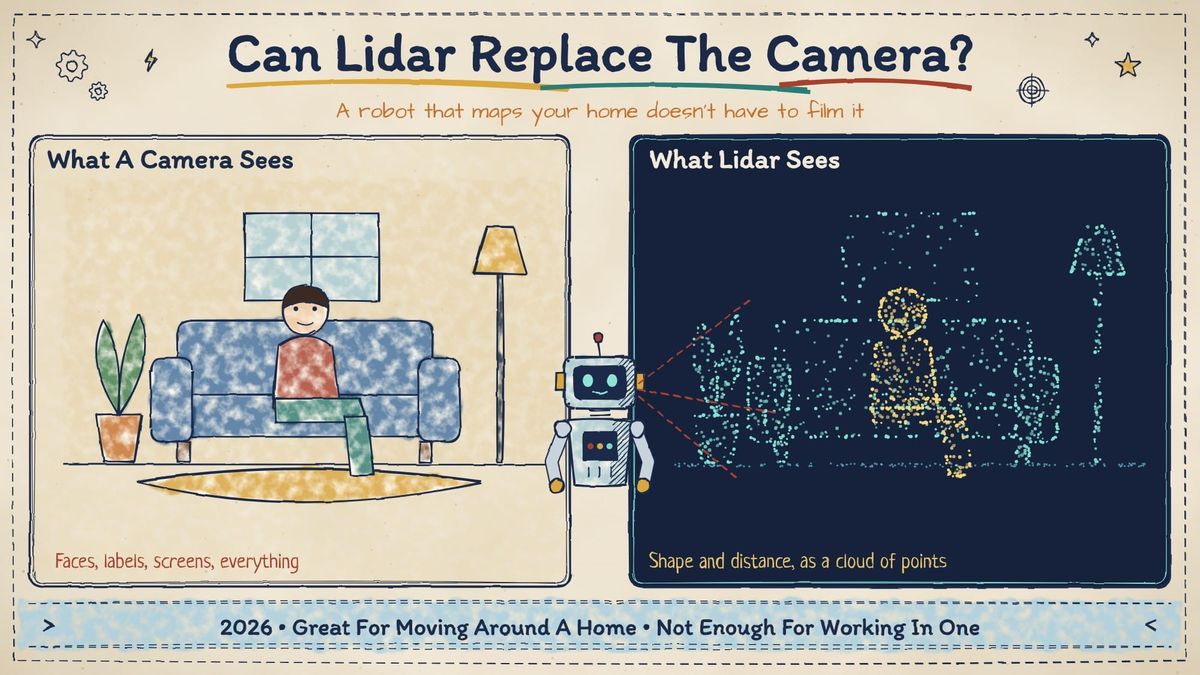
I'm happy for a robot to know where my couch is.
I'm much less happy for it to know what I look like on that couch at 2am.
That's the appeal of lidar in a home robot.
It measures the shape of a room with light, so in theory the robot gets a map of your home without ever filming it.
I think the idea is better than it sounds, and also weaker than the people selling it claim.
A home robot can do a surprising amount with lidar alone.
It can't do chores with lidar alone, and lidar isn't nearly as anonymous as its reputation suggests.
The Camera Problem Already Happened
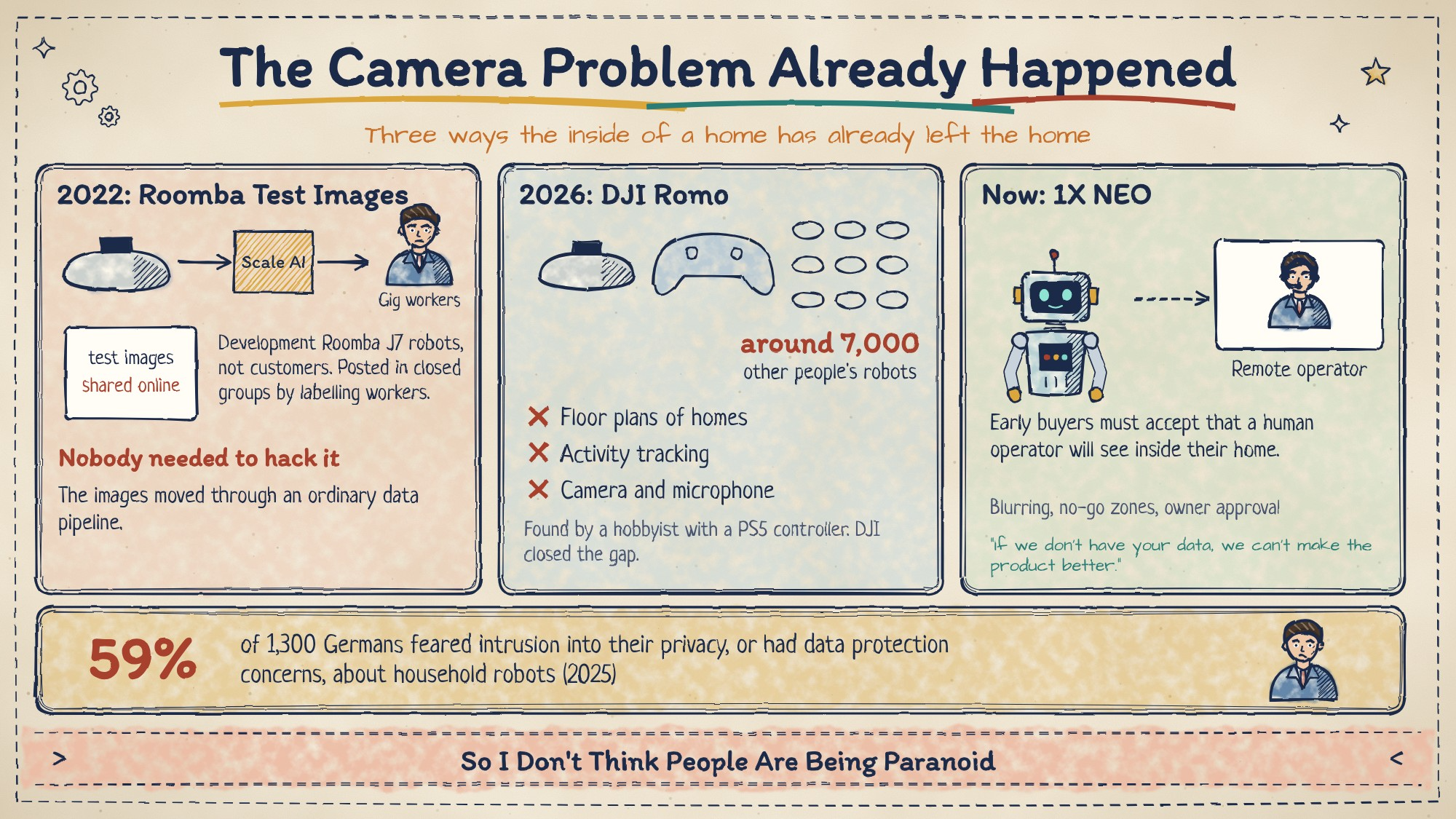
In 2022, MIT Technology Review reported on images taken by development versions of iRobot's Roomba J7.
One showed a young woman on a toilet.
These weren't customers, and iRobot said the people using those test robots had signed consent agreements.
The images still went to Scale AI for labelling, and gig workers in Venezuela posted some of them in closed groups online.
Nobody needed to hack anything for that to happen.
This February, a hobbyist who wanted to steer his DJI Romo with a PS5 controller found he could reach around 7,000 other people's robots.
That included floor plans, and a reporter said he could also access the camera and microphone, before DJI closed the gap.
1X is at least upfront about it.
Early buyers of its NEO humanoid have to accept that a human operator will see inside their home through the robot's camera.
The company offers blurring and no-go zones, and owners approve each session, but CEO Bernt Børnich was blunt: "If we don't have your data, we can't make the product better."
So I don't think people are being paranoid.
In a 2025 study of 1,300 Germans, 59% said they feared intrusion into their privacy or had data protection concerns about household robots.
What Lidar Actually Gives A Robot
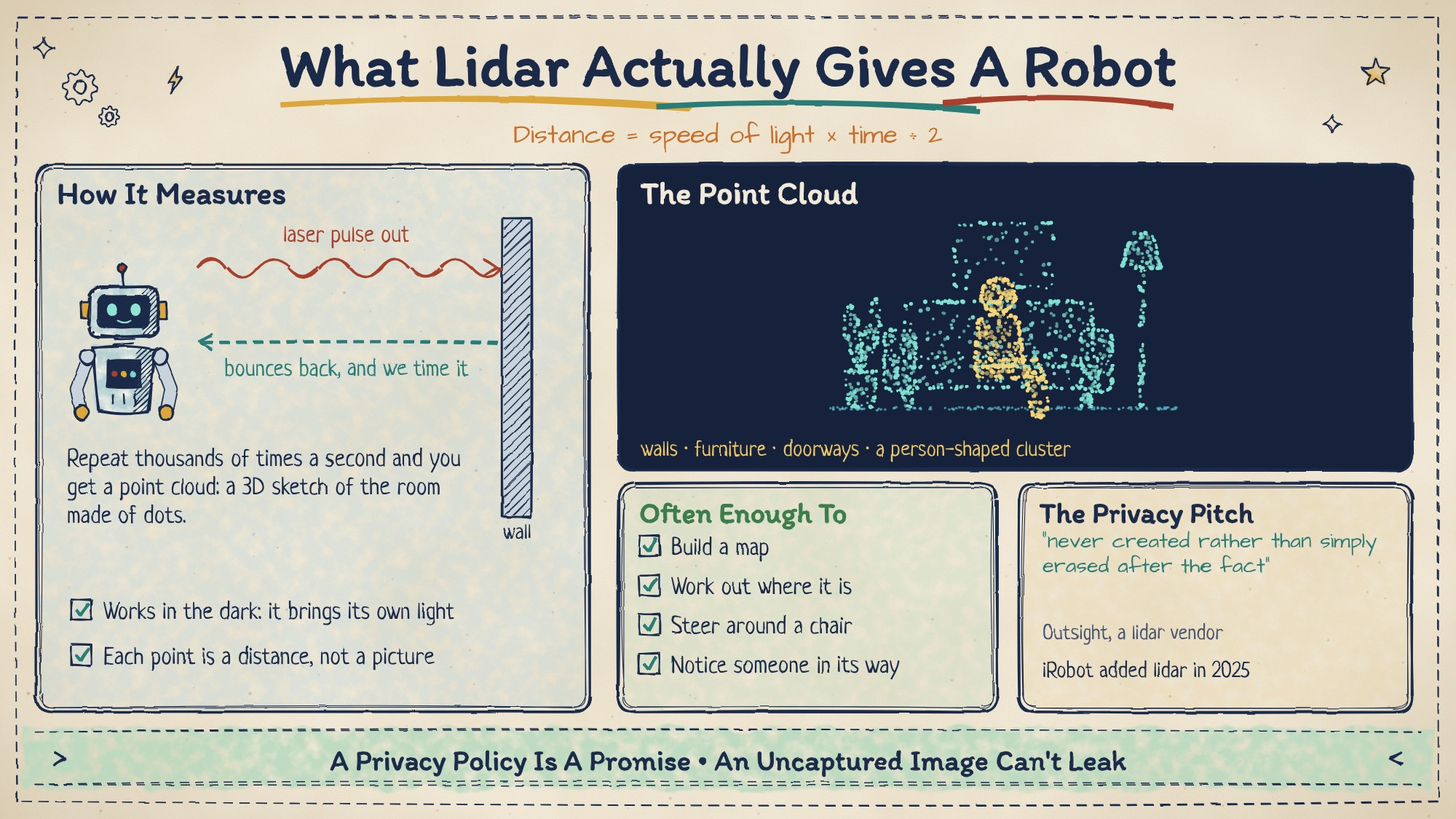
Lidar fires pulses of laser light and times how long they take to bounce back.
Multiply that time by the speed of light, halve it, and you've got a distance.
Do that thousands of times a second and you get a point cloud, a 3D sketch of the room made of dots.
The robot ends up with geometry: walls, furniture legs, doorways, a person-shaped cluster moving down the hallway.
For a lot of what a home robot does, that's plenty.
It can build a map, work out where it is, steer around a chair and notice someone standing in its way.
It also brings its own light, so a dark room doesn't bother it.
Robot vacuums have used this for years, and iRobot added lidar to its Roombas in 2025, although alongside a camera on at least some models.
Companies selling lidar into retail and public spaces already pitch it as a privacy feature.
Outsight calls lidar "natively anonymous" and says personal data is "never created rather than simply erased after the fact."
That's vendor marketing, but the second half is the strongest argument anyone has for this idea.
A privacy policy is a promise about what a company will do with your footage.
A sensor that never captured the footage doesn't have to promise anything.
Where Lidar Runs Out
This is where the no-camera dream meets actual chores.
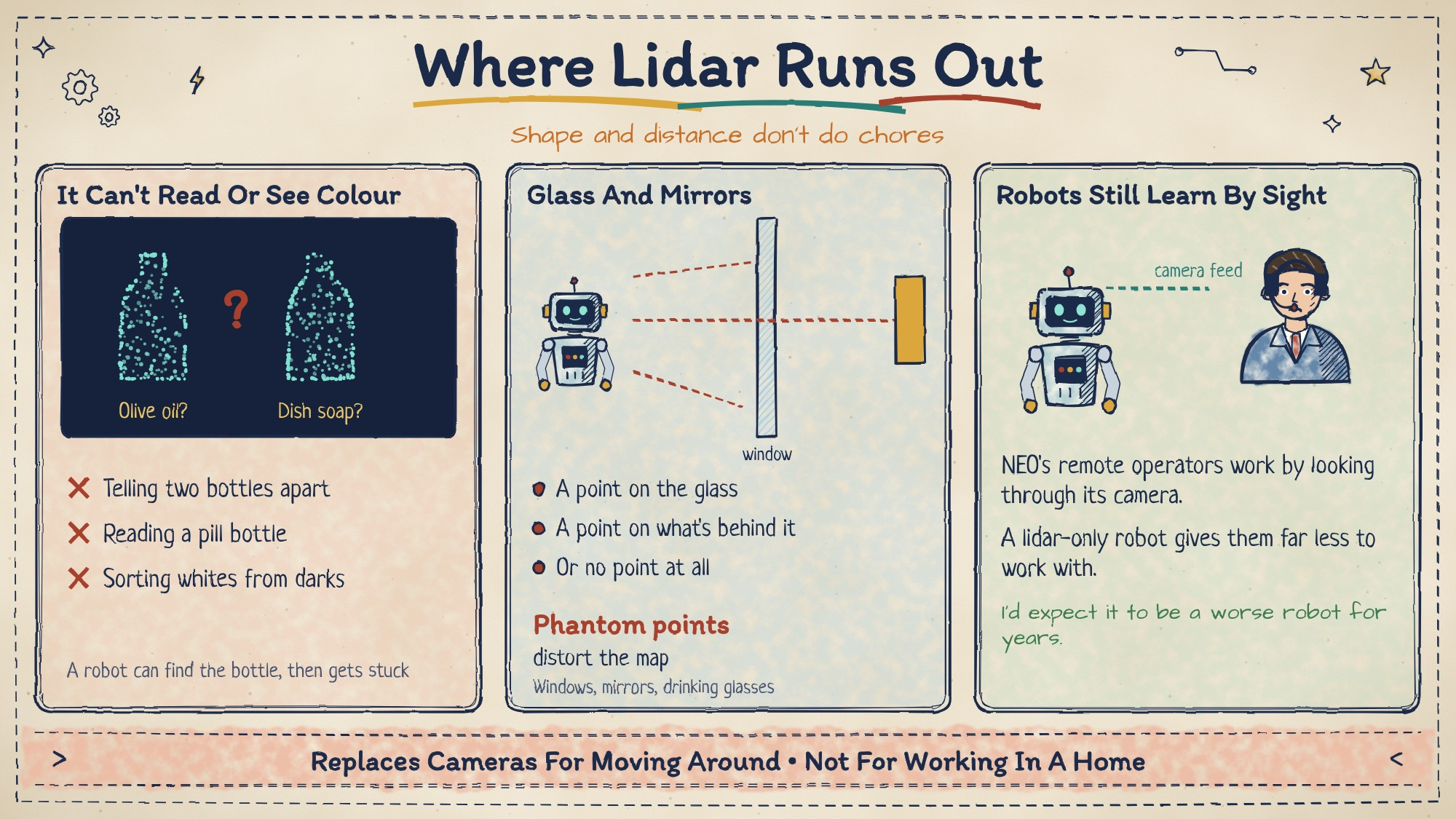
Standard lidar gives you shape and distance, so it doesn't see colour and it can't properly read a label.
A robot working from shape alone can find a bottle.
Telling olive oil from dish soap is another matter, and so is reading a pill bottle or sorting whites from darks.
Glass and mirrors are a separate headache.
Researchers at ShanghaiTech describe how a laser can return a point on the glass, on whatever sits behind it, or nothing at all, and those errors put phantom points into the map.
That's awkward in a home full of windows, mirrors and drinking glasses.
The bigger problem is how these robots learn.
NEO's remote operators work by looking through its camera, and that footage is the data 1X says it needs.
A lidar-only robot would give an operator far less to work with, so I'd expect it to be a worse robot for years.
That gives me an answer to the original question.
Lidar can replace cameras for moving around a home, but it can't replace them for working in one.
Lidar Isn't As Blind As It Sounds
I'd be careful with the word anonymous.
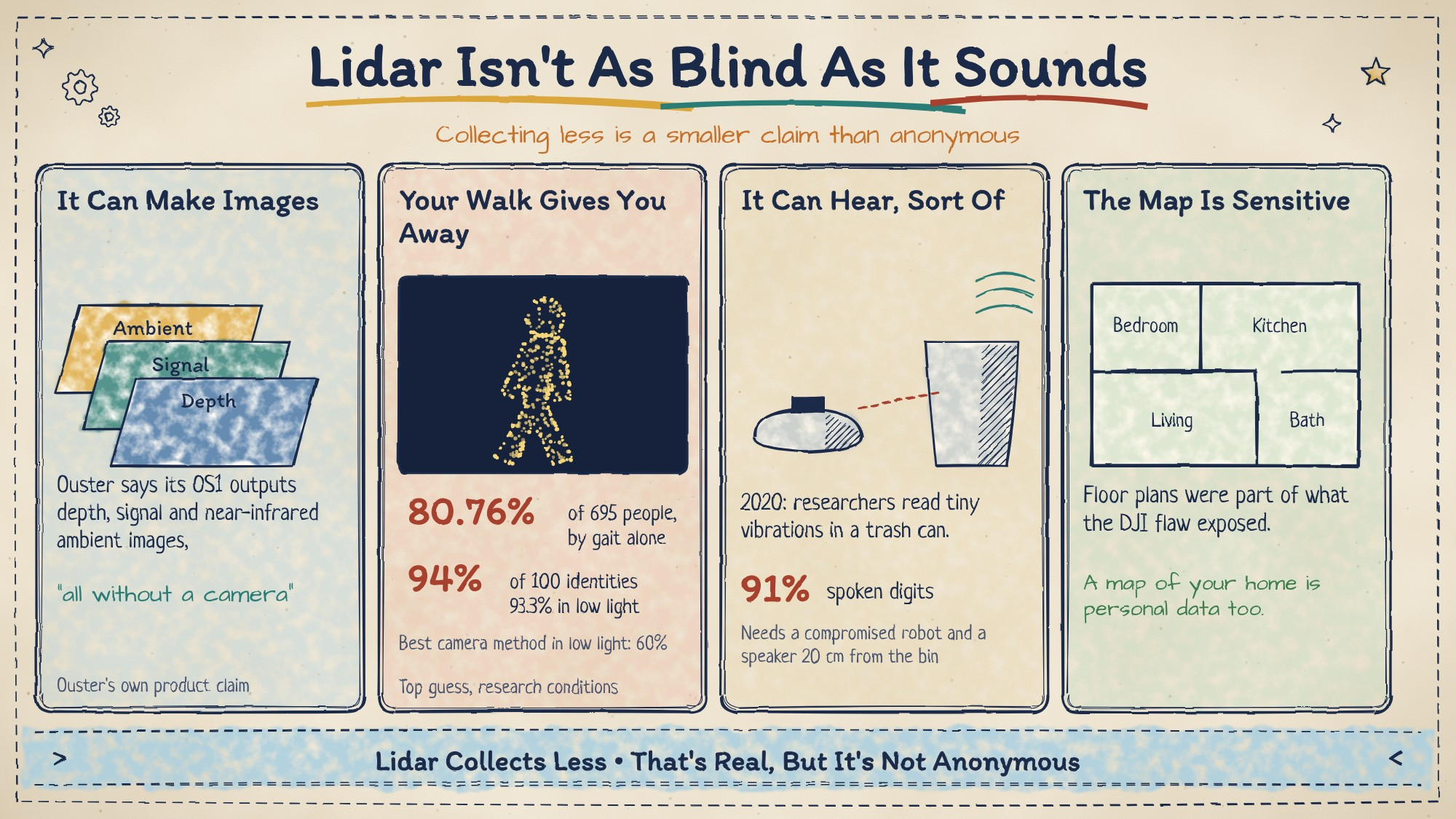
Ouster advertises that its OS1 lidar outputs depth, signal and near-infrared ambient images, "all without a camera."
That's a great feature for robotics, and it also means lidar isn't always just a cloud of dots.
Your body gives you away too.
A team at ShanghaiTech identified people from their walk using a single lidar, with the top guess correct 80.76% of the time across a test set of 695 people.
Another paper reached 94% on 100 test identities using height, body shape and gait, and it barely dropped in low light, where the best camera method it compared fell to 60%.
Those are research conditions, nowhere near a robot in a living room.
Then again, a household is a far smaller group to tell apart than 695 strangers.
My favourite example is from 2020.
Researchers turned a robot vacuum's lidar into a laser microphone by reading tiny vibrations in a trash can, and they classified spoken digits with about 91% accuracy.
It took a compromised robot and a speaker 20 cm from the bin, so nobody should panic.
It does show that a sensor can collect more than it was built to collect.
The map is sensitive too, and floor plans were part of what the DJI flaw exposed.
So I'd say lidar collects less, which is a real benefit but a smaller claim than anonymous.
The Robot I'd Actually Want
People don't seem to trust settings.
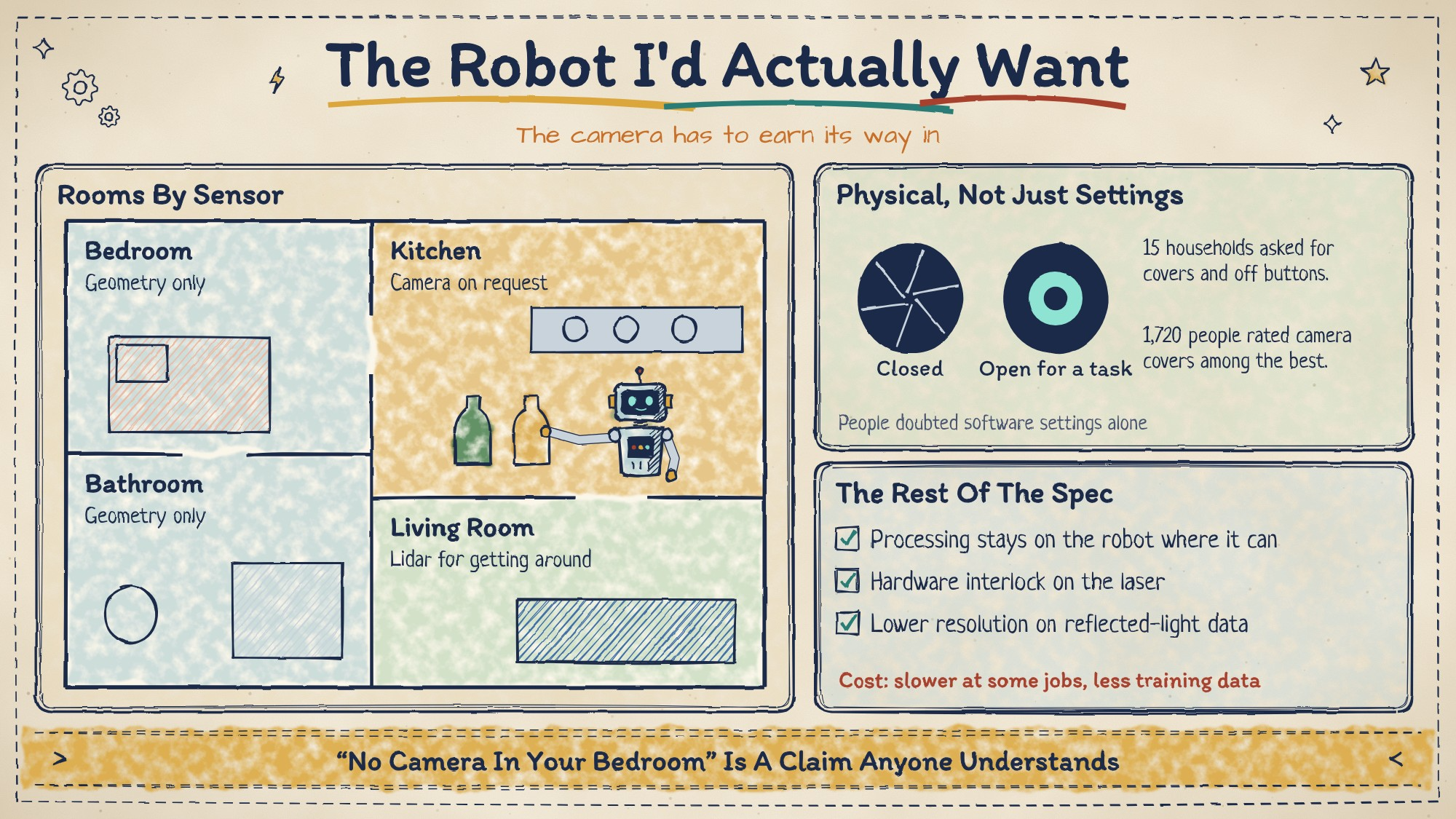
In a University of Wisconsin–Madison study of 15 households, participants asked for physical controls like on/off buttons and camera covers, and they doubted software settings alone.
In a survey of 1,720 people, physical camera covers and detachable microphones scored best on privacy.
That makes sense to me as a marketer.
"No camera in your bedroom" is a claim anyone understands in a second, while "we take your privacy seriously" tells you nothing.
So I wouldn't build a robot without cameras.
I'd build one where the camera has to earn its way in.
Lidar stays on for getting around the house.
The camera sits behind a physical shutter you can see, and it only opens for a task that needs it.
Bedrooms and bathrooms are geometry-only rooms, so the robot does less in there and you accept that.
As much processing as possible stays on the robot.
The lidar gets limits as well, and the LidarPhone authors already suggested two: a hardware interlock that stops the laser firing below a certain rotation speed, and lower resolution on any reflected-light data.
All of that costs something.
The robot gets slower at some jobs and it collects less training data, which is the opposite of what every robotics company wants right now.
I still think it would sell, because the alternative is asking people to trust a stranger, a labelling contractor and a cloud server all at once.
What To Watch Next
I'm looking for three things.
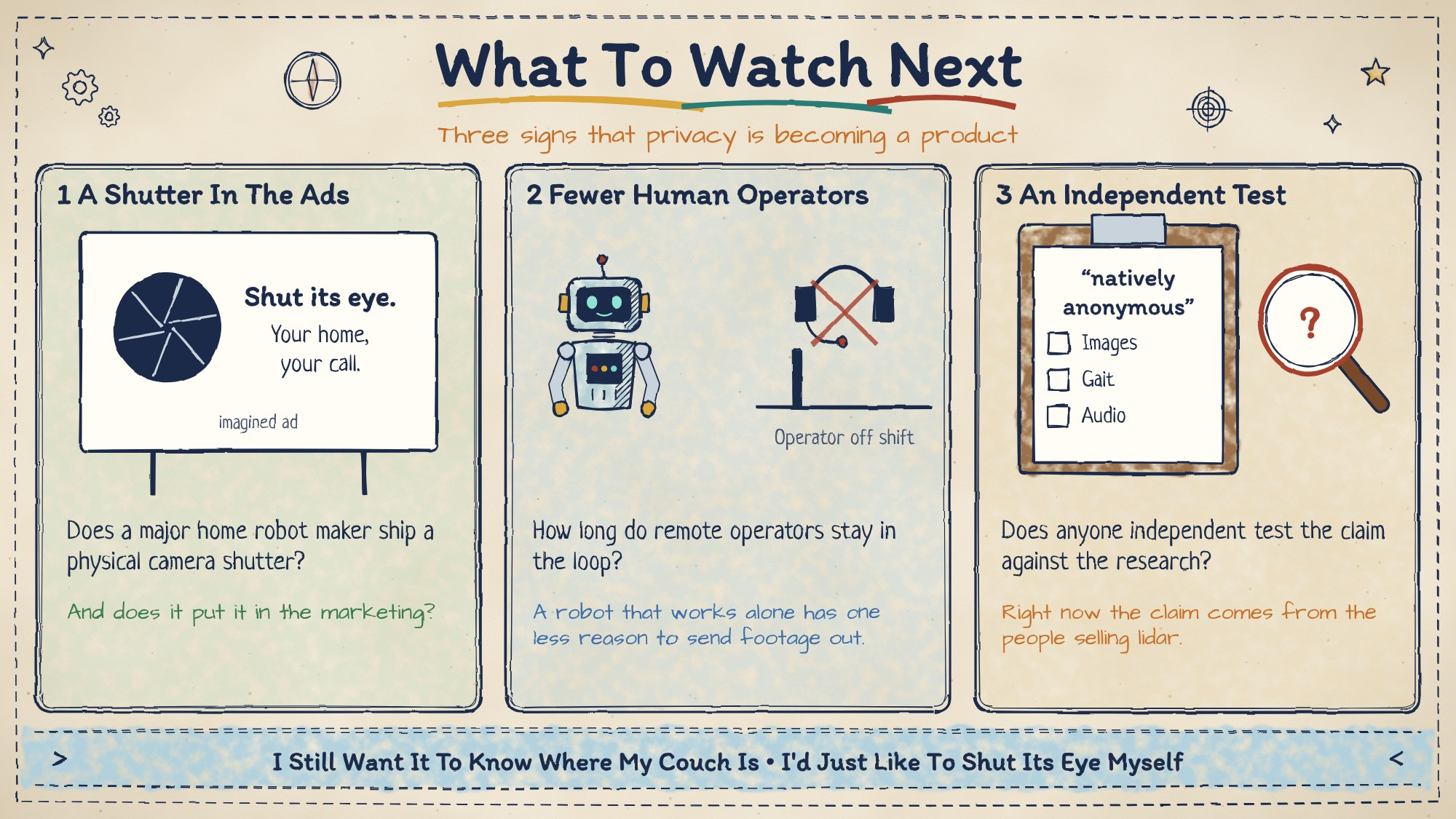
Does a major home robot maker ship a physical camera shutter and put it in the marketing?
How long do remote operators stay in the loop?
Once a robot can do its chores alone, one big reason for footage to leave your home gets weaker.
And does anyone independent test claims like "natively anonymous" against the re-identification research?
I still want a robot that knows where my couch is.
I'd just like to be able to shut its eye myself.
Sources
Pages I opened for the facts in this post:
- MIT Technology Review: Roomba test images
- Digitec: unauthorised access to DJI Romo robots
- Engadget: 1X NEO
- gfu and Oliver Wyman: household robots study
- Digitec: iRobot adds lidar to Roombas
- Outsight: third generation of people counting
- Zhao and Schwertfeger: 3DRef reflection dataset
- Ouster: The Camera Is In The Lidar
- Han et al.: Gait Recognition via Single LiDAR
- LiDAR-based Person Re-identification
- LidarPhone paper, SenSys 2020
- Li et al.: Multi-person households' privacy design preferences
- Windl et al.: Privacy Communication Patterns for Domestic Robots