What Is 5th Generation Warfare? A Supermarket Fridge Hack Explains It
In October, hackers turned supermarket freezers in France into ovens, and a month later nobody knows who did it or why. That uncertainty is what people mean by fifth-generation warfare, and it's also the easiest part of the idea to abuse.
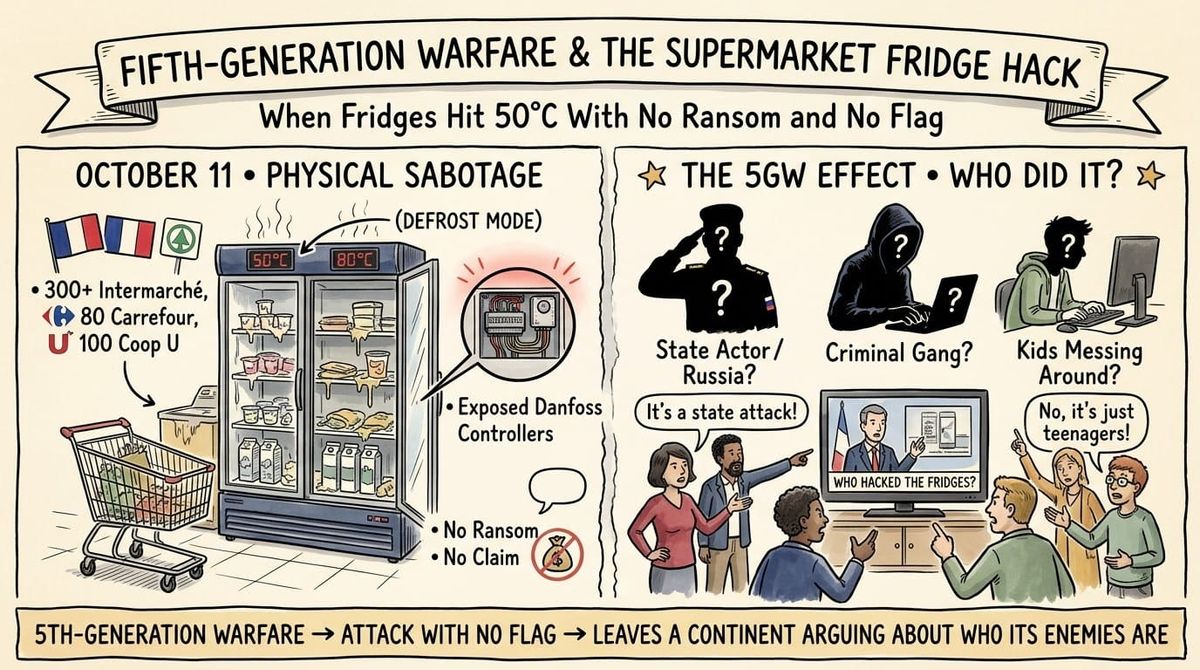
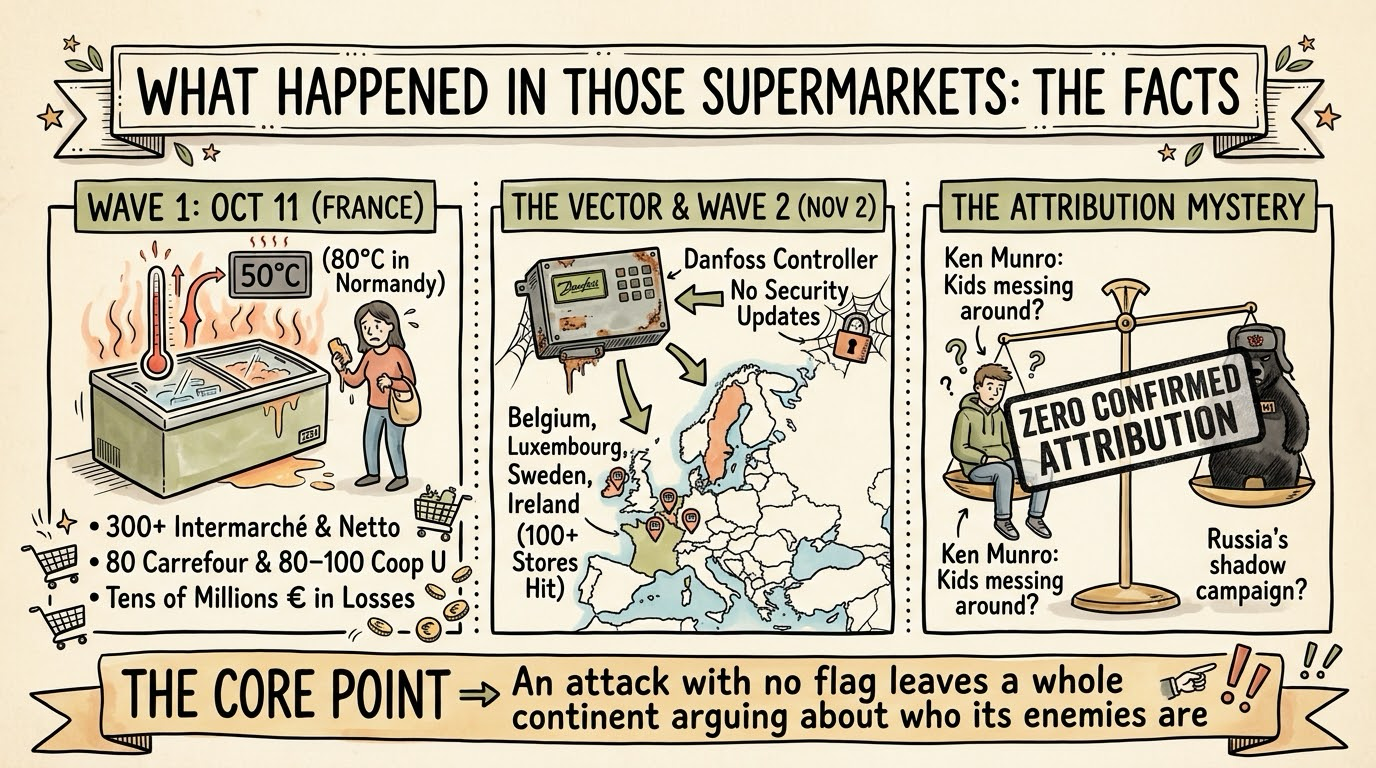
On the night of October 11, refrigerators in hundreds of French supermarkets were switched into defrost mode with the food still inside.
By morning, many had reached about 50°C, and some of the equipment had caught fire.
Nobody asked for a ransom, and nobody has claimed it.
A month later, investigators still haven't said who did it.
I watched a Dirty Civilian video on fifth-generation warfare that uses this attack as its sharpest example, and it got me thinking about the term.
I think the fridge hack is a good way to explain it, including the parts of the idea I'd push back on.
Five Generations, Briefly
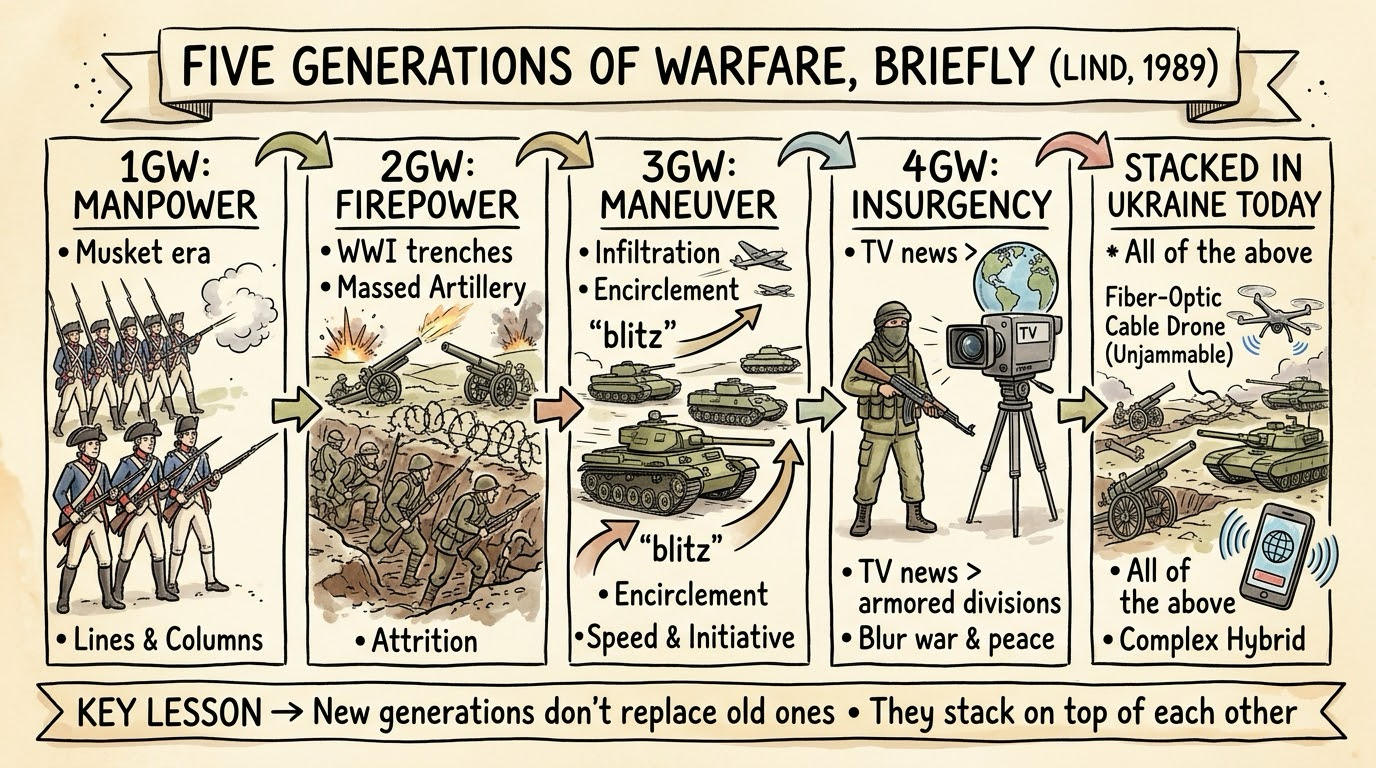
The framework comes from a 1989 Marine Corps Gazette article by William Lind and four military officers.
They described three generations of modern war.
The first was massed manpower, with musket-era lines and columns.
The second was massed firepower, which peaked in the trenches of World War I.
The third was maneuver, where speed and initiative replaced the slow grind of attrition.
Then they asked what a fourth would look like, and guessed it would blur war and peace, erase clear front lines and aim to collapse an enemy society from within.
One line from that article has aged better than most predictions: "Television news may become a more powerful operational weapon than armored divisions."
The fourth generation came to mean insurgency, where a small force wins by outlasting a superpower until its public gives up.
The video makes a point I agree with, which is that new generations don't replace old ones.
Ukraine has trench lines, massed artillery and maneuver, plus fiber-optic drones that ignore jamming because they're steered through a cable instead of radio.
All of it runs alongside a fight for foreign opinion, aid and weapons.
Nobody Agrees On The Fifth
This is the part the video moves past quickly.
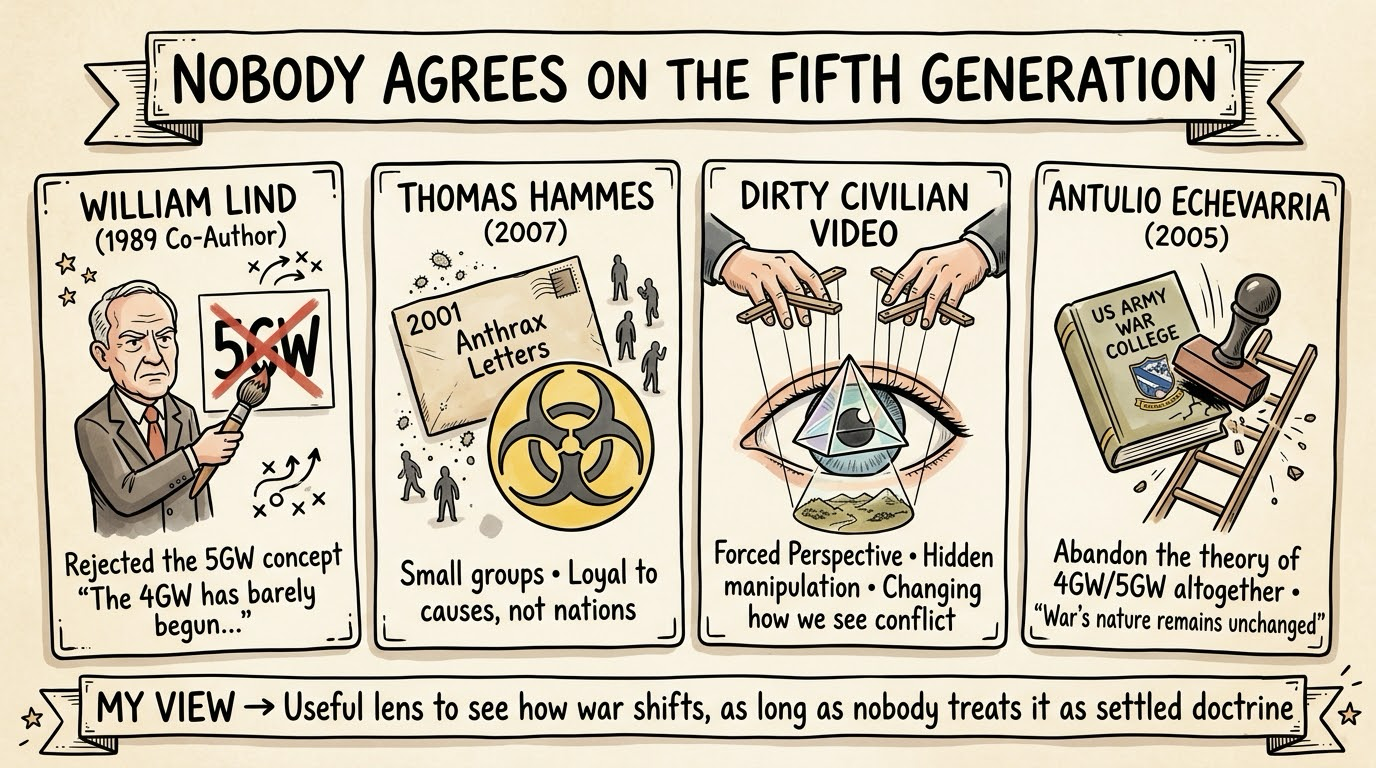
There is no widely agreed definition of fifth-generation warfare, and Lind himself rejected the idea.
Thomas Hammes, one of the best-known writers on the fourth generation, described the fifth in 2007 as small groups with biological weapons, loyal to "causes rather than nations."
He suggested the 2001 anthrax letters might have been the first 5GW attack.
The video defines it as "forced perspective," where you're manipulated without knowing who is doing it or what they want.
Those are very different ideas sharing one label.
Some scholars doubt the whole ladder.
Antulio Echevarria of the US Army War College wrote in 2005 that "We would do well to abandon the theory of 4GW altogether."
I wouldn't go that far.
I find the generations useful as a way to see how war shifts, as long as nobody treats them as settled doctrine.
What Happened In Those Supermarkets
The facts are worth getting right, because the video's version is a little off.
It says over 700 stores were hit and fridges were set to 120°F.
Reported counts by chain include at least 300 Intermarché and Netto stores, 80 Carrefour stores and 80 to 100 Coopérative U outlets, depending on the report, plus Monoprix and E.Leclerc.
Intermarché's owner said units heated to as much as 50°C, and one Normandy store reported 80°C.
The head of the group that owns Intermarché expects losses of tens of millions of euros across France.
The target was refrigeration controllers made by Danfoss, mostly older models that no longer receive security updates.
On November 2, a second wave hit more than 100 stores in Belgium, Luxembourg, Sweden and Ireland.
The EU's agriculture commissioner called it a "deliberate attempt to disrupt" the food supply, while saying food security wasn't currently at risk.
Here's the part that matters for this post.
We don't know whether this was a state, a criminal group or someone showing off.
Security researcher Ken Munro suggested it could have been "kids messing around," given how easy the exploit appeared to be.
Others point to Russia's shadow campaign against Europe, but no one has attributed it.
That uncertainty is what the fifth-generation idea is really about.
An attack with no flag leaves a whole continent arguing about who its enemies are.
Unrestricted Warfare, Read Carefully
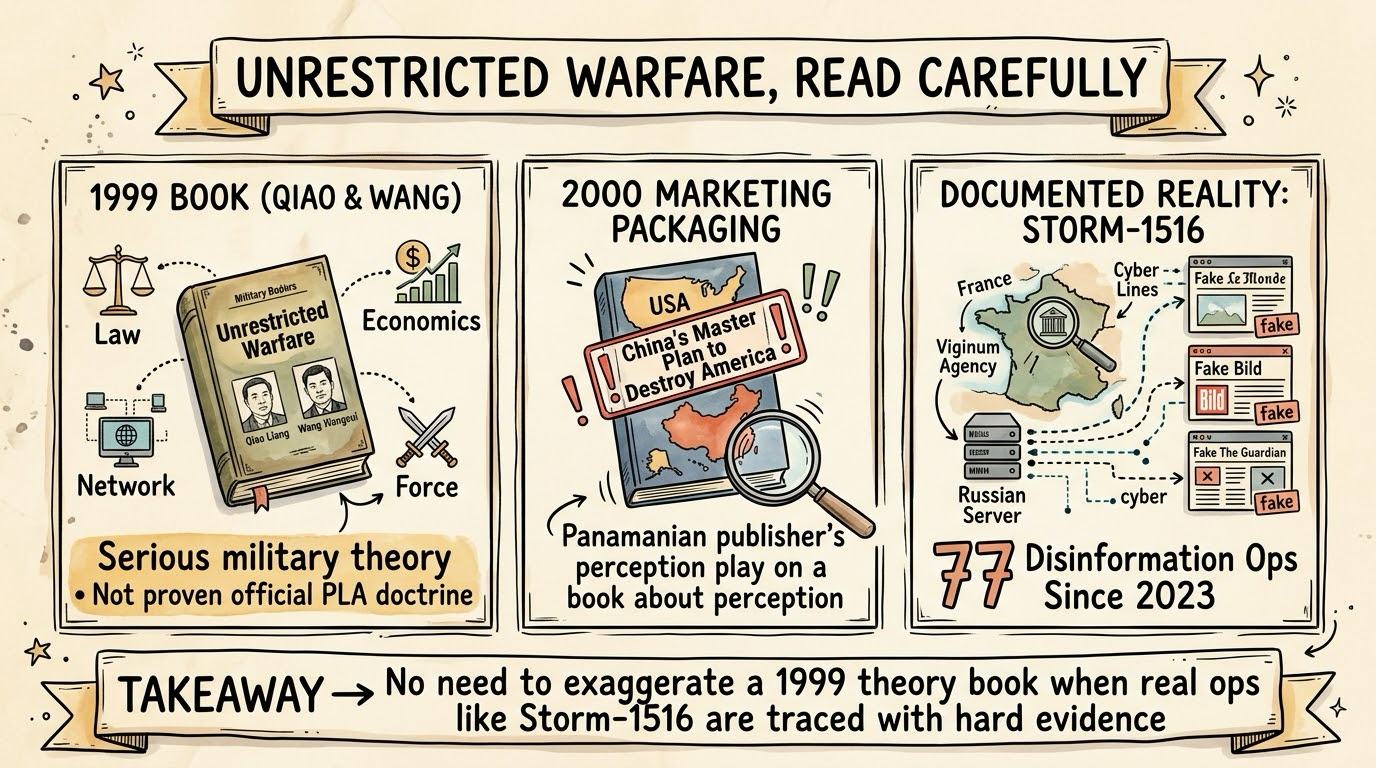
The video leans on Unrestricted Warfare, a 1999 book by two Chinese air force colonels, Qiao Liang and Wang Xiangsui.
It asked how a weaker country could beat the United States, and its answer was to use law, economics, information and other non-military tools alongside force.
The book argued these methods could have "the same and even greater destructive force than military warfare."
It's a serious text, and US military schools still study it.
It's also a work of military theory, and calling it official PLA doctrine goes further than the evidence I found.
One detail made me smile as a marketer.
A 2000 English edition from a Panamanian publisher added the subtitle "China's Master Plan to Destroy America" and put a burning World Trade Center on the cover.
The packaging of a book about perception was itself a perception play.
I've written about China eroding trust, and I don't think anyone needs to exaggerate the book to take that seriously.
When it comes to influence operations, the most documented case in Europe right now is Russian.
France's Viginum agency linked a Russian network called Storm-1516 to 77 disinformation operations since 2023, including fake versions of Le Monde, Bild and The Guardian.
That is the clearest real example of the video's warning, and notably, someone did trace it back.
The Trap In "Everything Is A Psyop"
The video's strongest insight is also its biggest risk.
It argues that once anything can be a weapon, you can no longer tell who your allies are, and even calling out a psyop might be part of the psyop.
That's true, and it's exactly why I'd be careful with how the idea gets used.
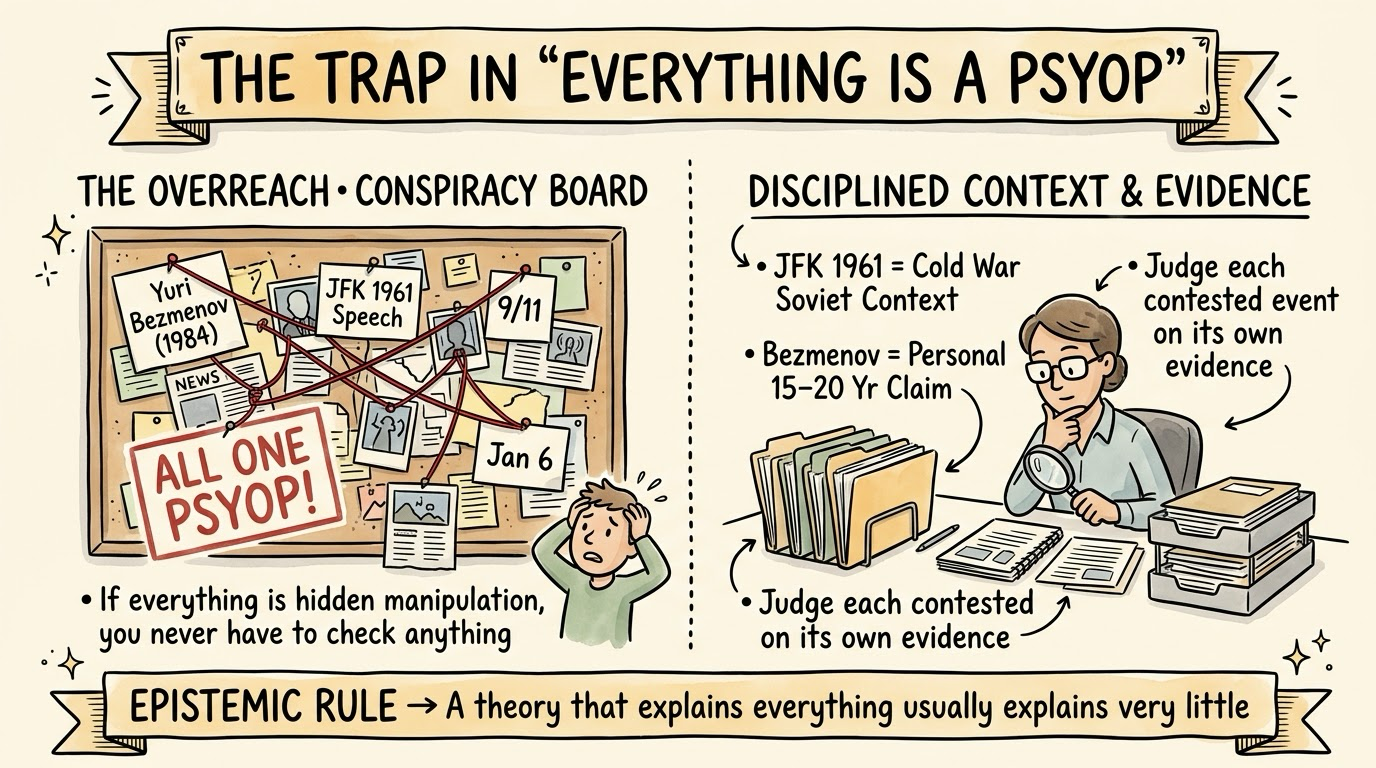
If every event can be explained as hidden manipulation, you never have to check anything.
The video opens with Yuri Bezmenov, a KGB defector who told G. Edward Griffin in 1984 that demoralizing a country takes 15 to 20 years.
It's a gripping interview, but the timeline is his own claim, and the KGB's long-term plans for the US remain largely unknown.
The video also quotes John F. Kennedy's 1961 speech about an opponent relying "on infiltration instead of invasion."
He was describing Soviet communism during the Cold War, and the line is often stripped of that context online.
The video then lists contested events, from JFK and 9/11 to January 6 and the shooting of Charlie Kirk, as examples of questions that never get settled.
I'd leave those out of a framework like this, because each one deserves its own evidence rather than a shared label.
I wrote about Professor Jiang Xueqin for the same reason.
A theory that explains everything usually explains very little.
I Do This For A Living
The video's warning about phones hits close to home.
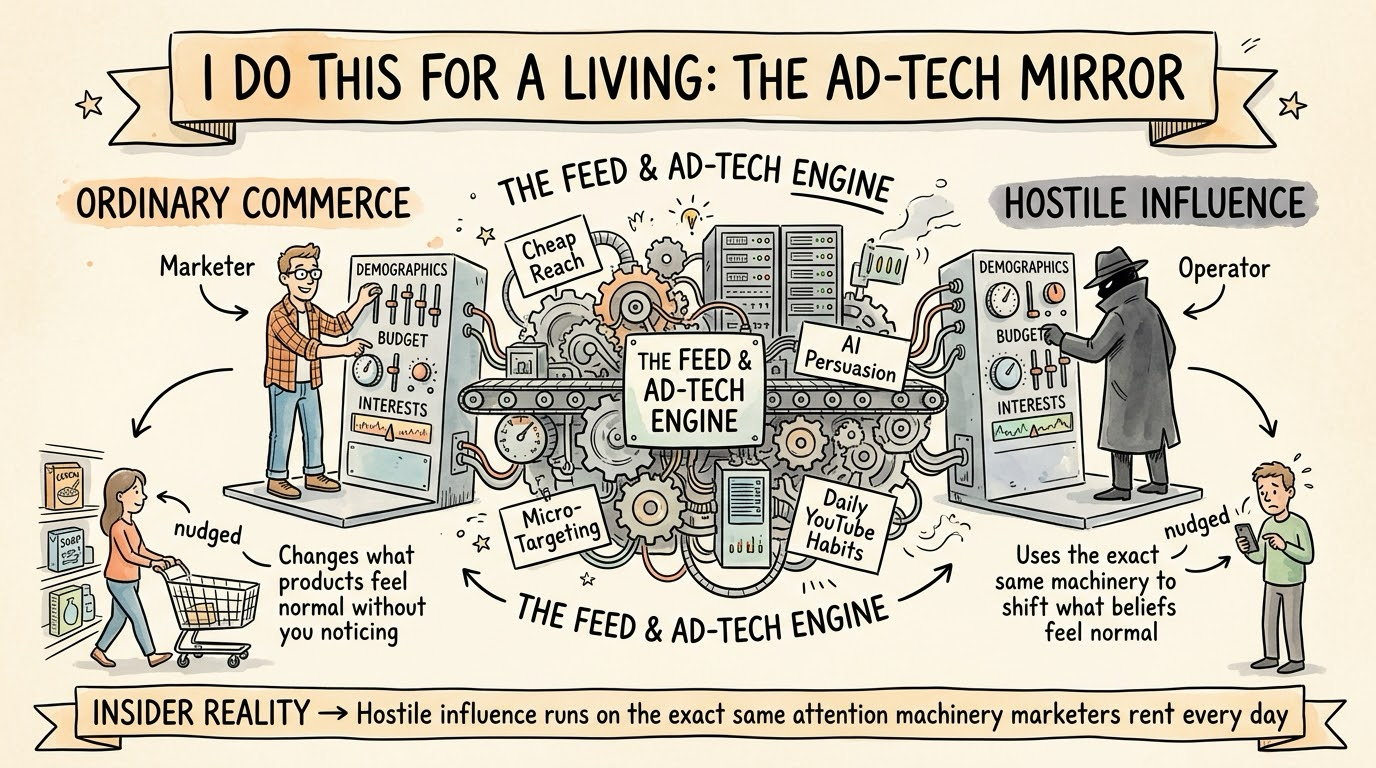
My job is buying ads that change what people think about a product, ideally without them noticing the nudge.
I know how cheap reach is, how precisely an audience can be targeted, and how much a feed decides what feels normal.
Most of that is ordinary commerce, and it still runs on the same machinery a hostile actor would use.
The video says even small daily habits, like what you watch on YouTube, can shift how you think over time.
I agree, and I'd include the video itself in that.
I've argued that AI agents are making censorship harder, and the same tools make cheap persuasion easier for anyone who wants to try.
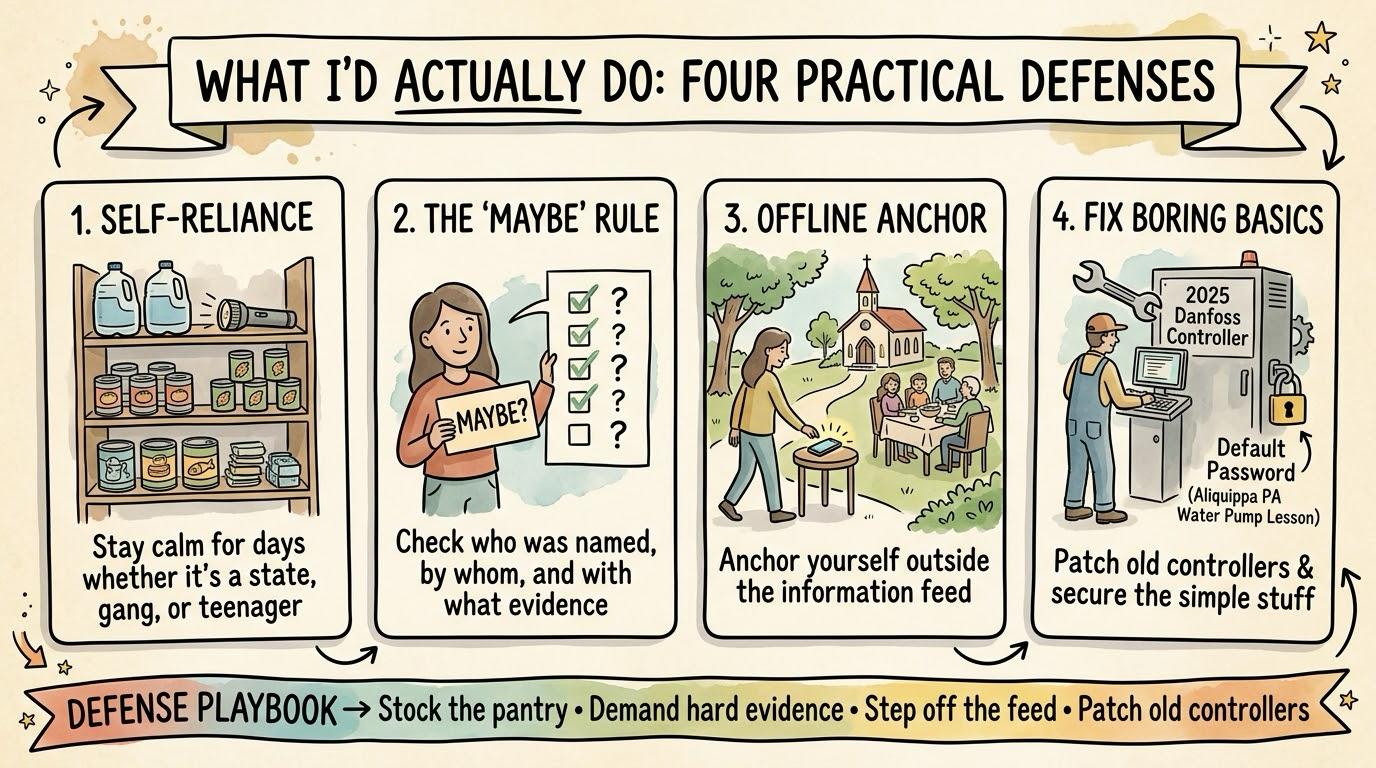
What I'd Actually Do
The video ends with three pieces of advice, and I'd keep two of them almost as they are.
The first is practical self-reliance.
If a cyberattack cuts food, water or power for a few days, a household with water, food and a plan stays calm while others panic.
That applies whether the attacker is a state, a gang or a teenager.
The second is the "maybe" rule.
When someone claims to have figured out who is secretly behind a crisis, the honest answer is often "maybe."
I'd add one step to that, which is to check who has actually been named, by whom and with what evidence.
The third is to anchor yourself in something outside the information war, and for the speaker that's his Christian faith.
Whatever your anchor is, I think the point holds that people who never step away from the feed get worn down by it.
I'd add a fourth for companies, because the fridge attack is a reminder of something unglamorous.
The controllers that failed were mostly old, unsupported devices reachable from the internet, and Danfoss had patched related flaws in a newer model in 2025.
The same was true when Iran-linked hackers took over a pump station controller in Aliquippa, Pennsylvania in 2023, which CISA said was exposed online with a poor password.
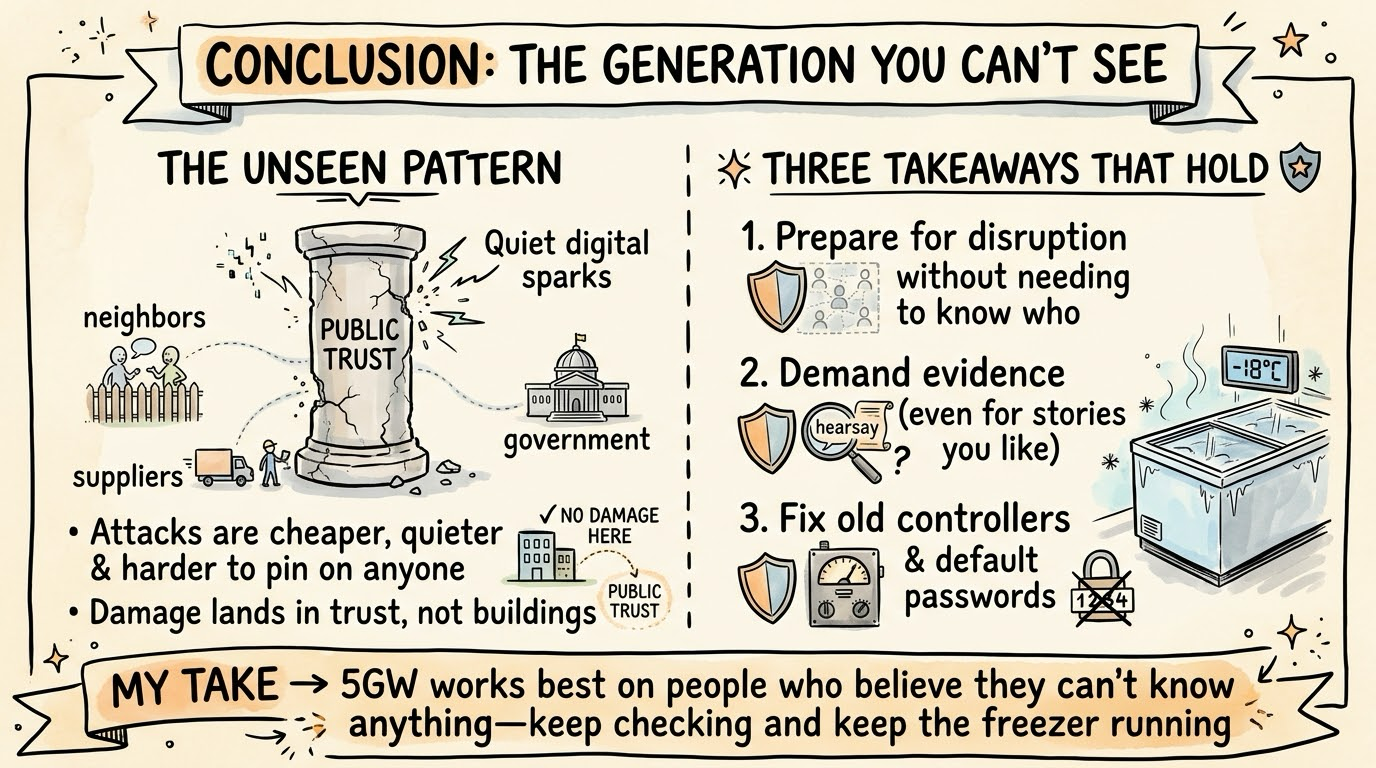
Conclusion: The Generation You Can't See
I don't think fifth-generation warfare is a clean category, and the people who coined the generations never agreed on it.
The pattern underneath it is real, though.
Attacks are getting cheaper, quieter and harder to pin on anyone.
The damage often lands in trust more than in buildings, with people suspecting their governments, neighbours and suppliers.
I take three things from this.
Prepare for disruption without needing to know who caused it.
Demand evidence before accepting anyone's story about hidden enemies, including the stories you already like.
And fix the boring things, like old controllers and default passwords, because that's where most of these attacks still get in.
My Take: Fifth-generation warfare works best on people who believe they can't know anything, so the best defense is to keep checking and keep the freezer running.
Sources
Pages I opened for the facts in this post:
- The Hacker News: French supermarket fridge attack
- CBS News: Hackers target supermarket refrigerators in France
- Wikipedia: 2026 French supermarket refrigerator hack
- Al Jazeera: Who's attacking Europe's supermarket freezers?
- Marine Corps Gazette: The Changing Face of War (1989)
- Ukrainska Pravda: Fiber-optic drones
- Wikipedia: Fifth-generation warfare
- Military Review: Thomas Hammes on the fifth generation (2007)
- US Army War College: Fourth-Generation War and Other Myths
- Wikipedia: Unrestricted Warfare
- European Policy Centre: Storm-1516
- Big Think: Yuri Bezmenov
- Miller Center: Kennedy's 1961 address to newspaper publishers
- CyberScoop: Aliquippa water authority hack