We're Obsessed With Building Agents. The Money Is In Using Them.
Everyone is building AI agents. The winners won't be the ones with the cleverest agent framework — they'll be the ones who figure out how to extract tangible value from using them. The moat isn't the agent. It's the application layer.
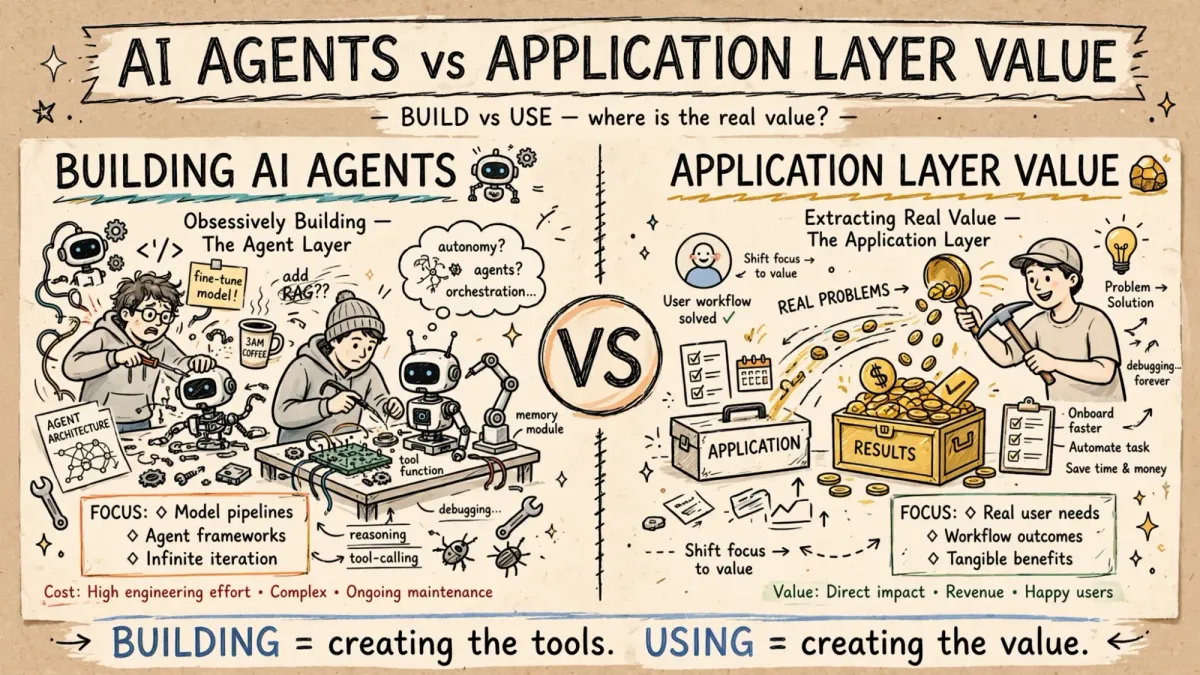
Right now, 90% of the conversation is: What framework? LangGraph vs CrewAI vs OpenAI Agents SDK? What memory? What reasoning?
Almost no conversation is: What workflow is worth automating, and what measurable outcome did we deliver?
That mismatch is why most agent projects are dying.
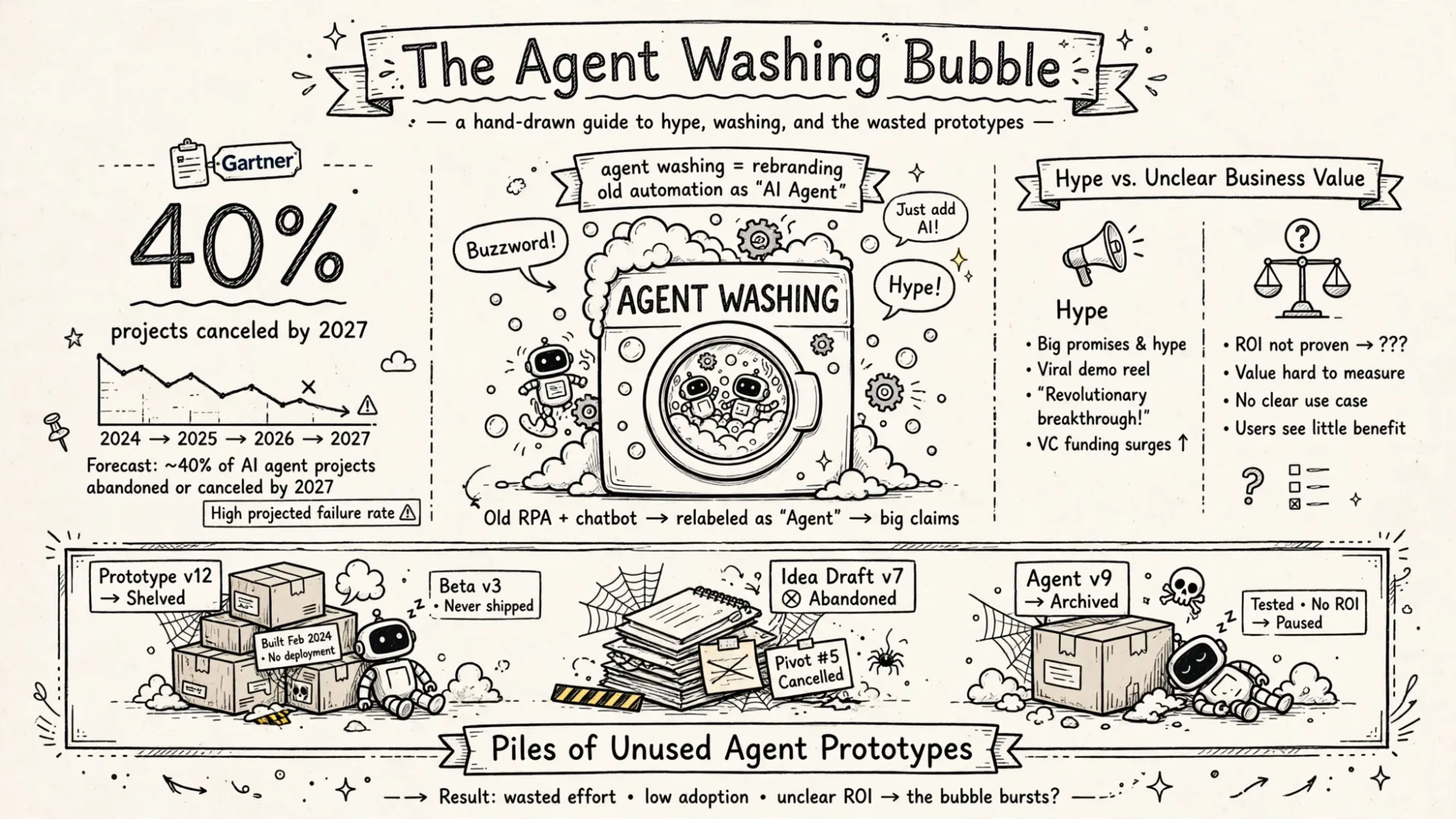
The Agent Washing Bubble
Gartner expects more than 40% of agentic AI projects to be canceled by the end of 2027 due to escalating costs and unclear business value, and warned of widespread "agent washing," where ordinary assistants are rebranded as agents without real capabilities.
The numbers are already brutal:
Gartner projected in June 2025 that over 40% of agentic AI projects will be canceled by the end of 2027, citing escalating costs, unclear business value, and inadequate risk controls. A widely cited MIT study found roughly 95% of enterprise GenAI pilots delivered no measurable return, most never crossed from pilot into durable production use at all.
McKinsey's cut is even harsher: 90% of projects bring no value, and only 6% of companies see real returns.
Why? We focus on tools instead of workflows, prototypes instead of architecture, and models instead of integration. Hype-driven initiatives rarely end well.
The Real Moat Is Value Extraction, Not Token Generation
Here's the mental model shift:
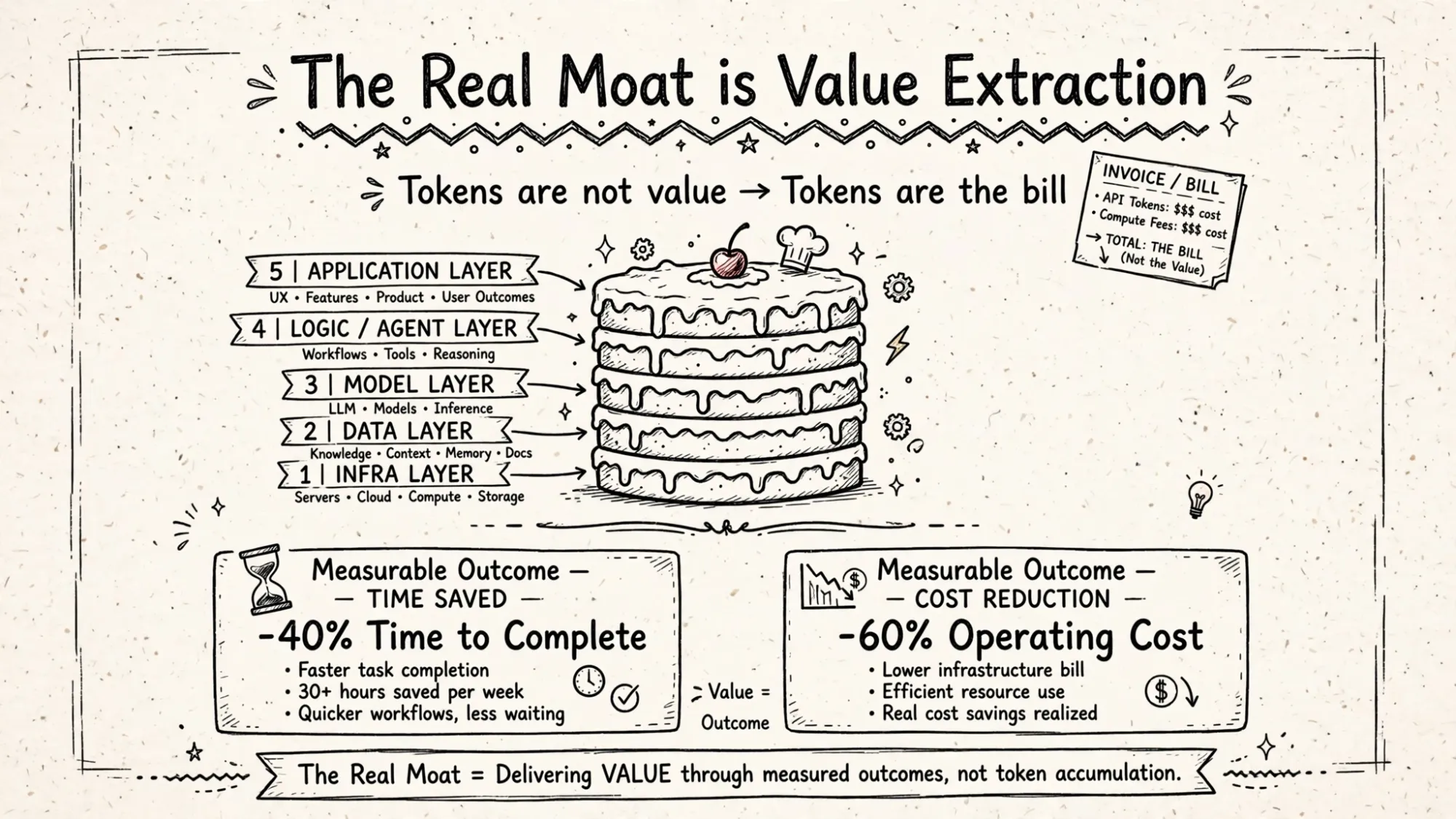
He calls the AI architecture a “five-layer cake”: energy at the foundation; chips on top of energy; networking and storage above; models on top of that; and applications and agents at the peak, where the headlines live.
The applications and agents get the press releases. The other three layers get the money.
And at the very top, the application layer, the rule is:
Tokens are not value; tokens are the bill.
The focus needs to be squarely on how to use AI agents to create value.
Building an agent that can do 100 things is a demo.
Extracting $100k of value from an agent that does 1 thing 10,000 times reliably is a business.
The market is reshaping, shifting towards maximizing the value of the entire agent ecosystem rather than the value of individual agents.
How to Build the Application Layer
This is the unsexy work everyone is skipping:
1. Start with process, not agent. The bottleneck in enterprise AI isn't models, it's deciding what to automate. Map processes, score them by feasibility, business value, risk, ROI, payback.
2. Define outcome before architecture. "Reduce processing time by 40%, cut reporting errors by 30%, or save 10 hours of routine work per week", that's a goal. "We want AI agents" is not.
3. Build the scoring layer. Ingest a company's processes, score each one, and return a prioritized backlog. Teams pick projects by hype, burn quarters on low-value pilots. You need a rigorous way to go from "here are our processes" to "here's the value-ranked plan."
4. Measure value, not tokens. Time saved. Cost reduced. Revenue accelerated. Error rate down. If you can't put a number on it that finance understands, you didn't extract value. You just burned tokens.
Everyone can now build an agent in a weekend.
Very few can deploy one that survives in production and shows up on a P&L.
That's where the next $100B in AI value will be created.
Not in the agent layer. In the application layer that figures out how to actually use them.
BUILDING = creating the tools. USING = creating the value.