AI Models Are Converging (And Thinking Alike)
Frontier models are no longer pulling away — they're converging. With open-source and distillation turning expensive reasoning into cheap, downloadable weights, intelligence is becoming commoditized. The next moat isn't smarter models. It's distribution and pricing.
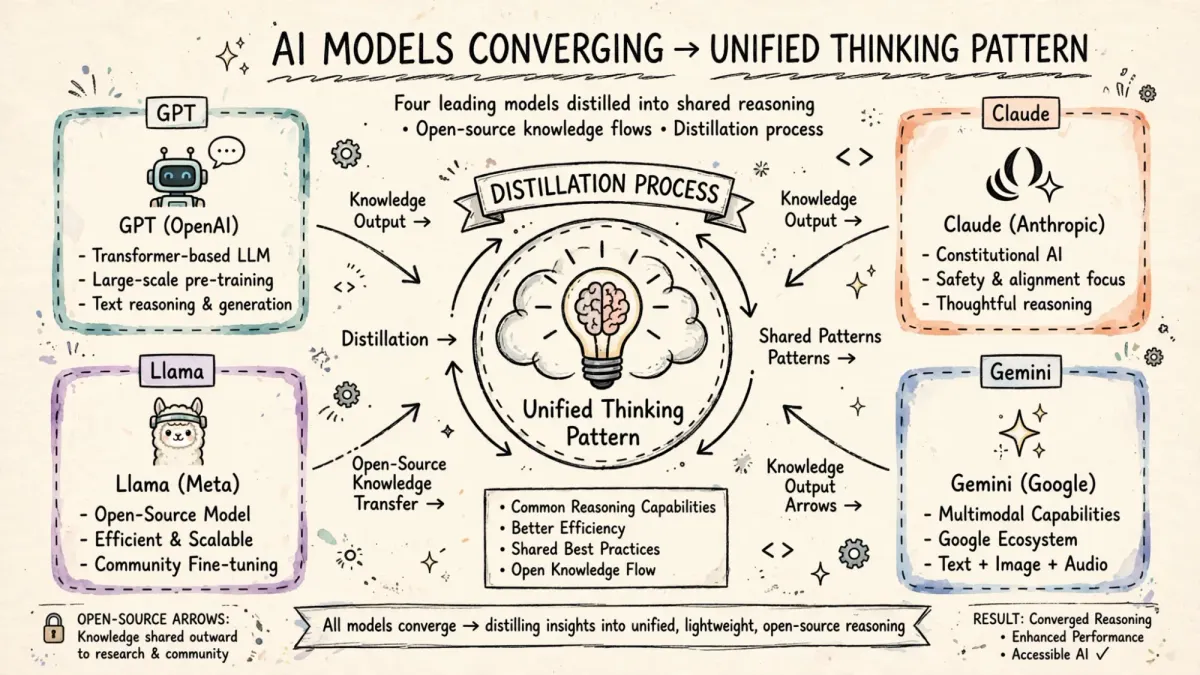
For two years we obsessed over which model is smartest. That race is ending in a tie.
1. The Convergence Is Real
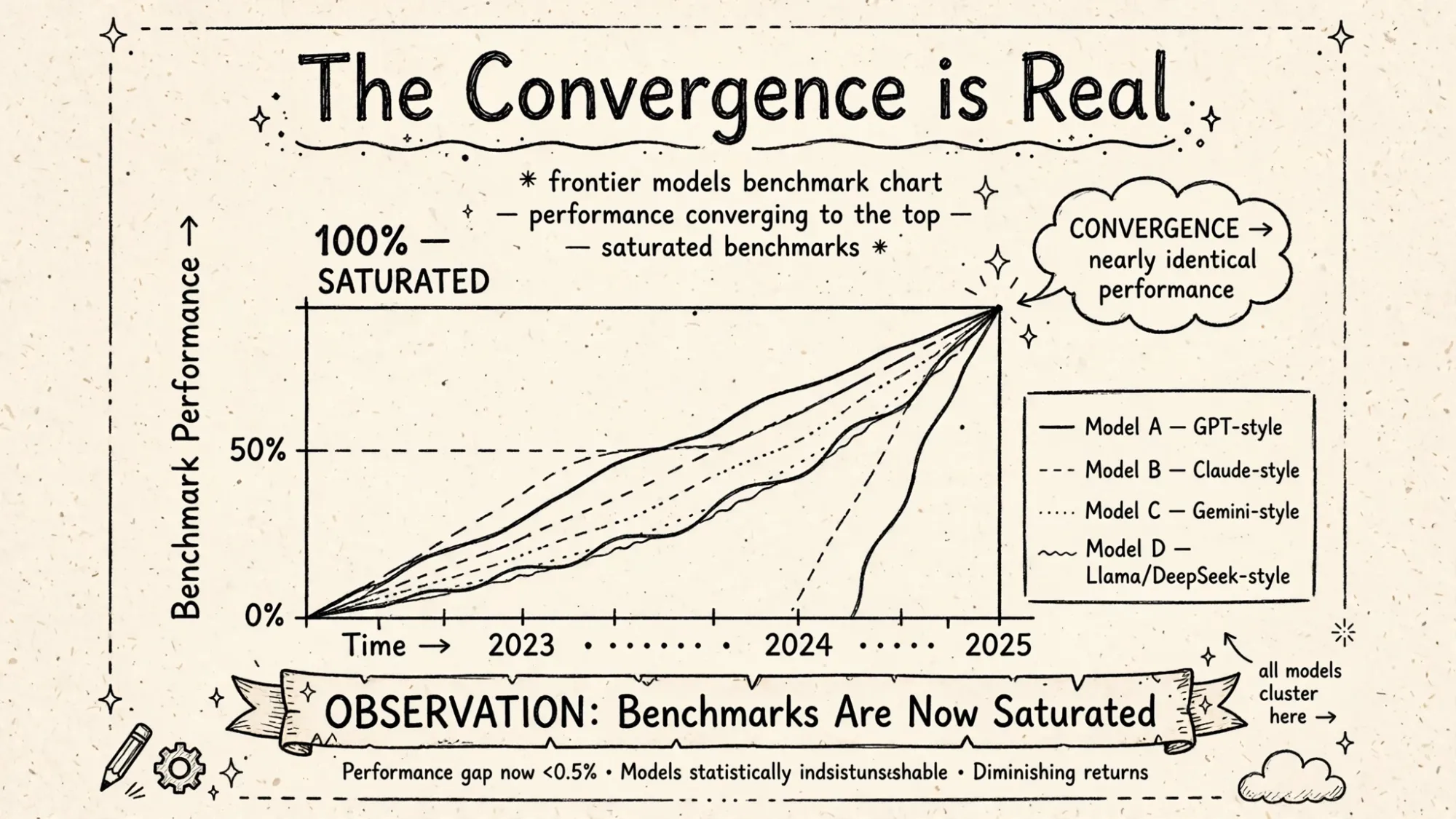
The latest EQS AI Benchmark tested frontier models on 120 real-world agentic workflows. Their conclusion: Frontier models converge at the top.
The same is showing up in general evals: Leading models are now “nearly indistinguishable” from each other when it comes to capability.
Open-weight models are more competitive than ever, but they are converging.
GPT-4o, Claude 3.5/4, Gemini 1.5/2.5, Llama 4 — the gap on MMLU, MATH, HumanEval, τ-bench is now 2-4%, not 20%.
They also think the same: same chain-of-thought patterns, same tool-use failures, same sycophancy.
We trained them on the same internet, same RLHF playbook, same evals. Of course they converged.
Intelligence alone no longer differentiates.
2. Why Open-Source + Distillation Supercharges It
This is where it compounds.
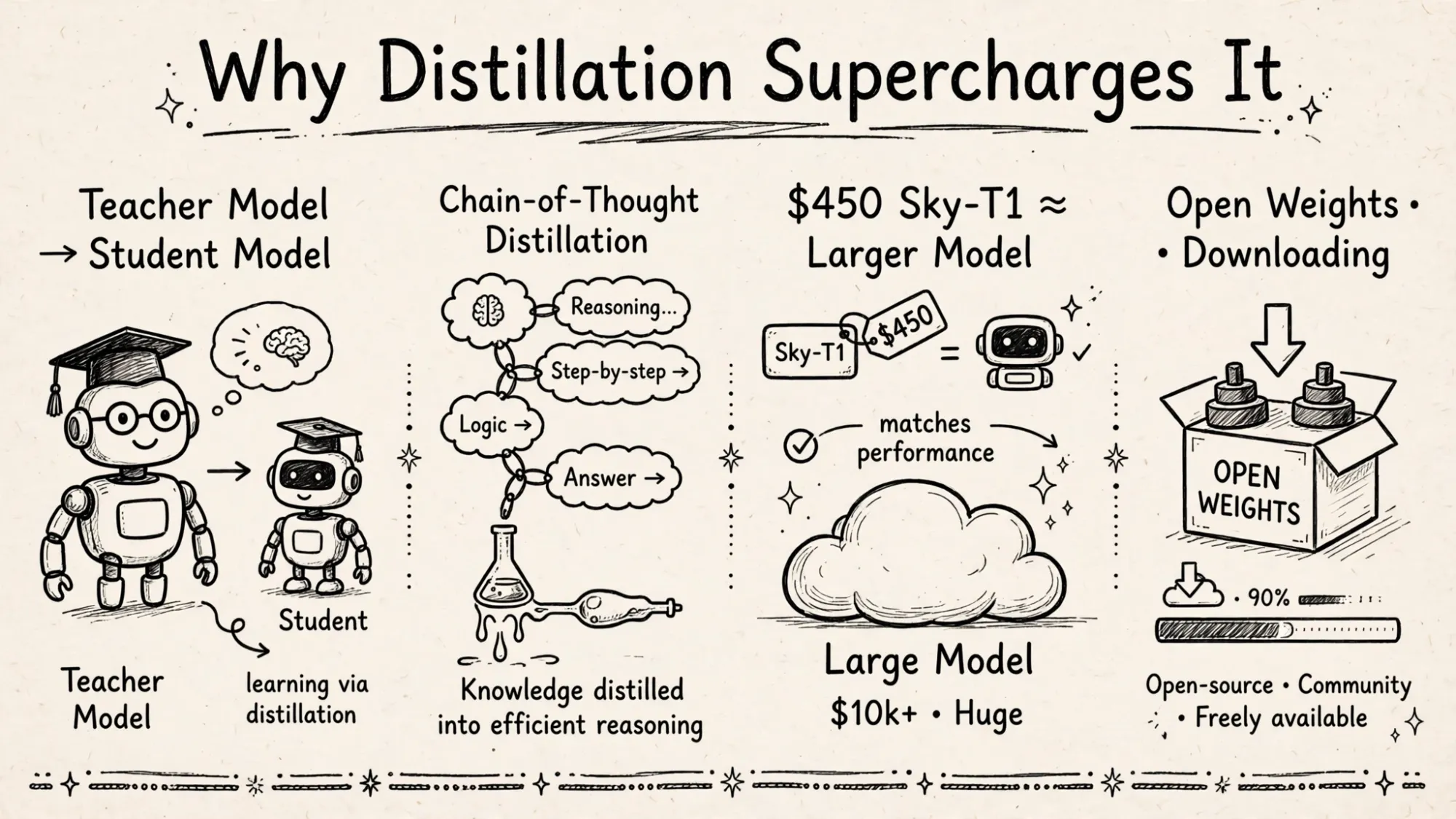
Distillation is simple: A student model could still learn quite a bit from a teacher model just through prompting the teacher with certain questions and using the answers to train its own models, an almost Socratic approach.
What was once a compression trick is now the core training strategy.
Distillation works well for training chain-of-thought reasoning models, which use multistep “thinking” to better answer complicated questions.
And it’s brutally efficient: NovaSky Lab at UC Berkeley showed its fully open-source Sky-T1 model cost less than $450 to train, and it achieved similar results to a much larger open-source model.
Two consequences:
1. Cheap clones: Because they are cheaper and can be downloaded to be used on companies' own devices and servers, Chinese open models like DeepSeek R1 and Qwen are gaining popularity globally. Distillation is just a particularly easy way of making an inexact copy of the model weights.
2. Reasoning leakage: When OpenAI, Anthropic, and Google release reasoning traces, even in truncated form, the entire ecosystem learns to think that way. The open-source community distills it within weeks.
Result: A $450 model today thinks like a $100M model from 6 months ago. The frontier moves, but the pack moves with it instantly.
3. Distribution and Pricing Will Matter Most
If intelligence is converging and commoditized, what wins?
Same as every platform shift before it: distribution and pricing.
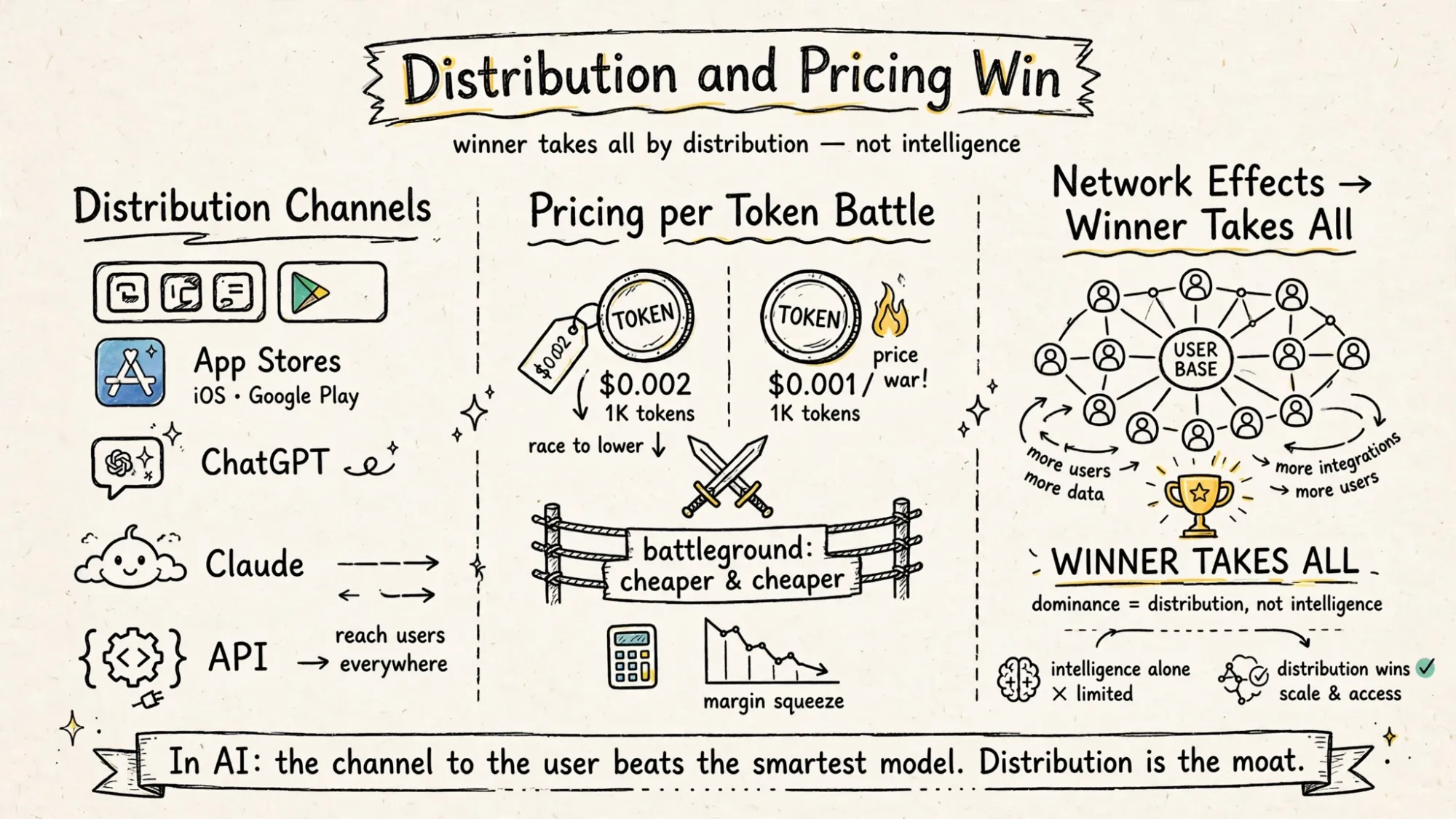
Distribution: Who owns the channel to the user? ChatGPT with 800M weekly users, Microsoft Copilot in Word/Excel, Meta AI in Instagram/WhatsApp, Apple Intelligence on iPhone, Claude in enterprise workflows via API.
The model that lives where work already happens wins, even if it's 2% worse on benchmarks. The user won't switch apps for 2%.
Pricing: When models think the same, the only decision is $/token. We're already in a race to the bottom: $5/$15 per million tokens last year is now $0.15/$0.60 for distilled equivalents.
If you can serve a distilled 70B that is 95% as good for 10x cheaper, you win the enterprise contract. Margin will come from bundling, not model quality.
Zuckerberg said it plainly: protect the principle that you can learn from anything you can observe.
Translation: distillation is inevitable. Don't fight it. Build the distribution moat.
The takeaway for builders:
Stop betting on a secret model moat. There isn't one.
Bet on:
- Owning a distribution surface (app, workflow, device)
- Relentless cost optimization via distilled / open models
- Data flywheel from distribution that can't be distilled
In the end, the channel to the user beats the smartest model. Every time.