Video Games Are Becoming Training Data For Robots, And Players Should Get A Cut
AI labs want gameplay because it records exactly what a player did and what happened next. Gaming could become a data business for robotics and world models, and the players doing the work deserve to be asked and paid.
Upper Echelon released a video this week arguing that gaming is changing again.
His claim is that the industry is turning from a business that sells games to players into one that sells player data to AI labs.
I think he's mostly right about where the money is heading.
I'm less convinced by his darkest prediction, and I think the most important question is one he only touches on: who gets paid for the data.
Why AI Labs Want Gameplay
Language models learned from text, and text tells you very little about how the physical world responds to actions.
The next step is world models, which predict how an environment changes when something acts on it.
That needs a specific kind of data.
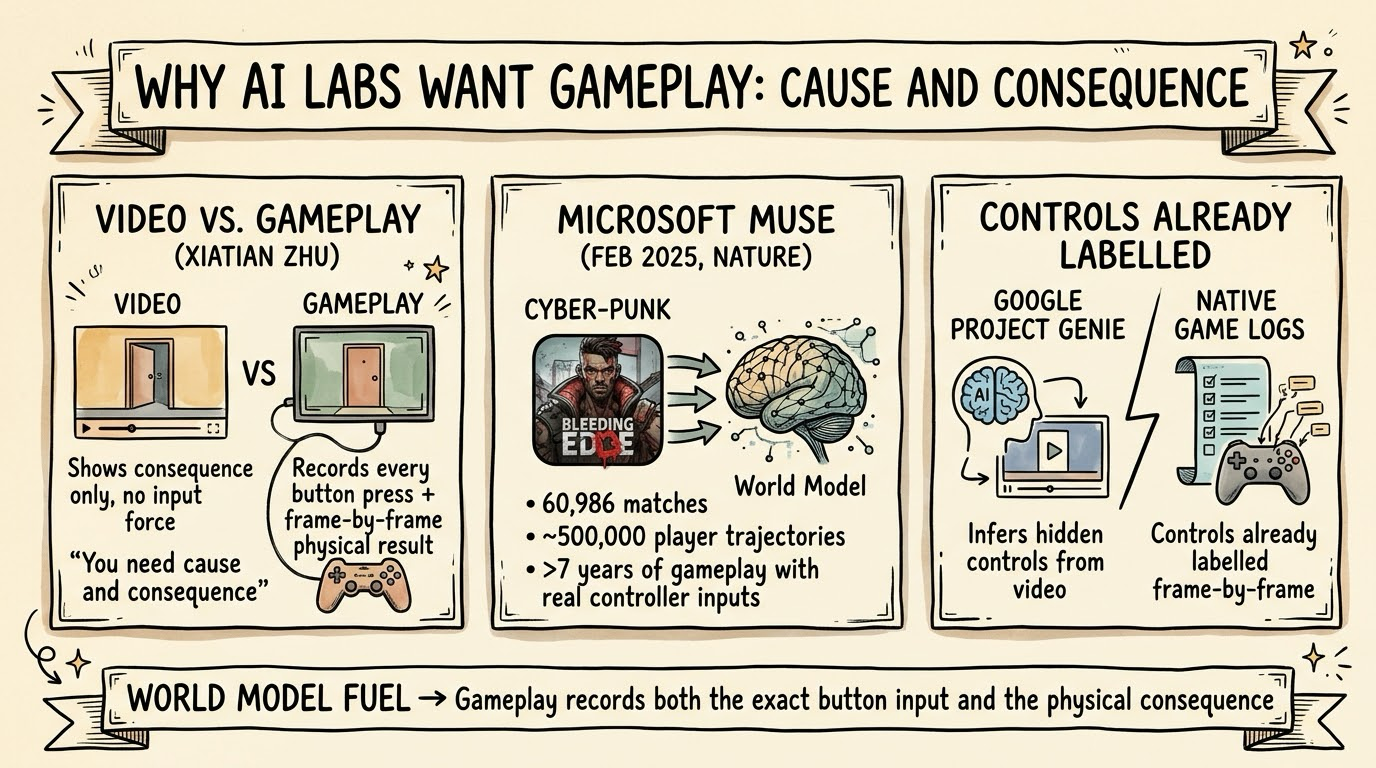
"For world models, you need cause and consequence," University of Surrey AI researcher Xiatian Zhu told WIRED.
A video of a door opening shows the consequence, but not the force or input that caused it.
A game records both, frame by frame, alongside every button press that produced the change.
Microsoft showed what that's worth in February 2025.
Its Muse model, built with Ninja Theory and published in Nature, learned from 60,986 matches of Bleeding Edge, about 500,000 player trajectories and more than seven years of gameplay, with the real controller inputs recorded for every frame.
I wrote about Google's Project Genie inferring the controls behind gameplay footage, and this is the same idea with the controls already labelled.
The Market Is Already Forming
This isn't just a theory anymore.
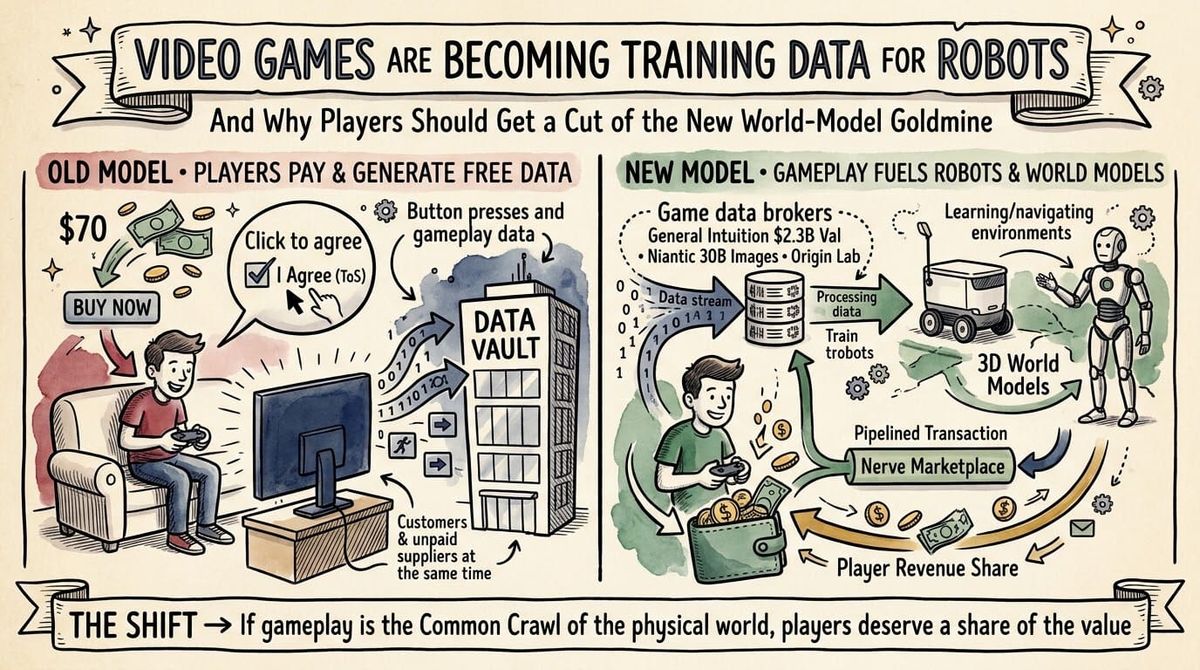
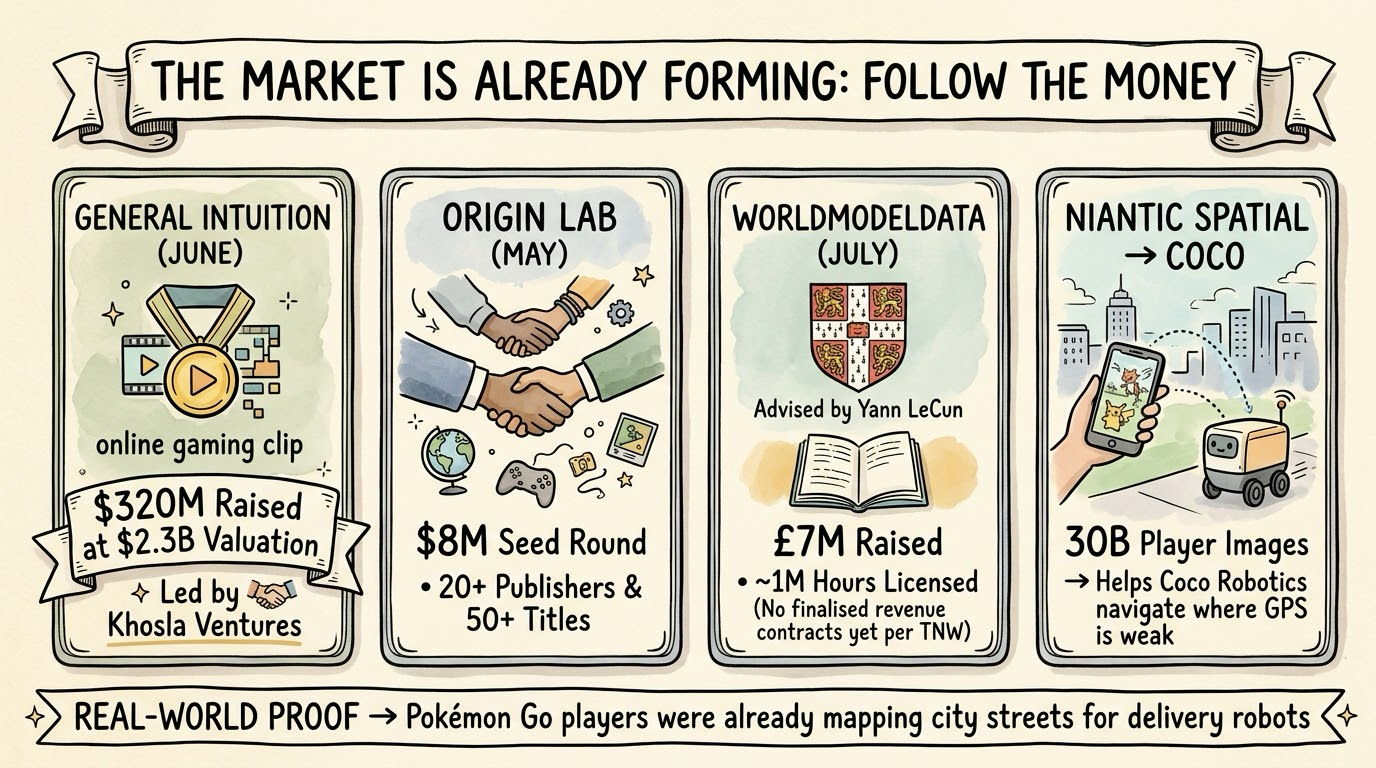
General Intuition, a spin-out of the game-clip platform Medal, raised $320 million at a $2.3 billion valuation in June, led by Khosla Ventures.
Origin Lab raised an $8 million seed round in May and reports partnerships with more than 20 publishers covering over 50 titles.
Worldmodeldata, a Cambridge startup advised by Yann LeCun, raised £7 million in July and says it has licensed almost 1 million hours of gameplay from unnamed studios.
TNW reported in July that it had no finalised customer contracts or revenue yet, so the market is still early.
Niantic is the clearest example of game data becoming infrastructure.
Niantic Spatial trained a model on 30 billion images captured by players, and Coco Robotics now uses it to help delivery robots navigate where GPS is weak.
Pokémon Go players were, in effect, mapping cities for robots.
Games As Benchmarks
Games also show how far AI still has to go.
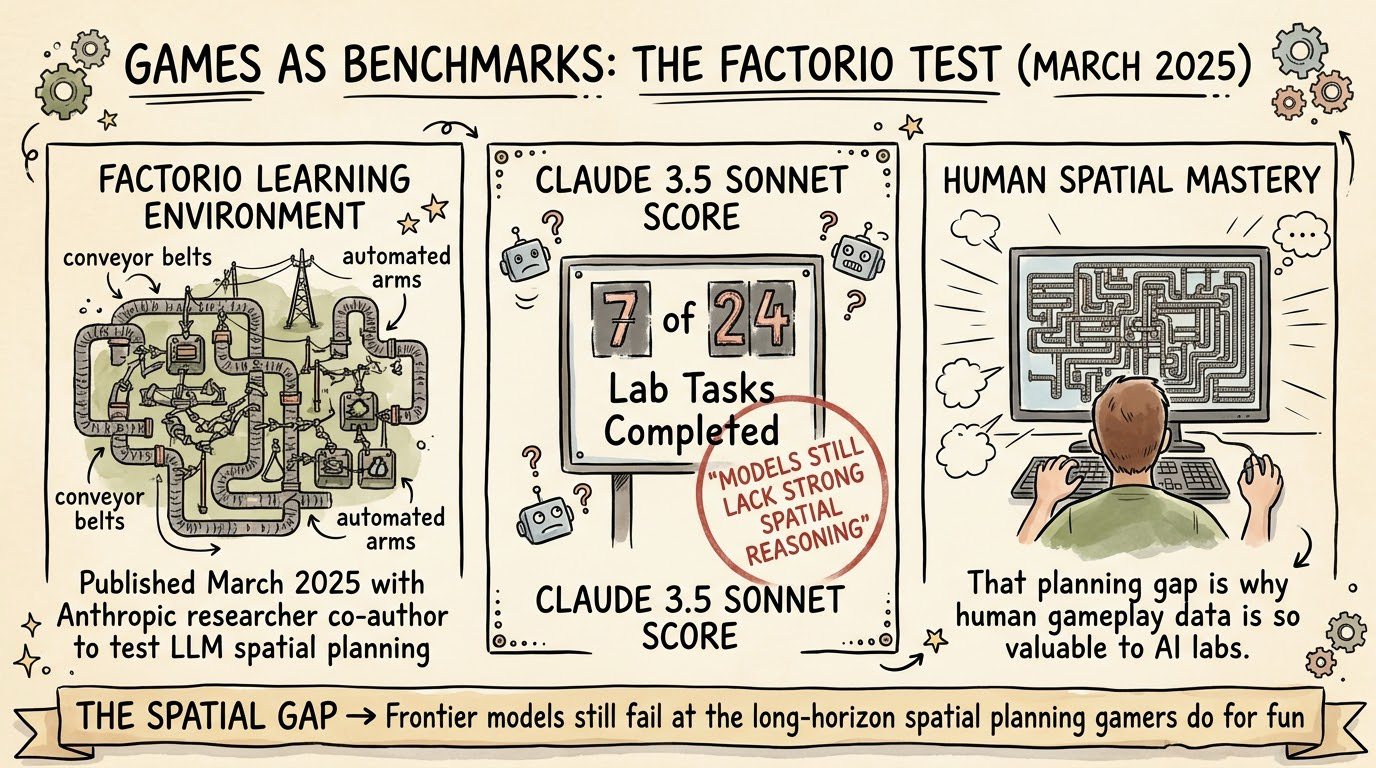
The Factorio Learning Environment, published in March 2025 with an Anthropic researcher among its authors, tested language models on the factory-building game.
The strongest model, Claude 3.5 Sonnet, completed 7 of 24 lab tasks.
The authors concluded that "models still lack strong spatial reasoning."
Factorio players spend hundreds of hours optimizing supply chains, which is exactly the kind of planning these systems struggle with.
That gap is why gameplay looks so valuable.
The Drone Simulator Problem
The most uncomfortable example in the video is the Ukrainian Fight Drone Simulator.
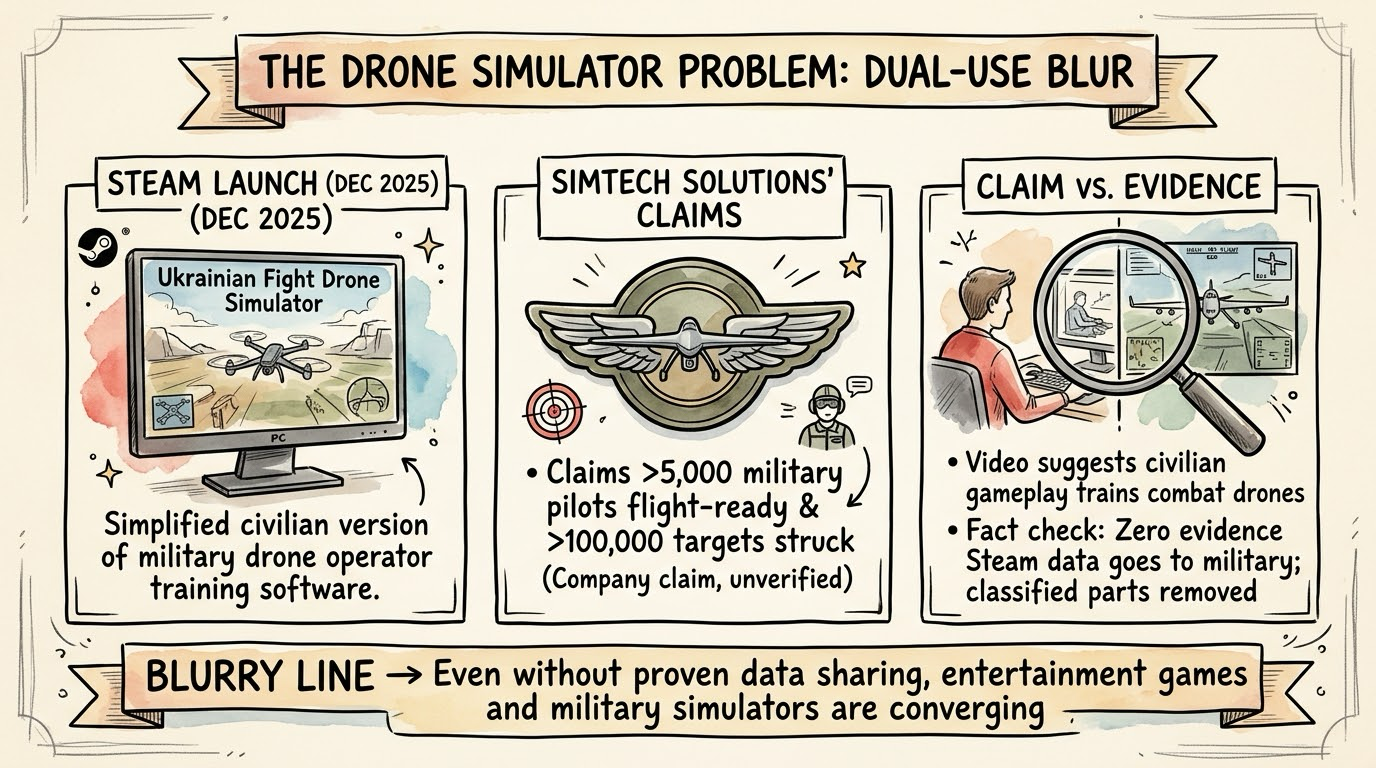
It launched on Steam in December 2025 as a simplified version of software used to train Ukrainian drone operators.
Developer Simtech Solutions says its platform has helped get over 5,000 military pilots flight ready, and that those pilots have struck over 100,000 real targets.
That's the company's claim, and it hasn't been independently verified.
The video suggests civilian players are generating training data for combat drones.
I couldn't find any evidence that the Steam version shares player data with the military, and the developer says classified elements were removed.
Still, I think it shows how blurry the line between a game and a training tool has become.
Who Owns The Data
This is where I'd push back on how quickly the industry is moving.
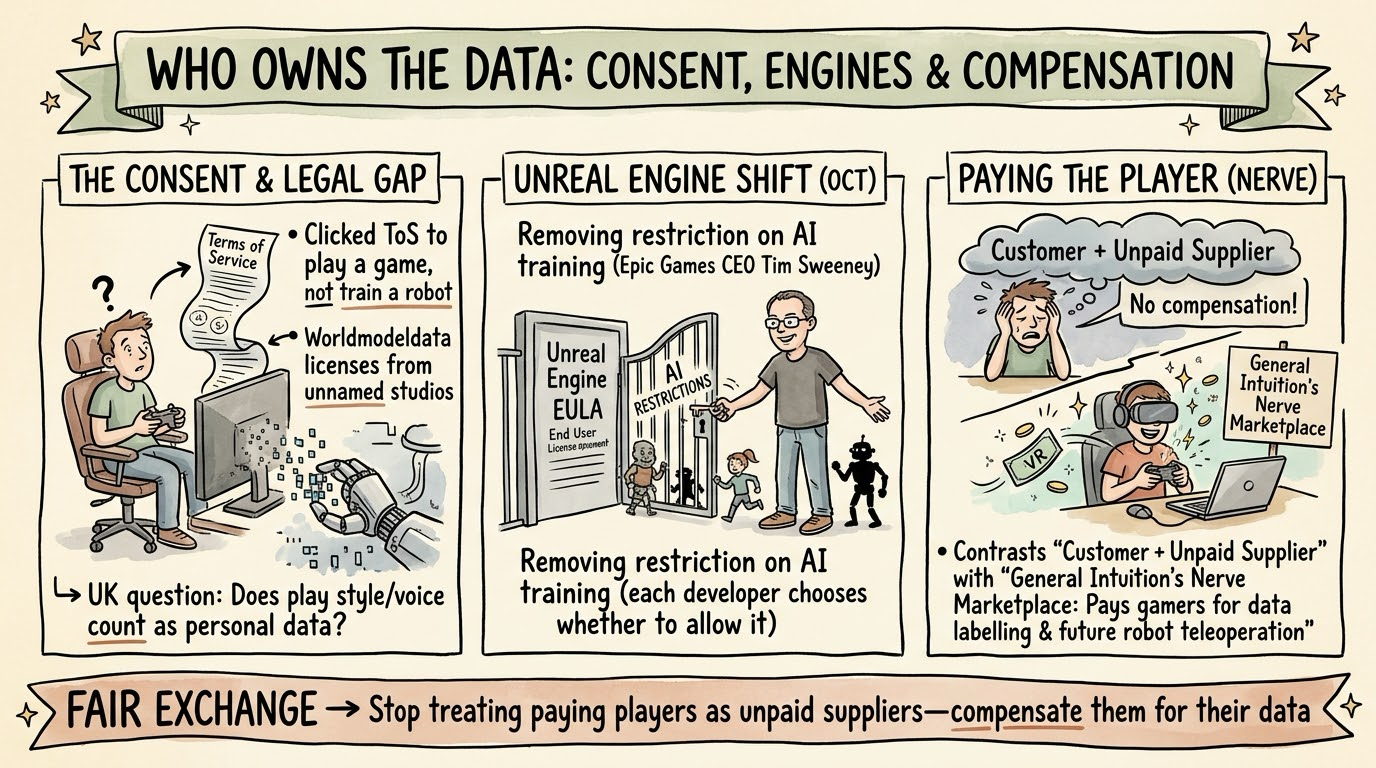
Most players accepted terms of service to play a game, not to train a robot.
Microsoft says it only recorded Bleeding Edge matches when players had accepted the game's licence, and that the data was anonymised.
Worldmodeldata licenses from unnamed studios, which makes the chain of consent hard to check.
WIRED also raised a real legal question in the UK: whether account-linked gameplay, voice chat or play style counts as personal data.
Engines are moving too.
Epic CEO Tim Sweeney said in October that Epic is working to remove the Unreal Engine EULA restriction on AI training, with each game's developer choosing whether to allow it.
As a marketer, I see a strange business model forming.
Players pay for the game, then generate the data that gets sold, which makes them customers and unpaid suppliers at the same time.
General Intuition's Nerve marketplace, which plans to pay gamers for data labelling and later robot teleoperation, is the first serious attempt I've seen to fix that.
I've written about AI turning old games into new ones, and I think paying players for their data could become just as important a shift.
Will Games Get Worse?
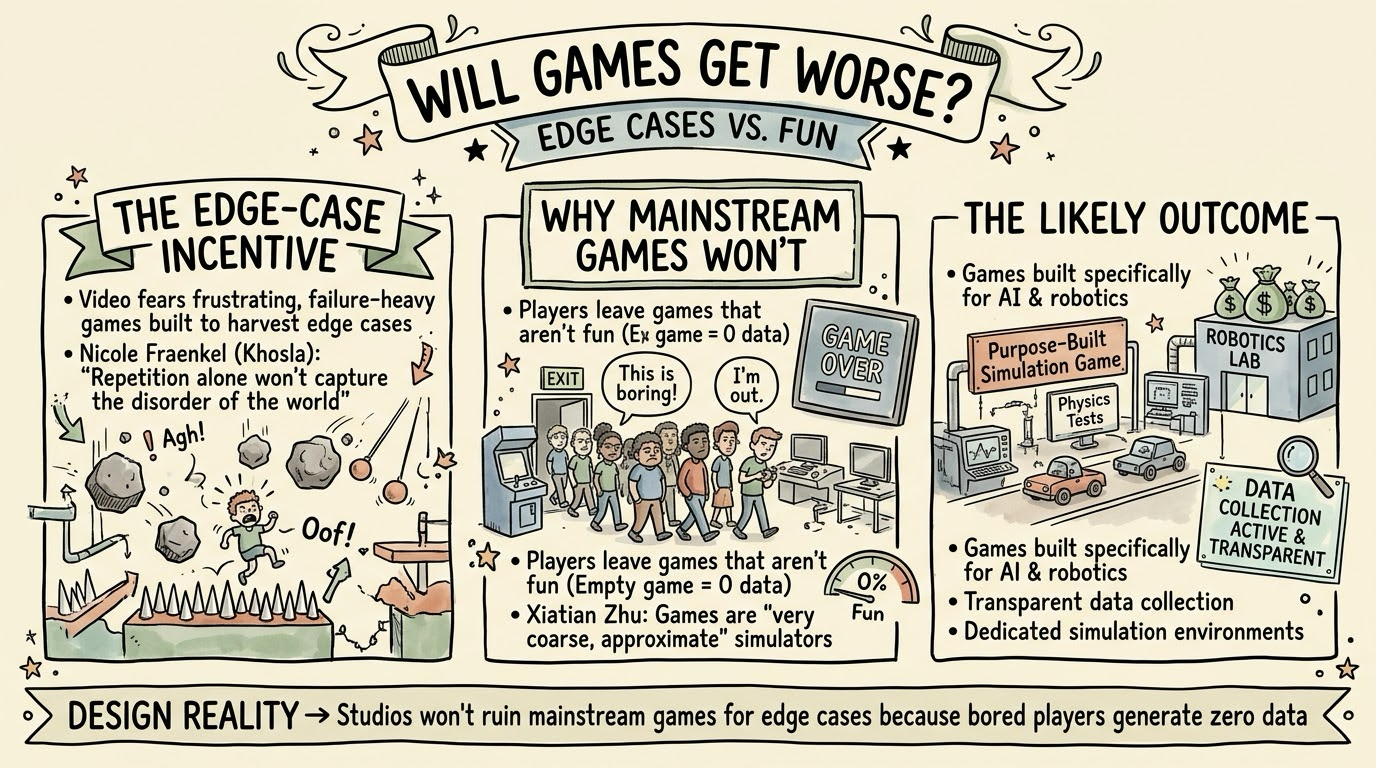
The video's boldest prediction is that studios will design frustrating, failure-heavy games to harvest rare edge cases for robotics buyers.
I think the incentive is real.
Edge cases are valuable, and Khosla Ventures' Nicole Fraenkel said "repetition alone won't capture the disorder of the world."
But I doubt it plays out in mainstream games.
Players leave games that aren't fun, and an empty game generates no data at all.
Zhu also called games "very coarse, approximate" simulators, so the value of artificial chaos may be lower than the video assumes.
I think the more likely outcome is purpose-built simulation games, funded by companies that need specific data and open about what they collect.
The Workforce Paradox
The video's sharpest point is about the people who make games.
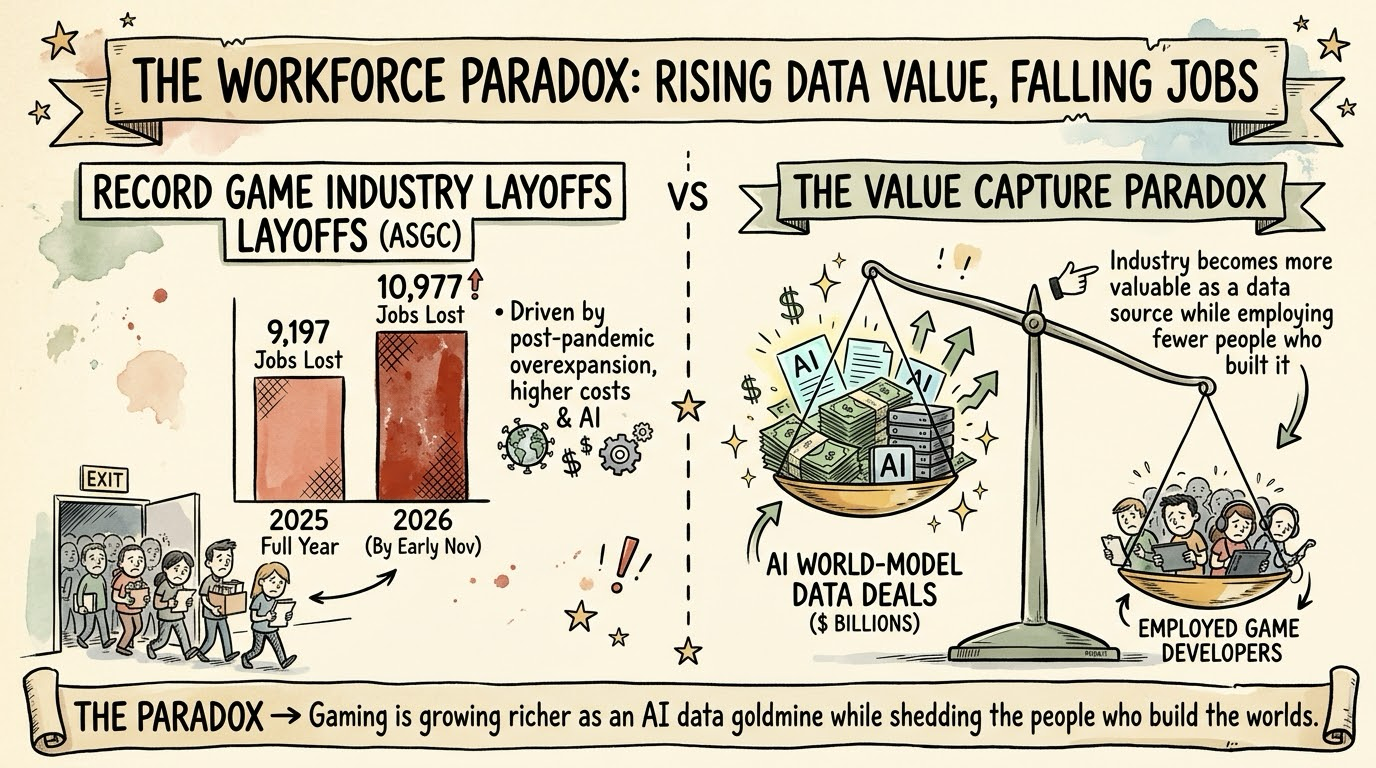
The industry had already lost 10,977 jobs in 2026 by early November, according to the ASGC tracker, more than the 9,197 lost in all of 2025.
So the same industry could become more valuable as a data source while employing fewer of the people who built it.
That isn't only about AI, since post-pandemic overexpansion and higher costs played a big part too.
But it makes the question of who captures the value even more pointed.
Conclusion: The Data Is The Game Now
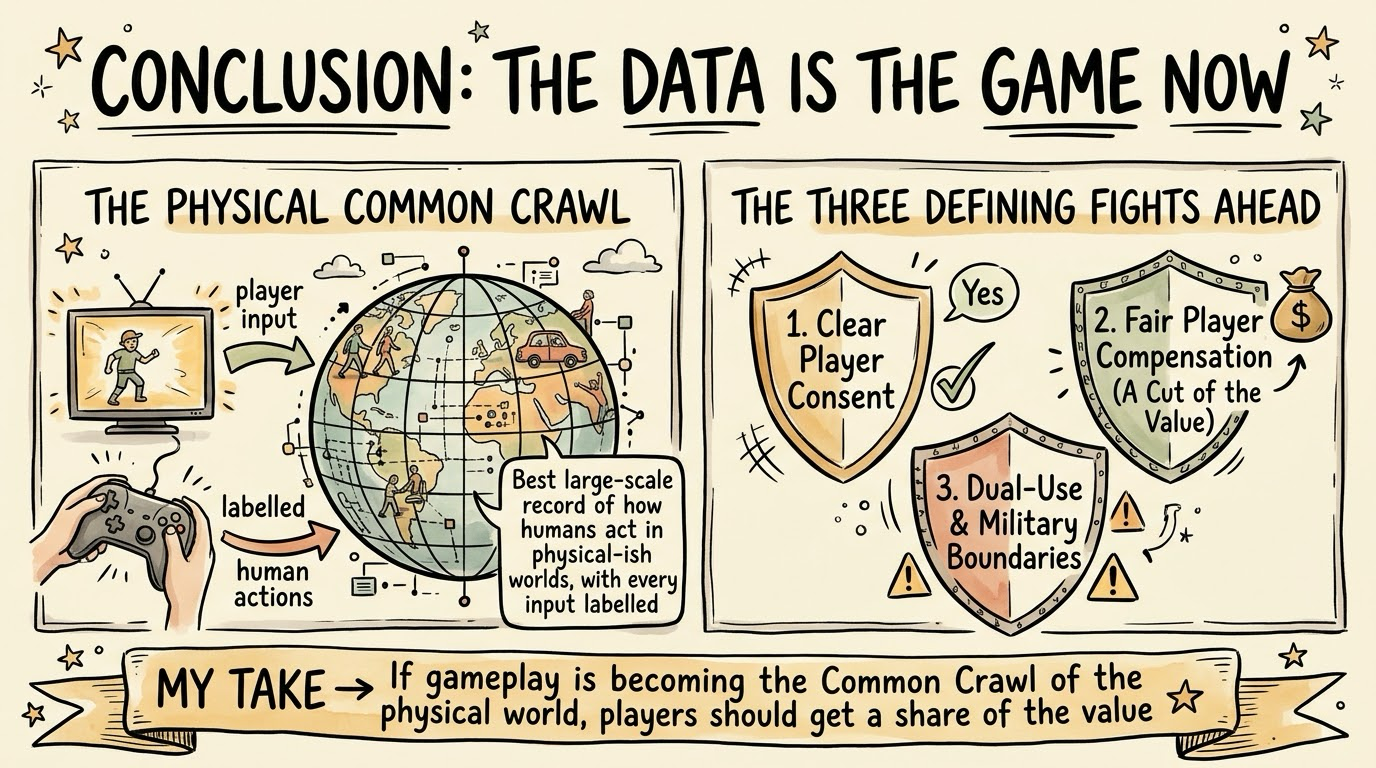
Games are the best large-scale record of how humans act in physical-ish worlds, with every input labelled.
AI labs have noticed, and money is already flowing to the companies that broker that data.
I don't expect mainstream games to become deliberately miserable, because players would simply leave.
I do expect consent, compensation and dual-use concerns to become the defining fights of this shift.
My Take: If gameplay is becoming the Common Crawl of the physical world, players should be treated as contributors with a share of the value, not just users who clicked "I agree."
Sources
Pages I opened for the facts in this post:
- Progressive Robot (via WIRED): Video game data and world models
- arXiv: Factorio Learning Environment
- Wikipedia: Ukrainian Fight Drone Simulator
- Nextgov: Train for the next drone war on simulated Ukrainian front lines
- Game Developer: Epic to allow AI training on Unreal Engine outputs
- Tech4Gamers: Game industry layoffs in 2026