The Housing Crisis Is a Policy Failure: Why Young Canadians Can't Afford a Home
Young Canadians are told to blame landlords, investors and the free market. The numbers point somewhere else: zoning, development fees, demand subsidies and population targets set by governments. Here's why the housing crisis was a policy choice, and what fixing it looks like.
Ask a young Canadian why they can't afford a home, and you'll usually hear one of three answers.
Greedy landlords.
Wall Street buying up houses.
Capitalism itself.
I understand the anger, but I think it's aimed at the wrong target.
When you look at the data, the biggest drivers of the housing crisis are decisions made by governments.
They decided what can be built, how much it costs to build it, how many people arrive each year and how much buyers can borrow.
This post focuses on Canada, but the pattern shows up in most expensive cities in the world.
The Numbers Young People Are Living With
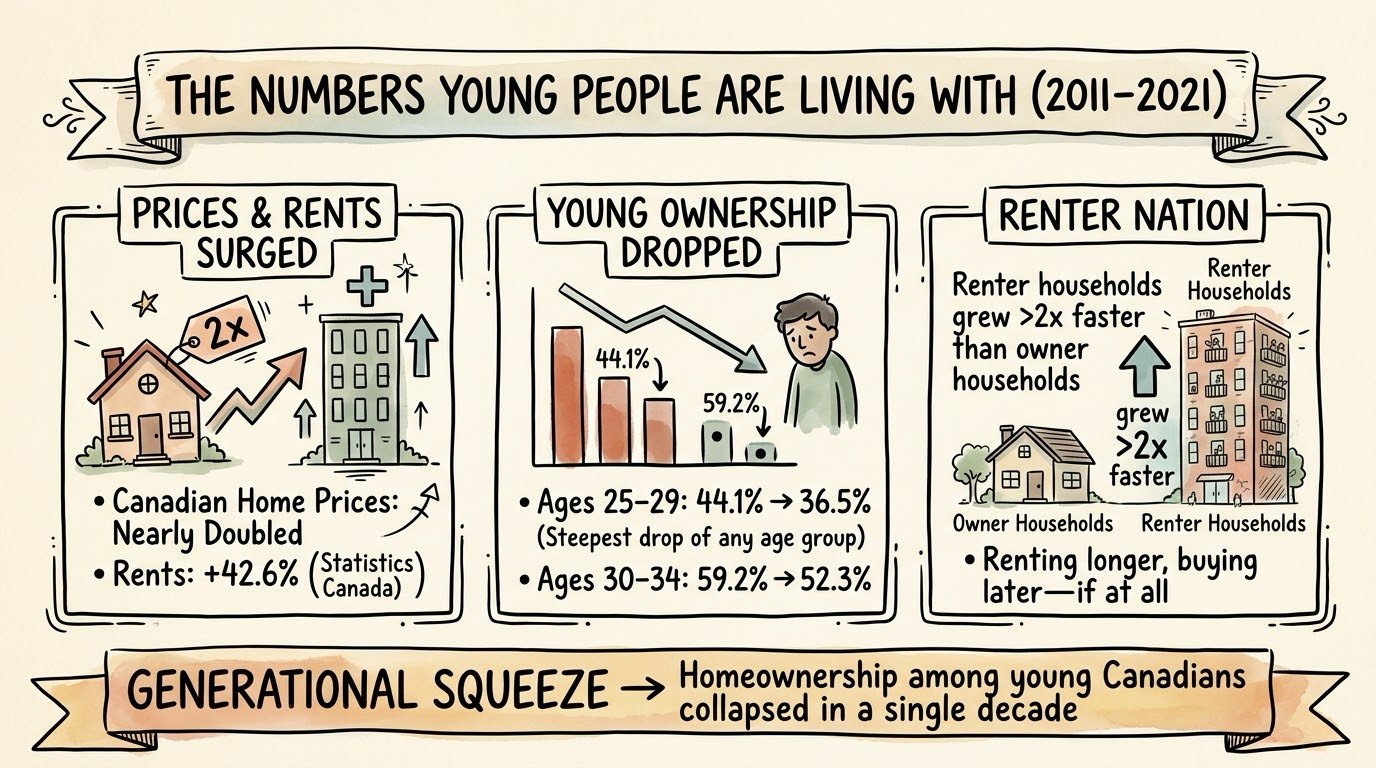
Between 2011 and 2021, Canadian home prices nearly doubled and rents rose 42.6%, according to Statistics Canada.
Over the same decade, homeownership among 25 to 29 year olds fell from 44.1% to 36.5%, the steepest drop of any age group.
For 30 to 34 year olds, it fell from 59.2% to 52.3%.
Renter households grew at more than twice the rate of owner households.
A whole generation is renting for longer and buying later, if they buy at all.
The Villains We're Told To Blame
Institutional investors are the most popular target.
The data doesn't support it.
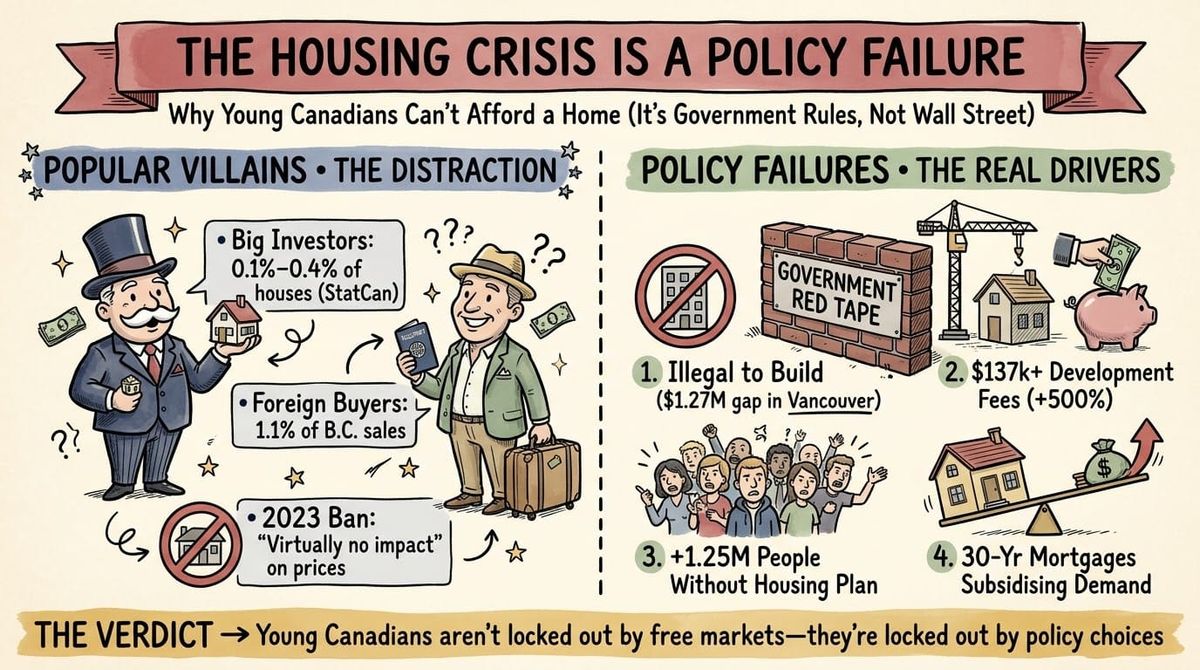
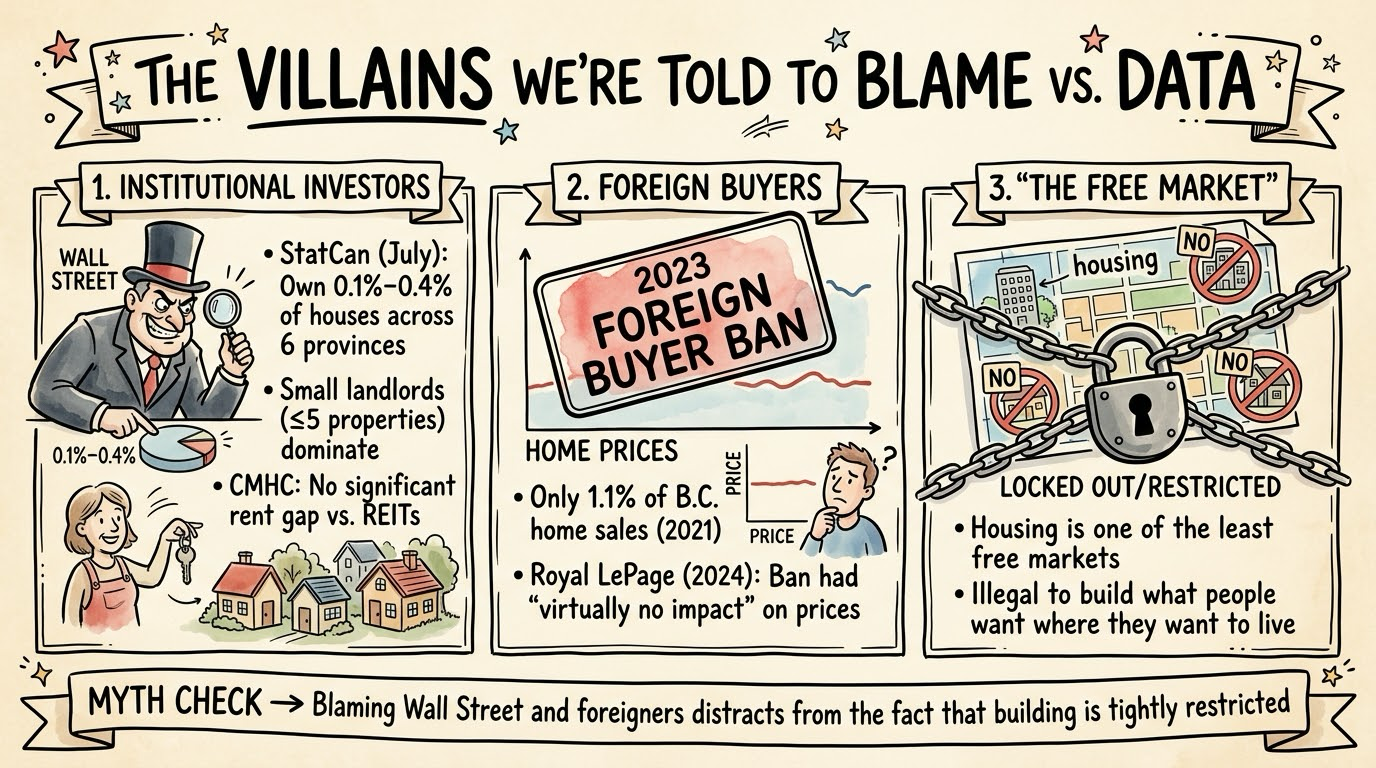
A Statistics Canada study released in July found that large institutional investors owned between 0.1% and 0.4% of houses in the six provinces it studied.
Small investors with five or fewer properties held the largest share of rental value in every province except Nova Scotia.
StatCan also found that rental markets in all 12 metro areas it examined were competitive.
It cited 2025 CMHC research that found no statistically significant rent difference between REIT-owned units and those of other landlords in the three largest metros.
Foreign buyers are the second target.
Ottawa banned most foreign purchases of homes from January 2023, and Royal LePage said in 2024 that the ban had "virtually no impact" on prices.
Foreign buyers made up 1.1% of B.C. home sales in 2021.
Then there's the free market.
I'd argue housing is one of the least free markets in the economy.
In most Canadian cities, you can't legally build what people want to buy on most of the land where they want to live.
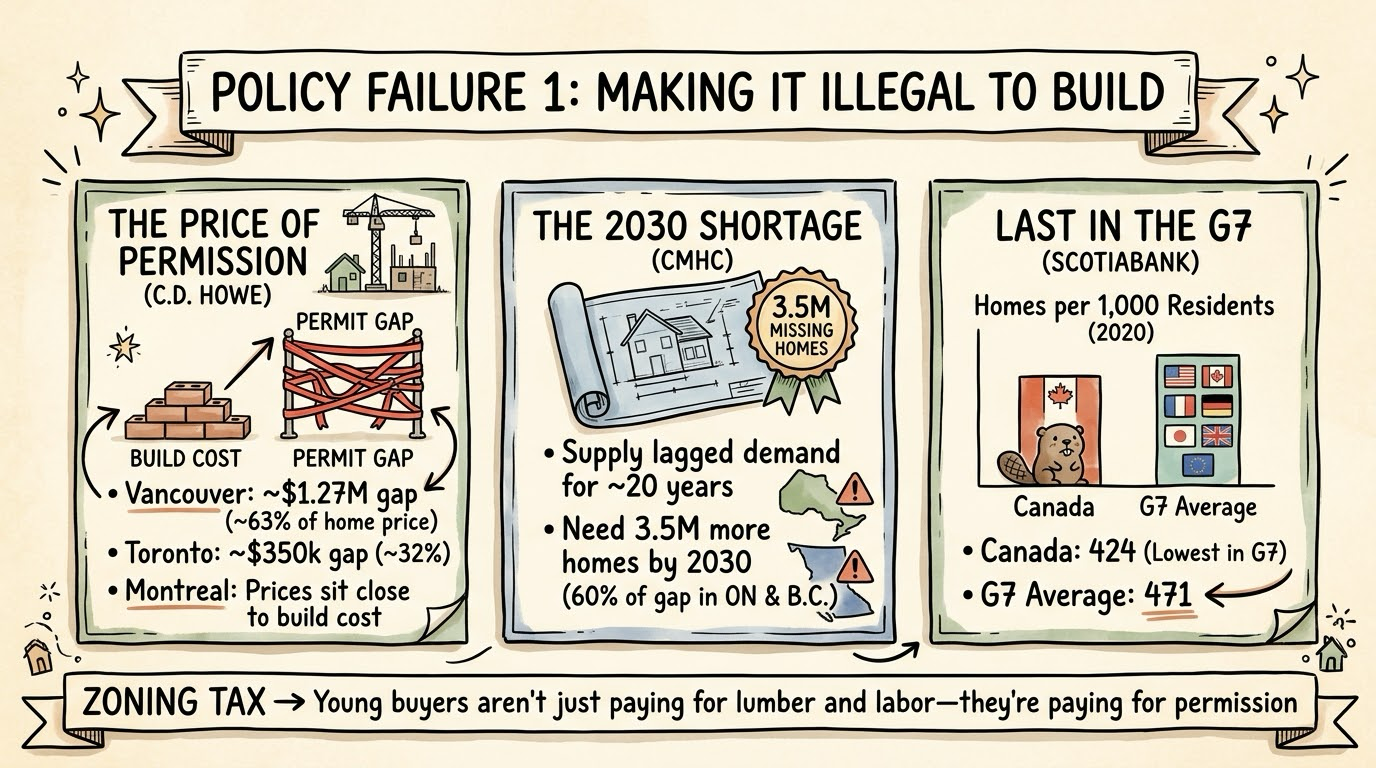
Policy Failure One: Making It Illegal To Build
The clearest evidence is the gap between what a home sells for and what it costs to build.
In a working market, those numbers should be close.
The C.D. Howe Institute estimated that gap at about $1.27 million per single-detached home in Vancouver, or around 63% of the price, over 2011 to 2021.
In Toronto, it was about $350,000, or roughly 32%.
In Montreal, prices sat close to construction costs.
The author attributes the gap to barriers like development charges, limited serviced land and restrictions on what can be built.
That gap is the price of permission, and young buyers pay it.
The shortage is the result.
CMHC says housing supply has failed to keep up with demand for about 20 years in some of Canada's largest cities, and estimates Canada needs 3.5 million more homes by 2030 than it's on track to build.
Ontario and B.C. account for about 60% of that gap.
Scotiabank found Canada had 424 homes per 1,000 residents in 2020, the lowest in the G7, against a G7 average of 471.
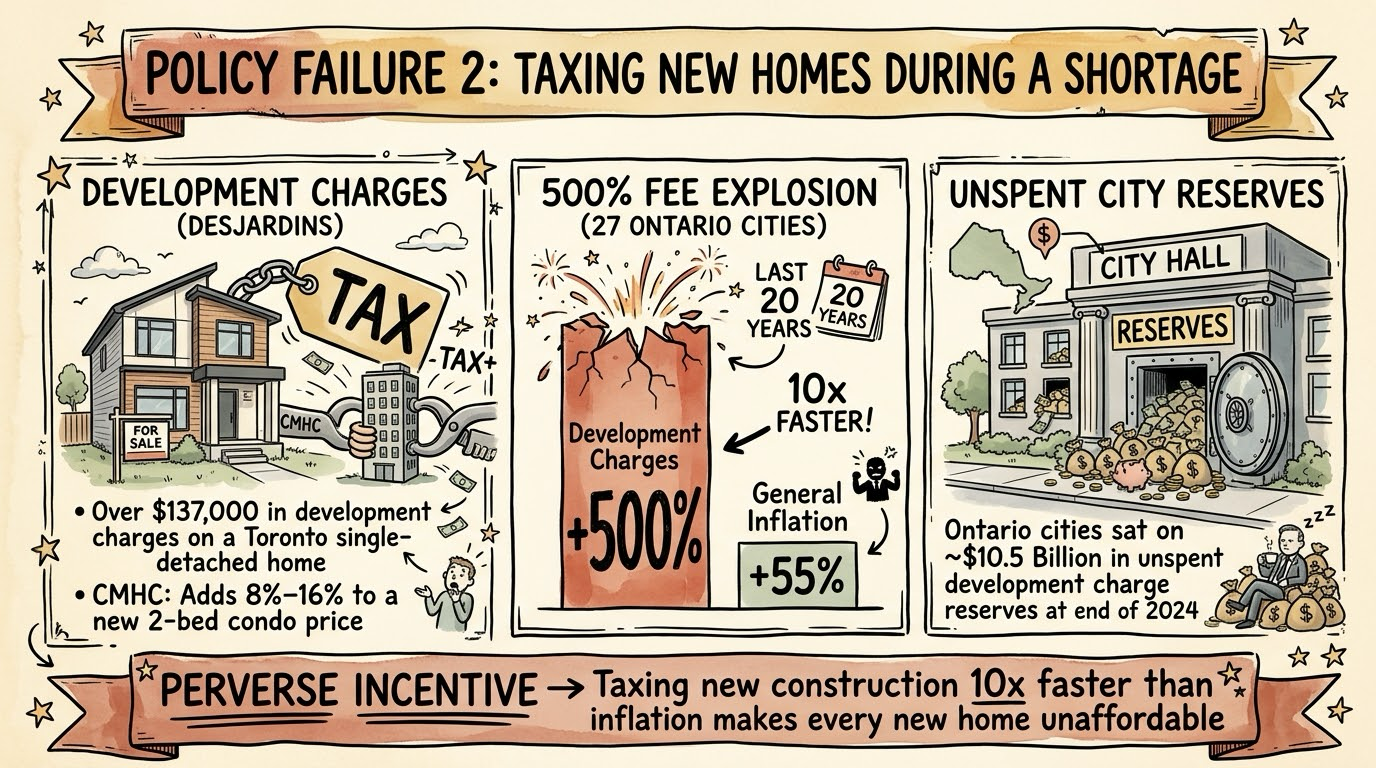
Policy Failure Two: Taxing New Homes
Cities fund new infrastructure by charging developers upfront, and buyers pay those fees in the price.
A Desjardins report from June puts development charges on a single-detached home in Toronto at over $137,000.
Across 27 Ontario municipalities, those charges rose about 500% over two decades.
General inflation rose about 55% over the same period.
CMHC estimates development charges add 8% to 16% to the price of a new two-bedroom condo.
Meanwhile, Ontario municipalities were sitting on about $10.5 billion in unspent development charge reserves at the end of 2024.
A tax on new housing during a housing shortage is hard to defend.
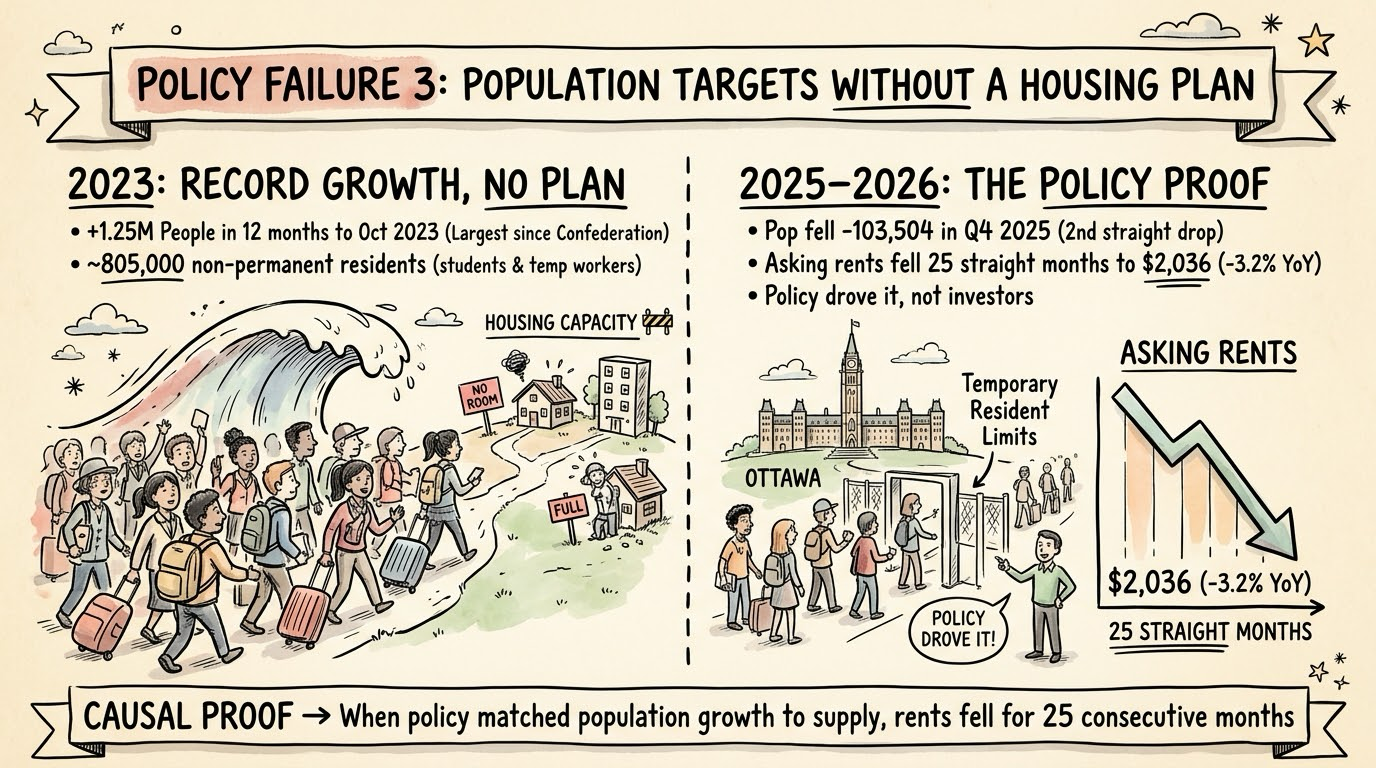
Policy Failure Three: Population Targets Without A Housing Plan
In the 12 months to October 1, 2023, Canada's population grew by 1.25 million people, the largest gain since Confederation.
About 805,000 of them were non-permanent residents, such as international students and temporary workers.
I'm pro-immigration, and this isn't an argument against newcomers.
It's an argument against setting population targets with no plan to house the people arriving.
The proof came when the policy changed.
Ottawa tightened temporary resident programs, and Canada's population fell by 103,504 people in the last quarter of 2025, the second straight quarterly decline.
National average asking rents have now fallen for 25 consecutive months, to $2,036 in October, down 3.2% from a year earlier.
RBC economists point to the population downturn and rising supply as the forces keeping apartment rents in check.
Investors didn't change their behaviour to cause that.
Government policy did.
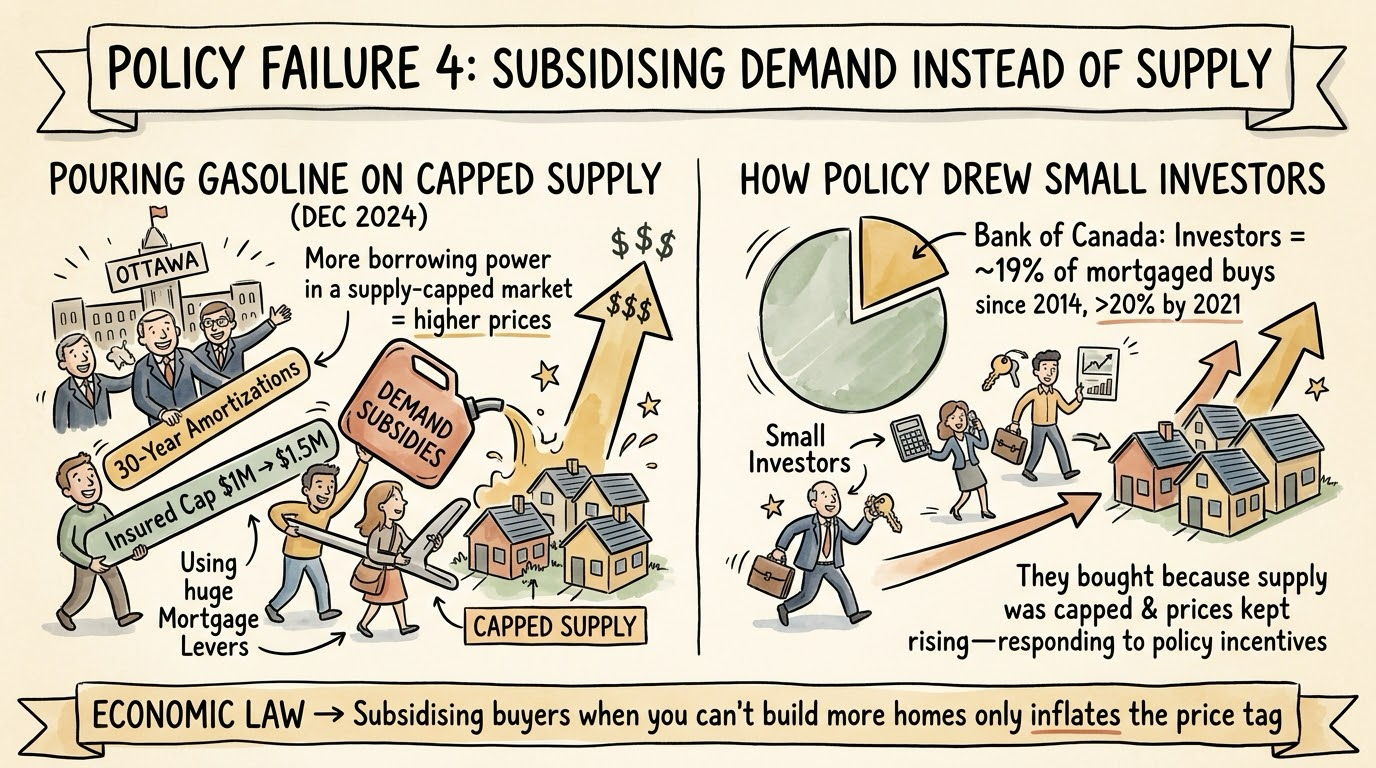
Policy Failure Four: Subsidising Demand Instead Of Supply
When prices rise, the political instinct is to help buyers borrow more.
In December 2024, Ottawa extended 30-year amortizations to all first-time buyers and all new builds, and raised the insured mortgage cap from $1 million to $1.5 million.
That makes monthly payments lower for the next buyer.
In a market where supply can't respond, I think more borrowing power mostly turns into higher prices.
The same logic applies to small investors.
The Bank of Canada found that investors made up about 19% of mortgaged home purchases since 2014, and just over a fifth by 2021.
They bought because prices kept rising, and prices kept rising because supply was capped.
They responded to incentives that policy created.
What Works Elsewhere
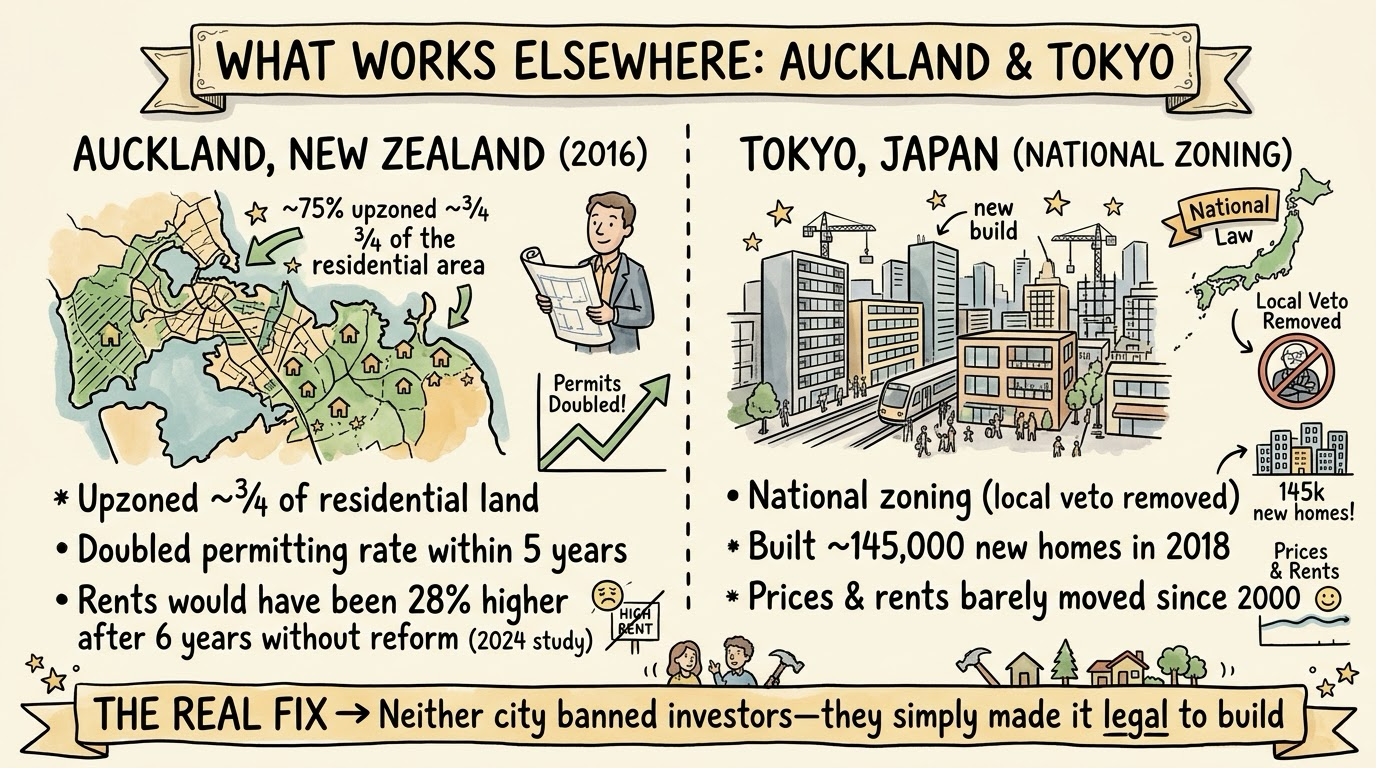
Auckland upzoned roughly three-quarters of its residential land in 2016.
Research from the University of Auckland found the reform roughly doubled the permitting rate within five years.
A 2024 study estimated rents would have been 28% higher six years after the reform if Auckland hadn't upzoned.
Tokyo is the other example.
Japan sets zoning nationally, and local governments have almost no power over development.
In 2018, Tokyo Prefecture built about 145,000 new homes.
Its prices and rents have barely moved since 2000.
Neither city relied on banning investors to get there.
They made it legal to build.
The Other Side Of The Argument
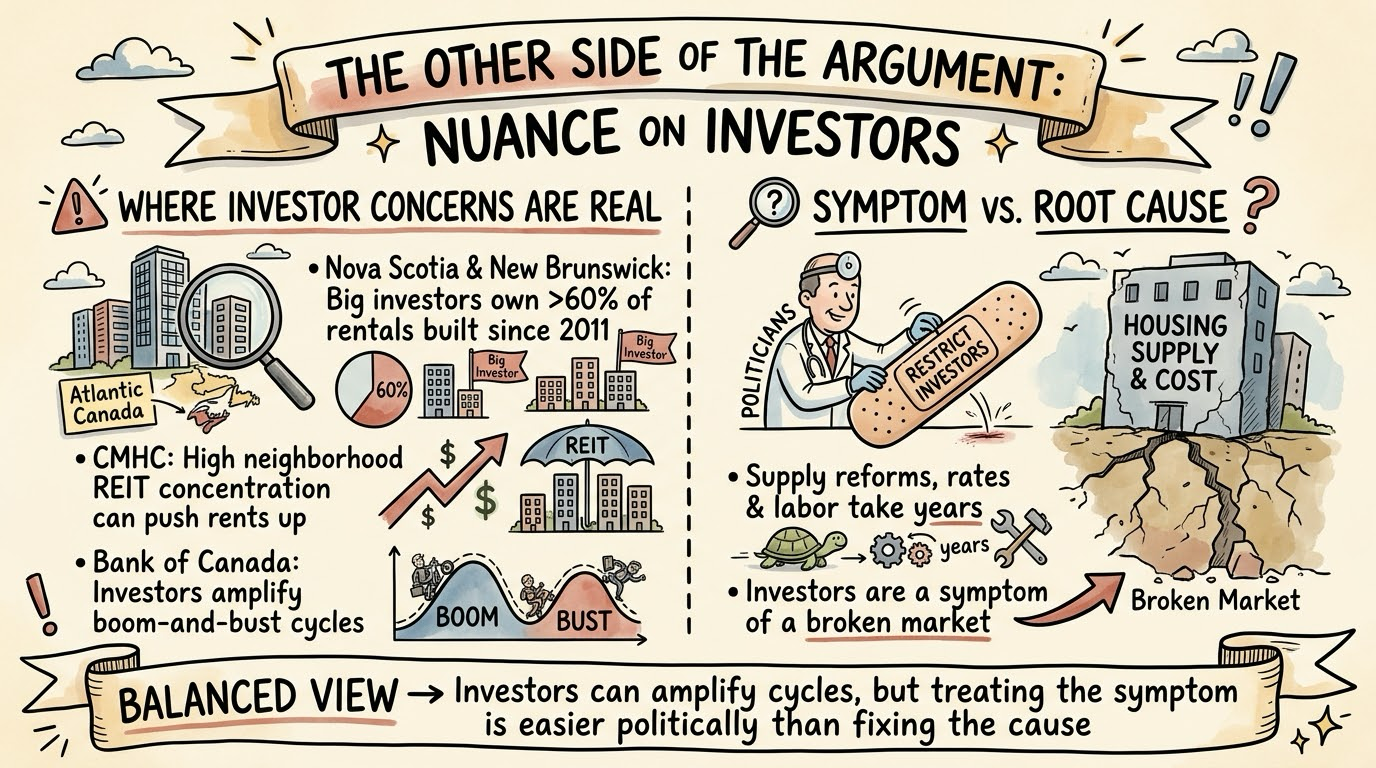
The case against investors isn't empty.
In Nova Scotia and New Brunswick, institutional investors owned more than 60% of rentals built since 2011.
CMHC has cautioned that REITs owning a large share of buildings in one neighbourhood could have room to push rents higher.
The Bank of Canada has warned that investors can amplify boom and bust cycles.
Supply reforms also take years, and interest rates, construction costs and labour shortages all affect how quickly homes get built.
I don't think investors are harmless.
I think they're a symptom of a market that governments broke, and treating the symptom has been easier politically than fixing the cause.
Conclusion: A Crisis Built By Policy
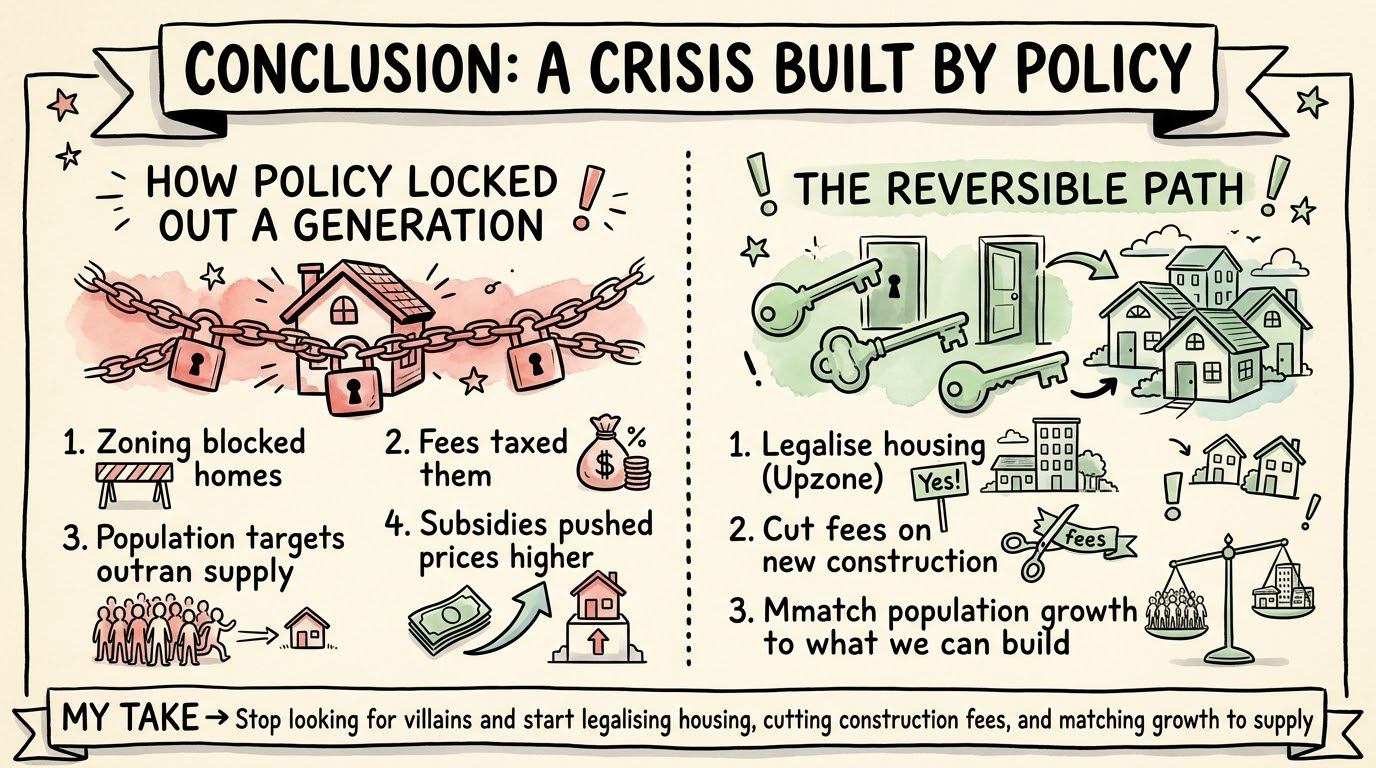
Young people didn't lose access to housing because markets failed.
They lost it because zoning blocked new homes, fees taxed them, population targets outran them and subsidies pushed prices higher.
Every one of those is a policy choice.
The good news is that policy choices can be reversed, and the rent decline of the last two years shows how quickly markets respond when policy changes.
My Take: If governments want young people to own homes again, they should stop looking for villains and start legalising housing, cutting fees on new construction and matching population growth to what the country can actually build.
Sources
Pages I opened for the facts in this post:
- CP24: How have real estate investors impacted rental and home prices in Canada (StatCan study)
- Benefits and Pensions Monitor: Big investors own no more than 0.4% of Canadian houses
- Global News: Canada's homeownership rate falls (2021 census)
- Canadian Mortgage Professional: Canada's foreign buyer ban is expiring
- C.D. Howe Institute: Buyers Beware
- CMHC: Housing shortages in Canada, updating how much we need by 2030
- Daily Hive: Canada has the lowest number of homes per 1,000 residents in the G7
- Desjardins: Development fees in Canada (June 2026)
- BNN Bloomberg: Population growth in Canada hits 3.2%
- Global News: Canadian population decreases
- CTV News: Average asking rents fall 3.2% in October
- RBC: Canada's population downturn, rising supply to keep apartment rents in check
- Department of Finance: Mortgage reforms come into force
- Bank of Canada: Staff Analytical Note 2022-1 on investors
- Cityscape (HUD): Auckland upzoning research review
- University of Auckland: Can zoning reform reduce housing costs?
- Sightline: Yes, other countries do housing better (Japan)