The Infinite Dataset: How Google Incentivized the World and Pivoted to Synthetic Vision
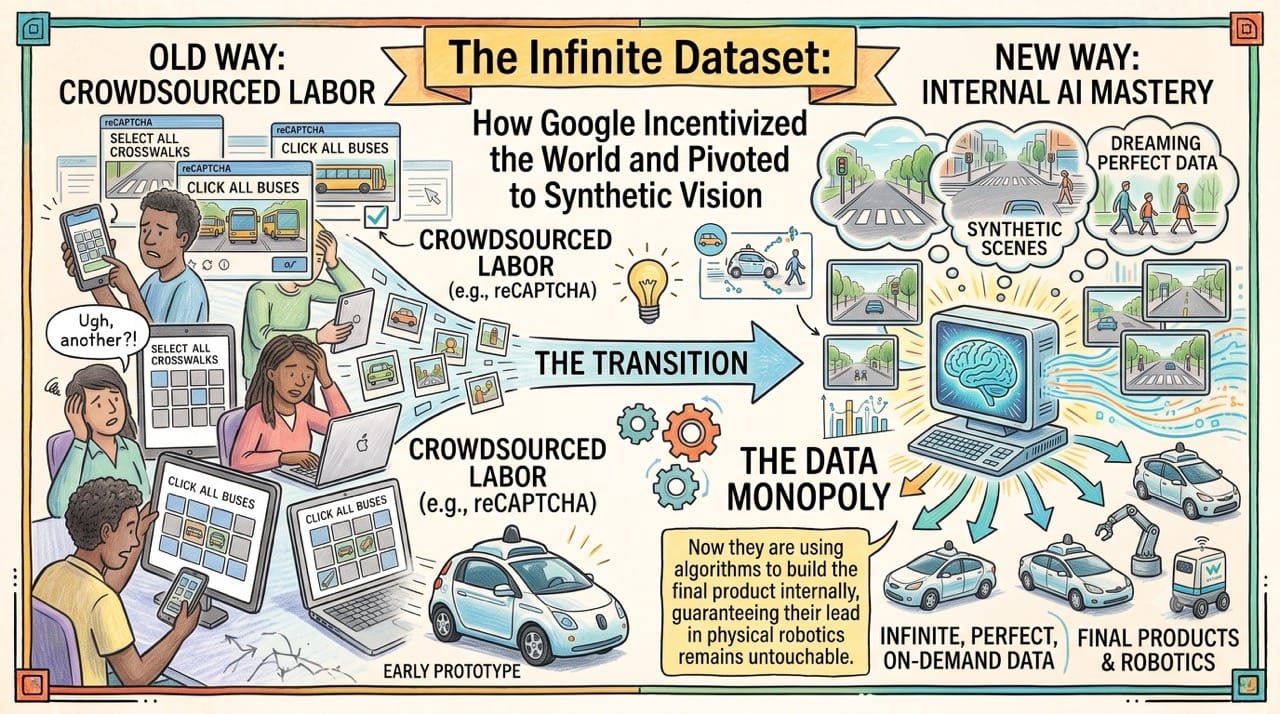
We assume clicking on pictures of stoplights was just a security measure to keep bots out of our accounts. In reality Google was crowdsourcing millions of hours of free human labor to build the most advanced autonomous driving network on earth.
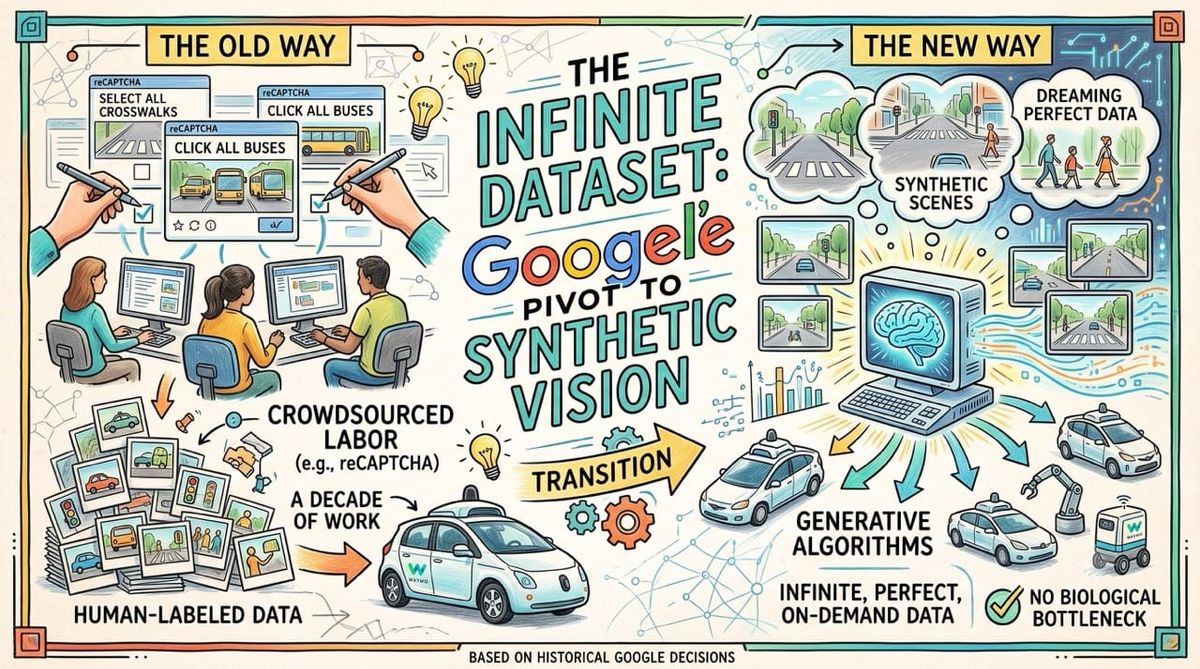
We spent a decade manually clicking crosswalks to train Waymo. Now generative algorithms are completely replacing human labelers by dreaming up perfect training data.
Inspiration: Analyzing the historical brilliance of Google using reCAPTCHA to crowdsource autonomous vehicle training data. Realizing their current pivot to using generative algorithms to train machine vision completely removes the biological bottleneck from physical robotics.
The Invisible Workforce
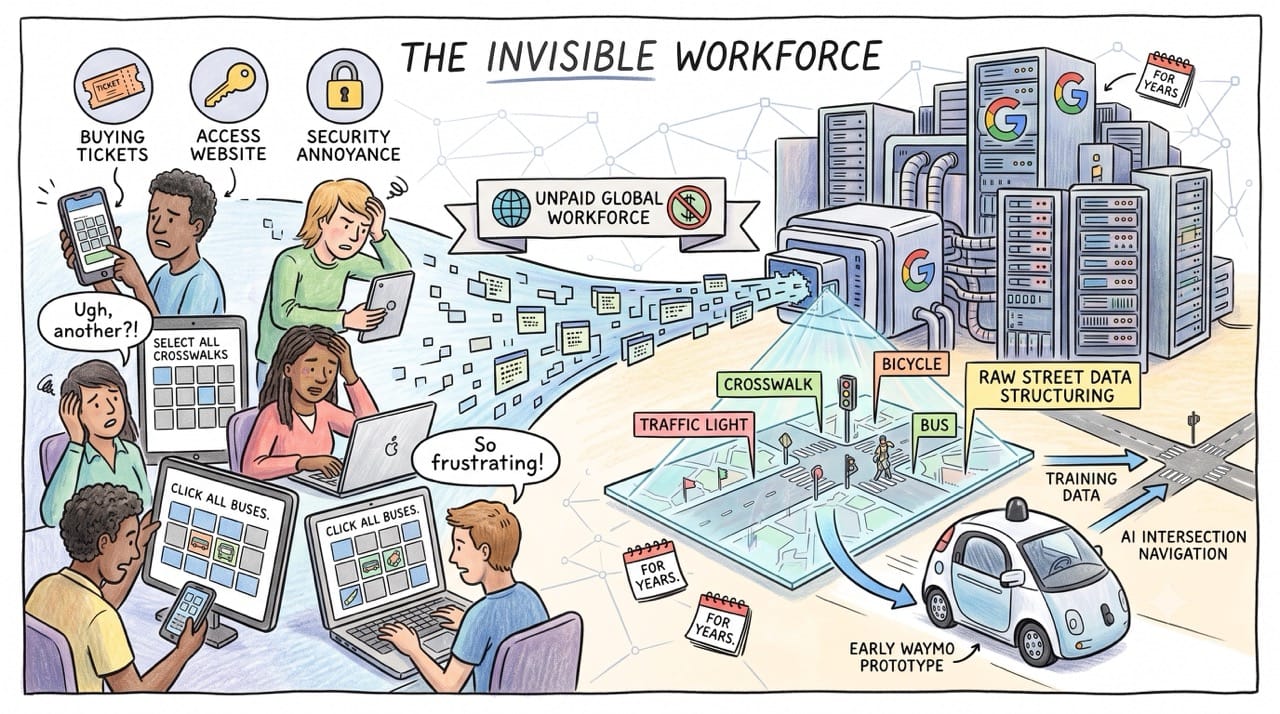
For years the entire internet population complained about having to select tiny squares containing a traffic light or a bicycle.
We viewed this as a highly frustrating security annoyance required just to access a website or buy concert tickets.
We were actually serving as an unpaid global workforce manually labeling raw street data for Google.
Every single time a user correctly identified a crosswalk they were actively helping an early Waymo prototype understand how to navigate a physical intersection.
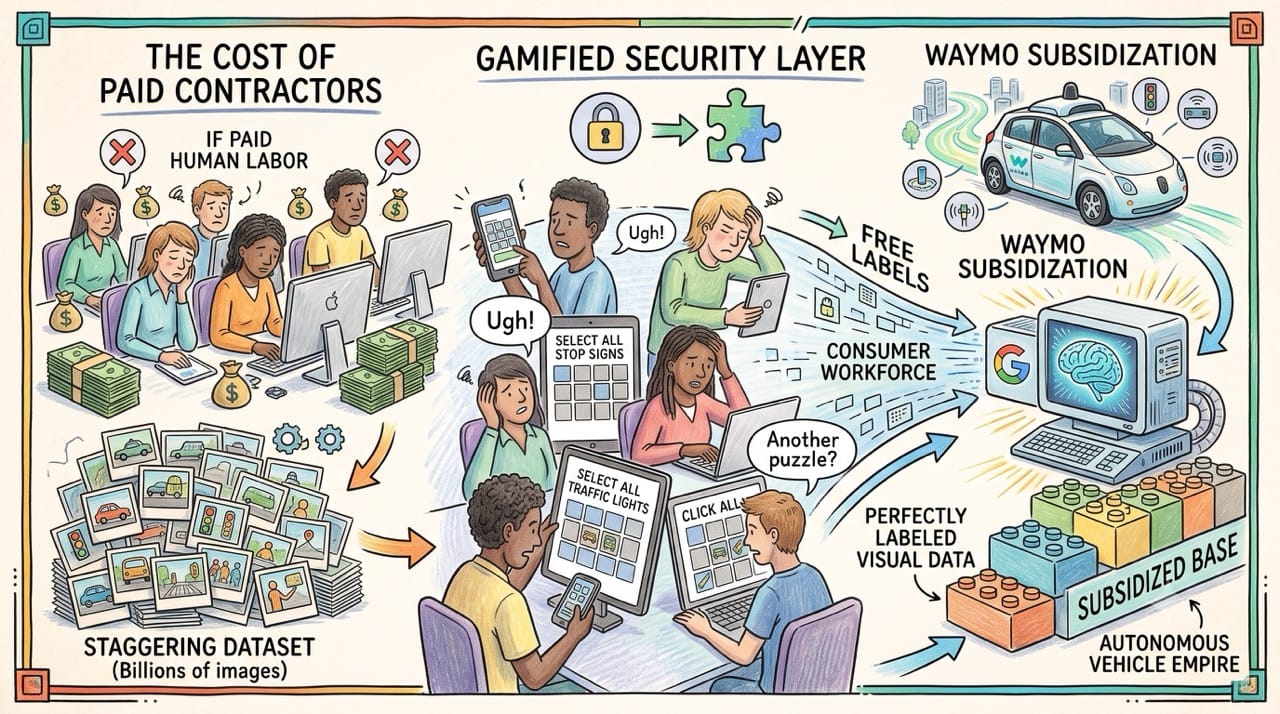
The Waymo Subsidization
Training a machine vision model requires a staggering amount of perfectly labeled visual information.
If Google had to pay human contractors to manually identify every single stop sign in their database it would have cost them billions of dollars in raw labor.
They brilliantly bypassed this heavy capital expenditure by gamifying the security layer of the internet.
They forced everyday consumers to do the tedious heavy lifting for free and subsidized the foundation of their autonomous vehicle empire.
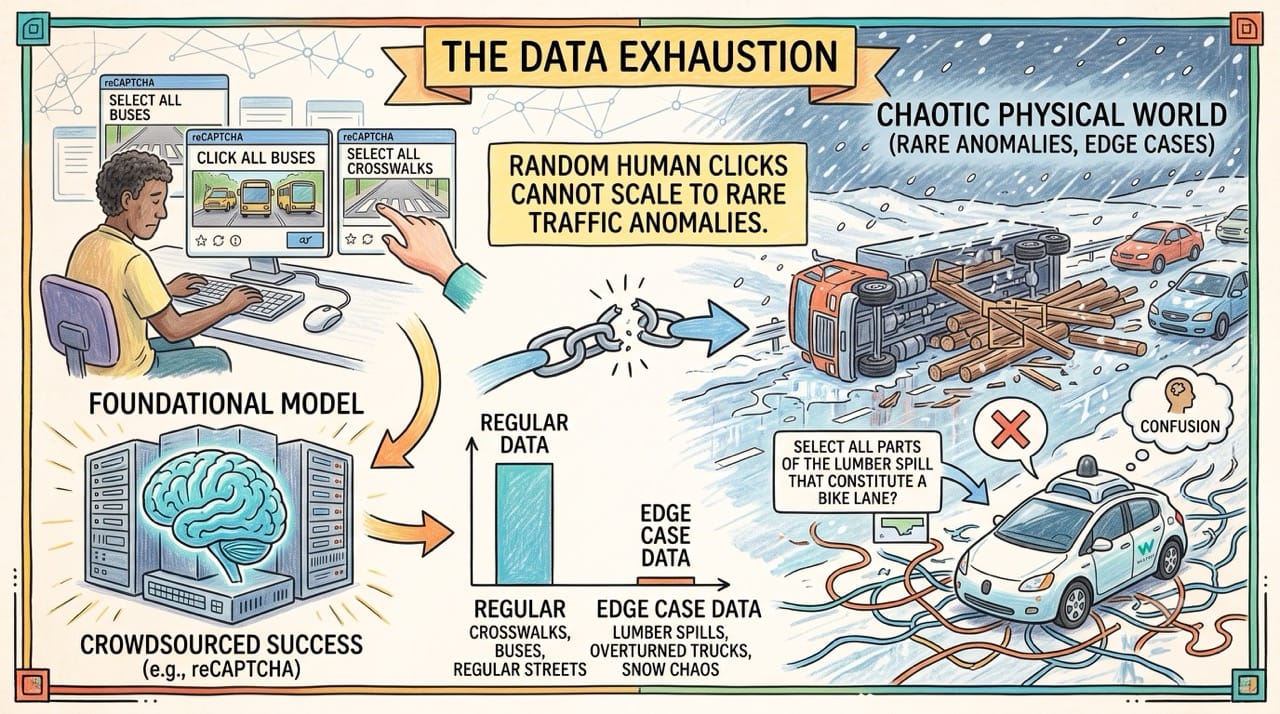
The Data Exhaustion
This crowdsourced strategy successfully built the foundational models for Waymo but the physical world is incredibly chaotic.
An autonomous vehicle needs to know exactly how to react to an overturned semi truck spilling lumber across a snowy highway.
The problem is that these highly specific edge cases happen very rarely in real life.
You cannot rely on a random human clicking a security prompt to properly label a once in a decade traffic anomaly.
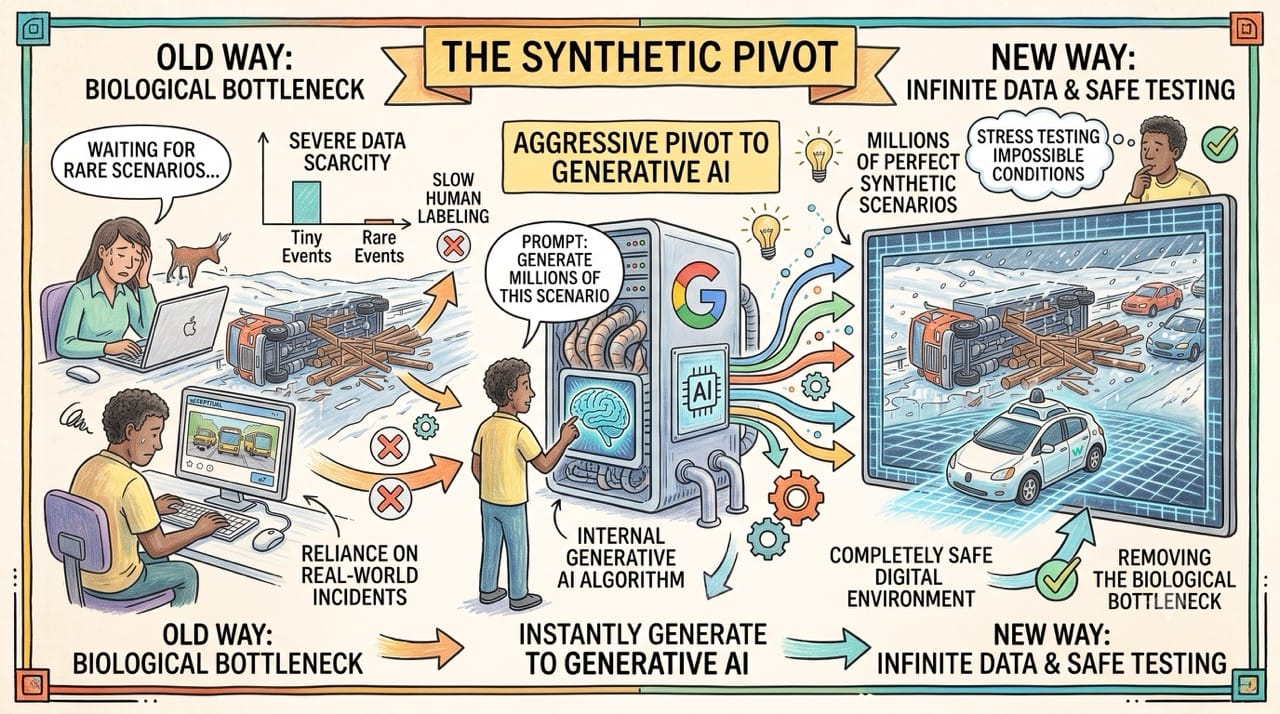
The Synthetic Pivot
To solve this severe data scarcity Google is aggressively pivoting toward generative artificial intelligence.
They no longer need to wait for a specific accident to occur in the real world and then hope a human properly identifies the footage.
They can simply prompt an internal algorithm to instantly generate millions of photorealistic images of that exact chaotic scenario.
This allows their engineers to actively stress test the autonomous driving software against impossible conditions in a completely safe digital environment.
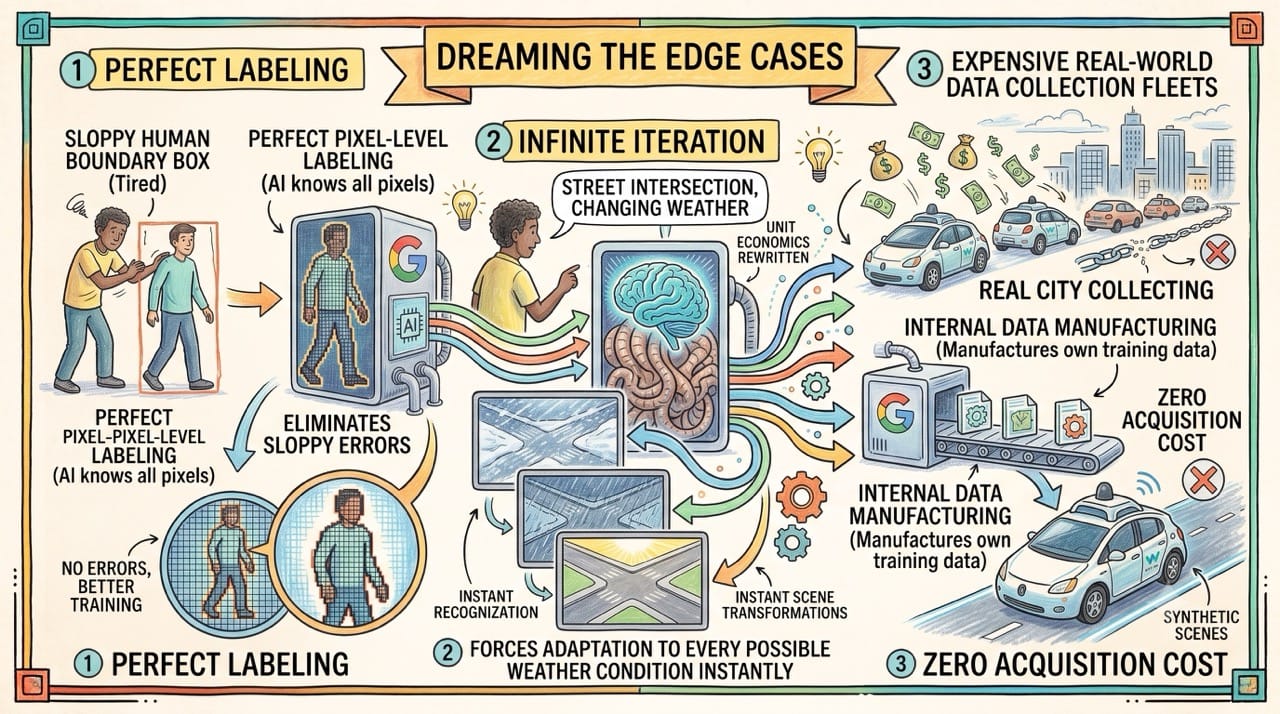
Dreaming the Edge Cases
This synthetic generation completely rewrites the unit economics of training physical robotics.
Using generative models to create training data provides three distinct strategic advantages.
- Perfect Labeling: When a generative model creates an image of a pedestrian it already knows exactly which pixels belong to the human. This completely eliminates the sloppy errors that happen when tired human contractors manually draw boundary boxes.
- Infinite Iteration: Engineers can prompt the system to generate the exact same intersection during a blizzard, in the pouring rain, or under blinding sunlight. This forces the machine vision model to adapt to every possible weather condition instantly.
- Zero Acquisition Cost: The company manufactures its own proprietary training data internally instead of relying on expensive real world data collection fleets driving around physical cities.
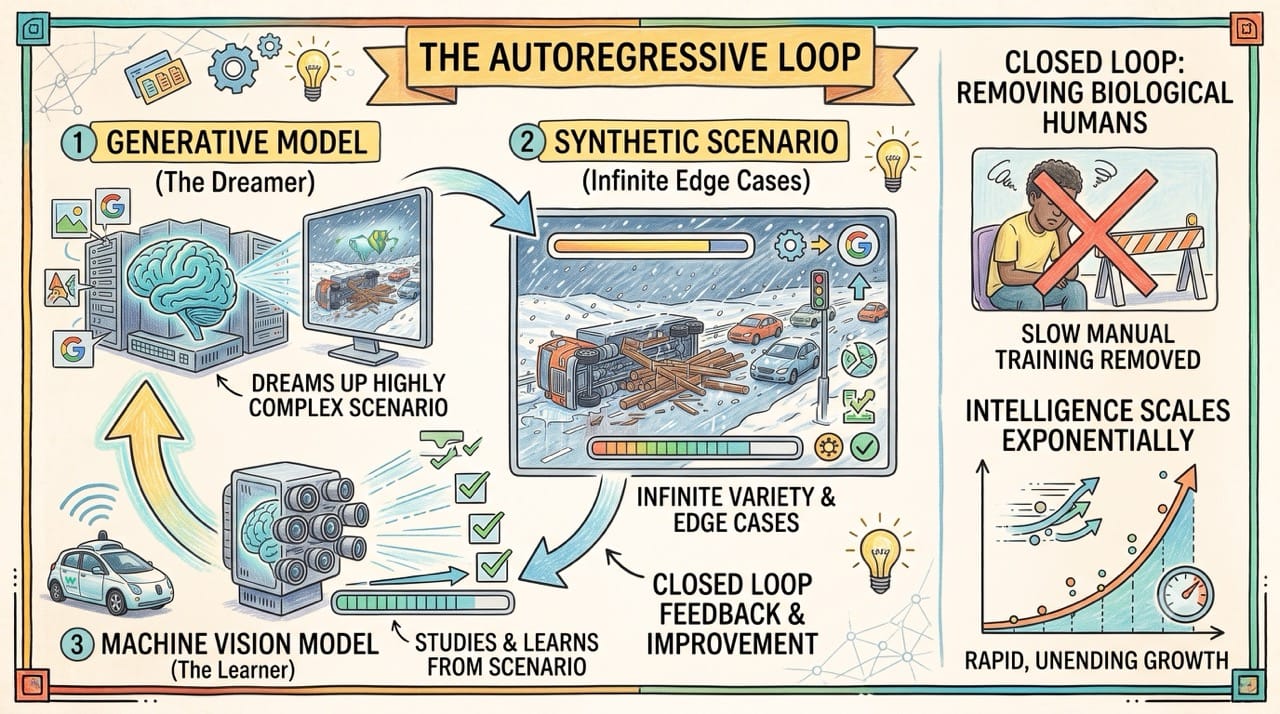
The Autoregressive Loop
We are officially entering an era where software programs are entirely responsible for educating other software programs.
The generative model dreams up a highly complex driving scenario and the machine vision model studies it to improve its own real world reaction time.
This closed loop system completely removes slow biological humans from the training pipeline and allows the intelligence to scale exponentially.
Conclusion: The Data Monopoly
Google successfully tricked the entire internet into building their first autonomous vehicle prototype for free.
Now they are using algorithms to build the final product internally, guaranteeing their lead in physical robotics remains untouchable.