Lilly Passes Berkshire, Wait For Sleep Drugs
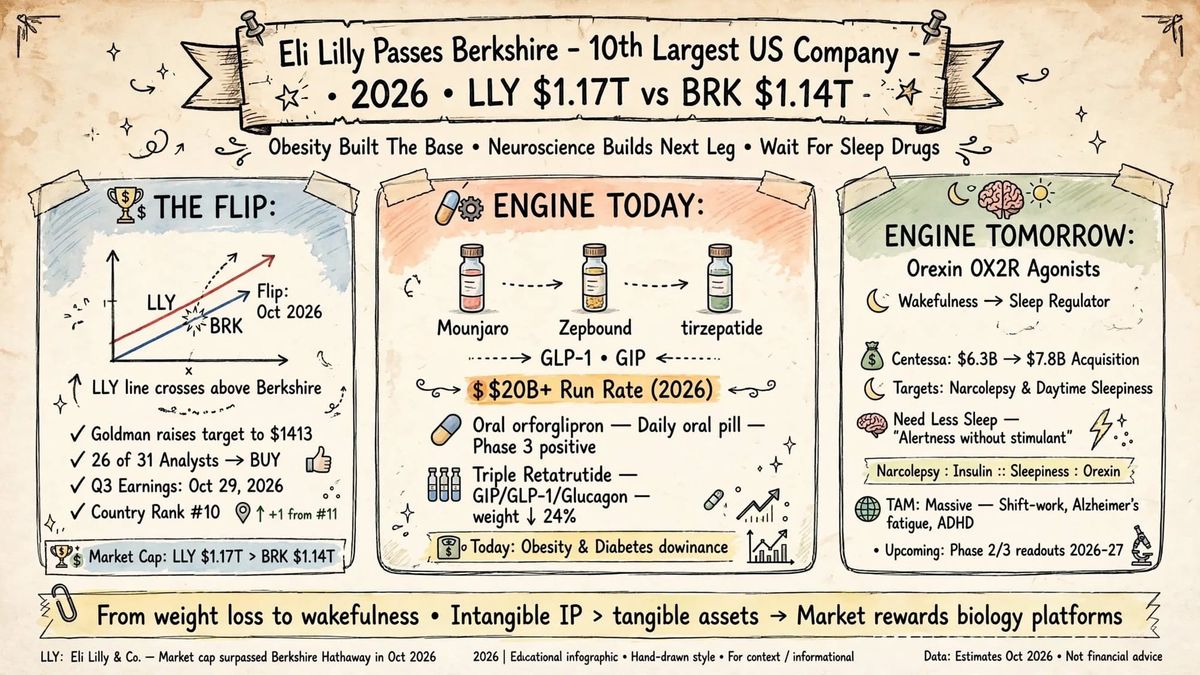
LLY just became the 10th largest US company. Obesity built the base. Neuroscience, and drugs that reduce the need for sleep, may build the next leg.
1. The Flip
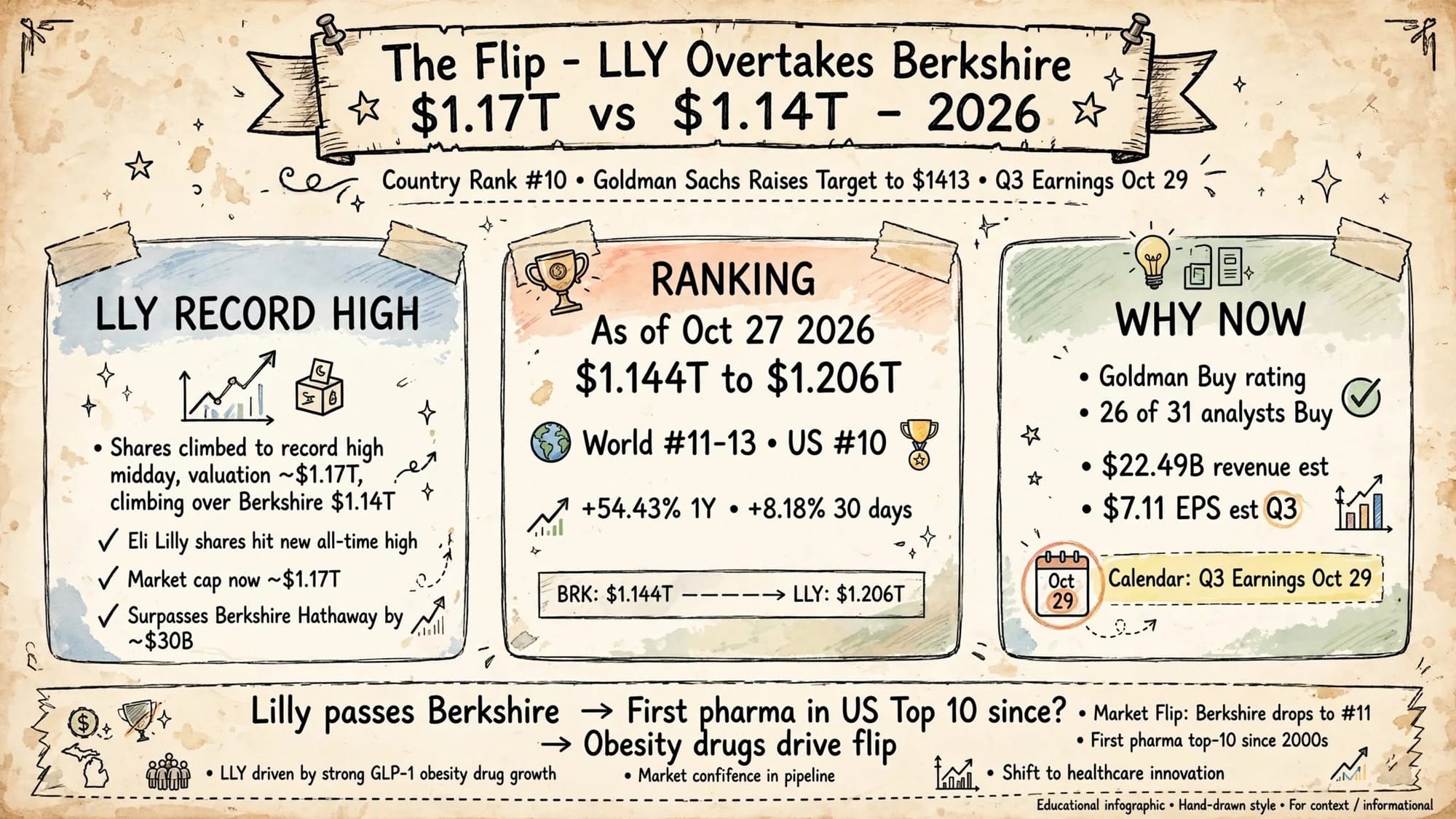
Eli Lilly shares climbed to a record high in midday trade, pushing its market capitalization above Berkshire Hathaway's after Goldman Sachs raised its price target ahead of Q3 earnings.
The company's valuation rose to approximately $1.17 trillion, climbing over Berkshire's $1.14 trillion.
As of October 2026, Eli Lilly has a market cap of $1.144 trillion USD, which makes it the world's 13th most valuable company by one dataset.
Other trackers show $1.14 trillion as of October 27, 2026, and $1.206 trillion as of Tuesday, October 27, 2026, making it the 11th largest globally and 10th largest in the US, up 54.43 percent over 12 months and 8.18 percent over 30 days.
Goldman raised its target to $1,413 from $1,371 and kept a Buy rating. Twenty six of 31 analysts now rate it Buy or Strong Buy.
Q3 estimates point to $22.49 billion revenue and $7.11 EPS, reporting October 29.
2. Why Obesity Is Still The Engine
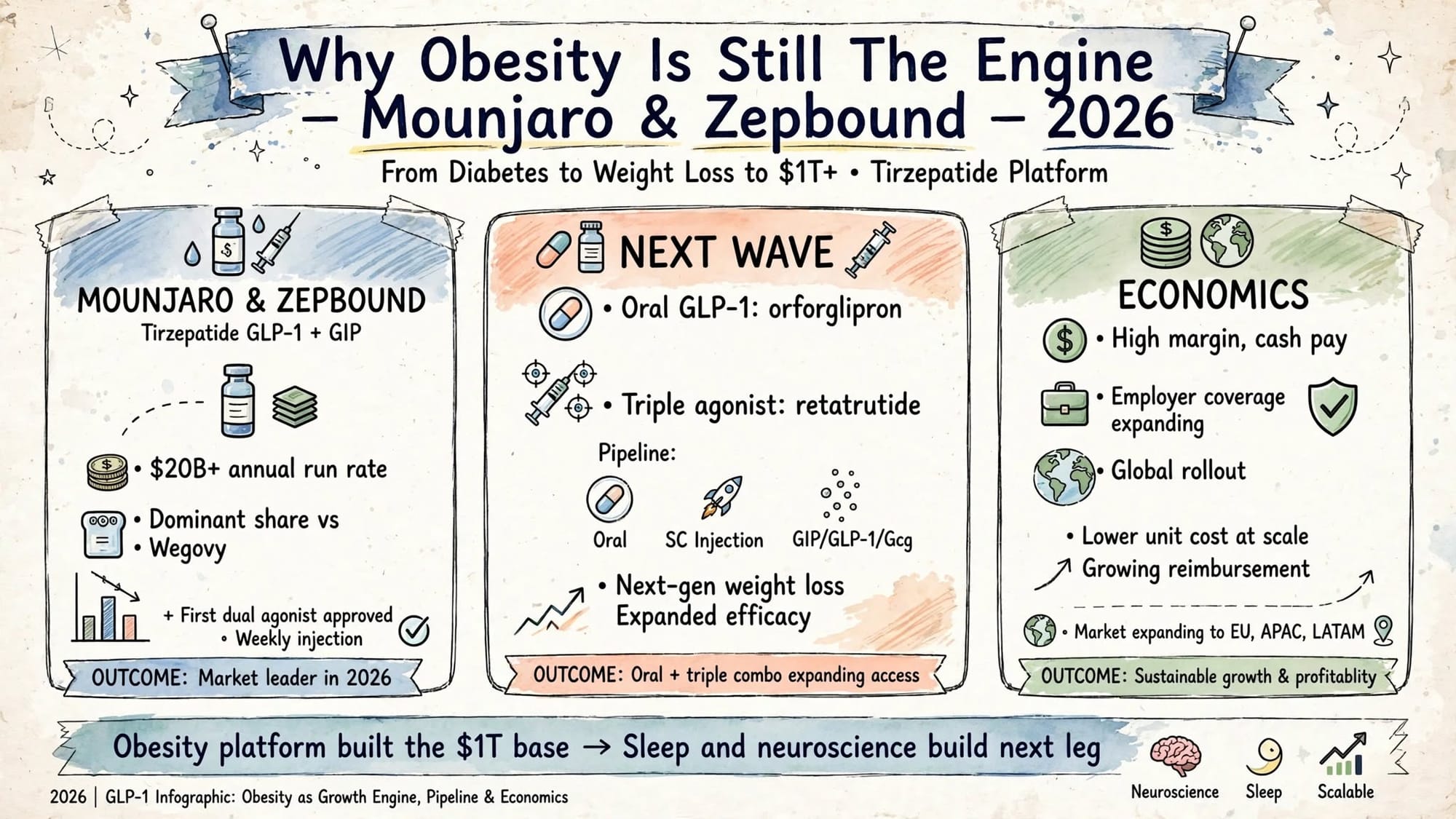
The base that created the flip is tirzepatide. Mounjaro for diabetes and Zepbound for weight loss are a dual agonist, GLP-1 plus GIP.
The platform now does more than $20 billion annual run rate and leads against Wegovy.
Next wave is already filed. Oral GLP-1 orforglipron aims at scale and convenience.
Triple agonist retatrutide, GIP plus GLP-1 plus glucagon, aims at higher efficacy. High margin, cash pay plus expanding employer coverage, plus global rollout keeps the economics intact.
3. Value vs Growth
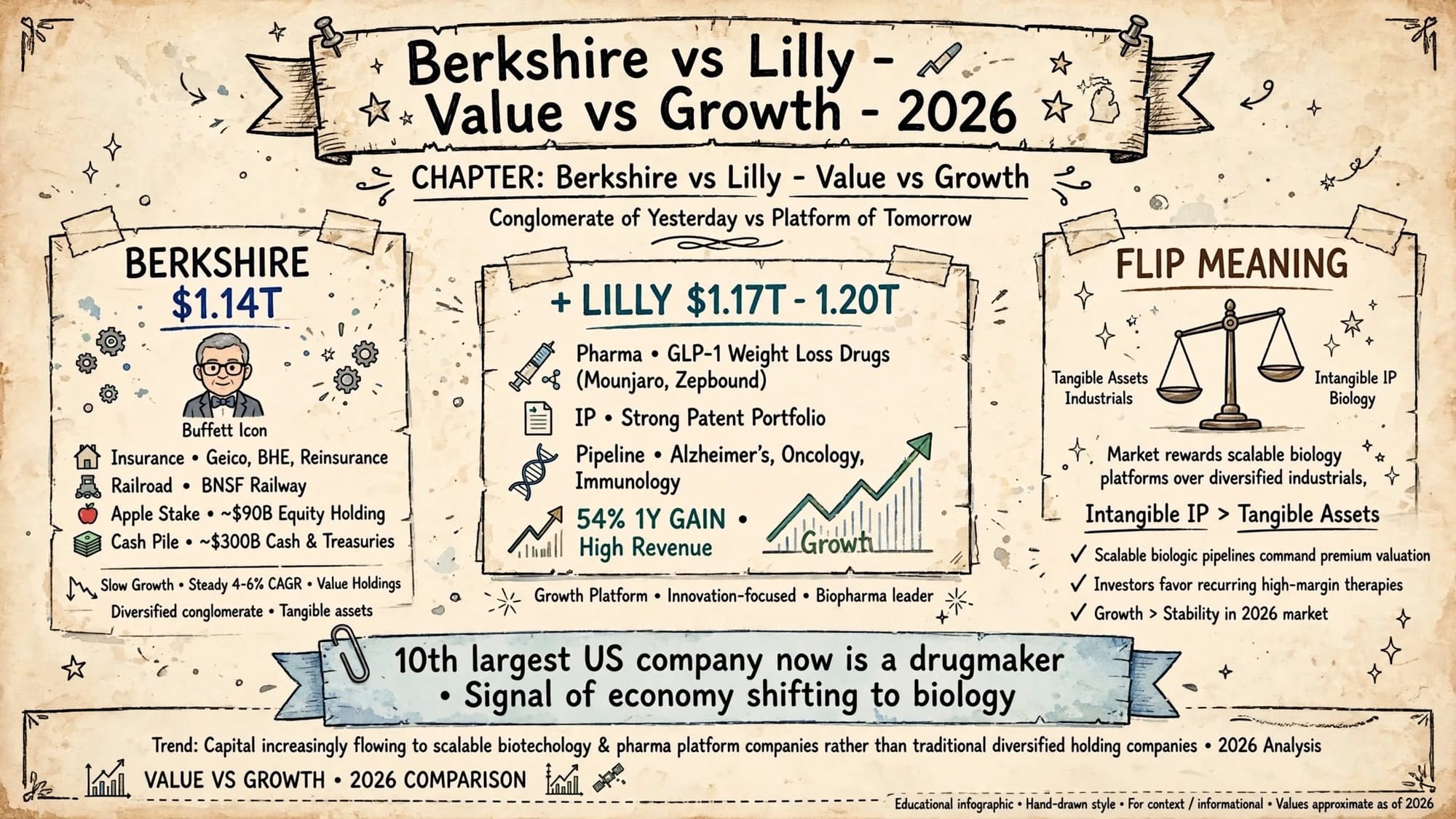
Berkshire at $1.14 trillion is insurance, railroad, Apple stake, cash pile, slow and steady. Lilly at $1.17 trillion to $1.20 trillion is patent, data, neuroscience platform, fast.
The market is rewarding intangible IP over tangible assets.
A drugmaker in the US Top 10 signals an economy shifting from factories and plants to biology platforms.
4. The Sleep Frontier
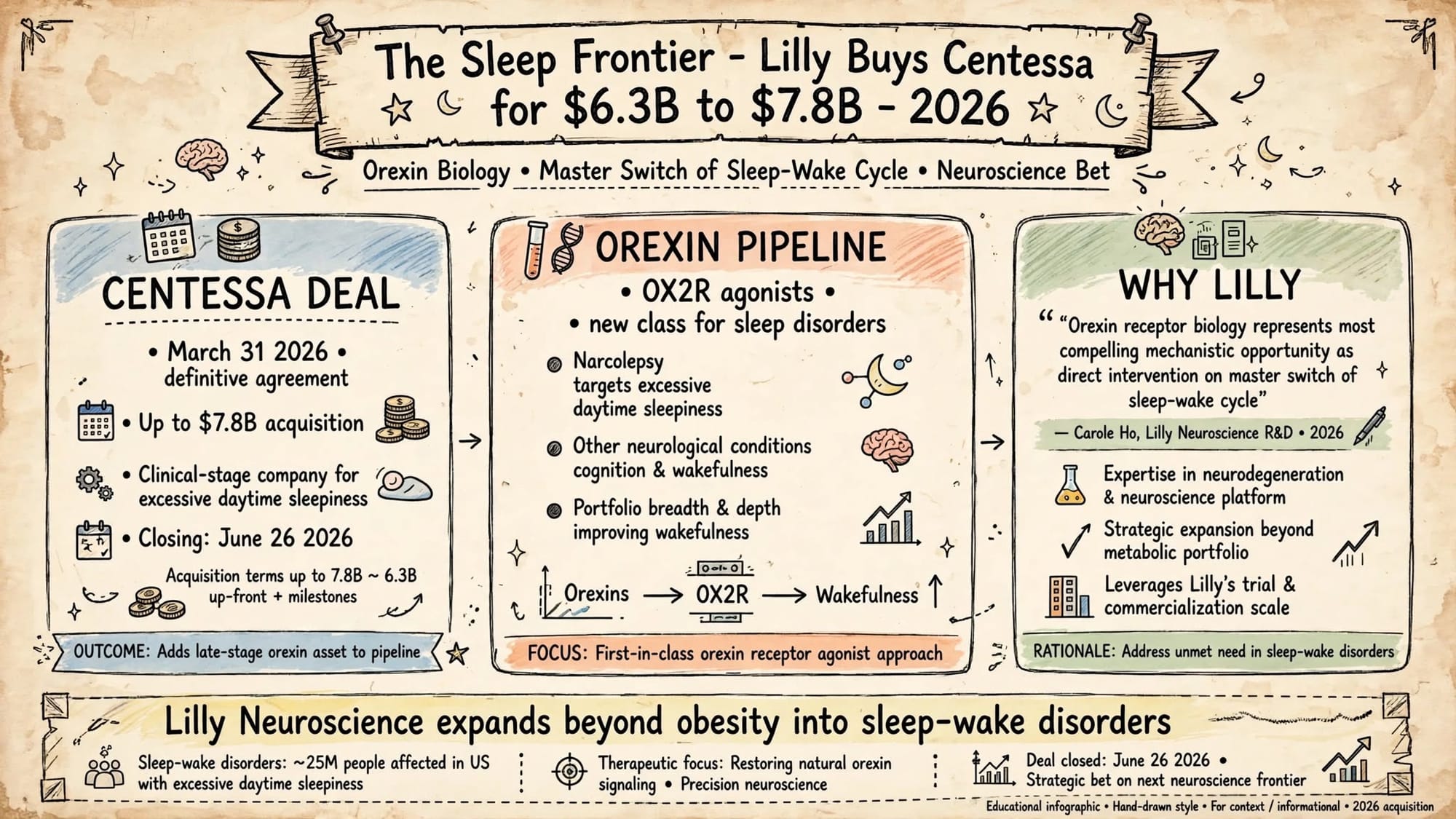
Lilly agreed to buy Centessa Pharmaceuticals on March 31, 2026 for up to $7.8 billion, with reports at $6.3 billion upfront plus milestones.
Centessa is a clinical stage company developing a new class of medicines for excessive daytime sleepiness.
Centessa is advancing a pipeline of orexin receptor 2, OX2R, agonists designed to address the neurobiological system critical to sleep wake cycle.
Carole Ho, executive vice president and president of Lilly Neuroscience, said orexin receptor biology represents one of the most compelling mechanistic opportunities in neuroscience as a direct intervention on the master switch of the sleep wake cycle.
The deal closed June 26, 2026, adding late stage orexin assets to Lilly's pipeline.
5. Need Less Sleep Drugs
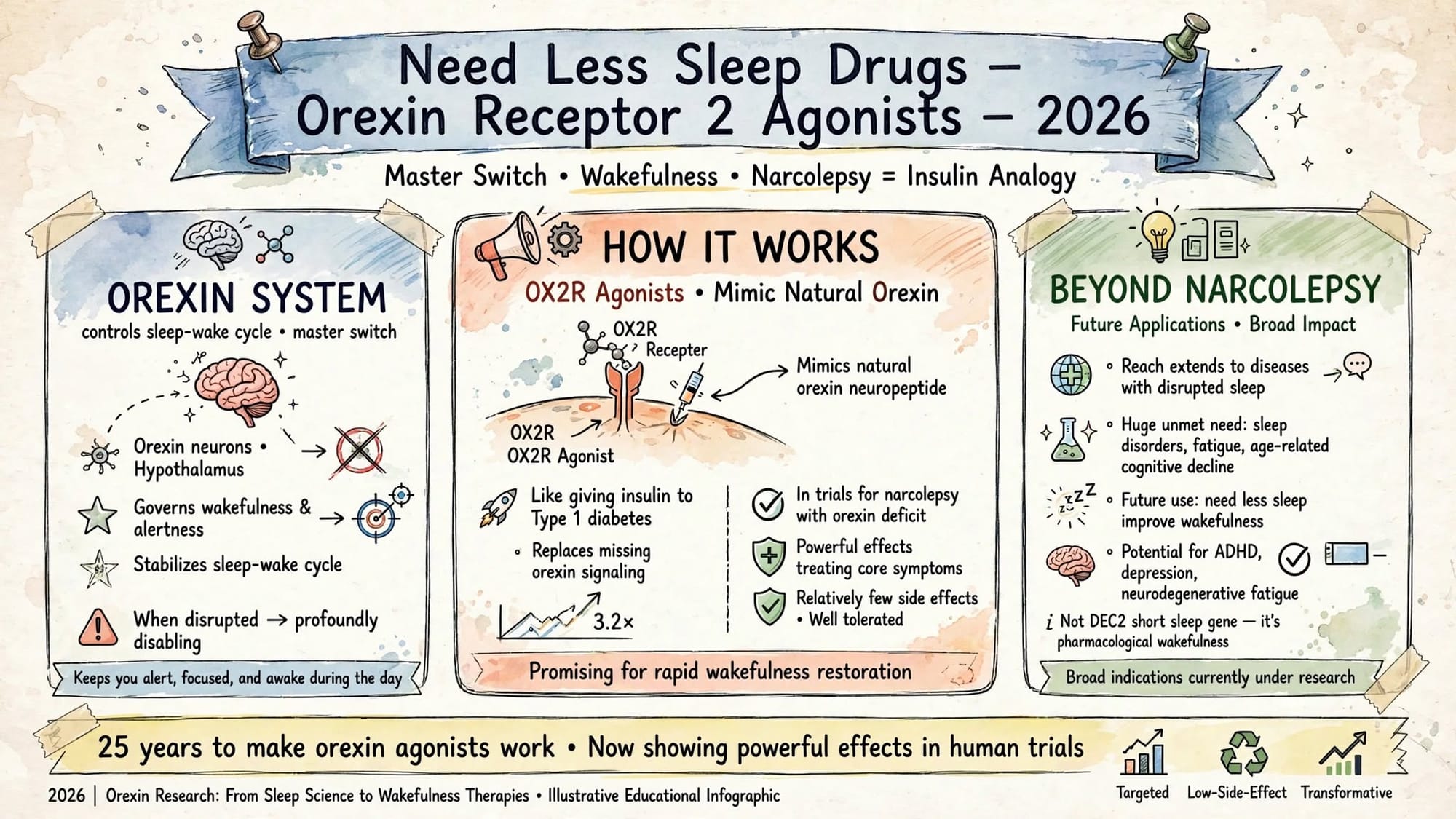
Orexin receptor 2 agonists are investigational medicines targeting the orexin system that regulates wakefulness and sleep.
The orexin system plays a fundamental role in human brain health, governing wakefulness, alertness and stability of sleep in ways that, when disrupted, can be profoundly disabling.
How it works: OX2R agonists mimic the natural orexin neuropeptide.
In patients whose narcolepsy is due to orexin deficit, experimental medicines have shown powerful effects treating a range of symptoms, so far with relatively few side effects.
The analogy used in trials is akin to giving insulin to type 1 diabetes.
This is not the DEC2 short sleep gene that lets natural short sleepers thrive on 4 to 6 hours. It is pharmacological wakefulness.
If it works beyond narcolepsy, indications expand to idiopathic hypersomnia, shift work disorder, depression related sleep disruption, and age related cognitive fatigue.
It took more than 25 years to make orexin agonists workable. Human trials now show rapid restoration of wakefulness.
6. What Comes Next
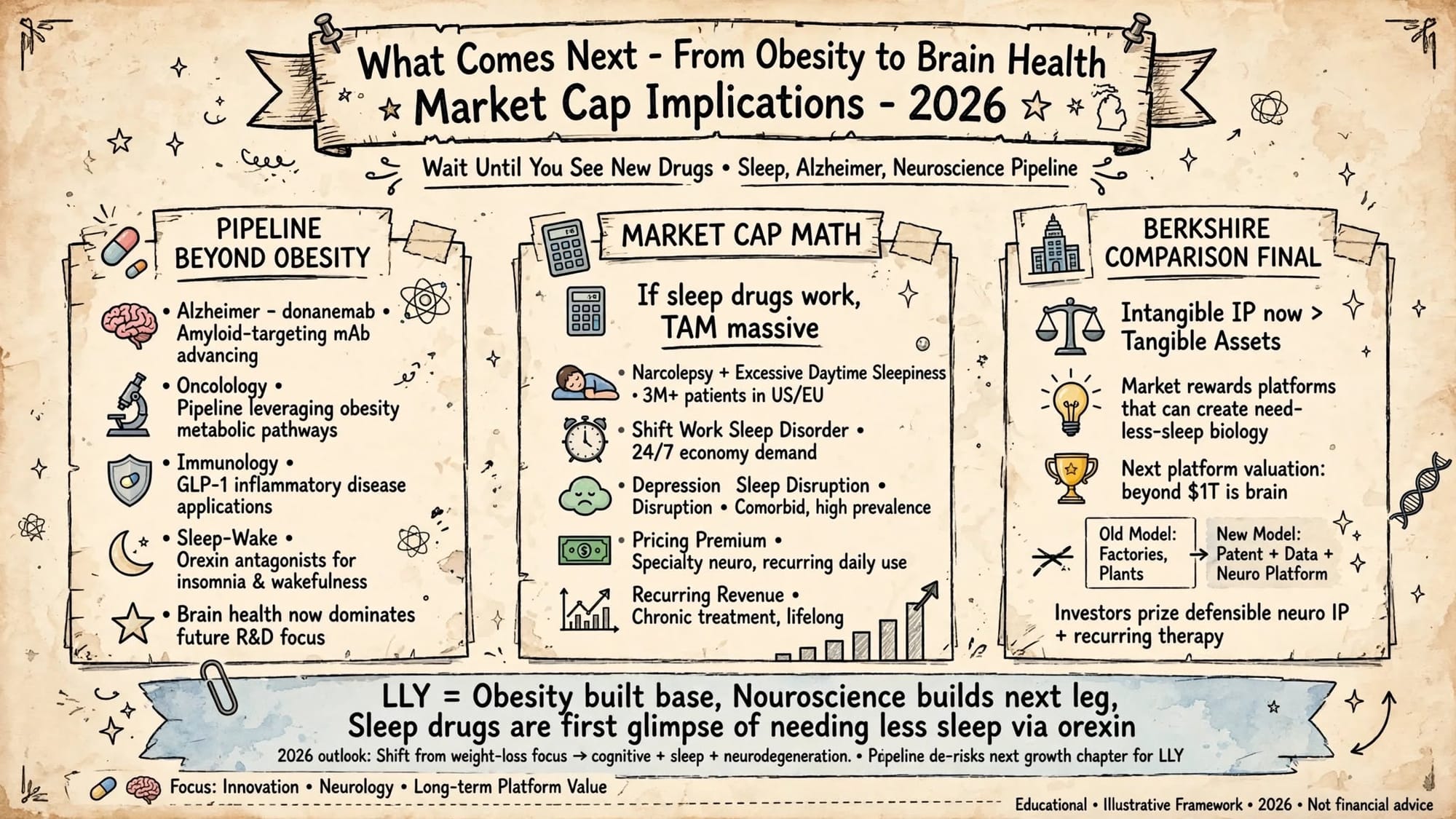
Pipeline beyond obesity already includes Alzheimer, donanemab, oncology leveraging metabolic pathways, immunology where GLP-1 shows anti inflammatory signals, and sleep wake with orexin.
If sleep drugs work, total addressable market is massive. Narcolepsy plus excessive daytime sleepiness is 3 million plus patients in US and EU.
Add shift work disorder for a 24/7 economy, depression related sleep disruption, high prevalence and chronic daily use.
Specialty neuro pricing plus lifelong recurring revenue changes the math.
LLY equals obesity built the base, neuroscience builds next leg.
The flip past Berkshire is not the end. Sleep drugs are the first glimpse of needing less sleep via orexin, and the market is starting to price the brain as the next platform.