Saudi Arabia Should Have Worked On Space Project Instead Of The Line
Saudi Arabia burned $50 billion on a mirrored wall in the desert. The same $50 billion could have bought the orbital landlord position for AI, defense, and the $1.8 trillion space economy.
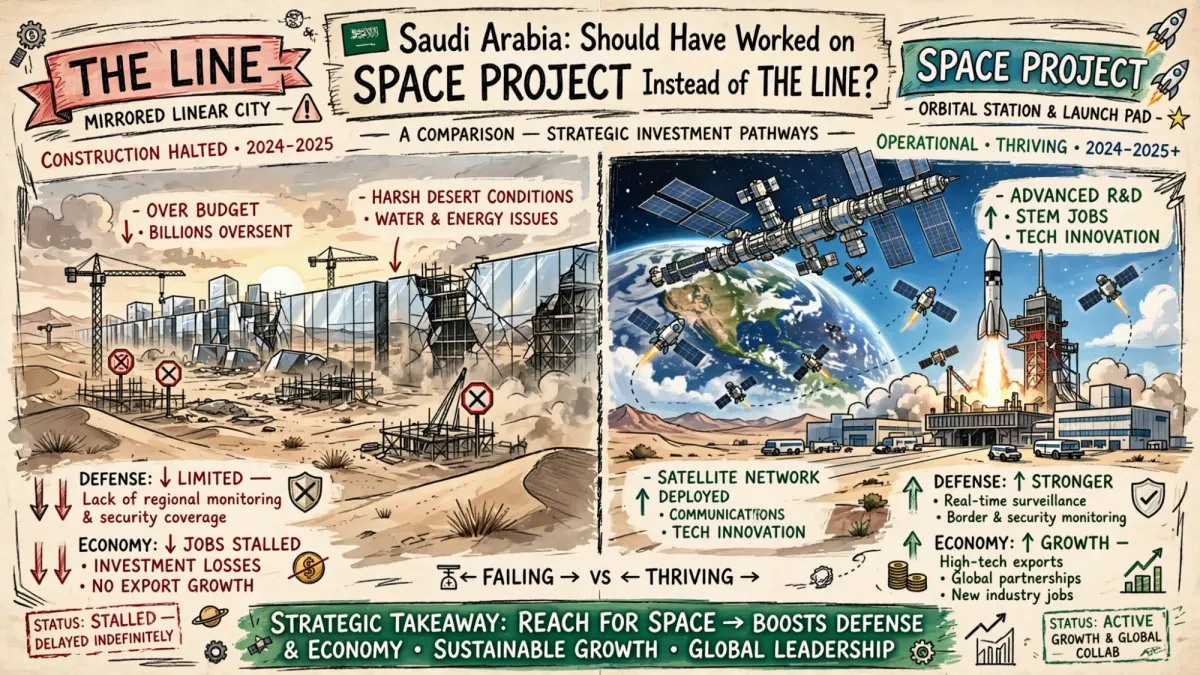
In 2017 Saudi Arabia announced Neom, a $500 billion megacity. Its centerpiece was The Line, a 170 kilometer linear city, 500 meters tall, a pair of mirrored skyscrapers meant to house 9 million people.
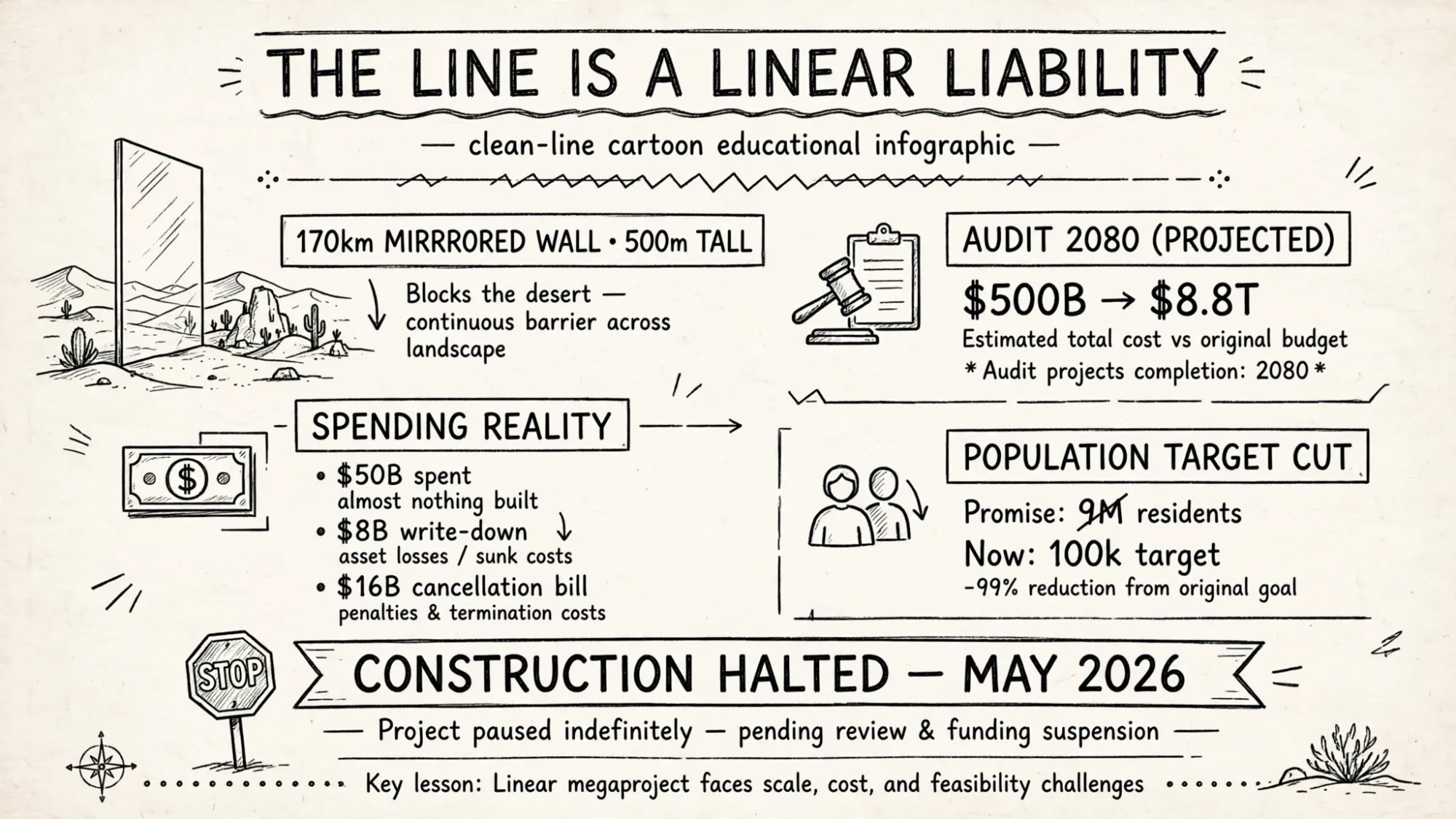
By September 2025 construction on The Line was formally suspended after $50 billion had been spent and almost nothing built.
An internal audit found the original plan would cost $8.8 trillion and finish only by 2080, and uncovered deliberate manipulation of revenue assumptions.
The Public Investment Fund wrote down $8 billion, relocated the workforce to Riyadh, and by May 2026 halted further work with no resumption before 2030 at the earliest.
The population target for the wider Neom zone was cut to a maximum of 100,000 people.
Authorities now expect cancellation costs will exceed construction costs over the next five years, with a $16 billion bill just to cancel contracts.
This is not just a failed building. It is a failed investment thesis. Saudi should have built up, not across.
The Line Is A Linear Liability
The Line fails for simple physics and economics.
It is 170 kilometers of wall in a desert with harsh desert conditions, water and energy issues.
It blocks wildlife migration, creates a wind tunnel, needs insane amounts of concrete and steel for 500 meter tall parallel structures.
It has no network effects.
If you build 2.4 kilometers of it, you get 2.4 kilometers of empty hallway, not a city.
That is what happened.
Only about 2.4 km of the original 170 km vision is under focus now.
It creates zero exportable tech. It creates construction jobs that disappear. It creates a maintenance backlog that rusts. And when you stop, you have a $16 billion cancellation bill and an $8 billion write down.
A city that cannot be phased is not a city. It is a liability.
Space Is Exponential Infrastructure
Now look at what Saudi's space economy actually is.
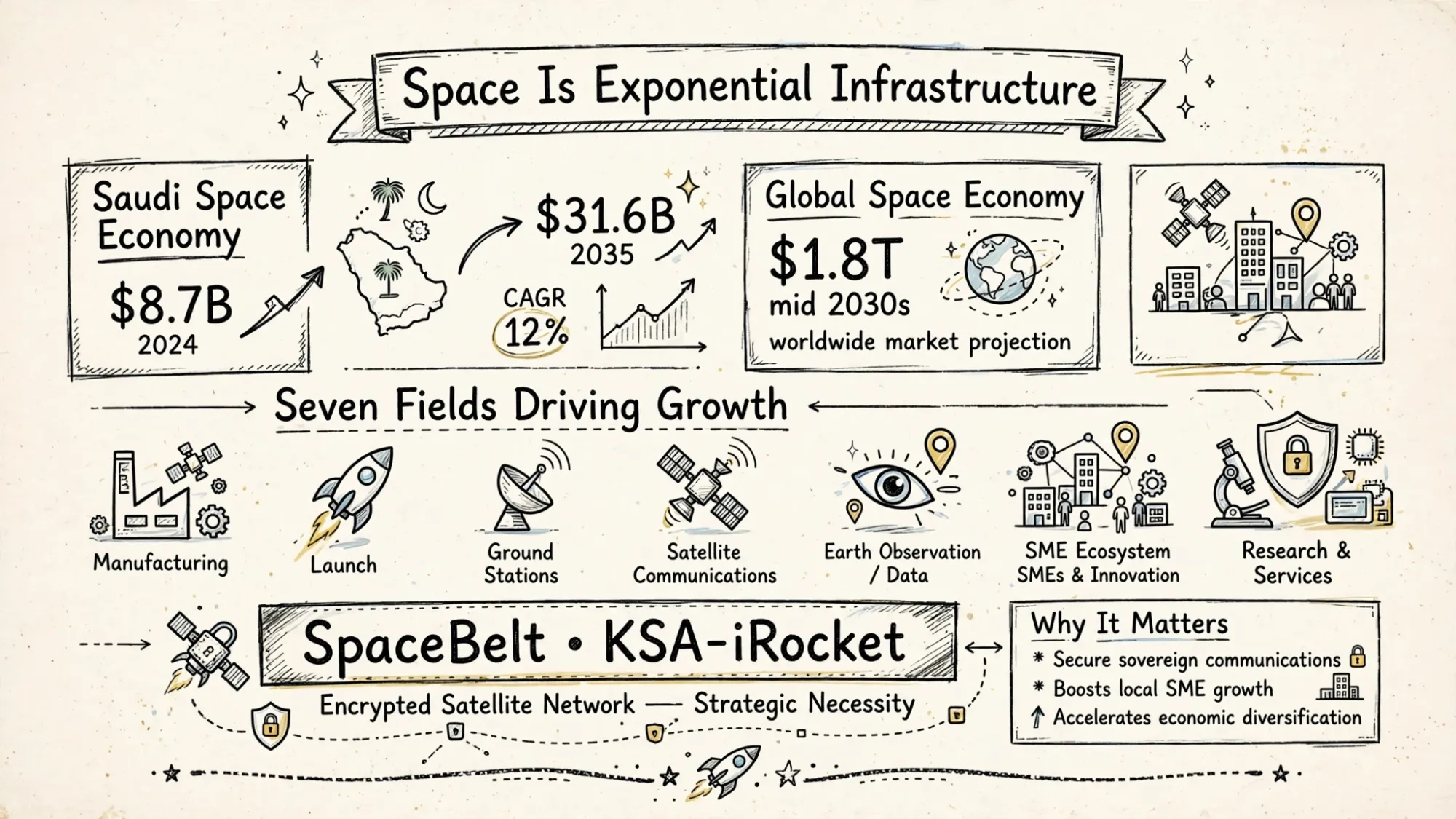
The space economy reached $8.7 billion in 2024, including all value added activities from space technologies and services.
It is expected to grow to $31.6 billion by 2035 with a compound annual growth rate of 12 percent.
The global space economy is projected to be worth $1.8 trillion by the mid 2030s, and $1.1 trillion in 2040 growing to $2.7 trillion.
The national roadmap already lists the right seven fields, manufacturing capabilities, launch services, and ground station infrastructure and services.
The SpaceBelt KSA-iRocket deal shows the model. This is not science fiction, it is strategic necessity for a resilient future economy.
he project aims to provide Saudi Arabia with an independent, encrypted satellite communications network, a capability that could transform its defense posture, economic security and technological self reliance.
Unlike The Line, orbital infrastructure compounds. One launch pad enables ten satellites. Ten satellites enable a data network.
A data network enables defense contracts, SME startups, research financing, and global partnerships. Saudi Space Agency was founded in 2018.
In 2023 it sent two astronauts including the first female Arab to the ISS and created the first sustainable Human Space Flight program.
The story started in 1985 when Sultan bin Salman became the first Arab to fly in space. The foundation is there.
Timing Would Have Made Saudi Early
Here is the part that matters for capital.
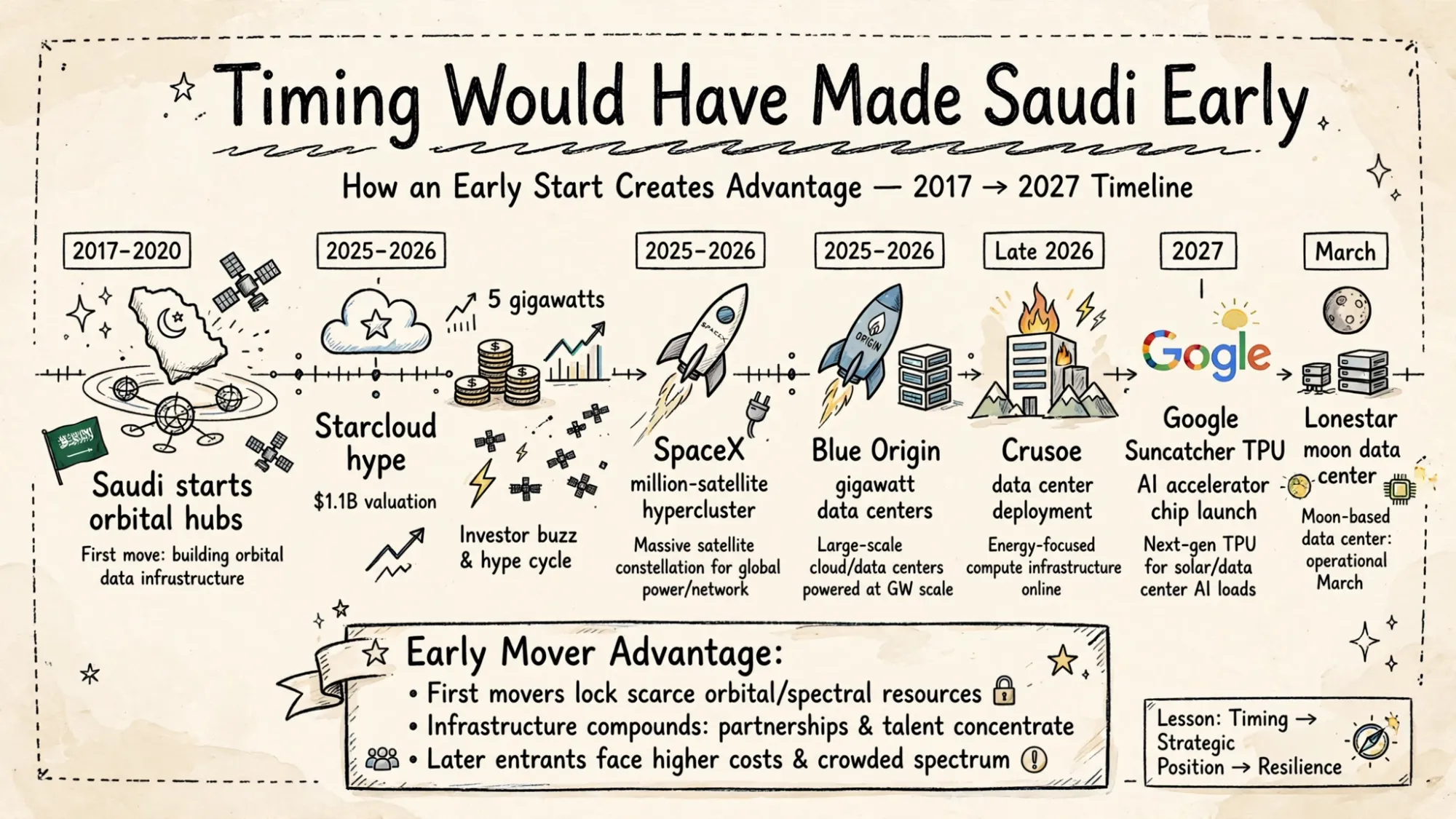
If Saudi had started a serious orbital infrastructure program in 2018-2020 instead of The Line, it would have been early by four years.
In 2025-2026 space servers went from meme to hype to funded reality.
Servers in space, tech firms excited at the idea of sending power hungry data centres into orbit. SpaceX's Starship is seen as the way of deploying data centre servers in space.
In February, SpaceX acquired xAI and revealed plans for a million satellite orbital data center network.
Blue Origin is working on orbital data center technology, Bezos predicted gigawatt scale data centers in space within the next 10 to 20 years and that continuously available solar energy meant they would eventually outperform those on Earth.
Google is pushing Project Suncatcher, a research effort to network solar powered satellites equipped with TPUs into an orbital AI cloud, with a prototype launch with Planet Labs around 2027.
Crusoe plans to deploy its cloud platform on a Starcloud satellite scheduled for late 2026.
Lonestar tested a small data center on the moon in March.
Axiom Space launched an orbital data center prototype to the ISS in August. Starcloud reached $1.1 billion valuation as AI space race heats up.
Even the skeptics prove the hype.
Amazon's AWS CEO said orbital data centers are pretty far from reality, while Gartner called it peak insanity.
That is exactly when you want to be the landlord.
If Saudi had desert ground stations, cheap solar, equatorial proximity, and sovereign wealth already invested in orbital nodes in 2020, by 2026 every AI founder raising for orbital compute would fly to Riyadh instead of San Francisco.
You cannot attract $1.1 billion valuations to a mirrored wall.
You can to an orbital cloud.
Defence You Cannot Bomb
The Line offers nothing for defense. Space offers everything.
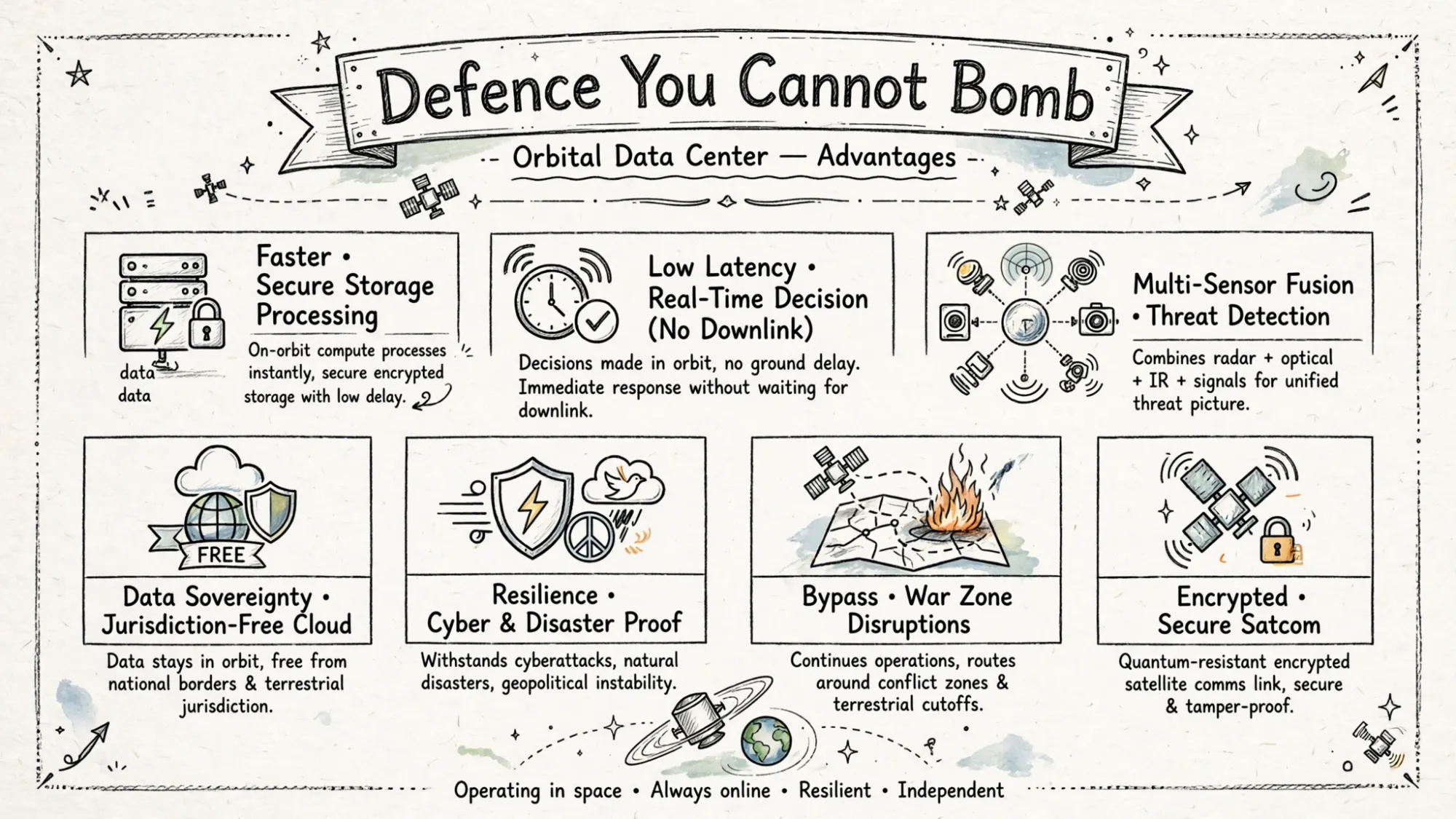
Orbital data centers reduce reliance on ground based systems, enable faster and more secure storage and processing of satellite and mission data, while creating an orbital cloud that strengthens global data sovereignty, AI autonomy and resilience against terrestrial disruptions including cyber threats, natural disasters and geopolitical instability.
In orbit processing delivers low latency analytics and real time decision making without constant downlinking.
For a country in a volatile region, this is critical.
Axiom Space's ODCs will transform space operations especially in the context of defense and security.
Use cases include on orbit and real time processing exploitation and dissemination of data from multiple national security and commercial satellites, and lower latency multi sensor fusion for terrestrial or space threat detection and tracking.
Other advantages:
Data sovereignty, meeting stringent data residency requirements, processing data within a defined orbital jurisdiction.
Orbital infrastructure technically in international territory could enable truly neutral jurisdiction free cloud compute for sensitive workloads.
By shifting data centers to orbit, firms aim to bypass terrestrial war zone disruptions and ensure sovereign data continuity.
Processing imagery with AI models on orbit before transmitting results rather than raw data can reduce bandwidth requirements by 90 percent and enable near real time insights for agriculture, defense, climate monitoring and disaster response.
The Line can be sabotaged with a single attack on power or water.
An orbital network cannot. It is distributed, encrypted and autonomous.
Economy That Compounds Not Rusts
Compare failure modes.
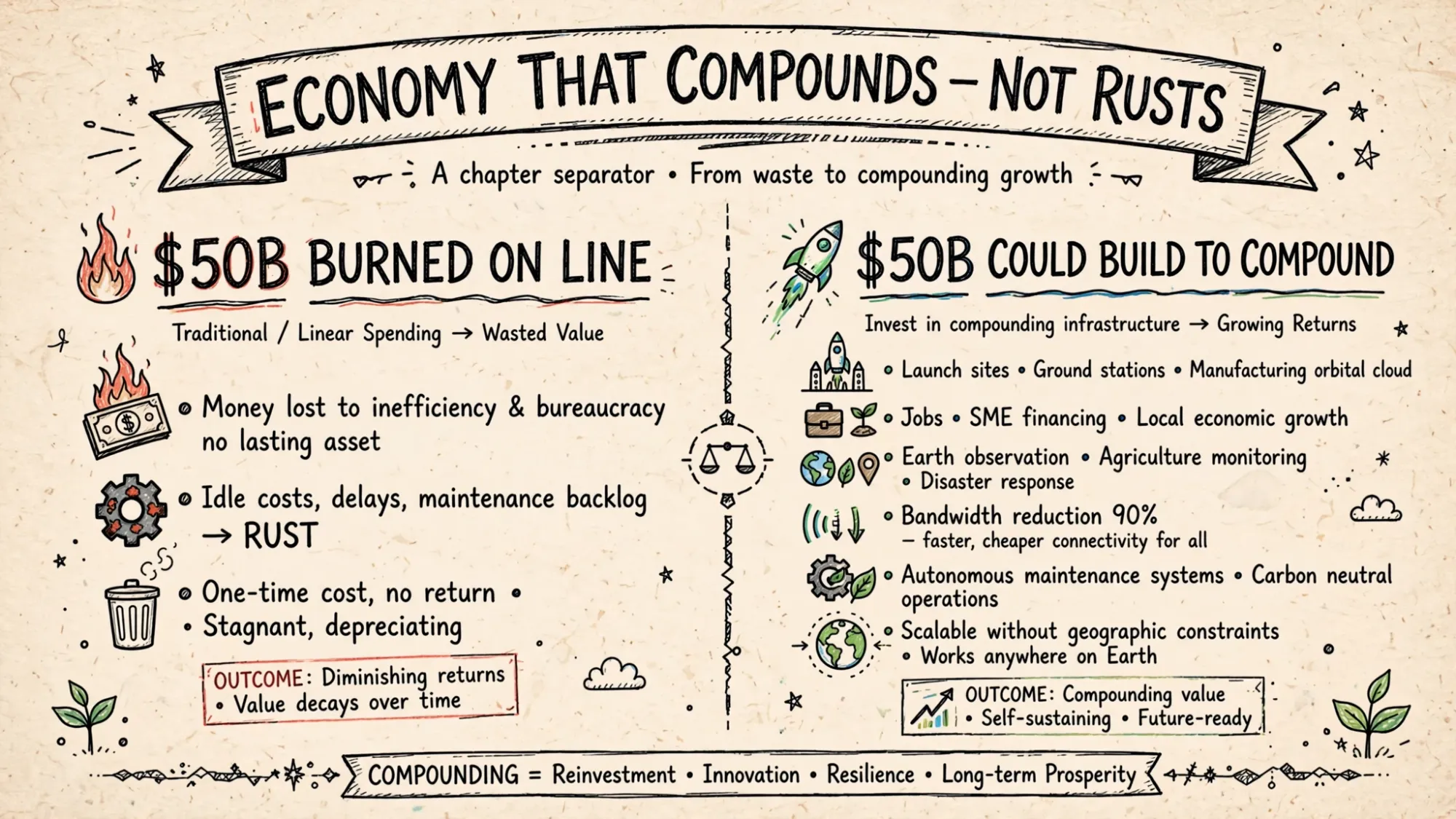
The Line fails expensively and leaves nothing. $50 billion burned, $8 billion written down, $16 billion to cancel.
No export, no IP, no recurring revenue.
A space program fails gracefully and compounds even when partially successful.
With $50 billion you could have built:
- Launch sites and ground stations in the Empty Quarter. Saudi has vast empty desert perfect for antennas and laser links, no NIMBY, abundant solar.
- Manufacturing for satellites and orbital server chassis. Local jobs, SME financing, local economic growth aligned with Vision 2030.
- Orbital cloud that scales without geographic constraints. Unlike Earth based facilities, orbital data centers can expand without limits and become carbon neutral with continuously available solar.
- Earth observation pipeline. Agriculture monitoring for Saudi food security, disaster response, climate monitoring. Bandwidth reduction 90 percent means you sell insights not raw pixels.
- Autonomous maintenance systems that work anywhere on Earth.
The space economy grows at 12 percent per year.
A mirrored wall depreciates the day you pour concrete.
The $8.7 billion to $31.6 billion projection does not even include the spillover of being the data center hub for the region.
If you are the country that hosts the ground station and the orbital node for African and Asian traffic, you become Switzerland for data.
What To Watch Next
Saudi still has a window but it is closing.
The smart play now is not to try to finish The Line by 2080 for $8.8 trillion.
It is to pivot the Neom capital into three things.
First, double down on SpaceBelt KSA-iRocket style encrypted satcom. Build an independent network that the army, Aramco and banks can use when undersea cables are cut.
Second, build the ground side of orbital data centers. OpenCurb OS did it for autonomous cars on parking lots.
Saudi needs OpenOrbit OS for desert ground stations. Offer cheap land, power, cooling for laser downlinks, and a regulatory sandbox for data sovereignty.
Third, fund the startups that are actually launching in late 2026. Starcloud, Lonestar, Axiom.
Instead of being a customer, be a co owner. In 2020 that would have been cheap. In 2026 it is still cheaper than another 2.4 km of mirror.
The Line wanted to be a symbol of the future.
Symbols do not attract capital. Infrastructure does.
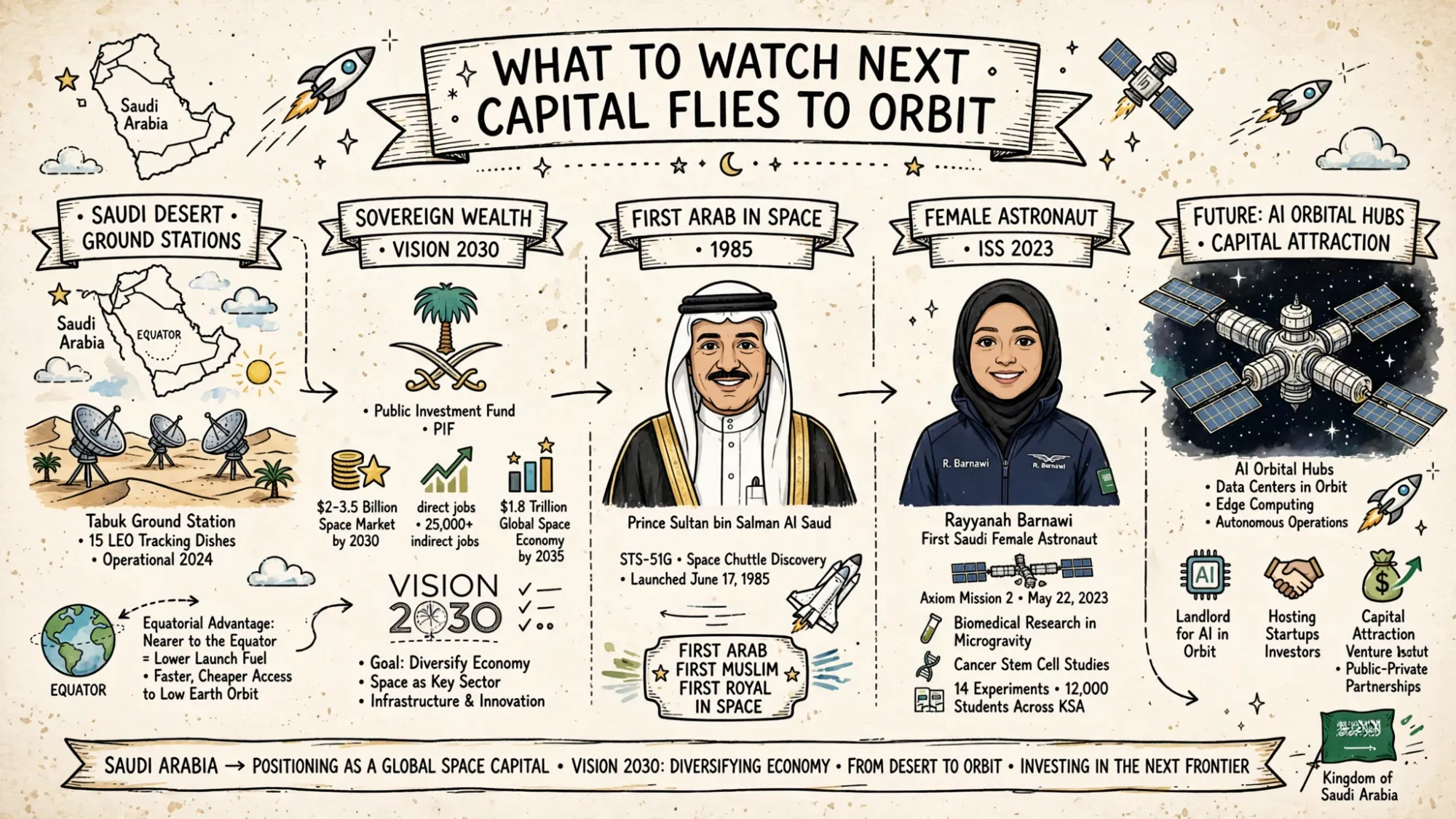
Saudi Arabia's first astronaut flew in 1985.
Its first female astronaut flew in 2023. The narrative of reaching for space boosts defense and economy and global leadership.
A 170 kilometer wall in the sand does not.
If Vision 2030 wants to be remembered as a technological transformation and not a $50 billion rendering, the answer is above us, not across the desert.