Horowitz Andreessen Academy and The Future of Education (The End of AI Doomerism)
If colleges will not adapt to AI fast enough, tech will build its own schools. And it will accelerate national prosperity faster than spreadsheets ever did.
The thesis
Today, a venture firm opened a school.
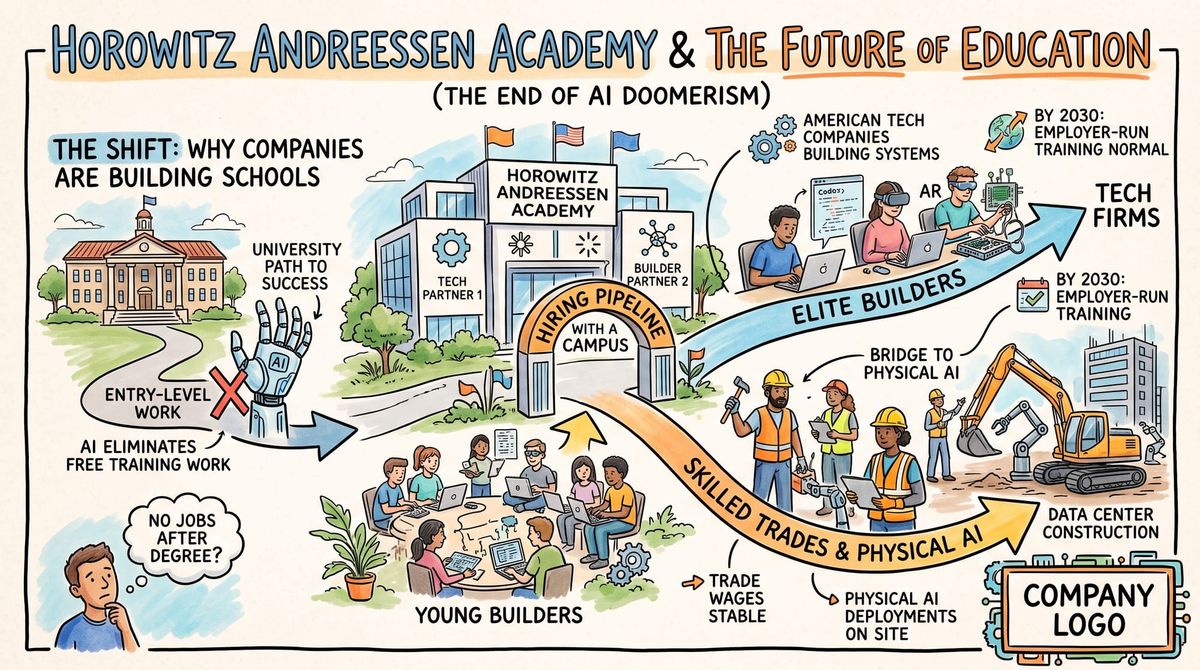
The Horowitz Andreessen Academy launched in San Francisco as an in-person program for young builders. It is backed by $42 million, with founding partners including Anduril, Anthropic, Coinbase, Google, Meta, NVIDIA, OpenAI, Palantir, Replit, and Stripe.
Read that partner list again. It isn't a school with corporate sponsors.
It's a hiring pipeline with a campus. FinancialContent
My claim is this. American tech companies are starting to build their own education systems, because AI is removing the entry-level work that used to train people for free.
They're doing it at two ends at once: elite builders at the top, and skilled trades at the bottom.
And the second one matters more than the first, because it's the bridge to physical AI.
Here's the falsifiable version.
If this is real, by 2030 employer-run training becomes a normal route into both software and the trades.
Trade wages hold up even as displaced white-collar workers pour in.
And the first large-scale deployments of physical AI land on the construction sites of the data centers themselves. If none of that happens, I'm wrong.
What's actually happening
Start at the top of the funnel.
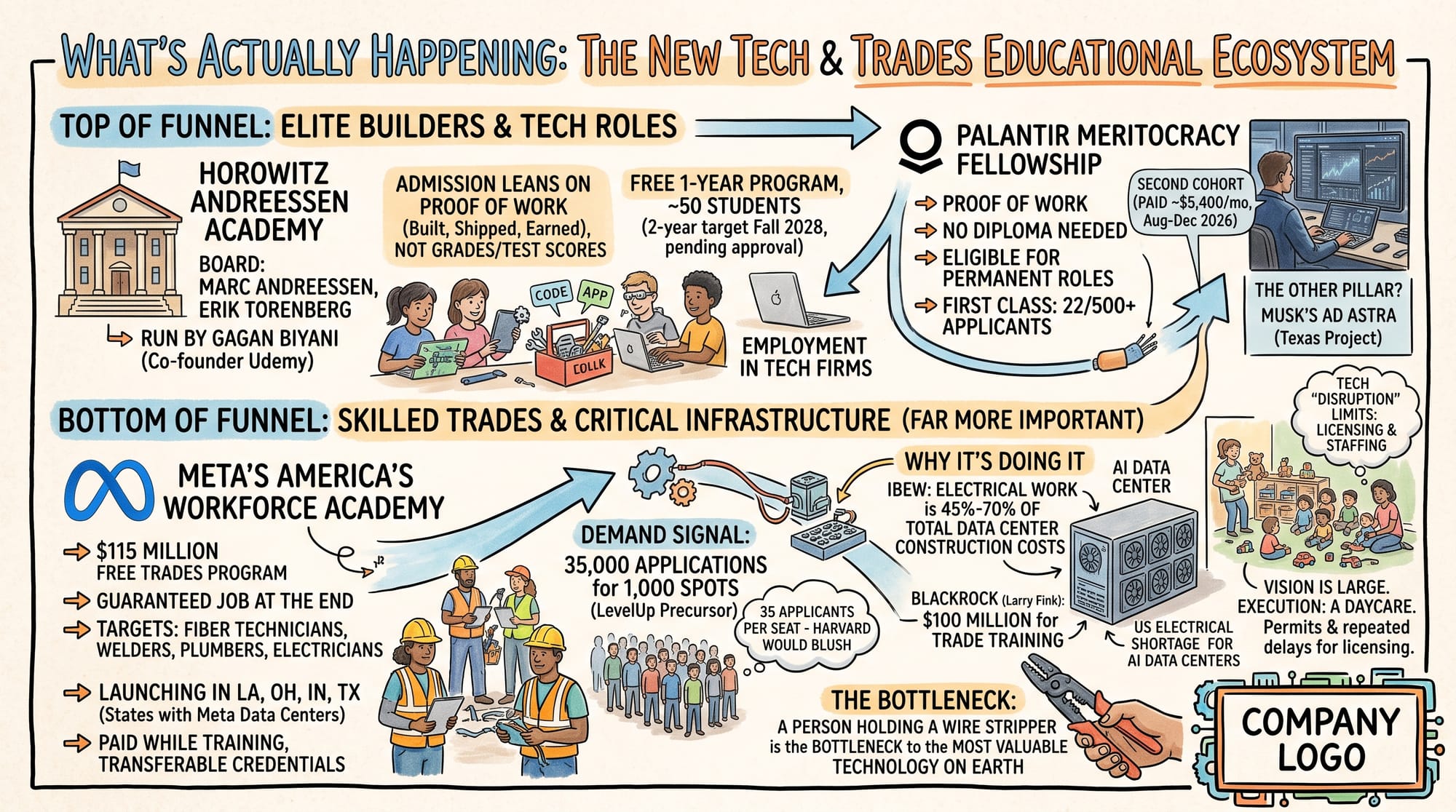
Admission to the Academy leans on proof of work, meaning what applicants have built, shipped, or earned, rather than grades and test scores.
The founding class is about 50 students, runs one year, and costs nothing, with a two-year program targeted for Fall 2028 pending regulatory approval.
It's run by Gagan Biyani, who co-founded Udemy, with Marc Andreessen and Erik Torenberg on the board.
Palantir got there first. Its Meritocracy Fellowship drew more than 500 applicants for a first class of 22, with strong performers eligible for permanent roles and no diploma needed.
The second cohort is paid roughly $5,400 a month and runs August to December 2026. Yahoo FinanceIndexBox
Now the bottom of the funnel, which got far less attention and is far more important.
Meta is putting $115 million into a free skilled-trades program with a guaranteed job at the end. America's Workforce Academy targets fiber technicians, welders, plumbers, and electricians, launching in Louisiana, Ohio, Indiana, and Texas, all states where Meta is building data centers.
Participants are paid while they train and earn credentials that transfer across employers. AxiosMeta Data Centers
The demand signal is the part I can't stop thinking about. The LevelUp fiber-technician program that preceded it received 35,000 applications for 1,000 spots in its first seven days.
That's 35 applicants per seat. Harvard would blush.
And the reason Meta is doing this isn't charity. According to the IBEW, electrical work makes up 45% to 70% of total data center construction costs.
BlackRock put $100 million toward training trades workers after Larry Fink warned the US could run out of the electricians needed for AI data centers.
The bottleneck to the most valuable technology on earth is a person holding a wire stripper. Fortune
Then there's Musk. I'd like to cite Ad Astra as the third pillar here, but honesty requires otherwise.
The New York Times described the Texas project as caring for about ten children aged five and under, staffed by two caregivers, after permit resubmissions and repeated delays.
The vision is large. The execution, so far, is a daycare. Worth remembering when we talk about how easily tech "disrupts" institutions that run on licensing and staffing. Quartz
Why now: the first rung is gone
The historical frame I keep coming back to is agriculture.
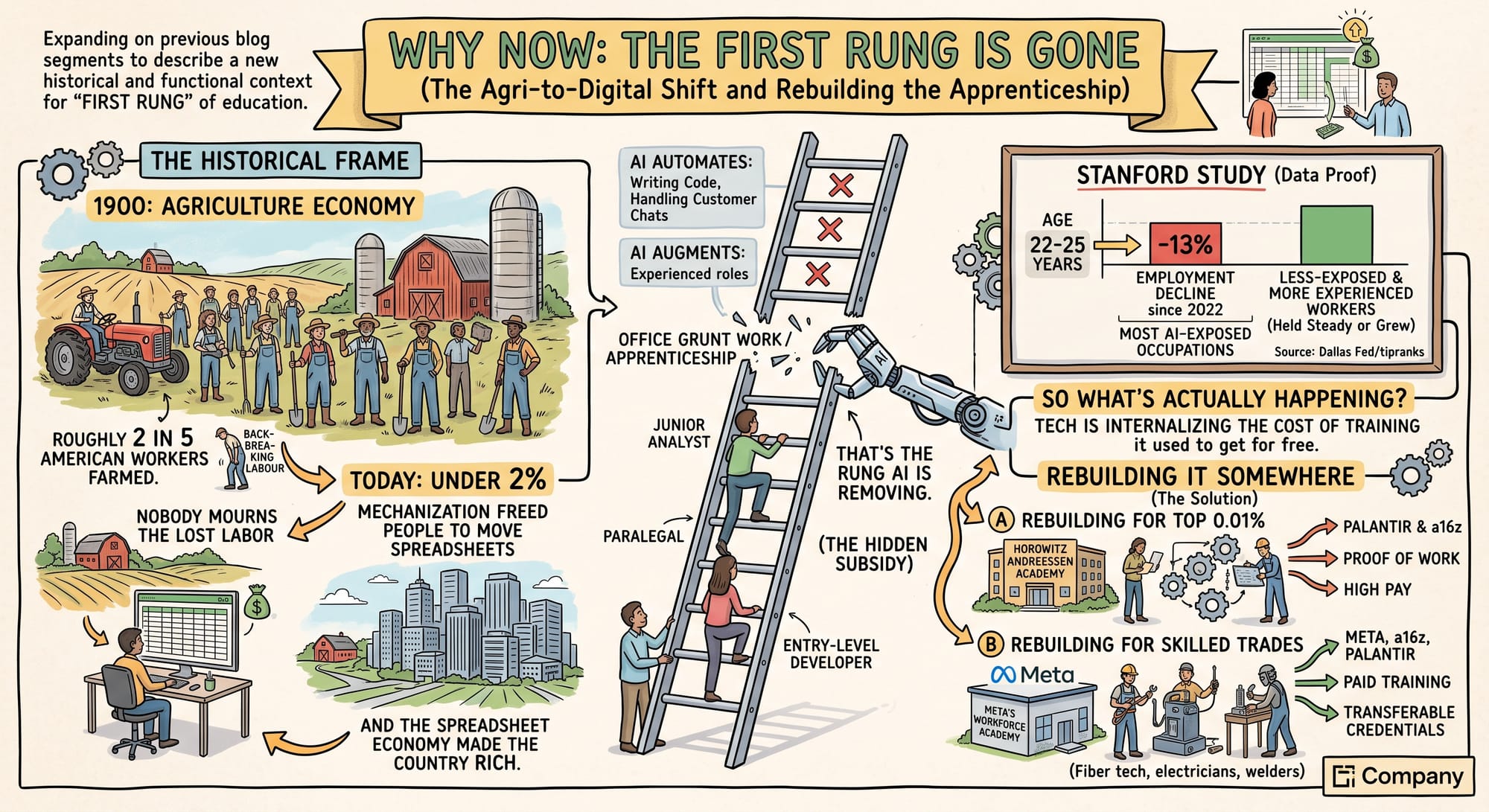
Around 1900, roughly two in five American workers farmed. Today it's under 2%. Nobody mourns the lost back-breaking labour, because mechanization freed people to move spreadsheets, and the spreadsheet economy made the country rich.
But that transition had a hidden subsidy.
The office itself trained you. Junior analysts, paralegals, and entry-level developers did grunt work that was really an apprenticeship with a salary.
That's the rung AI is removing.
A Stanford study found that workers aged 22 to 25 in the most AI-exposed occupations saw a 13% employment decline since 2022, while less-exposed and more experienced workers held steady or grew.
The effect shows up where AI automates tasks like writing code or handling customer chats, but not where it augments work. Dallas Fedtipranks
So what I think is actually happening is not "tech disrupts education." It's that tech is internalizing the cost of the training it used to get for free.
When you delete the apprenticeship, you have to rebuild it somewhere. Palantir and a16z are rebuilding it for the top 0.01%. Meta is rebuilding it for the trades.
The strongest case against me
I want to argue the other side properly, because it's strong.
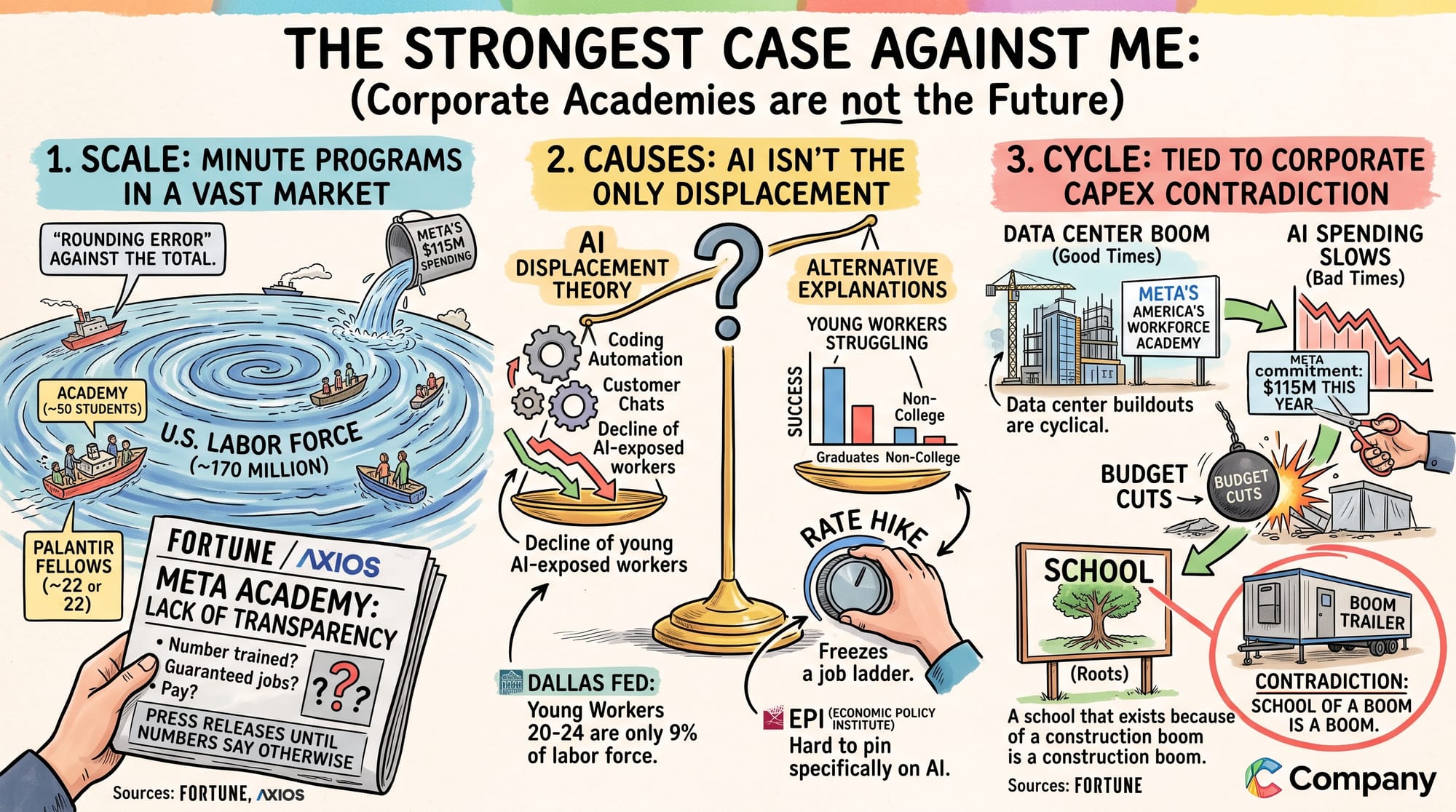
First, scale. Fifty students. Twenty-two fellows. Even Meta's $115 million is rounding error against a labor force of around 170 million.
Meta didn't answer Fortune's questions about how many people it plans to train or what the guaranteed jobs pay. These programs are press releases until the numbers say otherwise.
Second, the displacement may not even be AI.
The Dallas Fed notes workers aged 20 to 24 are only about 9% of the labor force, so the decline among the most AI-exposed young workers likely explains little of the rise in aggregate unemployment. T
he Economic Policy Institute points out that young non-college workers are struggling as much as young graduates, which makes it hard to pin the weakness specifically on AI. Rate hikes freeze job ladders too. Economic Policy Institute
Third, and most damaging: these programs are tied to the capex cycle. Meta's commitment is framed as $115 million this year.
Data center buildouts are cyclical. If AI spending slows, the academies are the first line item cut. A school that exists because of a construction boom is a construction boom, not a school. Fortune
The version that survives
Section three changed my answer, which is how I know I wrote it honestly.
The big version, that tech-run education will prevent AI displacement, doesn't survive. The scale isn't there, and the causal story is messy.
What survives is narrower and, I think, more interesting.
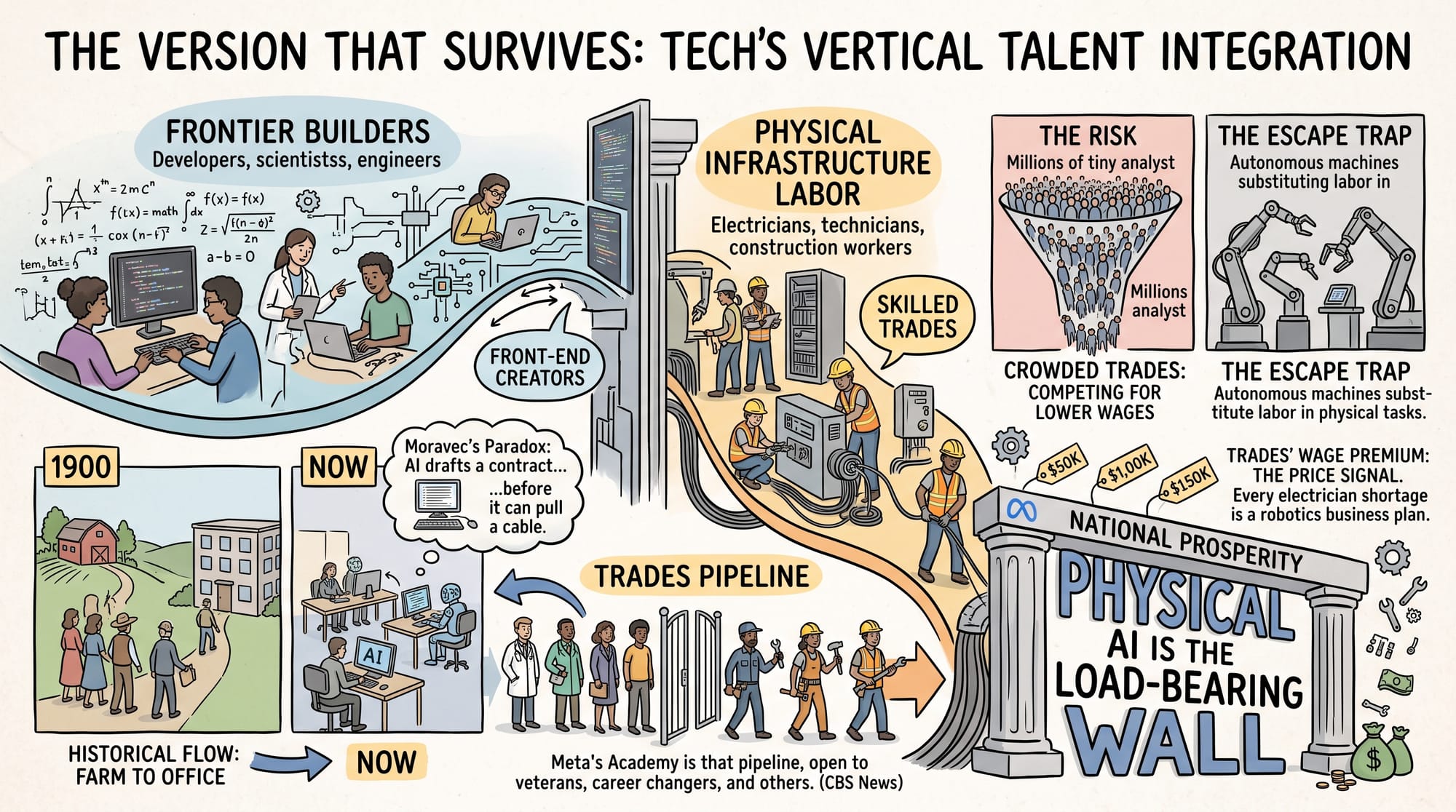
Tech companies are vertically integrating talent at their two tightest bottlenecks: frontier builders and physical infrastructure labor. And the second bottleneck reverses the historical analogy.
In 1900, people fled physical work for the office.
This time, AI automates the office first. Moravec's paradox in action: the model can draft a contract before it can pull cable through a conduit.
So the flow runs backwards. Displaced desk workers move toward the trades, and Meta's academy is literally that pipeline, open to veterans, career changers, and others looking to enter the skilled trades. CBS News
Here's the risk you flagged, and it's the right one. If millions of former analysts crowd into the trades, you get exactly what we don't want: more people competing for lower wages.
The only way out of that trap is capital substitution in the physical world.
Which is why I think physical AI stops being a nice-to-have and becomes the load-bearing wall of national prosperity.
The trades' wage premium is the price signal. Every electrician shortage is a robotics business plan.
My predictions
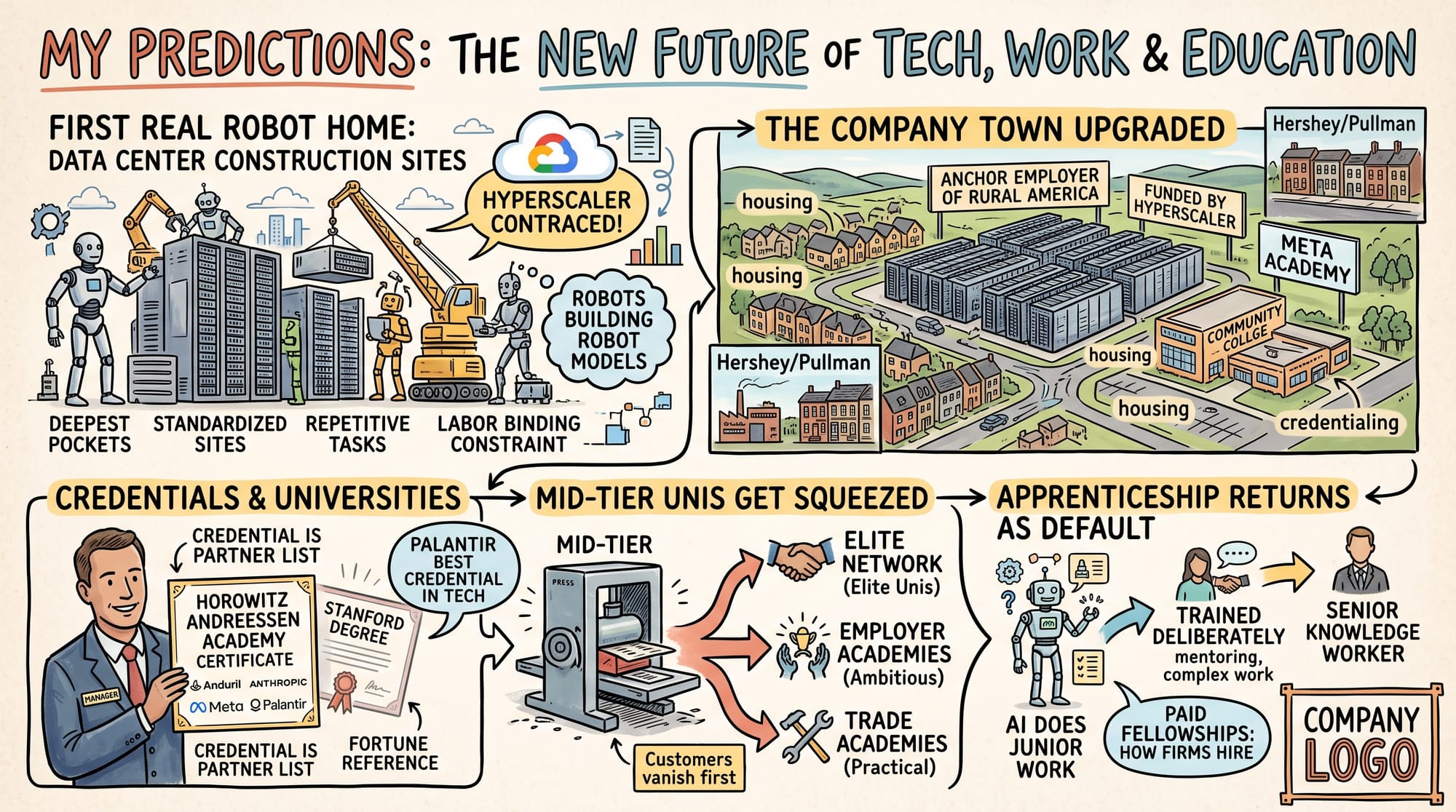
The first real commercial home for humanoid and construction robotics won't be your kitchen or a warehouse. It'll be data center construction sites.
The buyer has the deepest pockets in history, the sites are standardized, the tasks are repetitive, and labor is the binding constraint.
Robots building the buildings that host the models that train the robots. I'd expect the first large robotics contracts to be announced by a hyperscaler, not by a construction firm.
The company town is coming back, in an upgraded form. Meta already clusters its training where it builds.
I expect hyperscalers to fund community-college programs, housing, and credentialing around every major campus, the way Hershey and Pullman once built towns around factories. The data center becomes the anchor employer of rural America.
The employer becomes the credential. Alex Karp calls Palantir the best credential in tech, and that's the direction.
A Horowitz Andreessen Academy certificate will be read the way a Stanford degree was, not because of the curriculum but because of the partner list. Fortune
Mid-tier universities get squeezed from both sides.
Elite universities keep the network. Employer academies take the ambitious.
Trade academies take the practical. The middle loses its customers first.
Apprenticeship returns as the default entry into knowledge work.
If AI does the junior work, the only way to become senior is to be trained deliberately. Paid fellowships stop being novelties and become how firms hire.
The riskiest assumption, and how to test it
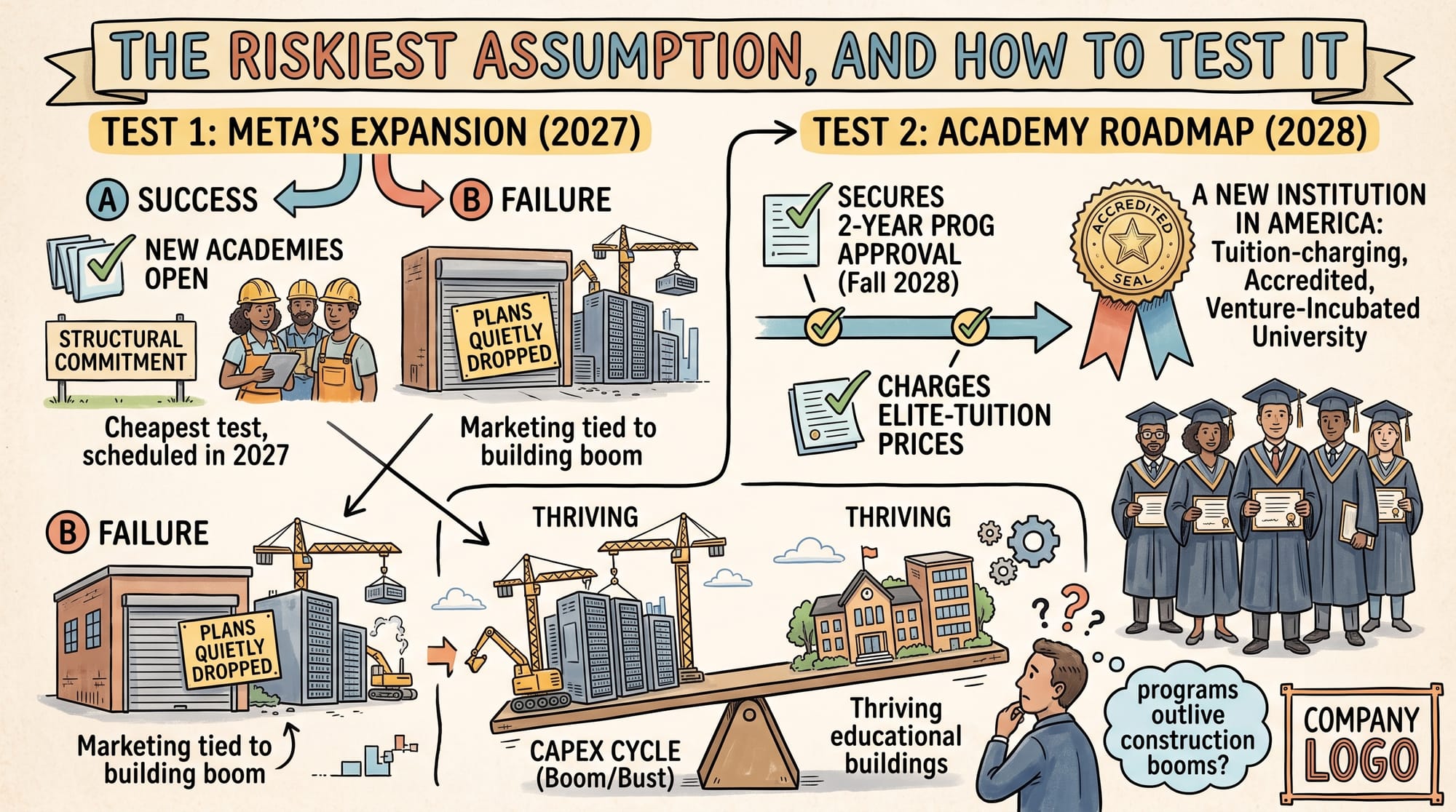
The one thing that kills this: that these programs outlive the capex cycle.
The cheapest test is already scheduled. Meta says additional America's Workforce Academy locations are expected in 2027.
If they open, the commitment is structural. If they quietly don't, it was marketing tied to a building boom.
The second test is the Academy's own roadmap.
Does it actually secure approval for the two-year program by Fall 2028, and does it charge elite-tuition prices as planned? A tuition-charging, accredited, venture-incubated university would be a genuinely new institution in America.
What would prove me wrong
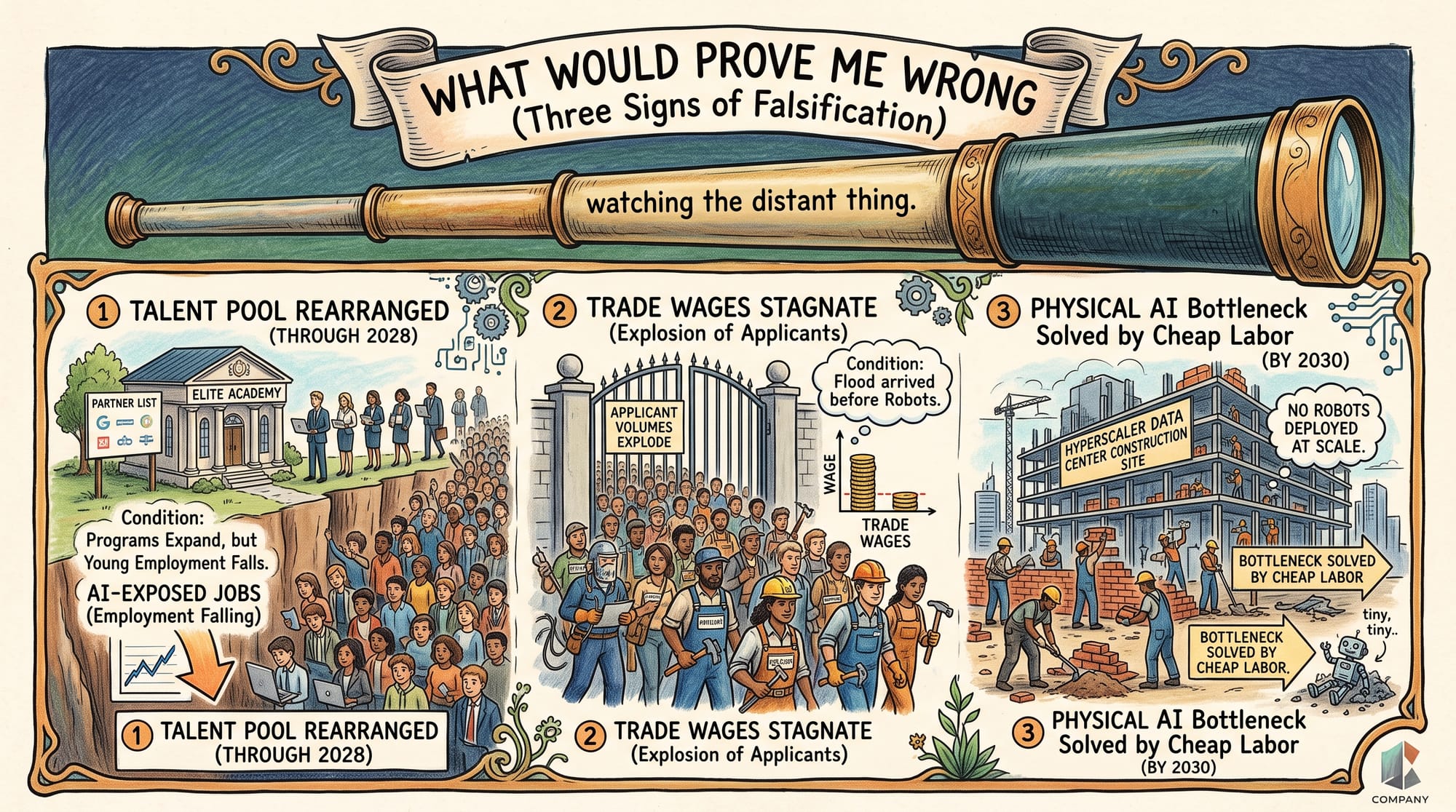
If young-worker employment in AI-exposed jobs keeps falling through 2028 while these programs expand, then they're rearranging the top of the talent pool and not touching the problem.
If trade wages stagnate while applicant volumes explode, then the flood arrived before the robots did, and my optimism about the transition was premature.
And if by 2030 no hyperscaler has deployed physical AI at meaningful scale on its own construction sites, then the physical bottleneck gets solved by cheap labor rather than capital.
That's the worse version of the future, and I'd have to say so.
Musashi wrote that you should see distant things as if they were close, and close things as if they were distant.
The close thing is fifty students in San Francisco. The distant thing is who builds America's next generation of infrastructure, and whether they're paid well to do it.
I'm watching the distant thing.