Google Should Stop Chasing the AI Frontier and Make Gemini Useful Where People Already Are
Google's best model ranks third on the main AI leaderboards, and the top spot changes every few weeks. Its real edge is a billion people already using its products. Here's why Google should stop chasing first place and make AI useful inside Search, Android and Workspace.
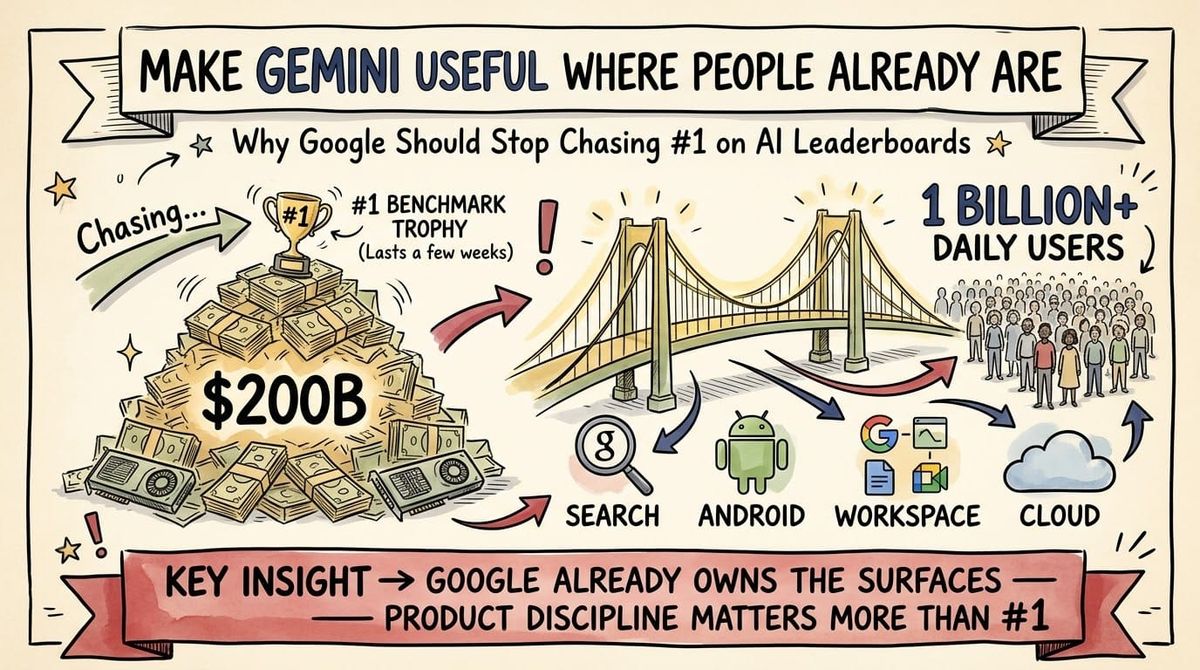
Google is spending around $200 billion this year, much of it on AI.
A lot of the attention goes to whether it has the best model, and I think that's the wrong race for Google to be running.
Its newest model is excellent, and it still ranks third on the main leaderboards.
Meanwhile, more than a billion people already use Google's AI inside products they open every day.
My argument is simple.
Google should stop treating first place on a benchmark as the goal and put that energy into making AI useful across Search, Android, Workspace and Cloud.
Google Is Close To The Top, And It Barely Matters
Google isn't losing badly.
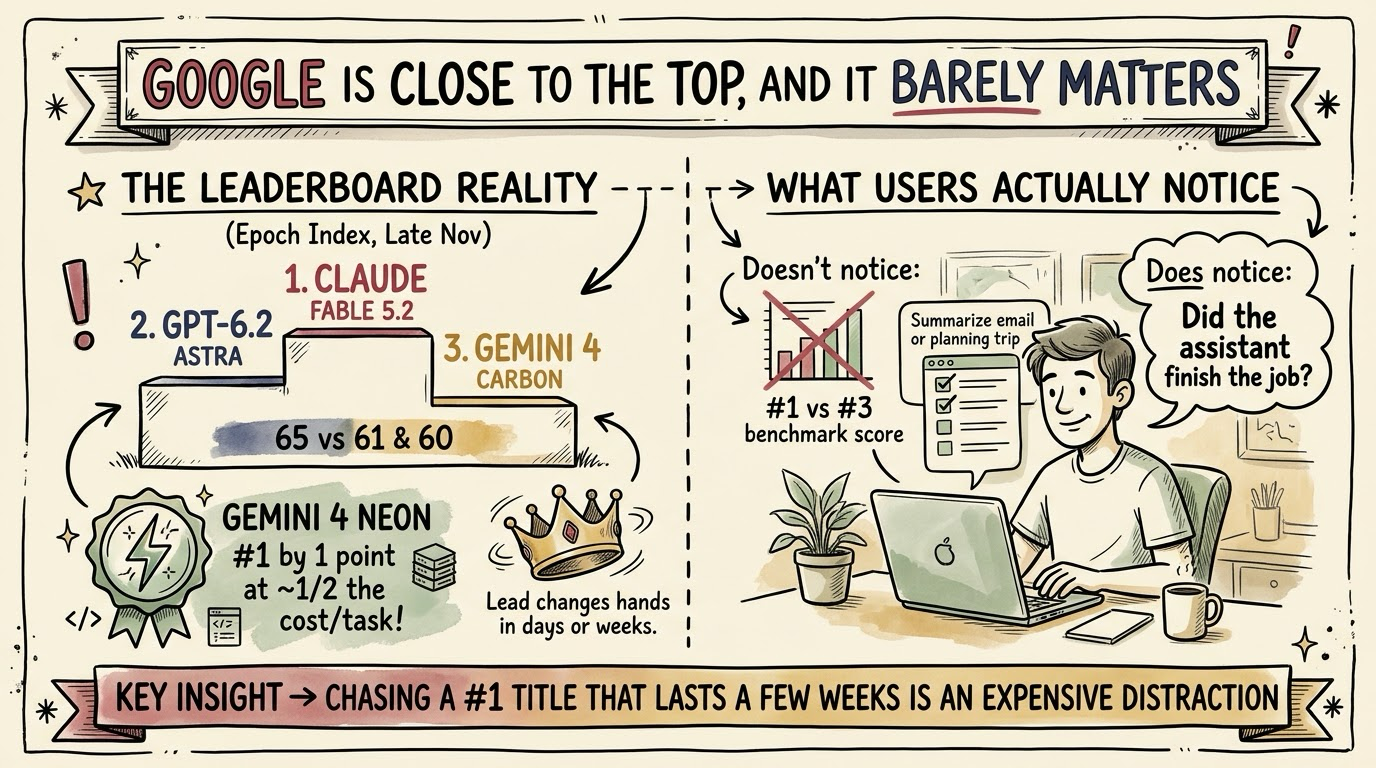
On the Epoch Capabilities Index in late November, its Gemini 4 Carbon model ranked third, behind Anthropic's Claude Fable 5.2 and OpenAI's GPT-6.2 Astra.
On another composite index, Fable scored 65 against 61 and 60 for Google's two best models.
Google does lead in places.
Its Gemini 4 Neon model tops one coding agent ranking by a single point, and it does so at roughly half the cost per task of its rivals.
Gemini models also reportedly lead several finance, legal and computer vision tests.
The same analysis notes that the lead has been changing hands within days or weeks.
That's the detail I'd focus on.
If first place lasts a few weeks, it's a very expensive title to keep chasing.
Most people will never notice the difference between the first and third best model when they're summarising an email or planning a trip.
They will notice whether the assistant actually finished the job.
What The Race Costs
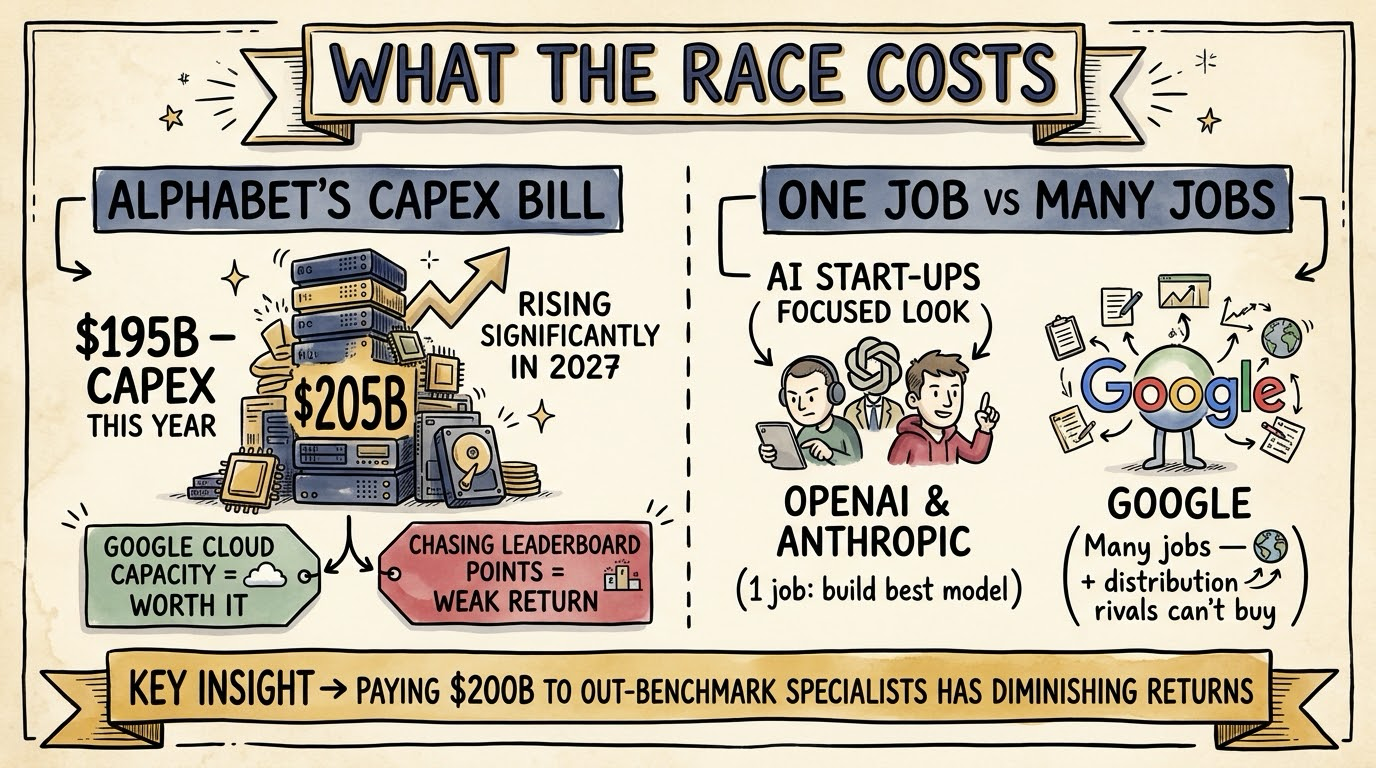
Alphabet expects to spend $195 to $205 billion on capital projects this year, and it has said that figure will rise significantly in 2027.
Much of that pays for the chips and data centers that train and run its models.
Some of this spending is clearly worth it.
Google Cloud is growing fast, and customers want capacity.
But the share that goes into winning leaderboard points against two well-funded specialists has a weaker return.
OpenAI and Anthropic have one job, which is to build the best model.
Google has many jobs, and it already has something neither rival can buy.
Google's Real Advantage Is Reach
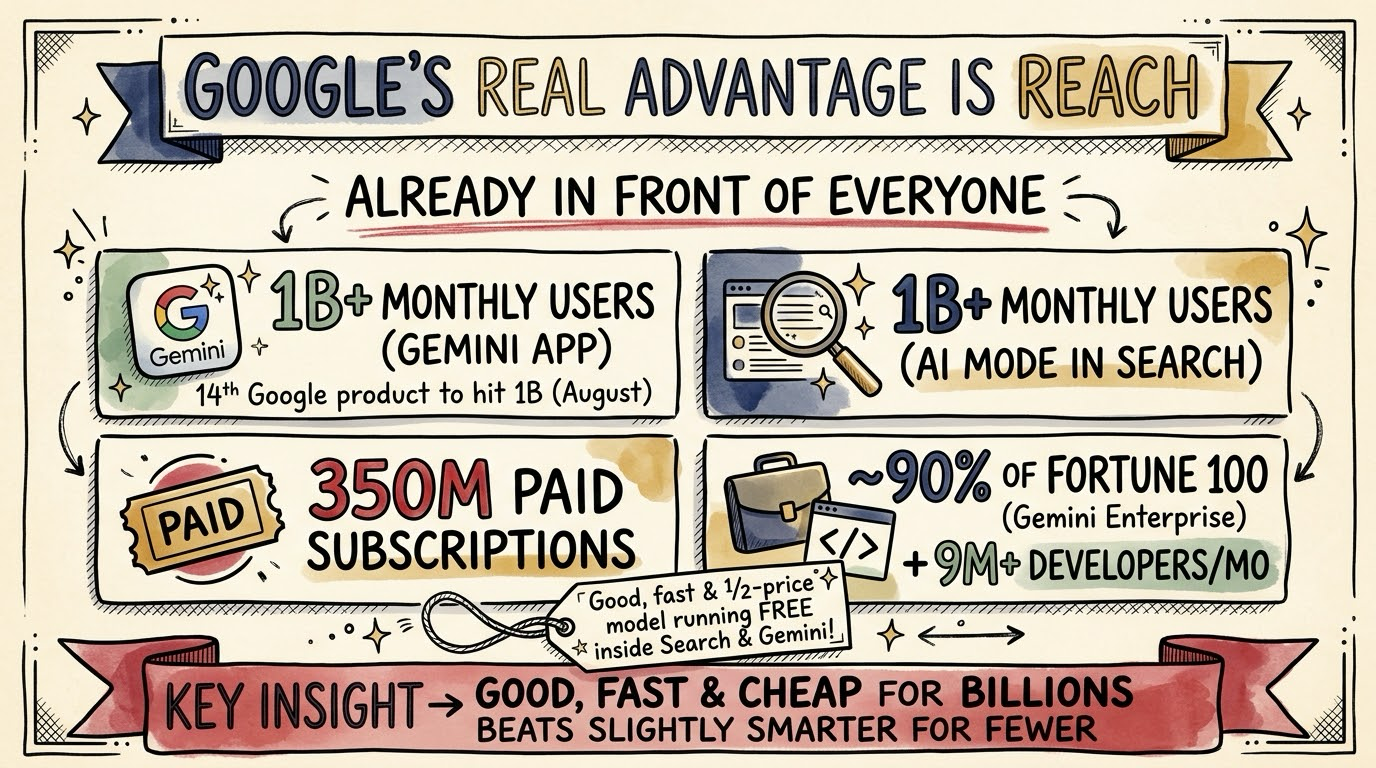
The Gemini app passed one billion monthly users in August, making it the 14th Google product to reach that mark.
AI Mode in Search has more than a billion monthly users as well.
Google reports 350 million paid subscriptions across its services.
On the business side, it says nearly 90% of Fortune 100 companies use Gemini Enterprise, and more than nine million developers build with Gemini each month.
These numbers come from Google and haven't been independently checked.
Even with a discount, they describe a company whose AI is already in front of more people than anyone else's.
Its cheaper models help here.
One of Google's newest models is priced at half its top coding model and runs for free inside Search and the Gemini app.
A model that's good, fast and cheap, delivered to billions of people, is a stronger position than a model that's slightly smarter.
I've argued before that Google won't win the AI assistant race and might not need to.
This is the other half of that argument.
Where The Products Fall Short
The reach is there, but the experience is messy.
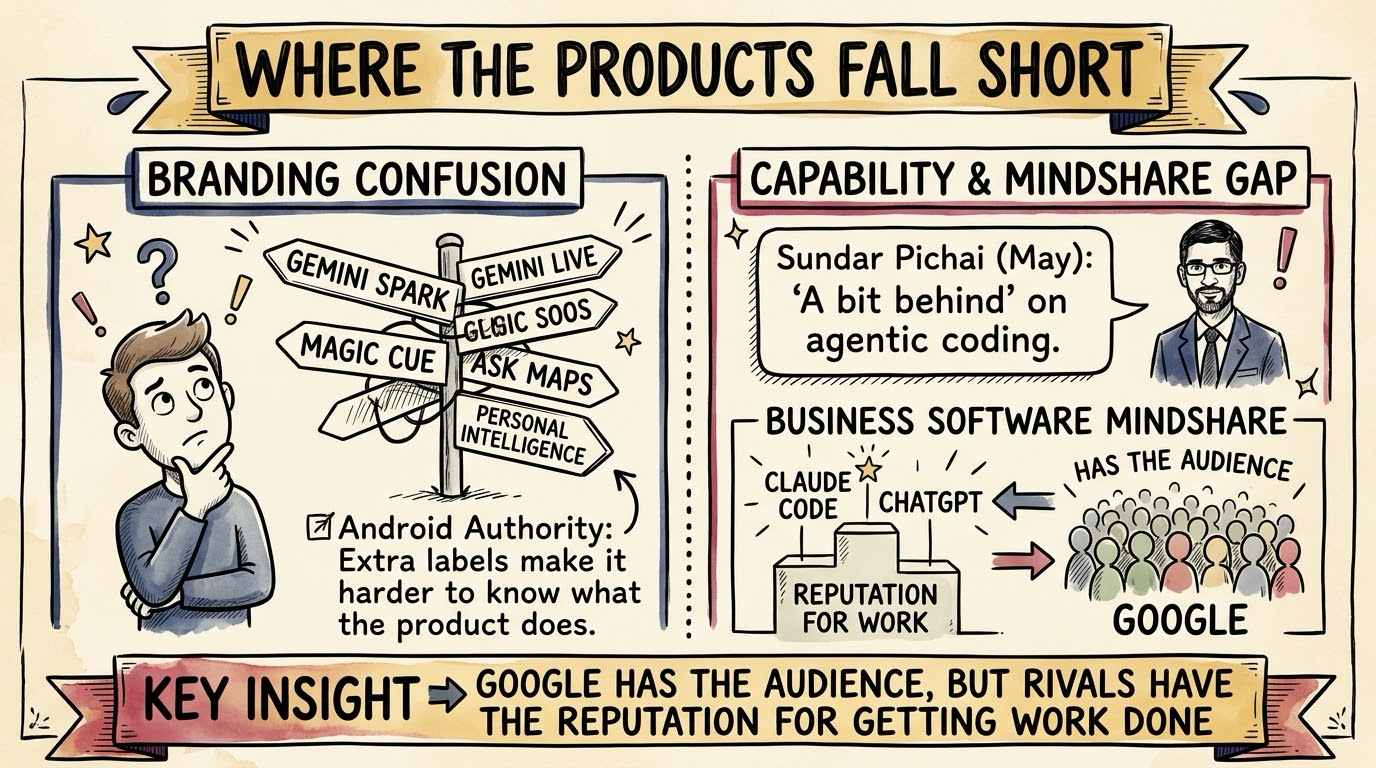
Android Authority recently listed how many names Google has given its AI features, including Gemini Spark, Gemini Live, Magic Cue, Ask Maps and Personal Intelligence.
The writer's complaint was that people only need to know Gemini is helping, and the extra labels make it harder to understand what the product does.
I agree, and as a marketer I see it as a positioning failure.
Every new name asks the customer to learn something.
There's a capability gap in practical work too.
Sundar Pichai said in May that Google was "a bit behind" on agentic coding.
In business software, Anthropic's Claude Code and OpenAI's ChatGPT still have stronger mindshare with the people who choose tools.
So Google has the audience, and its rivals have the reputation for getting work done.
What Useful Would Look Like
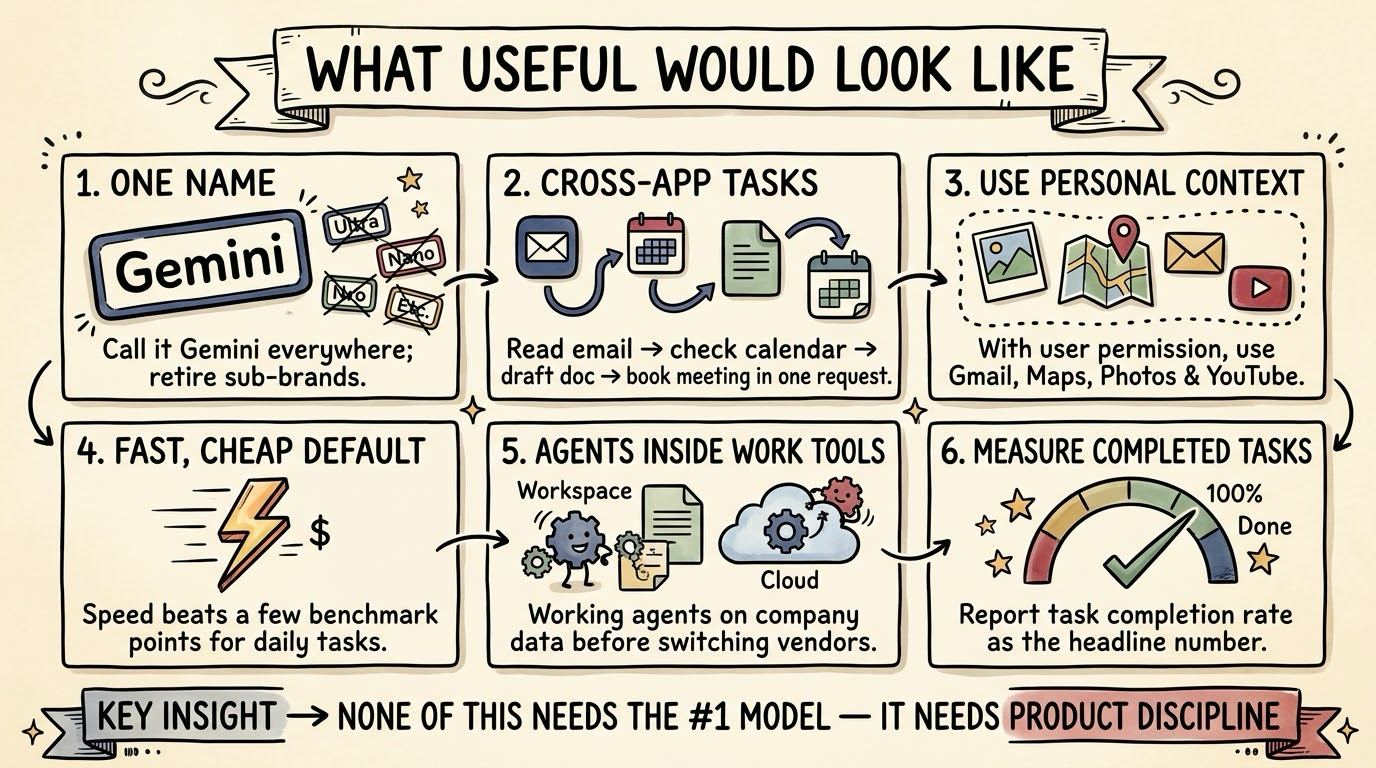
Here's what I'd prioritise if the goal were usefulness.
- One assistant with one name. Call it Gemini everywhere and retire the sub-brands.
- Tasks that cross apps. Let it read the email, check the calendar, draft the document and book the meeting in one request.
- Use what Google already knows, with permission. Gmail, Maps, Photos and YouTube history are context no rival has, as long as the user chooses to share it.
- Make the fast, cheap model the default. Most everyday tasks don't need the biggest model, and speed matters more than a few benchmark points.
- Agents inside the tools companies already pay for. Workspace and Google Cloud customers should get working agents for their own data before they think about switching vendors.
- Measure completed tasks. Report how often the assistant finished what people asked, and treat that as the headline number.
None of this needs the world's top-ranked model.
It needs product discipline, which is harder for a company Google's size.
As I wrote about the personal agent war, the winner will be whoever people trust to act for them.
Google has more surfaces to earn that trust on than anyone.
Where This Argument Has Limits
Google can't simply stop doing frontier research.
Its products are only as good as the models underneath them, and falling two generations behind would show up everywhere.
Cloud customers also want access to top models.
Talent is another factor.
The best researchers want to work where the hardest problems are being solved.
And Google's robotics and science work depends on that same research base.
So I'd put it this way.
Google should stay close to the frontier and stop paying a premium to be first.
Third place at half the cost, in front of a billion users, is a winning position if the products are good.
Conclusion: Win The Product First
Google is in a strange spot.
It has a top-three model, some of the lowest costs and the largest audience, and it's still judged as if it's behind.
The gap that matters is between what its AI can do and what its products let people do with it.
Closing that gap would be worth more than any benchmark title.
My Take: Google's priority should be the most useful AI in the places a billion people already are, and it should spend accordingly.
Disclosure: I use Claude, made by Anthropic, as a research and writing assistant. I own a Nasdaq-100 index fund, which holds Alphabet. This post is my opinion and isn't investment advice.
Sources
Pages I opened for the facts in this post:
- Qualiteg: LLM rankings 2026, November 23 edition
- MindStudio: Google vs Anthropic vs OpenAI, who actually leads AI right now?
- The Motley Fool: Alphabet Q3 2026 earnings call transcript
- TechCrunch: Google's Gemini app surges to one billion users
- Growthcentr: Google Gemini statistics 2026
- Android Authority: How I'd fix Google's AI branding