Dead Artist Effect & AI: Would it still exist?
When an artist dies, prices spike because supply becomes finite. When their estate can license an AI to make infinite new songs and hologram tours, does scarcity die too?
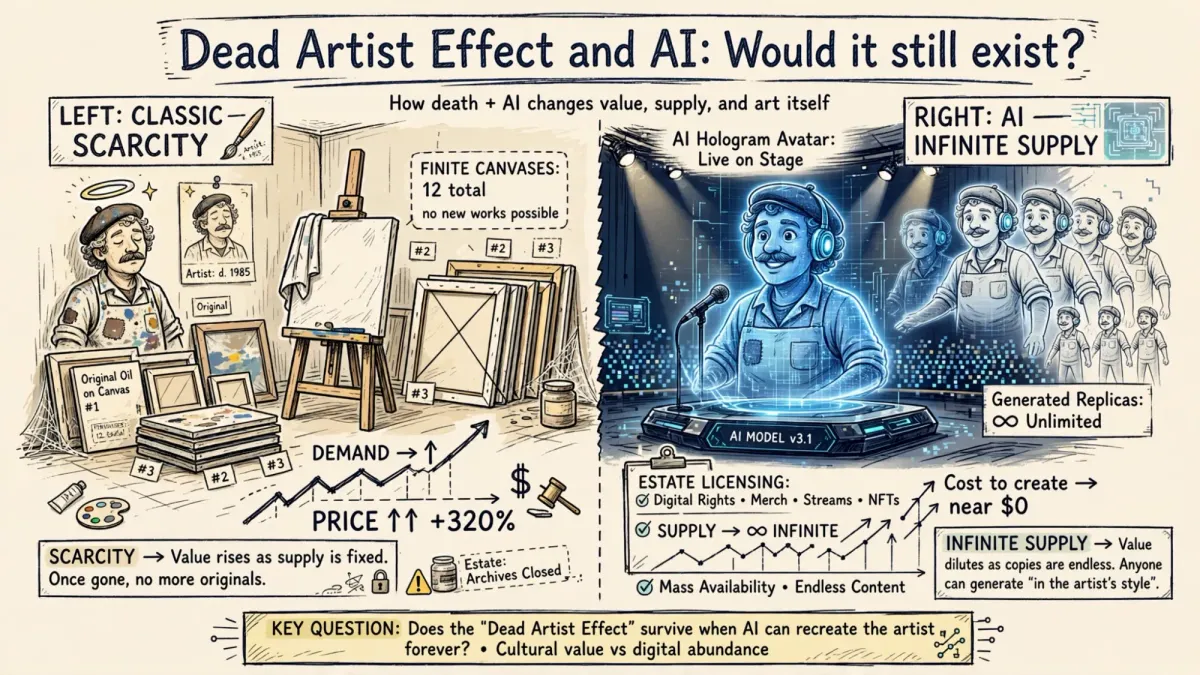
On Moonshots with Peter Diamandis, there was a prediction that stuck. Dead artist's estates will license their AI appearances. Not just a hologram cameo, but full tours, new albums, movies. If Tupac can do Coachella 2012 and ABBA can sell out London in 2022 as 1979 ABBAtars, why would Elvis stay dead?
If that happens, what happens to the dead artist effect?
What Is The Dead Artist Effect
In the art world, it sounds cynical but it is economics.
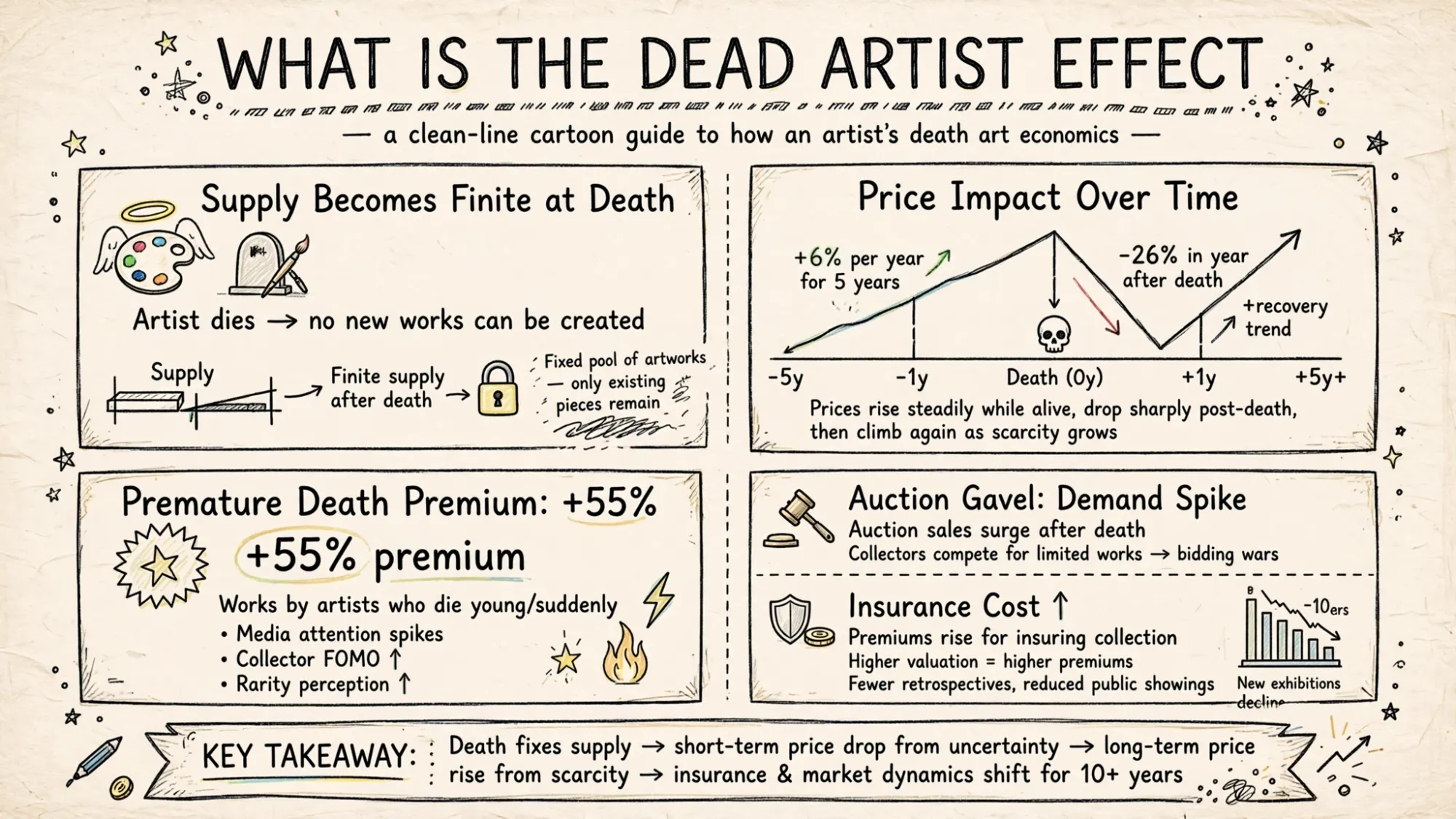
Once an artist dies, no new works can ever be created, instantly turning their entire body of work into a finite collection. That certainty is valuable.
Collectors know supply will never grow again.
Research backs it. Prices rise at the end of an artist's career, on average 6% over the last five years of life, suggesting the market prices a death effect in while the artist is still alive.
This is followed by falls, on average, of 26% in the year after death, a result of oversupply at auction and speculation, but as the years pass, markets rise again.
The effect is not equal. The effect of a premature death is particularly large, 55 percent, which is a quasi natural experiment and exogenous shock to markets. Sudden deaths tend to generate stronger price responses.
Age at death acts as a proxy for predictability.
There is also a hidden cost.
Legal and transaction cost frictions such as rights clearance, estate negotiations, and insurance costs are expected to increase after death.
Exhibition numbers drop and roughly ten years after death, exhibitions are back to pre death levels. Higher valuation raises insurance cost for exhibitions.
So the classic formula: death = finite supply + media attention + collector FOMO + higher costs = short term dip, long term premium.
AI Breaks The Two Assumptions
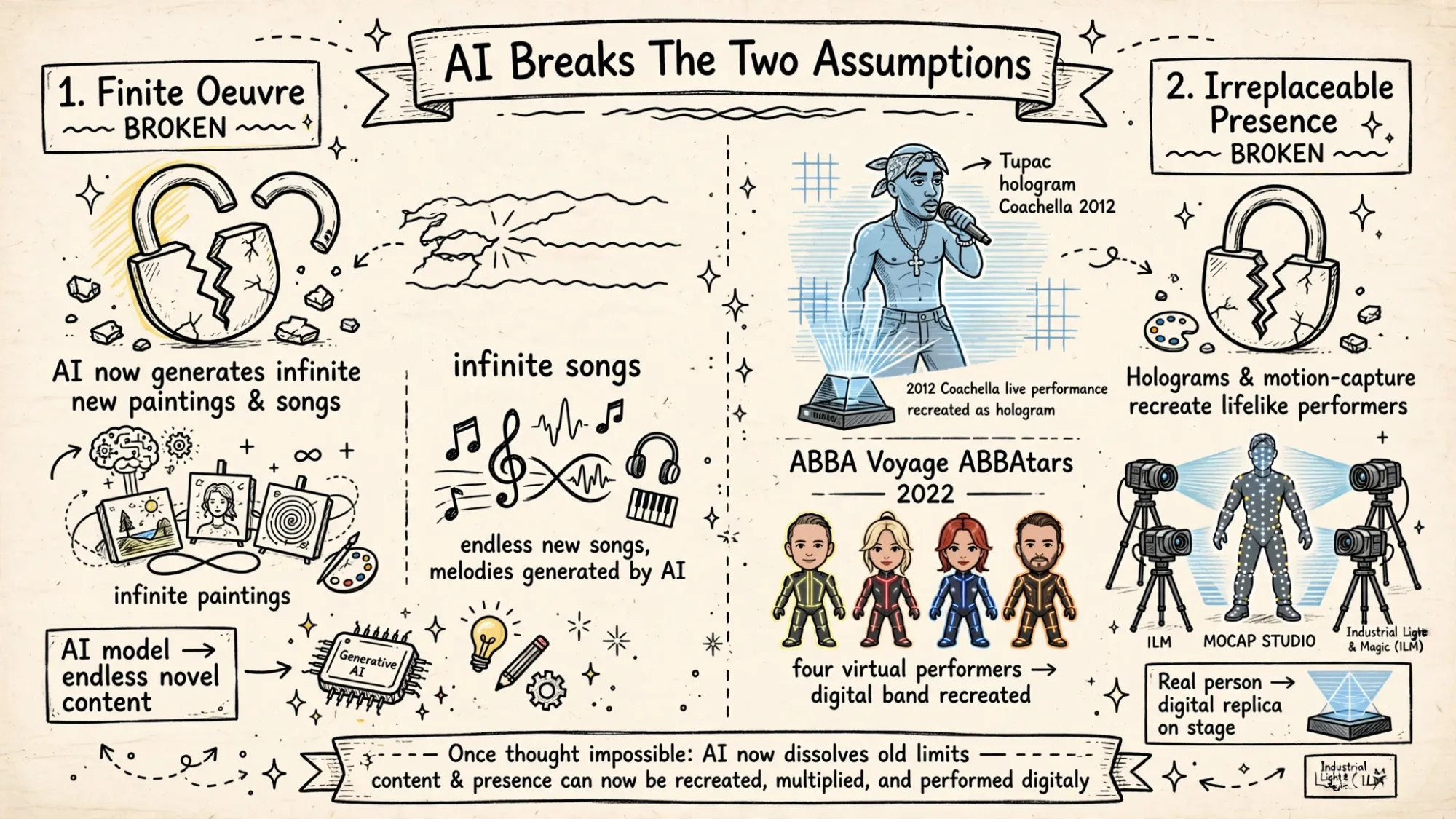
The dead artist effect relies on two assumptions that AI just killed.
Assumption 1: The oeuvre is finite.
When the artist unexpectedly dies, the price increases on impact because supply is fixed. AI makes it not fixed.
If an estate can license an AI to write a new song in the style of the artist, paint a new painting, or finish an unfinished album, the oeuvre becomes infinite. The coming era of dead musicians resurrected by AI, making money for the living, is already here.
Old songs now represent almost 75% of streams. Tribute bands are the rage, while defunct bands put out new albums using AI to replace missing members.
Assumption 2: Presence is irreplaceable.
You could never see them live again. That scarcity drove nostalgia and ticket prices. Now you can.
The first widely discussed hologram concert was the digital resurrection of rapper Tupac Shakur at the 2012 Coachella Valley Music and Arts Festival.
Created by special effects studio Digital Domain, Tupac appeared alongside Snoop Dogg and Dr. Dre.
Living pop group ABBA launched their ABBA Voyage residency in London, performing as digital ABBAtars created by George Lucas' Industrial Light & Magic, giving fans the illusion of seeing the original band live in 1979. New Elvis AI hologram shows are being built from home video footage and personal photos, described more like time travel than ABBA Voyage.
Whitney Houston and Roy Orbison hologram tours followed.
If presence can be licensed, death stops being final. It becomes a distribution strategy.
Estates Become Netflix Not Museums
This is where the Moonshots prediction gets sharp.
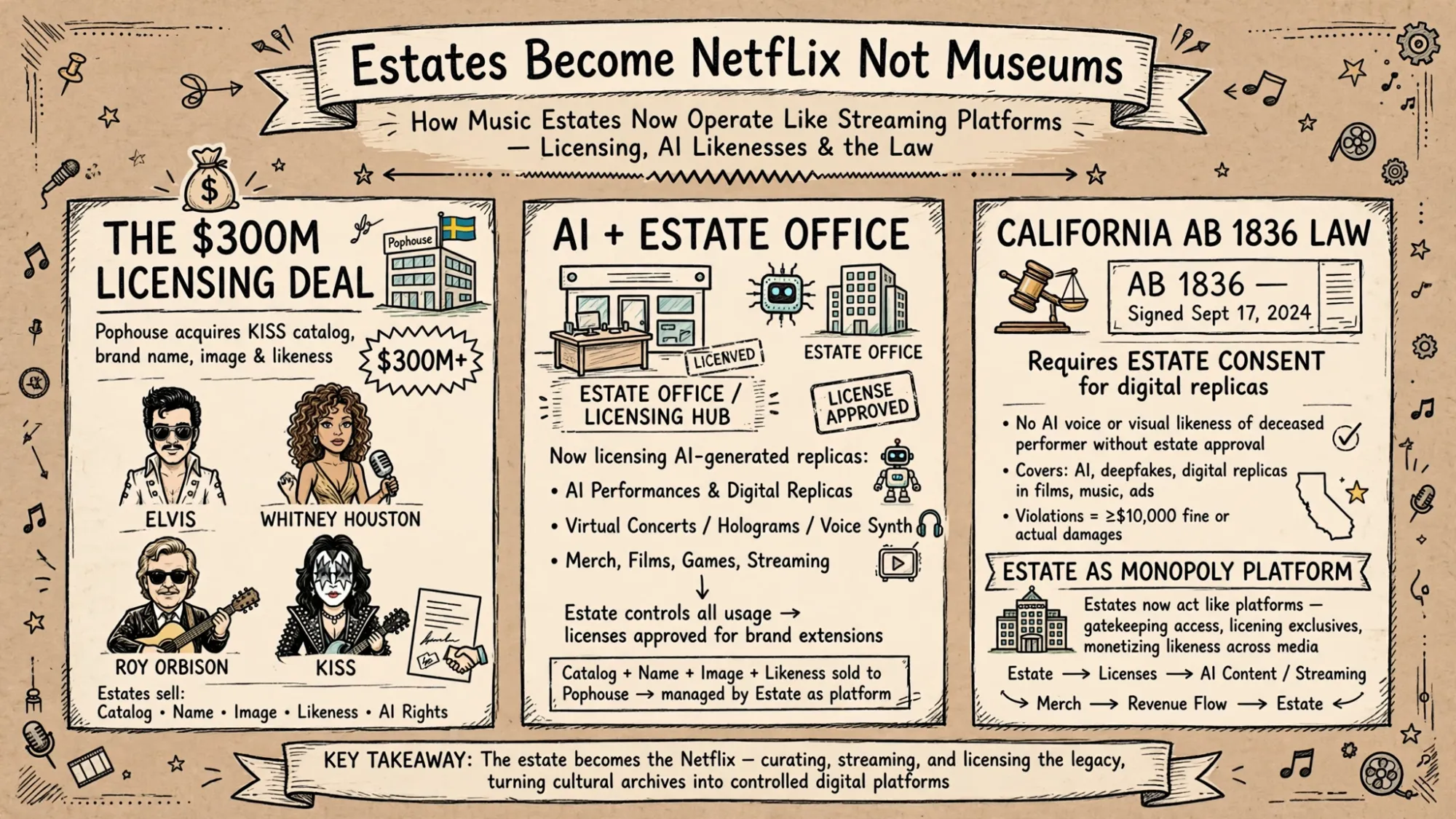
Before, estates acted like museums. Restrict supply, protect legacy, pump price through scarcity. After AI, estates act like Netflix.
California just made it legal and mandatory.
Assembly Bill 1836 mandates that consent from the estates of deceased performers is required before creating digital replicas using AI.
The bill covers all forms of digital recreation using AI, including still images, voice clones, and full character portrayals in films.
At federal level, the TAKE IT DOWN Act signed in 2025 adds takedown procedures for nonconsensual AI deepfakes.
That law does not stop AI. It creates a monopoly for the estate. Only the estate can license the official AI Elvis.
We already see the model. Kiss sold its song catalog, as well as its name, image, and likeness rights to Pophouse Entertainment for over $300 million as a step in developing a hologram show similar to ABBA Voyage.
Now the estate controls all usage, licenses approved for brand extensions, merch, films, games, streaming.
Catalog plus name plus image plus likeness sold to Pophouse, managed by estate as platform. Estate → Licenses → AI Content → Revenue Flow → Estate.
But there is a catch that heirs themselves flagged. AI fakes can depress licensing rates by flooding markets with inauthentic sound alikes, undermining price discipline, provenance, and consumers' trust online.
Up to 70% of streams on some platforms are fake, powered by AI tools and bot farms. Deepfake albums mimicking dead legends to exploit fanbases dilute brand integrity.
If the official estate floods the market with AI Elvis albums, it competes with the unofficial flood. Scarcity dies twice.
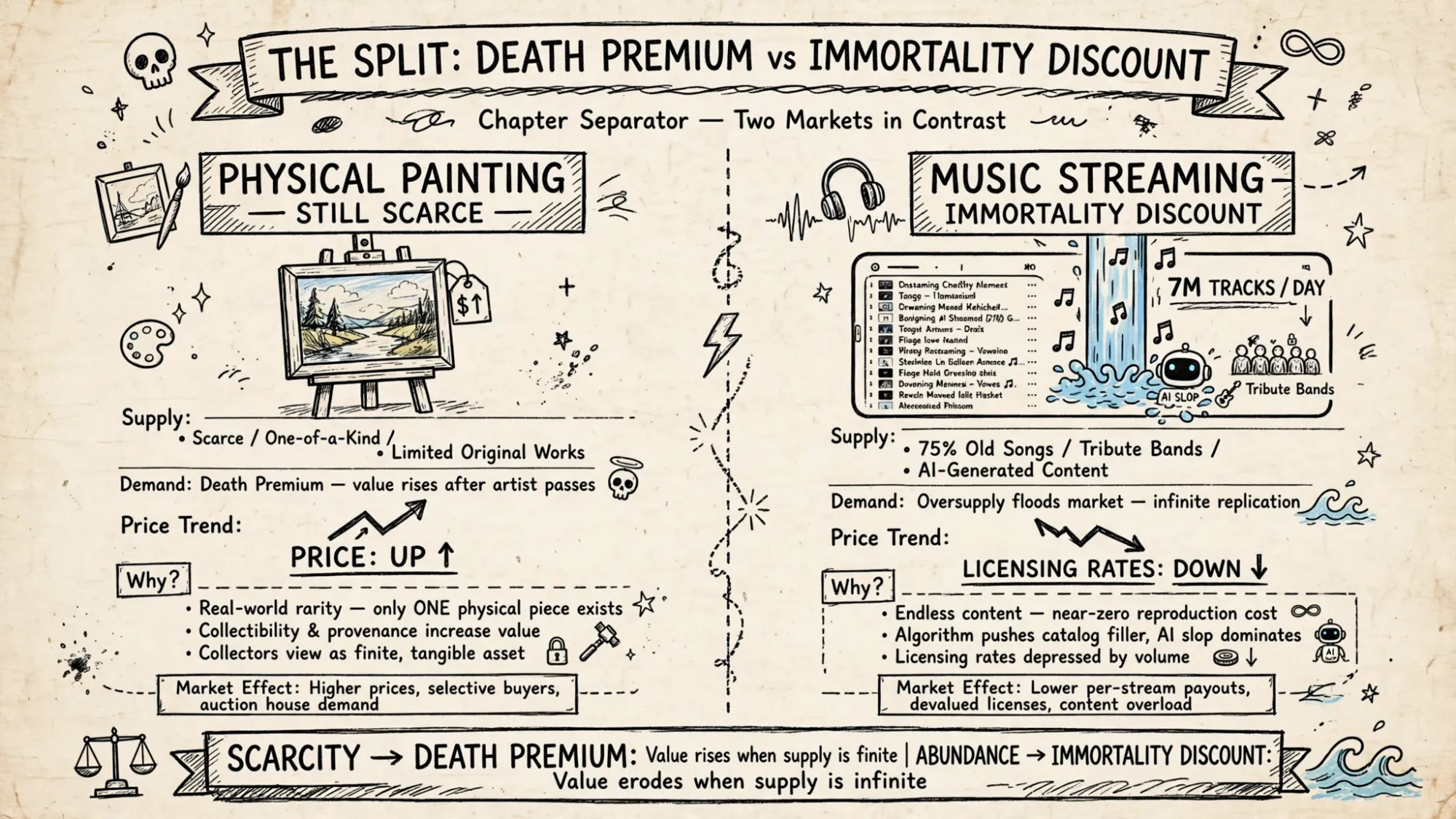
The Split: Death Premium vs Immortality Discount
So will the dead artist effect still exist? Yes and no. It splits.
For physical, unique objects, the effect gets stronger.
A Basquiat painting is still one painting. You cannot AI print another original canvas with provenance.
Insurance costs, estate negotiations, finite supply, all remain. Premature death premium of 55% will stay, maybe grow, because physical scarcity is now the only true scarcity left.
For performance, voice, and digital catalog artists, the effect flips to an immortality discount.
Music, acting, and persona are replicable. If an estate can release a new album every year forever, supply is infinite.
The classic post death dip of 26% in the year after death becomes permanent. Instead of prices rising because there will never be a new work, prices fall because there will always be a new work, and it is cheaper to license an AI version than the original master.
The music compression thesis describes it perfectly.
A shrinking population, an infinite flood of AI generated tracks, 7M AI tracks a day on Suno, broken discovery, and a hollowed out industry squeezing value.
The music industry has fallen in love with the dead and dying because dead artists are reliable IP.
Result: being dead becomes a good career move, but not a valuable one. You work forever, but your original masters do not appreciate. You become stock footage.
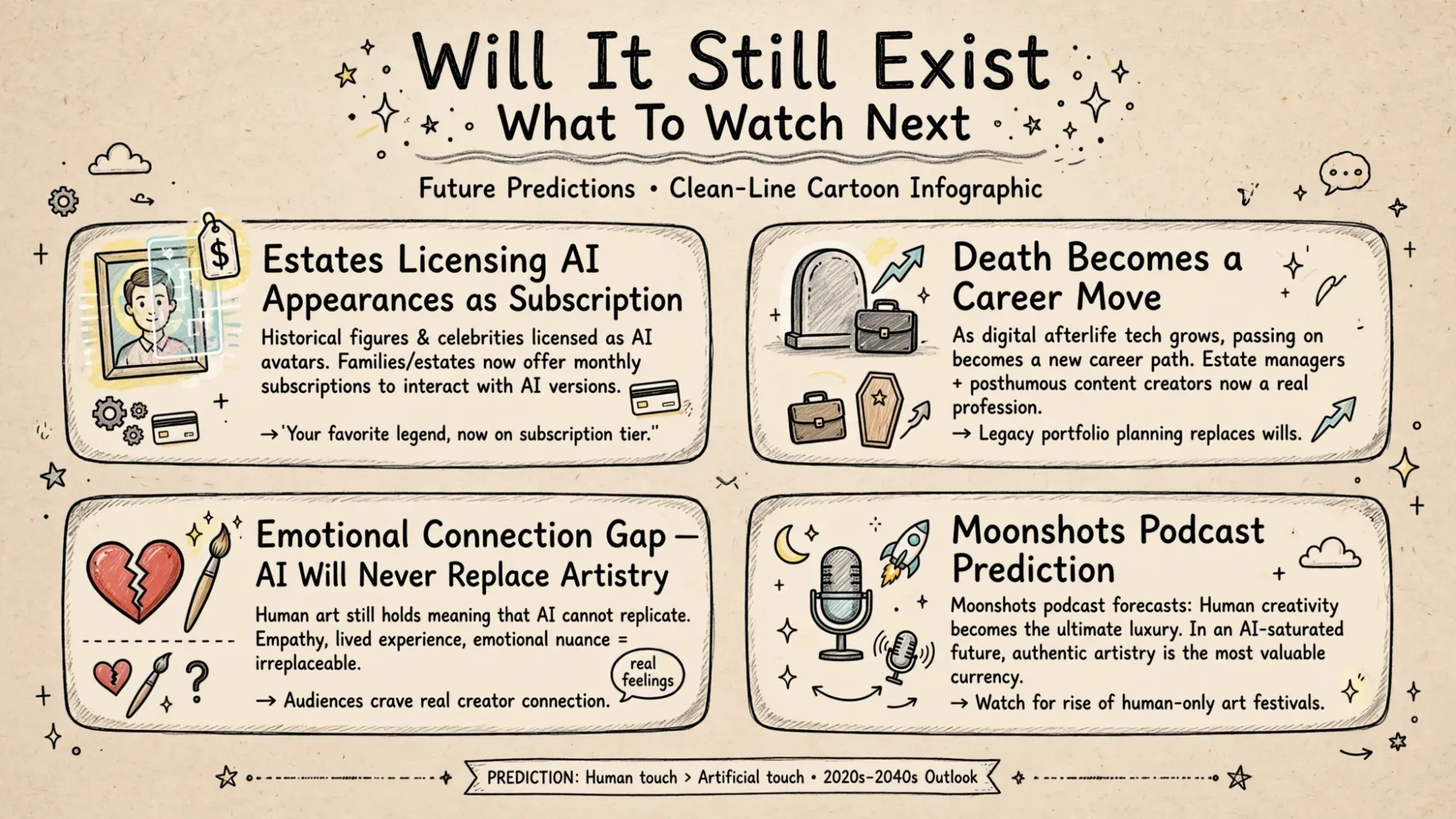
Will It Still Exist? What To Watch Next
The dead artist effect will not die. It will bifurcate into two markets.
- The Relic Market: Paintings, handwritten lyrics, first pressings, one of one objects. Here death still equals finite supply. Prices rise steadily while alive, drop sharply post death, then climb again as scarcity grows. Estates will protect this by keeping physical archives locked.
- The Likeness Market: Voice, face, motion, style. Here AB 1836 gives estates a legal monopoly, but AI abundance kills the premium. Estates that act like Netflix, licensing infinite AI appearances, will make more total revenue but lower per unit licensing rates. The emotional connection that lies within art, as ABBA Voyage co producer Svana Gisla said, AI will never provide that communication or replace artistry in any form. Fans may pay for novelty once, but not forever.
The prediction from Moonshots is right, but incomplete. Estates will license AI appearances, and that will put an end to the dead artist effect for anyone whose value was in performing, not in making a singular object.
For the next three years, watch:
- Who signs AB 1836 style estate AI deals first. Frank Sinatra and Bob Marley estates already signed petitions against devaluing work.
- Whether estates choose scarcity or Netflix. Luna Del Rey style clauses writing into wills to not release any music after they die versus Kiss style $300M sale.
- Whether auction data shows the 6% pre death rise and 26% post death fall getting wider. If AI flooding happens, the post death fall should deepen to 35 to 40% and never recover.
If you are collecting, buy physical. If you are an estate, do not become Spotify. Scarcity still pays. Immortality does not.