Artificial Intelligence Will Boost Netflix's Margins
Netflix spends $18B on content. AI doesn't just make it cooler, it makes it cheaper, better targeted, and far more profitable. From VFX to dubbing to ads, here is the full margin playbook.
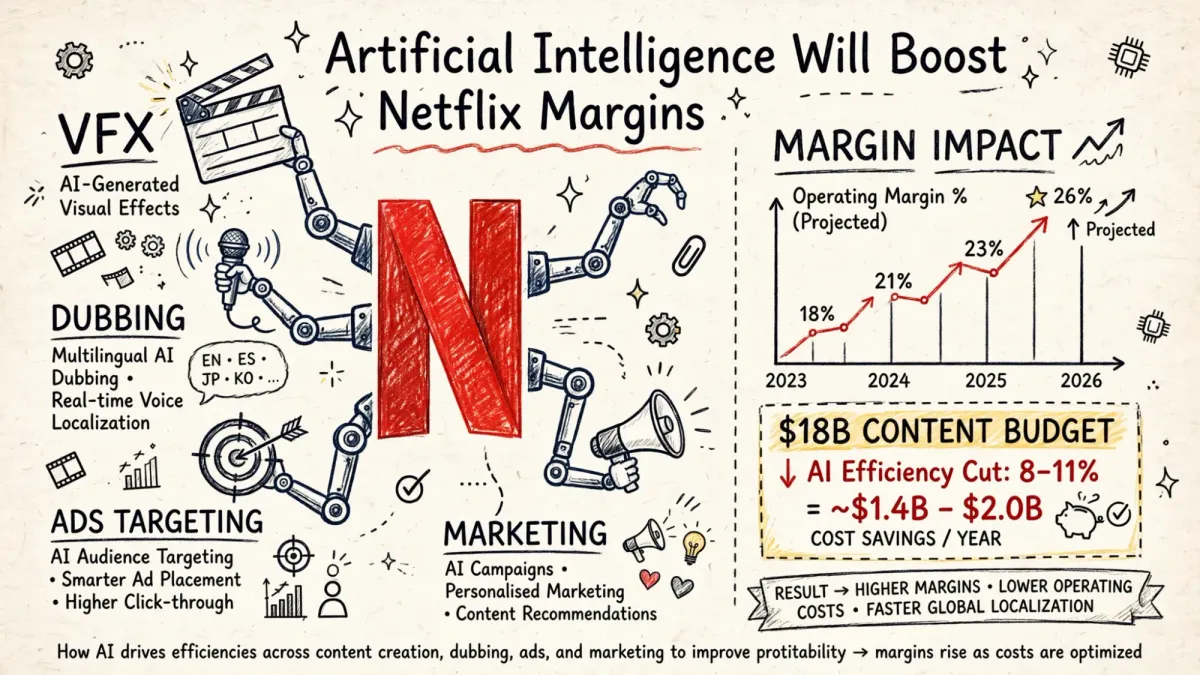
Everyone talks about AI making Netflix's shows weirder. No one talks about it making Netflix's margins wider.
It is already happening. 31.7% operating margin in Q2, $18B content budget that is 42% of revenue, and an ad tier with 94 million subscribers. The old equation was grow subscribers to offset rising content costs. That no longer works.
AI is now the operating leverage. Not as a gimmick, but as cost control across the entire pipeline.
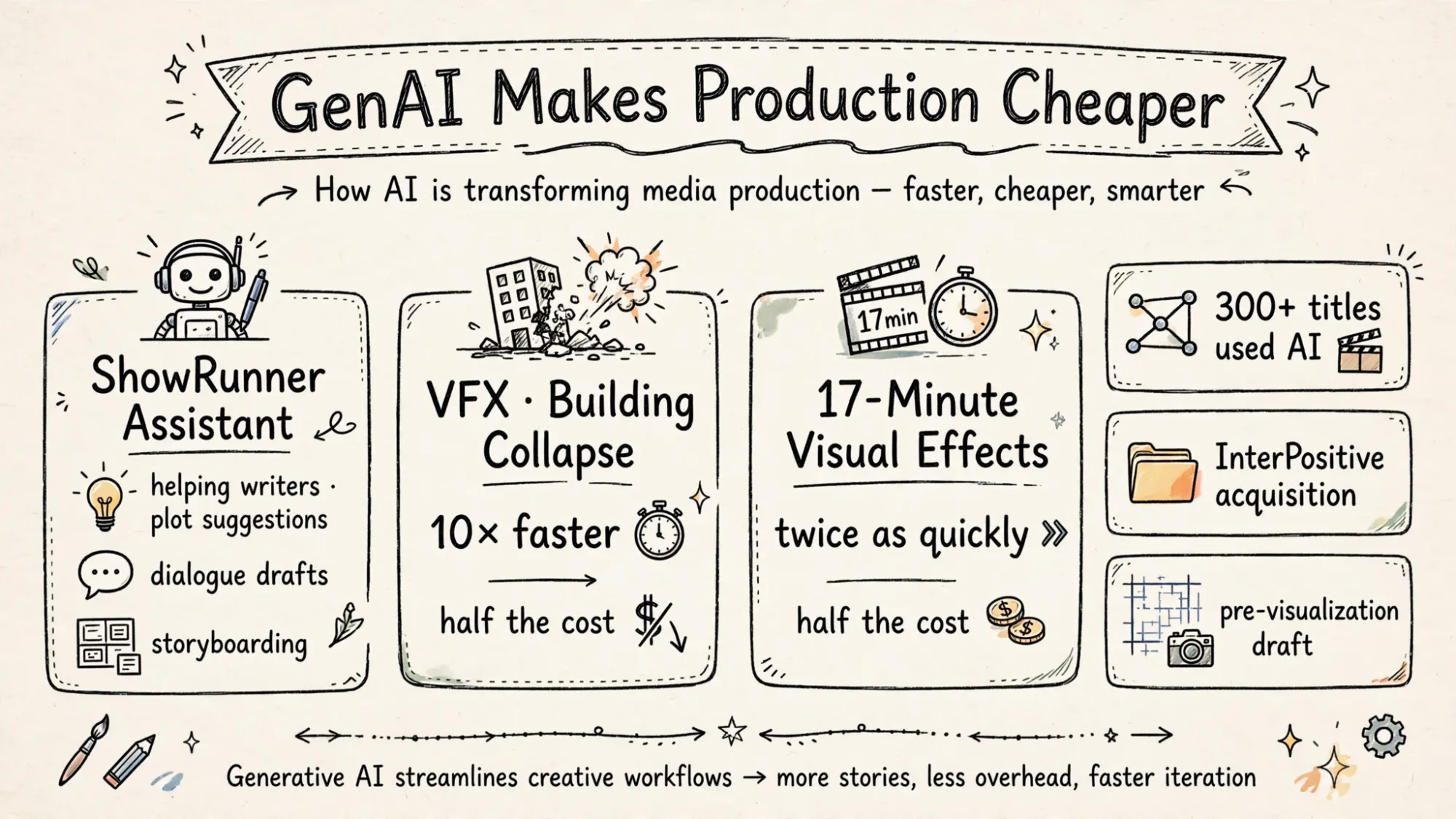
1. GenAI Makes Production 15-25% Cheaper
Netflix just disclosed it has used generative AI in around 300 titles this year, primarily to speed up visual effects work and reduce production costs.
The examples are concrete:
VFX at half the cost: In one title, AI helped complete about 17 minutes of visual effects work in roughly half the time and at about half the cost of traditional methods.
In The American Experiment, a building collapse scene was finished 10x faster than with traditional VFX tools, and it cost less. Without AI, some scenes would have been removed entirely because budgets could not accommodate them.
Pre-production compressed: Internal tool ShowRunner's Assistant aids human writers by generating plot suggestions, dialogue drafts, and storyboarding assets, dramatically cutting down pre-production cycles.
Pre-visualization reduces wasted production effort.
Proprietary moat: Netflix acquired InterPositive, an AI-focused company co-founded by Ben Affleck, tailored specifically for filmmaking.
Its Eyeline Studios lab with Stanford and Stony Brook released Go-with-the-Flow video model in January 2025. Morgan Stanley estimates InterPositive workflows, once integrated across 120+ active slates by 2028, could cut per-title production costs by 8-11% and reduce post-production timelines by 18-22%.
Netflix's own rules show how serious this is. New guidelines allow AI for early ideation tasks such as moodboards or reference images, but stricter oversight applies beyond that stage: generated content must not replicate copyrighted works, security of inputs must be maintained, and storage or reuse of production data by AI tools is prohibited.
Analysts project these efficiencies could add $1.2 to $1.8 billion annually to the bottom line by 2027.
Amazon accelerated AI research budget by 40% in response, Apple is partnering with Pixar on AI animation.
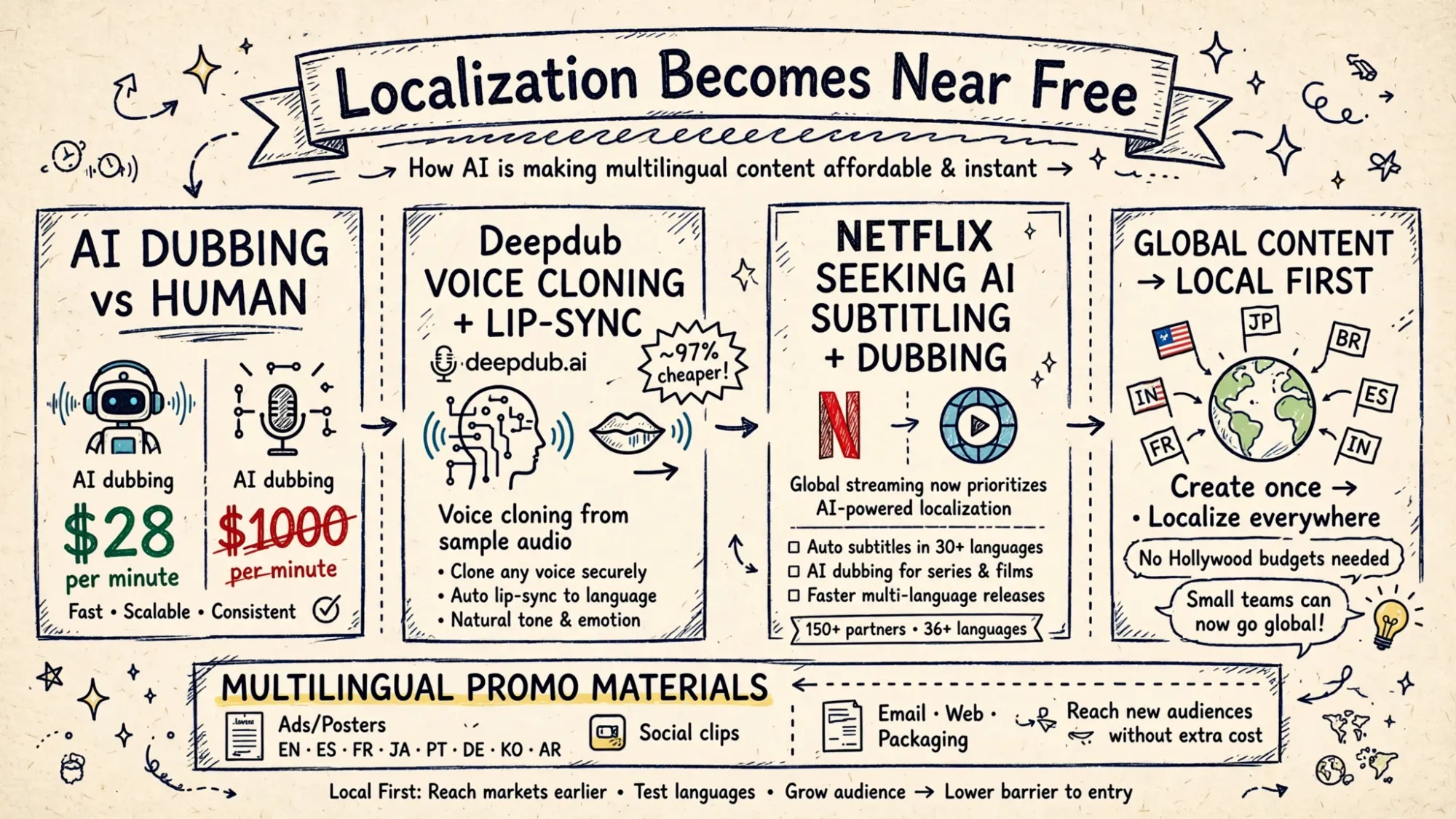
2. Localization Becomes Near Free
This is the biggest unlock for a global platform. Netflix can produce high-quality, local-first content without importing Hollywood-sized budgets everywhere.
Traditional dubbing is expensive and slow. AI dubbing changes the math:
Recent advancements such as OpenAI's Voice Engine and Deepdub enable real-time voice cloning and language translation, reducing costs to $28 per minute. Dynamic lip-syncing through generative AI further enhances content realism.
Netflix is seeking applications of AI for subtitling and dubbing, funding research and listing roles for AI subs and dubs.
Initial trials show voiceovers and subtitles created with AI could be as close as having a human translator, but Netflix does not neglect human approval.
The flywheel: Create once, localize everywhere.
Auto subtitles in 30+ languages, AI dubbing for series and films, faster multi-language releases, plus multilingual promo materials.
That means small teams can go global.
A Korean drama or Spanish thriller no longer needs a $1,000 per minute dubbing budget to hit 190 countries. It needs $28 per minute and an afternoon.
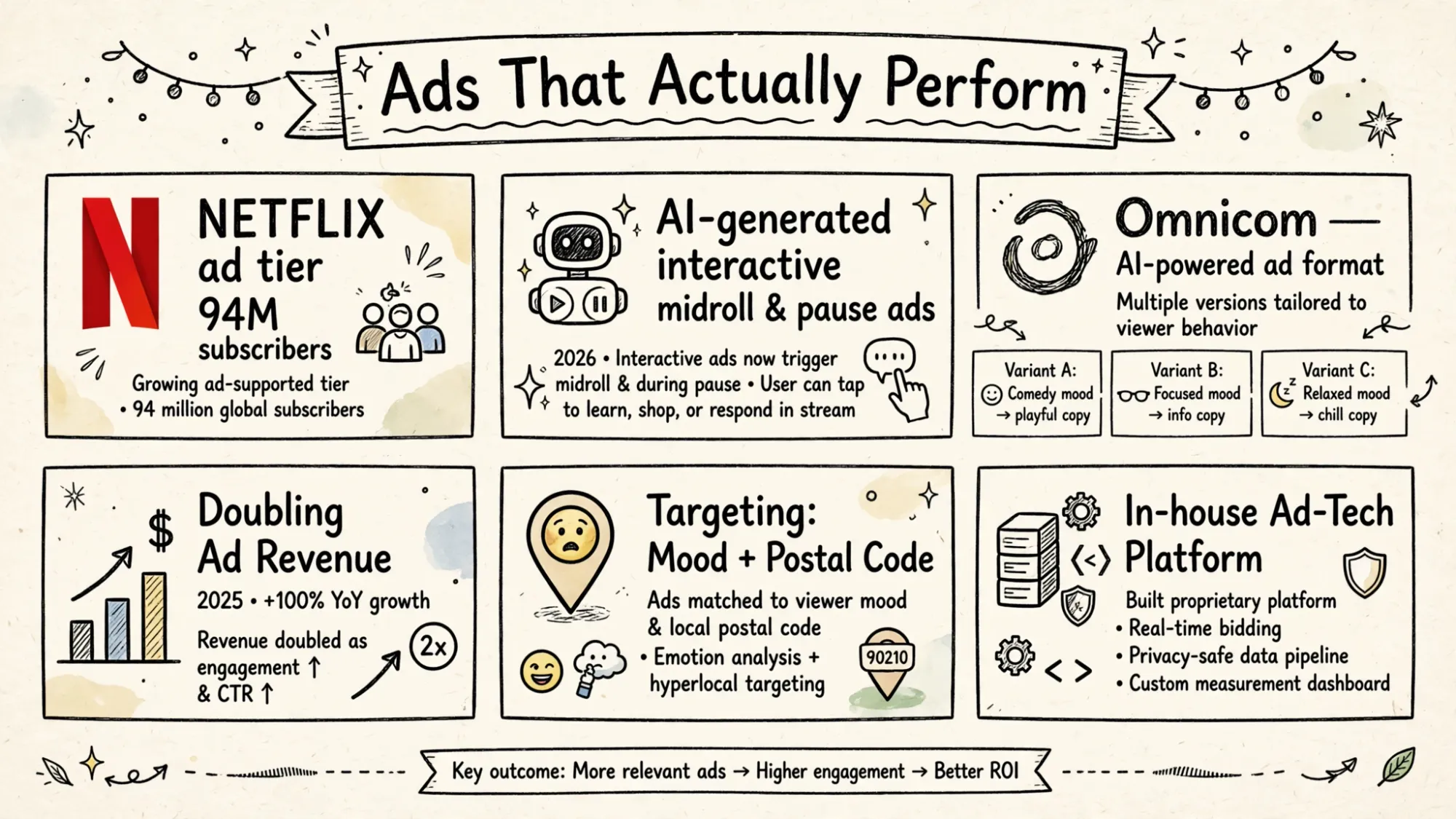
3. Ads That Actually Perform
The ad tier started as a cautious move. It is now a margin engine, and AI is central.
- Scale: Netflix's ad-supported tier hit 94 million global monthly viewers. It is expanding into 15 additional countries from 2027 including Indonesia, Philippines, Thailand. The company expects to roughly double ads revenue in 2025.
- New formats: Interactive midroll and pause ad formats incorporating generative AI will be available by 2026 in all ad-supported markets. Netflix plans to show AI-generated ads that seamlessly blend with content by 2026.
- AI-powered creation: Partnership with Omnicom: advertisers can now create multiple versions of their ads, tailored to viewer behavior and specific programming, using Netflix's AI-enabled platform. Available to Omnicom Media clients in the US, expanding by end of 2026.
- Targeting: Advanced targeting suite launched July 1, 2025 for EMEA: mood-based audience segmentation, postal code-level targeting, audience forecasting, contextual targeting. Accessible via The Trade Desk, Google DV360, Microsoft, Magnite, Yahoo DSP. In-house ad-tech platform rolled out in all markets where ad tier is available.
President of Advertising Amy Reinhard said AI would help bring advertisers closer to the content.
Translation: brands can generate and localize entire ad experiences in real time, tied to the IP you are watching.
YouTube has Peak Points, Netflix has in-house AI that actively generates ads.
Higher relevance = higher CPMs = higher margin without more content cost.
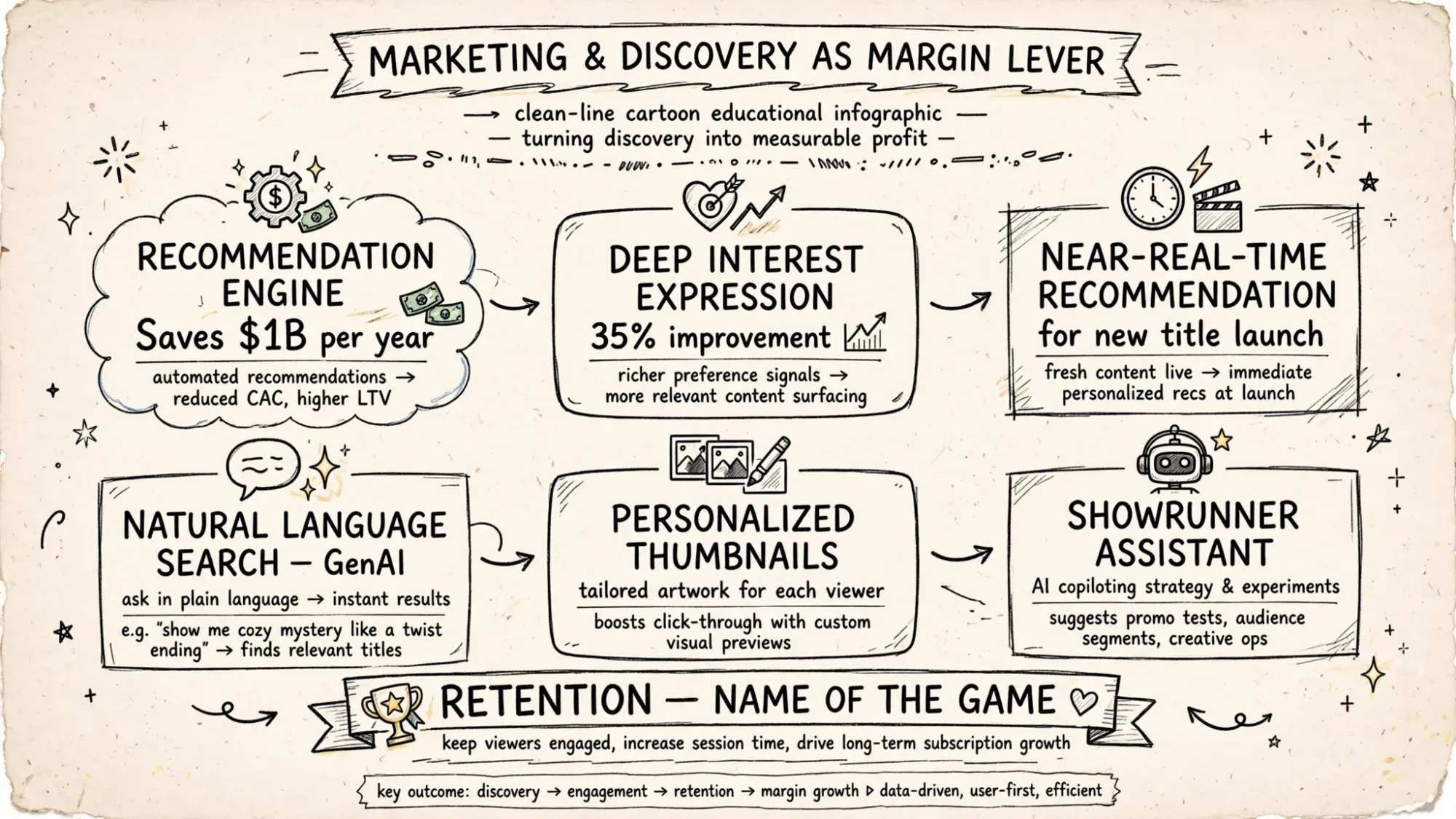
4. Marketing And Discovery As A Margin Lever
Netflix's personalized recommendation engine is worth $1 billion per year.
The combined effect of personalization and recommendations save us more than $1B per year, per an academic paper by Chief Product Officer Neil Hunt.
A new neural system called Deep Interest Expression improves recommendations by up to 35%.
Why is that margin? Because discovery is retention, and retention is cheaper than production.
Netflix moved from batch processing to near-real-time recommendation to accelerate learning for time-sensitive scenarios such as new title launch campaigns or strong trending popularity cases.
Next steps in the shareholder letter:
- Natural language search: Using GenAI for content recommendation, letting users search in natural language without exact titles. Revealed in Q3 2025 letter.
- Personalized marketing: Using AI to distribute promotional materials in different languages to help content reach wider audience. Personalized thumbnails, trailers cut automatically for your taste, email and push campaigns generated per micro-genre.
- Automated planning: Netflix is deploying machine learning to help advertisers create more relevant campaigns, automate planning workflows, and tailor creative to Netflix's IP.
Retention is the name of the game. Reducing friction improves retention without adding content costs. Discovery is not a design problem alone; it is a margin lever.
Other quiet margin levers you will not see in a sizzle reel: AI for content greenlighting predicting viewership per dollar, script coverage, scheduling shoots to avoid overtime, customer service deflection, churn prediction, and fraud detection on shared accounts.
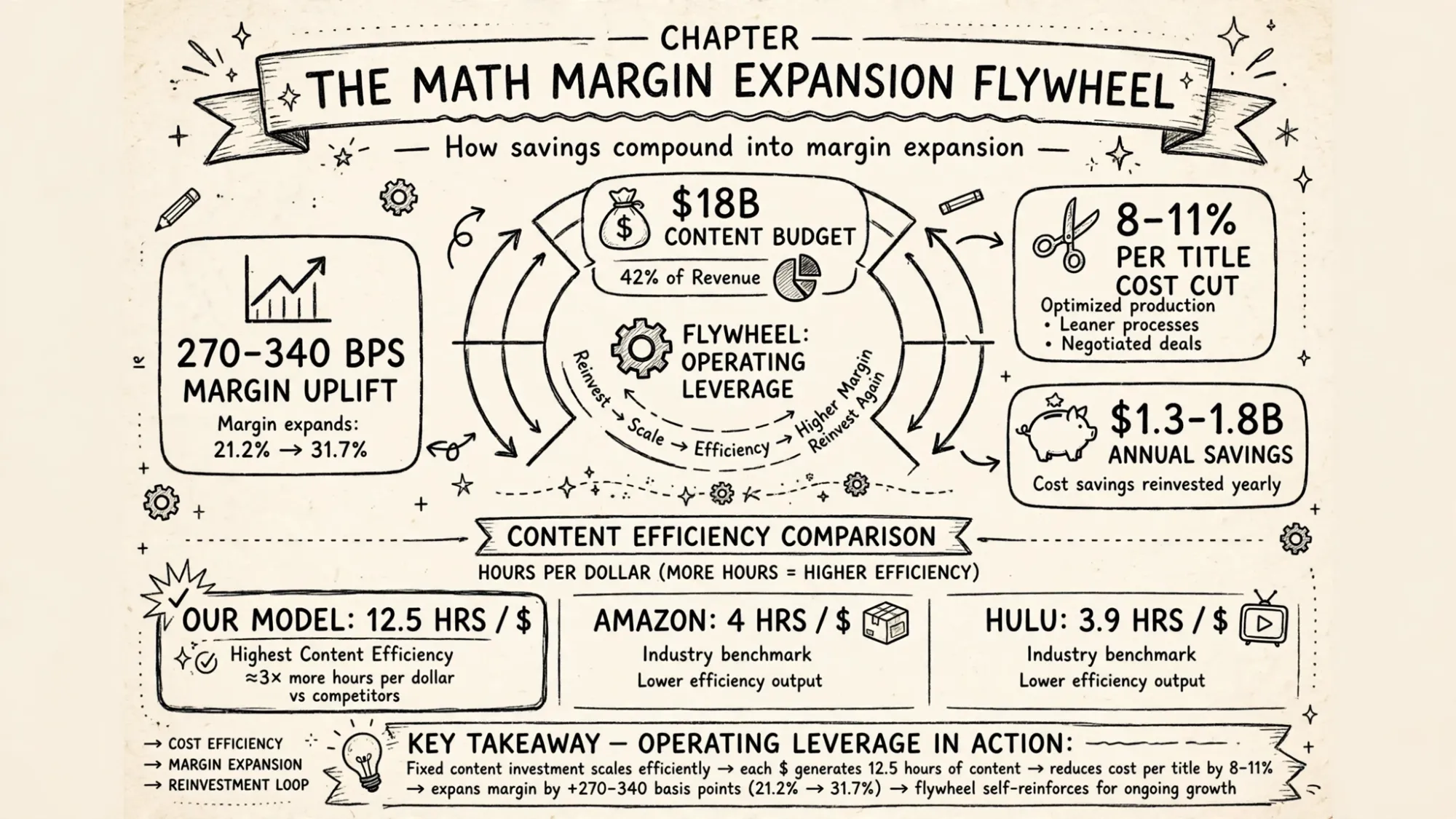
5. The Math: Margin Expansion Flywheel
Put it together.
Netflix's 2025 content production budget hit $19 billion, representing 42% of total annual revenue.
Even a 10% reduction in production costs driven by widespread adoption of InterPositive's AI tools would translate to $1.9 billion in annual operating savings, boosting adjusted EBITDA margins by an estimated 350 basis points over three years.
Morgan Stanley's math: 8-11% per-title cost cut + 18-22% faster post-production = $1.3B to $1.8B annual run-rate savings and 270 to 340 basis points uplift in adjusted operating margins from 21.2% reported for full-year 2025 to 31.7% and beyond.
And Netflix is already the most efficient. UBS: Netflix gets 12.5 hours of watching per dollar it spends on content, versus Amazon 4 hours and Hulu 3.9 hours. Roughly 3x more efficient than Amazon or Hulu.
Operating leverage means how much of each extra dollar of revenue survives as profit once costs are mostly fixed or falling.
AI savings improve it: each additional Netflix show costs less to finish. But it multiplies growth, it does not create it. That is why margins pull away from content spend.
The full AI margin stack:
Production 15-25% cheaper -> Localization $28/min not $1,000/min -> Marketing automated and personalized -> Discovery reduces churn -> Ads more relevant -> Doubles ad revenue -> Reinvest savings -> More local-first hits -> Higher hours per dollar -> Higher margin.
Netflix is not using AI to replace creators.
It is using AI to make a $18B budget behave like a $14B budget while delivering more titles, in more languages, with better ads.
That is how you get from 18% operating margin in 2023 to 21% in 2024 to 23% in 2025 to 26% projected in 2026 and beyond.