Will Palmer Luckey Run for President in His 60s? The Long Game
Palmer Luckey is 34. The real question is whether he runs for president in his 60s, after decades of building wealth, allies and influence in Washington. Here's why a late run is far more plausible than an early one, what history says about outsiders, and what could stop him.
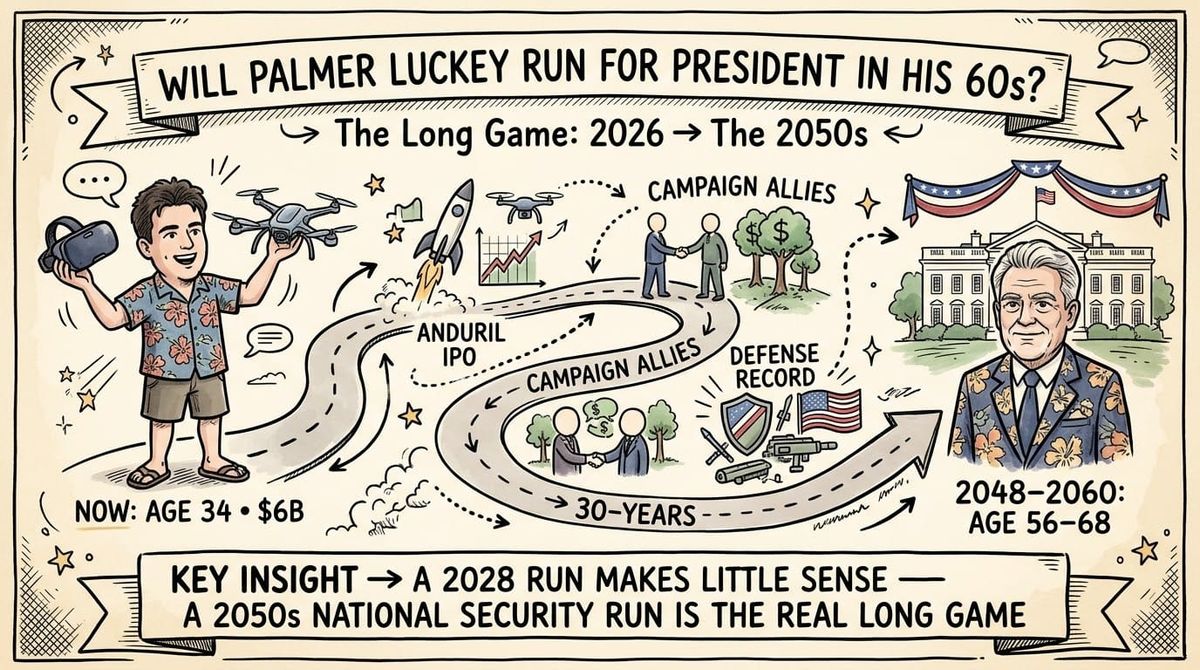
Palmer Luckey is 34.
Asking whether he'll run for president in 2028 misses the more interesting question.
What does he look like at 60 or 65, after three more decades of building companies, funding campaigns and working with every administration?
I couldn't find any public statement from Luckey saying he plans to run for president, or that he never will.
So this is my own reasoning about the long game.
I think a late run is far more plausible than an early one, and it would look very different from what most people picture.
The Timeline That Matters
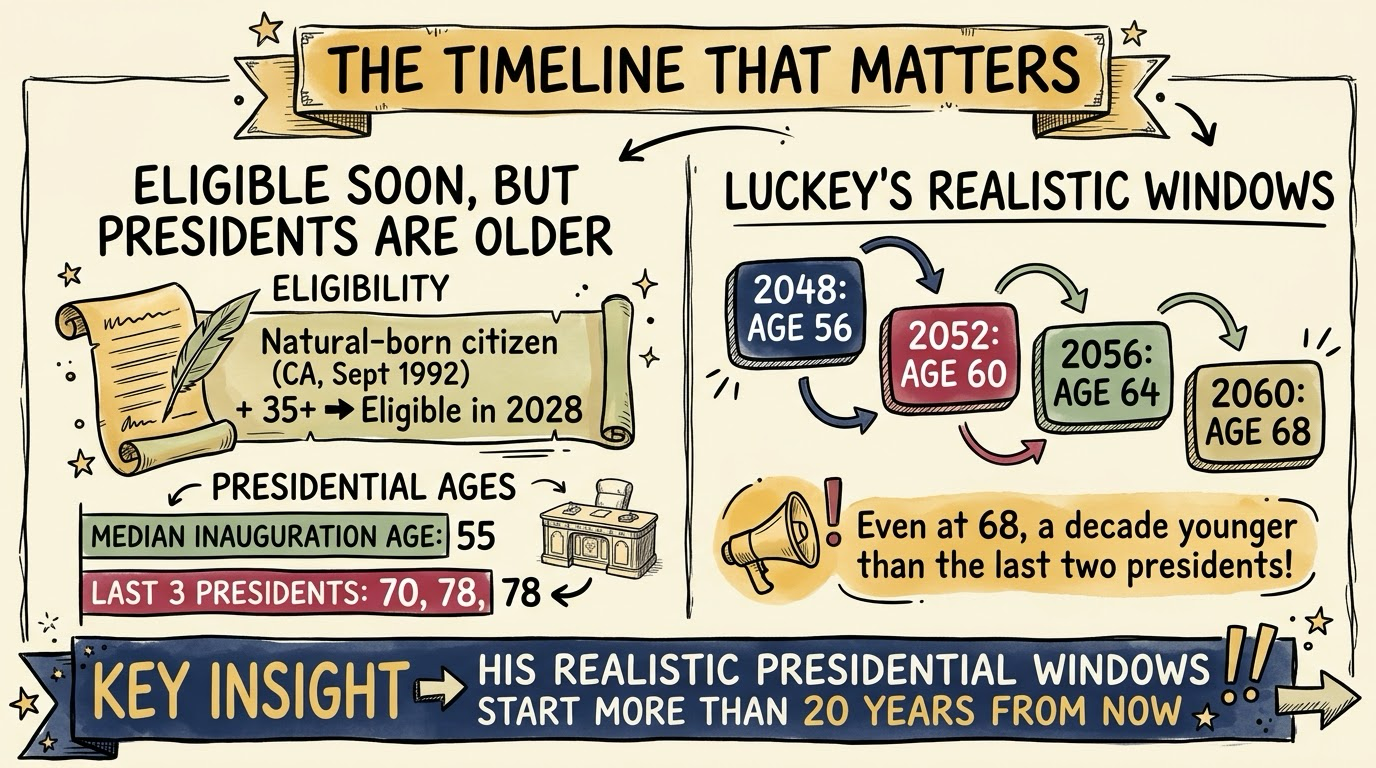
Legally, Luckey can run as soon as 2028.
The Constitution requires a president to be a natural-born citizen and at least 35, and he was born in California in September 1992.
But presidents are rarely young.
The median age at inauguration is 55.
The last three inaugurations involved presidents aged 70, 78 and 78.
Luckey will be 56 at the 2048 election, 60 in 2052, 64 in 2056 and 68 in 2060.
Even at 68, he'd be a decade younger than the last two presidents were on inauguration day.
So his realistic windows start more than twenty years from now, and there are at least four of them.
What Thirty Years Of Compounding Looks Like
Power in Washington builds slowly, and Luckey has started early.
Start with money.
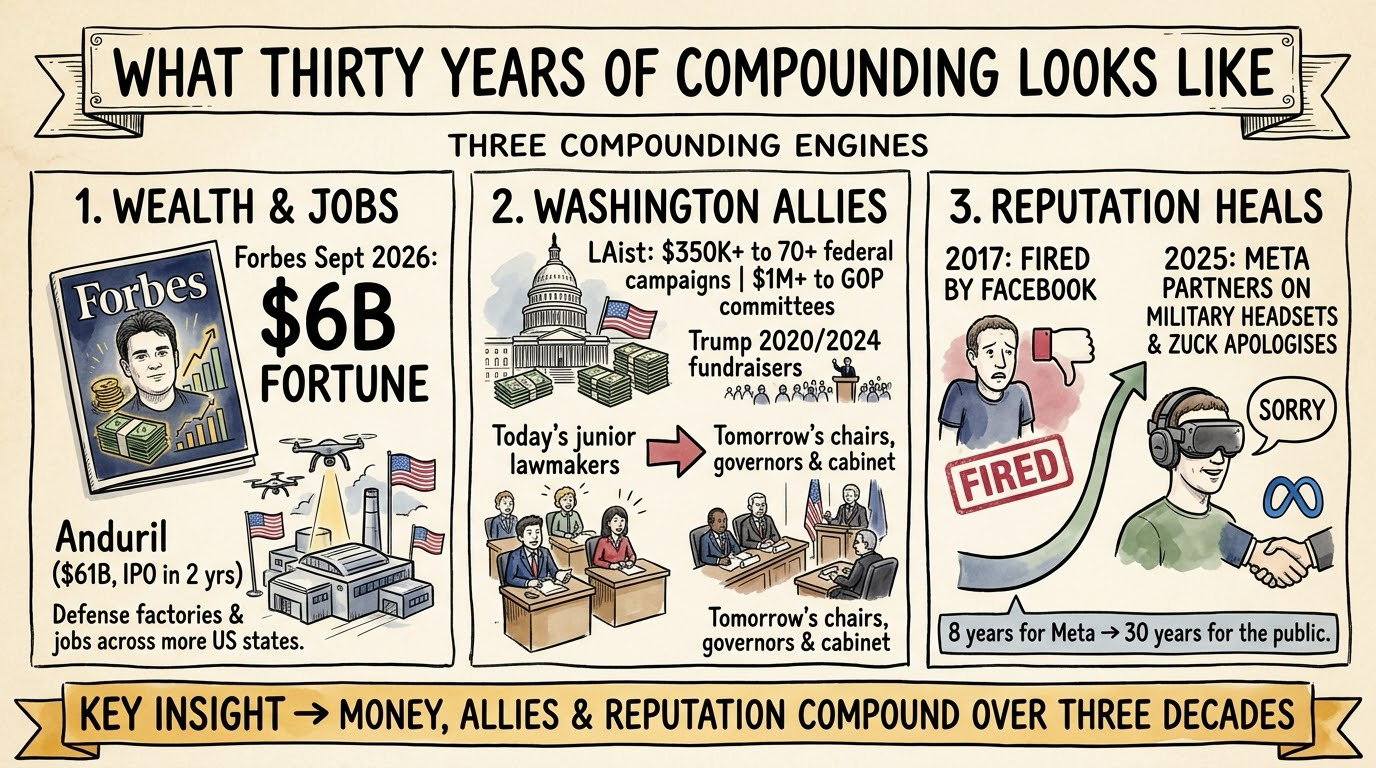
Forbes put his fortune at $6 billion as of September 2026.
Anduril was last valued at $61 billion and hopes to go public within two years.
If it grows into one of the country's main defense contractors, his wealth grows with it, and so does the number of states with Anduril jobs in them.
Then there are relationships.
LAist reports that he gave more than $350,000 to over 70 federal campaigns this cycle, nearly all Republican, and more than $1 million to Republican committees over time.
He hosted fundraisers for Donald Trump in 2020 and 2024, and for two senators and a congressman this summer.
Keep that up for thirty years and the junior lawmakers he backs today become committee chairs, governors and cabinet secretaries.
The people who work at Anduril now will also spread through government and industry over time.
Reputation changes with time as well.
Facebook pushed him out in 2017 after a political donation.
By 2025, Meta was his partner on military headsets, and he said Mark Zuckerberg had apologised.
If the company that removed him came around in eight years, I think a wider public could come around in thirty.
I've profiled him before as the uncancellable builder, and that pattern is the reason.
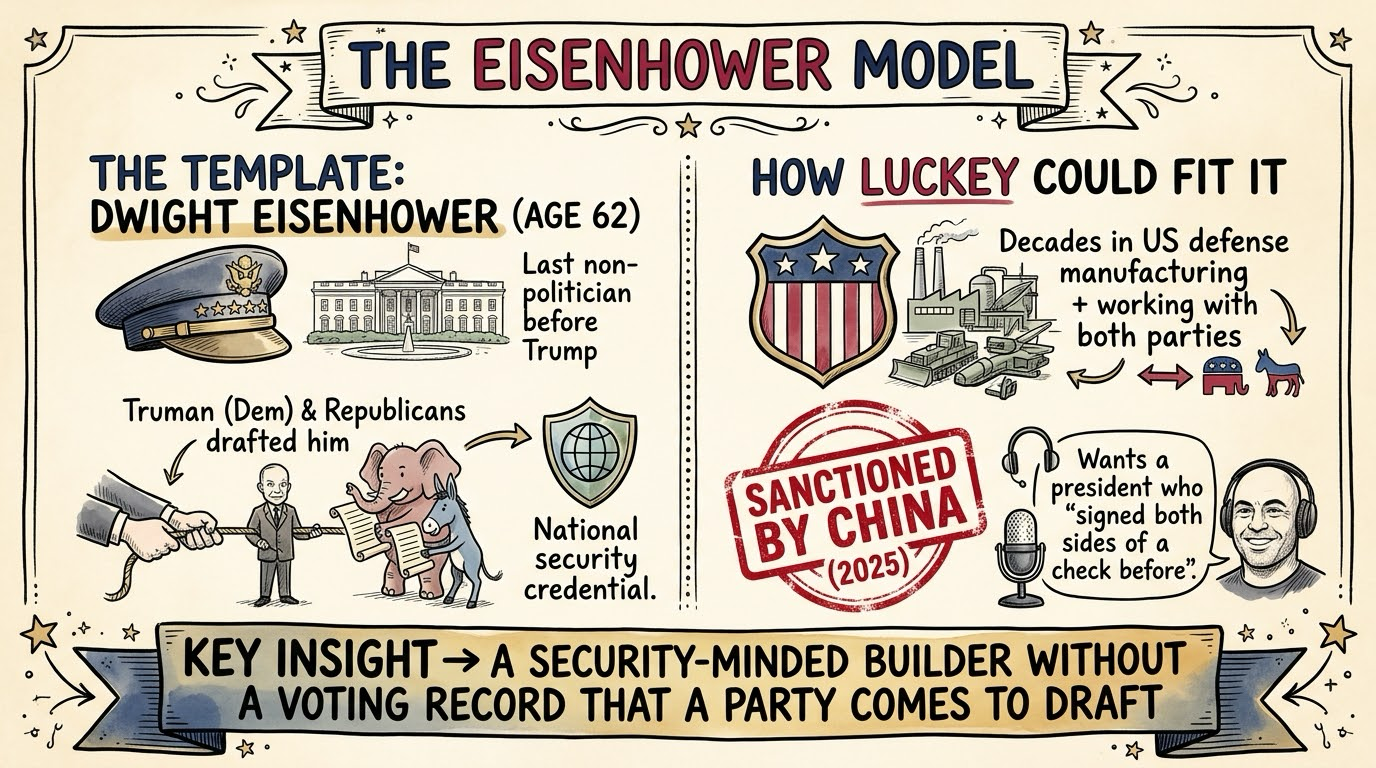
The Eisenhower Model
History offers a template for how a non-politician reaches the White House late in life.
Donald Trump is the only president who held no political office or military post before winning.
Before him, the last president with no political experience was Dwight Eisenhower, who took office at 62.
Eisenhower didn't climb through elections.
Both parties wanted him.
Harry Truman pressed him to run as a Democrat, and Republicans organised a movement to draft him.
His credential was national security, earned over decades.
That's the path I'd watch for Luckey.
By his 60s, he could be the best-known figure in American defense manufacturing, with a long record of working with presidents from both parties.
China already sanctioned him personally in 2025, which is an unusual line on a civilian's record.
If the rivalry with China is still the central issue in the 2050s, a party looking for a security-minded candidate without a voting record could come to him.
His own stated preference points the same way.
On Joe Rogan's podcast last year, he said he wanted a president who had "signed both sides of a check before."
Someone who believes builders make better leaders than career politicians has probably thought about what that says about himself.
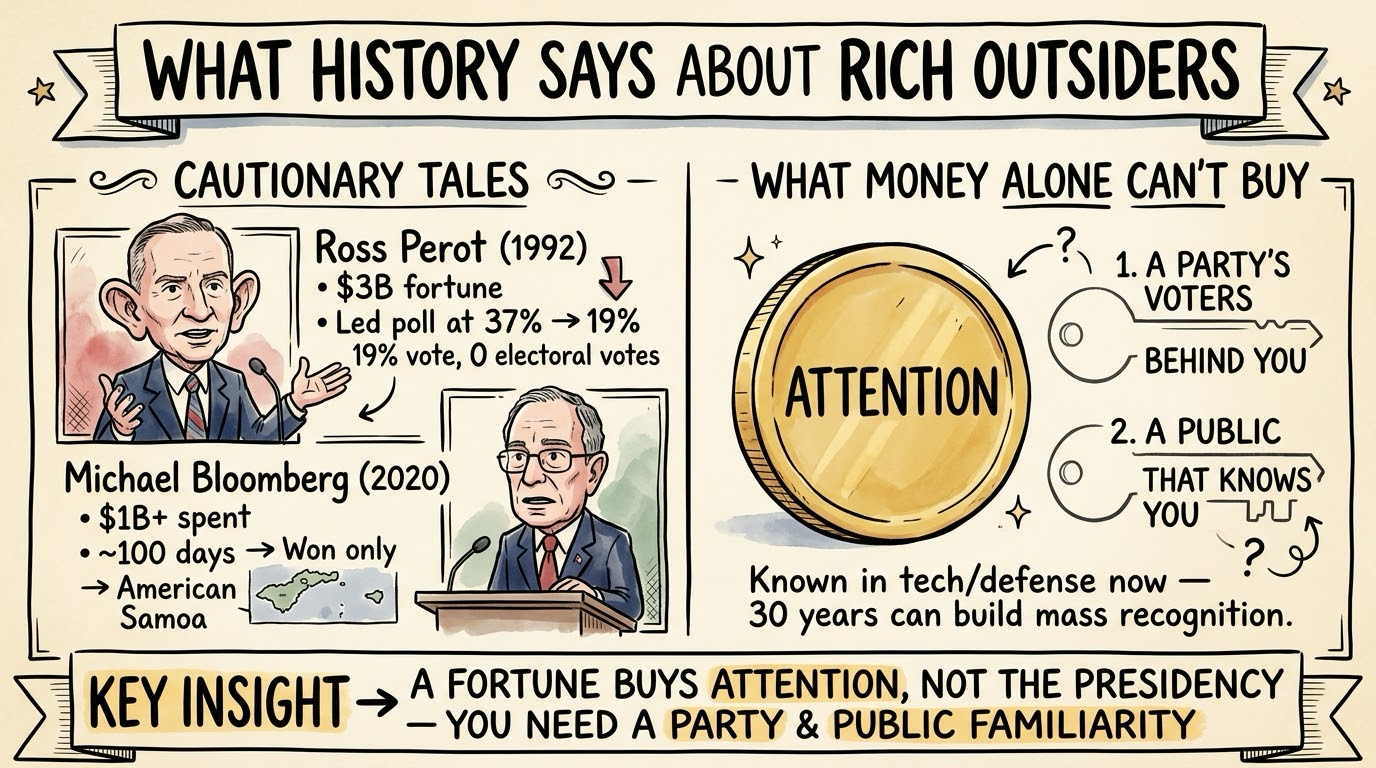
What History Says About Rich Outsiders
Money alone has a poor record.
Ross Perot had a fortune of about $3 billion and paid for most of his own 1992 campaign.
He led one national poll at 37% that June.
He finished with about 19% of the vote and no electoral votes.
Michael Bloomberg spent more than $1 billion of his own money in 2020.
His campaign lasted about 100 days and won only American Samoa.
The lesson I take from both is that a fortune buys attention and very little else.
A candidate needs a party's voters behind them and a public that already knows who they are.
Today, Luckey is well known in technology and defense circles and much less known outside them.
Three decades is plenty of time to change that, and in my view he's already more comfortable in front of a microphone than most founders.
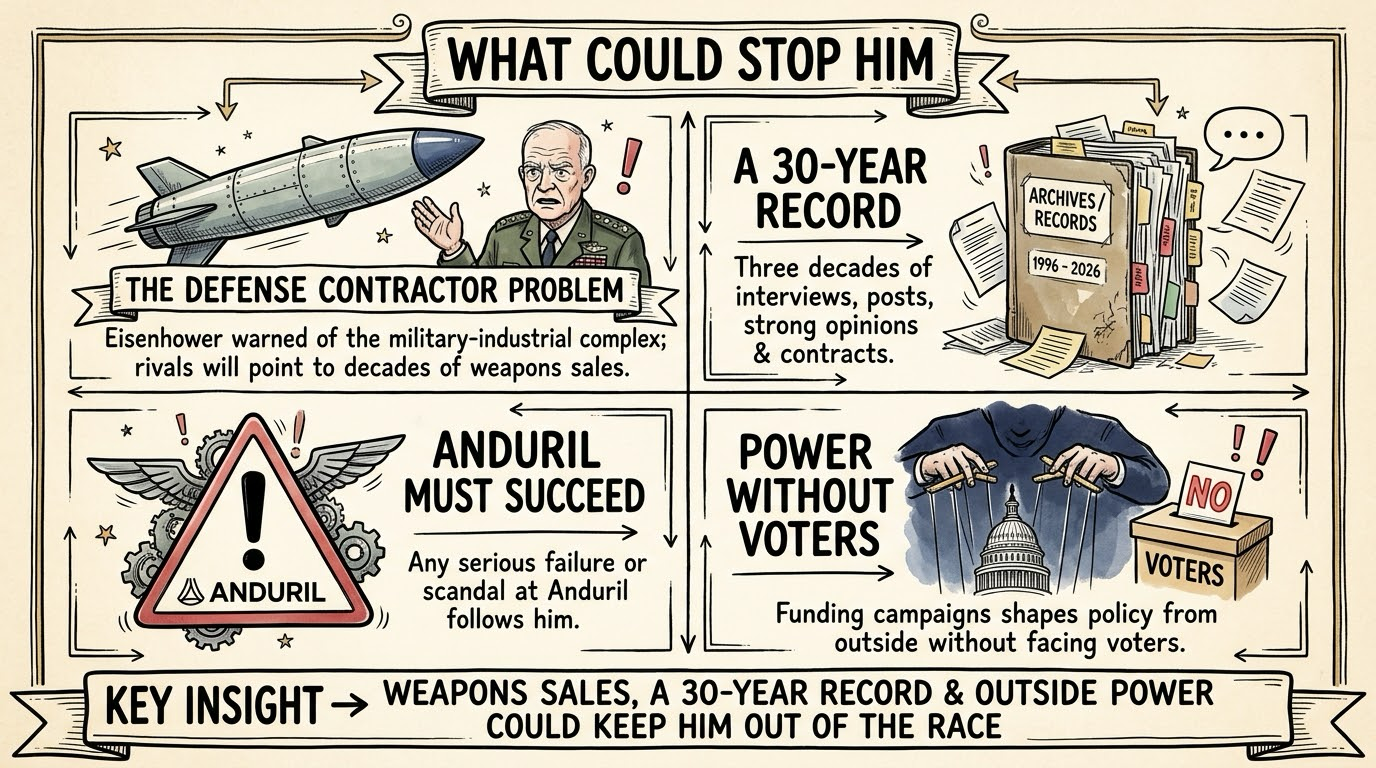
What Could Stop Him
Time solves some problems and creates others.
The defense contractor question never fully goes away.
There's an irony in the Eisenhower comparison.
Eisenhower used his farewell address to warn the country about the growing influence of the military-industrial complex.
Luckey would be asking voters to elect one of its most successful builders.
Even if he sold every share, opponents would point to decades of weapons sales and to every conflict those weapons were used in.
A long career also means a long record.
Thirty more years of interviews, posts and contracts gives rivals a lot of material.
He holds strong positions that already divide opinion.
Anduril has to keep succeeding too, and a serious failure or scandal at the company would follow him.
And he may simply prefer the power he'd already have.
A founder of a major defense company who funds dozens of campaigns can shape policy whoever is in office, without facing voters.
As I wrote in Anduril and Palantir, the duo that will establish US dominance, these companies already influence national security from the outside.
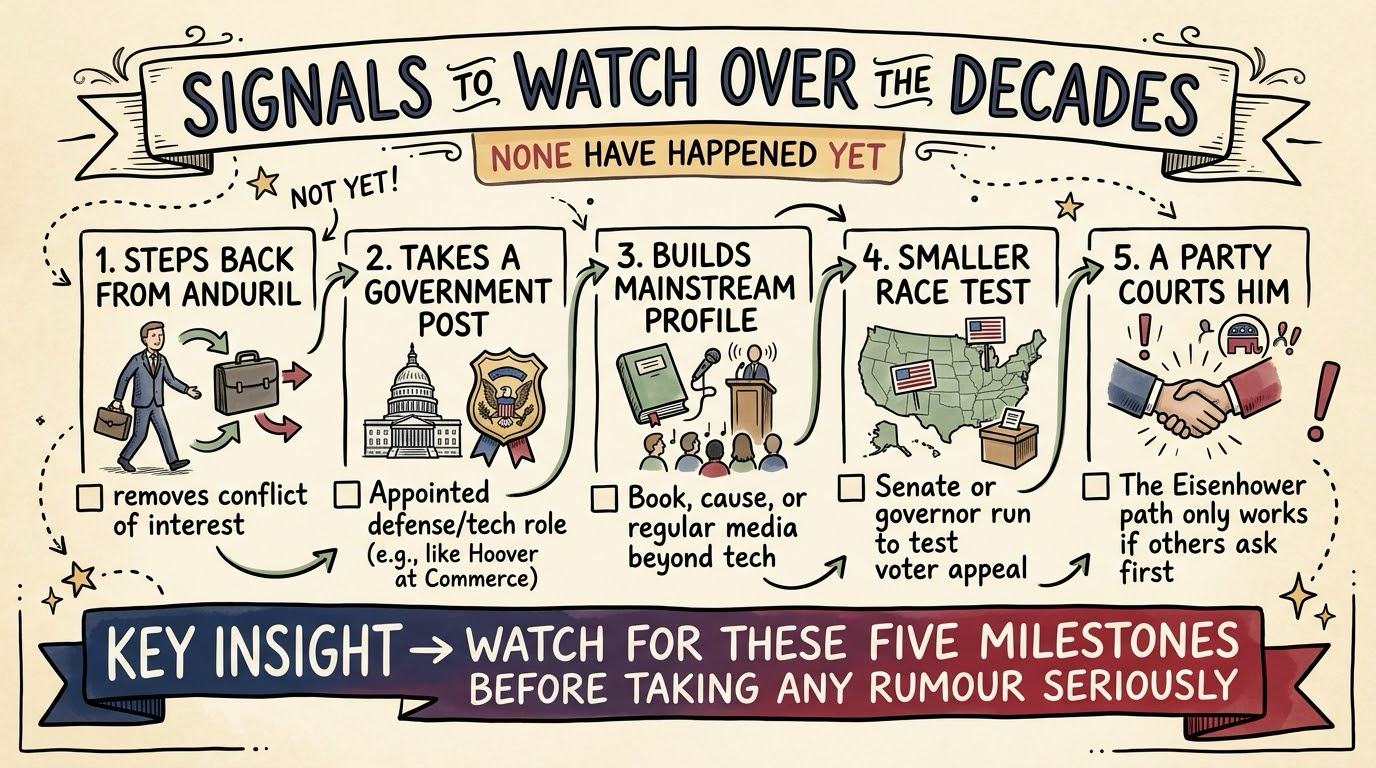
Signals To Watch Over The Decades
If he's playing this game, I'd expect to see some of these along the way.
- He steps back from Anduril. Handing over control or selling down his stake would remove the most direct conflict.
- He takes a government post. An appointed defense or technology role would give him the public service record he lacks, the way Herbert Hoover served as Commerce Secretary before running.
- He builds a profile beyond tech. A book, a cause or a regular media presence would introduce him to ordinary voters.
- He tests himself in a smaller race. A Senate or governor's campaign would show whether his appeal travels.
- A party starts courting him. The Eisenhower path only works if others ask first.
None of these has happened yet, as far as I can find.
Where This Argument Has Limits
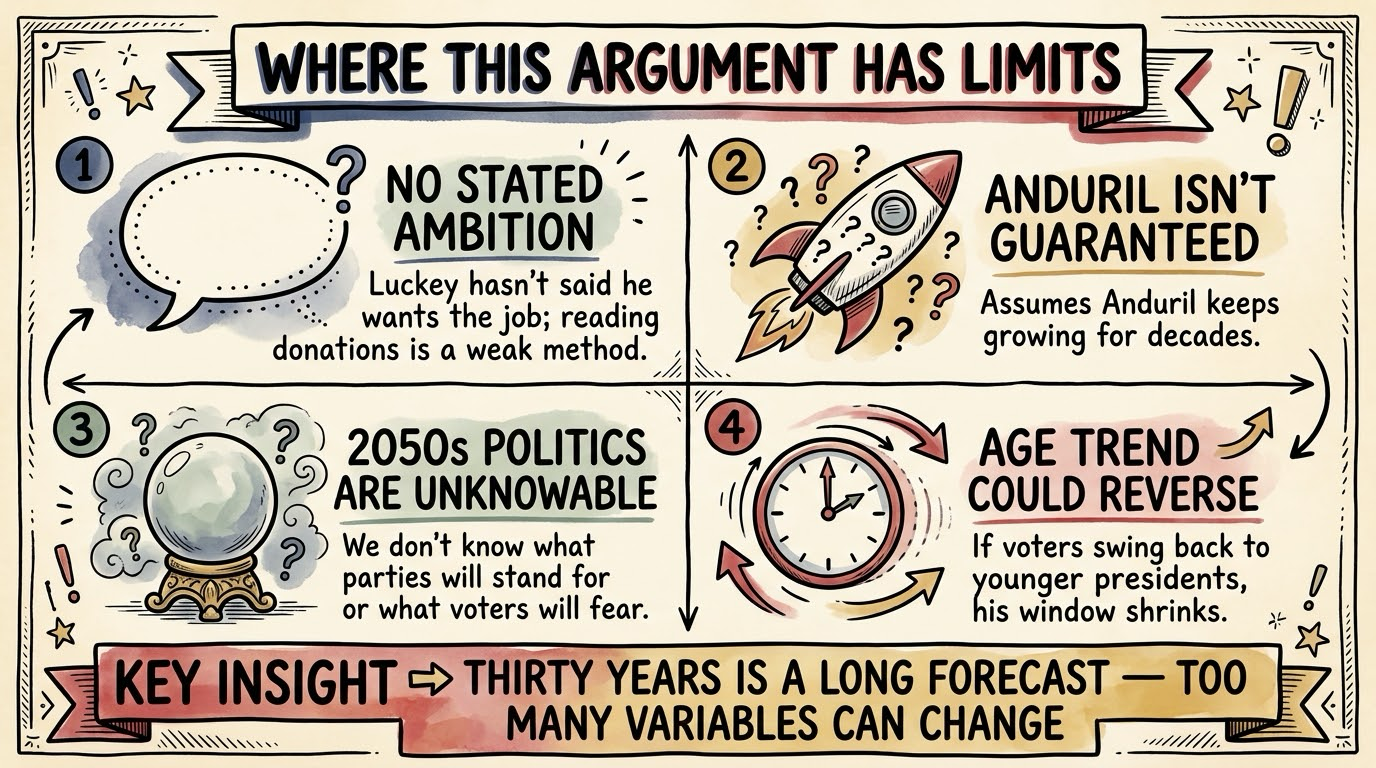
This is speculation about one person's choices over thirty years.
Luckey hasn't said he wants the job, and reading ambition from donations and interviews is a weak method.
I'm also assuming Anduril keeps growing, and that's far from guaranteed.
The politics of the 2050s are unknowable, including what the parties will stand for and what voters will fear.
And the trend toward older presidents could reverse, which would shrink his window.
Conclusion: The Sixty-Something Candidate
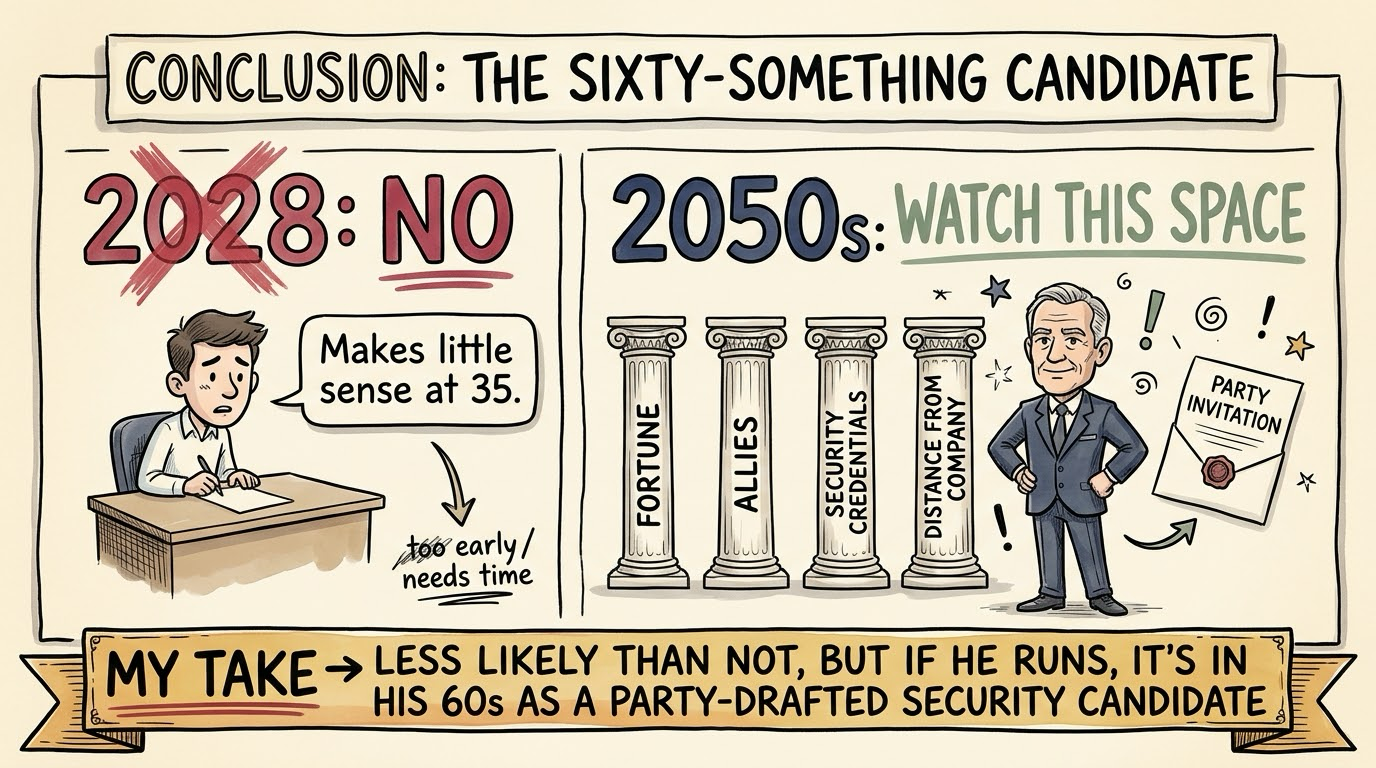
A Palmer Luckey campaign in 2028 makes little sense.
A campaign in the 2050s is a different matter.
By then he could have the fortune, the allies, the security credentials and the distance from his company that a serious run needs.
History says wealth won't be enough, and that he'd need a party to want him.
It also says the country has twice chosen a non-politician in the modern era, when the moment suited one.
My Take: I still think it's less likely than not, but if Luckey ever runs, it will be in his 60s as a national security candidate that a party comes looking for, and I can't name another founder of his generation better placed to become that person.
Sources
Pages I opened for the facts in this post:
- Wikipedia: Palmer Luckey
- Wikipedia: Article Two of the United States Constitution
- Wikipedia: List of presidents of the United States by age
- Wikipedia: List of presidents of the United States by previous experience
- Wikipedia: Dwight D. Eisenhower
- Wikipedia: Ross Perot 1992 presidential campaign
- Wikipedia: Michael Bloomberg 2020 presidential campaign
- LAist: At Anduril, executives are betting on both parties ahead of Election Day
- Fox News: Palmer Luckey on being an early Trump supporter
- Fortune: Palmer Luckey, Mark Zuckerberg and the Anduril-Meta partnership
- TechCrunch: Anduril raises $5B, doubles valuation to $61B