Why Physical AI is the New Gold Rush (The "Bits to Atoms" Tech Cycle)
We assume the future of technology is just building smarter software and charging a monthly subscription. The historic funding of Travis Kalanick's new robotics holding company proves the real money is aggressively moving back into the physical world.
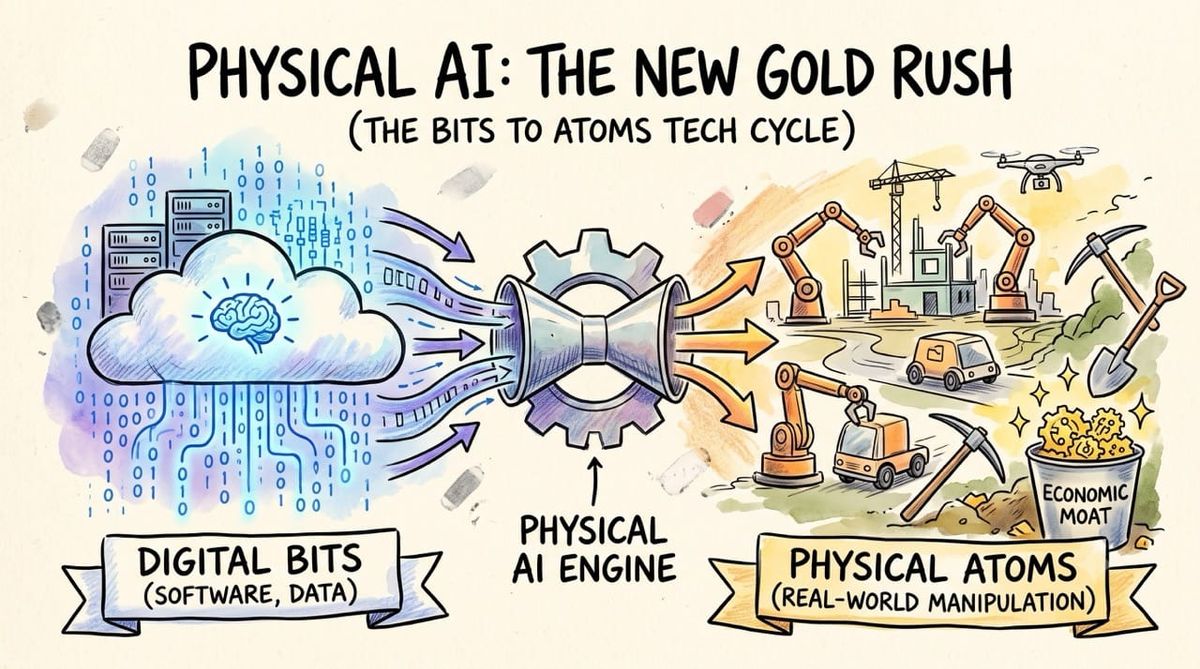
Digital intelligence is becoming a cheap commodity. The ultimate economic moat of the next decade belongs to the companies that can successfully manipulate physical reality.
Inspiration: Analyzing the recent funding round for Travis Kalanick's physical AI company, Atoms.
Realizing that the transition from software to hardware completely rewrites how venture capital will value defensibility and data collection over the next ten years.
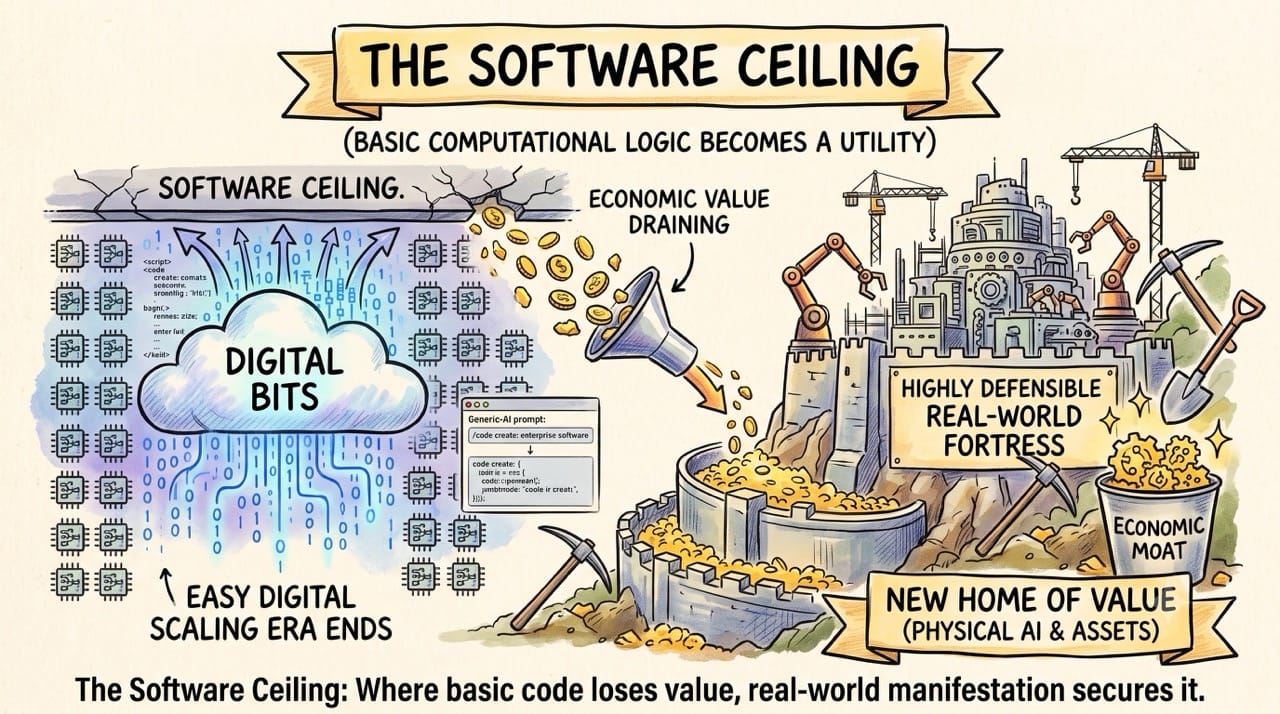
The Software Ceiling
For decades the technology industry was completely obsessed with zero marginal cost software.
Founders built incredible fortunes on the premise that once you write a piece of code you can distribute it globally for practically free.
That era of easy digital scaling is officially ending.
As foundational artificial intelligence becomes increasingly ubiquitous, basic computational logic is rapidly turning into a standard utility.
If anyone can prompt an algorithm to write enterprise software, the economic value naturally drains out of the digital layer and seeks a highly defensible new home.
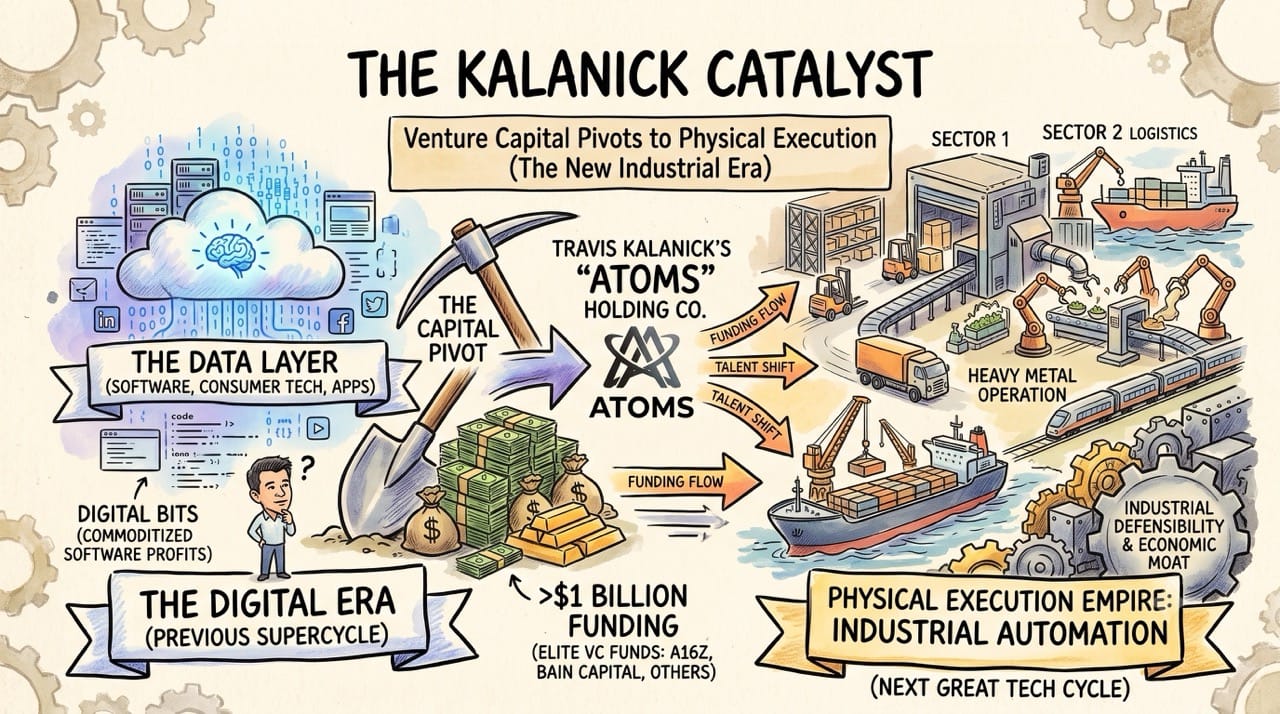
The Kalanick Catalyst
The smartest venture capital on earth is already pivoting hard toward physical execution.
We just saw this structural transition validated by the jaw dropping funding round secured by Travis Kalanick and his holding company Atoms.
Securing over a billion dollars from elite funds like Andreessen Horowitz and Bain
Capital effectively signals the maturation of the commercial robotics sector. Kalanick is building an empire focused entirely on industrial automation across logistics, food production, and heavy transport.
This proves that the next great technological supercycle is about moving heavy metal rather than just processing text on a screen.
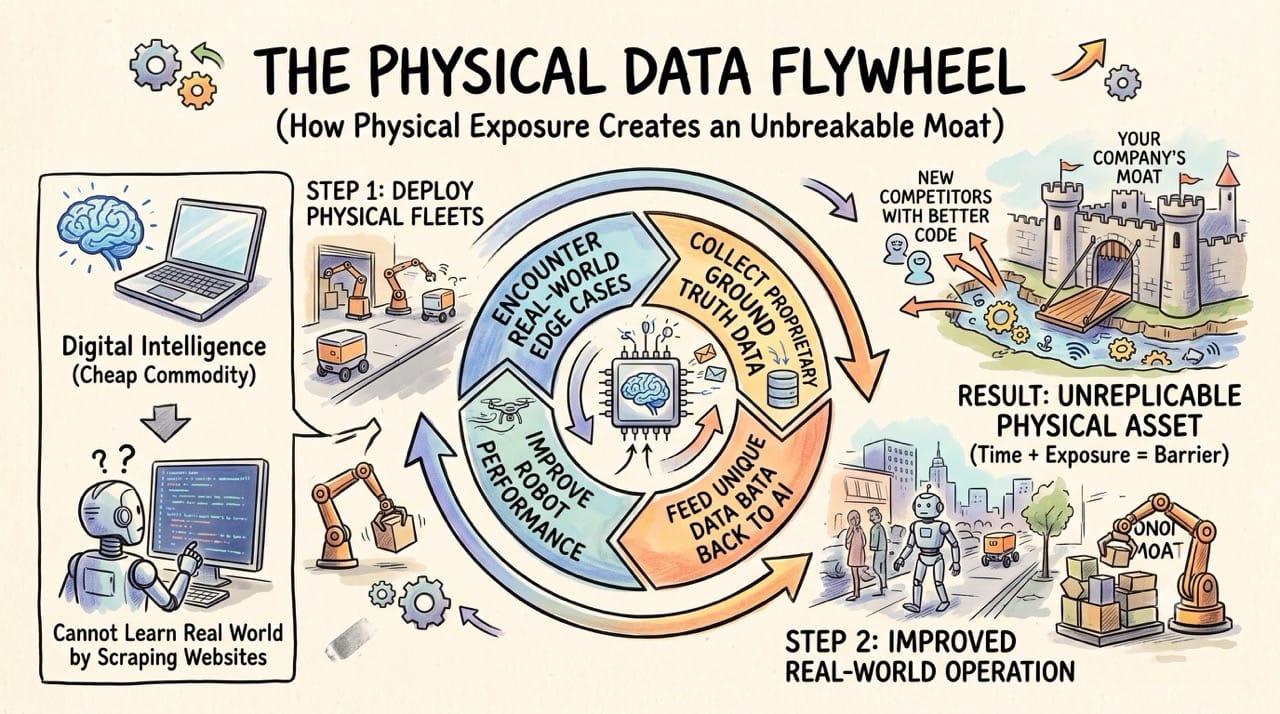
The Physical Data Flywheel
When digital intelligence is practically free the ultimate competitive advantage becomes your ability to operate safely in the real world.
You cannot teach a robot how to navigate a crowded sidewalk or a chaotic warehouse simply by scraping websites.
Training physical artificial intelligence requires vast amounts of compound ground truth data. Every time a delivery robot hits a curb or struggles to grasp an irregular package it feeds highly localized edge case data back into the system.
The companies that deploy fleets today accumulate a proprietary physical asset that new competitors simply cannot replicate with better code. Time and physical exposure become an unbreakable barrier to entry.
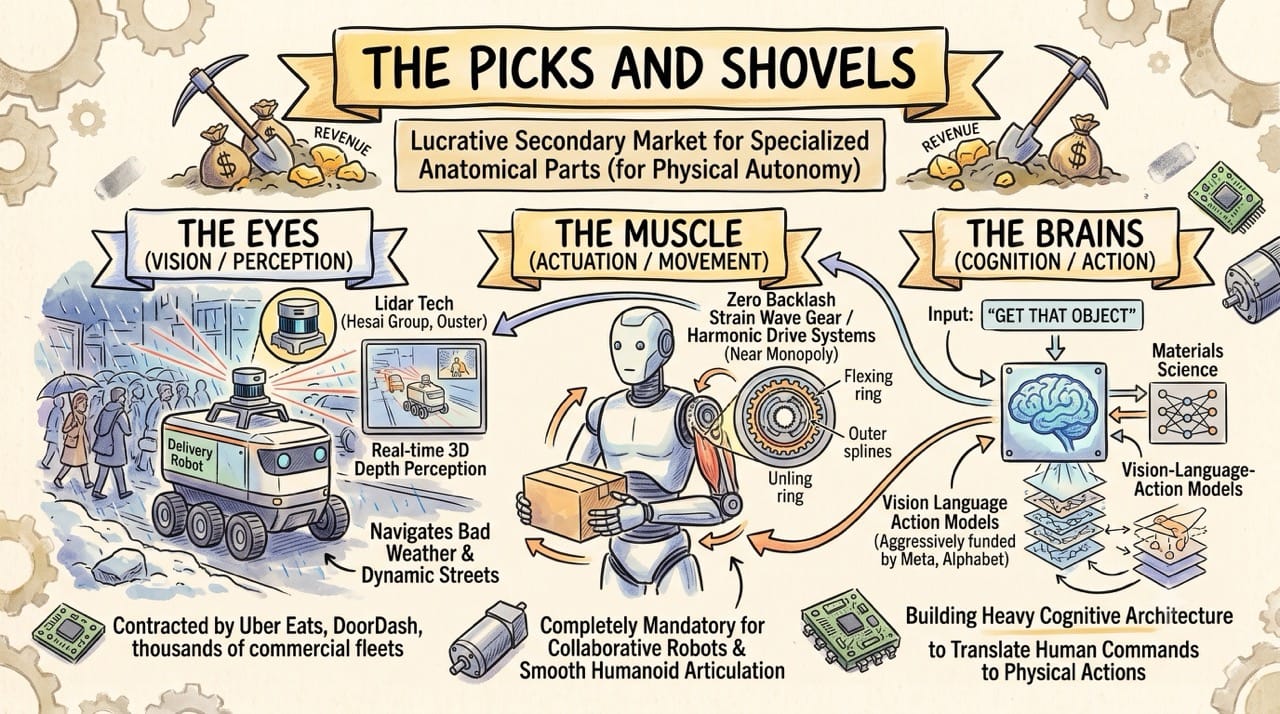
The Picks and Shovels
You do not have to build an entire humanoid robot to profit from this transition.
A highly lucrative secondary market is emerging for the companies building the specialized anatomical parts required for physical autonomy.
- The Eyes: Delivery robots rely entirely on precise Lidar technology to navigate bad weather and dynamic urban streets. Suppliers like Hesai Group and Ouster are quietly securing exclusive contracts to integrate their laser sensors into thousands of commercial fleets for platforms like Uber Eats and DoorDash.
- The Muscle: Precision robotic movement requires highly specialized mechanical joints. Manufacturers like Harmonic Drive Systems operate a near monopoly on zero backlash strain wave gears. These highly complex components are completely mandatory for the smooth articulation of humanoid arms and collaborative warehouse robots.
- The Brains: Companies like Meta and Alphabet are aggressively funding the underlying materials science and vision language action models. They are building the heavy cognitive architecture required to translate basic human commands into actual physical movement.
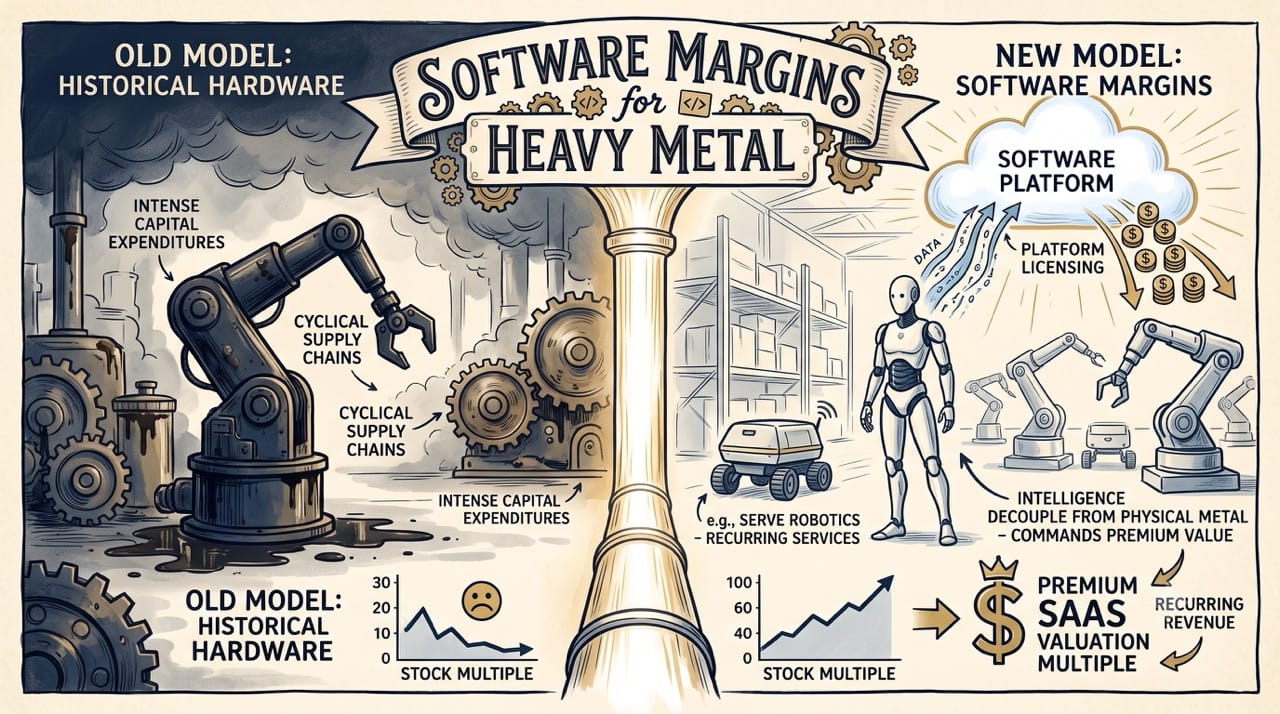
Software Margins for Heavy Metal
Historically investors hated hardware companies because manufacturing physical goods requires intense capital expenditures and highly cyclical supply chains. This specific tech cycle is completely destroying that old financial model.
Modern robotics companies are actively decoupling their hardware sales from their software intelligence.
A company like Serve Robotics generates nearly half of its revenue through recurring software services and platform licensing.
By adopting this specific business model these hardware operators will eventually command the exact same premium valuation multiples as traditional enterprise software platforms.
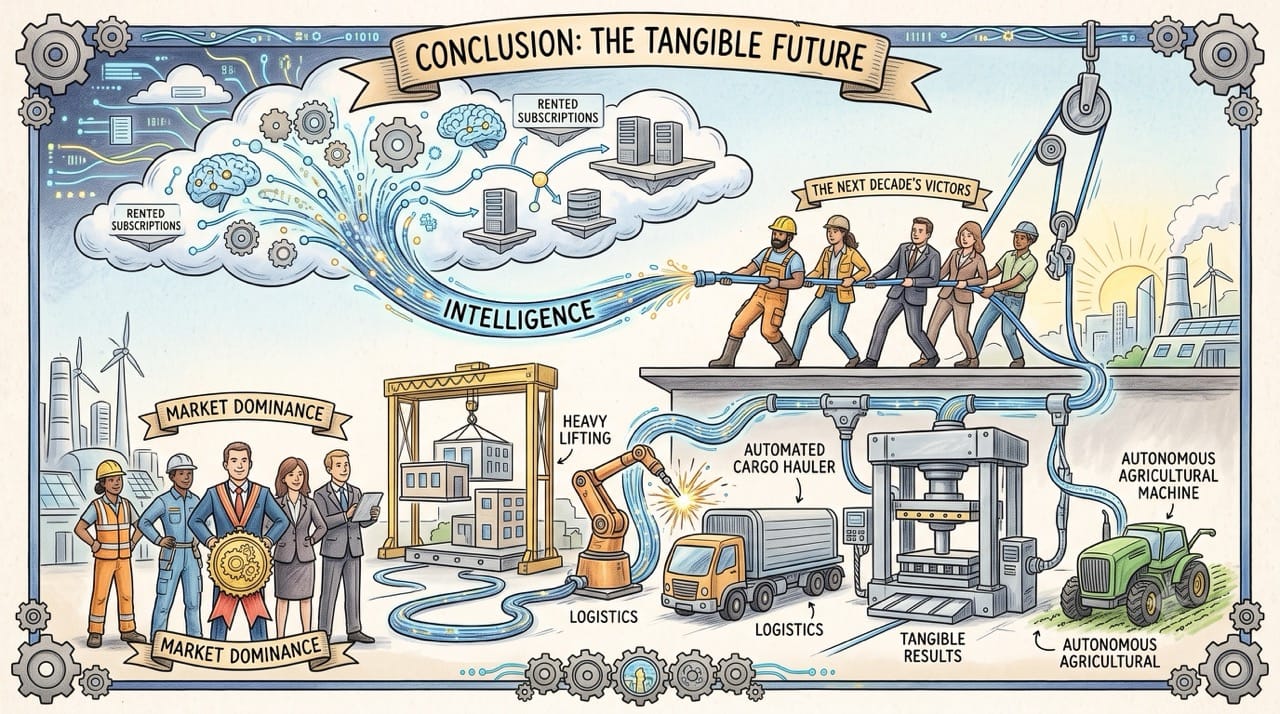
Conclusion: The Tangible Future
The victors of the next decade will realize that renting intelligence in the cloud is no longer enough to dominate an industry.
Sustained market dominance will belong strictly to the organizations capable of pulling that intelligence down to earth and forcing it to do our heavy lifting.