Title: Holograms Soon (Thanks to Smart Glasses)
True hologram messages are not arriving immediately. Processing power, optics, and battery hurdles still exist. But Meta AI glasses with digital screens already create the intermediate step. Think little notecards that can extend into 3D when glasses read a QR code.
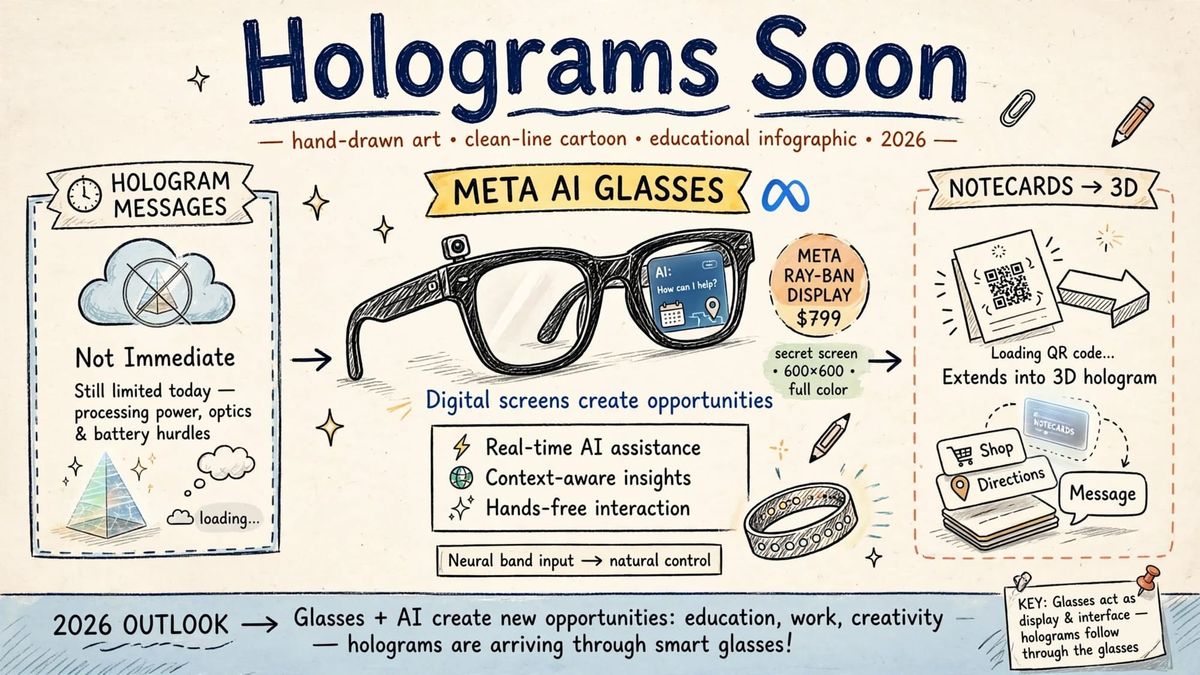
Hologram Messages Are Not Here Yet, The Bridge Is
Walking directions will use visual landmarks, allowing the glasses to give instructions such as turning at a particular building rather than referring only to street names.
Another feature, Hologram, will create a digital version of the wearer for hands free video calls.
That is the direction. Hologram messages, the sci fi dream of a person appearing in a room, are still in development, delayed arrival, instant 3D holograms everywhere still question mark.
What is here now is more practical: Meta AI glasses with digital screens that act as display and interface. Holograms are arriving through smart glasses, not through standalone projectors.
Meta Ray-Ban Display: Secret Screen plus Neural Band plus Hologram
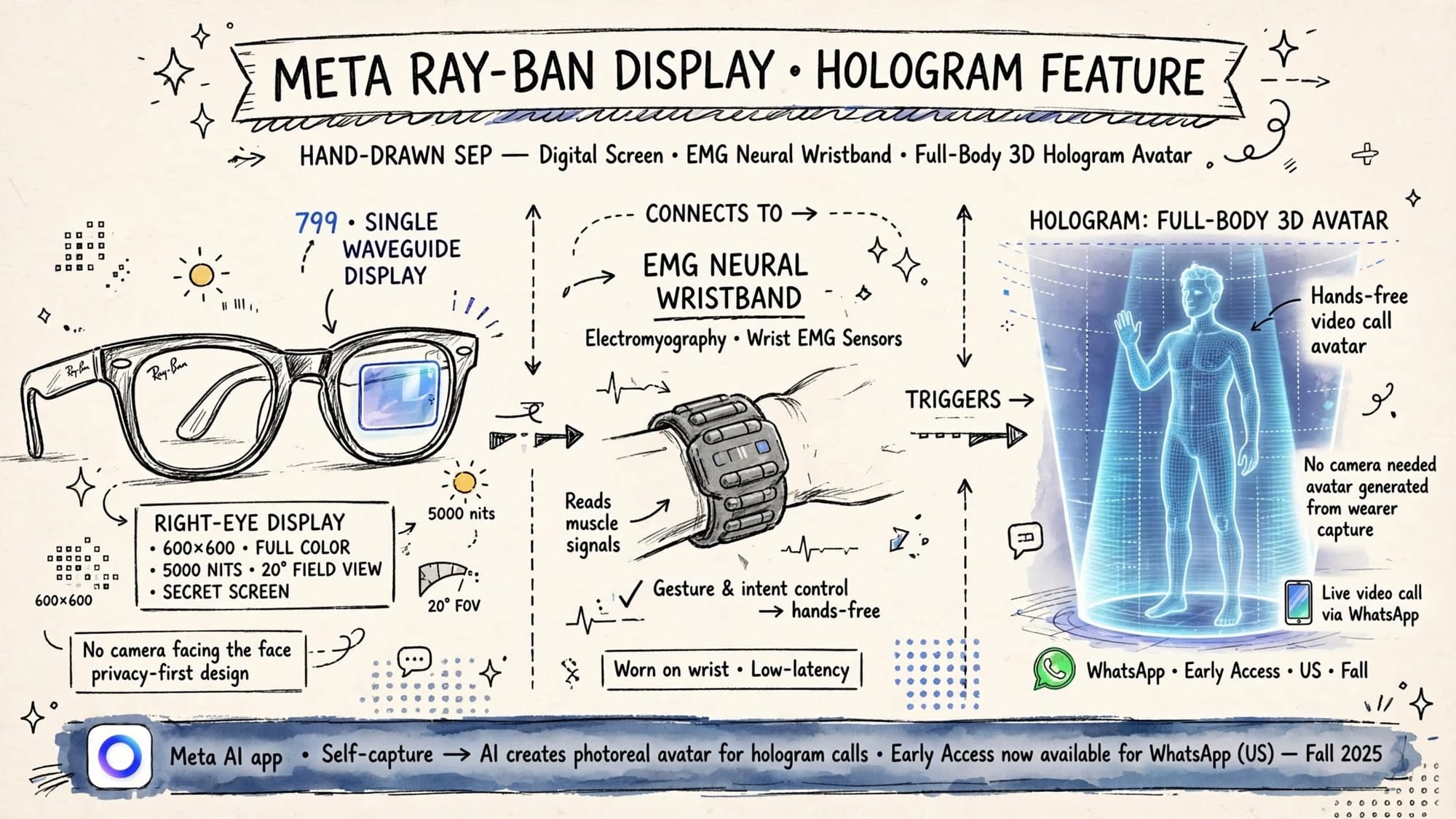
Meta Ray-Ban Display is a pair of 800 dollar smart glasses that comes with a single waveguide display in the right eye and an EMG powered Neural wristband for some pretty amazing and lowkey UI control.
The Ray-Ban Display launched September 30, 2025 looks like classic Ray-Bans until you notice the secret: a 600 by 600 full color display in the right lens, blasting up to 5000 nits with a 20 degree field of view.
Until now, the glasses could show the wearer's surroundings during video calls, but there is no camera facing the user's face.
With the new Hologram feature, the display glasses will now create a photorealistic digital avatar of the wearer and show it to the other person during video calls.
Meta is putting photorealistic hologram calling on Meta Ray-Ban Display, and the version arriving on the glasses is driven by your voice rather than your face. Hologram begins rolling out in Early Access on WhatsApp to Meta Ray-Ban Display users in the US later this fall, after what it describes as a short self capture in the Meta AI app.
The feature is designed to solve one of the biggest limitations of making video calls through glasses. Instead of showing the user's face, the glasses normally transmit a view of whatever the wearer is looking at.
Meta's new Hologram system creates a digital representation of the caller that can appear to the person on the other end of the call.
Meta VR Glasses announced at Connect 2026, 100 grams, 5K micro OLED screens, can create a full body 3D hologram of the person you are calling.
The glasses carry that long running wager that computing can move beyond phones and traditional screens. Movies, sports, games and multiple computer screens, all viewed through a pair of glasses.
QR Codes Are Little Notecards That Extend Into 3D
This is where the opportunity explodes.
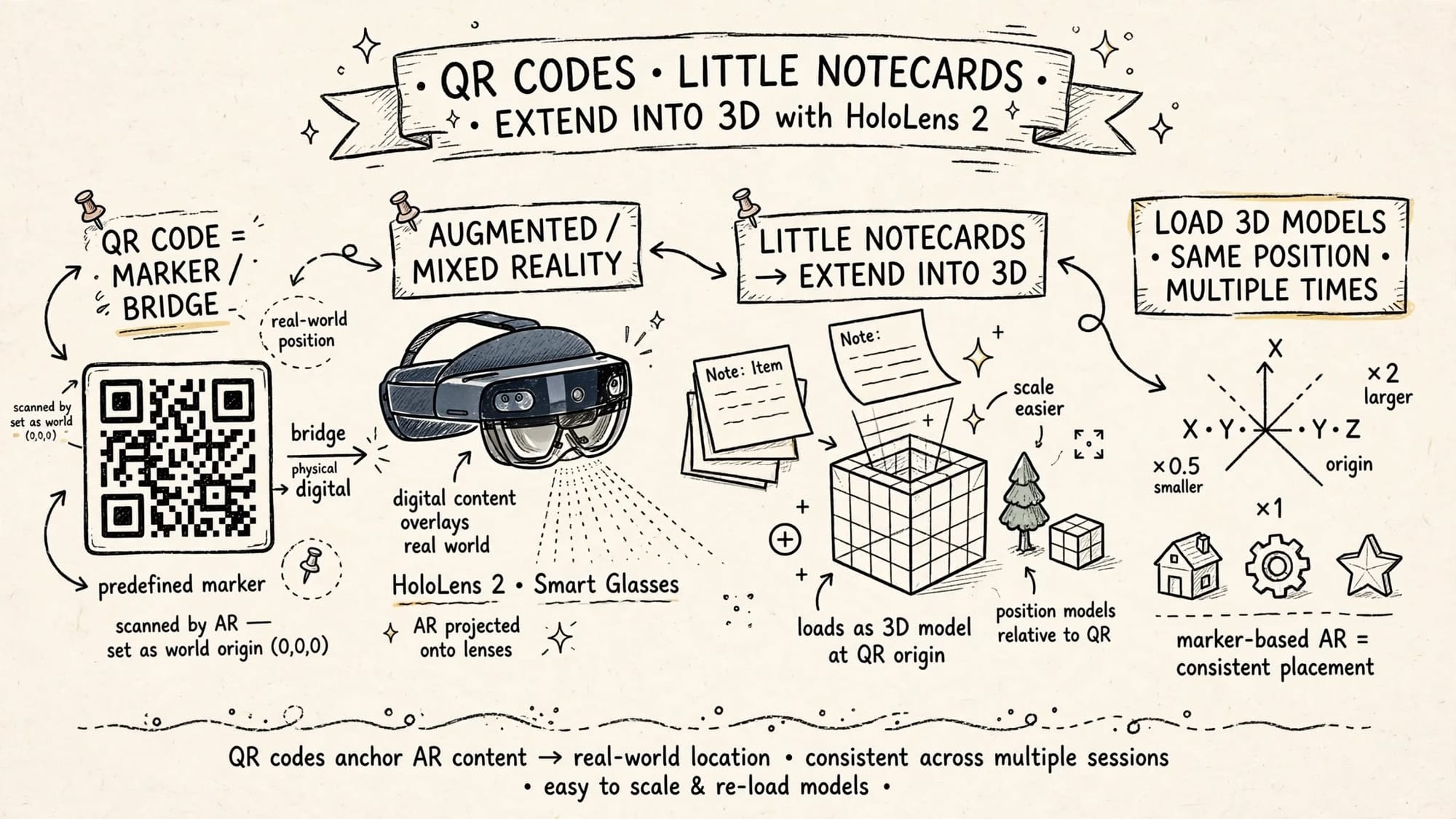
QR codes can be used in Augmented and Mixed Reality in a variety of different ways depending on the use case.
They allow users to set a point of origin in the real world using a QR code, and with Microsoft HoloLens 2 users can position models in relation to the QR code.
With QR codes you can load 3D models into the same position multiple times and are able to scale models easier in AR.
Marker Based AR requires predefined markers like QR codes, images for overlaying digital content.
The synergy between AR and QR codes relies on the ability of the QR code to act as a bridge between the physical world and digital content. AR content is projected onto screens such as smartphones and smart glasses.
Think of a QR code as a little notecard that extends into 3D with glasses:
- Scan a QR code in a textbook, students can see historical events unfold in front of them or explore human anatomy in 3D
- Scan a QR code on a patient's wristband, bring up medical history and vital signs on a doctor's AR glasses
- Scan a QR code on a product box, load a shop or directions or message that pops up in 3D around the box
- Scan a QR code on a business card, the person extends into a hologram introduction
Glasses act as display and interface. QR acts as anchor. The physical world becomes clickable.
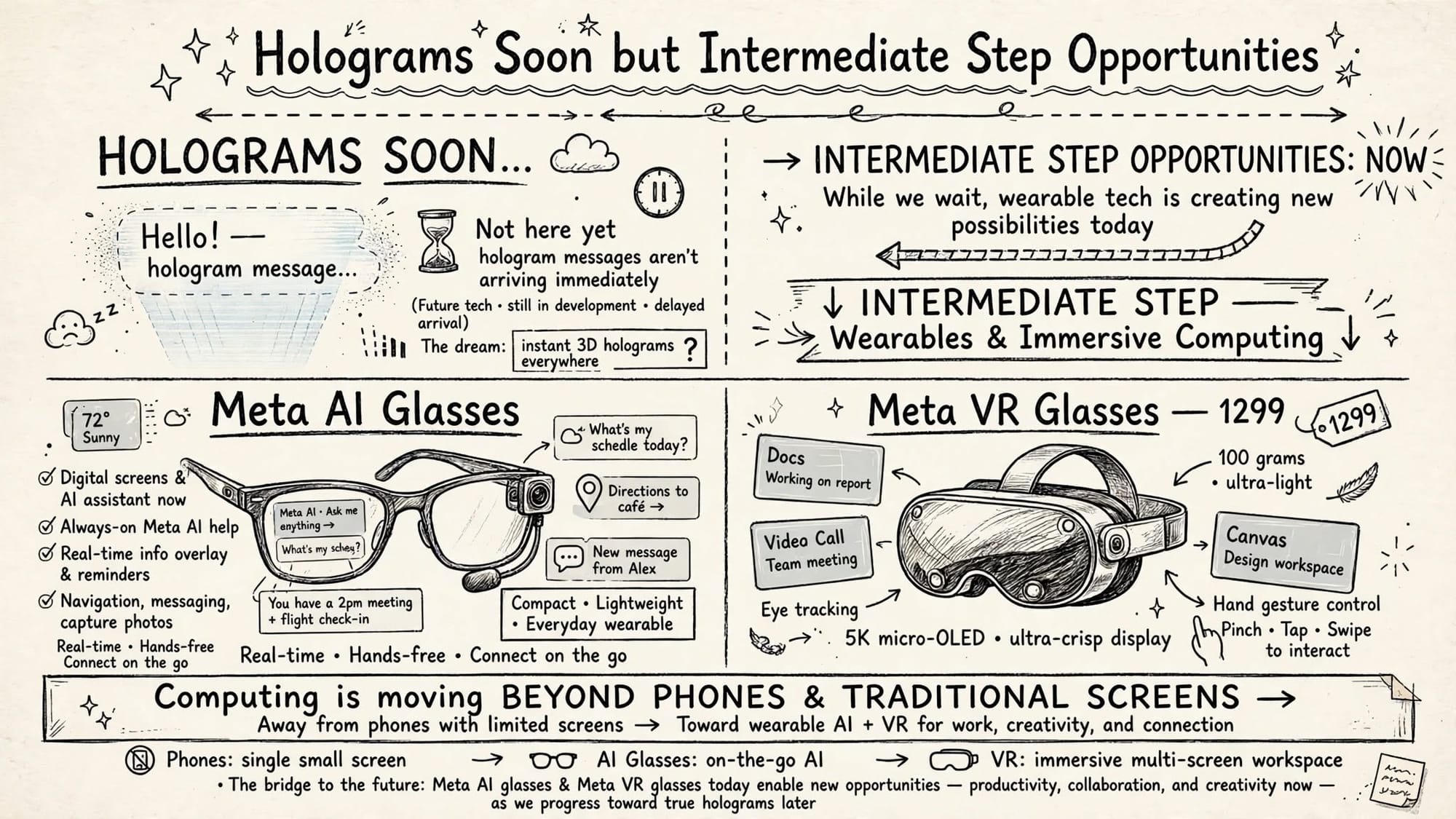
Intermediate Step Opportunities: Now
While we wait for true hologram messages, wearable tech is creating new possibilities today.
Meta AI Glasses: digital screens and AI assistant now, always on Meta AI help, real time info overlay and reminders, navigation, messaging, capture photos, compact lightweight everyday wearable, real time hands free connect on the go.
Meta VR Glasses: 1299, 100 grams ultra light, 5K micro OLED ultra crisp display, eye tracking, hand gesture control pinch tap swipe to interact, Docs working on report, Video Call team meeting, Canvas design workspace.
Computing is moving beyond phones and traditional screens, away from phones with limited screens toward wearable AI plus VR for work, creativity, and connection.
The bridge to the future: Meta AI glasses and Meta VR glasses today enable new opportunities, productivity, collaboration, and creativity now, as we progress toward true holograms later.
Holograms soon does not mean holograms later only.
It means notecards to 3D today, photorealistic avatar calls this fall on WhatsApp, full body 3D calls next spring with 1299 VR glasses. The path is QR plus display plus neural band plus AI.