New AI Czar and the Age of Reconnaissance
Jay Clayton is now AI Czar and DNI. A Wall Street lawyer running Super Intelligence Force. Signals AI is now national security, not just tech. Age of reconnaissance is here.
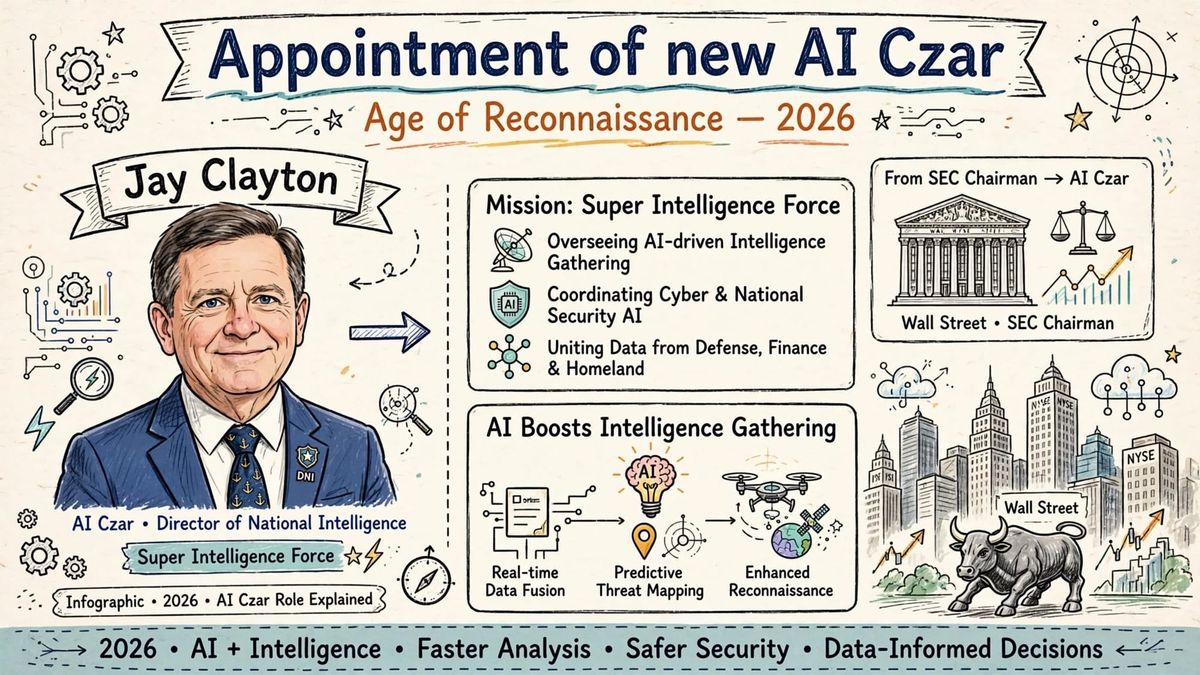
Who Is Jay Clayton
US President Donald Trump said on Sunday he had named Director of National Intelligence Jay Clayton the administration's AI czar, tasking him with coordinating the federal government's efforts to maintain US leadership in the technology.
Trump said Clayton would head the newly created Super Intelligence Force, overseeing the government's engagement with consumers and industry.
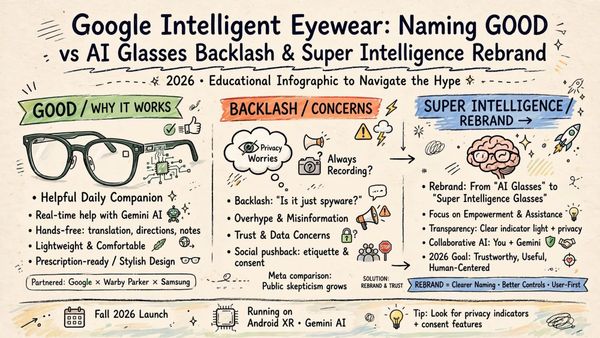
Trump, who has pushed to rename artificial intelligence as super intelligence, said Clayton would head the newly created Super Intelligence Force.
The group has 120 days to assess AI's risks and opportunities, examine existing laws and recommend how the government should respond to threats including AI enabled cyberattacks.
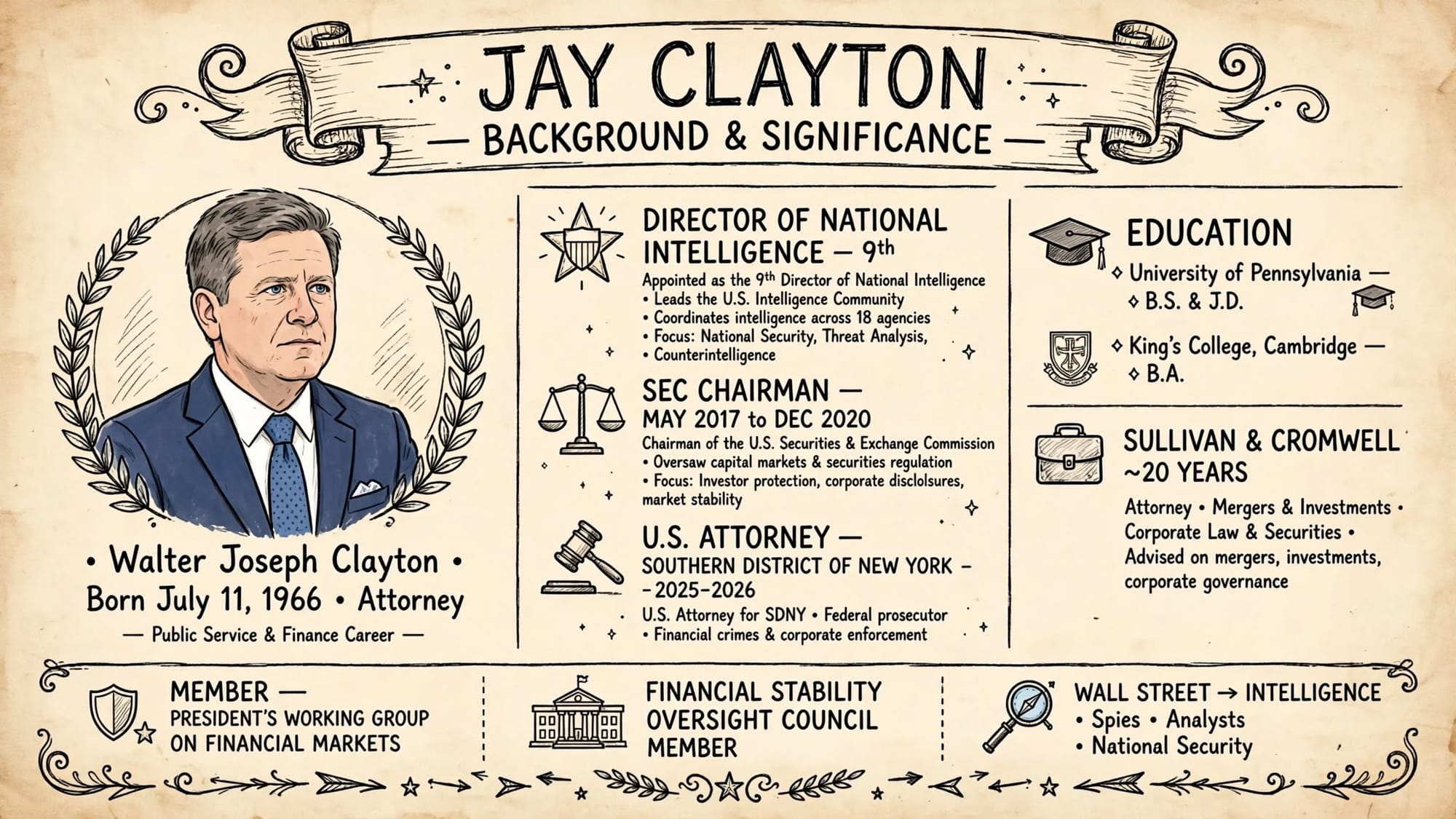
Why Clayton is significant:
- Walter Joseph Jay Clayton III born July 11 1966 is an American attorney who has served as the 9th director of national intelligence since 2026. He served as United States attorney for the Southern District of New York from 2025 to 2026, and as chairman of the Securities and Exchange Commission from 2017 to 2020.
- Chairman May 2017 to Dec 2020. Jay Clayton was nominated to chair the US Securities and Exchange Commission on January 20 2017 by President Donald J Trump and was sworn in as Chairman on May 4 2017. In addition to chairing the SEC, he was a member of the President's Working Group on Financial Markets, the Financial Stability Oversight Council, and the Financial Stability Board.
- Education University of Pennsylvania BS, JD, King's College, Cambridge BA.
- Before joining the SEC, Clayton worked for more than 20 years at the law firm Sullivan and Cromwell, where he advised companies on investments, mergers, corporate rules, and other legal issues.
- Born July 11 1966, Walter Joseph Jay Clayton III brings a heavyweight Wall Street resume to a job associated with spies, analysts and national security professionals.
Clayton's appointment to the task force appears to signal a shift by the administration to cast AI as a geopolitical and national security subject area.
Clayton brings a background as a corporate lawyer and former SEC chairman, making him a unique pick compared to people with more tech focused backgrounds that hail from Silicon Valley.
This is not a tech guy appointment. It is a markets and law and intel appointment. He understands market integrity, disclosure, enforcement, systemic risk, and now intel. Perfect for AI that blurs finance, defense, and information war.
He also served as 9th director of national intelligence since August 2026 and additionally served as White House AI czar since October 2026.
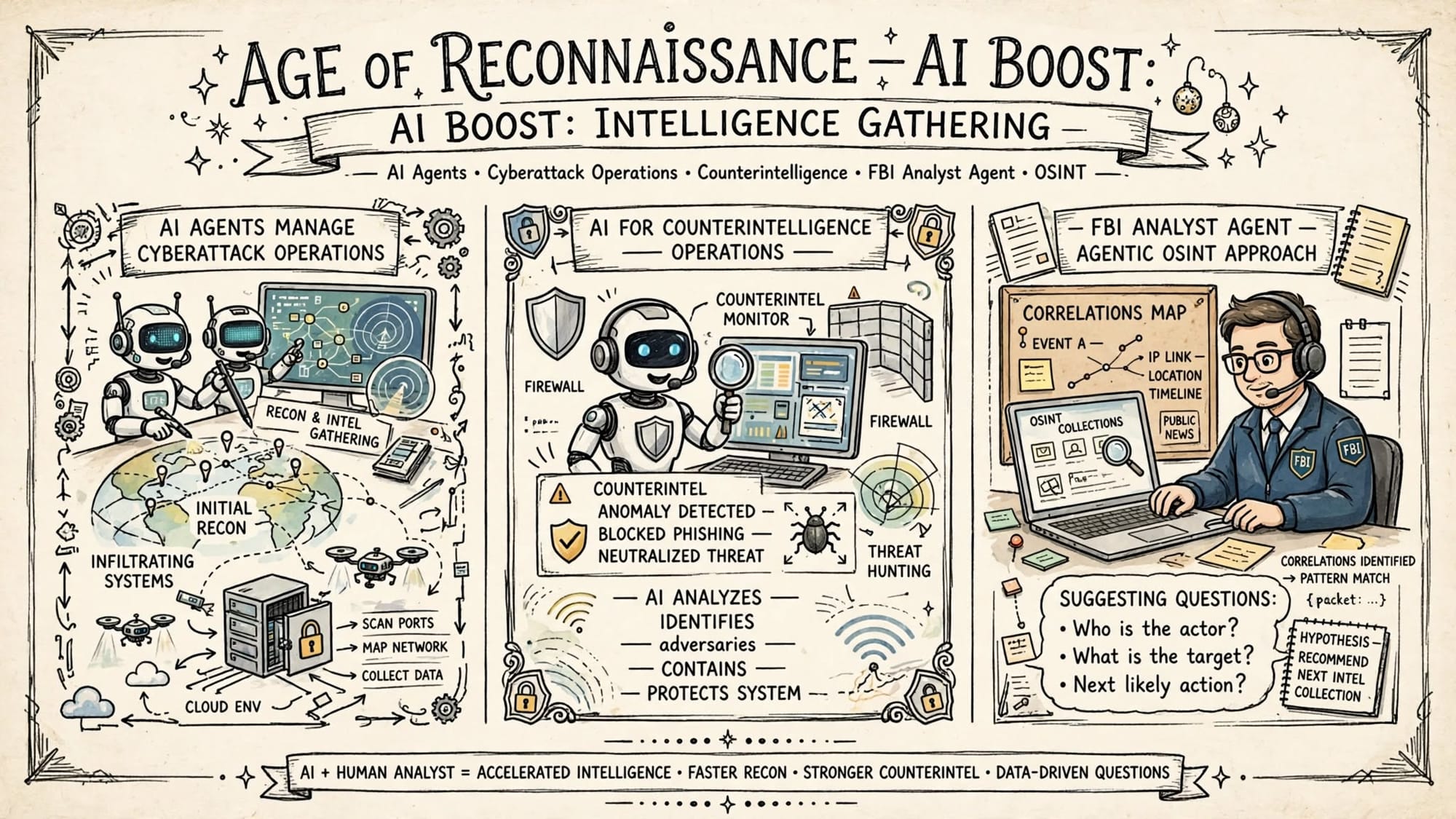
Age of Reconnaissance
Reconnaissance used to mean sending a person. Person gets caught, person becomes counterintelligence liability.
AI changes that.
AI agents could eventually manage entire cyberattack operations, from initial reconnaissance and intelligence gathering to infiltrating systems, deploying malware and extorting organizations over stolen data.
All of this will be carried out entirely by interconnected AI agents operating within a single framework.
At the FBI, chief artificial intelligence officer Katie Noyes said the bureau's initial agentic approach is being organized around specific roles.
A counterterrorism analyst, for example, could have an agent pulling together open source and intelligence collections, identifying correlations and suggesting what questions to ask next.
AI will be fantastic for counterintelligence operations, with intelligence gatherers using it to detect deception and fabrications.
We are entering age where reconnaissance is persistent, cheap, and deniable.
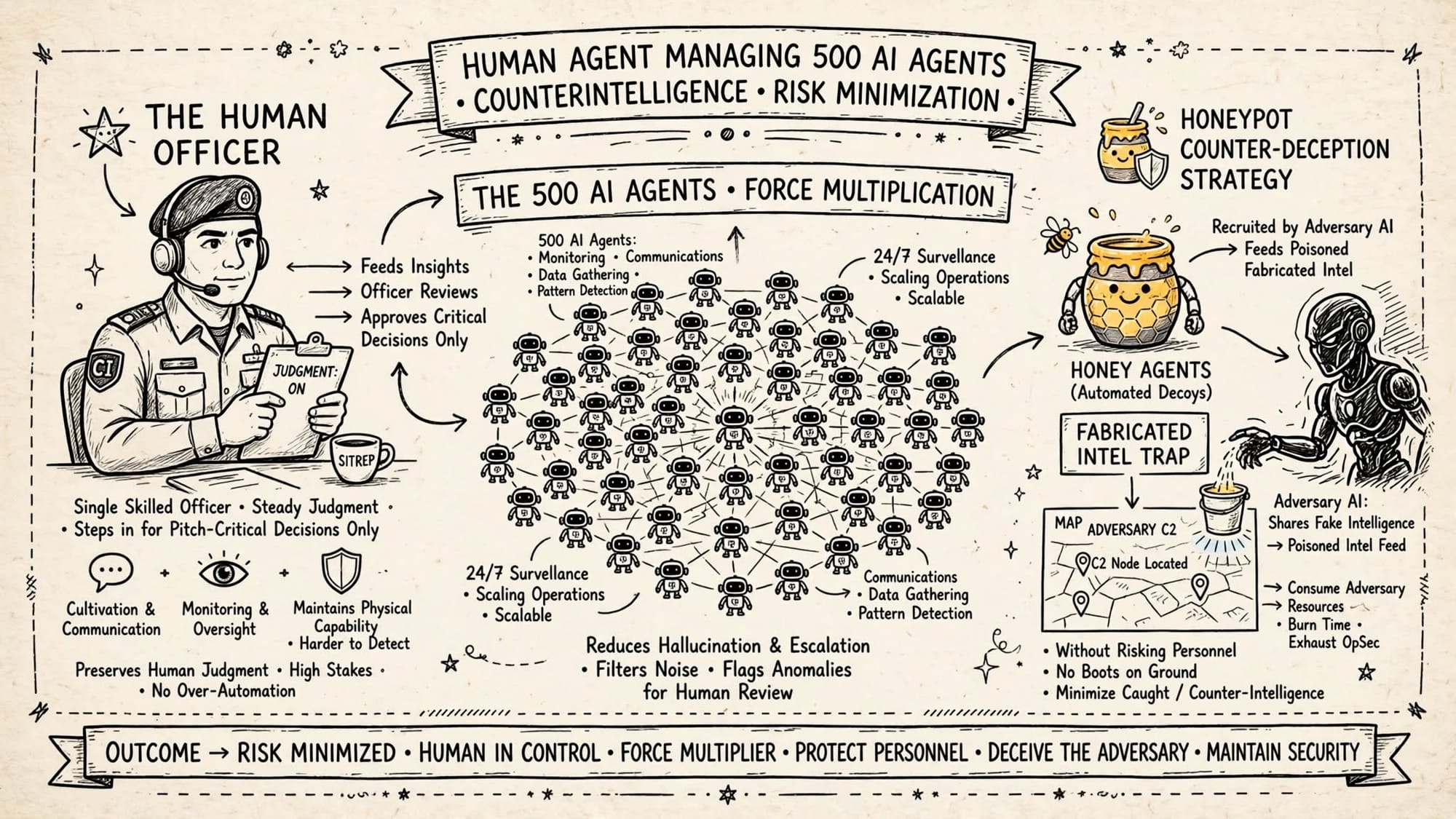
Human Federal Agents Managing AI Agents
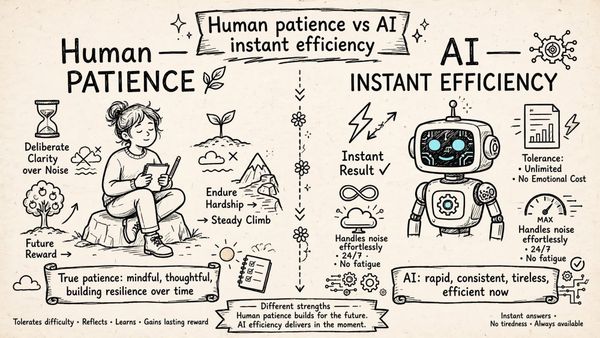
The breakthrough is not pure AI. It is hybrid.
A single skilled officer managing 500 AI agents that handle cultivation, communication, and monitoring, stepping in only for The Pitch and critical decisions, represents a force multiplication that pure AI cannot achieve.
This hybrid model preserves human judgment for high stakes decisions, reduces hallucination and escalation risks, maintains physical capability for critical operations, creates traditional CI signatures diluted but present, proves harder to detect than pure AI operations.
Translation: no more lone officer meeting asset in dark parking lot with risk of surveillance.
AI agents do cultivation, long tail comms, pattern detection, language translation, open source correlation, 24/7 monitoring.
Human officer reviews, approves critical decisions only.
Benefits for intel:
- No boots on ground for initial phases. Minimizes risk of personnel caught.
- No human in hostile territory for routine collection. Minimizes counterintelligence exposure.
- Scalable. One officer can run 500 agents across languages and regions.
- Diluted CI signature. Harder to detect than pure AI or pure human.
- Maintains physical capability only for critical moment: the pitch.
Then add counter deception layer: Honey Agents.
AI agents created by counterintelligence specifically designed to be recruited by adversary AI agents.
Once recruited, Honey Agents feed adversaries poisoned or fabricated intelligence, map adversary C2 infrastructure through controlled interaction, consume adversary computational resources on false leads, enable agent vs agent attribution.
That is reconnaissance and counter reconnaissance without risking personnel. Adversary AI thinks it recruited a source, but source is our honey agent that maps their command and control and wastes their compute.
Jay Clayton understands this from market angle too.
Markets have honeypots, wash trading detection, mapping illicit C2 infrastructure.
Same logic now for intel.
The age of reconnaissance is not about sending more people. It is about sending fewer people, managing more agents, with Wall Street grade risk controls.