FQ-44A Fury: The Drone Wingman That Could Extend US Air Dominance
Anduril's FQ-44A Fury went from prototype award to a production contract in just over two years. It has fired a live missile and taken orders from an F-22 pilot. Here's how a drone wingman at a third of an F-35's price could extend US air dominance, and what could hold it back.
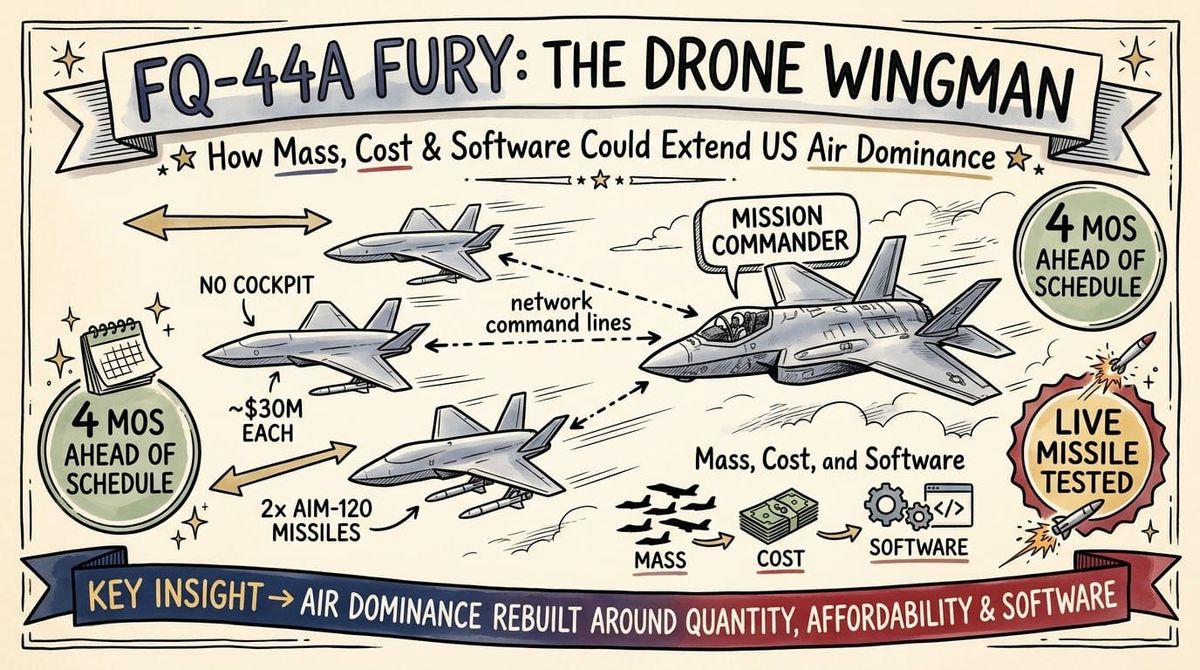
One of the most important new aircraft in the US Air Force has no cockpit.
It's called the FQ-44A Fury, and it's built by Anduril, the company founded by Palmer Luckey.
In June, the Air Force moved it from prototype to production, four months ahead of schedule.
Since then it has fired a live missile, flown alongside F-35s and taken orders from an F-22 pilot in the air.
I think it's the product most likely to extend American air dominance over the next decade.
The reason has less to do with the jet itself and more to do with numbers, cost and software.
What The FQ-44A Is
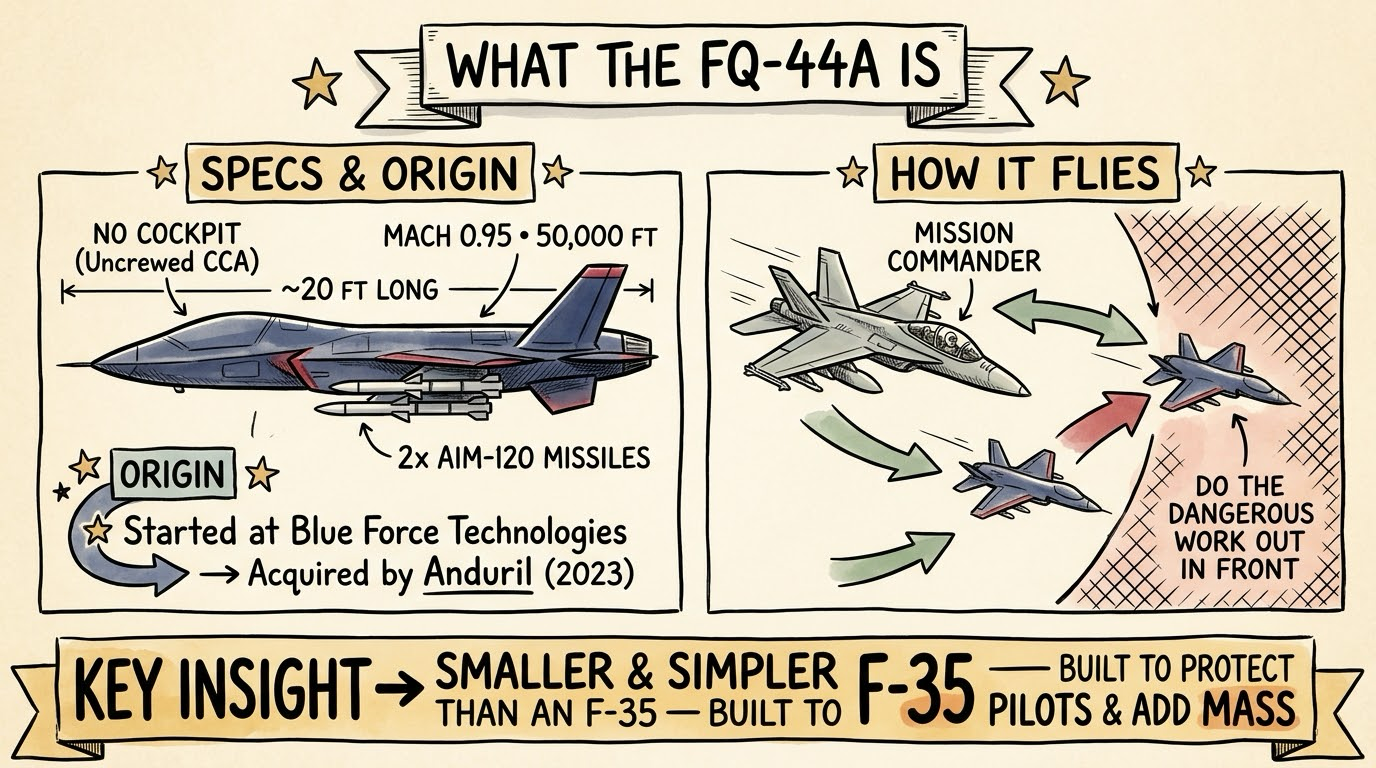
The Fury is an uncrewed jet designed to fly alongside crewed fighters as a wingman.
The Air Force calls this category Collaborative Combat Aircraft, or CCA.
The design started at a small company called Blue Force Technologies, which Anduril acquired in 2023.
It's about 20 feet long, flies at up to Mach 0.95 and reaches 50,000 feet.
It carries two AIM-120 air-to-air missiles.
That makes it much smaller and simpler than an F-35, and that's the point.
The pilot in the crewed fighter acts as a mission commander, and the drones do the dangerous work out in front.
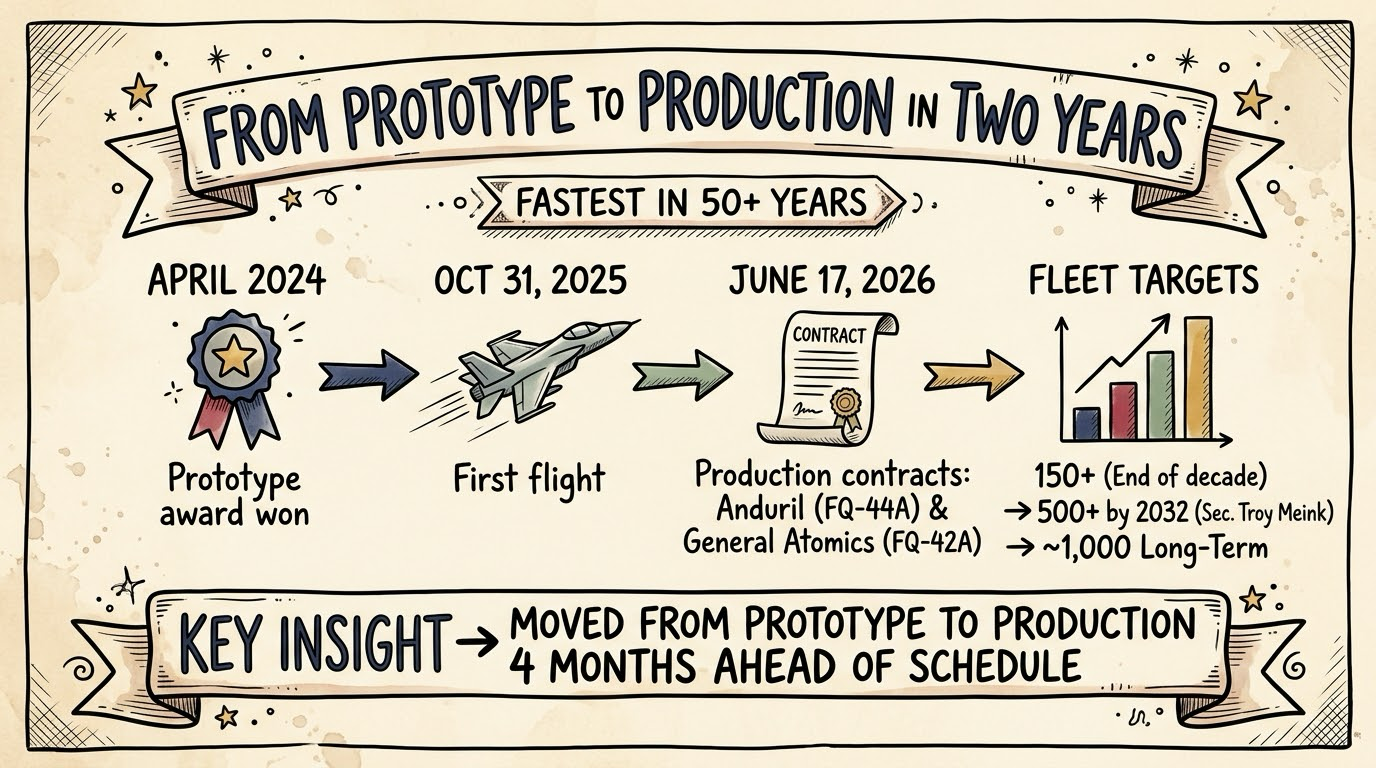
From Prototype To Production In Two Years
The speed of this program is unusual for military aviation.
Anduril won its prototype award in April 2024.
The aircraft first flew on October 31, 2025.
On June 17, 2026, the Air Force awarded its first CCA production contracts to Anduril for the FQ-44A and to General Atomics for the FQ-42A.
Anduril says that's the fastest path from prototype award to fighter production in more than 50 years.
The Air Force hasn't disclosed the contract values or how many of each aircraft it ordered.
It did say it can buy more than 150 combat-capable CCAs by the end of the decade.
In September, Air Force Secretary Troy Meink raised the target: "We intend to have at least 500 of these in service by 2032."
The long-term goal is about 1,000.
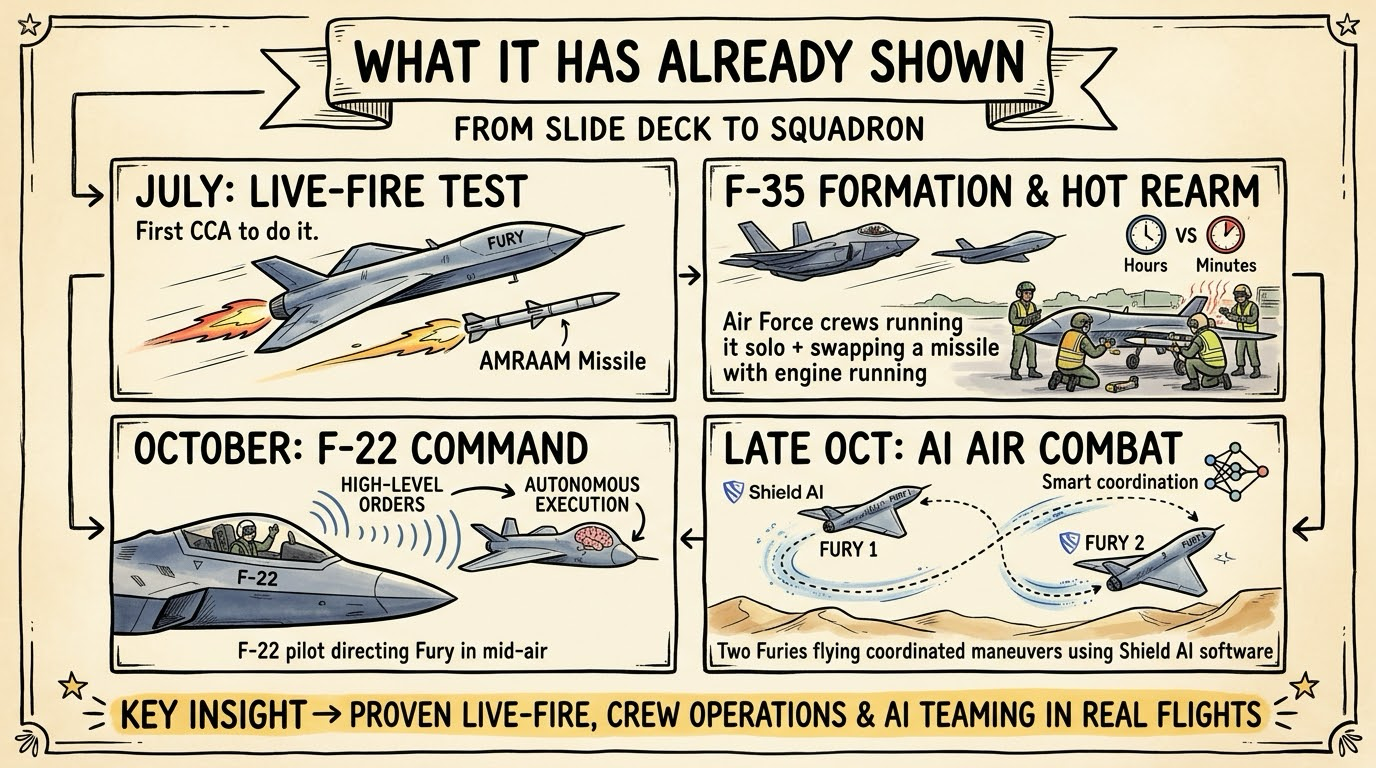
What It Has Already Shown
The test record this year is what convinced me.
In July, the Fury became the first CCA to complete a live-fire test, firing an AMRAAM air-to-air missile.
It has flown in formation with crewed F-35s.
Air Force crews have launched, flown and recovered it without Anduril staff present.
They also swapped a missile onto the aircraft with the engine still running, which cut turnaround time from hours to minutes.
In October, an F-22 pilot commanded a Fury in flight for the first time, giving high-level directions that the drone's software carried out.
Later that month, two Furies flew coordinated air combat maneuvers against a simulated threat using Shield AI's autonomy software, with only a ground operator giving broad direction, according to Shield AI.
Each of those steps moves the idea from a slide deck toward something a squadron can use.
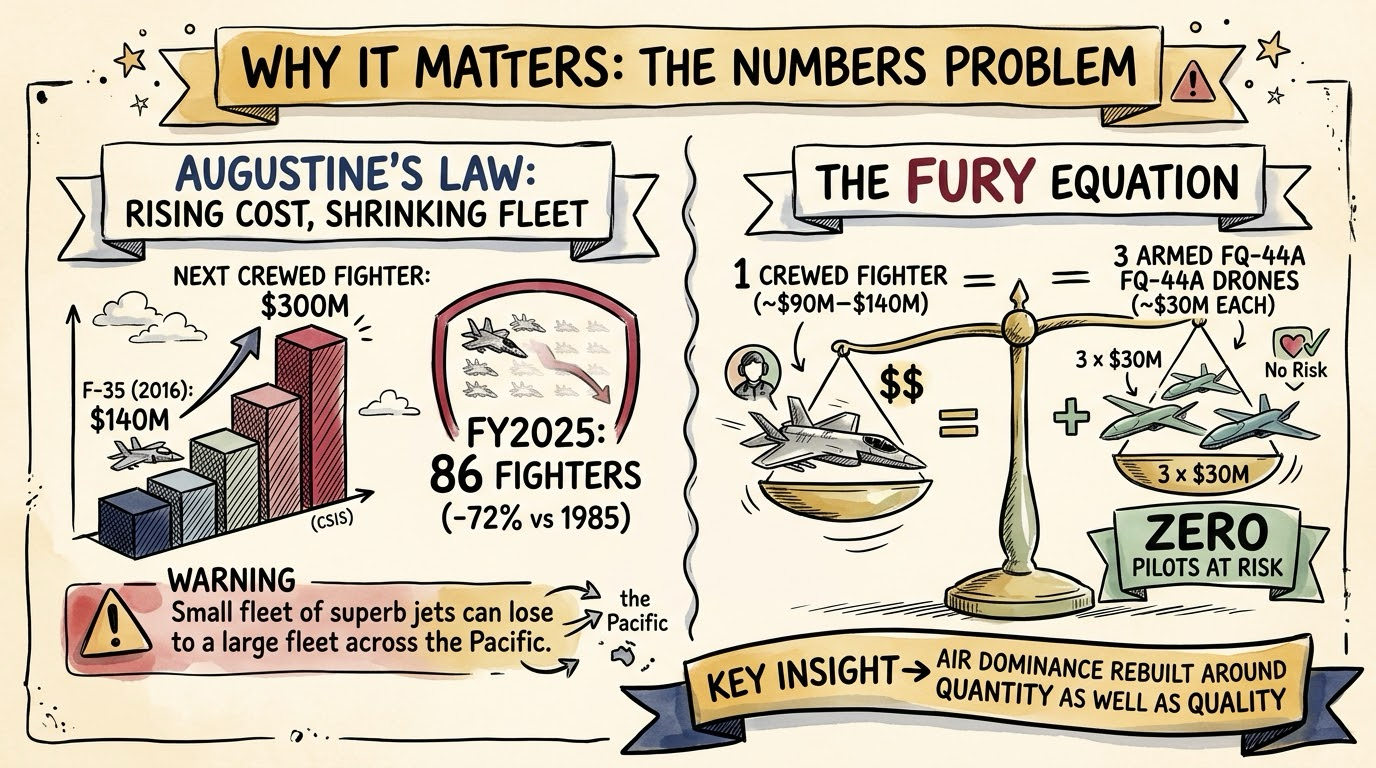
Why It Matters: The Numbers Problem
American air power has a math problem, and the Fury is aimed directly at it.
Fighter jets keep getting more expensive.
A defense official named Norman Augustine pointed out in 1979 that the cost of a new fighter had risen about tenfold every 20 years.
The trend never stopped.
According to CSIS, the F-35 averaged $140 million per aircraft when it entered service in 2016, and the next crewed fighter was estimated at $300 million.
As prices rise, fleets shrink.
The Pentagon planned to buy 86 fighters in fiscal 2025, which is 72% fewer than it bought in 1985.
A small fleet of superb aircraft can still lose to a large fleet of good ones, especially across the distances of the Pacific.
The Fury changes that equation.
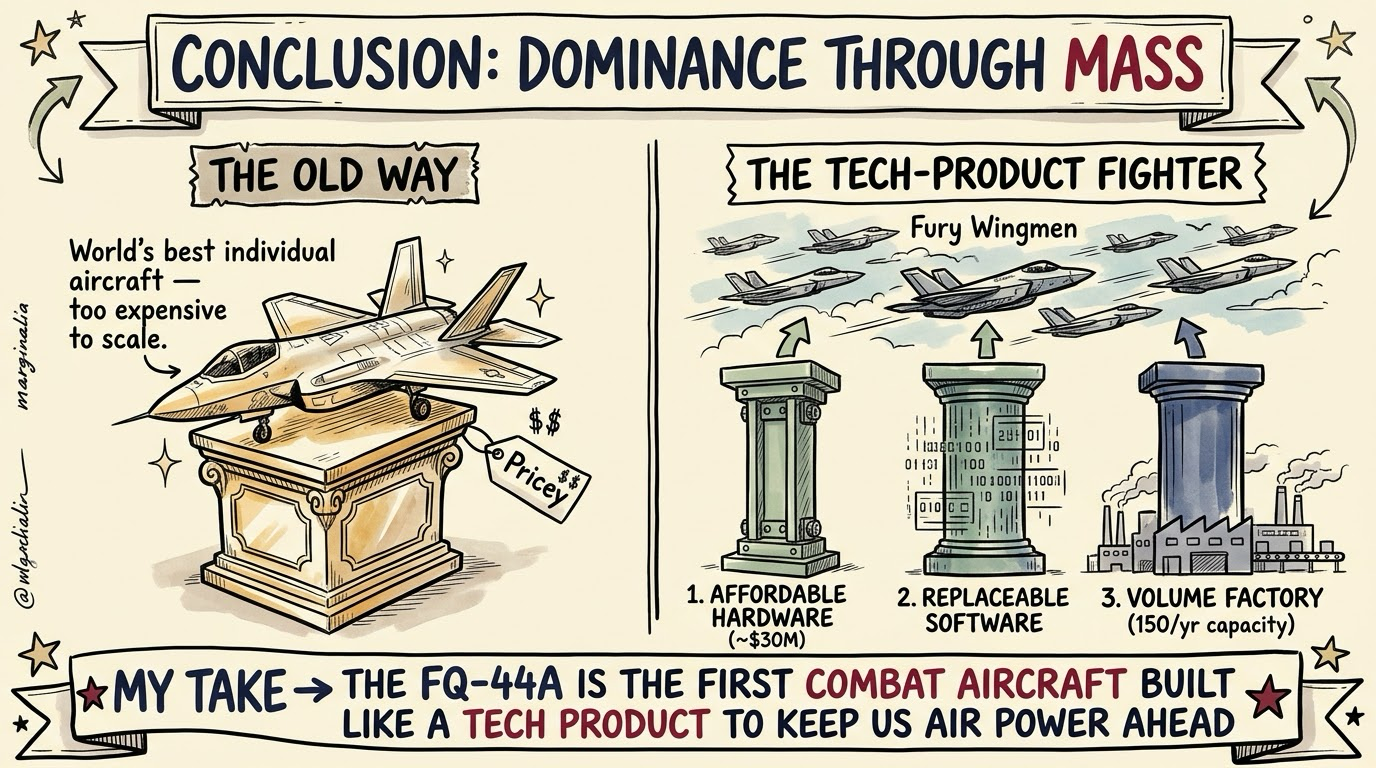
The Air Force has aimed for about $30 million per drone, roughly a third of an F-35, and officials say the program is beating that projection.
So for the price of one crewed fighter, a commander could add about three armed wingmen.
None of them puts a pilot at risk.
That's what air dominance looks like when it's rebuilt around quantity as well as quality.
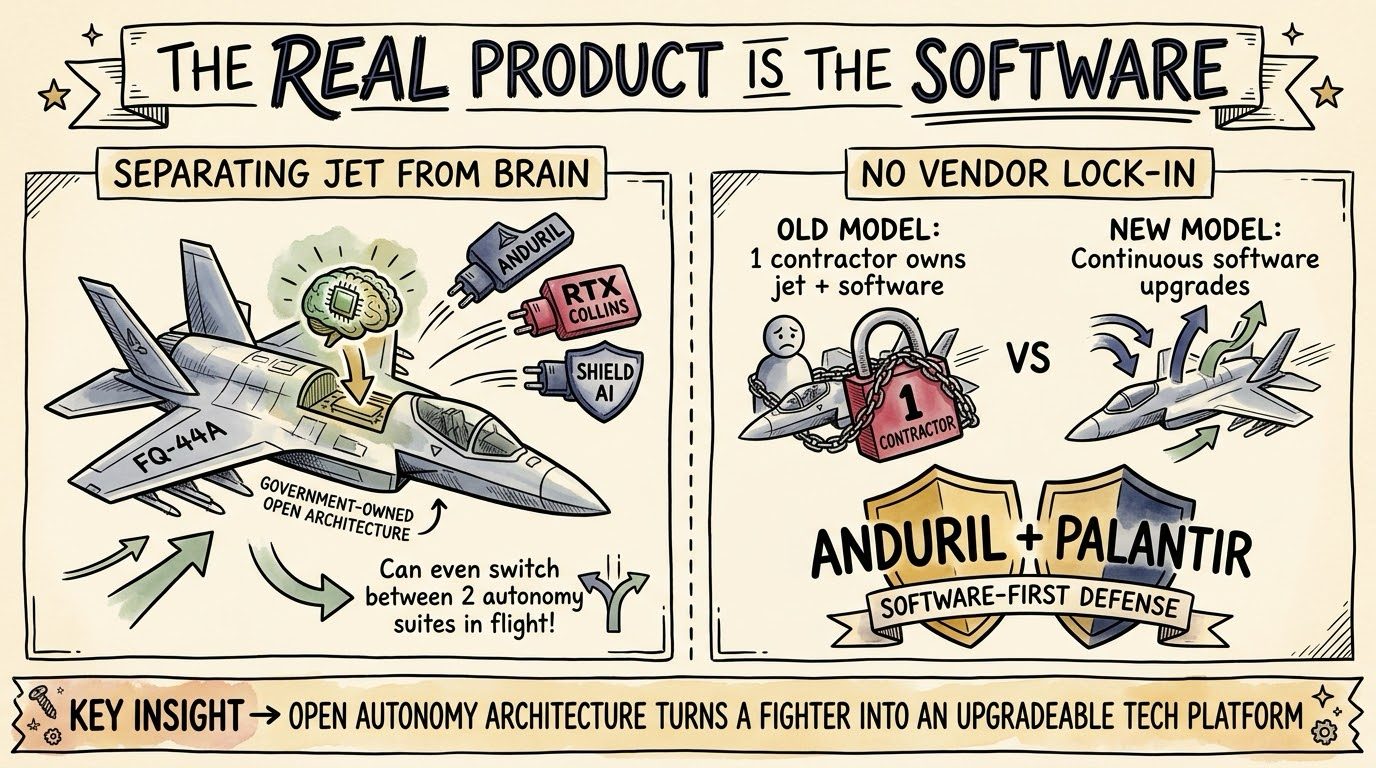
The Real Product Is The Software
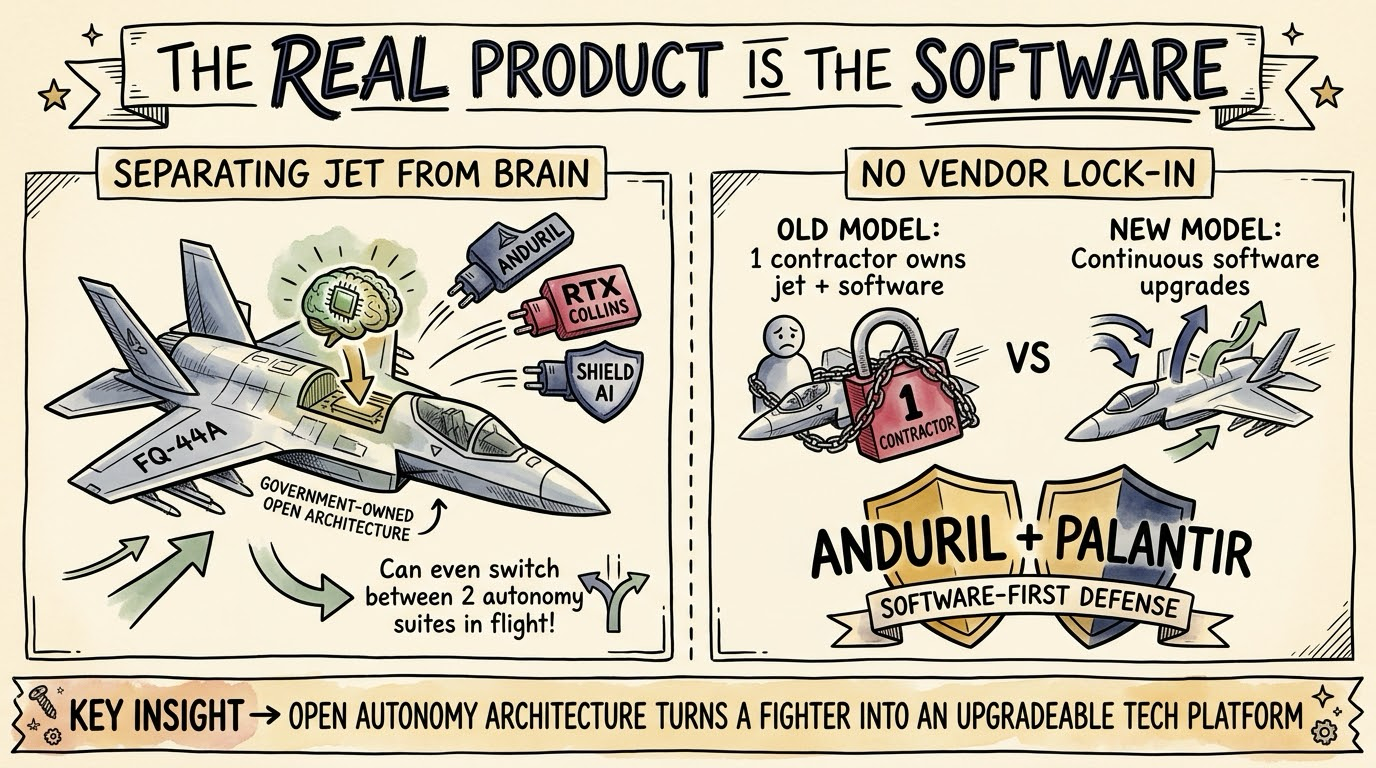
The part I find most interesting is how the Air Force has split the aircraft from its brain.
It uses a government-owned open architecture so that different companies' autonomy software can run on the same airframe.
Six companies are in the pool, and three are competing head to head in the first round: Anduril, RTX Collins Aerospace and Shield AI.
The Air Force plans to pick a primary software provider by summer 2027.
The Fury can even switch between two autonomy suites in flight.
That's a very different model from the traditional one, where a single contractor owns the jet and everything in it.
It means the aircraft can keep improving through software updates, and no single vendor can hold the program hostage.
It also explains why I see Anduril and Palantir as the duo that will establish US dominance, since both treat software as the core of defense.
Years ago, a video game imagined a battlefield full of drones, which I wrote about in the game that guessed the drone war.
The Fury is that idea arriving in real squadrons.
Where This Argument Has Limits
The biggest risk right now is in Washington.
Anduril says it can't start building under its production contract until Congress passes the fiscal 2027 budget.
Its Ohio factory can make up to 150 Furies a year, and current orders don't come close to that.
The technology has open questions too.
Analysts such as Justin Bronk of RUSI have argued that these drones depend on datalinks that an enemy could jam.
The Fury is subsonic and carries two missiles, so it supports crewed fighters and can't replace them.
Cost deserves skepticism as well.
CSIS notes that the Pentagon's idea of a low-cost drone has risen from about $3 million to $25 to $30 million in eight years.
Other countries are building their own versions.
Australia's Ghost Bat fired an air-to-air missile in December 2025, China has a two-seat J-20 designed to command drone wingmen, and Turkey is flying its own.
And Anduril shares this program with General Atomics, so the Fury is one of two answers the Air Force is buying.
Conclusion: Dominance Through Mass
For decades, the US kept its edge in the air by building the best individual aircraft in the world.
That approach has become too expensive to scale.
The FQ-44A offers a way to add numbers quickly, keep pilots out of the most dangerous roles and upgrade the fleet through software.
If Congress funds it and the autonomy holds up under jamming, it will change how the Air Force fights.
My Take: The FQ-44A matters because it's the first combat aircraft built like a tech product, with affordable hardware, replaceable software and a factory designed for volume, and that combination is what will keep US air power ahead.
Sources
Pages I opened for the facts in this post:
- Wikipedia: Anduril YFQ-44
- Military Times: US Air Force awards first CCA production contracts to General Atomics, Anduril
- Army Recognition: US Air Force chooses Anduril FQ-44
- DefenseScoop: Air Force plans to field 500 CCA drones by 2032
- Breaking Defense: Anduril can't start on CCA production contract without FY27 budget
- Defense News: US Air Force F-22 pilot controls unmanned FQ-44 in flight
- MiGFlug: FQ-44A Fury CCAs fly AI-directed air combat
- CSIS: Updating Augustine's Law
- Wikipedia: Collaborative combat aircraft
- Anduril News: Fury status page