Sun is Running Out of Hydrogen and World Will Be Inhabitable. So We Should Work With AI To Transfer Knowledge To Future Generations
The Sun has burned half its fuel. Earth has ∼1 billion habitable years left, not 5 billion. Knowledge rots faster than stars die. If we start archiving with AI now, it compounds for the people who will need it after us.
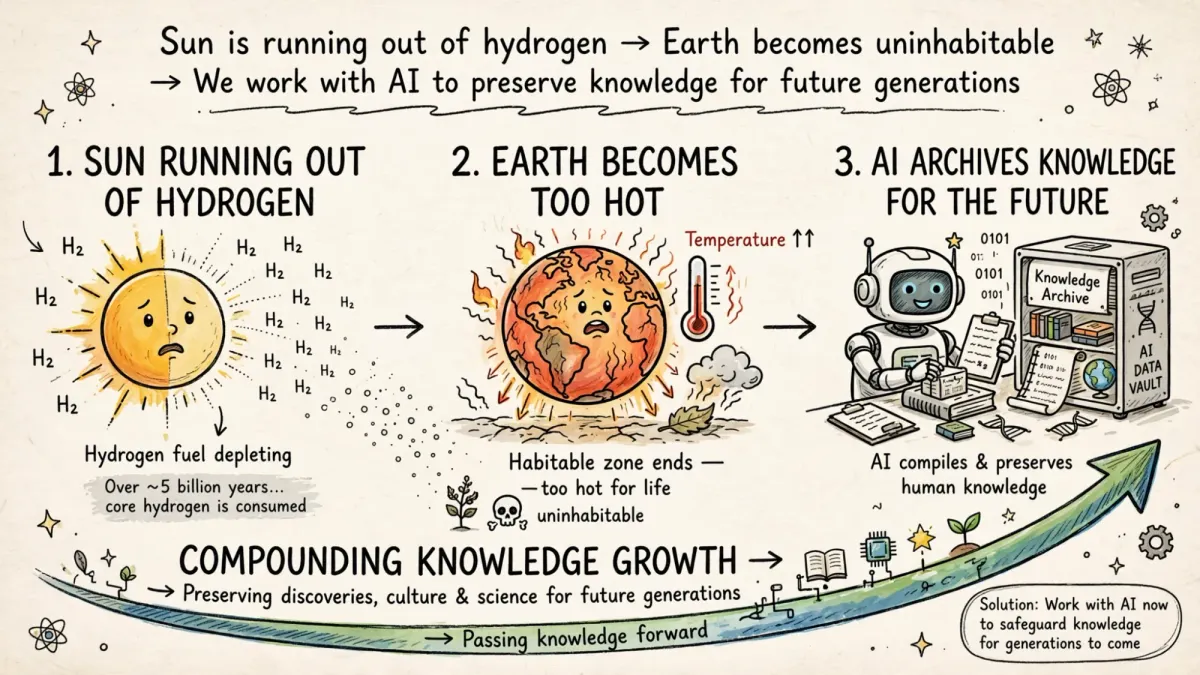
We act like time is infinite. It is not.
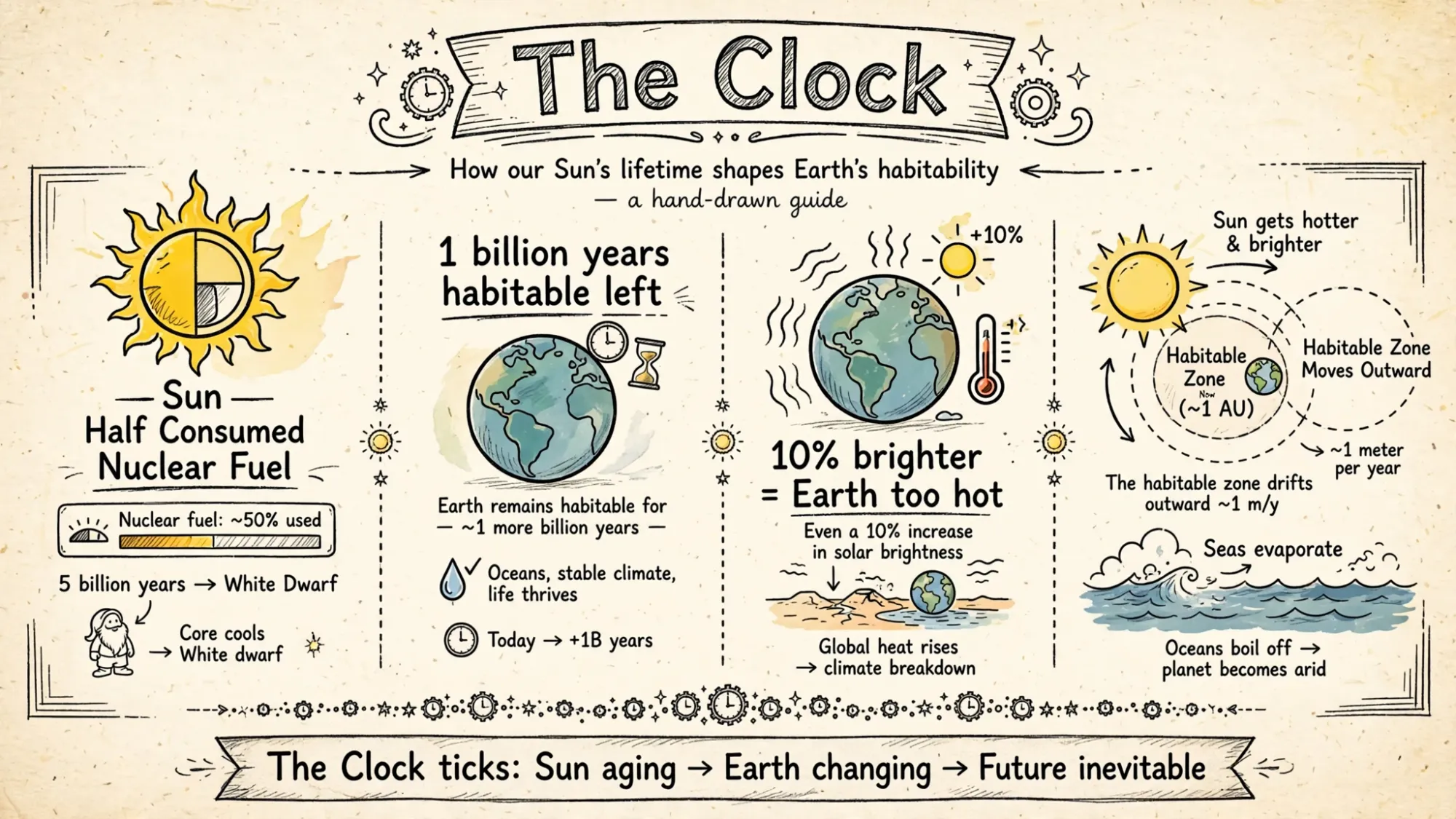
The Sun has only consumed about half of its nuclear fuel, so it still has a long life ahead as a main-sequence star — about 5 billion years before it becomes a white dwarf. It will expand into a red giant 250 times its current size, engulf Mercury and Venus, and possibly Earth as well.
But we do not have 5 billion years. We have about 1 billion.
1. The Clock
Here is the real timeline NASA does not put on posters:
- The Sun gets brighter as it ages. It is fusing hydrogen into helium. More helium in the core = hotter core = more brightness.
- With a 10% increase in brightness, Earth will no longer be within the habitable zone. By the time the sun stops burning hydrogen in its core, Mars will be in the habitable zone, and Earth will be much too hot to maintain water.
- The habitable zone moves outward ∼1 meter per year. The latest model predicts a total habitable zone lifetime for Earth of 6.3 to 7.8 billion years, suggesting life is already about 70% of the way through its run. Other estimates are harsher: Earth will cease to be habitable somewhere between 1.75 and 3.25 billion years from now. After this point, Earth will be in the 'hot zone' with temperatures so high seas would evaporate.
- Left unchecked, Earth's current habitability will end in one billion years. That is the consensus you see in megaengineering papers.
So 5 billion years to white dwarf, but only ∼1 billion years of oceans, stable climate, and life as we know it. The seas boil off, the planet becomes arid.
A billion years feels long. On a civilizational scale it is short. We went from cave paintings to ChatGPT in 50,000 years. That is 0.005% of the time we have left.
2. Why Knowledge Dies Faster Than Stars
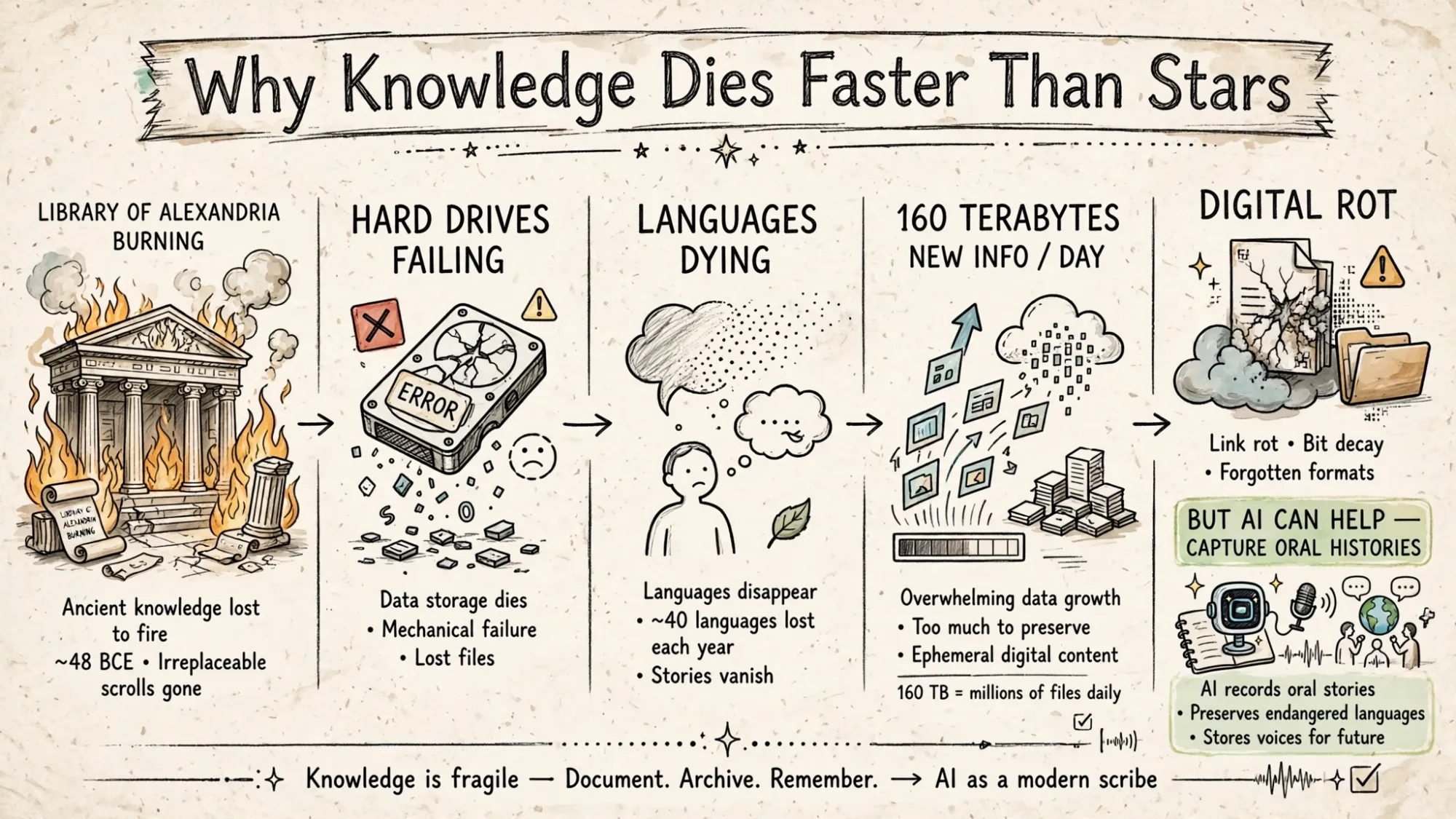
Stars die slowly. Knowledge dies fast.
We create up to 160 terabytes of new information every day, and most of it will not survive 20 years.
Hard drives fail.
Formats die.
Links rot.
Languages die with their last speaker.
The pre-AI internet is already contaminated and disappearing.
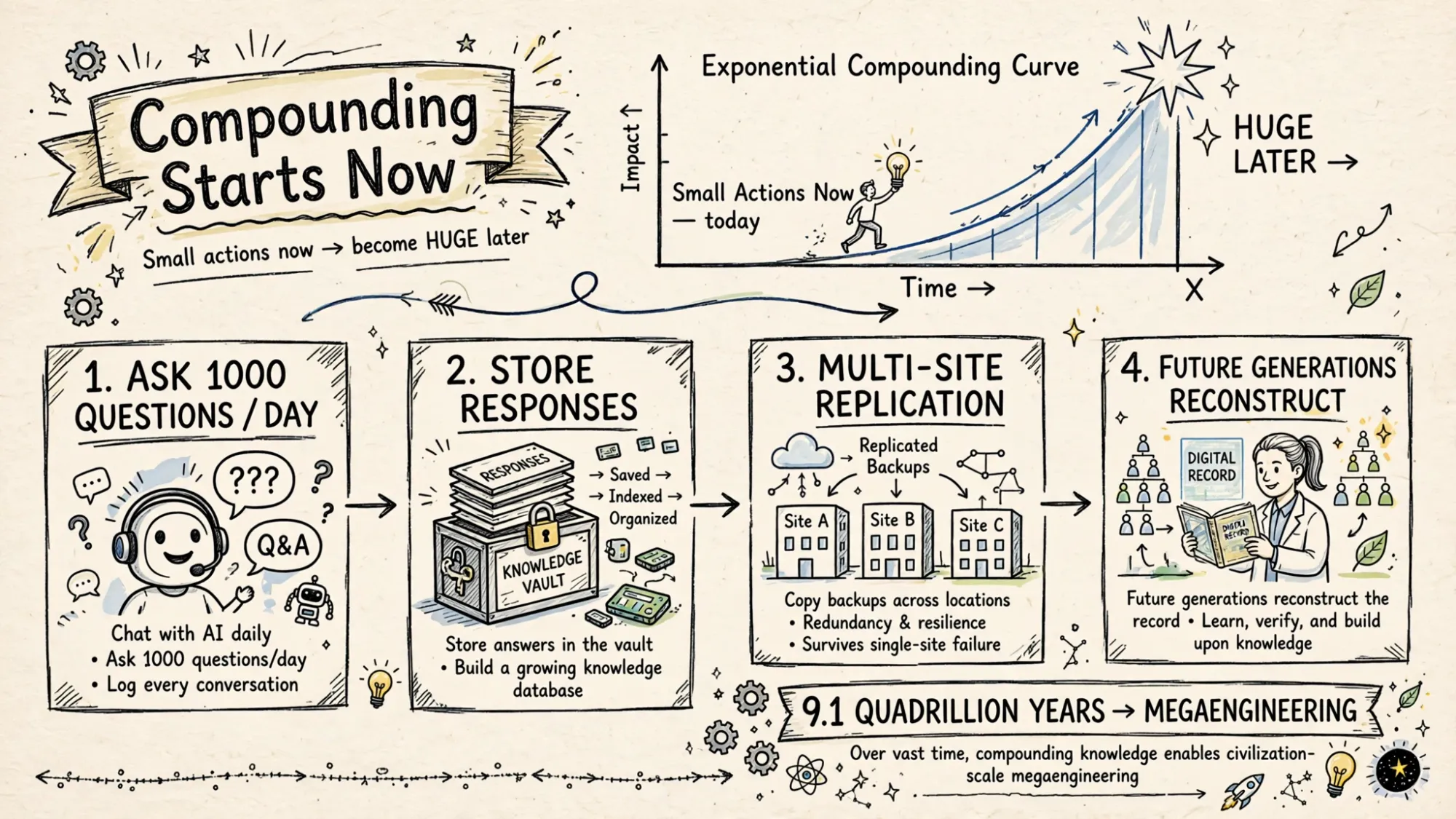
Researchers now propose asking 1000 topical questions a day of chatbots and storing their responses, using AI to record the changing output of AI for future humans.
If we do not actively preserve, future generations will inherit our ruins, not our understanding.
They will have to rediscover antibiotics, crop genetics, chip fabrication, constitutional law from scratch.
That is the waste we cannot afford when time is finite.
AI gives us something no previous generation had: a way to capture not just documents, but context, reasoning, oral histories, endangered languages, and how we actually thought.
3. AI as Time Capsule
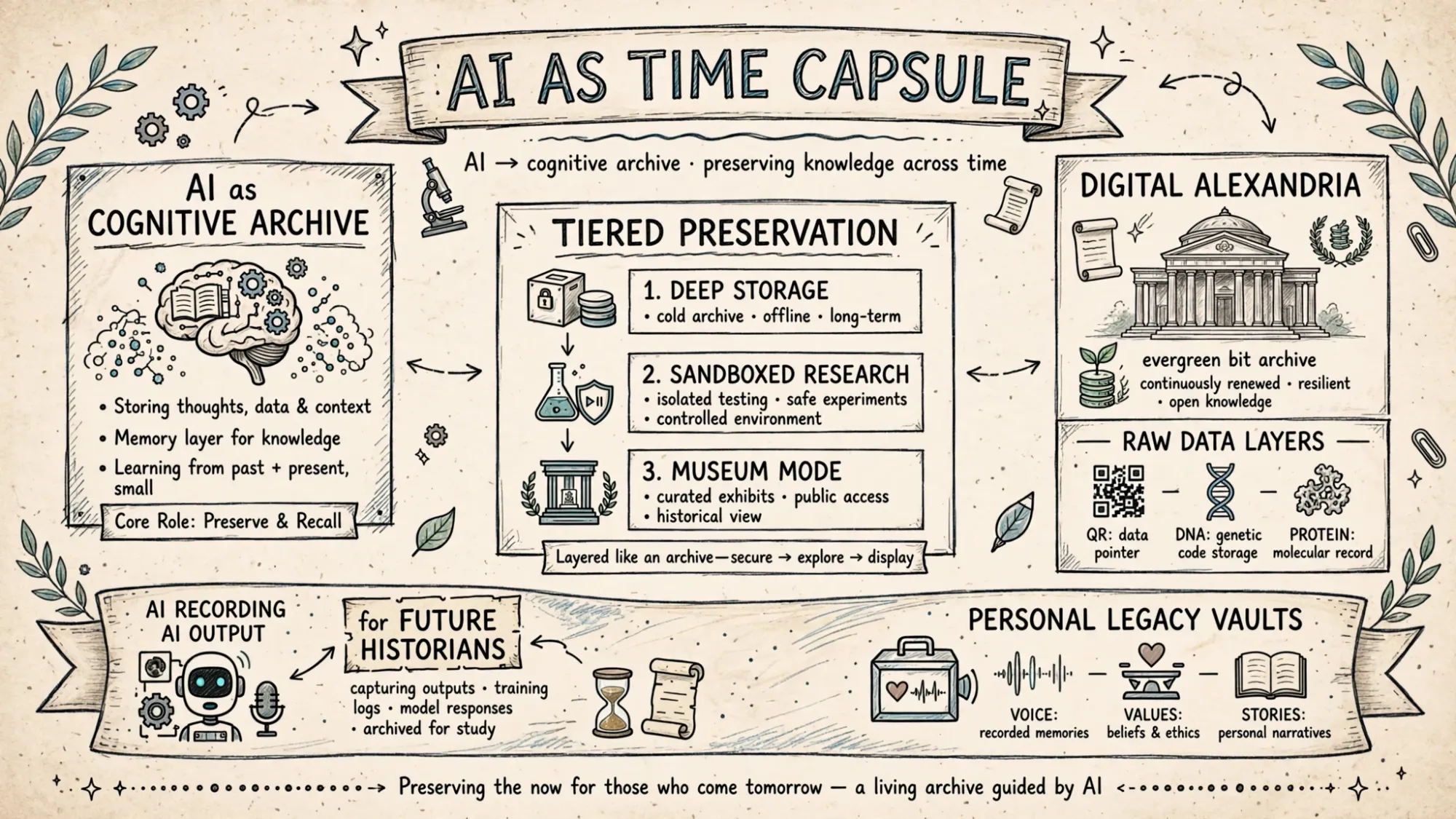
I think of AI not as a chatbot, but as a cognitive archive.
A proposal called The Cognitive Archive lays it out as a tiered preservation system, encompassing deep storage, sandboxed research access, and public museum modes, the framework ensures that dynamic cognitive snapshots remain viable for future study.
Think in three layers:
1. Deep Storage: Cold, offline, long-term. An evergreen bit archive that outlasts hardware lifecycles, supports multi-site replication, and enables future generations to reconstruct humanity's digital record regardless of media available. Projects like Digital Alexandria store every ≤1 KiB data block with extreme deduplication and multi-modal encodings — raw, QR, DNA, protein — designed to preserve humanity's knowledge for centuries.
Raw data layers: QR as pointer, DNA as genetic code storage, protein as molecular record.
2. Sandboxed Research: Isolated, safe. Future historians can spin up an old model, ask it questions, test it, without risking the archive.
3. Museum Mode: Curated, public. What the Library of Alexandria wanted to be, but with AI that can translate, explain, and converse.
Add two more dimensions we are already building:
AI recording AI output: capturing outputs, training logs, model responses archived for study. Because how we reasoned in 2026 will be as valuable as what we knew.
Personal legacy vaults: NeoLegacy and BruceAI archiving voice, values, life stories for children, messages for future generations, emotional milestones and memories become structured knowledge vaults accessible through AI-assisted conversation. The goal is to create an AI system capable of archiving music, knowledge, stories, reflections, personal growth so they can be passed forward across generations.
And at scale, AI preserves marginalized cultures by recording endangered languages, creating interactive learning tools, and preserving oral histories.
4. Whatever We Start Now Will Compound
Here is the part that matters: whatever we start now will compound.
A 1% improvement in preservation per year, over 1,000 years, is not 10x. It is 20,000x. Over 1 billion years, even 0.0001% compounding becomes everything.
We do not need to solve interstellar transfer today. We need to start the flywheel:
- Ask and archive 1,000 questions a day. Philosophy, physics, medicine, farming, law, love letters. Store answers from different models. That becomes a stratigraphy of human thought.
- Build evergreen, AI-ready archives. Not PDFs on a single server. Deduplicated, multi-site, multi-modal: raw + QR + DNA + protein. An archive that can survive EMPs, floods, and bit rot.
- Turn personal knowledge into legacy vaults. Your voice, your values, your failures. Structured. Searchable by your great-great-grandchildren's AI.
- Teach AI to preserve, not just generate. Preservica's AI-powered Active Digital Preservation automatically keeps every file alive in future-friendly formats over decades. Same idea for all human knowledge.
- Megaengineering mindset. One paper proposes safeguards that could stretch Earth's habitability to 9.1 million billion years. That only happens if knowledge compounds first.
The Sun running out of hydrogen is not depressing. It is clarifying. It tells us our job is not to live forever, but to make sure what we learned lives forever.
The Sun gave us energy. Our job is to give the future meaning.
Start now. Archive one story. Record one language. Save one paper in a format that will outlive you. Build one AI that can explain it to a child 500 years from now.
Compounding does the rest.