Could Abdul El-Sayed Become a President One Day (like Obama did)?
Identity matters, but coalition matters more. Obama won with broad appeal. El-Sayed's Michigan Senate run is the first real test.
Who Is Abdul El-Sayed
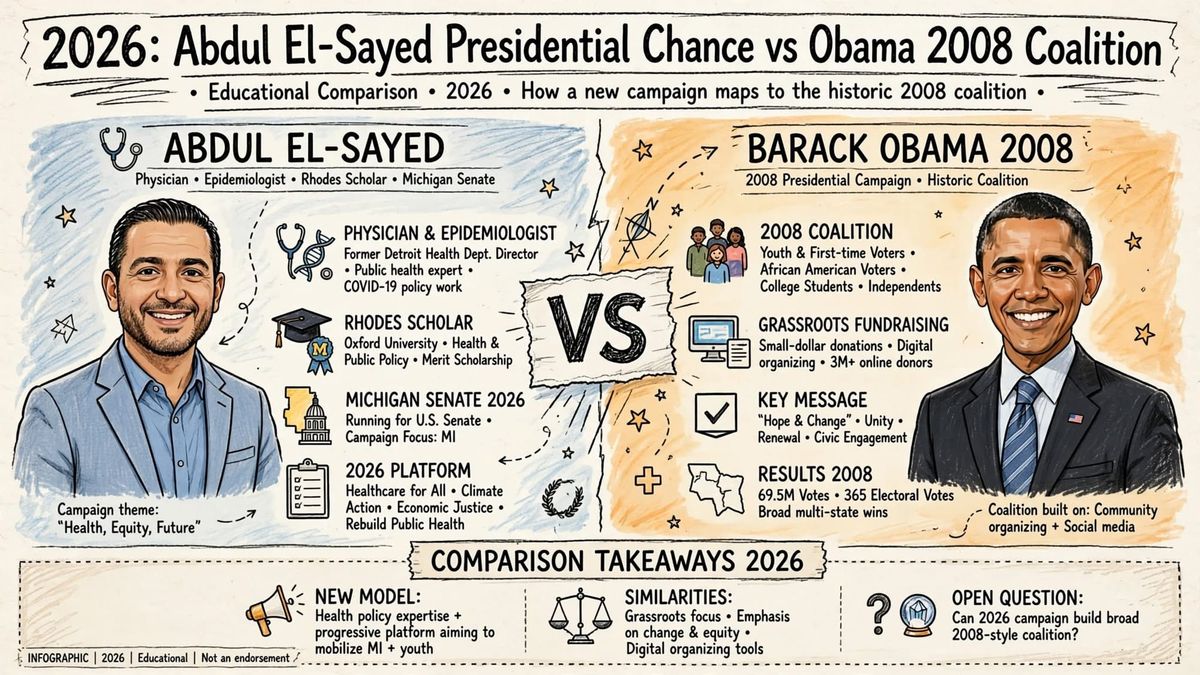
Abdul El-Sayed is now the first Muslim elected to the U.S. Senate. The Washington Post
He won Michigan’s open seat on November 3, 2026, beating Republican former Rep. Mike Rogers. NPR
He was born in Rochester Hills, Michigan, in 1984. bridgemi
His parents were Egyptian immigrants who divorced when he was three, and his father and Michigan-born stepmother raised him in the Detroit area. Wikipedia
He studied at the University of Michigan, won a Rhodes Scholarship to Oxford, finished a doctorate in public health there in 2011, and completed his medical degree at Columbia by 2014. bridgemi
He was 30 when he became Detroit’s health director. fox17online
He took that job in 2015 and left in 2017 to run for governor, finishing second to Gretchen Whitmer in the Democratic primary. bridgemi
He later ran Wayne County’s Department of Health, Human and Veteran Services from December 2022 to April 2025, then resigned to run for Senate. bridgemi
He has a medical degree but chose not to practice and holds no Michigan licence, which turned his use of the word “physician” into a campaign dispute. bridgemi
He had never held elected office before this win. PBS
The Obama Comparison: Useful But Different
The comparison raises a fair question: how much does identity matter, and how much can political circumstances overcome it?
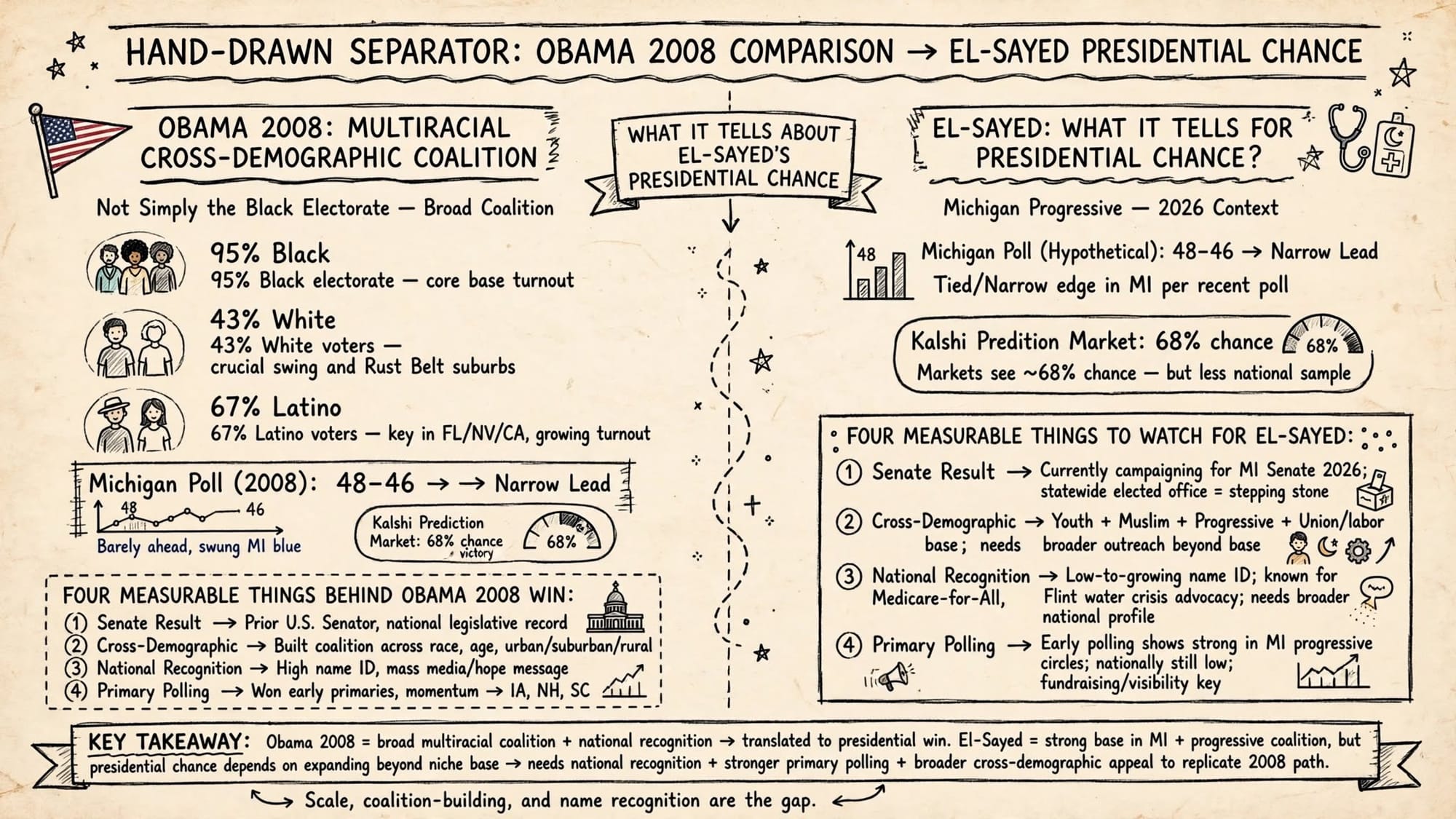
Obama’s 2008 victory was built on a multiracial coalition, not the Black electorate alone.
The national exit poll had him winning 95 percent of Black voters, 67 percent of Latino voters and 43 percent of white voters. muni
White voters made up 74 percent of that electorate and Black voters 13 percent, which is why his white support mattered so much. muni
A Muslim presidential candidate would need the same kind of math, with votes from people of every religious background.
El-Sayed differs from Obama in three visible ways: he is Arab American, he is Muslim, and he is shorter than the traditional presidential image.
A University of Michigan club lacrosse roster listed him at 5'9", and conservative critics have argued he is shorter than that. freebeaconenjoyer
Height is probably the weakest of the three objections.
One study of U.S. presidential elections found taller candidates won more of the popular vote but were not significantly more likely to win the election. northumbria
Obama’s path also ran through the Senate.
He won his seat in 2004, launched his presidential campaign in early 2007 and won the White House in 2008.
El-Sayed has now taken that first step.
Obama even campaigned with him in Detroit in the final stretch. PBS
The Religion Hurdle Is Real, But Numbers Have Moved
This is where the data matters, and the dates matter just as much.
Pew has asked Americans whether a candidate’s traits would make them less likely to offer their support.
The share less likely to back a Muslim candidate fell slightly from 46 percent in 2007 to 42 percent in 2016. pewresearch
Over the same period, the penalty for not believing in God dropped from 61 percent to 51 percent. pewresearch
Republicans (62 percent) and white evangelical Protestants (65 percent) were the most negative toward a Muslim candidate. pewresearch
Gallup asks a different question: would you vote for a well-qualified nominee of your party who happened to be Muslim?
In 2015, 60 percent said yes, tied for second lowest among the 11 categories tested. gallup
By 2019 that had climbed to 66 percent, up from 58 percent in 2012. gallup
Gallup’s early 2020 results stayed within a few points of that. gallup
Republicans were still far less willing, at 42 percent. alaskawatchman
Age is the most interesting split.
In 2015, 76 percent of 18 to 29 year olds said they would vote for a Muslim candidate, compared with 44 percent of seniors. christiancenturypos
The catch is that the newest Gallup figure I could find is from 2020, so these numbers show direction, not today’s exact level.
Population share is a separate issue.
Black Americans are about 14 percent of the population, while Muslims are about 1 percent of American adults. pewresearchtmj
That gap sounds decisive, but a candidate does not need most of the votes to come from their own group.
Obama did not.
The Religion Hurdle Is Real, But Numbers Have Moved
This is where the data matters, and the dates matter just as much.
Pew has asked Americans whether a candidate’s traits would make them less likely to offer their support.
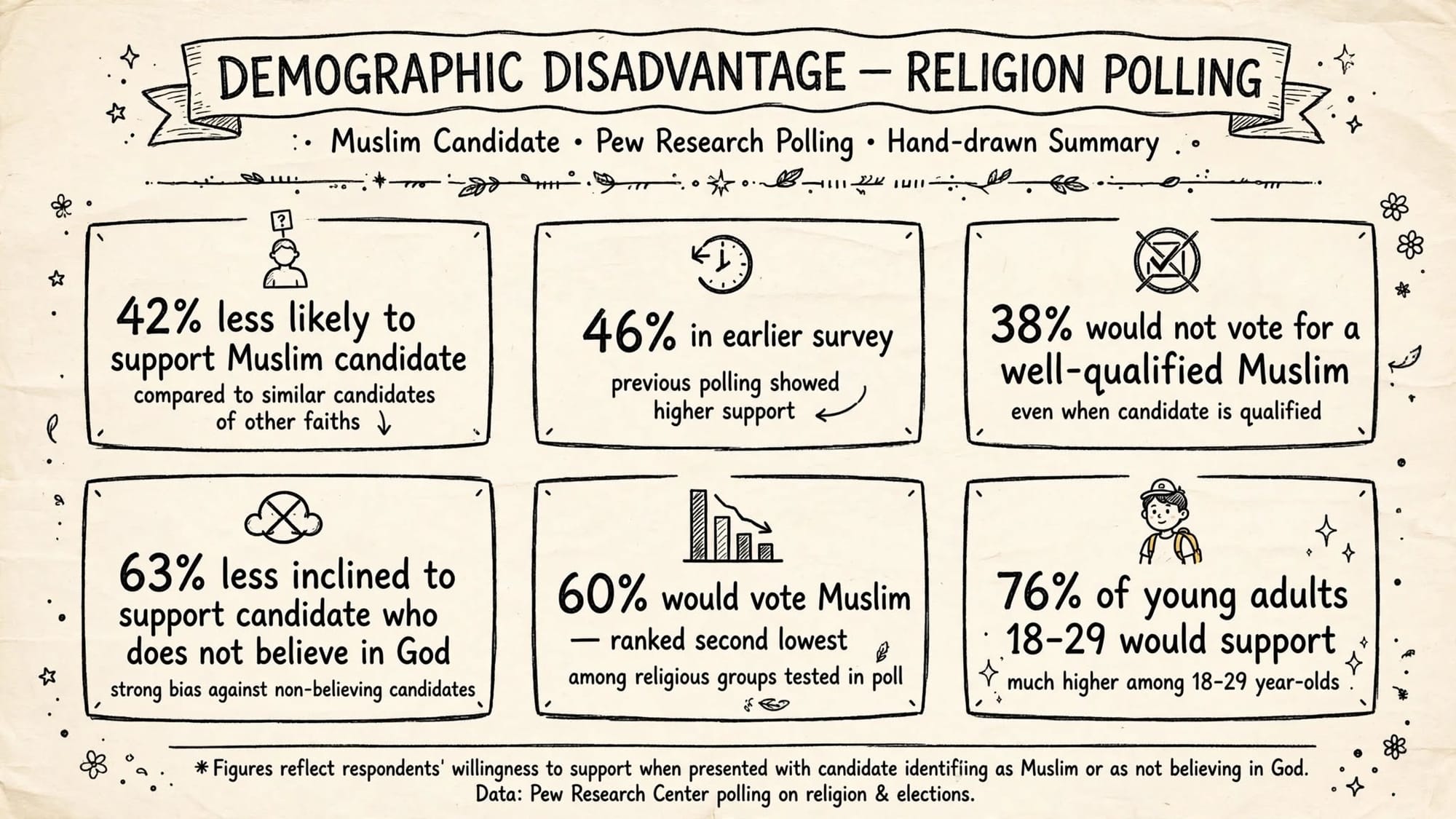
The share less likely to back a Muslim candidate fell slightly from 46 percent in 2007 to 42 percent in 2016. pewresearch
Over the same period, the penalty for not believing in God dropped from 61 percent to 51 percent. pewresearch
Republicans (62 percent) and white evangelical Protestants (65 percent) were the most negative toward a Muslim candidate. pewresearch
Gallup asks a different question: would you vote for a well-qualified nominee of your party who happened to be Muslim?
In 2015, 60 percent said yes, tied for second lowest among the 11 categories tested. gallup
By 2019 that had climbed to 66 percent, up from 58 percent in 2012. gallup
Gallup’s early 2020 results stayed within a few points of that. gallup
Republicans were still far less willing, at 42 percent. alaskawatchman
Age is the most interesting split.
In 2015, 76 percent of 18 to 29 year olds said they would vote for a Muslim candidate, compared with 44 percent of seniors. christiancenturypos
The catch is that the newest Gallup figure I could find is from 2020, so these numbers show direction, not today’s exact level.
Population share is a separate issue.
Black Americans are about 14 percent of the population, while Muslims are about 1 percent of American adults. pewresearchtmj
That gap sounds decisive, but a candidate does not need most of the votes to come from their own group.
Obama did not.
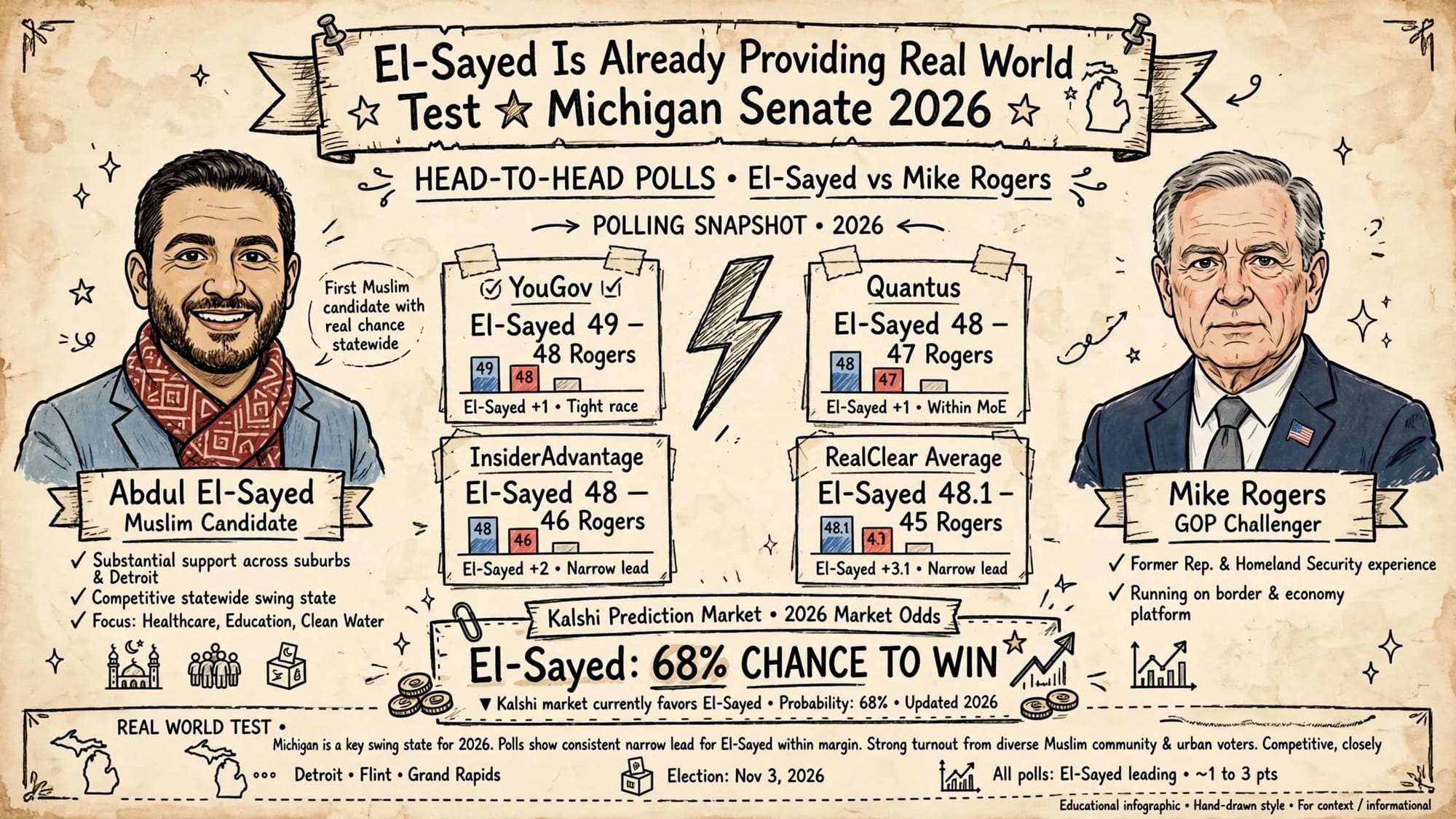
El-Sayed Is Already Providing Real World Test
Michigan has now given us a result, so the pre-election polls can retire.
With about 97 percent of the vote counted, El-Sayed led Rogers 52.5 percent to 45.5 percent. NBC News
That was slightly better than 270toWin’s final polling average of 50.8 to 44.9. 270towin
Michigan is a real swing state, and Donald Trump carried it by 1.4 points in 2024. Wikipedia
Trump and other Republicans repeatedly tried to link El-Sayed to terrorist groups without evidence and questioned his loyalty to the country. PBS
Trump also claimed he was tied to the Muslim Brotherhood. thenationalnews
Old posts from his half-sister about their mother’s past activism in the group added fuel, and El-Sayed denied any ties and disavowed the organization. keyt
Bridge Michigan found no direct evidence for Rogers’ claim that he had pledged support to it. bridgemi
His primary rival, Rep. Haley Stevens, then endorsed Rogers two days before the election. PBS
The race was also the most expensive in Michigan history, with more than $270 million in disclosed spending by last month. bridgemi
He won by about seven points anyway.
Muslim voters backed him 92 percent to 8 percent, according to the NBC News Exit Poll, but they are only about 2 percent of Michigan’s population. NBC News
So almost all of his winning coalition came from outside his own religious group, which is the exact question this post started with.
There is a serious caveat.
All 83 Michigan counties moved toward Democrats compared with 2024, and turnout of more than 4.8 million appears to be a midterm record. bridgemi
Democrat Jocelyn Benson won the governor’s race on the same ballot by more than 10 points, about three points better than El-Sayed. bridgemi
Democrats also won control of both chambers of Congress. PBS
Michigan shows a Muslim progressive can win a swing state in a strong Democratic year.
It cannot yet show how he would do in a neutral year, or in front of a national electorate.
What Would Actually Tell Us About Presidential Chance
The first obstacle is El-Sayed himself.
He told Meet the Press that he has no plans to ever run for president and has never wanted to. Fox News
Politicians do change their minds, but that is his position on the record.
JD Vance was already floating the idea of a President El-Sayed the day after his primary win. washingtonexaminer
He is 42 and was born in Michigan, so he is eligible and has time.
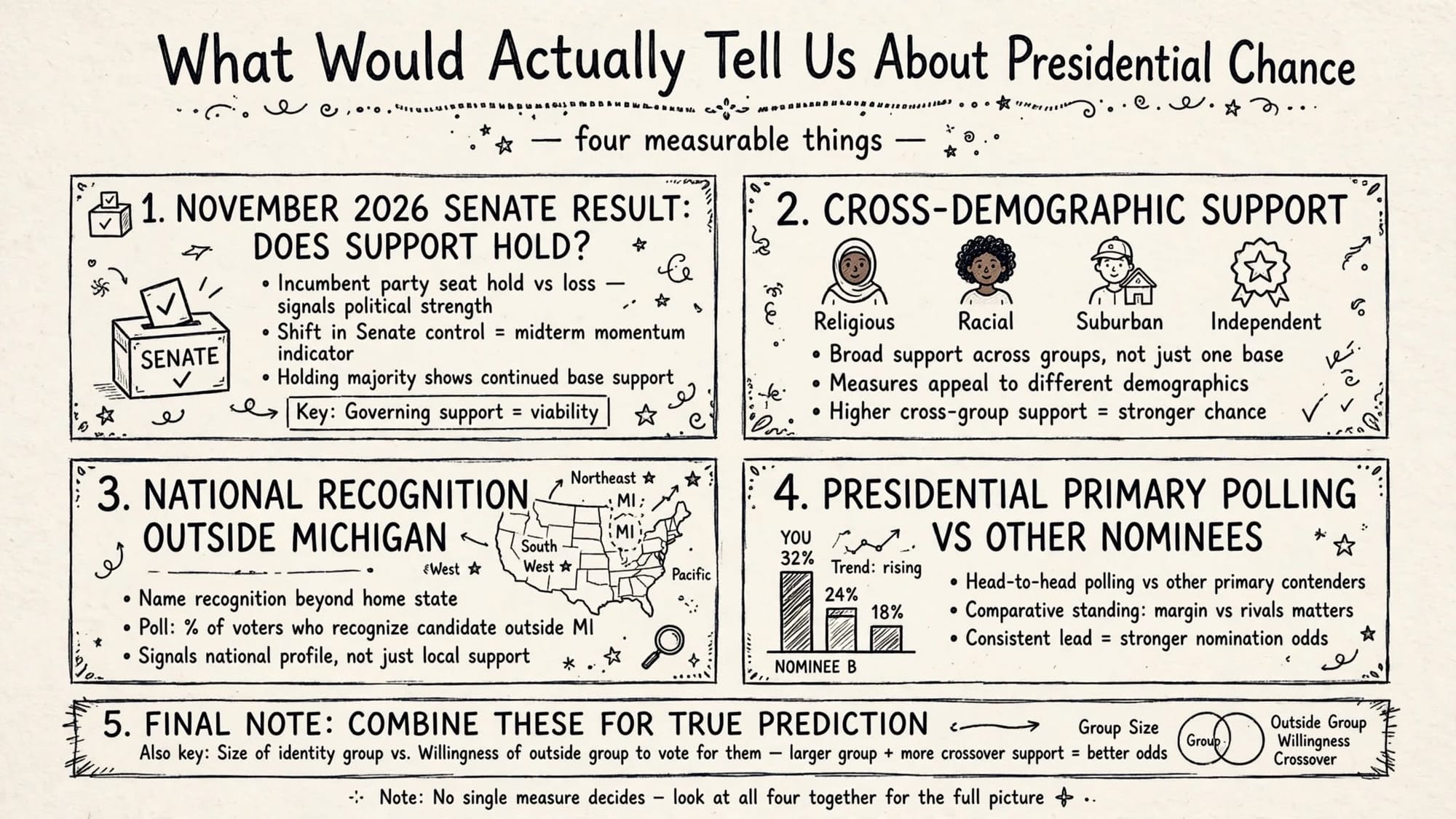
Rather than assign a speculative probability, watch four measurable things:
1. November 2026 Senate result: This test is passed. Support held when voters actually cast ballots. Republicans have not won a Michigan Senate race since 1994, but Rogers lost the state’s 2024 race by barely 19,000 votes, so this was far from a free win. It gives him the Obama-like stepping stone. Wikipediawpxi
2. Cross demographic support: The early picture is mixed. He won Oakland County with 56 percent, ahead of Kamala Harris’s 54 percent in 2024. He took 69 percent of voters aged 18 to 29 and won union members 58 percent to 41 percent. Marist’s October poll had him ahead among independents 50 to 44. His 86 percent among Black voters was about four points below the usual Democratic Senate number in Michigan. Rogers also gained in some heavily Jewish Oakland County communities, rising from 42 percent to 46 percent in West Bloomfield Township. How Abdul El-Sayed, Jocelyn Benson won Michigan: Big turnout, Democratic shifts - Bridge Michigan +4
3. National recognition: I have not seen solid national polling on him yet. The real question is how voters outside Michigan respond once they know his record, including Medicare for All and his sharp criticism of Israel. PBS
4. Presidential primary polling: Would Democratic voters across multiple states support him against other prospective nominees? Prediction markets currently place Alexandria Ocasio-Cortez among the leading 2028 contenders, so the left lane already has a name in it. ABC News has suggested El-Sayed could instead become an important voice that presidential contenders want on their side. Newsweekgoodmorningamerica
The key distinction is between the size of a candidate’s identity group and the willingness of people outside that group to vote for them.
Obama’s election demonstrated the importance of the second one.
El-Sayed’s win is the first hard evidence that an openly Muslim candidate can clear that bar statewide in a swing state.
It still cannot tell us how a nationwide presidential campaign would unfold.
If he builds a broad coalition beyond his progressive base, and shows lasting strength with independents and suburban voters, the Obama path becomes a plausible template.
If his support stays narrow, or he simply keeps his word and never runs, a presidential bid remains unlikely.
History says the barrier is real but not fixed.
The data suggests it has been shrinking, especially among young voters.
Michigan just moved that from theory to evidence.
Sources:
- AP via PBS: Democrat Abdul El-Sayed wins election to U.S. Senate from Michigan
- Bridge Michigan: How Abdul El-Sayed, Jocelyn Benson won Michigan
- Bridge Michigan: Who is Abdul El-Sayed?
- Bridge Michigan: Senate election coverage and spending
- Bridge Michigan: El-Sayed disavows Muslim Brotherhood
- NBC News: 2026 Senate results
- NBC News: Midterm live blog and exit poll
- NPR: El-Sayed defeats Rogers
- The Washington Post: Michigan Senate results
- 270toWin: Michigan Senate polls
- Marist Poll: Michigan, October 2026
- Wikipedia: 2026 United States Senate election in Michigan
- Wikipedia: Abdul El-Sayed
- FOX 17: Get to know the candidates
- CNN via KEYT: El-Sayed disavows Muslim Brotherhood
- The National: Trump accuses El-Sayed of Muslim Brotherhood ties
- Fox News: El-Sayed on running for president
- Washington Examiner: Vance floats President El-Sayed
- ABC News: El-Sayed’s primary win and 2028
- Newsweek: Cruz on Ocasio-Cortez and 2028
- Washington Free Beacon: El-Sayed’s listed height
- Enjoyer: How tall is Abdul El-Sayed?
- Stulp et al., The Leadership Quarterly: Tall claims?
- 2008 National Exit Poll, via CNN
- Pew Research Center: Religion and other candidate traits
- Pew Research Center: The growing diversity of Black America
- The Muslim Journal: Pew study on American Muslims
- Gallup: Six in 10 Americans say yes to a Muslim president
- Gallup: Less than half would vote for a socialist for president (2019)
- Gallup: Socialism and atheism still U.S. political liabilities (2020)
- Alaska Watchman: Gallup 2020 party breakdown
- Christian Century: Are Americans ready for a Muslim president?
- Public Opinion Strategies: Gallup age breakdown
- Fox Local: What to know about El-Sayed vs. Rogers