Nuclear War Is Inevitable. Both Population Paths Lead There.
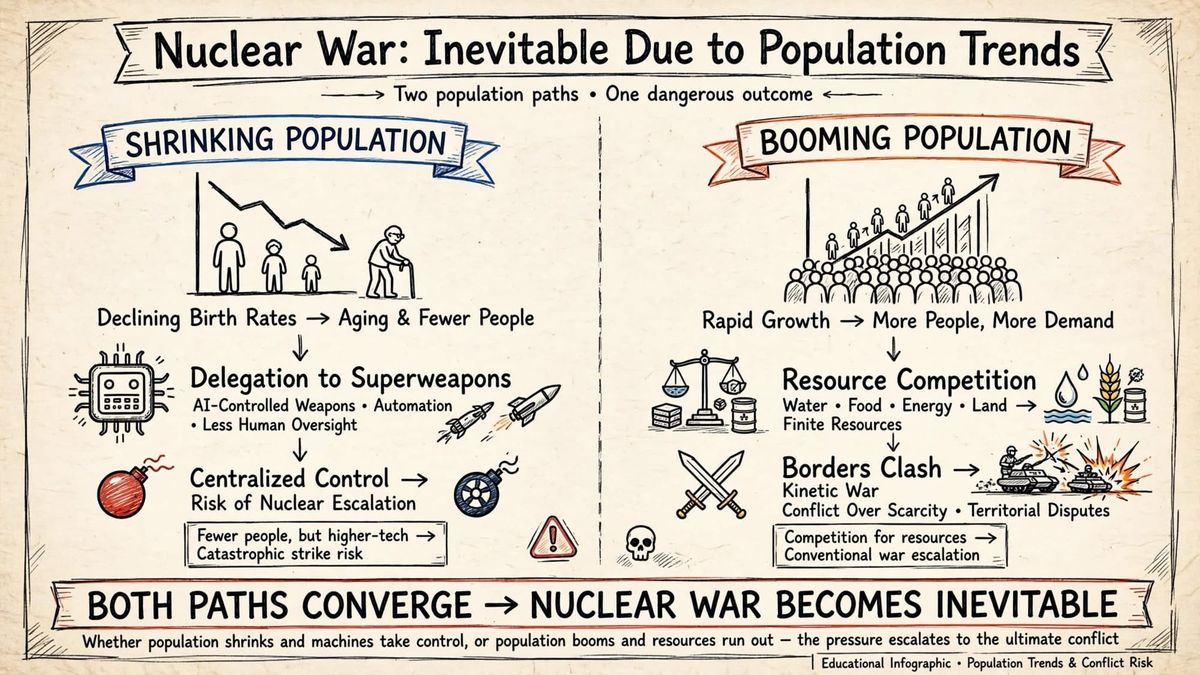
There are two population futures ahead of us — collapse or boom. Both end in the same place. One path automates war because we have no people to fight it. The other path fights for water, food, and energy because we have too many. Either way, nuclear war is inevitable.
Everyone wants to believe we can avoid it. That diplomacy, deterrence, or economic interdependence will save us. It won't. Because no matter which demographic future you pick, the logic of conflict pushes us toward superweapons.
There are only two roads. Both lead to the button.
Path 1: The Population Keeps Shrinking (So We Delegate Kinetic War To Superweapons)
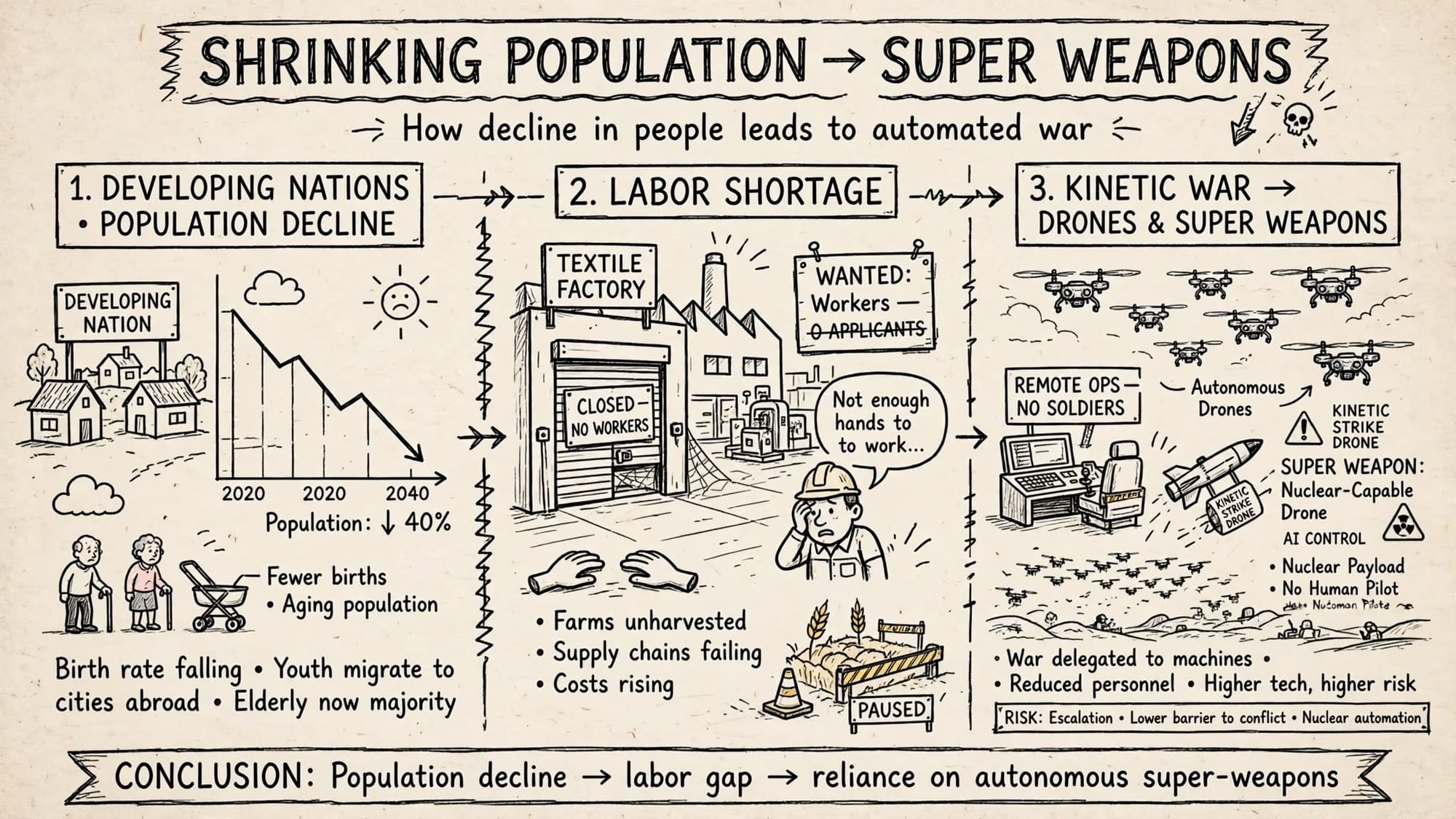
Developing nations were supposed to keep growing forever. They aren't. Birth rates are falling even in Africa, India, Bangladesh, Latin America.
Youth migrate to cities and abroad. The elderly become the majority. Farms are unharvested. Factories post "WANTED: Workers — 0 Applicants." Supply chains fail.
What does a state do when it has fewer young men to put in trenches but still has territorial claims, borders to defend, and rivals to deter?
It does what every labor-starved industry does: it automates.
Kinetic war becomes: Remote Ops — No Soldiers.
Autonomous drones. AI-controlled weapons. Less human oversight. The entire battlefield is delegated to machines because there are simply not enough hands to work it.
And once war is delegated to machines, escalation becomes effortless.
A commander doesn't have to write letters to 10,000 mothers.
He clicks. A drone swarm with nuclear-capable payloads can be launched by three operators in a bunker.
Centralized control replaces mass mobilization. The barrier to using a superweapon collapses.
Fewer people, but higher-tech means catastrophic strike risk skyrockets.
The more we shrink, the more we trust AI to make targeting decisions.
And AI doesn't fear radiation. It doesn't negotiate. It optimizes for win.
This is how a shrinking world ends in nuclear war: not because we have too many soldiers fighting, but because we have too few, so we let machines fight for us, and machines don't hesitate to use the biggest bomb.
Path 2: Population Starts Booming Again — So We Fight For Finite Resources
Now flip it. Imagine fertility rebounds. Imagine Africa hits 3 billion, South Asia 3 billion, the world pushes to 11 billion again.
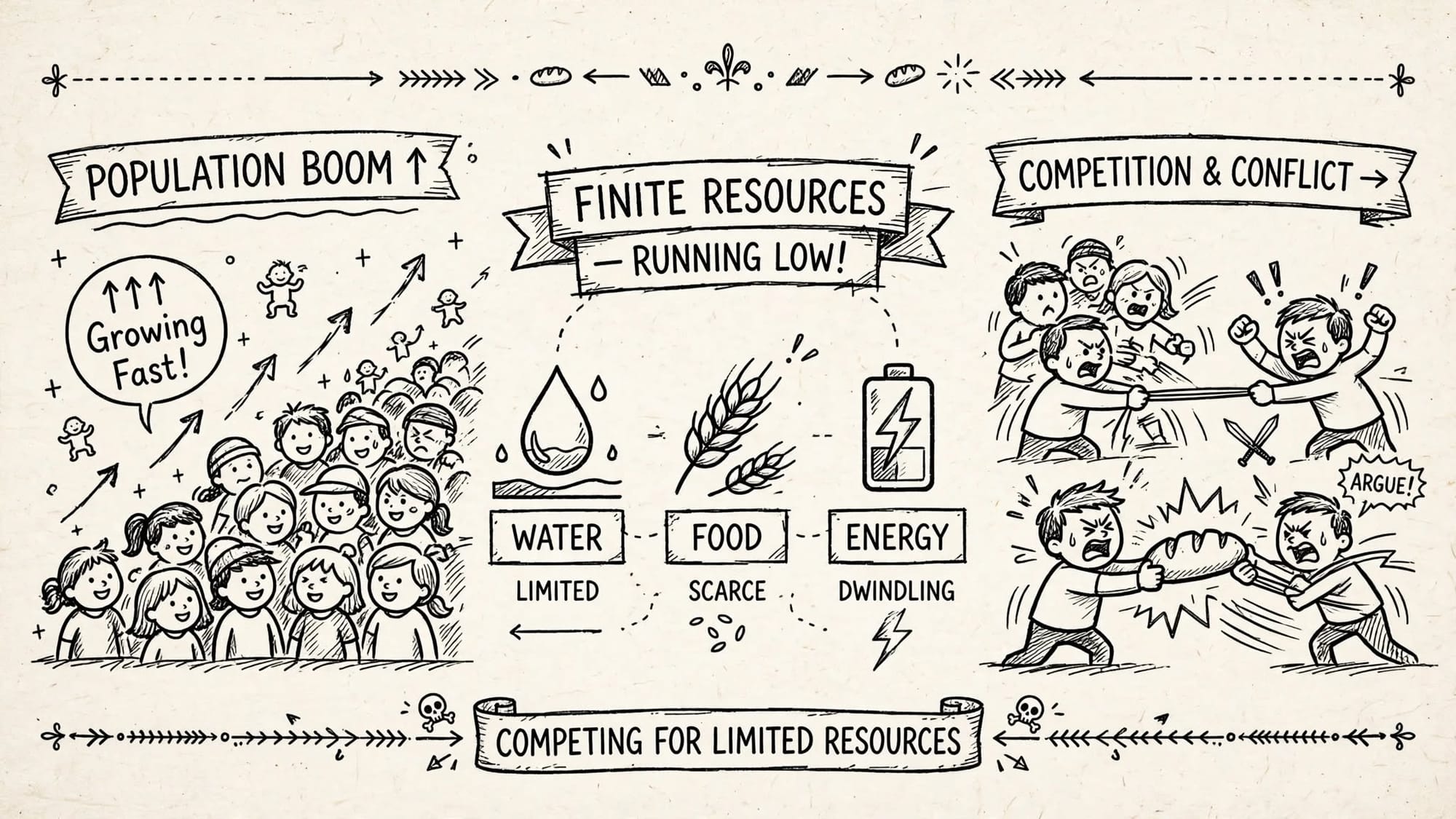
What do we get? Rapid growth → More people, more demand. Finite resources — running low. Water limited. Food scarce. Energy dwindling.
You cannot create more water. You cannot create more arable land. You can only fight for it.
Growing fast means competition becomes survival.
Two villages fighting over a river becomes two provinces fighting over a dam becomes two nations fighting over a river system.
That argument over a loaf of bread scales into borders clashing, kinetic war, conflict over scarcity, territorial disputes.
History is clear: every major resource squeeze becomes a conventional war first.
Then conventional war over survival becomes existential.
When a country believes its people will starve or dehydrate without that valley, that oil field, that watershed — it will not accept defeat. It will escalate.
Competition for limited resources → conventional war escalation.
And conventional war between nuclear powers over resources has never stayed conventional.
Both Paths Converge
This is the trap no one wants to admit:
- If we shrink: Labor gap → reliance on autonomous super-weapons → centralized control → risk of nuclear escalation → catastrophic strike because war is too easy to start.
- If we boom: More demand → water, food, energy shortages → competition & conflict → borders clash → kinetic war for survival → nuclear escalation to avoid losing.
Whether population shrinks and machines take control, or population booms and resources run out, the pressure escalates to the ultimate conflict.
We think peace is the default and war is the exception.
It's the opposite. War is the default when systems are stressed, and nuclear weapons are the final stress valve.
Shrink or boom, we end up in the same place: fewer humans making bigger decisions with bigger weapons, or more humans fighting over smaller pies until someone reaches for the biggest weapon.
That's why nuclear war is inevitable.
Not because humans are evil.
Because math and scarcity and automation leave us no other exit.
The question is not if. It's which population path gets us there first.