The AI Bubble Will Continue Until The Cash Runs Out. And Right Now, Google and Meta Are Still Printing It.
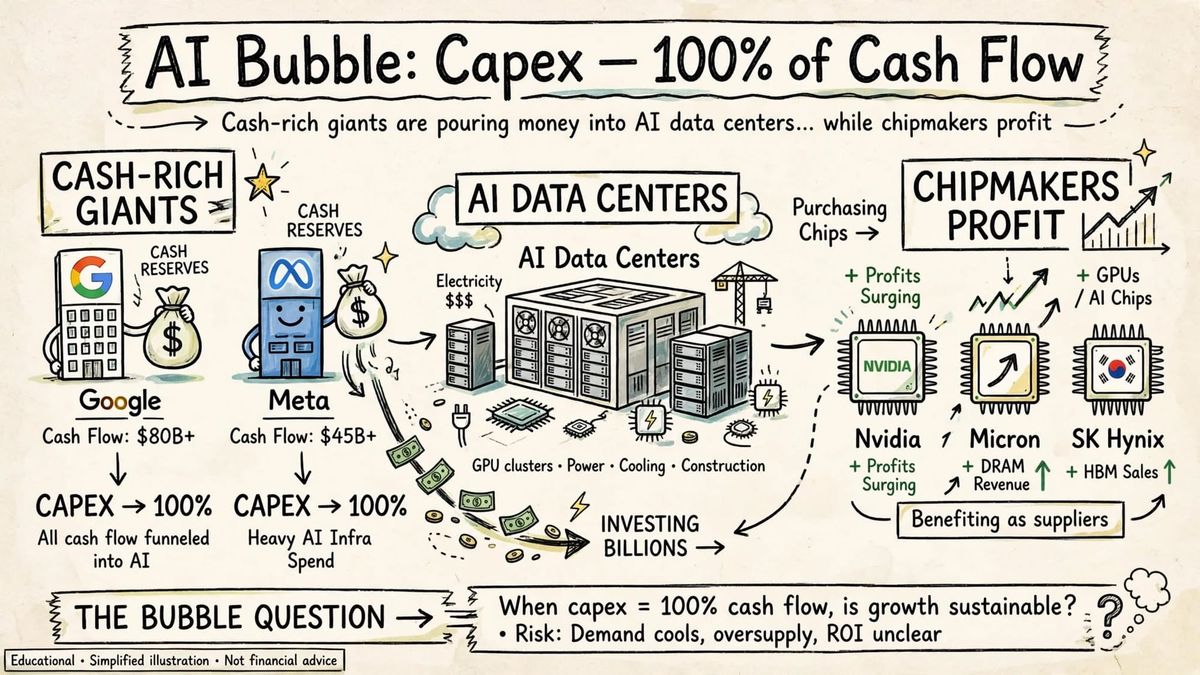
The AI bubble has a simple fuel: Google and Meta printing cash and pouring 100% of it into capex. Market hates them for it. Market loves Nvidia, Micron and SK Hynix for it. That divorce can't last.
Everyone is calling the top of AI. But bubbles don't pop when you think they should. They pop when the money stops.
And the money hasn't stopped. It's actually accelerating.
The Numbers Are Insane
Google parent Alphabet says its capital spending could double to $235 billion amid AI race. Along with Meta, the big cloud companies are expected to collectively shell out more than US$500 billion on AI in 2026.
Meta last week hiked capital investment for AI development in 2026 by 73 per cent, targeting spending between US$115 billion and US$135 billion.
Let's zoom out:
The four major U.S. hyperscalers - Microsoft, Amazon, Alphabet and Meta - together are expected to spend roughly $725 billion in capital expenditures in 2026.
Meta alone? On Wednesday, the company narrowed its capex guidance, saying it would spend between $70 billion and $72 billion this year, up from the earlier range of $66 billion to $72 billion.
...And Meta further said it would ensure capex growth is considerably faster in 2026.
For context: In 2025 they spent $72.2B. In 2026 they're guiding $115-135B. That's a double in one year.
This is not a normal capex cycle. For instance, Microsoft, Amazon, Alphabet (Google), and Meta are spending an estimated 100% of operating cash flow on Capex in 2026, compared to their historical average of 40%.
Their capex-to-revenue ratio is set to nearly double this fiscal year. Meta is expected to hit 54.9% from 35.9%, Alphabet 41% from 23%, Microsoft 45% from 31%.
Google and Meta are literally taking every dollar of free cash flow their ad machines generate and turning it into concrete, copper, and HBM.
As long as they do that, the bubble continues.
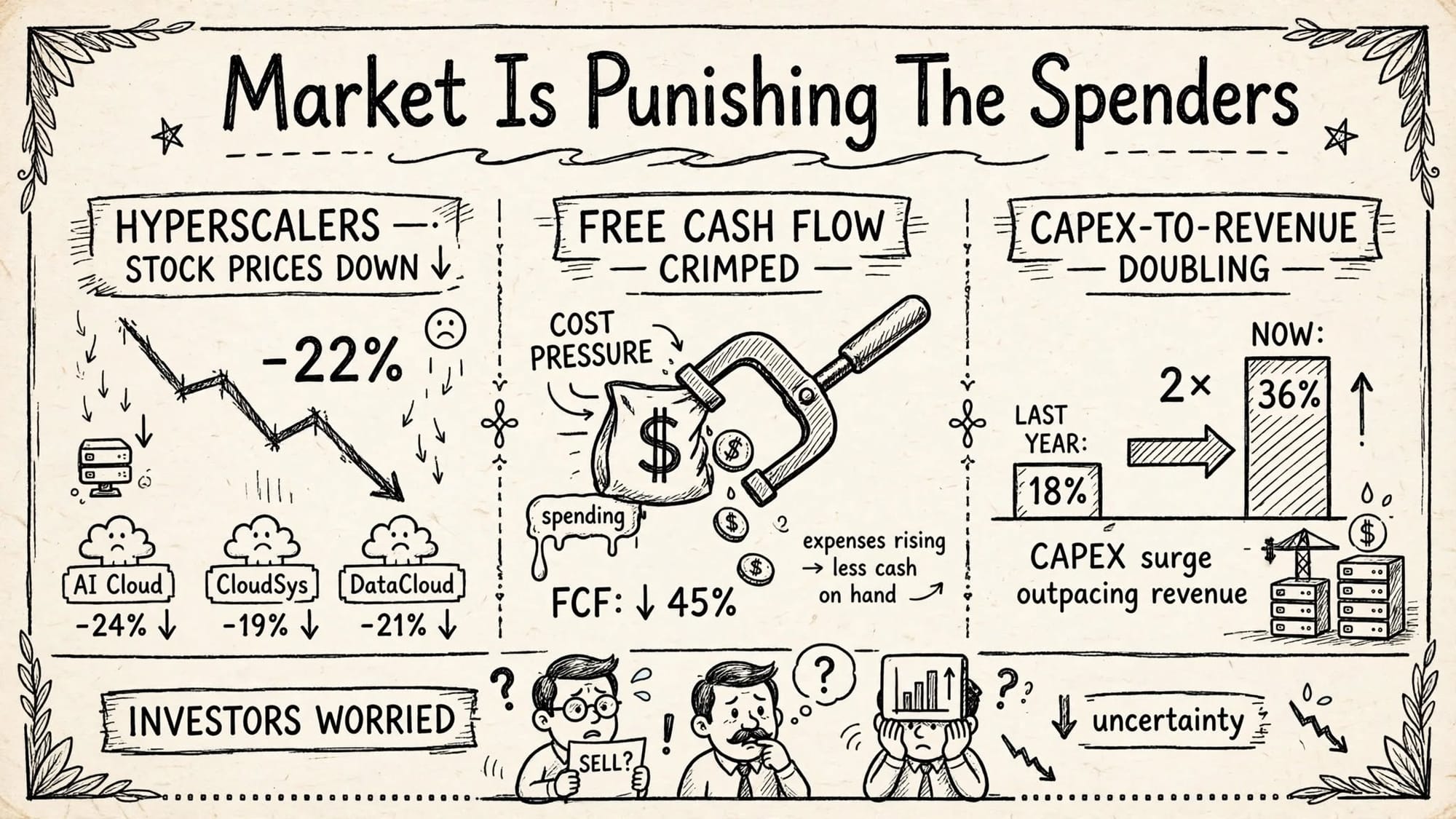
Market Is Punishing The Spenders, Rewarding The Sellers
Here's the perverse market dynamic right now:
Wall Street analysts estimate that combined capital spending by Google, Microsoft, Amazon.com and Meta Platforms surged 74% year over year to hit $168 billion in the June-ending quarter.
This spending is crimping both the free cash flow and stock prices of those four companies; only Google-parent Alphabet has managed to outperform the S&P 500 this year.
So Meta and Google stock flat to down, despite being the most profitable companies in human history.
Who's up? The pick-and-shovel sellers.
SK Hynix jumped as much as 14.9%, taking the South Korean chipmaker's market value to a record 1,680 trillion won ($1.12 trillion) and propelling the country's benchmark KOSPI index to a record high.
Strong demand for high-end memory chips used in AI chipsets like those designed by Nvidia has tightened supply and driven up prices.
Micron has already said its entire supply of HBM chips for 2026 is sold out. Manufacturers such as Samsung, Micron, and SK Hynix found it more profitable to prioritize production of these chips, leading to a shortfall of the mainstream memory types.
Nvidia, Micron, SK Hynix, Samsung - all $1T club now. They have pricing power because hyperscalers HAVE to buy. It's a seller's market.
So you get this weird divergence: The guys building the future are being punished, the guys selling the concrete are being rewarded.
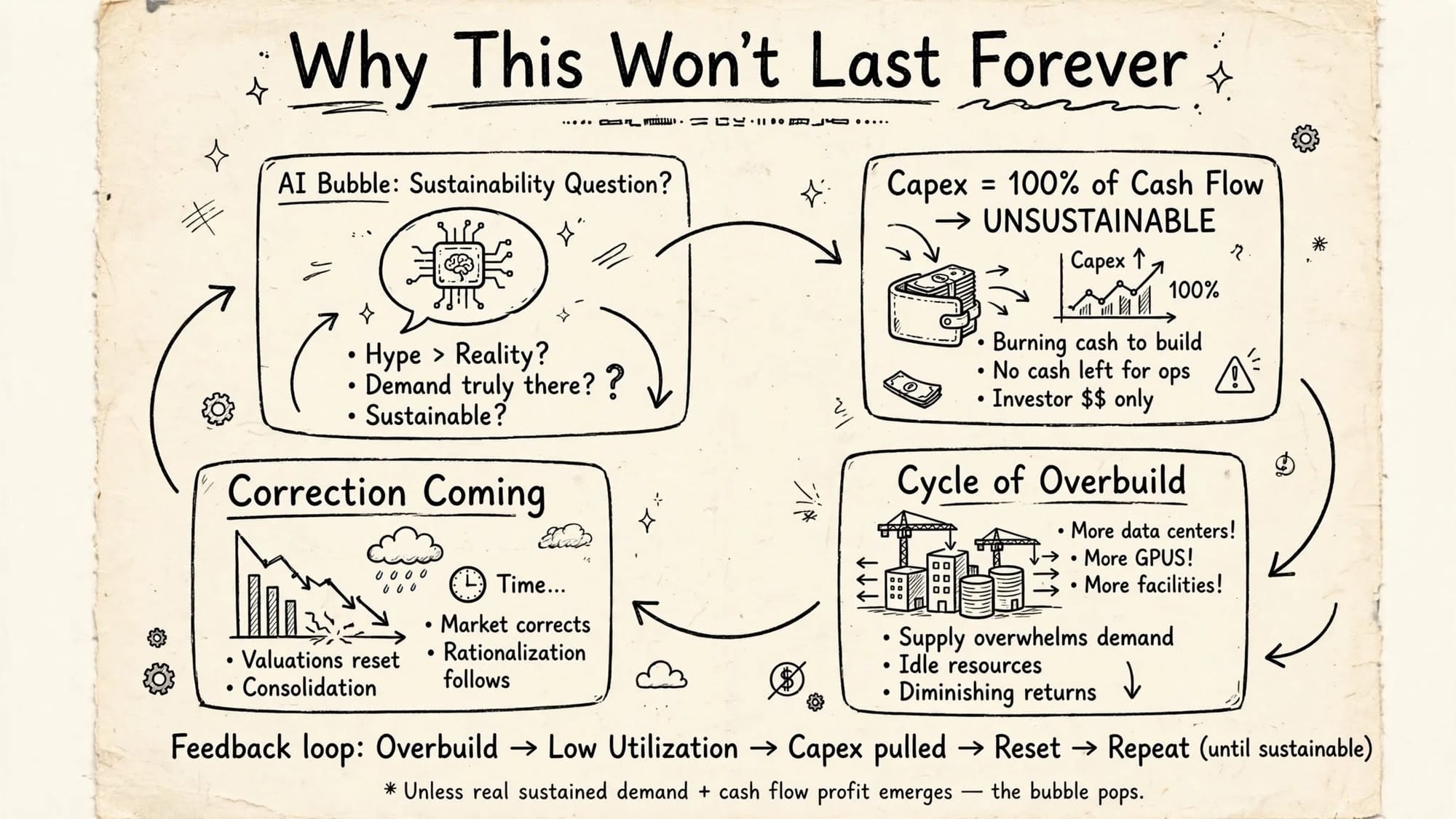
Why This Won't Last Forever
This is classic late-cycle AI infrastructure economics.
1. 100% of cash flow is not sustainable.
You can't spend 100% of operating cash flow on capex forever. One ad downturn, one recession, one quarter of weak ROAS, and the math breaks. Meta has already gone from net-cash to net-debt for the first time to fund this.
2. Overbuild -> Low Utilization -> Reset.
We build too many data centers, too many GPU clusters, too much HBM. Then we realize demand for inference isn't yet $700B/year. Utilization drops. Then capex gets pulled. That's when Micron's "sold out for 2026" becomes "inventory glut in 2027". Memory cycles are brutal - we've seen this in 2019, 2022.
3. ROI question gets louder.
What investors are looking for is "what's the return on all the capex?" So far, Google Cloud is growing, Meta says Reels engagement is up, but Meta, meanwhile, does not have a cloud division, "so it's not going to get instant revenue from all this spending."
One of the biggest problems with the AI mania is that the numbers don't seem to add up—yet.
The bubble continues as long as Google and Meta can afford to ignore ROI and just build because they have amazing cash flow. They can. For now.
But when a company spends 54.9% of revenue on concrete instead of returning cash to shareholders, eventually shareholders ask questions.
And when they do, the first to fall won't be Google or Meta.
It will be Micron, SK Hynix, and Nvidia - the ones who went up 300% selling shovels for a gold rush that overbuilt.
We're still in Act 2. Act 3 is the reset.