Why AI Will Not Destroy Jobs, But Dissolve Them (The Fractional Future)
We are terrified that artificial intelligence will eliminate our jobs entirely. The reality is much more subtle and structural. AI will not destroy the workforce, but it will dissolve the traditional forty-hour workweek into fractional, part-time labor.

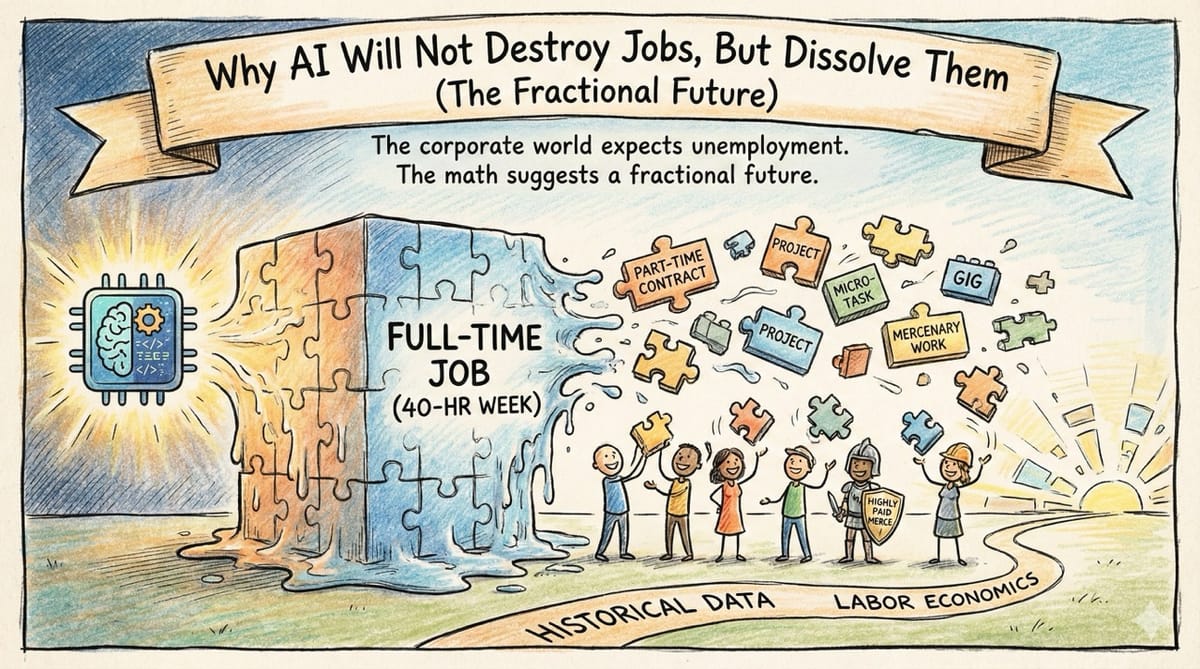
The corporate world expects a massive wave of unemployment. The math suggests a different outcome, where we all become highly paid, part-time mercenaries.
Inspiration: Observing the panic around AI job displacement and analyzing the actual historical data on technological shifts. Realizing that the forty-hour workweek is an artificial construct that is finally breaking down.
The current sentiment surrounding artificial intelligence is entirely binary. People believe they will either keep their comfortable corporate job or become entirely obsolete.
This black and white thinking completely ignores the fundamental mechanics of labor economics.
The truth is that companies rarely fire their entire staff overnight. Instead, they optimize for efficiency margins.
If a new software tool allows a worker to complete their tasks in half the time, the company will simply stop buying forty hours of their week.
The full-time job will not vanish in a dramatic explosion.
It will slowly dissolve into a series of part-time contracts.
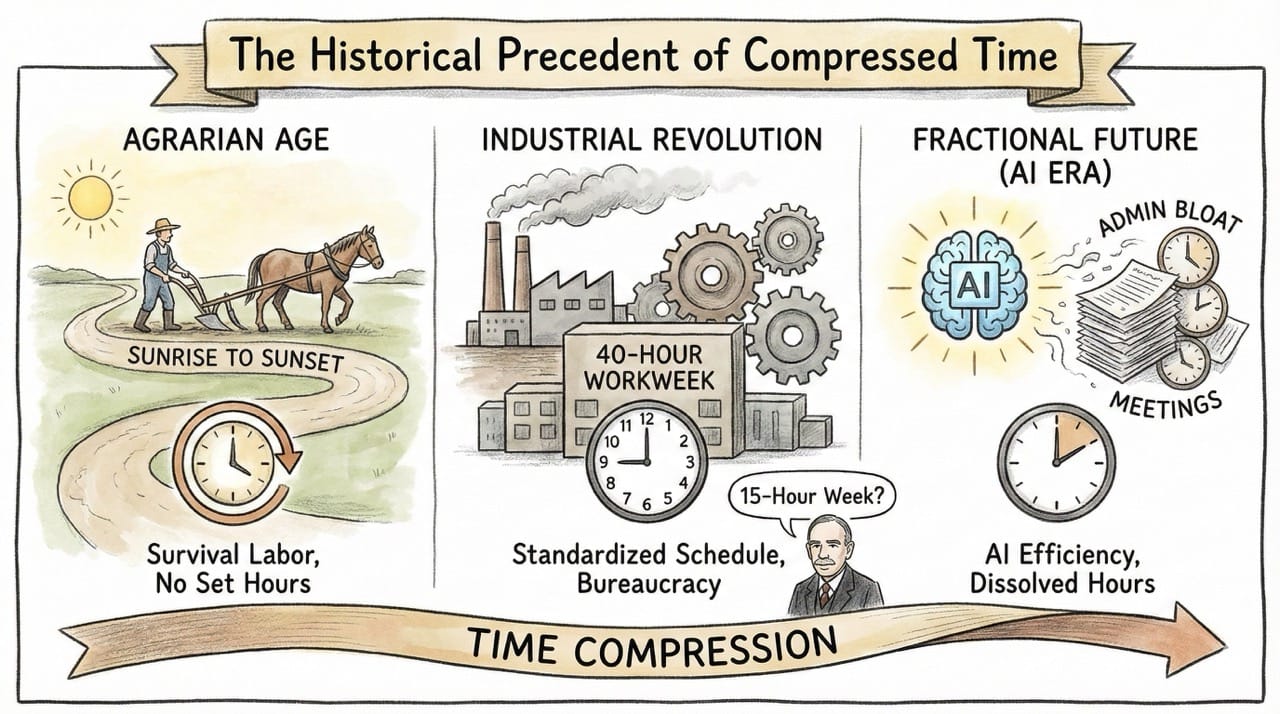
The Historical Precedent of Compressed Time
This is not a new economic phenomenon. We have seen technology compress working hours throughout human history.
Before the industrial revolution, agrarian workers labored from sunrise to sunset just to survive.
When tractors and automated looms were introduced, we did not face permanent global unemployment. Instead, we standardized the forty-hour workweek.
Economist John Maynard Keynes famously predicted that technological advancement would eventually lead to a fifteen-hour workweek.
We temporarily delayed his prediction by inventing massive corporate bureaucracies to fill the time.
We padded our schedules with endless meetings and administrative bloat. But artificial intelligence is too efficient to allow us to fake a forty-hour week anymore.
The Portfolio Career and the New Compensation
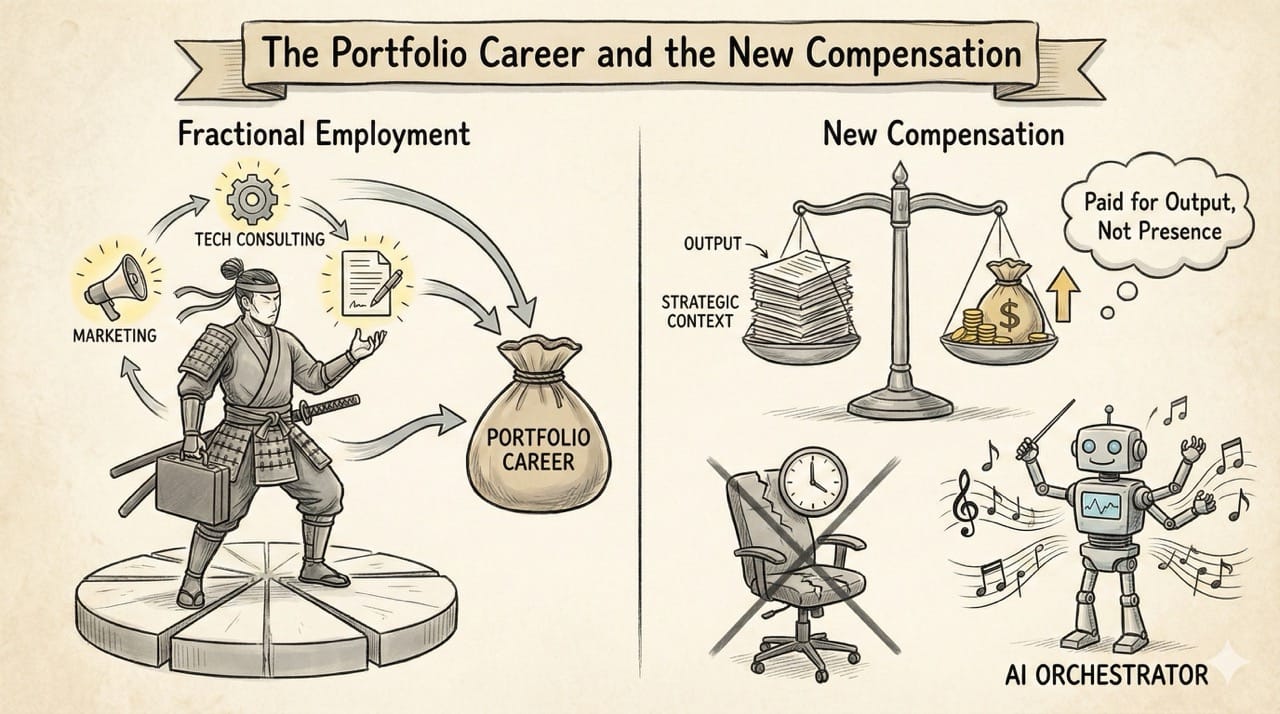
The future of employment is entirely fractional.
You will no longer pledge absolute loyalty to a single corporate entity.
Instead, you will operate like a mercenary or a Ronin.
Professionals will manage a "portfolio career" consisting of multiple income streams.
You might work fifteen hours a week for a marketing agency and ten hours consulting for a tech startup.
Your compensation will no longer be a rigid annual salary based on your physical presence in an office chair.
You will be paid strictly for your output and the strategic context you provide.
Hourly rates for highly skilled orchestrators of AI will skyrocket because their output is massively amplified.
However, guaranteed corporate salaries with built-in idle time will become incredibly rare.
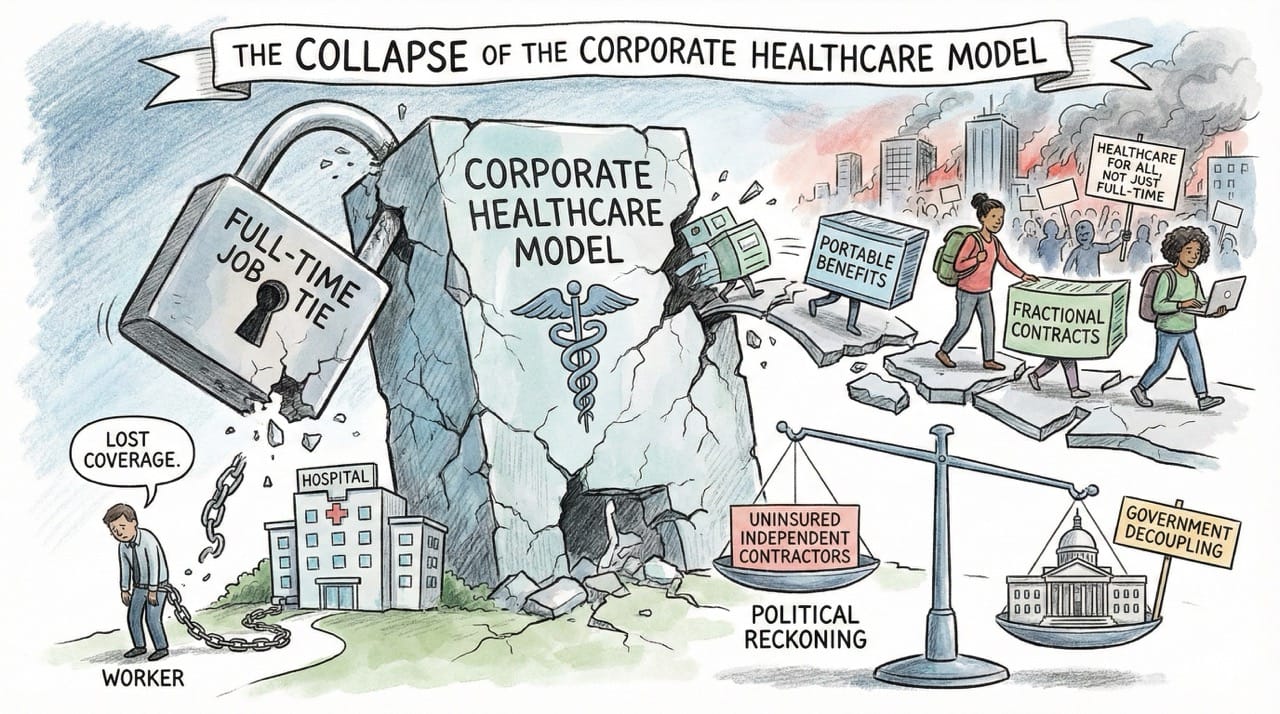
The Collapse of the Corporate Healthcare Model
This structural shift will completely break the American healthcare model. In the United States, quality healthcare is inextricably tied to full-time corporate employment.
Companies use these benefits to attract and lock in top talent.
If the majority of the workforce transitions to part-time or fractional contracts, millions of people will lose their coverage.
Corporations will refuse to pay massive health premiums for workers who only log twenty hours a week. This friction will force a massive political reckoning.
Governments will be forced to decouple healthcare from employment. We will likely see the rise of portable benefits tied to the individual worker rather than the corporation.
If this does not happen, the system will collapse under the weight of uninsured independent contractors.
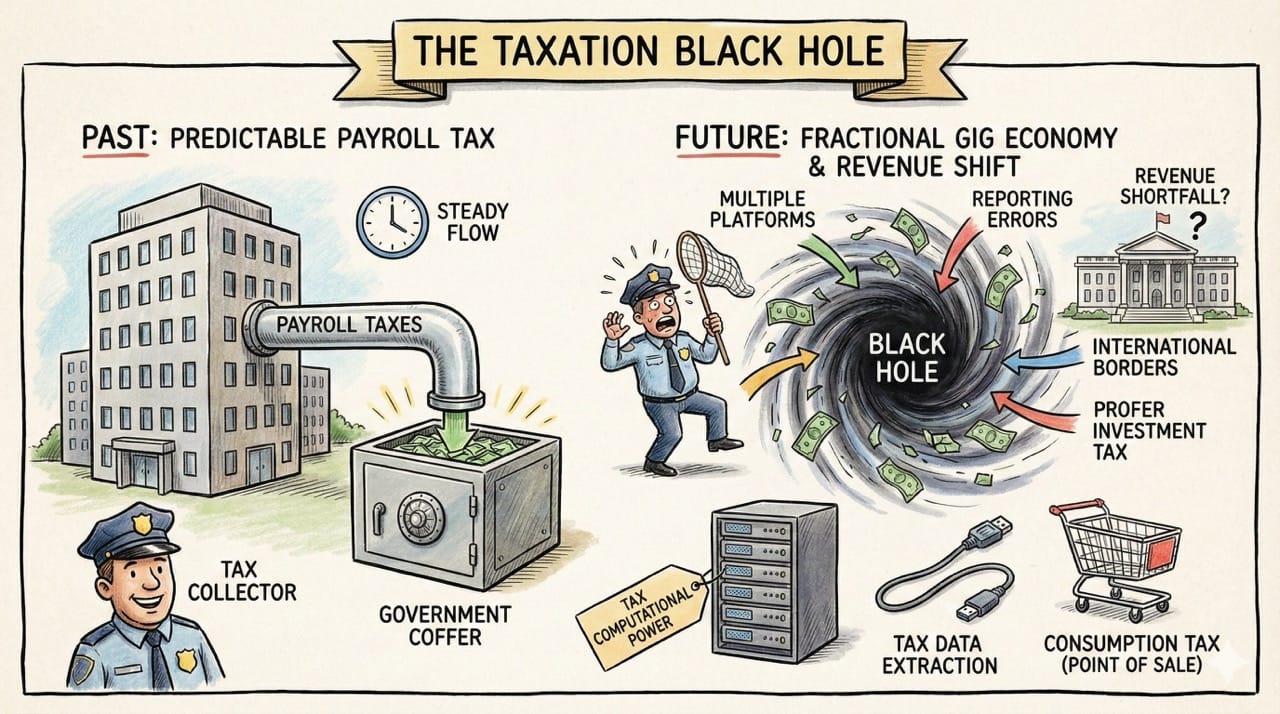
The Taxation Black Hole
Governments rely heavily on the predictable extraction of payroll taxes.
The traditional corporate employment structure makes tax collection seamless and automatic for the state.
A fractional gig economy destroys this financial predictability.
When workers are paid across multiple platforms and international borders, reporting errors and tax evasion skyrocket.
Governments will face massive revenue shortfalls just as the demand for social safety nets increases.
They will have to radically change how they collect revenue.
We will likely see a shift away from taxing human labor.
Instead, governments will begin taxing computational power, server usage, or corporate data extraction.
They might also shift entirely toward aggressive consumption taxes to capture revenue reliably at the point of sale.
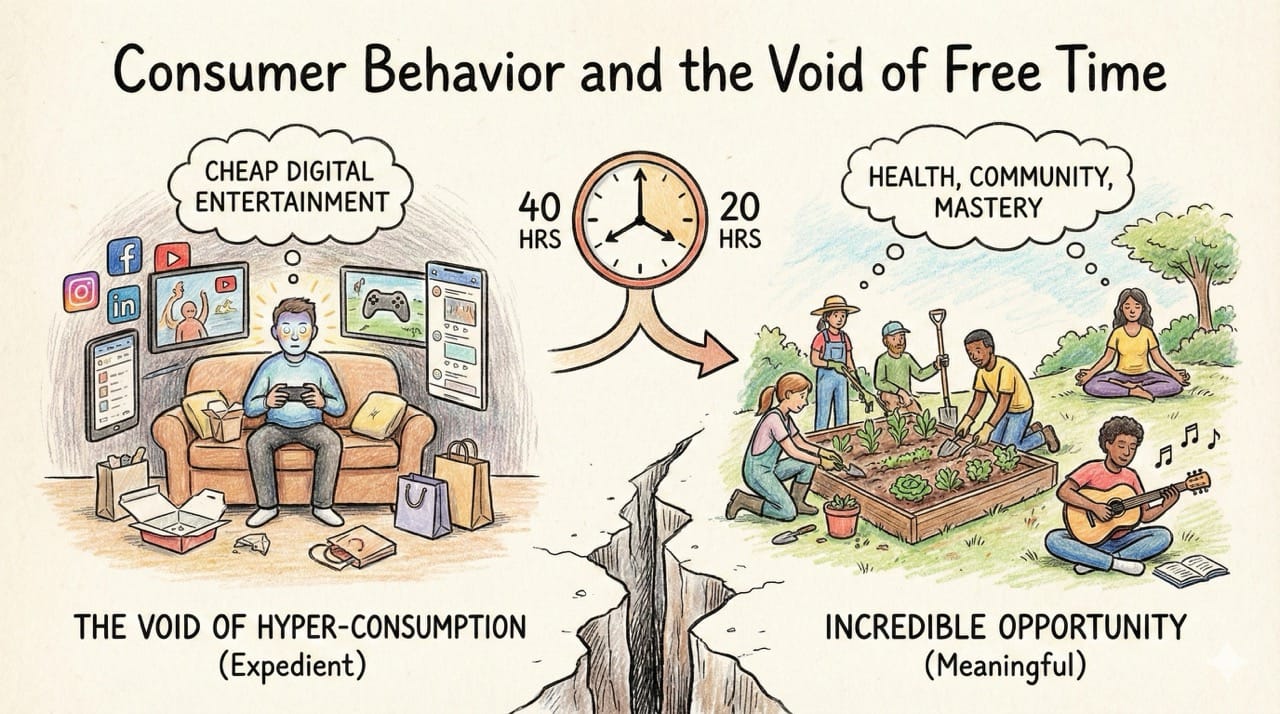
Consumer Behavior and the Void of Free Time
This transition will fundamentally alter how we spend our time and money.
If the average workweek drops to twenty hours, society will face an unprecedented abundance of free time.
This presents a deep and dangerous psychological challenge.
Without the forced structure of a corporate job, many people will fall into a void of hyper-consumption.
They will numb themselves with cheap digital entertainment generated infinitely by algorithms. The baseline dopamine threshold will drop even further.
However, this also presents an incredible opportunity for those who are highly intentional.
It perfectly mirrors the philosophy of pursuing what is meaningful rather than what is expedient.
People will finally have the time to focus on deep physical health, community building, and true personal mastery.
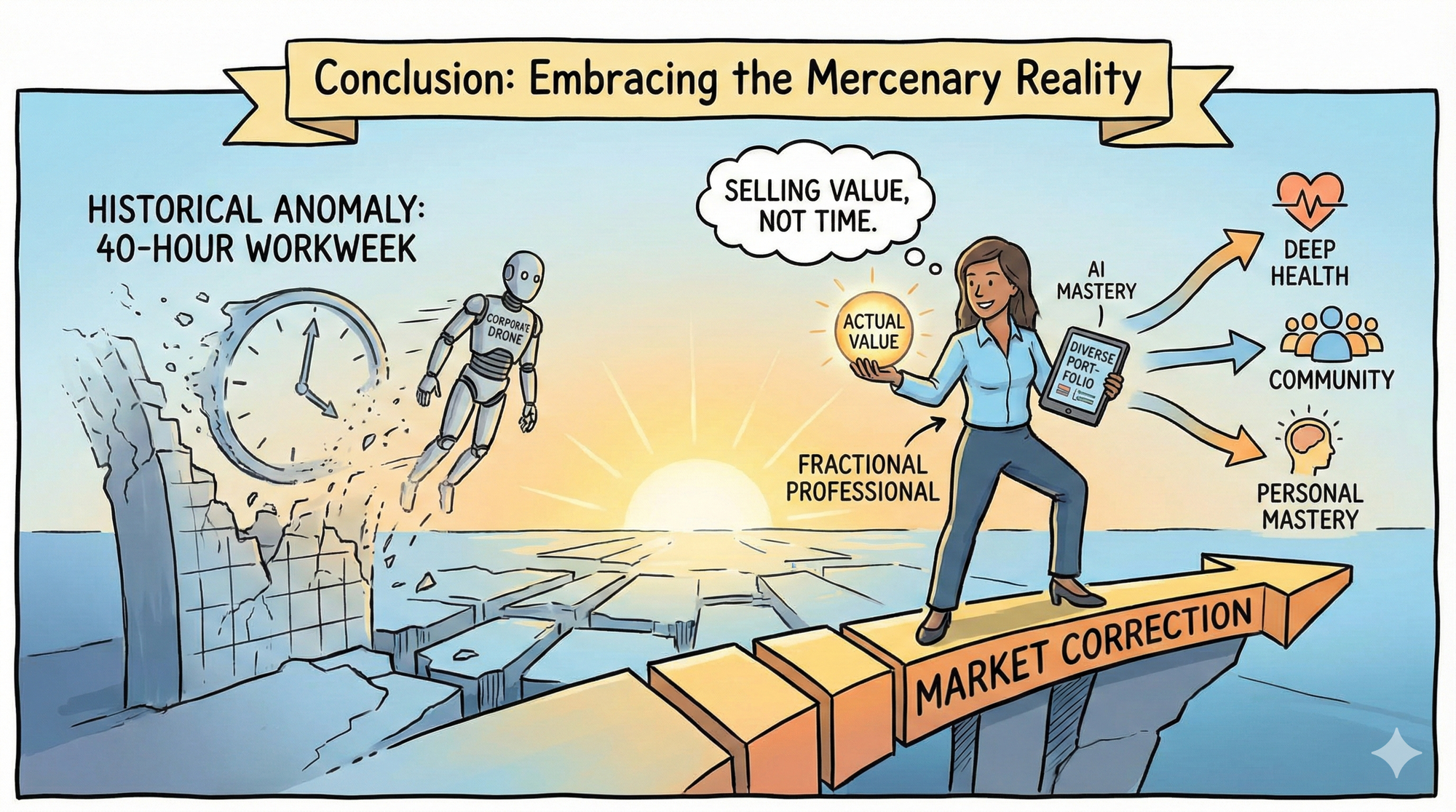
Conclusion: Embracing the Mercenary Reality
The dissolution of the full-time job is not an economic apocalypse.
It is a transition back to a more natural state of human output.
We are moving away from selling our arbitrary time and toward selling our actual value.
The professionals who thrive will be the ones who aggressively embrace this fractional reality.
They will build diverse portfolios of income, master artificial intelligence, and rigorously defend their newly acquired free time.
The forty-hour workweek was just a historical anomaly, and the market is finally correcting the timeline.