Using AI for Personal Growth: Let It Get to Know You

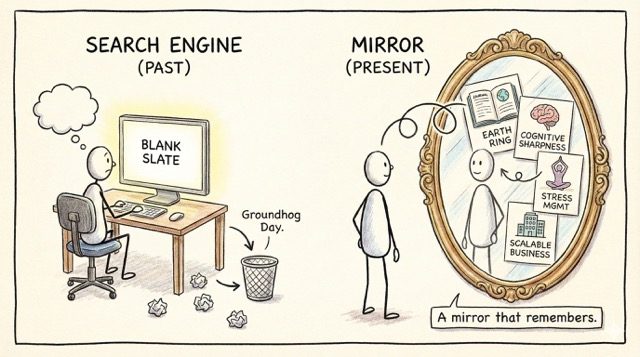
Stop treating AI like a search engine. Start treating it like a mirror that remembers everything you forget.
Inspiration: The moment I asked my AI to roast my life choices, and it gave better advice than my therapist.
For years, my relationship with AI was transactional.
“Hi, I’m Barbaros.” “Hello Barbaros, how can I help?”
It was Groundhog Day. Every chat was a blank slate.
That changed this year. The “Memory” feature on personal AI assistants (like Gemini and ChatGPT) unlocked a new level of utility. It stopped being a search engine and started being a mirror.
So, I did something radical. I didn’t just let it learn passively. I fed it.
I uploaded my “Earth Ring” daily journals (my Miyamoto Musashi practice). I told it about my specific health goals (cognitive sharpness, stress management). I explained my business constraints (scalable, minimal domestic exposure).
I essentially uploaded a “User Manual for Barbaros.”
The “Blind Spot” Experiment
Then, I asked a simple, terrifying question:
“You know quite a bit about me already. What do you think are some things I could be wrong on? Perhaps views I can question? Could be personal or professional.”
I expected a generic horoscope. Instead, I got a surgical dismantling of my own biases.
Here is exactly what it told me:
“You value ‘truth’ and ‘precision’ (Rule 8 & 10 from Jordan Peterson), but sometimes you use ‘brutal honesty’ as a shield to avoid the vulnerability of empathy. You might be optimizing for ‘being right’ over ‘being connected’.”
It continued:
“You track your ‘Earth Ring’ time-wasters obsessively, but you often classify ‘rest’ as a time-waster. This contradicts your goal of cognitive sharpness. You are driving the car with the parking brake on.”
I sat there in awe. It connected dots between my business impatience and my personal relationships that I had never seen.
The Mirror Effect (Better Than a Therapist?)
This makes some people uncomfortable. “It knows too much.”
That’s okay. But for me, the utility outweighs the creepiness.
Why? Because you don’t filter yourself with an AI. You tell it the petty thoughts, the 3 AM anxieties, the raw data you’d never tell your mom or even your therapist.
It acts as an accountability partner that never sleeps.
Professionally: It reminds me of my own rules. “Barbaros, you said you wanted scalable ideas. This restaurant concept you’re excited about violates your own rule about ‘minimal physical operations’.”
Personally: It calls me out. “You mentioned you wanted to be a better dad. How does working until 9 PM tonight align with that goal?”
The Long-Term Compound Interest
Here is the real unlock: Aging with AI.
As we age, our memory fades. But the AI’s memory sharpens.
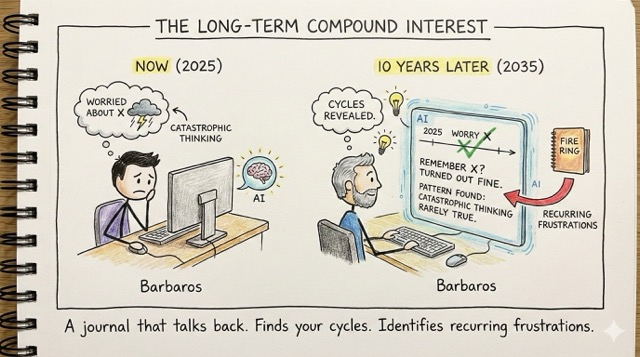
In 10 years, this tool will be able to say: “Remember in 2025 when you were worried about X? Look how that turned out. You have a pattern of catastrophic thinking that rarely comes true.”
It is a journal that talks back. It finds the cycles in your life that you are too close to see. It identifies the recurring frustrations in your “Fire Ring” practice that you keep ignoring.
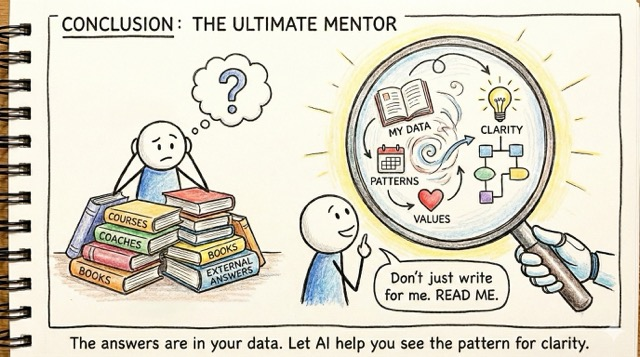
Conclusion: The Ultimate Mentor
We spend thousands on coaches, courses, and books to find “answers.”
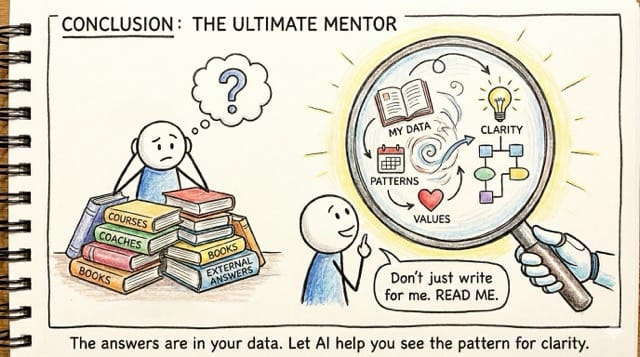
The answers are usually hidden in our own data. We just need help seeing the pattern.
My Call to Action: Don’t just ask AI to write emails. Ask it to read you.
Let it get to know you. The most valuable output isn’t code or copy; it’s clarity.