Understanding (and Perhaps Fixing) Climate Change with AI: Google WeatherNext 2

We finally have a tool that can simulate the planet faster than the planet can change. This isn't just a weather forecast; it's a survival engine.
Inspiration: Watching the Google WeatherNext 2 announcement and realizing it was tagged “Climate Change” for a reason.
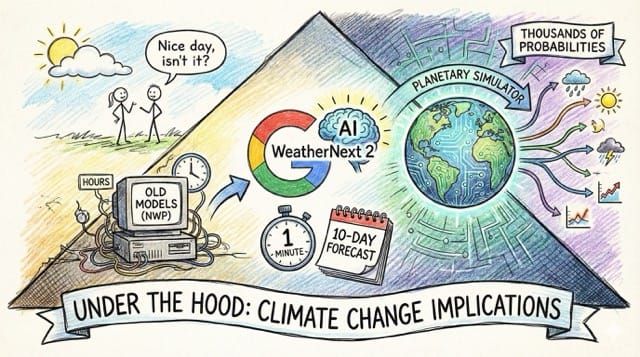
We usually talk about the weather when we have nothing else to say. “Nice day, isn’t it?”
Google just dropped WeatherNext 2. And while they marketed it as a better forecast, the implications are much, much bigger.
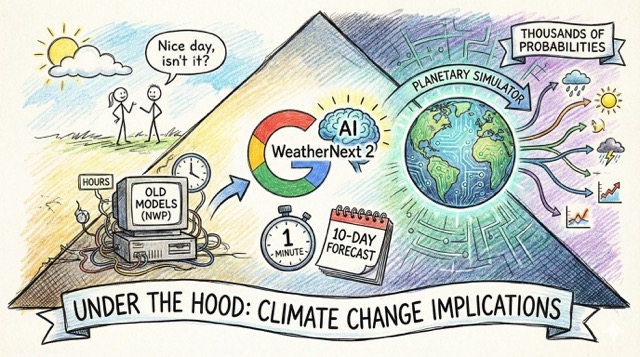
Under the hood, this is a planetary simulator.
Traditional models (Numerical Weather Prediction) solve complex physics equations on massive supercomputers. It takes hours.
WeatherNext 2 uses AI to predict patterns based on historical data. It generates a 10-day forecast in one minute.
Crucially, it doesn’t just predict one outcome; it predicts thousands of probabilities instantly.
Why I Am Excited (The Use Case for Survival)
The announcement video was ironically tagged “Climate Change” on YouTube. That wasn’t an accident.
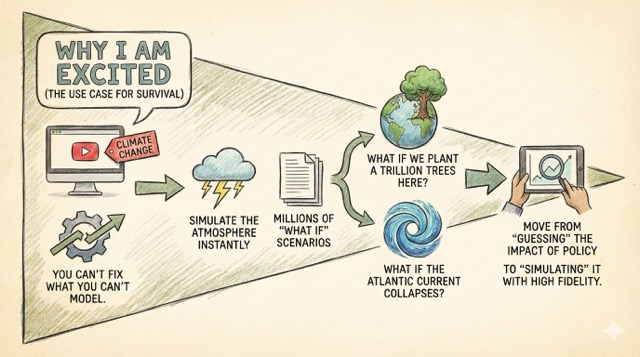
You can’t fix what you can’t model.
If we can simulate the atmosphere instantly, we can run millions of “What If” scenarios.
- What if we plant a trillion trees here?
- What if the Atlantic Current collapses?
We move from “guessing” the impact of policy to “simulating” it with high fidelity.
Building the Future (City & Infrastructure)
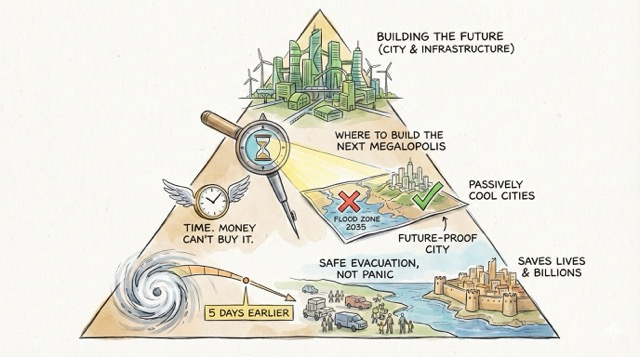
This tool tells us where to build the next megalopolis.
We stop building in flood zones that look safe today but will be underwater in 2035. We design cities based on future wind corridors to passively cool them, reducing energy load.
It gives us the one thing money can’t buy: Time.
Predicting a hurricane’s exact path 5 days earlier means safe evacuation, not panic. It saves lives and billions in assets.
The Space Leap (The Final Frontier)
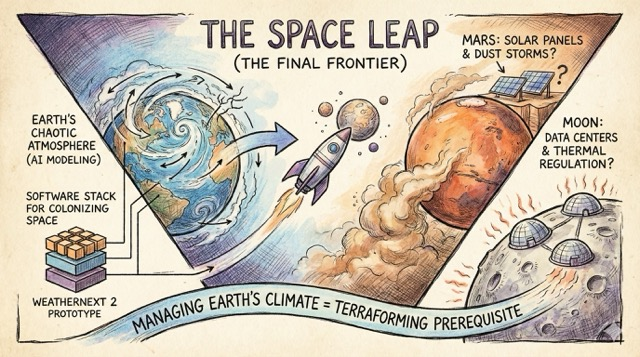
If you can model Earth’s chaotic atmosphere with AI, you can model any atmosphere.
This is the software stack for colonizing space.
- Where do you put the solar panels on Mars to survive the dust storms?
- Where do you build the data centers on the Moon to handle thermal regulation?
Successfully managing Earth’s climate is the prerequisite test for terraforming other worlds. WeatherNext 2 is the prototype for that operating system.
Conclusion: From Passive to Active
For all of human history, we have been passive observers of the weather. We hid in caves; we built umbrellas.
With tools like this, we are becoming active managers of our biosphere. We aren’t just predicting the rain; we are learning how to navigate the storm.