The Salary Cap on Creativity: Why Marketers Are Paid to Be Cowards
Marketers have a "Call Option" on failure (firing) but no "Call Option" on success (equity). This structural asymmetry forces them to optimize for "Defensibility" rather than "Profit."

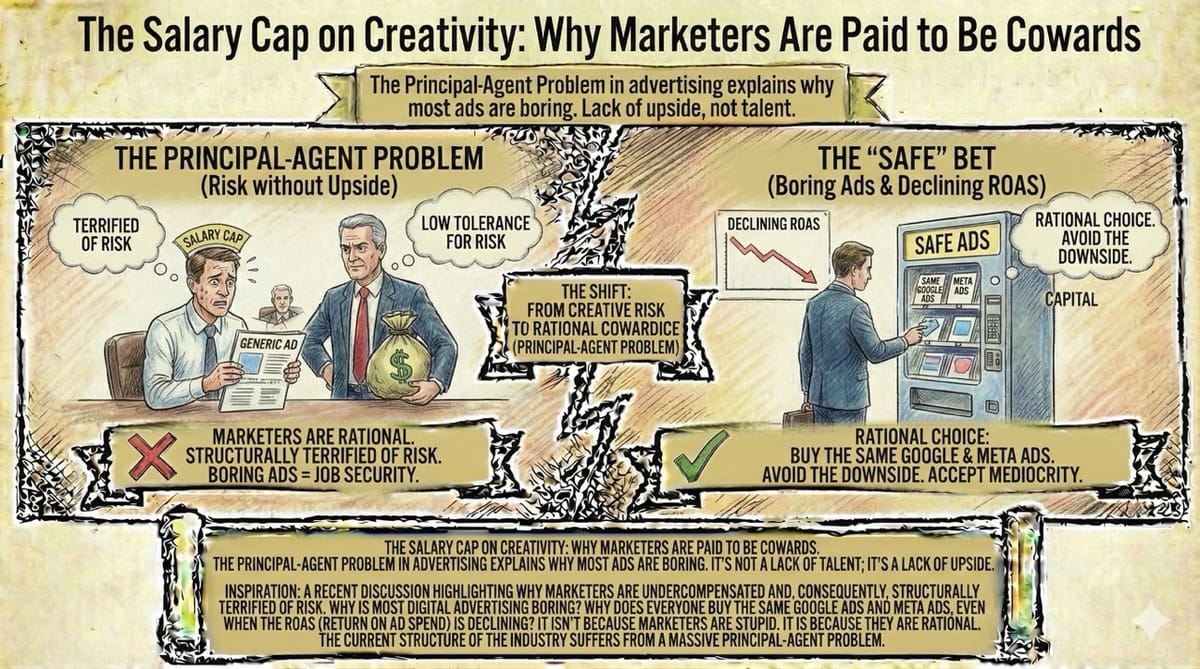
The Principal-Agent Problem in advertising explains why most ads are boring. It’s not a lack of talent; it’s a lack of upside.
Inspiration: A recent discussion (linked below) highlighting why marketers are undercompensated and, consequently, structurally terrified of risk.
Why is most digital advertising boring? Why does everyone buy the same Google Ads and Meta Ads, even when the ROAS (Return on Ad Spend) is declining?
It isn't because marketers are stupid. It is because they are rational.
The current structure of the industry suffers from a massive Principal-Agent Problem.
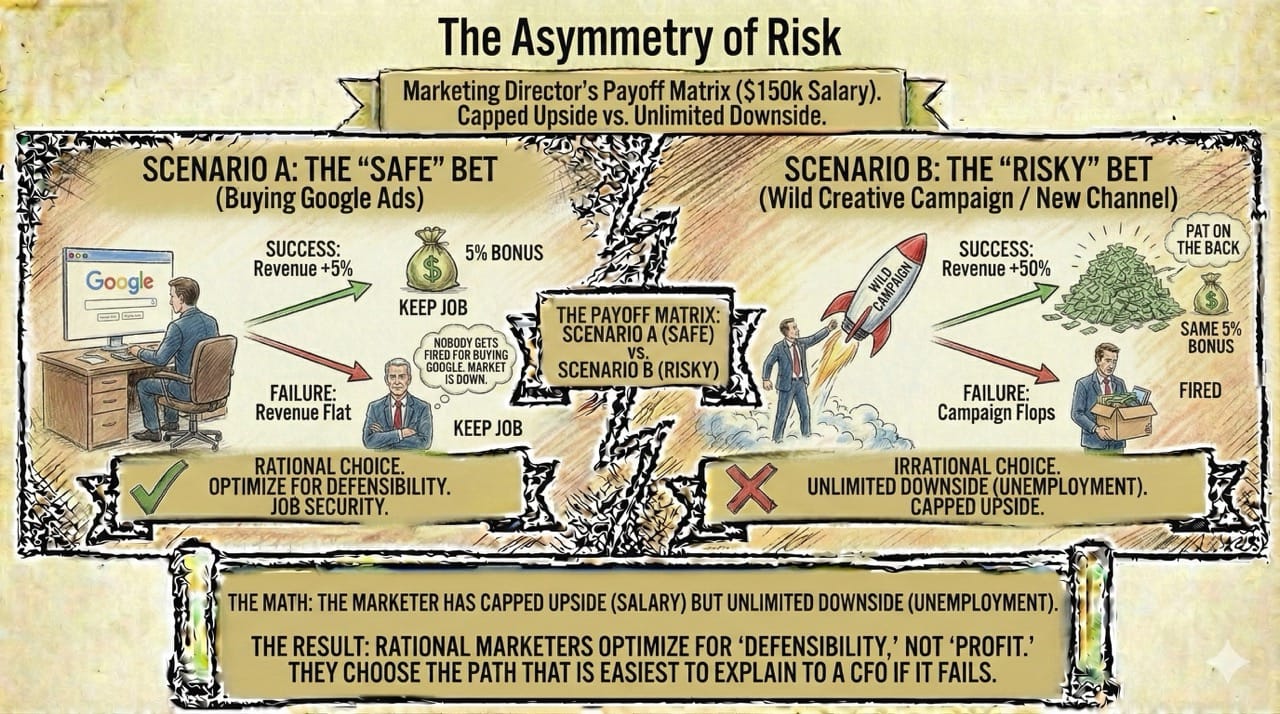
The Asymmetry of Risk
Let’s look at the payoff matrix for a Marketing Director earning a $150k salary.
Scenario A: The "Safe" Bet (Buying Google Ads)
- Success: Revenue goes up 5%. The marketer keeps their job and maybe gets a 5% bonus.
- Failure: Revenue goes flat. The marketer says, "Well, the market is down, and nobody ever got fired for buying Google." They keep their job.
Scenario B: The "Risky" Bet (A Wild Creative Campaign / New Channel)
- Success: Revenue goes up 50%. The company makes millions. The marketer gets... a pat on the back and the same 5% bonus.
- Failure: The campaign flops. The marketer gets fired.
The Math: The marketer has capped upside (salary) but unlimited downside (unemployment). The Result: Rational marketers optimize for "Defensibility," not "Profit." They choose the path that is easiest to explain to a CFO if it fails.
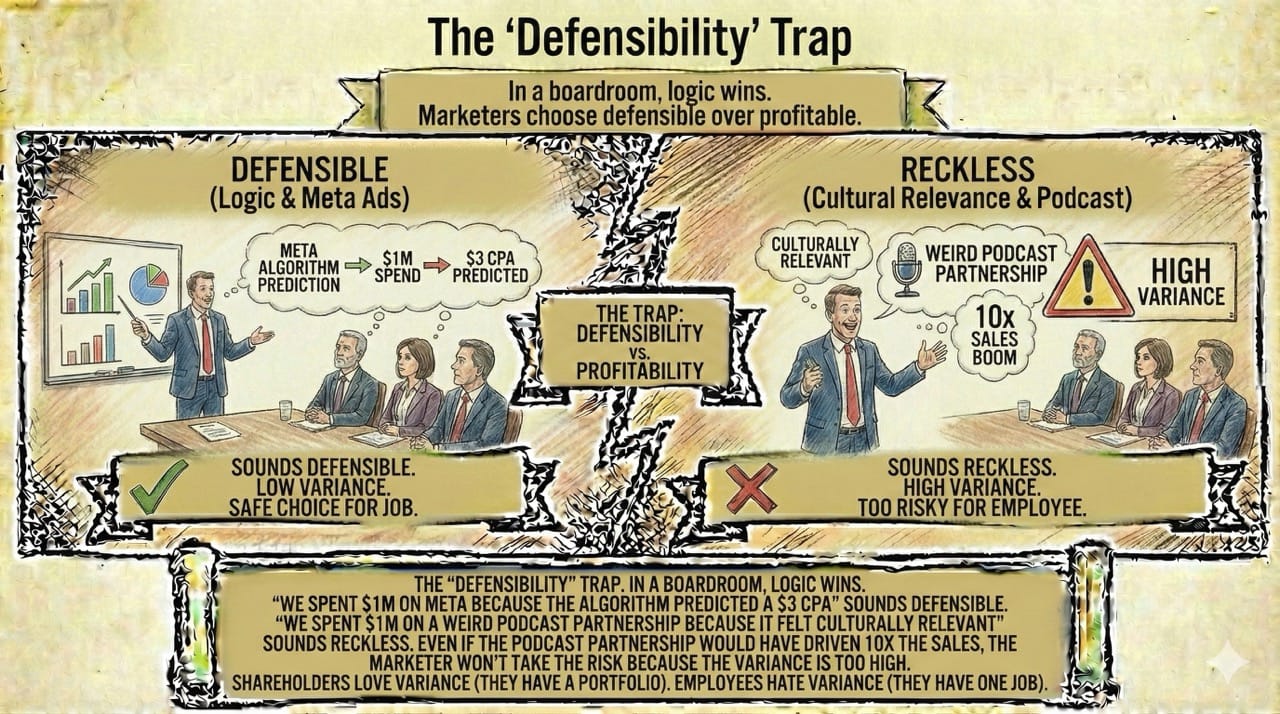
The "Defensibility" Trap
In a boardroom, logic wins.
"We spent $1M on Meta because the algorithm predicted a $3 CPA" sounds defensible.
"We spent $1M on a weird podcast partnership because it felt culturally relevant" sounds reckless.
Even if the podcast partnership would have driven 10x the sales, the marketer won't take the risk because the Variance is too high. Shareholders love variance (they have a portfolio). Employees hate variance (they have one job).
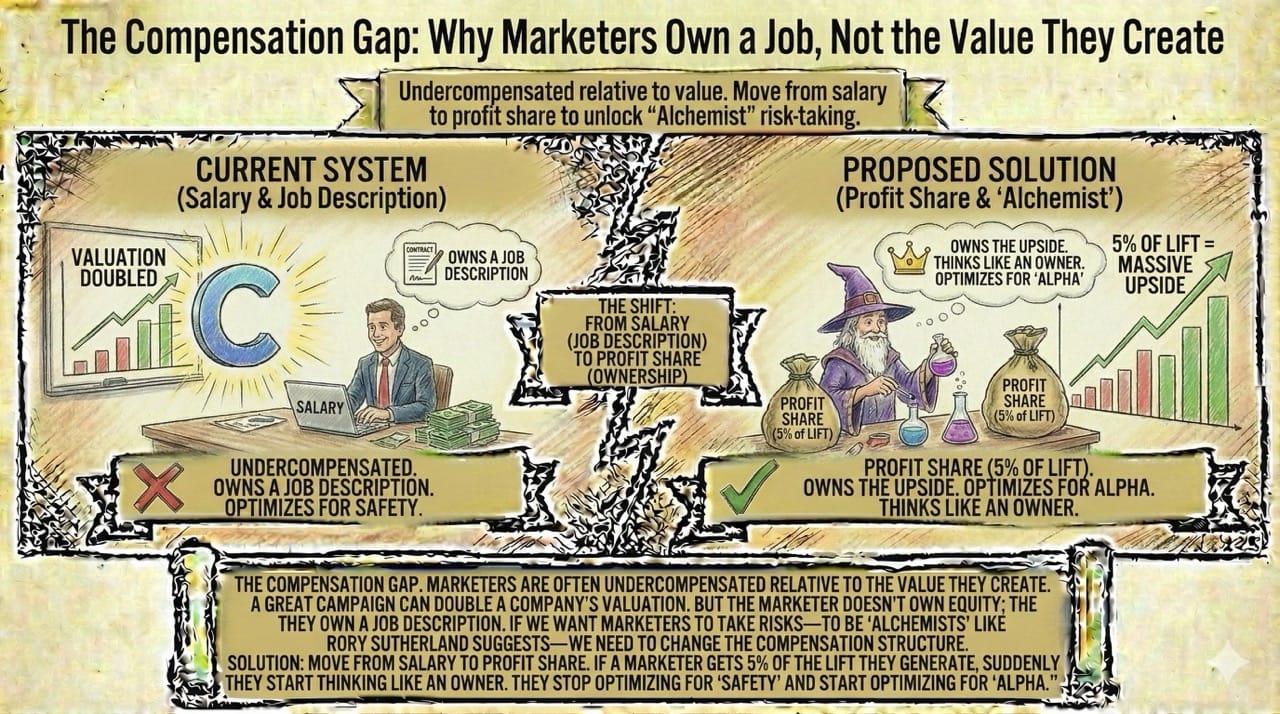
The Compensation Gap
Marketers are often undercompensated relative to the value they create. A great campaign can double a company's valuation. But the marketer doesn't own equity; they own a job description.
If we want marketers to take risks—to be "Alchemists" like Rory Sutherland suggests—we need to change the compensation structure.
The Solution: Move from Salary to Profit Share. If a marketer gets 5% of the lift they generate, suddenly they start thinking like an owner. They stop optimizing for "Safety" and start optimizing for "Alpha."
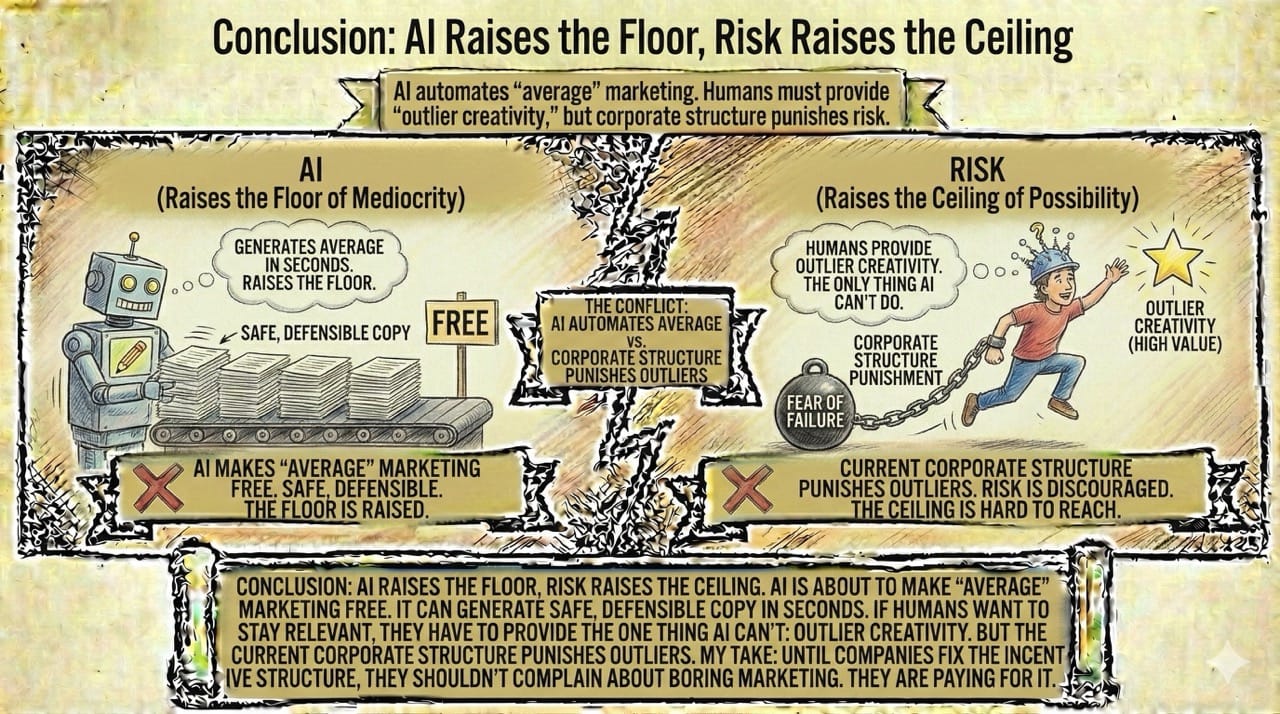
Conclusion: AI Raises the Floor, Risk Raises the Ceiling
AI is about to make "average" marketing free. It can generate safe, defensible copy in seconds.
If humans want to stay relevant, they have to provide the one thing AI can't: Outlier Creativity. But the current corporate structure punishes outliers.
My Take: Until companies fix the incentive structure, they shouldn't complain about boring marketing. They are paying for it.
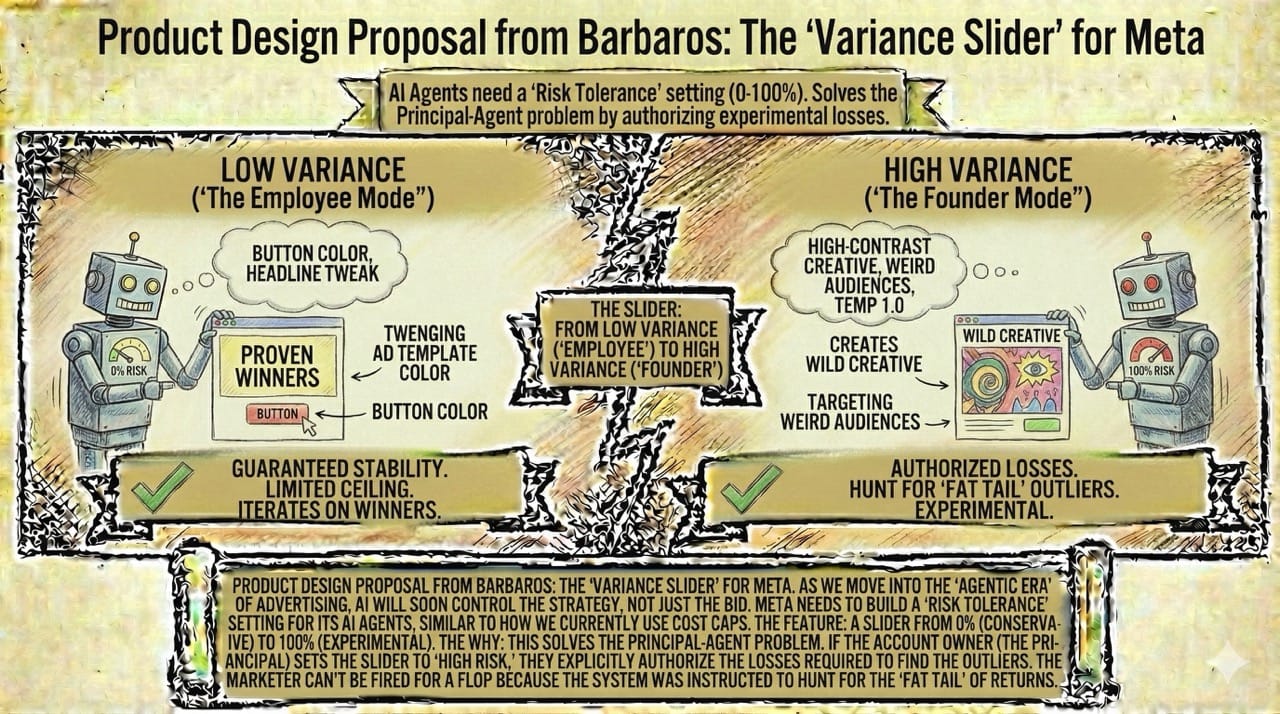
Product Design Proposal from Barbaros: The "Variance Slider" for Meta
As we move into the "Agentic Era" of advertising, AI will soon control the strategy, not just the bid.
Meta needs to build a "Risk Tolerance" setting for its AI agents, similar to how we currently use Cost Caps.
The Feature: A slider from 0% (Conservative) to 100% (Experimental).
- Low Variance (The "Employee" Mode): The agent iterates on proven winners. It changes the button color. It tweaks the headline. It guarantees stability but limits the ceiling.
- High Variance (The "Founder" Mode): The agent tries unconventional angles. It uses high-contrast creative. It bids on weird audiences. It mimics the "Temperature 1.0" setting in LLMs.
The Why: This solves the Principal-Agent problem. If the account owner (The Principal) sets the slider to "High Risk," they explicitly authorize the losses required to find the outliers. The marketer can't be fired for a flop because the system was instructed to hunt for the "Fat Tail" of returns.
Here is the epic chat: