The Great Rebalancing: Assessing the Four-Day Workweek as a Stabilization Mechanism for AI-Induced Labor Displacement
The 4-day workweek is being sold as a wellness perk. But structurally, it might be the only macroeconomic shock absorber capable of handling the AI labor displacement. The math, however, is more complex than "work less, earn same."

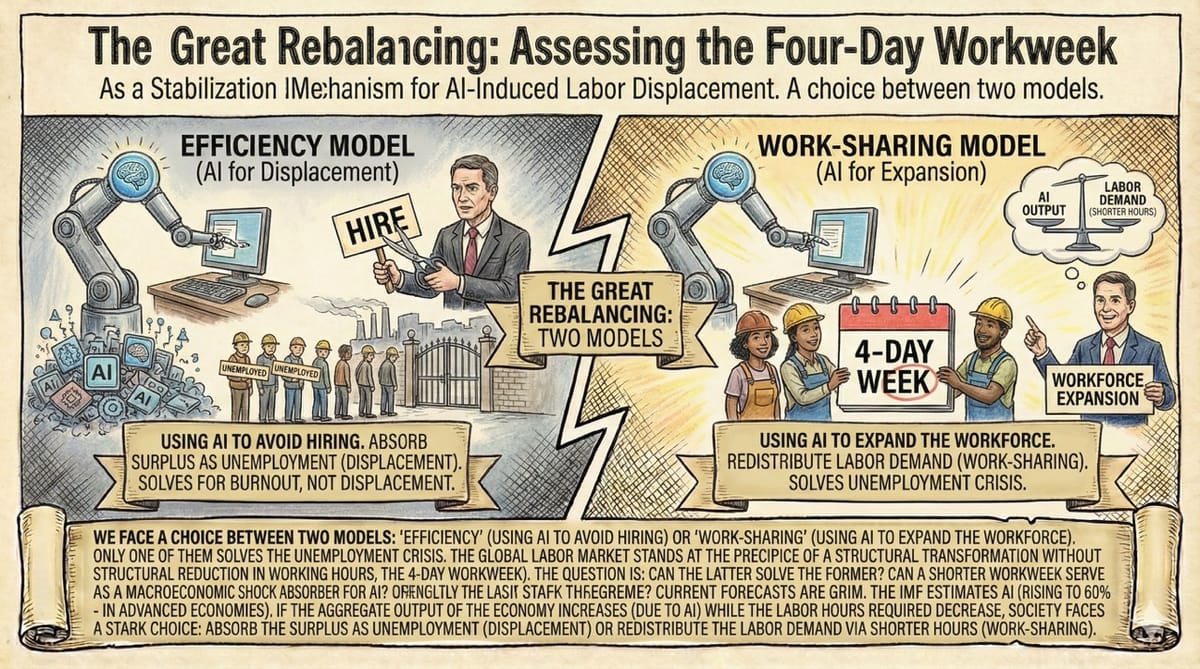
We face a choice between two models: "Efficiency" (using AI to avoid hiring) or "Work-Sharing" (using AI to expand the workforce). Only one of them solves the unemployment crisis.
Inspiration: Reading the IMF report on AI exposure and realizing that the current corporate trials of the 4-day week are solving for burnout, not displacement.
The global labor market stands at the precipice of a structural transformation without precedent.
We are witnessing the convergence of two powerful forces:
- The Supply Shock: Generative AI is automating high-skilled cognitive labor.
- The Social Demand: The momentum for a structural reduction in working hours (The 4-Day Workweek).
The question is: Can the latter solve the former? Can a shorter workweek serve as a macroeconomic shock absorber for AI?
Current forecasts are grim. The IMF estimates 40% of global employment is exposed to AI (rising to 60% in advanced economies). Unlike robotics, which replaced muscle, AI substitutes for cognitive agency.
If the aggregate output of the economy increases (due to AI) while the labor hours required decrease, society faces a stark choice: absorb the surplus as unemployment (displacement) or redistribute the labor demand via shorter hours (work-sharing).
The Paradox: Efficiency vs. Work-Sharing
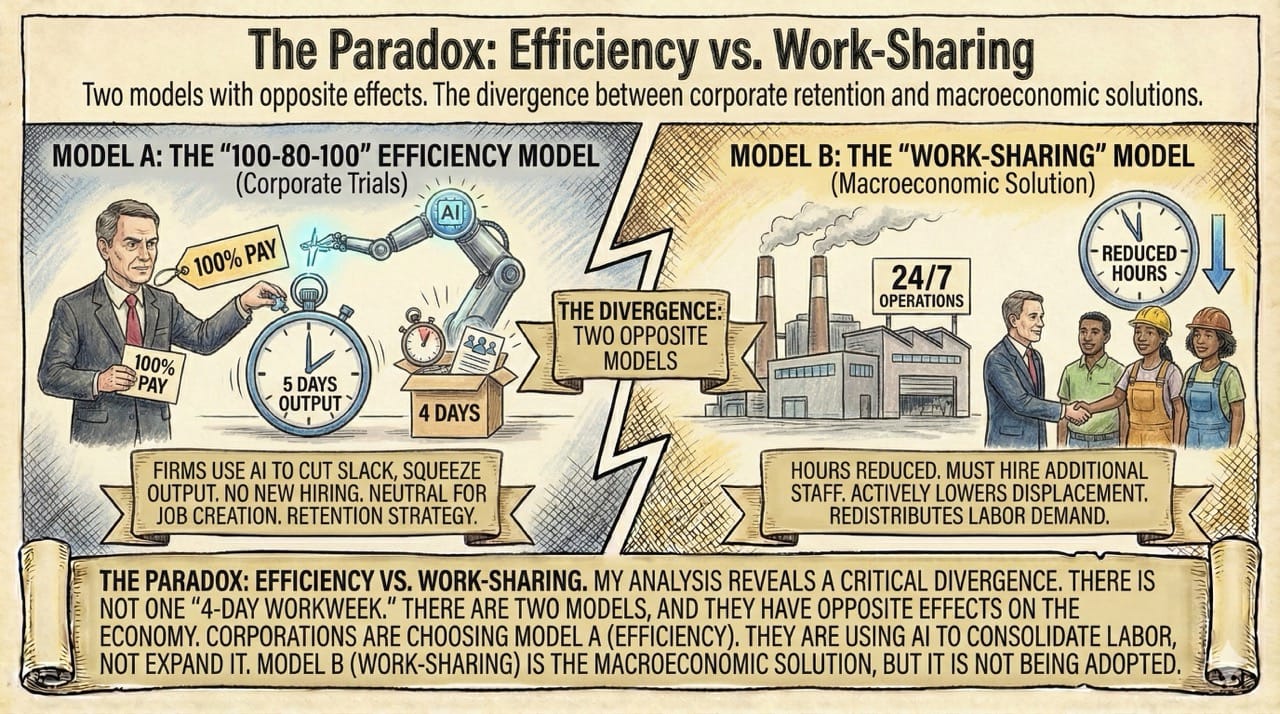
My analysis reveals a critical divergence. There is not one "4-Day Workweek." There are two models, and they have opposite effects on the economy.
Model A: The "100-80-100" Efficiency Model This is what corporate trials (UK, US, Ireland) are using today. 100% pay, 80% time, 100% output.
- The Mechanism: Firms use AI to cut "slack" (meetings, admin) to squeeze 5 days of output into 4.
- The Impact: This is neutral for job creation. Because the firm maintains output with the existing staff, there is no need to hire displaced workers. It is a retention strategy, not a displacement cure.
Model B: The "Work-Sharing" Model This is the macroeconomic solution.
- The Mechanism: Hours are reduced below the threshold of productivity gains. To maintain operations (e.g., a hospital running 24/7 or a factory), the firm must hire additional staff to fill the gaps.
- The Impact: This actively lowers displacement. It redistributes labor demand across a larger population.
The Problem: Corporations are choosing Model A. They are using AI to consolidate labor, not expand it.
The "Early Warning" Signal: Entry-Level Erosion
We don't need to wait for the future to see this. It is happening now.
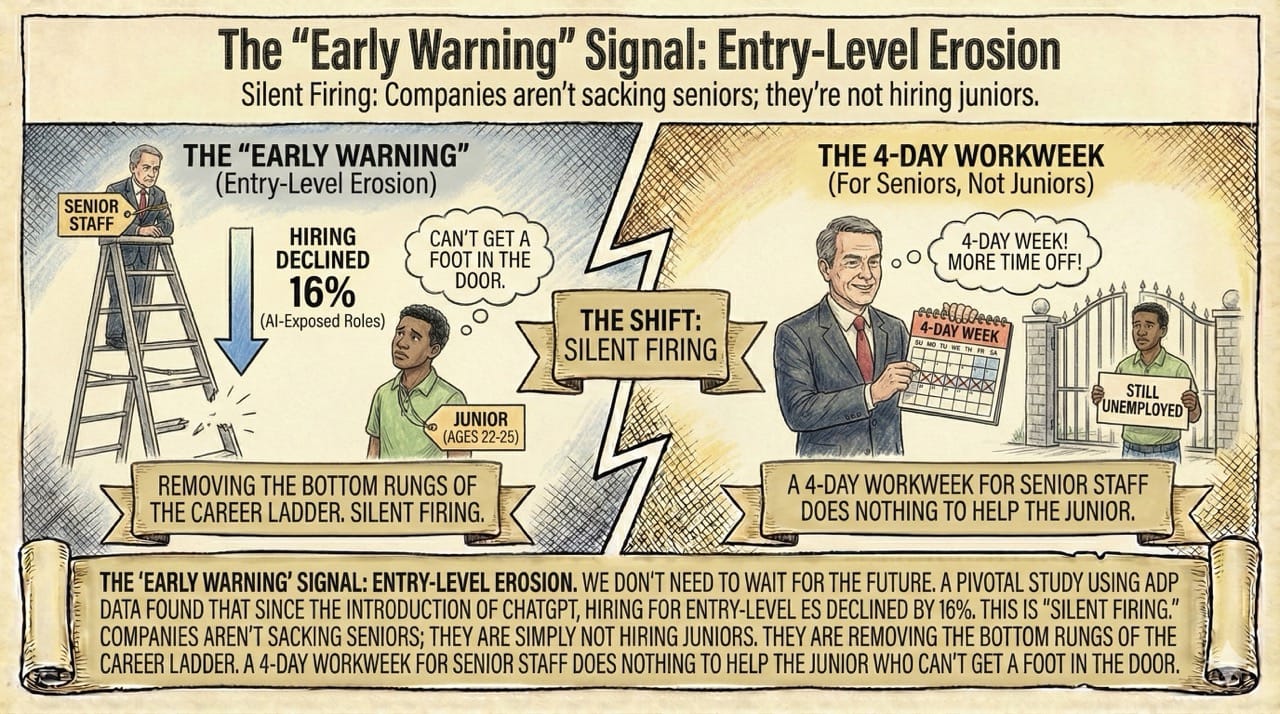
A pivotal study using ADP data found that since the introduction of ChatGPT, hiring for entry-level workers (ages 22-25) in AI-exposed roles declined by 16%.
This is "Silent Firing." Companies aren't sacking seniors; they are simply not hiring juniors. They are removing the bottom rungs of the career ladder. A 4-day workweek for senior staff does nothing to help the junior who can't get a foot in the door.
The Structural Barrier: Fixed Costs
If Work-Sharing is the solution, why aren't firms doing it?
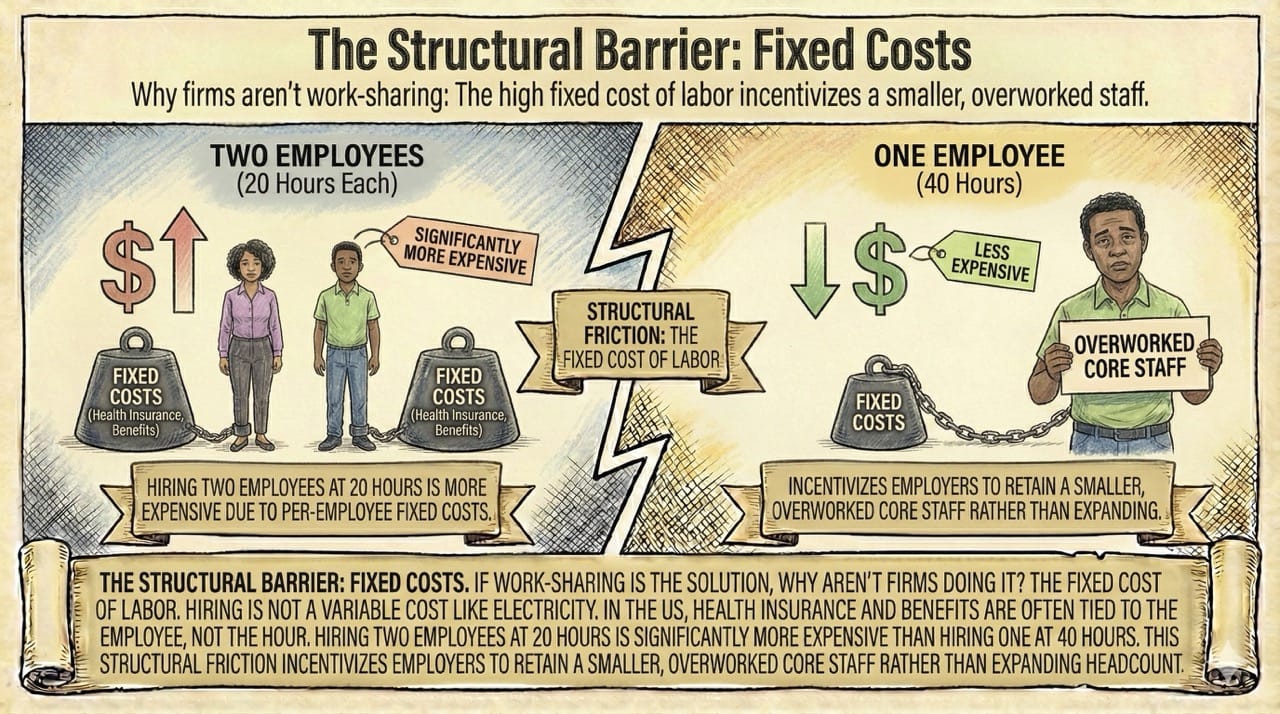
The Fixed Cost of Labor. Hiring is not a variable cost like electricity. In the US, health insurance and benefits are often tied to the employee, not the hour.
Hiring two employees at 20 hours is significantly more expensive than hiring one at 40 hours. This structural friction incentivizes employers to retain a smaller, overworked core staff rather than expanding headcount.
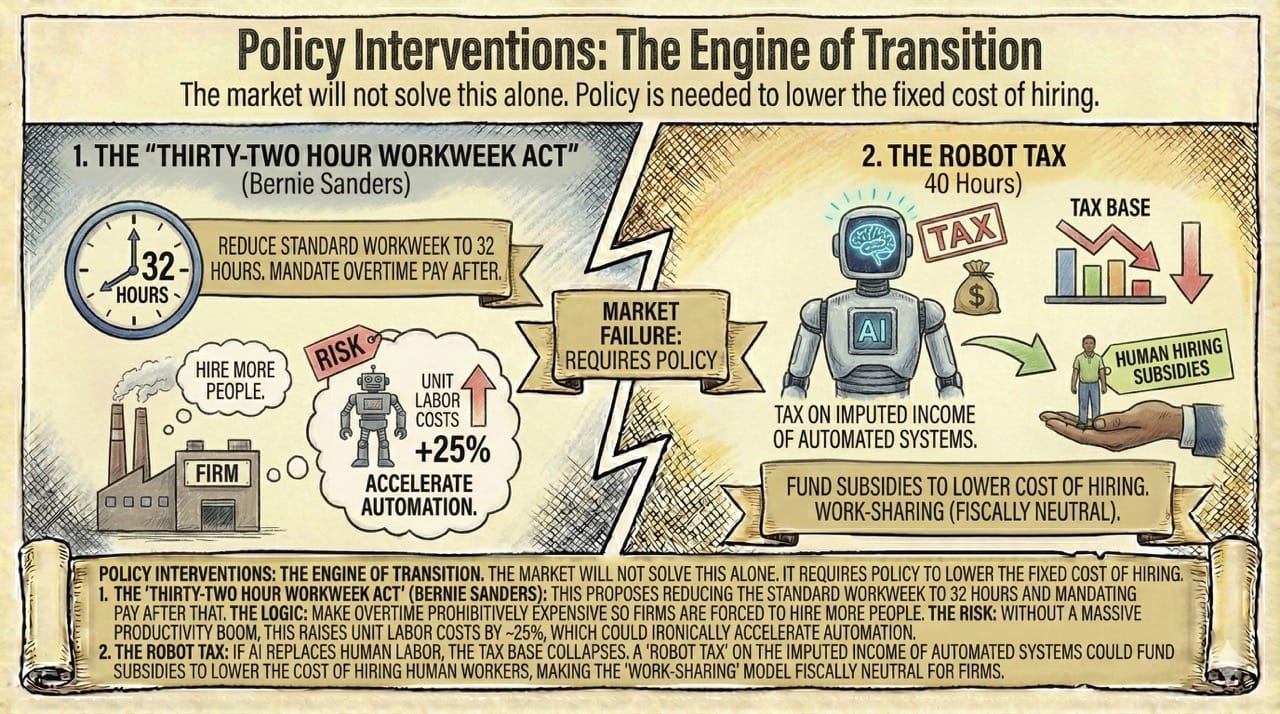
Policy Interventions: The Engine of Transition
The market will not solve this alone. It requires policy to lower the fixed cost of hiring.
1. The "Thirty-Two Hour Workweek Act" (Bernie Sanders): This proposes reducing the standard workweek to 32 hours and mandating overtime pay after that.
- The Logic: Make overtime prohibitively expensive so firms are forced to hire more people.
- The Risk: Without a massive productivity boom, this raises unit labor costs by ~25%, which could ironically accelerate automation.
2. The Robot Tax: If AI replaces human labor, the tax base collapses. A "Robot Tax" on the imputed income of automated systems could fund subsidies to lower the cost of hiring human workers, making the "Work-Sharing" model fiscally neutral for firms.
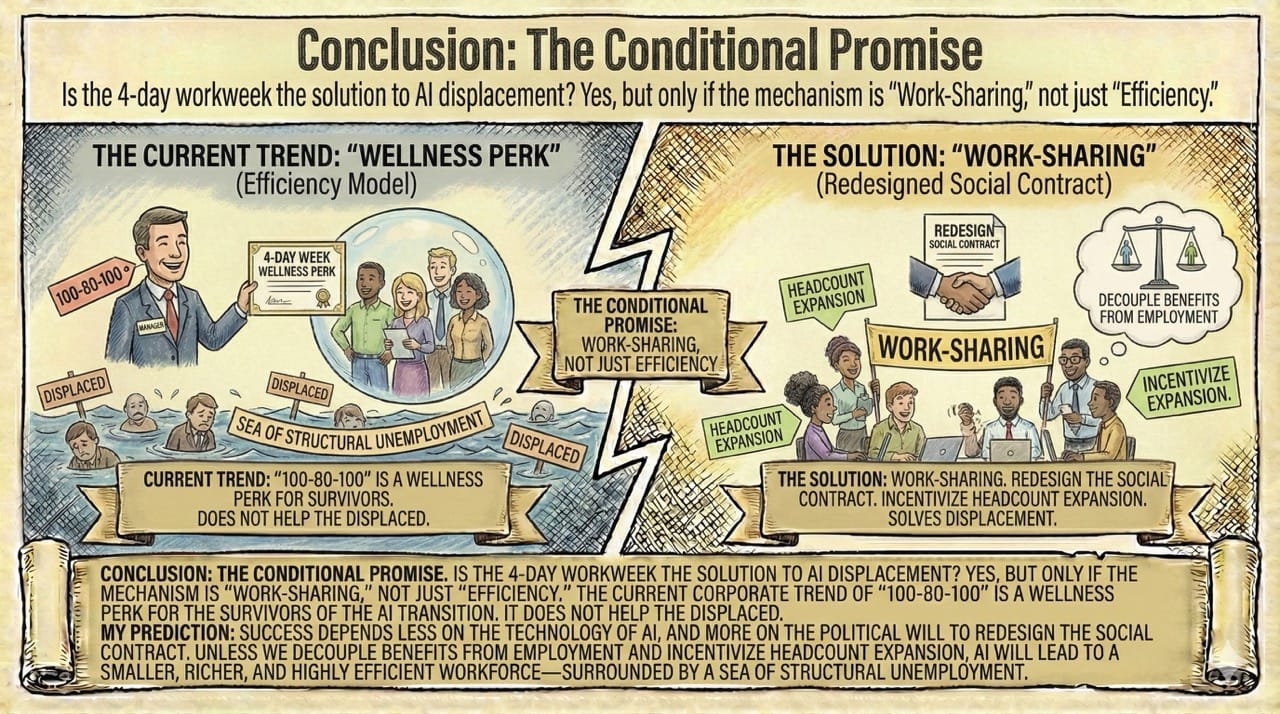
Conclusion: The Conditional Promise
Is the 4-day workweek the solution to AI displacement?
Yes, but only if the mechanism is "Work-Sharing," not just "Efficiency."
The current corporate trend of "100-80-100" is a wellness perk for the survivors of the AI transition. It does not help the displaced.
My Prediction: Success depends less on the technology of AI, and more on the political will to redesign the social contract. Unless we decouple benefits from employment and incentivize headcount expansion, AI will lead to a smaller, richer, and highly efficient workforce—surrounded by a sea of structural unemployment.